

Latest News

McGill, News

A conversation with Arts Senator-Elect Víctor Muñiz-Fraticelli

Víctor Muñiz-Fraticelli is an associate professor of Political Science and Law at McGill, making him jointly appointed in both the Faculty of Law and the Faculty of Arts. His union membership card pledges the Association of McGill Professors of Law and he will serve as one of the representatives of the Arts Faculty at the Senate starting in September 2024. The Tribune spoke with Muñiz-Fraticelli hours before the results of the election were announced. 

Ghazal Azizi: First, let’s talk about why you decided to run for McGill Senate.

Víctor Muñiz-Fraticelli: I have been Vice-President (VP) External of MAUT [the McGill Association of University Teachers] for two years [….] I decided not to run again as VP External for MAUT because I expect the law union to which I belong to get a collective agreement with the university, at which point the MAUT Constitution makes me ineligible for MAUT membership. But I still wanted to be involved in university governance. I have an academic interest, not just an interest as an employee of the university […] in the history and justifications of university governance. 

Currently, TA strikes and three different faculties are pushing for collective agreements with McGill. How do you see the university labour landscape changing? 

I’ll give you the scholarly pitch here. Universities in Europe organized around the 11th and 12th centuries as either student associations or faculty associations. The first university in Europe, the University of Bologna, start[ed] as basically a student union […] and what they used as a legal institution to organize is the Roman corporation [or] universitas. So we’d like to think that the university is this universal thing, but it actually just means “turned into one thing.”

Today, what we see is a system of supposed shared governance, where academic matters are decided by the Senate and financial and administrative matters are decided by the Board of Governors [BoG]. The BoG is overwhelmingly controlled by non-academics [….] Meanwhile, in the Senate, what you see is [the] control of the agenda by high-level administrators […] who answer ultimately to […] that same BoG [….] And my sense is that, in order to return to the original idea of the university, faculty members need to use the institutional means at their disposal, which today are labour unions, to organize a body that only answers to faculty. 

With student unions, we’ve reached the point where it’s difficult to get students engaged. Do you foresee this disengagement happening with faculty unions?

There are roughly two models that labour unions have followed. One […] is an activist model […] where the labour unions mostly relate to their membership in a constant organizing mode. So we’re always organizing for the next collective agreement negotiation […] which means that you need to get people constantly involved, constantly writing, and governance has to be horizontal. The other model has been the service model […] where the labour unions mostly relate to their members in terms of the services they can provide for them [….] All labour unions still have to offer some of those services, but the problem is that if you go too far towards the service side, people become disengaged [….] The idea, for me, is to see the faculty more seriously as your identity [….] This is one of the main sources of satisfaction for you as a person, so you should cultivate membership to the faculty as a body.

What are your hopes for the Arts Professors Union’s launch rally today?

What I’m mostly hoping for, quite frankly, is a show of solidarity from the other associations on campus [….] Right now we have 15 certified unions […] plus two that are seeking certification, in addition to two non-unionized associations […] MAUT and MUNASA [the McGill University Non-Academic Staff Association]. [A] lot of them have expressed not only support in social media for the Faculty of Arts Union but are also going to […] brave the elements to show solidarity for them. 

This is a sea change in terms of the way that professors perceive themselves in the university and the way they perceive their relationship to others [….] Professors now realize they have […] a reconfigured common interest with all these other people on the campus, because […] everybody’s doing an essential job […] from the maintenance of the power plant to the data centres to all the administrative support we have, to, of course, [teaching assistants]. We cannot do our job without everybody else, which means that we need to be in solidarity with them, just as they are in solidarity with us.


News, SSMU

SSMU Legislative Council learns SACOMSS failed internal review of services

The Students’ Society of McGill University (SSMU) Legislative Council convened for its second-to-last meeting of the 2023-2024 academic year on Thursday, April 4. The meeting saw reports on the First Year Council (FYC), Library Improvement Fund Committee, Environment Committee, Services Review Committee, and Varsity Council; a presentation of the 2024-2025 SSMU budget by the Vice-President (VP) Finance; and executive reports from the VP Internal and VP Sustainability and Operations. All motions put forward during the meeting were passed. 

VP Internal Jon Barlas presented a report on the FYC, discussing the various events and meetings that happened between Feb. 29 and April 4, such as a clothing swap and McGill’s Got Talent, which was held on April 2 in the New Residence Hall Ballroom. 

Next, VP University Affairs Lalia Katchelewa presented the end-of-year report for the Library Improvement Fund Committee. Katchelewa discussed the changes made throughout the year to increase student hires and library hours as well as proposals to improve the libraries next year, including updating the charging stations in Schulich Library.

The Services Review Committee gave a lengthy presentation on all 15 SSMU Services offered during the 2023-2024 academic year. Nadia Dakdouki, VP Student Life, stated that the Services Review is crucial for ensuring that SSMU Services are fulfilling their mandate. Reviews are created using self-reports, interviews, and external surveys. 

The only service to receive a failing mark from the Committee was the Sexual Assault Centre of McGill’s Student Society (SACOMSS). 

“[SACOMSS] struggles with the services they provide because they’re not professionals. It’s very difficult in some cases to provide support without providing straight-up therapy or trained professional support,” Dakdouki said. 

As they were deemed to have not fulfilled their mandate, this mark identified the organization for intervention to improve the services they provide. In an email to The Tribune, SACOMSS stated that it announced a pause in services on Feb. 1 “due to significant concerns about capacity to provide quality support.”

“In response to the grade, we met with the VP of Student Life and the Services Coordinator, Nadia and Stella, this past Friday, who were satisfied with our explanation and restructuring plan, and will be bringing it to the committee. Ultimately, we believe it is necessary and long overdue for SACOMSS to internally restructure, and hope that we will soon be able to provide the quality services McGill students deserve,” the organization wrote.

Following this report, Sustainability Commissioner Jaanashee Punjabi detailed the Winter semester’s Environment Committee report. 

“We identified [that] an issue on campus was that a lot of sustainability clubs were looking for volunteers and outreach and communication,” Punjabi said. “So, our aim was to promote sustainability in student groups and student initiatives amongst McGill students, and bring together resources that sustainability initiatives in groups can use under one umbrella.” 

The Environment Committee unified all environment and sustainability clubs and initiatives across campus, including Campus Crops, Little Forests McGill, and the McGill Environment Students’ Society. The Committee created a smaller environment executive committee which does structural and procedural administrative work to provide resources for these clubs and organizations.

After a brief recess, the Motion Regarding the Renewal and Amendment of the Climate Justice Policy, the Motion Regarding the Approval of the Environment Committee Funding Request for Trash 2 Treasure, and the Motion Regarding the Renewal of the Milton Parc Relations Working Group were all approved without debate. 

VP Sustainability and Operations Hassanatou Koulibaly presented the Motion Introducing the Internal Regulations of Sustainability and Operations. This motion related to the governing of the portfolio of the VP Sustainability and Operations and passed after a brief question period. 

VP Finance Amina Kudrati-Plummer outlined two proposed changes to the Internal Regulations of Finance. First, limiting the power that the VP Finance has to make revisions to the budget and second, removing the mandate to revise the operating budget, which the motion deemed inefficient and unnecessary. The motion was approved. 

The final motion for the day was the proposed 2024-2025 budget. The 2023-2024 budget accounts for a $723,000 deficit, whereas the following year’s budget accounts for a $460,000 deficit. Kudrati-Plummer explained that 92 per cent of next year’s proposed budget will go toward salaries, and the remaining 8 per cent accounts for other fees and costs. 

On April 7, SSMU sent a message to all its members stating that the union will reduce some of its services and close both the SSMU offices and the University Centre from April 8 to 19 due to budget constraints.

Moment of the Meeting: 

At the end of the meeting, the Council discussed the need for more candidates to come forward for the positions of 2024-2025 SSMU President and VP Finance. While the position of President has received three nominations, Kudrati-Plummer noted that the VP Finance position had only received one nomination. They expressed that a multitude of candidates is needed for the “democratic health” of SSMU.

Soundbite:

“I’ve been very careful to make sure […] we don’t expand any of our services, both internally and externally. [The proposed 2024-2025 budget is] limiting […] but it’s kind of what we have to work on. As long as we are operating in such a large deficit, essentially, there’s very little I can do within the budget to reduce costs any further.” — Kudrati-Plummer, explaining the reasoning behind the proposed 2024-2025 budget.

Student Life

If these stalls could talk

As the year comes to a close, we at The Tribune have been reflecting, and one topic of our reflection has been the hallowed bathroom stalls across campus. But what does your go-to bathroom say about you?

Leacock basement bathroom 

You’re an Arts student, but that’s just your part-time gig. Full-time, you’re breaking necks, dropping jaws, and slaying in your role as resident McGill fashion icon. People say that the school has a fashion culture because of you. Every class is a runway show, and every stride through the Y is a catwalk. If McGill has taught you anything, it’s that your suburban hometown held you back. You are a star. Now get that mirror fit-pic, baddie! 

OAP Porta-Potty 

You are probably laughing while reading this, even though I haven’t gotten to any jokes yet. You’re here for a good time, not necessarily a long time (especially if your essay due at 11:59 pm has anything to say about it. Yeah, remember that?). Nonetheless, you are the lively spirit that we need here at McGill, reminding all of us that we’re only young once, everyone’s trying their best, and we need to take time and celebrate ourselves. 

SSMU basement bathroom 

Not to be confused with the seasonal OAP-porta-potty regulars, you are committed to the celebratory lifestyle. Sessions in McLennan followed by a run to Gerts is your version of a Pomodoro timer. You’re not afraid of a 20-page essay, or problem sets so long as there are celebratory cheers on the other side of it. You embody McGill’s work hard, play hard spirit, and execute it with pride, and you know what? We salute you. 

SSMU fourth-floor bathroom

If more than once, you’ve found yourself reaching for a nonexistent roll of toilet paper to wipe your tears, then you’re probably a club executive holding it together by a thread on the fourth floor of the SSMU building. Your ideas are incredible, obviously. You’re always right, clearly. You are the heart and soul of that team, and everyone there is lucky to have you! But right now, take a breath, and take a moment. Whatever crisis needs averting will be solved, I promise. 

McGill Gym bathroom 

You are a beast. You are Thor. You are… hoping no one was paying close attention to your form during that last set of bicep curls. If the bathrooms down the hall from the gym are one of your favourite haunts, then you are a McGill gym baddie. You hit a question set in the AM and quads set in the PM. Day in, day out, you’re here grinding and getting better and praying not to have a surprise cameo on Spotted: McGill

Stewart Bio fifth-floor bathroom

You are a STEM baddie and McGill’s resident Rapunzel, locked in your tower atop the hill, wondering when will my life beginnnnnn? You are the best of us; stay strong soldier.

McLennan third-floor bathroom

If you routinely find yourself in the third-floor bathroom in McLennan, then life is a cruise ship, and you’re the entertainment director. And the third floor is your lido deck. You and your huge group of friends regularly regale the entire floor with your gossip and jokes, always making sure that everyone can hear you (wouldn’t want anyone to miss out on the tea, right?). You like to think of the library as both a place for studying and socializing. You know how sad the mood can get during finals, so you’re always there to bring the vibes up. Like, all the time. It’s a tough job, but you’re up to it. Besides, what would we all do without you?

McLennan sixth-floor bathroom

You are a soldier, you have nostrils of steel, and (I hope) shoes with thick soles.

McLennan-Redpath Complex first floor bathroom

If you often find yourself under the bright lights and endless stalls of the McLennan-Redpath Complex first-floor bathroom, then you are… all of us. You’re clocking in and chasing that degree one day at a time. Maybe you know what your future holds, or maybe you’re just happy to be here. But either way, you’re showing up, learning, working hard, and looking amazing doing it (upholding our reputation as Canada’s hottest university). Keep going, kid. Good luck this finals season and go easy on the Redbulls—you’ve got this! 

Editorial, Opinion

Cops off our campus, protect the pickets and protests

Last week, the teaching assistants’ (TAs) strike took priority at McGill as they protested to demand a fair wage for their work, healthcare, and indexed working hours. Beginning on March 25, students arrived on campus to the sight of picket lines and bright banners, full of signs indicating that all 1,600 TAs will continue to pressure the university administration to renegotiate a new collective agreement (CA) with TAs, under the Association of Graduate Students Employed at McGill (AGSEM). However, TAs have not been alone in raising banners and chanting on campus, as Palestinian and pro-Palestinian students continue to call on McGill to divest from corporations tied to Israel and cut ties with Israeli universities, as they have done since October. McGill quickly responded to both protests by increasing police presence on campus and avoiding to engage in any kind of constructive conversation with students.

The administration’s reaction to protesters on campus is far from unprecedented. In 2011, Montreal riot police officers brutalized McGill students protesting on campus against tuition hikes. Last November, McGill President Deep Saini requested police presence for a peaceful protest led by Solidarity for Palestinian Human Rights (SPHR) at McGill, and the university called the police in response to the Feb. 22 pro-Palestine protest in front of the Bronfman Building. The students blockaded the building for the entire school day in response to the Desautels Faculty of Management’s course offerings of ORGB 434: Special Topics in Organizational Behaviour, Comparing Startup Ecosystems of Israel, and Canada and FINE 434: Topics in Finance—which includes a collaborative three-week study trip with the Hebrew University Business School. Saini deemed the obstruction of university activities, including blocking access to buildings, “unacceptable.” The disruption of classes on campus and “interference with McGill’s operations” is a necessary step toward change, and is a direct result of the university administration’s unwillingness to meaningfully engage with its student body.

When essential workers strike and frustration with the McGill administration is widespread, every single student must call for solidarity. Chanting and banners are not intended to intimidate fellow students, as the university claims, but serve to call for basic rights and fair treatment. While no one deserves to feel unsafe, the uncomfortable nature of activism is a necessary aspect of bringing about change. Course disruptions and uncertainty can be frustrating and confusing at the individual level, however, protesters’ continuous mobilization strives to gain students’ support and remind them who is at fault, because no change can be achieved in the silence of playing by the university’s rules. For this reason, students must join and protect the picket line, by calling out professors who engage in and even encourage scabbing.

Students must understand that increased police presence on campus is a tool for the university to secure its property and protect its image, not its students. The university uses security on campus to distract the student body, professors, and staff from the fact that their decision to dismiss calls for divestment and meet the TAs’ demands is a deeply rooted political and institutional issue, not a safety one. Security for the administration is not security for the students, and no circumstance justifies the presence of violent, racist, and colonial police on our campus. Resisting policing in the university is the first step to building an actual safe and free campus, where all students are liberated and all workers fairly treated.

McGill profits from the confusion and demonization of protesters on campus to try and turn students against their peers. In an email communication sent to the entire student body on Thursday, March 28, the administration announced that the police “made at least one arrest” and that McGill would press charges against a protester breaking the law. This strategy of threat and intimidation is meant to paint student mobilization as violent to the rest of the student body. Students must resist this tactic and instead see police presence on campus for what it really is: McGill’s fear of seeing its students and workers organize peacefully and its unwillingness to respect the growing consensus on the ground for fair treatment, divestment, and a better world.

Commentary, Opinion

Being a recreational musician at McGill is almost impossible. It shouldn’t be.

My first semester at McGill marked my 12th year playing the violin, and I auditioned for the Classical Music Club as soon as I knew whom to email. I was placed in a trio with a flutist and a pianist and we were told to rehearse in a room on the fourth floor of the University Centre on Monday nights. As the music school practice rooms are open only to those with a Schulich School of Music student ID, practice rooms for any non-music students are nestled far and wide in the far and high-up corners of campus. Without the all-consuming commitment required to get a music degree at McGill, a musician is exiled to the periphery of McGill’s facilities. 

On the night of our first rehearsal, my flutist, pianist, and I met outside our allotted room in which another pianist and violinist were rehearsing an impressive duet. We waited for ten minutes, then sent our own pianist unwillingly to claim our rehearsal space. We felt awful, and the talented duet apologetically shuffled out. 

The next week the room was locked, as it was the week after. By the fourth week, our trio deserted the likely locked rehearsal space and opted instead to break into one of the Schulich School of Music practice rooms. This was both stressful and time-consuming, as it meant we had to trudge up and down the staircases until we caught a music student leaving the other way. Then we would slip into the hallway on the other side, and test our luck at an open room. As both the practice rooms and the music lockers open only to music-student ID cards, us recreational musicians found ourselves barred from a practice space, and without a place to keep a violin or a flute except for our bedrooms at home. I cannot imagine my predicament had I chosen twelve years ago to play the tuba. 

McGill’s Schulich School of Music is a prestigious school that attracts musicians from across the world. As grateful as I am to be at an institution where musical talent is given so much attention, I resent the way in which this attention has shut out what I consider a middle-class of musicians, like myself.

All three of us were good musicians. Our pianist had been playing longer than I had, and knew all of J.S Bach’s twenty children; our flutist was shy and nimble and could play arpeggios of high sixteenth-notes like the songbird on imagines a flute should emulate. I, for my own part, could play the entire Bach Double by heart and could sight-read most moderately challenging pieces of music on the first try. But finding space to practice as a group––an official music group, part of an official McGill music club––was more difficult for us than learning the musical repertoire we had to play. Finding a space at all was lucky, and twice when we succeeded we were shortly asked to leave––first by an opera singer and then by a cellist. We evacuated, peeved. However, our frustration was not at the musicians who kicked us out but at the fact that we––though not rehearsing for the Philharmonic––could not have a space to at least try.

Playing recreational music is made difficult at McGill. It is limiting enough that McGill does not have an arts centre for fine and performing arts, but to then render the few available spaces as unavailable and exclusive prevents a dimension of well-roundedness that ties an aloof academic institution like McGill to other important corners of the world—like pulling out a guitar at a dinner party instead of opening a discussion of Weber’s concept of the state.  

There is nothing commendable in evicting those of us who––regardless of skill level––have brought our instruments to university with us and want to play, whether we can play Paganini or not. A recognized school club such as the Classical Music Club, or those rehearsing for the novice Beethoven Orchestra, should not face relegation to the fourth floor of the University Centre for an unreliable practice space, the same way an individual involved in nothing except their own love of music should have just the same opportunity.

As McGill already chooses not to invest in a fine arts program—or in an arts centre for fine and performing arts at all––the least it could do is open its music facilities to anyone who wants to play music.

Arts & Entertainment, Theatre

Players’ McGill Drama Festival showcases the best of student theatre

From exploring dusty old houses in A Farce About Time Travel to a complicated reunion with old friends (or more than friends) in Coping Mechanisms, the McGill Drama Festival (MDF) had something for everybody. With prizes handed out for Best Script and Best Directing, the festival’s only real loser was rural Ontario, with more than one play shining a light on the trials and travails of life in Canada’s least interesting province. 

Players’ Theatre’s annual festival featured five plays, all written and produced by students. 

“What I love about the McGill Drama Festival is that it’s a showcase of entirely student talent. Everything is written […] directed, acted, and produced all by students,” Danica Friss-Wilson, U1 Arts and the festival’s coordinator, explained in an interview with The Tribune

For many aspiring playwrights, MDF presents their first opportunity to have directors and actors bring their scripts to life. 

“For the writers, it showcases that there are people who can work on your script,” Friss-Wilson said. “You write something and you have a vision of it, and then you see it up on stage and it’s like nothing that I can describe.”

This was the case for Keianna Lewis, U2 Arts, who wrote the eerie discussion between some old circus colleagues that became Big Top Down. Having only started writing plays last fall, this performance marked the first time Lewis had seen a piece of their writing come to life.

“Knowing that this is something that I originally conceived while I was [in high school] and had no idea who I was as a writer, and then getting to edit it, and workshop it, and see it be brought to life by this wonderful director and wonderful cast—it’s kind of magical,” Lewis said in an interview with The Tribune

As it turned out, the judges agreed—Big Top Down’s Andrea Landeata, U2 Arts, brought home the prize for Best Directing. While the characters worked through their old grudges and familial conflicts by way of letters from long-lost loved ones, a mime lit up the show with spot-on reactions and an interlude between scenes. 

Meanwhile, in Ontario, the witty confusion and all-too-relatable family pressure in All You Can Eat earned it the award of Best Script. Written by Corey Madelzys, BCL/JD ‘24, and directed by Nora Bartram-Forbes, U3 Science, the play centres on a multi-generational family celebrating their youngest son’s last dinner before going off to college. 

By creating a space for student-written work to be directed and performed, MDF also allows students to take a chance on more experimental work and try out a new genre or style of storytelling. 

“I was intrigued by the idea of writing a play when the call came out this year, but really it was my roommate who pushed me to try something new,” Harriet Faught, U1 Education and the playwright behind Red Wine, Women, and Song told The Tribune

Faught’s play presents a series of vignettes, each centring around women in their early twenties exploring what womanhood means to them. As Faught explained, one goal of the play was for it to be an opportunity for the cast and crew to experiment.

“I really wrote the show to be whatever the directors and the actors wanted,” Faught said. “I didn’t actually give the characters names. [They] were chosen by the actors and directors, and I left the script really open because I wanted it to feel really real.”

The chance to play around, try out new things, and develop their craft isn’t limited to playwrights, actors, and directors. Claire Tees, U3 Arts and Executive Director of Players’ Theatre, emphasized that the festival was also a venue for running crew, light and sound technicians, and stage managers to gain hands-on experience. 
“That’s the other great thing about the McGill Drama Festival: Because there’s so many shows, there’s a lot more opportunity in tech as well,” Tees said in an interview with The Tribune. “The whole point is an opportunity for people to learn, for first time actors—first time everything!”

Arts & Entertainment, Books

A letter to lonely writers: Words of wisdom from Heather O’Neill

“Oh here comes the torture” and “oh what crap” are phrases that acclaimed author Heather O’Neill uses to describe the harrowing experience of reciting passages from her novels in public. She is McGill’s Writer-In-Residence, known for her debut novel Lullabies for Little Criminals, which won Canada Reads (2007) and When We Lost Our Heads, her most recent bestseller. 

O’Neil alluded that the re-read is one of the most harrowing experiences for young writers; it’s the dreaded moment when you realize that the masterpiece you wrote not 24 hours ago is one of the worst things you’ve ever read. Unfortunately, O’Neill confirmed in an interview with The Tribune that the 24-hour expiry date does not dissipate with age, acclaim, or experience. 

As children, we hoped to be older and cooler with glossed lips and dyed hair. As teens, we hoped to be older and more sophisticated with our shit together. This much sought-after “final form writer” is as elusive as Peter Pan’s shadow. Once, an attendee at one of O’Neill’s book events asked her about an opinion of hers. She replied incredulously that she no longer agreed with that opinion and inquired when she had expressed it originally. The attendee replied that it had been no more than 20 minutes ago. Humans, flawed as we are, are trapped in a cycle of change as unpredictable as the Canadian weather.

As a child, O’Neill knew exactly what she wanted to be when she grew up. From reading out newspaper clippings at dinner to printing zines at 50 cents apiece, no one could deny that O’Neill was destined to be an author. She faced many “weird kid accusations” with her attempts to spark conversation about books. As many introverts will understand, O’Neill did not experience this as a loss, thriving in a world rich with ink-sketched companions. Not only could these characters satisfy the role of a friend, but O’Neill’s own characters became self-reflections. These are characters that O’Neill would get along with, while simultaneously tiring of them, knowing as much as she does. 

When asked for her advice on writing, O’Neill encouraged young writers to embrace rejection.

“I just treat [rejection] like the flu,” she said in an interview with The Tribune. “I’m just gonna feel bad for three days […] but after three days I’m gonna feel fine.” 

While O’Neill refers to writing specifically, these words of wisdom apply to rejections of all kinds. O’Neill also advises creating and enforcing deadlines to motivate oneself. Additionally, she discourages attaching weight to literary trends as a means of success.

”You just have to be saying things no one has said before […] You want to become the trend.”

O’Neill muses that she would have liked to tell her younger self to elicit attention from more older authors and “forcefully” encourage them to mentor her. For legal purposes, this is not a suggestion to harass senior citizens. As for her writing process, O’Neill likes to get right into it by sketching out scenes to see how her characters improve with one another. She alternates her writing projects in three-month increments to help keep ideas fresh. 

O’Neill is looking forward to the release of her latest book this September; although specifics are top secret, she hinted that it may be her new favourite. Perhaps even more exciting is an idea that she pitched offhand, a podcast hosted by 80-year-old agoraphobic Heather who seldom interacts with people except to interview them from the comfort of her home. 

A final word of wisdom for the lonely writers who feel like they’re just not good enough yet, awaiting that moment of “older and wiser”:

“[You] get to a certain age and you’re like ‘okay, this is as much as I’m gonna know, so I might as well go out there and be confident.’”

That age is right now. So get out there and write.

Commentary, Opinion

Why we need to reconsider Quebec’s subsidization of private schools

Amid the François Legault government’s contentious policy decisions, including recent tuition hikes, Quebec’s substantial financial backing for private schools raises significant concerns for equal access to education across the province. This policy, whereby the majority of independent private schools receive subsidies from the government for each student, not only undermines the quality and accessibility of public education but also deepens the socio-economic divides within the province. Quebec must rethink its approach to educational funding, by shifting the focus and resources from private to public schools thereby fostering a more equitable and inclusive educational landscape.

Public education advocates and concerned taxpayers have increasingly scrutinized Quebec’s approach to funding education, particularly criticizing the generous subsidies it extends to private schools. In the 2018-19 academic year, 170 private schools received a total of just over $522 million in direct subsidies, along with an additional $27.6 million in approved transportation costs. Meanwhile, public school revenues from local taxation in 2020-21 were less than half of what they were in 2017- 18, representing 7.5 per cent of total revenues compared to 17.8 per cent three years prior. This, despite the fact that private schools cater to a considerably smaller, and often more affluent, portion of the province’s population. The decision to prioritize private education resulted in a concerning shift in the educational landscape and an alarming preferential shift among parents and students away from public schools: The market share of private schools has surged from 5 per cent in 1970 to a significant 21 per cent in 2022. In Montreal, the figures are even more pronounced, with private school enrollment reaching 39 per cent. This upward trend in private school enrolment not only siphons vital resources away from the public sector but also exacerbates socio-economic disparities. The burgeoning private school sector, bolstered by public funds, thus poses a direct barrier to an equitable and heterogeneous educational system.

The substantial public investment in private education amplifies advantages for the already privileged. Both national and international bodies have critiqued the profound consequences of this funding imbalance, including the Conseil supérieur de l’éducation, an extension of the Minister of Education, who declared Quebec’s system the most unequal in Canada. UNESCO has attempted to hold Quebec accountable for its “segregated” three-tier school system (subsidized private, public, and selective-public) in lieu of their recommended public single-system. Public schools—facing higher numbers of students who cannot financially access private and selective-public schools—struggle to provide quality education, creating a detrimental cycle where richer parents opt for private schools as opposed to advocating for better funding within the public system. The province’s neglect of the public school system leads Quebec to have the highest student dropout rates in the country and increasing teacher attrition, with a quarter of teachers leaving the profession during their first five years on the job market. 

Quebec’s restrictive language laws (especially Bill 101) exacerbate the harmful effects of the province’s private school subsidization. By requiring that the children of non-Canadian residents, immigrants, refugees and Canadian citizens who were not educated in English in Canada attend French-language schools, many newcomers are forced to send their children to French public schools. Meanwhile, a growing number of Quebecois parents have taken their children out of the public system and sent them to private schools. This disparity in education for the children of immigrants, refugees, and non-Canadian residents makes the adjustment to a new province all the more difficult. The flight of wealthier families who flee the public system and flock to government-supported private schools guarantees the continuation of this division. 

Private schools discriminate, using subjective criteria such as test scores, gender, economic status, and religion for admissions without external oversight. Additionally, the creation of a  selective public network, aiming to counter private schools’ elitism, instead inadvertently deepens educational divisions, entrenching a system where privilege determines educational quality. Quebec’s segregative system is paradoxical to the province’s professed values of equality and inclusivity.The recent tuition hikes for anglophone Quebec universities underscore the pressing need for a more equitable distribution of provincial resources. When even public universities, which //should// be accessible to all, are being forced to raise out-of-province tuition by nearly 30 per cent while Quebec private schools continue to receive hundreds of millions of dollars in funding each school year, it is imperative to question the Legault administration’s priorities. We all need to advocate for a system where education acts as a power of equalization, not division.

McGill, News

Protesters stage ‘die-in’ at Y-intersection to draw attention to McGill’s complicity in ongoing genocide of Palestinians

Content Warning: Mentions of genocide and a hunger strike.

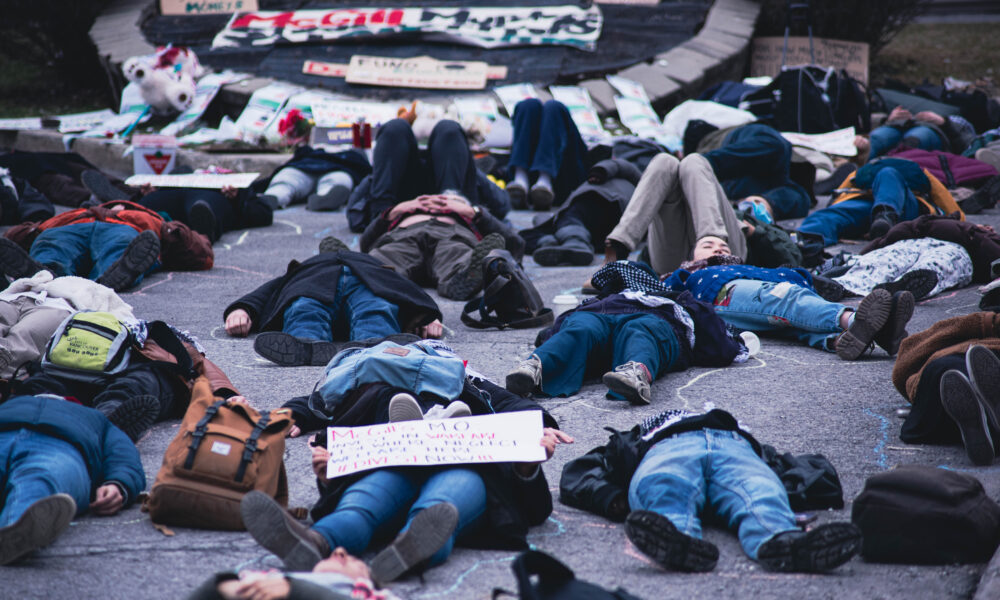
On March 28, more than 40 protesters lay silently on the ground in front of the Arts Building for half an hour, their hands doused in red paint and bodies traced in chalk, to protest McGill’s financial and academic ties to the state of Israel. This ‘die-in’ was organized by the McGill Hunger Strike for Palestine—a group of students who are starving themselves in solidarity with Gazans who are facing famine to push for an end to McGill’s complicity in Israel’s ongoing genocide of Palestinians.

Speeches began around 1 p.m. as the crowd continued to grow.  

“Today, we are standing on the edge of day 39 of our hunger strike. Thirty-nine days fueled by outrage, disgust, courage, love, compassion, unwavering conviction, and an unyielding demand for justice in Palestine,” Sage, who is part of the hunger strike, told the crowd.

Sage reiterated why the hunger strikers feel that immediate divestment from and an academic boycott of Israel are critical.

“By choosing McGill for our education, you and I are actively complicit,” Sage said. “We are participating in this genocide at this very moment, whether we want it or not. This is why we are here today to let McGill know that we are not okay with our education taking away lives.”

According to Solidarity for Palestinian Human Rights (SPHR) at McGill, another group fighting for the administration to cut ties with Israel, McGill invests approximately $20 million in companies supporting Israel’s siege on Gaza. The university also has partnerships with Israeli universities and institutions, through initiatives such as the Sylvan Adams Sports Science Institute and courses like FACC 501 in the Faculty of Engineering.

During his speech, Chadi, who is on an indefinite hunger strike, highlighted Israel’s targeting of academic infrastructure and students in Gaza.

“McGill university has funded the apartheid state of Israel and the ethnic cleansing of the Palestinian people all throughout this genocide,” Chadi said. “It bears responsibility for the destruction of all twelve universities in the Gaza strip, which have been systematically targeted by a settler state. Over 4,326 Palestinian students in higher education, 231 teachers, and 94 professors have been martyred. If we were to dedicate a second for every single one of those students, you would stand silent for an hour and a half.”

Speakers also stressed the interwoven nature of anti-colonial struggles throughout the protest, linking the fight for Palestinian liberation to the Kanien’kehá:ka Kahnistensera’s (Mohawk Mothers) ongoing legal battle with McGill and the violence that western powers have instigated globally. 

“At the heart of our movement […] lies a fundamental truth that binds us all. That truth is the interconnectedness of our struggles,” Sage said. “We are not here just as individuals, but as representatives of the myriad of communities to which we each belong. Our fight for Palestine is intrinsically linked to the global struggle against imperialism and colonialism and all forms of oppression that seek to divide us.”

Throughout the die-in, organizers and protesters alike were critical of McGill’s response to the hunger strike and other pro-Palestine mobilization. The university has expressed concern over the health of hunger strikers, but has said that students must go through the official, bureaucratic channels if they wish to change McGill’s policies and investments. McGill has also stated that it will not consider severing ties with academic institutions in Israel. 

Chadi feels that the university’s messaging is contradictory to their actions.

“I think McGill’s unwillingness to discuss [divestment and an academic boycott] shows how blatantly hypocritical they are,” Chadi said in an interview with The Tribune. “They claim inclusion; they claim diversity; they claim freedom; and when the majority of their student body, when faculty and staff bring up something that is very dear and important in the midst of a genocide, when we are talking about where we want our money spent as students, they are shutting it down, and they are not allowing even discussion. At this point we are far beyond discussion; we are at action.”

In an email to The Tribune, the McGill Media Relations Office reaffirmed the university’s respect for “students’ rights to pursue political objectives and express political conviction.” 

”We urge them to do so in a way that prioritizes their health,” the office continued. “We have reminded the students that there is a process in place for expressing their concerns about any investment holding of the university. We have offered more than once to meet with them, but they have refused to meet on the terms proposed.” 

Em Kester, one of the students who participated in the die-in, spoke to the university’s response to pro-Palestine protests in an interview after the die-in. Over the past weeks, McGill has sent multiple universitywide emails telling protesters to respect McGill’s rules and regulations and telling both students and staff that they should avoid engaging with protesters and call security services if they are unable to get into buildings or have classes disrupted.

 Kester condemned McGill’s email communication around protests, calling them “fear-mongering.”

“I am saddened by the culture at McGill, and not supporting this, and not making it a university-wide thing, or even putting out a letter of support to protesters—like an email,” Kester said. “It’s a very conservative university and it makes that known every day.”

Kester also said that McGill has sent them emails saying that protesting could impact their ability to graduate.

“The university is threatening its students for doing a basic act of protesting. And I think that a lot of students are afraid of it,” Kester said.

The university did not respond to The Tribune’s questions about whether participating in on-campus protests may impact students’ graduation. The Media Relations Office did, however, state that it “is actively reviewing evidence and will begin disciplinary proceedings against any McGill students identified as having contravened the Code of Student Conduct, as [its] normal process.” On the evening of March 28, the university announced that it had called the police on protesters, and that at least one arrest “related to campus disruptions” had taken place. According to both the March 28 email and the Media Relations Office, the university plans to press charges.

One student who wished to remain anonymous spoke about the power of collective action in an interview after the protest, encouraging students who feel hopeless to mobilize.

“For people who haven’t been doing this because they feel kinda hopeless about it: When you’re occupying a space that you’re not supposed to occupy because McGill is telling you not to, you feel that power in the steps that you’re taking, and you feel that power in the collectiveness of it all. And these things only work if everybody does it,” they said.

After the die-in, organizers walked some protesters to meet the Kanien’kehá:ka Kahnistensera at the site of McGill’s New Vic project, where the Kahnistensera believe there to be unmarked Indigenous graves, while others went to join a SPHR protest taking place by the Milton Gates.

Off the Board, Opinion

In defense of gullibility

I have always been a little too gullible for my own good. From an early age, I internalized the idea that other than injuring someone or hurting their feelings, one of the worst things you could do was lie. Assuming that everyone around me was on the same page, I would nod in wide-eyed wonder as my elementary school classmates regaled me with tales of daring spring break adventures or claims of celebrity bloodlines. I was certain that they must be telling the truth, however fantastical the stories were. Even into junior high, I was quick to believe even the most improbable stories. One classmate managed to convince me that they were family friends with Martha Stewart because of their frequent trips to Martha’s Vineyard. While I eventually put it together that they were lying about the familial connection, it took me a frankly embarrassingly long time (midway through my second year at McGill) to realize that the charming coastal vacation spot was not, in fact, owned by Snoop Dogg’s bestie.   

I was also a very easily distracted kid, getting swept away in daydreams the moment some flower or passing stranger caught my eye. To my parents’ chagrin, this meant that I had a bad habit of wandering off whenever the impulse overtook me, meandering down side streets or off hiking paths wherever we went, with them always anxiously chasing after me. My flightiness has been an equally great source of entertainment for my family as it has a source of stress. The story of the time my six-year-old self strolled into a cruise ship casino and sat under a poker table while on a family reunion has been repeated enough times to make my cheeks burn at the sight of a slot machine. 

My over-trusting nature and penchant for distractibility combine into a formidable pair that has made me the perfect target for pranks, of the April Fools’ variety and otherwise. Whether it’s an elaborate deceit, a corny prank call, or a good old-fashioned whoopee cushion, you can bet that I’ve fallen for it. I once ate the better half of a Stink Bug–flavoured Jelly Bean pack, swallowing my disgust and powering on because a friend had given them to me as a “gift” with a seemingly earnest smile. Even tricks that seem too clichéd for a D-rate buddy comedy have managed to leave me bamboozled. Once, while I was attending a sleepaway camp in the middle of the Rocky Mountains, a camp counselor pointed off into the woods with an exaggerated, “Hey, is that a wolf?” While my bunkmates snickered and rolled their eyes at my obliviousness, I spent a solid two minutes scanning the treeline for the creature before realizing that the counselor had run in the opposite direction, cackling atop a hill while she triumphantly waved my stolen toothpaste above her head.  

For most of my life, my gullibility left me feeling embarrassed and a little stupid. Yet in the past few years, I’ve grown to appreciate the faith I have in other people, even when it’s to a fault. I don’t think I fall for these sorts of pranks and deceits because I’m stupid (at least, not entirely), but because I’d rather believe the people in my life and potentially fall for another prank than let myself become jaded and mistrusting. While I think a healthy amount of scepticism is required to navigate a world replete with misinformation—or avoid getting sucked into a cult—I would rather be overly trusting than overly suspicious of others. So if there’s even a slim possibility that they’re telling the truth, you can bet I’ll still turn and look when a friend takes the time to point out a wolf.

Read the latest issue

Read the latest issue