Latest News

Creative

Life in a Postcard

I call this series Life in a Postcard, a visual love letter to my hometown. Growing up, I failed to

take the time to explore the possibilities within my small rural town. My parents were never big

outdoor people and since I was little, nothing seemed to matter except school and sports. After

suffering a sports injury that ultimately ended my time with that sport, I began to look for

meaning in other things. I found myself leaning on art, music, and the outdoors during this time.

What seemed in the moment an incredible loss, ended up introducing me to something even

more inspiring and significant to my life today.

Combining my love for photography and the outdoors has been such a gift. While I could never

convey the entire experience of being within the mountains, photography has allowed me to

express my love for the outdoors and has offered me an opportunity to attempt, to the best of my

abilities, to share its beauty.

Along with my love for the outdoors, is my love for my friend; who was key in introducing me

to it. Portrayed in a couple photos within this series, it can not be over-emphasized her

contributions to these experiences.

Behind every one of these photos, is a mind, body, and soul experience. If I had one wish, it

would be to give the world these moments.

Features

Home runs in a circular motion

As a kid with a penchant for playing house, I was always concerned by the ideal setup for community living. After much thought, around the age of eight, I decided that acquiring a barren piece of desert and erecting a flower-shaped cul-de-sac, with each petal boasting one house, would be most sensible for my purposes. Hastily, I drew up a plan.

(cartoon: picture of the imagined flower, cloudy for dream emphasis)

(maybe labels: friend’s house #1, friend’s house #5, playground, paths for crossing, the rest of society)

I was enchanted by the American suburban promise of safety in seclusion, a concept graciously fed to me in the form of Bil Keane’s Family Circus comics. Drawn within a circle rather than the common square, an irresistible snugness contained each faithful ode to the nuclear family. A simple existence in a utopically peaceful neighbourhood, recurring every day for the comic’s six-decade history? I was sold.

(cartoon in 2 squares: a simple life in a circle, an exciting life in a jagged shape)

Growing out of that sentimental illusion swung me dramatically in the opposite direction. My need for environmental novelty brought me to Montreal, and once I got used to life here, I moved on to Paris. In standard twenty-year-old style, my ultimate aim was to shoulder off any anchors and escape the confines of convention. However, after returning from my semester abroad, my appreciation for the community here blossomed, and I accidentally began to feel rooted.

I was then faced with the challenge of nurturing stability and a sense of being home while fending off the reverence for tradition that often underpins these sentiments. How do you establish a sense of permanence in a place when there is no promise that you, or your peers, will continue living there in a few years’ time? I brought the question to some articulate young folks with exceptional home-making faculties.

(Quotes in speech bubbles, in a 3-square comic strip)

Aleksi: “It’s hard to put into words… May I do an interpretive dance?”

Eva & Natalia: “The home is our playground.”

Aleksi: “Home is where the hugs are.”

These poetic remarks awakened me to the centrality of kinesthesia to the matter. Following the counsel of these experts, I turned my attention to how the desire to stay put manifests physically, and ventured to build a space that nurtures that feeling.

(cartoon, 2 squares: a nice space vs a hostile one)

A truly comforting space arrests the body, holding it in relief and allowing a heavy serenity, even sleepiness, to wash over it. Uncomfortable spaces can be arresting in the opposite way—the sterile white lighting and cramped plastic seating found in most lecture halls survey, rather than envelop, their students.

ENGL 472–Feminist Cultural Studies: Video and Performance, taught by Professor Celia Vara, was a research-creation cultural studies seminar that attended to the body in a way that I had not yet encountered at McGill. The environment reflected each student’s personality, and such tailoring required an overhaul of the classroom’s defining features. Often, the overhead lights were replaced by a coloured lamp, tables and chairs were displaced to serve the activity of the day, and soft drapes and blankets were brought in for physical ease. Music played as we worked.

(Cartoon of Jocelyn: “why must you pester me on my vacation?”)

For Jocelyn Wong, a classmate and recent research-creation convert, spending a semester in this space altered her perspective on knowledge. 

“The research-creation method reframed my conception of learning from focusing on the result to being process-oriented,” Wong explained. “The environment for each of the group projects was curated to provoke specific feelings which would create each of the moods that were intended.”

This mutable, emoting, and nourishing environment recalled the classrooms of my early childhood, where learning and playing were seen as one and the same. I came to understand that most successful learning spaces treat the classroom as a type of home.

(Cartoon diagram: Figures 1 & 2

Is a person’s circle like this?

Or more like this?

I like to think of it in Figure 2’s terms)

A desire to reintroduce this wide-eyed warmth became the catalyst for my current fixation: Circle Time. 

An unruly spin on the joyful aspects of the classroom, Circle Time is a series of gatherings, primarily chez moi, which seek to nurture the kinds of knowledge that flow out of feeling safe and united with one’s peers. At Circle Time, we provide our attendees with gentle, undemanding stimuli—themed music and visuals, small and optional activities, and a lot of free space to gather and get comfy.

Cartoon of Anna: “It has made me more of a constructivist.”

I spoke to Anna Chudakov, my Circle Time co-conspirator, roommate, and Multimedia Editor at //The Tribune//, about the impetus for this style of event. 

“As someone who was raised with the Montessori method, the tactile element of learning was really formative, and every time I am in a typical classroom, I feel a burning lack. Every time I am forced to raise my hand instead of placing it on my teacher’s shoulder, a small part of me withers, and I am left to pine for more,” Chudakov generously shared. “Circle Time revolves around a return to playfulness, and cultivating a space of safety and curiosity where the participants can bring in an element of themselves.”

(Cartoon of Vivian – In speech bubble: “Circle Time was crazy… it literally felt like a weight was lifted off of my shoulders… or my chest, whatever the saying is.”)

(photo of Circle Time)

At Circle Time, the limiting social codes typical to a party scene are nowhere to be found. Chudakov explains: “We pay a significant amount of attention to the space in which our events take place, out of the belief that in a comfortable space, people take on a more open and inquisitive attitude.”

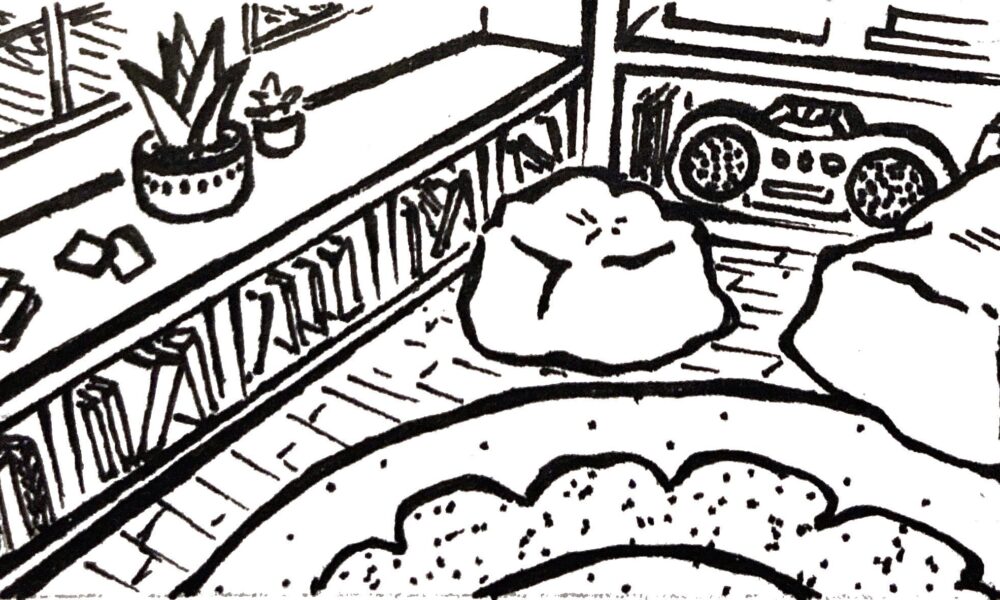
Opportunity to lay down and go silent abounds. In this regard, we draw inspiration from the 1990s vision of a chillout room. Providing dancers with a beanbag-padded, ambient musical haven, the chillout room was a feature of early rave spaces which the party cultures of today have largely abandoned.

(Cartoon of Sako)

There are, however, event organizers in Montreal who keep this fantasy alive in innovative ways. Sako Ghanaghounian, man-about-town and ambient sleepover specialist, is one of them. The first edition of S0undbath (now zzzzzz.club) transformed a loft space into a cloud-filled, downtempo dream world, made for drifting in and out of sleep. 

“The ambient events I’ve hosted in the past, particularly the sleepovers, draw heavy influence from chillout rooms that many raves would have in the ’90s and ’00s,” Ghanaghounian explained. “Unfortunately, parties in Montreal don’t normally feature side rooms where people are given the opportunity to collectively rest, immerse, and bliss out in such a way due to the limited amount of spaces and resources in this city–so why not just make it an event of its own?”

(photo of S0undbath, provided by Sako)

Creative ideas always seem to flow in these states of half-consciousness, when the body is totally relaxed and the mind has long wandered off into a cloudy landscape. Making room for drowsiness is as crucial for innovation and exploration as it is for leisure—and this can be induced by the qualities of a space. Circle Time attendee and seasoned chiller Vivian Miyata noted, “I think it was the blue lighting that really did it for me. I felt like I was underwater, it felt like I could fall asleep at any moment […] it was lovely and beautiful.” For Ghanaghounian, the comfort of an event depends on having “ample room to move about without disturbing those around you, an abundance of spaces to rest so that you can endure the night, and very careful attention to the way the room sounds, with low amounts of lighting.”

(dreamscape cartoon)

Under the purview of Tourisme Montréal, access to this kind of awe and escape has become framed as a purchasable “immersive experience”—but collective rest and sensory nurturing don’t need to be mediated by a museum exhibit. The marketization of “chill out” products can lead us astray from the truly healthful pleasures of a comforting collective existence. By the late 1990s, music associated with the chillout room scene was co-opted by television programs and commercials which sold relaxation as a quick fix, fitting into a stressful schedule. Now, as the once-radical concept of self-care is increasingly linked to individualism and indulgence, we need to look for comfort elsewhere.

(cartoon of a person luxuriating in ‘self-care’)

As student-residents of Montreal, we can find ourselves at home by separating tranquility from removal, stagnation, and consumption. Crafting temporary “chillout” spaces for shared comfort provides a way to engage with homemaking and community-building that accommodates change and retains a forward-looking creativity. Contrary to expectation, you don’t need to invent your own suburb to build space for a peaceful togetherness—though I’m still not opposed to employing the flower as a template where possible. Wherever we are, we deepen our connection to place and with each other by gathering around—and learning from—rest


Editorial, Opinion

McGill must protect its queer students and stand against growing bigotry

On Feb. 22, 2024, the town of Westlock, Alberta, voted to prohibit rainbow crosswalks and flying anything other than government flags. This measure is yet another recent example of Canadian politicians implementing homophobic and transphobic policies, all of which normalize hatred against queer communities.

The Westlock decision came after Alberta Premier Danielle Smith announced a dangerous plan early last month to prevent young people from accessing gender-related therapies such as hormones and puberty blockers. In response to Smith’s policy, Conservative leader Pierre Poilievre claimed that young people should only be able to make choices concerning their bodies “when they’re adults” and explicitly stated his opposition to puberty blockers for people under 18. Poilievre also affirmed his undying support for trans-exclusionary rhetoric, saying that trans women have no place in women’s sports. As politicians weaponize women’s identities and openly disregard science to serve their electoral agenda, institutions—from all levels of government to universities—must speak out against this dangerous rhetoric and actively protect the human rights of the 2SLGBTQIA+ community.

Decisions taken “in the best interests of the child” not only cater directly to Conservatives’ ideas of what gender identity should look like but are also life-threatening to trans youth. According to a 2022 study published in the Canadian Medical Association Journal, transgender adolescents are five times more likely to consider suicide and almost eight times more likely to die by suicide. Restricting access to gender-affirming care will increase mental suffering for young transgender people who already face isolation due to a lack of support systems. Requiring parental approval for trans teenagers to access care, whether it is for surgery or for changing their pronouns, ignores the rejection and bigotry that many trans children face within their families and larger social circles.

These discourses and policies that put trans youth’s bodily autonomy in the hands of their parents emerge directly from an ideology that perpetuates shame, hate, and violence against trans identity and trans people. Smith and Poilievre dishonestly build their anti-trans rhetoric around “safety” while putting 2SLGBTQIA+ youth in danger. Just last month, 16-year-old two-spirit teen Nex Benedict died following a violent confrontation with classmates in their high school in Oklahoma. Across North America, two-spirit people, the broader Indigiqueer community, and other queer and trans people of colour experience homophobia and transphobia in addition to white supremacy and settler colonialism.

The Liberals’ response to the Conservatives is far from sufficient. Prime Minister Trudeau’s accusation of Poilievre attacking “some of the most vulnerable people in society” does not provide any tangible measure to protect queer and trans Canadians. The 2SLGBTQIA+ community must be included in policy discussions of their human rights, not sidelined as vulnerable.

Furthermore, the political sphere is not alone in enabling harmful discourse against transgender people and endangering their autonomy and livelihood. Though McGill has offered resources in support of 2SLGBTQIA+ students often well after community organizing by Queer McGill, the Union for Gender Empowerment, and the Trans Patient Union, powerful stakeholders in the administration have platformed transphobic speech in the name of academic freedom. In Jan. 2023, McGill University’s Centre for Human Rights and Legal Pluralism (CHRLP) invited transphobic professor and lawyer Robert Wintemute to host a talk entitled “Sex and Gender Identity.” The McGill community responded immediately as protesters from various student groups stopped the event before it even began, successfully forcing its cancellation. 

The McGill administration must live up to the values of openness that they publicly promote. Navigating academic spaces for the first time can be a considerable strain on trans students especially, and they should not have to struggle with bureaucracy when it comes to changing their student ID and email address to align with their chosen name. Queer McGill has led a campaign against misgendering and deadnaming, and the university must listen.

McGill students must continue to stand against transphobia and refuse to let their university put trans people’s rights up for debate to fulfill their commitment to “the exchange of ideas.” Trans people’s right to exist is not a conversation, and with substantive care, protection, and support, will not become one.

Sports

Know Your Sport: The McGill Woodsmen saw it all

On Mar. 9, McGill’s Macdonald Campus hosted its 62nd Annual Woodsmen Competition, serving as the penultimate stop for the universities competing in the Canadian Intercollegiate Lumberjacking Association (CILA). The athletes hailed from six different Eastern Canada post-secondary institutions: Algonquin College, Dalhousie University, Fleming College, Maritimes College of Forest Technology, and the University of New Brunswick.

With over a dozen events, the competition is split into team, doubles, and singles events, each of which is subdivided by gender. After the opening ceremony’s early 8:30 a.m. start, friends, family, and curious onlookers were welcomed by the pulp-throwing events, introducing the physical and excitement that would unfold during the day.

Events revolved around traditional lumberjack skills, including multiple variations of woodchopping, with competitors using a Swede saw, a single buck saw, a chainsaw, or an axe. Other events, such as axe throwing or log rolling, offered constant entertainment for the families and friends in attendance. 

Arguably one of the most impressive events—the pole climbing competition—saw multiple competitors try to climb a 28-foot-tall pole as fast as possible. Parker Chase led McGill to a third-place finish under the watchful eyes of her teammates. Next to the pole, the log decking event took place, where athletes took turns trying to roll the log from end to end of the course. McGill’s log decking team faced some challenges, as the log slipped and had to repeatedly be brought back on the trail.

The afternoon opened with light rain and hail, but that did not deter the pairs from competing in the overhand and quarter splits events. Women’s captain Louanne Marquis and teammate Marlene Herzog succeeded Massimo Malorni and Sebastien Beaulieu for the underhand event.

“We were excited for the competition today with all our family and friends out here to support,” said Herzog, who was competing in the overhand and single buck event, in an interview with //The Tribune//. “I feel like we’re crushing it so far today.” 

This prediction came to fruition, as the McGill women’s team delivered an outstandingly speedy and technical performance on the team Swede. The even saw six teammates try to succeed each other in chopping wood discs from a trunk as possible in under five minutes. Their cohesion and technique propelled the women’s team to second place overall, closely following Dalhousie University’s score. The team achieved first place in the team sawing and crosscut saw events, as well as winning individual honours, with first place in single buck sawing and individual supersweet sawing, and podiuming in chainsaw and water boiling. 

The competition ended with the long-awaited water boil event. Each participant gets a tin can filled with water and soap and needs to make a fire out of a supplied log, bringing the can’s contents to boil until the liquid overflows. The spectacular panorama of competitors, each kindling the flames in hopes of heating the can as fast as possible, left audience members speechless. 

As the 2023-24 season is coming to a close soon, coach Andreanne La Salle reflected on the performance of the teams. 

“We just want to keep up our game like it is right now. Just keep focusing and correct a few things that could have gone better in the last competition,” La Salle said. “Maybe fine tuning a bit of technique [here and] there.”

As the only Quebec team on the circuit, the team faces more difficulty with recruiting, which plays a role in their ability to compete with provinces where logger sports are more popular.

“For example, in the Maritimes, the logger sports are something that they do in 4-H, whereas in Quebec, even though we do have really big, deep roots in the logger disciplines or work field, it’s not a sport that’s well known,” La Salle concluded. 

The Macdonald Campus Woodsmen will be travelling to Nova Scotia to attend Dalhousie’s 38th annual Rick Russel Loggersport Competition on Mar. 23.

Arts & Entertainment, Books

Revisiting Lucy Maud Montgomery

I didn’t grow up by the sea. It’s strange that it elicits nostalgia from me—I hadn’t even visited the East Coast until last summer. But it also makes a lot of sense: I spent a good portion of my childhood within books, and many days with Anne Shirley. It started with the first Anne book. In a Victorian novel about Prince Edward Island (PEI), red hair, broken slates, raspberry cordial, and orphanhood, I found a depiction of childhood and the natural world truer than anything I’d ever experienced.

Growing up, Lucy Maud Montgomery’s island seemed to be refracted around me. Southwestern Ontario has a similar softness to it—rolling hills, blithesome rivers, land that’s open, but not flat. 

I visited PEI for the first time in August. I wanted to see the place that had existed in my head for so long—there was a temptation to keep it that way, but my desire to feel close to Montgomery overwhelmed my fear of damaging my imagined idyll. I visited the major literary landmarks: Green Gables Heritage Place, the Lake of Shining Waters, Lover’s Lane, and the Haunted Wood. I dragged my boyfriend—who once told me he hated The Sound of Music because there was “too much music”—to see Anne and Gilbert: The Musical.

Montgomery’s old church still stands (it’s now a fast-food joint called “BOOMburger,” but the original exterior has been preserved).

I felt closest to Montgomery in natural spaces—while walking along Lover’s Lane, gazing out at the sea, watching the breeze rustle the grass, looking out at ruddy, eroding cliffs, and anytime I looked at a tree for long enough. In these moments, I had the strangest feeling that I had been there before. And, in a way, I had. 

Montgomery’s descriptions of nature are those of someone who has observed something very closely for a very long time. It extends into her prose itself: Blooming with mayflowers; warming with the break of day.

“I felt there was a rhythm in the language that resembled the land itself,” Dr. Elizabeth Epperly, a Montgomery scholar and Professor Emerita at the University of Prince Edward Island (UPEI), said in an interview with The Tribune. Epperly was born in Virginia—her love of Montgomery drew her to the island, where she enrolled as UPEI’s first student in 1969. 

“The ocean has its own feeling of striving, standing on the shore,” Epperly said. “Mountains always at least make me feel like striving. They remind me of effort, and of climbing. But because [Montgomery’s] favorite passage was the Alpine Path […] I always thought of the mountains, even the physical ones, as metaphorical [….] And so the ocean, deep as she goes—the illimitable sea—was for her, like the mountains.”

Returning to Montgomery’s novels in the past year, I began to see something that had glided past me before—over time, they take on a certain hardness. As Anne aged, something seemed to change. The darkening of Montgomery’s novels echoes the author’s own evolving worldview and personal trials—but also the fogginess of a society traumatized by the First World War.

“I don’t think [the war] changed her outlook on nature,” Epperly observed. “But I think it changed her outlook on human nature.”

Montgomery’s novels, beautiful and nostalgic, take on new meaning in the era of the climate crisis. The Great War destroyed large swaths of the natural world, and modernity brought about a certain kind of speed: Fast cars, skyscrapers, industry, new forms of communication—many of which are deeply intertwined with fossil fuels.

Montgomery’s writing is highly attuned to natural cycles. I’ve always loved how time passes within her novels: Fresh buds in spring, golden summers, fiery autumns, elegant lacy winters. But recently I’ve begun to notice something else: Decay.

When she left her beloved island upon marrying the Reverend Ewan Macdonald, she revisited the past through her fiction. Many of Montgomery’s works have a lovely stillness to them. They’re vivid and lively, but they displace the reader into a dreamlike bygone past, distorting time by standing still.

Jane of Lantern Hill (1937), one of her later works, opens with the description of a Victorian mansion in Toronto that seems to atrophy. The house is said to have “died thirty years ago.”

Mistress Pat (1935), the sequel to Pat of Silver Bush, takes place over 11 years, when Pat—the heroine who Montgomery said resembled her most in spirit—is a young woman. The first year lasts 110 pages; then, as time goes on, each year takes up fewer and fewer page numbers. The 11th year lasts but 15. At the edge of youth, the days slowly begin to dissolve into the background. The novel ends with Silver Bush, Pat’s beloved home—essentially an extension of her own body—going up in flames. Place decays with life.

“Within the Pat books, there’s a reference to how all the bears have been gone,” Kate Scarth, Chair of L.M. Montgomery Studies at UPEI, told The Tribune. “I forget when the last bear was killed or died in PEI. But there is, you know, a sense in the novels of the community’s hands, of a world that has been dramatically altered.”

After the war, after Montgomery lost a child, after she had left the Island, her writing changed. It’s as if the sun didn’t shine quite as bright upon her heroines—but she continued to write. And she found solace in nature, even as it was being destroyed.

“Montgomery believed that no matter where you were, you could find nature,” Epperly said. “You could, even if it was just looking in a flower pot, you know, seeing it there, too […] It’s that feeling not that we’re escaping out of, but we’re escaping into.”

This June, Montgomery scholars and enthusiasts from around the world will gather at UPEI for the L.M. Montgomery Institute’s Biannual International Conference to escape into her work together over the course of five days.

“It is really such a wonderful event because it really feels like a homecoming,” Scarth said. “You know, whether or not you’ve been there before, because everyone has this shared love [….] It’s just a really collegial and fun and interesting space.”

Epperly’s keynote address at the Conference will incorporate Angus Fletcher’s Wonderworks: Literary Invention and the Science of Stories—exploring why we return to stories through neuroscience.

“No wonder we enjoy rereading all through our lives, rereading favorite books, because […] the actual nerve hints are entangled and so you’re reading your old self as well as creating a new self while you’re reading it. It’s quite an interesting take on a neurological level,” Epperly remarked.

Montgomery describes a kind of veil. Something fluttering between the visible and the sublime, obscuring this world from something else, something untouchable, undefined. But there are moments when the veil blows aside.

“Amid the commonplaces of life, I was very near to a kingdom of ideal beauty. Between it and me hung only a thin veil,” Montgomery wrote. “I could never quite draw it aside, but sometimes a wind fluttered it. I seemed to catch a glimpse of the enchanting realm beyond—only a glimpse—but those glimpses had always made life worthwhile.” 

There have been moments where I’ve felt something akin to “the flash.” Clear summer nights on Beausoleil Island on Georgian Bay, walking along the Speed River in Guelph at night after a fresh snowfall—for a moment, or maybe less, everything becomes hyper-sensory. Something else seems to emerge, not only out of the margins, but in the spaces between stars, between pine needles. 

This sudden, fleeting escape into another world, a place that seems uncertain and phantasmal, but which I also know to be deeply true, is difficult to describe. The best comparison I can make is to say that this is how reading makes me feel. 

Through time, through conflict, personal and political, through the climate crisis, as seasons meld and familiar cycles spin out of control, as the past dissolves, upon each new read the wind lingers a bit longer, and the veil blows back a bit further, and Montgomery’s enchanted realm coalesces the slightest bit more with ours.

Montgomery should be read in childhood—and again in adolescence, and again in adulthood. Her works should be read to comfort and uplift, but also to confront and challenge. Every time I open one of her works, I discover something new that had just slipped out of view, and it makes me yearn to return to the island.

McGill, Montreal, News

Open letter supporting Hunger Strike for Palestine amasses over 1,000 signatures

On Mar. 2, a group of McGill alumni drafted an open letter to McGill’s administration in support of the McGill Hunger Strike for Palestine. As of March 10, it has received over 1,100 signatures from alumni, faculty, and students alike. The letter calls on McGill to meet the demands of the hunger strikers by cutting ties with corporations and academic institutions complicit in Israel’s ongoing siege on Gaza and the genocide of Palestinians

The hunger strike was launched by twelve students on campus. Sage*, U3 Arts and member of McGill Hunger Strike for Palestine, told The Tribune that the strike came after the university ignored students’ continued demand that McGill take a stand against the genocide in Palestine.

“We have been protesting, emailing, and calling the Board [of Governors], and we just haven’t had any response back,” Sage said. “So for us, this was really our last chance to show them that we were actually very serious about this.”

The open letter, which started circulating eighteen days into the strike, urges McGill to meet the demands of the hunger strikers and divest from companies directly or indirectly supporting Israel’s genocide against Palestinians. Solidarity for Palestinian Human Rights (SPHR) estimates that these investments total approximately $20 million—including $519,949  in Lockheed Martin, $1,546,209 in Safran SA, $1,820,816 in Airbus SE, $1,217,646 in L’Oréal, $1,323,824 in Thales SA, $1,396,445 in Chevron Corp, $1,215,308 in Coca-Cola, $11,372,580 in Royal bank of Canada, and $605,482 in Unilever 

The letter also supports hunger strikers’ demand that McGill boycott academic institutions complicit in the genocide of Palestinians, including universities involved in Israel’s military research and development. Although the university has stated that they will not cut ties with academic institutions because of where they are located, the letter asserts that the boycott demands were not linked to the institutions’ location but rather stemmed from their involvement in the human rights abuses against Palestinians. 

The letter reads, “We wish to emphasize that the calls to cut ties with Israeli academic institutions are not aimed at institutions because of where they are located. Rather, they are aimed at specific Israeli institutions with well-documented records of complicity in human rights violations against Palestinians.”

The authors of the letter also condemn McGill’s response to the hunger strike. Sage explained that although the McGill administration has been willing to meet with the hunger strikers, they have been unable to agree on the terms of a meeting. On Feb. 19, McGill invited the hunger strikers to meet with them. On Feb. 21, the hunger strikers responded, asking for a public meeting so that students supporting the cause could attend and asked McGill to set the meeting a week in advance so that hunger strikers could sufficiently prepare. They also asked to meet for at least an hour and a half so they would have enough time to discuss their demands. 

According to the group, on Feb. 28, the McGill administration agreed to these terms and set a meeting date for Mar. 11. However, they quickly rescinded the offer. Later that day, the McGill administration stated that although they would be willing to explore a public meeting in the future, they wished to have a private meeting with the strikers on Mar. 4, given the health risks of a hunger strike and the urgency of the situation. Strikers refused the terms of this meeting, maintaining that they were uninterested in discussing the health of the strikers. In response, McGill stated that they felt a meeting to discuss the hunger strikers’ demands would be unproductive. Consequently, discussions stalled and students continued their strike over the reading break. 

“McGill supports the rights of students to exercise their rights in connection with civic engagement in accordance with the Charter of Student Rights and applicable laws [.…] It is equally important to note that all members of our community have the right to learn, teach and work in a peaceful environment. Any civic engagement that results in a hindrance of those rights is not acceptable,” McGill’s media relations officer Frédérique Mazerolle wrote to The Tribune

Although the hunger strike does not interfere with the conduction of classes, SPHR, asserted that “[the hunger strikers] demonstrate how McGill’s inaction and refusal to heed student demands has pushed committed students to extreme forms of protest.”

Sage told The Tribune they were hopeful the letter would pressure the university to take the demands of the hunger strikers seriously.

“[The letter] legitimizes our strike,” Sage said. “We believe that support from alumni, staff, and faculty is a good step forward.” 

Behind the Bench, Sports

Public subsidies for sports facilities are a misuse of public funds

In recent decades, city and state governments across North America have earmarked huge amounts of public funds for sports infrastructure projects. As part of the legislative session that ended on Mar. 1, Utah’s state lawmakers passed bills approving $900 million in funding for a baseball stadium and $500 million for a new hockey arena in Salt Lake City. Utah has neither a Major League Baseball (MLB) team, nor a National Hockey League (NHL) team, but the legislature was evidently not interested in letting present-day reality stop them from funding the potential presence of future big league teams.

Public subsidies for privately-owned sporting facilities have been a perennial headache for elected officials. Privately-owned men’s sports teams threaten underfunded municipal governments with relocation if they do not receive generous financial packages to fund exorbitant stadium infrastructure plans complete with incorporation into public transport systems, resulting in a humiliating ‘race to the bottom’ at taxpayer expense. Funds are committed to attract lucrative men’s major league professional sports teams, rather than invested into women’s, grassroots, or other levels of sports, and single-team stadiums are common, meaning the investment needed is often multiplied two or three times depending on the number of teams a city has. 

Governments have allotted eye-watering amounts of public dollars to build stadiums in recent years. These subsidies include building new facilities at the taxpayers’ expense for existing teams that already have functioning stadiums. New stadiums are built to increase profitability as they contain higher percentages of more lucrative seating, such as luxury suites. These profits then flow into the pockets of ownership groups rather than back to the city or local community. If these stadiums aren’t full, franchises will often leave regardless of investment, hoping to increase profits in other markets. For instance, the state of Tennessee and the city of Nashville are contributing $500 million and $760 million respectively to a new stadium for the National Football League’s (NFL) Tennessee Titans. The Buffalo Bills scored $850 million in funding from their state and county for a new stadium. Oklahoma City residents passed an $850 million funding package to replace a 22-year-old basketball arena in a public referendum that totalled 58,000 votes. The list could go on, but the pattern is clear.

Hidden costs, invisible benefits

In negotiations for public subsidies, team owners typically cite the community benefits that these infrastructure projects can provide. Friends and families can create lifelong memories at the live events these stadiums host. The argument that communities need these facilities in the same way they need public swimming pools, libraries, and museums is understandable. 

 The problem lies in the staggering dollar amounts contributed to these facilities—especially in cases where infrastructure already exists. When large-scale sports infrastructure projects are funded to the tune of hundreds of millions of dollars but governments leave roads and bridges in disrepair, fail to provide adequate support to underfunded school systems, and neglect entire networks of overcrowded, short-staffed hospitals, officials are failing those they are elected to serve. 

Prospective owners claim that tangible benefits for communities and governments come in the form of an increase in economic activity and tax revenue as a result of these projects. They suggest that tourists will occupy hotel beds, eat at restaurants, and contribute to the local economy when they are in town for sporting events and concerts. However, studies have shown that the economic impact of tourists visiting a city specifically for a single live event is negligible, and, in most cases, those tourists would still visit and be contributing to the local economy in other ways. 

The environmental impacts of sports stadiums are almost never considered. Stadiums, such as Los Angeles’s SoFi stadium, are often built on land at the fringes of urban areas which previously were green spaces. These stadiums require transportation infrastructure built with public funds, and result in emissions from fans driving cars. Despite stadiums becoming increasingly energy efficient, huge amounts of energy remain necessary  to power operations, and tonnes of waste are created with each event. Increasingly, teams such as Everton in the Premier League are choosing to build new stadiums rather than update old ones, as Liverpool did with Anfield. Concrete production and construction generate huge amounts of carbon dioxide, and in a climate crisis we must ask ourselves: Is this really what we want to spend emissions on?  

Breaking ground by sharing grounds

While teams may find the prospect of operating their own facilities appealing for the bottom line, they should consider using existing facilities or holding their events in venues that are already being used by other local teams. For instance, basketball and hockey arenas are often shared—as is the case for soccer and football stadiums—as the seating configuration is similar enough for those sports’ purposes. Yet there are many cases where soccer-specific stadiums are being built for Major League Soccer (MLS) teams in cities where an NFL or college football stadium already exists, including New York City and Miami. While team owners in those cities are funding their projects with private dollars, it is estimated that the deal in New York will cost $516 million in lost property tax revenue over 49 years by leasing the land to developers instead of selling it, while the Miami club is benefiting from a no-bid lease agreement. Teams are also looking for considerable sums to fund renovation projects or, worse yet, ditch their existing stadiums, even in cases like Oklahoma City’s, where the stadium is not yet 30 years old. In these cases, public funding packages yield no added community benefit, as adequate infrastructure already exists.

Not every city needs to play in the big leagues

North American sports franchises are notorious for moving cities as soon as it is no longer lucrative to remain in place. The reality is that not every city has a market for a major team in some of the most lucrative leagues in the world. As soon as attendances drop, a franchise’s viability is at risk—a fact that supporters of the Oakland Athletics and the Winnipeg Jets know all too well. The value of sport to local communities is not in question: But does every city need an NHL team? Utah is a state of 3.4 million people which is already home to the NBA’s Utah Jazz and MLS’s Real Salt Lake. According to this 2014 survey by the University of Utah, the most popular sport is college football. Are state residents really clamouring for more professional men’s sports teams?  

When franchises leave, it is local communities who lose. Afterall, the capital investment is transitory: Ownership groups do not need to take on expensive stadium build costs or deal with the legacy that these crumbling concrete monsters leave behind in their communities. Ownership groups also do not feel the traumatic repercussions which reverberate throughout communities when much-loved teams leave. Elite sports franchises can be synonymous with community investment but not intrinsically so. 

Most cities do not have the capacity to support more men’s major professional sports leagues: Athletes are overworked, and more and more games are being fit into increasingly tight schedules. We need more investment outside of the status quo: into burgeoning women’s sports leagues such as the NWSL and the WNBA, into second and third division development leagues, into grassroots sports, and into youth development pathways. The strength of the National College Athletics Association (NCAA) means that many development leagues are little more than an afterthought. However, for sports such as baseball and hockey, minor league teams are vital community institutions. One of those minor league teams is located just south of the border, in Burlington, Vermont, where the Lake Monsters, a former affiliate of the Montreal Expos, continue to honour their parent club’s legacy during a theme night, taking the field in Expos colours. In other countries with competitive league pyramids decided by promotion and relegation, small town teams may never get to the top, and that is fine. They are proud community institutions with deep roots. When they do make it to the top, as Luton Town did last season, it means all the more, as the fairytale has come true. 

The last thing we need is for more municipalities to be held hostage by corporate greed. Private ownership groups bully elected officials by leveraging their franchise mobility against the best interests of communities, wrecking everything in their path. It is time for local governments to be brave and stand up to private ownership groups for the benefit of those who really matter—the supporters. The Green Bay Packers are living proof this model can be achieved even in North America. After all, a team is not a team without a community rooting it firmly in place.

Commentary, Opinion

The latest draft of Bill 96 is the latest demonstration of Quebec’s lose-lose francophone agenda

The most recent draft of Quebec’s Bill 96 is yet another in a long line of regulations whose promotion of the French language comes at the unnecessarily hostile suppression of English. This newest draft, published on Jan. 10 by the Quebec government’s Official Gazette, imposes a regulation whereby any storefront signage or document inscription must be accompanied by its French translation in a size at least twice as large as the English text. Thus, for the first time since the assent of Bill 96 in June of 2022, Quebec’s pro-francophone regulations have become unavoidably visible, making it clearer than ever that one population is welcome, while another is not. 

Quebec’s relationship with its coexisting anglophone and francophone communities, as well as its relationship with Canada as a whole, has been a point of contention for decades. The province made numerous attempts to separate in the latter half of the 20th century, culminating in the unsuccessful 1995 referendum that voters narrowly defeated. Since then, the Canadian federal government has acknowledged Quebec’s individuality as a province whose official language is French, but Quebec is still under the umbrella of the national government and included in the Canadian national identity. 

The primary aim of Bill 96, officially labeled the “Act respecting French,” is to “affirm that the only official language of Quebec is French.” Such regulation enforces stricter linguistic regulations on the workplace, higher education, public services, and commercial advertising, thus rendering social and economic participation in Quebec much less accessible to any citizen who does not speak French . 

This clash of motives and cultural values between Quebec and Canada as a whole is unproductive for both governments. The latest draft of Bill 96 solidifies Quebec’s exclusive stance, ensuring that Quebec––regardless of its success in official separation––will not conform to Canada’s explicit commitment to respectful and inclusive multiculturalism. Thus, Quebec stands in the way of a unified, multicultural Canadian identity, yet its connection to Canada instigates internal cultural conflicts that destabilize its provincial strength in both political and social realms. It is a political stalemate that harms Quebeckers. With such logic, a sovereign Quebec seems the only realistic sustainable path.  

Ideally, Quebec would find compromise for harmonious cultural coexistence between anglophone, francophone, and allophone communities. The vehement addenda to Bill 96, however, show that such harmony is unrealistic. While demonstrated dissent should be a fundamental catalyst for positive change, the protests against Bill 96 have yet to create space for cultural harmony in Quebec. 

The latest draft regarding commercial signage displays an illogical and costly desperation for a French Quebec; it represents a massive visual shift for cities like Montreal. The CBC published an article on Jan. 26 broadcasting the concerns of municipal governments (including Montreal) regarding the $7-15 million required provincewide to make these infrastructural changes. The article also highlighted the translation issues of store names such as Costco, Walmart, and Starbucks, whose names are not direct translations of French or English. This regulation is expeditious (demanding implementation by the summer of 2025) and proves Quebec’s determination, regardless of its Canadian ties or its large anglophone and allophone communities, to root the francophone agenda deeply in its physical infrastructure.

Quebec’s latest drafts to Bill 96 reaffirm its intensifying nationalist francophone agenda. In such an environment, conflict will persist both within the population and between citizens and the provincial government. These drafts also make it impossible to solidify a unified Canadian identity. While Quebec’s endorsements of Bill 96 trigger immediate, short-term changes, dismissing the protests of the substantial anglophone community in Quebec is not a sustainable strategy, and will inevitably delegitimize any progress being made toward a francophone Quebec. It is critical that Quebec radically rewrites Bill 96, understanding its implementation and motivation as harmful to Quebec’s francophones, anglophones, and allophones alike. Otherwise, the remaining realistic future is a sovereign Quebec.

Sports

Varsity Roundup: March 1-10 

While some McGillians jumped on a plane for a beach vacation, headed home, or found a way to make a stay-cation work in Montreal for reading week, the Redbirds and Martlets remained hard at work. 

On Friday, Mar. 1, the Redbirds (21–5–2) hockey team bounced back from their game-one loss to the Université du Québec à Trois Rivières (UQTR) Patriotes (21–6–1) in the Ontario University Association (OUA) East men’s hockey best-of-three series. With their season on the line, the Redbirds looked to stave off elimination and push the series back to McConnell Arena. Despite going down 3-0 just seven minutes into the first period, the Redbirds dug deep with Eric Uba scoring three unanswered goals to register a hat trick. With the game tied at three, Zach Gallant netted what would be the game-winning goal with just under two minutes remaining. As four seconds remained on the clock, Mathieu Gagnon scored the final goal of the game resulting in a 5-3 victory for the Redbirds. 

Unfortunately, for the Redbirds fans who remained in Montreal, McGill could not find the same magic in game three of the series. The Redbirds fell 4-0 to the two-time defending league champions, leading them to face off against the Brock Badgers (21–7–0) in the OUA bronze medal game on Mar. 9. The Badgers, who finished first overall in the OUA West’s regular season, fell to the Toronto Metropolitan University (TMU) Bold (19–9–0) in the OUA semi-final. The Bold went on to lose 3-2 in double overtime to the Patriotes in the OUA finals. As for the Redbirds, they successfully defeated the Badgers 5-2 with goals from Uba, Charles-Antoine Dumont, Caiden Daley, and William Rouleau. McGill will play next at the U SPORTS National Championship hosted by TMU from Mar. 14-17. 

In the pool, McGill hosted the U SPORTS National Championship where the Martlets finished fourth overall and the Redbirds claimed bronze. The Martlets’ competition was highlighted by Naomie Lo snagging a silver medal in the 400 m freestyle. As for the Redbirds, Pablo Collin flourished yet again, taking home gold in the 200 m freestyle. Collin, Artiom Volodin, Bruno Dehem-Lemelin, and Mats Baradat earned the Redbirds their second gold medal in the 4x200m freestyle relay. The Redbirds also medalled in the 4x100m freestyle relay while Malachy Belkhelladi took home a silver in the 50 m freestyle and Hazem Issa added a bronze to McGill’s medal tally in the 50 m butterfly. Baradat also claimed a bronze medal in the 400 m freestyle. The Redbirds’ third-place finish with 898 points was behind the University of Calgary’s 922.5 and the University of Toronto’s dominating 1,145 points. As for the Martlets, their fourth-place finish was with 788.5 points while the University of Toronto claimed 1,444 points, just ahead of the University of British Columbia’s 1,300 and the University of Calgary’s 872.5. 

On the track, McGill travelled to Winnipeg for the U SPORTS Track and Field National Championship. The Redbirds finished fourteenth overall while the Martlets finished sixteenth overall. In terms of medals, Matthew Beaudet earned silver in the 3,000 m with a time of 8:01:44 and snagged a fifth place finish in the men’s 1,500 m. Donna Ntambue took home a third place finish in the women’s 60 m and helped carry the Martlets’ 4×200 m relay to break the McGill record by 1.5 seconds. In the men’s 4×800 m, the Redbirds earned a fifth place finish and round it all out, Kilty McGonigal took home a fourth place finish in the men’s heptathlon and set a new Redbirds record.

Read the latest issue

Read the latest issue