Google Chrome has been the most popular browser for nearly a decade. While it was a welcome change during its early years, it has since rested on its laurels, providing a resource-heavy and lacklustre browsing experience that disregards privacy and doesn’t offer useful tools for students. Just as the world moved away from Internet Explorer in the 2010s, it’s time to consider some other browsing options.
Edge
Microsoft’s default browser has come a long way since the Internet Explorer days. Edge is a powerful browser with a minimalist interface, but is loaded with tools that are handy for students. Edge’s Collections features make compiling sources a breeze—they allow you to save links quickly and then export all the citations with one click. Other handy features include its built-in screenshot tool that lets you to capture entire webpages, an immersive reader to eliminate distractions on webpages, a battery saver mode for laptops, touchscreen writing input, and a PDF viewer that allows notetaking and annotations.
Vivaldi
Vivaldi excels in customization. There are so many ways to modify the browser to your preferences, including its appearance, functionality, privacy, and layout. The personalization features can be a bit overwhelming at first, but putting the time in can prove worthwhile in the long run. The private calendar and email client help limit the number of apps you need open to stay organized and the built-in note taker and reading list keep you on track during assignments.
Opera
Opera is one of the oldest browsers that is still around. It has a few unique tricks up its sleeve that make it a good alternative to Chrome and Safari. The apps in the sidebar are handy for staying on top of social media and messaging apps like WhatsApp, Messenger, and Instagram and the player tool keeps your music streaming platform only a click away. The workspaces are a great way to separate your browsing for each class and stay organized during the semester. Opera emphasizes AI tools in recent updates. For gamers, try Opera GX, a version of Opera with RBG accents, a CPU and RAM limiter, and other gaming-focused features.
Firefox
Firefox is unique among tech companies as it is the only mainstream browser owned by a non-profit organization: The Mozilla Foundation. Mozilla has been a vocal advocate for ensuring the web is safe, accessible, and secure; the browser embodies these principles as it is open source, built on its own engine (not Google’s Chromium like every other browser on this list), and privacy-focused. It has fewer productivity features than other browsers but for those looking for a simple browser that runs well on both modern and older hardware, Firefox is a great option.
Brave
From its proprietary search engine to its advanced cookie and ad-blocking, Brave focuses on privacy and security. Beyond this, it can be a bit light on features, leaving a lot to be desired. But if that’s what you value above all else, Brave is an attractive choice. Another notable feature is its opt-in ad system, which rewards you in crypto tokens for allowing acceptable ads.
Sidekick
Sidekick is a productivity-focused browser with many tools that will help students with their assignments. Sidekick allows you to convert any website into an app that conveniently sits on your sidebar. Sidekick’s tab sessions are one of the most intuitive ways to avoid hoarding tabs, allowing you to collapse entire groups of tabs quickly so you can get back to them later. The search feature parses through your tabs, apps, and documents, helping you to not get lost during research. The focus mode will prove valuable for those late-night sessions at Redpath, when absolute productivity is necessary.
Arc
Though it’s only available for Mac at the moment—a Windows app is still in development—the Arc browser is a welcome newcomer to the browser space. The split-screen feature is so intuitive that it makes you wonder why it’s not offered on every browser. Like other browsers, it has a way to organize tabs, which, much like the rest of the browser, is very aesthetically pleasing.
On the afternoon of Friday Oct. 20, polls for the Students’ Society of McGill University (SSMU) Vice President (VP) Finance by-election came to a close with only 12.4 per cent of eligible students voting. Amina Kudrati-Plummer won the election with 60.6 per cent of the votes. The only other candidate, Brishti Guha, earned 31.5 per cent of the votes, the remaining votes being abstentions. The election came as a result of the resignation of former VP Finance Alice Fang on Aug. 7. Since Fang’s resignation, the VP Finance’s duties have been divided between the current SSMU executives.
“I want to thank the McGill community for putting their trust in me, and I recognize my opponent for her good effort in this election,” Kudrati-Plummer wrote in an email to The Tribune. “I look forward to following through with the initiatives I have proposed and ensuring the transparency of SSMU finances.”
Kudrati-Plummer, U3 Arts, emphasized the importance of transparency and accessibility of SSMU financial documents in their platform. In particular, she criticized the student government for failing to post the 2023-2024 budgets on its website and for making the budgets for the previous two academic years only accessible under the “Legislative Council documents,” rather than under the “Budgets” tab. Kudrati-Plummer also highlighted the need for more information to be provided alongside financial documents to make them more accessible for students.
“I would really like to make those budgets more logical, easier for the average person to understand and also just make sure they are available, because that is a huge misstep on SSMU’s part over three years to just have those hidden on the very dense SSMU website,” Kudrati-Plummer said in an interview with The Tribune.
Similarly to Kudrati-Plummer, transparency was a key issue in Guha’s campaign. One of Guha’s proposals was to create a financial dashboard online to make public-facing SSMU financial documents more easily understandable for students.
“The dashboard would be a digital platform offering a snapshot of SSMU’s finances [such as] revenues, expenditures, allocations to clubs in a visually appealing and interactive manner,” Guha wrote to The Tribune. “Because every student has a right to easily understand where their fees are going and how their money is being used.”
Sophia Karabatsos—a physiology master’s student and former co-director of the McGill chapter of Scientista—echoed the need for greater transparency from SSMU. In an interview with The Tribune, Karabatsos noted the difficulties that Scientista faced because of unclear information on the SSMU website concerning club financial matters.
“You want to kind of know where everyone’s money from the tuition is going,” Karabatsos said. “And if there is this money available for clubs, it would be good to be transparent about it, because a lot of clubs could use it.”
To limit any delays regarding funding as a result of the unfilled position, Kudrati-Plummer also plans on holding regular office hours and a workshop—something normally provided by the VP Finance at the beginning of each semester—for clubs in need of assistance with financial procedures.
The VP Finance-elect’s platform also focuses on creating economically sustainable programs for students, including relaunching programs that were discontinued since the COVID-19 pandemic began. One program Kudrati-Plummer proposes reintroducing is a textbook exchange program wherein Le James bookstore buys students’ used books back from them to sell at a reduced price. “Initiating economically sustainable programs for students is really important, especially bringing back ones that died out over COVID, because a lot of stuff did,” Kudrati-Plummer said. “Especially as things like food insecurity become more pressing topics on campus, and also with these new laws that [the] Quebec [government] is suggesting, it’s really important for SSMU to make student life as affordable as possible.”
A second round of negotiations between the McGill administration and the Association of Graduate Students Employed at McGill (AGSEM) took place on Oct. 19. According to the union’s press release, the four-hour session was focused on aligning the new contract with McGill’s policies on intellectual property, labour relations, and university governance. The meeting also touched on establishing timelines for addressing employee grievances.
The collective agreement between the university and the union expired on Jul. 31, and the sides first exchanged proposals for a new agreement on Sept. 21. As expressed in their “No More Free Hours” campaign, the union’s core demand is to end the time teaching assistants (TAs) spend reading course material and sending emails that is not recorded or paid. The union also aims to establish better conditions for McGill TAs in terms of wages, healthcare, and methods of preventing sexual harassment. The group alleges that McGill steals $1 million each year in TA wages.
The early negotiation talks have been around issues other than wages, including job security and ensuring that TAs have access to TA jobs. Another bargaining committee member, Nada El Baba, a second-year biology Ph.D. candidate, explained in the union’s press release that “information accessibility” was additionally discussed at the session.
“TAs usually do not know the number of students enrolled in classes which they apply to,” El Baba wrote. “This is particularly relevant to those who teach labs where they are responsible for not only students’ education but also their physical safety around dangerous materials. TAs have the right to know what they are signing up for to make the best decisions for themselves and their students.”
In addition to the previously determined topics of discussion, the Quebec government’s decision to raise tuition for out-of-province students could impact negotiations as James Newman—the Vice President of Communications for the Association of McGill University Support Employees (AMUSE)—explained.
“I think McGill is going to be, as usual, very austerity-minded and not want to really offer much in terms of wages and benefits, particularly considering the pressure caused by the new decision,” Newman said. “They’re probably going to say that they’ve got new pressures, that they’re going to cut costs.”
Thomas Chalmers, the president of the McGill University Non-Academic Certified Association (MUNACA), said that MUNACA was “deeply concerned” that McGill may use the tuition hike as an excuse to refuse wage increases or justify wage decreases.
Even without added pressures, negotiations over collective agreements can be an arduous process according to Chalmers. In an email to The Tribune, Chalmers explained that, when MUNACA negotiated their collective agreement—a two-year process that ended in 2022—the union found the McGill administration resistant to change.
“Our biggest challenges about our negotiations were the stubbornness, interminable delays, and resistance to change we met at a great deal of our demands, whether that was non-monetary or monetary,” Chalmers wrote. “At the time we were negotiating we kept hearing the same replies: Workday [McGill’s employee management software] cannot do that and we have no appetite for that, were often repeated answers.”
Sean Cory, president of the Association of McGill University Research Employees (AMURE), said in an email to The Tribune that while the uncertain financial situation could impact negotiations, wages do not usually come from tuition or government funds, but rather from research funds.
Cory also said that his membership was happy with the results of their negotiations and that negotiations for good collective agreements take time.
“The more gains you want to make, the longer negotiation takes,” Cory wrote. “It takes time to actually negotiate and discuss the issues, […] it takes time to hold out for the positions and improvements that you want in your collective agreement.”
AGSEM and McGill’s next bargaining sessions are scheduled for Nov. 9 and 22.
When I first applied to McGill in the middle of the pandemic, I had never stepped foot in Montreal, much less onto McGill’s campus. In an attempt to recreate a traditional university visit, I watched McGill’s promotional videos, trying to weave video fragments of the campus together to imagine the place I would call home for the next four years. Images of the Arts Building, with the McGill flag waving red and white from the top of the dome, and the Macdonald-Stewart Library Building with its half-moon windows were ingrained in my mind. What I didn’t anticipate, and what was never shown in these videos, was the constant noise of construction across campus. Buildings that McGill presented to me as the cornerstones of campus were, in fact, covered in scaffolding when I arrived.
McGill’s campuses are always going to be a work in progress. The inevitable trade-off is that historic buildings, while beautiful, require frequent maintenance to ensure that they meet modern building codes. McGill has 200 active construction projects at any given time, according to McGill Media Relations Officer Frédérique Mazerolle, due to the campuses’ sheer number of aging buildings and new construction undertakings. These projects range from the installation of electrical sockets to the New Vic project which is estimated to cost at least $700 million. According to Mazerolle, McGill allocates about $150 million to construction projects annually.
McGill is currently playing catch-up to address all of its buildings’ maintenance issues, such as the ongoing construction in the Macdonald campus’ Raymond Building and Centennial Centre. As projects get underway, new ones are slotted for future maintenance and different issues sprout up that require even more work. The inventory of construction projects has become larger than what funding can provide. This results in deferred maintenance, which refers to the stalling of projects that are slated to be completed. And now, as the institution stares down the reality of climate change, broader changes to the campus have to be made to adapt; changes that cannot be prioritized until deferred maintenance is resolved. How did McGill get to this moment, and what does it mean for its built environment?
Facilities Management and Ancillary Services (FMAS) is the department that oversees and plans construction at McGill. FMAS comprises six units: Operations, Campus Planning and Development, Design Services, Project Management, Campus Public Safety, and Risk Advisory and Insurance Services. It is clear that McGill’s priorities lie in management and maintenance; even in name, the department is focused on management rather than planning, with the latter being a subset of the department rather than its primary focus. Currently, the department oversees at least half a billion dollars worth of construction projects across the Downtown and Macdonald Campuses.
[insert flow chart from Sofia of FMAS structure?]
Climate change is no longer a vague phenomenon looming on the horizon; we are already witnessing the faults of McGill’s infrastructure and how climate change alters the environment we live in. As the beginning of the Fall semester feels hotter and hotter each year, and walking into the non-air-conditioned Arts Building for class offers no relief, the effects of climate change are palpable. Predictions for the Montreal area suggest that the summer heat trend will only worsen, and the region will experience much more precipitation. Extreme weather events such as flash floods and ice storms are also expected to be increasingly common.
Michael Jemtrud, associate professor in the Peter Guo-hua Fu School of Architecture, told The Tribune that the most sustainable buildings are “the ones that are already built.” According to him, the problem is not in the resilience of McGill’s current buildings but in the planning being done at the institutional level. He believes McGill and FMAS need to focus more on long-term planning rather than maintenance of buildings in order to transition the university’s infrastructure to one that is climate-resilient.
“I personally think [McGill is] way underestimating stuff,” Jemtrud said. “I think the five-year model [for climate change] was actually the twenty-year model. We have to be prepared for that and we have to plan our infrastructure accordingly.”
While FMAS’ Campus Planning and Development unit released a Master Plan in 2019 that outlines the long-term goals for both the Downtown and Macdonald campuses, little progress has been made toward these goals so far. Factors such as the need for maintenance, the pandemic, and now post-COVID inflation, have stood in the way.
Jemtrud, who is working on the BARN project—a new interdisciplinary research facility with a focus on decarbonization—on the Macdonald campus, told The Tribune that his team has faced bureaucratic roadblocks involving zoning issues that have delayed the project. With inflation, the grant he received pre-COVID is insufficient for the project, so the team has had to find alternative funding options. Jemtrud believes this speaks to the inefficiencies of FMAS as he thinks these issues could have been avoided by putting more money into research early on in the process.
“We need to have a more serious planning department, maybe campus architects, someone who’s looking at this in a different way, who’s more familiar with new construction,” Jemtrud said. “We need to fund that department as well as FMAS because this kind of cost-recovery model that the university has adopted as if we were some corporation—which we’re not, we’re publicly funded—doesn’t work if you want to do strategic planning. In my opinion, it doesn’t work if you want to do proper risk management.”
In McGill’s construction projects, they work to meet certain sustainability objectives, one being Leadership in Energy and Environmental Design (LEED) certification. Jemtrud said that these objectives do not necessarily constitute sustainable infrastructure and in some cases are performative rather than substantially progressive toward sustainability. Jemtrud proposes thinking about innovative solutions and involving the experts who work and study at the institution.
“It sucks to have to plan for the worst-case scenario, but I think you’re foolish if you don’t at this point. On a day-to-day basis too, I think, there are ways that we can start to look at maybe some not-so-obvious solutions to things, use our expertise a little bit more, be leaders in using low carbon [design]— Seriously, though, not just the greenwashing crap that we do.”
McGill cannot hope to plan for the future if it is already struggling to keep up with the necessary maintenance needed for its aging infrastructure. Nowhere is this more evident than on the Macdonald campus. According to FMAS’ maps of current construction projects, over half of the construction budget at the Macdonald campus is allocated to deferred maintenance.
Mazerolle explained that in 2020, McGill “launched a $100-million building renovation program at Macdonald Campus,” and that the renovations “involve critical—and long-deferred—upgrades needed to bring the campus facilities up to modern building codes and standards.”
That means that the maintenance is long overdue but was delayed because of constraints, whether financial, labour-related shortages, or the prioritization of maintenance elsewhere. Anja Geitmann, Dean of the Faculty of Agricultural and Environmental Sciences and Associate Vice-Principal (Macdonald Campus), spoke to the obstacles faced when it comes to keeping up with maintenance at Mac.
“The amount of aging buildings that McGill has with respect to other Quebec universities is probably higher than most others,” Geitmann said. “The total number of buildings, the situation on the labour market, the situation on the construction market, is really an overall perfect storm that lands us here in 2023 with a whole lot of challenges.”
Coupled with these obstacles is McGill’s consistent deprioritization of the Macdonald campus versus the Downtown campus.
“Each individual prioritization that a provost might have done in the last few decades might have made sense,” Geitmann said. “If you see there’s a building downtown that services 10,000 students versus a certain building at Mac that services 2,000 students […] in that moment, that decision makes sense to go for the building that services 10,000 students. However, if you do that five times in a row, you never get to that building that only serves 2,000 students. So it’s a series of decisions where the global consequences were maybe underestimated in terms of what that means for Macdonald.”
When I walked around the campus with Meryem Talbo, President of the Macdonald Campus Graduate Student Society (MCGSS), the effects of the administration’s years-long neglect of the campus were clear. The Raymond Building, which houses the Department of Plant Science, has been closed for deferred maintenance since the fall of 2021. According to Geitmann, the building housed fifteen research labs and four classrooms that cannot be used until construction ends, tentatively in the fall of 2024. Talbo told me that while the loss of these spaces perhaps would not be significant on the Downtown campus, they certainly are on the Macdonald campus.
“It’s ‘out of sight, out of mind,’ ” Talbo told me. “It’s a smaller campus, smaller student population, it’s [far away] [….] I completely understand the logic behind [prioritizing the Downtown campus], but I do think it’s a little bit flawed because you’re still impacting people’s lives. And students’ lives and their work and their research and their development in your institution. And here, because it’s a smaller campus, if you remove just a little bit, it’s felt. Like, if you close just one side, you lose half of your lab space.”
Neglecting maintenance on the Mac campus for so long has led to a situation where many maintenance projects—albeit, much-needed—are occurring at the same time, disrupting research and classes significantly. Being a smaller campus, flex spaces are harder to come by. In the severe case when McGill abruptly closed the Raymond building last winter due to asbestos, it put additional pressure on the already strained campus to find space for people who had lost their lab spaces. Talbo told me that, specifically with the Raymond building closure, multiple graduate students’ research was disrupted which, in some cases, delayed their graduation dates.
“A lot of my friends for example […] their labs are wet labs, and everything was shut down. You have some experiment that you need to prepare for for weeks, suddenly shut down and you can’t access it. So that definitely impacted a lot of people, a lot of students as well. Either the projects needed to be further pushed, sometimes they needed to be canceled, or the students themselves needed to push their graduation dates [….] It definitely impacted not just the morale, but also the students’ [lives].”
There are many factors that play into the ineffectiveness of McGill’s infrastructure management, but underlying them all is the need to focus energy on long-term planning as opposed to patching up holes when they sprout up. While we spend a few years at this institution, expecting instantaneous change, the built environment that we engage with will continue to impact generations to come.
“It’s a complicated issue and it’s even more complicated now that [we’re getting] through this horrible phase of the deferred maintenance or a big chunk of it, but now we’ve got the Royal Vic on our plate, and we’ve got climate change on our plate,” Jemtrud said. “So I think it’s even more important now than ever to kind of rethink: Do we have the right structures in place to deal with all of that?”
NEW YORK CITY, 2009—Two Asian Canadian best friends, Dani and Zoe, have been planning this trip for ages. They seize the opportunity during their first winter break in university. Dani studies Fine Arts at Concordia; Zoe studies Life Sciences at Queen’s (she wants to study Neuroscience, but that’s just a plan, she’ll see how first year goes).
Soon enough, a problem arises. The problem’s name is Fiona, and she meets Dani at Concordia. Fiona knows New York—it’s the first place she got drunk. “With a drummer. In a Grateful Dead t-shirt.” She smokes and calls herself a bitch.
There is friendship. There is conflict. There is adventure. There is vomit.
Award-winning duo Jillian and Mariko Tamaki’s new graphic novel captures the feeling of being young and free and scared all at once with tenderness and incredible attention to detail. Even the illustration of an Ontario driver’s license is accurate—I checked it next to mine.
Reading Roaming is a peculiar paradox: At times, Zoe, Dani, and Fiona inhabit a comforting otherworld, but at others, they could jump off the page and walk down the street.
They brim with adventure, but also worry about turning on data roaming on their phones. I saw myself reflected in these characters not only as a fellow (half)-Asian-Canadian university student, but in small movements and expressions that are hard to articulate. Roaming will delight readers who have never experienced a life similar to the ones on the page. Reading it made me nostalgic for a New York I’ve never been to.
The characters inhabit a world coloured with only a black, white, lilac, and sort of peach-like hues. The reader sees the story unfold through a pastel, dreamlike, slightly hazy filter. It’s so beautiful and beguiling that—just for a moment—you forget that subway cars aren’t really pink and pepperoni isn’t really purple.
Tamaki and Tamaki’s romanticized New York is arguably a realistic portrayal: Reading Roaming feels like visiting the city for the first time. The graphics are often drawn from the perspective of someone looking up in wonder. However, not everyone is so enchanted.
As a local tells Dani, “New York City is forty per cent vampire. And ten per cent psychopath.”
The characters’ struggles are both tremendous and trifling. There are seemingly ordinary trials: Zoe is perpetually put off by the radical greasiness of New York pizza, and habitually dabs her pizza with a napkin. Dani goes shopping and can’t find any pants that fit her—an experience shared by nearly every teenage girl I know.
Between these everyday moments, or perhaps even simultaneously, they tackle issues bigger than any of us: During a conversation about the hyper-vigilance of American border security, Dani recalls her dad being pulled into an airport interrogation room. Fiona asks her if it’s because he’s not white. Dani hesitates.
“Oh. Uh. Maybe? He’s Korean. So that’s like… different?”
Later that day, an older man harasses them at a bar. Fiona tells him to leave, and he leans over the table. She tells him to go fuck himself, and he calls her a fucking bitch. The moment may seem out of place in a pastel-coloured friends’ trip to New York, but it’s also one intimately familiar to many young women traveling with friends—one moment, you’re taking in a new, beautiful city, the next, you’re catcalled into a harsh reality.
Zoe and Fiona have a complex relationship—they share a kiss in the butterfly garden at the Museum of Natural History, and more. Zoe also bristles when Fiona tells her she has “that cool d*ke thing going on.” Roaming isn’t a fantasy. Relationships aren’t only beautiful. They’re also destructive.
More often than not, developing feelings around race, identity, family, and sexuality are not articulable, much less understandable. Roaming is not a manifesto; it’s real life. The characters of Roaming struggle and fail and refuse to give us clear-cut answers, just as real friends do.
With midterm season in full swing, this past fall reading week served as a much-needed reprieve from the academic grind—and the perfect chance to relax with a good book, movie, or album. From stellar British hip hop albums to the Fat Bears gracing your Twitter timelines and everything in between, The Tribune’s Arts & Entertainment section share their highlights from the break.
The Best We Could Do by Thi Bui
Maria Gheorghiu, Contributor
Between midterms and research-heavy proposals, I fell in love with The Best We Could Do (2017), a graphic novel memoir by Thi Bui. Narrating over visually striking illustrations, Bui delves into her family’s flight from a war-torn Vietnam, recalling the memories of her grandparents and parents, from colonial occupations to dictatorial regimes. She contrasts depictions of her family’s migration to the United States and the hardships associated with being a newcomer in America with her and her parents’ recollections of their lives in their homeland. In the process, Bui explores themes of childhood, parenthood, and the emotional loads they impart. As a child of immigrants, I read the book through tears and will be recommending it to anyone who asks.
No Country for Old Men
Sophie Naasz, Contributor
A whirlwind of tumbleweeds and bloody travels, No Country for Old Men is a chilling twist on the classic Neo-Western film. The cinematic adaptation of Cormac McCarthy’s novel follows Llewelyn Moss (Josh Brolin), a hunter who discovers more than $2 million when he stumbles upon a drug deal gone wrong. His inability to resist the cash, paired with his compassion to help a dying man at the scene, leaves him on the run from a twisted sociopath with only a bizarre air compressor for a weapon. The movie offers a look into the lives of war veteran Llewelyn struggling to get by, a deranged killer named Anton Chigurh (Javier Bardem) at ease with life, and a determined but saddened Sheriff Bell (Tommy Lee Jones). While its ambiguous ending will leave you feeling uneasy and unsatiated as you consider how evil morphs over time, this is a thriller you don’t want to miss.
Sometimes I Might Be Introvert by Little Simz
Charlotte Hayes, Contributor
With a jarring sense of confidence and genuine talent to back it up, Little Simz stands out as an anomaly in the British rap scene. Besides breaking barriers as a woman in a male-dominated sphere, Little Simz also delivers a powerful message of self-assurance and love. Her 2021 album, Sometimes I Might Be Introvert, takes the smooth sounds of modern British rap and weaves them seamlessly with orchestral and gospel music. The result is a captivating musical experience that feels both euphoric and cathartic, placing her miles ahead of her peers in terms of sonic innovation. Little Simz’s lyrics are a refreshingly introspective departure from the usual hook-and-verse formula, prioritizing storytelling over a catchy hook. At times, they resemble spoken word poetry, inviting the listener to embrace their emotional experience and identity with honesty and strength. Little Simz’s genre-defying masterpiece shatters both social and musical boundaries, cementing her as a force to be reckoned with in British rap.
The Haunting of Hill House
Aimee DeLong, Contributor
Picture a graveyard’s worth of ghosts, an episode of Fixer-Upper, and the most tense family Thanksgiving dinner that you can remember. Combined, this doesn’t sound like a successful horror show, but Mike Flanagan’s The Haunting of Hill Houseproves that at the heart of every scary story is an even scarier piece of family drama. The show—adapted from American author Shirley Jackson’s celebrated novel of the same name—follows the Crain family across two timelines: A past fateful summer spent in a house that culminates in the death of the mother, Olivia, and a present-day tragedy that draws the estranged family to the house once more. Instead of relying on superficial tropes, Flanagan captivates audiences by tackling issues such as mental health and addiction—and, of course, the long-term effects of being followed around by ghosts for your whole life. Packed with twists and heart-wrenching turns, The Haunting of Hill House delivers a beautiful story about healing from a haunting past, both literally and figuratively.
“My Evil Mother” by Margaret Atwood
Ava Ellis, Contributor
After loving classic feminist novel The Handmaid’s Tale, I was intrigued by Canadian literary icon Margaret Atwood’s other stories. A quick read, “My Evil Mother” follows a young, unnamed woman and her evolving relationship with her eccentric mother. In her formative years, the mother’s enigmatic behaviour—which includes eerily predicting her daughter’s boyfriend’s demise and offering assistance to local women with their marital woes—alludes to the possibility of her being a witch. As the story unfolds, we witness the protagonist’s intermittent presence in her mother’s life while she forges her own path. The simplicity of their conversations enhances the brilliance of this narrative. While the mother is a social outcast, she has many profound quotes throughout the book about ignoring the judgement of others. Atwood expertly crafts a poignant mother-daughter bond, illustrating the lengths parents will go to protect their children and how we often take such sacrifices for granted until faced with comparable dilemmas.
TAPE 2/FOMALHAUT by BERWYN
Luke Pindera, Contributor
During this past reading break, I couldn’t stop listening to TAPE 2/FOMALHAUTby London-based artist BERWYN. It is unfair to put BERWYN in a musical box, as the self-taught musician raps, sings, produces (along with longtime collaborator Fred Again..), and writes on the follow-up to his Mercury Prize-nominated mixtape, DEMOTAPE/VEGA. The Trinidad-born artist explores a multitude of personal grievances on his second mixtape, including betrayal, drug addiction, loss, and his precarious immigration status. BERWYN conveys the overarching theme of loneliness throughout the record, reflecting its title; Fomalhaut is known as “the loneliest star in the sky”. BERWYN’s distinct writing style of direct and raw depictions of his reality showcases his vulnerability, which is a breath of fresh air in the ultra-commercial context of music. I believe it may only be a matter of time until the buzz around BERWYN crosses the Atlantic.
the record by boygenius
Dana Prather, Arts & Entertainment Editor
Five years after releasing their eponymous debut EP, boygenius’s first full-length project, the record,proves that some things really are worth the wait. The indie trio comprises Julien Baker, Phoebe Bridgers, and Lucy Dacus, each formidable solo artists in their own right. Yet, when the women of boygenius collaborate, the result is a masterful mix of Baker’s impressive guitar work, Bridgers’ eviscerating, confessional lyricism, and Dacus’ signature haunting vocals that is more than the sum of its parts. Freewheeling through a collage of rock, folk, pop, and even country sounds, the album’s throughline is the trio’s friendship; whether it’s the simple admission that, “it feels good to be known so well” in the Dacus-fronted “True Blue” or the trio’s harmonic reflections on a group beach day gone (almost) wrong during “Anti-Curse,” the band members prove time and again that platonic love can be as profound, lasting, and meaningful as any romantic connection.
Fat Bear Week
Suzanna Graham, Arts & Entertainment Editor
I don’t know about all of you, but my March Madness involves fat bears and intense Twitter (X) polls. From Oct. 4 to 10, twelve of Katmai National Park’s most winter-ready brown bears faced off in head-to-head battles that gathered over 1.3 million votes. An annual tradition since 2014, park rangers showcase each bear’s glow up between spring and fall of that year, educating the masses on the importance of bear nutrition and fuzzy little ears. But don’t fear—Katmai National Park gives bears of every size and shape the opportunity to win. Contestants included tiny teen bears like 806 Spring Cub, four-time Fat Bear champion 480 Otis, and defensive mamma bears like 435 Holly. With a roster like this, each bear has more personality (and diversity) than your average reality TV show. So connect to those 24/7 Love Island-esque livestreams, pick your favourites, and keep an eye on the gorgeous Ursa Chonkuses that bless your Twitter timeline.
On Oct. 13, the Quebec government announced that tuition for incoming out-of-province Canadian students hoping to study at Quebec universities would double, at both anglophone and francophone post-secondary institutions. This measure will come into effect for all incoming students in Fall 2024 and would entirely reshape the province’s educational landscape. According to French Language Minister Jean-François Roberge, the policy is a means to combat the decline of French in Quebec, which the provincial government blames in part on the influx of out-of-province anglophone students. The province claims that the money collected from the hike in tuition will serve to fund French universities in Quebec.
After the introduction of Bill 96 in 2023, this new measure is yet another addition to Quebec’s wide array of discriminatory language laws—with each new one further repressing non-native French speakers’ rights in the province. While the provincial government claims that it will uplift and protect the French language and culture in Quebec, this rhetoric is nothing short of a weapon for the implementation of nationalist and exclusionary policies. The dangerous discourse that a nation can only be unified through a single language allows the Quebec government to discriminate on who gets represented in ideals of Québecois identity, while actively surveilling all of those who do not fit its exclusive standards. For anglophone and allophone Quebecers, this is yet another sign that they are not welcome in their own home.
Fighting the decline of French by preventing out-of-province students, anglophone or not, from studying in Quebec presents a logical flaw. Many out-of-province students speak French or are actively trying to learn. For out-of-province anglophones who studied French before university, studying at English-speaking universities in a francophone province allows them to both foster their learning of French and submit academic work in their first language. Reducing Canadians’ interactions with Quebec and limiting who can learn in the province will only further disincentivize non-speakers from engaging with French language. The Quebec government actively ignores the provincial economic ripple effects this measure will have, especially in a bilingual hub such as Montreal. If the province is concerned about out-of-province students leaving to work elsewhere after graduating, the government must instead address the discriminatory and unwelcoming environment that they create. Measures implemented by Bill 96, including requiring new immigrants to learn French within their first six months in Quebec, are completely unrealistic and only benefit the CAQ’s electoral viability.
McGill’s already high out-of-province tuition fosters an environment where education is a class privilege. Increasing the minimum out-of-province tuition from 8,991.90 CAD per year to about 17,000 CAD will make higher education even less accessible,in a country where many entry-level jobs require an undergraduate degree. Considering the class demographic that could afford the tuition change, this measure risks causing a rent hike in Montreal and worsening the city’s housing crisis.
McGill penned an email to the student body against the measure, and must continue to confront the discriminatory policies the Quebec government has taken without university consultation. McGill must acknowledge its already inaccessible tuition for lower-income people and people without intergenerational wealth, and follow the University of Toronto’s move to cover the costs of tuition for the nine surrounding First Nations.
Quebec should, of course, protect the French language. However, the province’s blatant hypocrisy and racist double standards cannot be tolerated any longer. As long as Quebec continues to discriminate in deciding what French-speakers are deemed “acceptable” by prioritizing the financial support of francophone students from France and Belgium, while limiting support to those hailing from non-white Francophonie countries, the province continues to perpetuate colonialism. Quebec must recognize that discriminating against non-French speakers and imposing the French language on its citizens particularly affects Indigenous peoples whose land language rights the province has stolen. Students must resist the hike in their tuition fees for generations to come. The 2012 Quebec student strike was successful in preventing Jean Charest’s provincial government from raising tuition prices then, and collective action is the only thing that can save students now.
It’s official: October is here and fall is in full swing. If you couldn’t tell from the leaves changing or all the sweaters around campus, that crisp autumn wind is a telltale sign. Somehow we’re already addicted to pumpkin spice and apple everything, and it’s only a little while before the Halloween decorations get put up. While we all start layering up and leaving our windows open at night for that fresh cool air, there’s a strong desire to avoid homework. So put on a classic fall favourite and curl up under some blankets next to someone whose ears pop out from under the blanket and gives you a big slobbery kiss on the cheek. Yep, welcome to missing-your-pet-101!
As a relatively diverse and international university, McGill attracts students from all over the world, who make the exciting journey to Montreal through planes, trains, and long automobile rides—trips that are hard for our furry friends. The reality is that most pets get left at home; even if they could journey to Montreal, uni-student life and city living space are often not conducive to pet ownership. This means we’re left missing our best friends, texting in our family group chats for pet pictures, and then getting upset when they’re too cute.
For many students, one of the greatest losses of leaving their pets at home is the lack of a constant stress reliever. How can you relieve stress if you do not have that big dog hug, those purrs from that tabby, or the hiss of your (friendly) serpent on call?
Animals can be the best help when you’re overwhelmed as they offer a loving, non-judgemental companionship—something that is so often sorely lacking at university where everyone’s stress levels run high. Whether you’re missing your cat, dog, bunny, or lizard, don’t worry: Here are The Tribune’stips for staving away the pet blues.
Hosted every Monday and Thursday from 1-2:30 p.m. in the Brown Building, these therapy sessions are the perfect time to get some puppy love and de-stress while having snacks and conversations in a relaxing setting with other attendees.
2. Make friends with a neighbour who is a pet owner
Although having a pet as a student is hard, many other city residents have pets, which can work in your favour. Make friends with your neighbours and offer to pet sit when they’re away. Maybe you can make some cash while also satisfying the need for a little cat cuddle.
3. Say hi to pets on the street
Sometimes all a day needs is a little hello from a dog or cat. Politely ask someone who’s walking their pet if you can give them a pat (try to hold yourself back from a whole-body hug—I know it’s hard). A little hello from a furry friend always leaves me smiling!
4. Volunteer at an animal shelter
If these activities aren’t enough for you, and you have some spare time in your schedule, consider volunteering at a nearby shelter such as the Montreal SPCA or Friends of Humane Society International where you’ll get to work with animals one-on-one for multiple hours. Helping an animal find a new home is always rewarding, but the hardest part will be not taking one home with you!
Although you can never stop missing your pets, I hope these tips will help you decompress a little and enjoy the fall. As schoolwork and other stresses accumulate, make sure to take the time to relax and maybe make some new furry friends!
Content Warning: Descriptions of Israel-Palestine conflict, mentions of death, violence and mourning
Montreal’s Israeli and Palestinian communities organized events and rallies during the week of Oct. 8 in reaction to the escalating conflict in Israel and Gaza. The Tribune covered events across the McGill campus and city.
The Hamas attack on Oct. 7 has killed around 1,200 Israelis according to a spokesperson for Israel’s foreign ministry. As of Monday, Oct. 16, Israel’s airstrikes in response have killed at least 2,700 Palestinians and injured 9,700, according to Palestinian health officials.
MCGILL CAMPUS, OCT. 8 — Fabrice Labeau, Deputy Provost (Student Life and Learning), and Angela Campbell, Associate Provost (Equity and Academic Policies), sent a message to McGill University students and staff acknowledging the rising conflict, expressing condolences, and urging the community to act safely.
CHANGE.ORG, OCT. 8 — A petition was started under the name “McGill Peace” pressing for the removal and discipline of Solidarity for Palestinian Human Rights McGill (SPHR), a Students’ Society of McGill University (SSMU) club, over its “hateful speech.” The petition came in response to a since-deleted post from SPHR McGill, which read: “Last night, the resistance in Gaza led a heroic attack against the occupation and has taken over 30 hostages.” As of Monday, Oct. 16, the petition had received over 2,700 signatures.
MCGILL CAMPUS, OCT. 10 — Christopher Manfredi, Provost and Vice-Principal (Academic), condemned SPHR McGill’s social media posts.
“I have directed the Deputy Provost to inform the SSMU that SPHR’s use of the University’s name is non-compliant with the terms of the [Memorandum of Agreement] and, furthermore, to revoke permission for this club to use the McGill name,” the Provost wrote.
The next day, SPHR McGill responded with a statement alongside other local pro-Palestine groups rejecting Manfredi’s statement and affirming their support for the Palestinian people.
“We reject the claims by the McGill administration that SPHR McGill’s social media posts ‘celebrate recent acts of terror and violence,’” the Facebook post said. “We are not celebrating violence, we are looking at the prospect of liberation.”
In response to a question about Manfredi’s message, SPHR McGill told The Tribune that “this is not the first time our members and allies have been doxxed and threatened for speaking out.”
“SPHR is appalled by Manfredi’s direct targeting of a McGill student group whose values and demands have remained consistent and are supported by our broader university community,” the group wrote. “SPHR McGill is committed to providing a space for students of all backgrounds to meet and organize in support of Palestine. As long as Israel continues to indiscriminately bomb, killing thousands, we won’t be silenced and we will continue to educate our peers, organize, and reiterate our strong support for Palestinian liberation.”
DORCHESTER SQUARE, OCT. 10 — Some attendees cried and others stood stern as around 200 grieving adults and children gathered at Hillel Montreal’s 8 p.m. candle service.
The smell of burning wicks disseminated through the crowd as folks waited to place pocket-sized candles behind the Sir Wilfrid Laurier monument to mourn their Israeli loved ones from afar.
Police remained on the corners while a few men waving an Israeli flag watched the perimeters.
On the edge of the crowd was a middle-aged mother who does not normally come to downtown Montreal.
“I have a brother in Jerusalem,” she said, leaning backward. “I’m worried for him, […] and for everyone.”
She watched on as the swaying crowd sang hymns and prayers, clapped, waved their phone flashlights in sync, and listened to a handful of speakers voicing community unity.
One of the speakers included a rabbi, who passionately spoke about 19th- and 20th-century Jewish oppression, citing a number of examples including the Holocaust.
As the service came to a head, many banded together, hugging their friends, community members, and family.
(The Tribune)
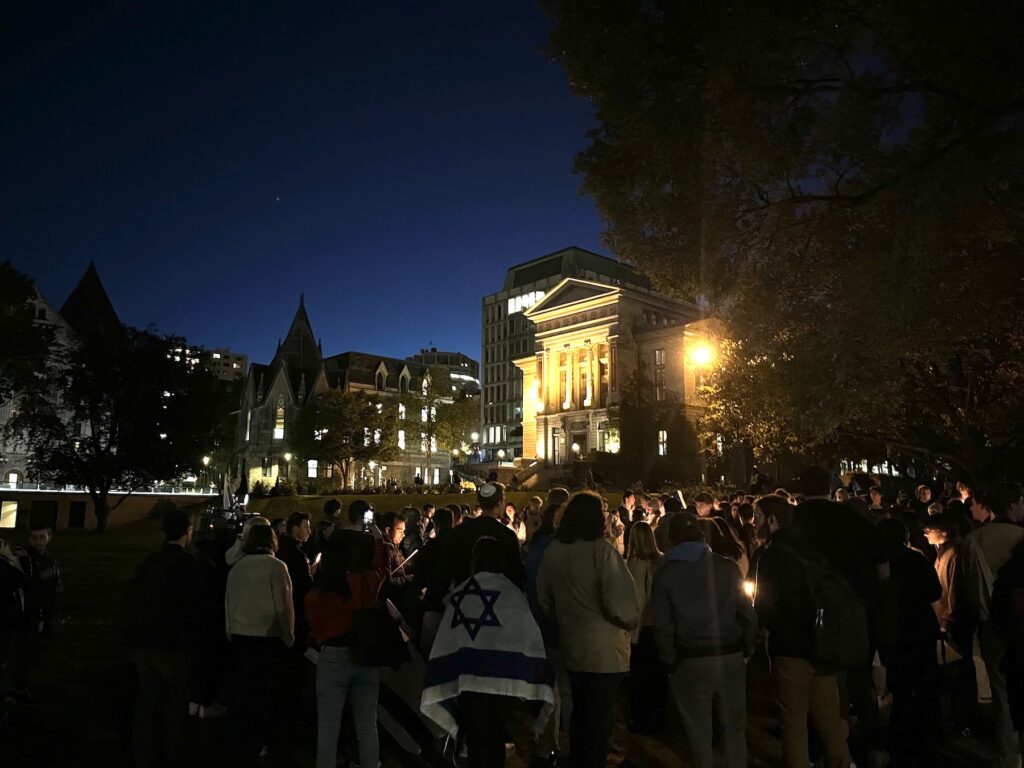
MCGILL Y-INTERSECTION, OCT. 12 —A crowd slowly amassed around Hillel Montreal organizers at the corner of Lower Field on Thursday evening, many bearing the Israeli flag. By 7 p.m., the crowd had grown to over 100 people.
The Tribune spoke to Avishai Infeld, BA’ 23 and Advocacy Coordinator at Hillel Montreal, before the event.
“The way the Jewish community works […], because it’s so tight-knit, and it’s pretty small, […] everyone has family, they have friends in Israel,” Infeld said. “Many people know people who have unfortunately been lost, who are missing, who are taken captive. The most important thing right now, what people are really feeling, is just the need for community and to be together.”
(The Tribune)
As organizers distributed and lit candles, the event began with the recognition of some of the people present, including Deputy Provost Labeau. The rabbi then recited a series of prayers, some in Hebrew and some in English, for the still-growing crowd to repeat.
Throughout the vigil, speakers denounced Hamas’ Oct. 7 attack and grieved those who had died or are missing. Many called for peace and heightened compassion in times of crisis. One speaker led a prayer for members of the Israel Defense Forces. Another speaker read a letter to his family in Israel. As the event wrapped up, the tearful crowd sang “Oseh Shalom”—a call for peace.
(The Tribune)
Kadi Diallo, a first-year law student at McGill, was one of the many attendees who had lost a friend or family member in the conflict.
“I came because a close friend of mine was killed at the rave,” Diallo said after the vigil. “He was doing security when Hamas attacked, and I just wanted to show solidarity with the Jewish people, but specifically try to mourn what happened.”
David Ivanchikov, a Concordia student, echoed the sentiment about the importance of community and spoke about the “polarization and fear” that abounds.
“It’s really easy to get sucked into these cycles,” Ivanchikov said. “But, at the end of the day, we’re only feeding into the negative cycles if we allow ourselves to get sucked into that.”
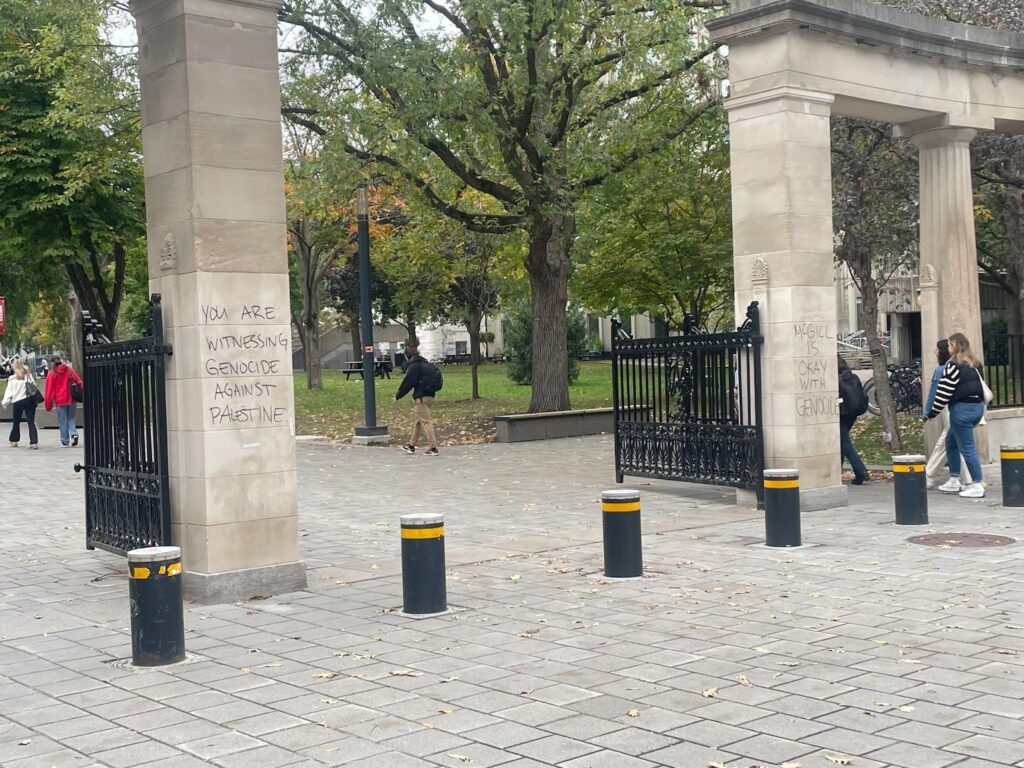
MCGILL RODDICK GATES, OCT. 13 — On Friday morning, the phrases “YOU ARE WITNESSING GENOCIDE AGAINST PALESTINE” and “MCGILL IS OKAY WITH GENOCIDE” were written on the pillars of the Roddick Gates. The writing was removed by the afternoon.
(The Tribune)
NORMAN BETHUNE SQUARE, Oct. 13 — The Palestinian Youth Movement (PYM) called a press conference under the marble statue of the square’s namesake at 4 p.m. on Friday, where an audience of ten or so journalists huddled in a tight circle.
PYM representative Sarah Shamy, BA ‘21, demanded that the Canadian government condemn the hate crimes towards Arab and Muslim communities, citing a specific incident of a Montreal woman verbally assaulting a woman with a Palestinian flag on her car. Shamy added that more preventative measures need to be put in place and an official condemnation of hate crimes toward the Arab and Muslim communities is necessary.
“As we speak, Israel has cut off food, water aid, electricity and fuel from the Gaza Strip [….] Canada is green-lighting this genocidal campaign by providing Israel with diplomatic cover and material support,” Shamy said. “Canada has made it clear to its citizens that they do not care about the Arab and Muslim communities despite having a sizable population of both.”
Shamy also spoke in support of SPHR McGill and criticized the McGill administration’s response to the organization after the conference in an interview with The Tribune.
“The work that the [SPHR] students are doing there is really important,” Shamy said. “McGill has done things like threatening to defund the Student Union [SSMU] before [like] in 2021 when the [Palestine] Solidarity Policy passed with 71 per cent[of the vote].”
(The Tribune)
Criminal litigation attorney John Philpot also spoke at the press conference, echoing Shamy’s criticisms of the Canadian government for not providing greater support to Palestinians in Gaza.
“When people are fighting for their freedom, after years of being slaughtered, massacred, losing their children––it is not tidy,” Philpot said. “It’s not a calm process. It’s a revolution.”
A number of interruptions occurred throughout the conference, with media and non-media attendees speaking out of turn and expressing their opposition to Shamy and Philpot’s words.
As the conference concluded, media members dispersed and supporters gathered in the square to prepare for the subsequent protest, organized by the PYM, SPHR McGill, and SPHR Concordia, at the Guy-Concordia Metro.
GUY-CONCORDIA METRO, OCT. 13 — The bellowing “So-so-so, solidarité, avec-avec, avec la Palestine” chants from pro-Palestine protesters echoed across downtown Montreal.
Attendees assembled around a black-painted truck, strapped with some half-a-dozen concert-sized speakers and parked outside the Tim Hortons, at the All Out for Gaza protest.
Palestinian flags waved and a sea of signs with slogans like “Resistance until liberation!” and “End the siege on Gaza now!” moved up and down as a group of organizers, wearing keffiyehs, circled around the black truck, initiated the chants, and directed the crowd.
Dozens of people quickly turned to hundreds as the clock hit 5:30 p.m., with supporters overflowing off the sidewalks onto the Concordia-metro junction. By 6 p.m., the hundreds had turned to thousands.
“What do we want?” one of the speakers cried out. “Justice!” roared the crowd. Followed immediately by, “When do we want it?” “Now!”
“I’m here to show support for the people of Palestine,” a young woman who wished to stay unnamed told The Tribune. “In the upcoming days, we can expect a lot of tragedy,” she said.
(The Tribune)
As the truck maneuvered from outside the Tim Hortons to down in-between Rue Guy and Rue de Maisonneuve, the speakers reminded the crowd to remain peaceful and to stay behind the truck, which would slowly lead them. The crowd followed suit.
Yellow-vested organizers dotted the sidewalks and the perimeter, ushering the crowd together. Bike-mounted police followed from behind—keeping some 50 metres back for the majority of the march.
“What I think is that there is too much injustice. It’s unfair. It’s unfair,” a woman, who did not want to be named, told The Tribune.
The protest began to pick up pace as it moved along from downtown to Atwater—and toward the Consulate General of Israel in Westmount.
Thousands moved through the streets as passersby and residents in apartment blocks watched on.
Approaching the towering glass Israeli consulate on the corner of Av. Wood and De Maisonneuve, the crowd ushered around to the main steps of the building where they faced a line of riot police wearing helmets and armour guarding it.
(The Tribune)
And so the chanting continued until the protest wrapped up at 8:30 p.m. Flares and sparks turned heads as a drone with flashing Palestinian colours flew overhead. One of the men bearing the megaphone touched on the Palestinian lives lost and calmly and assertively implored everyone to stand together—now and in the weeks to come.
The Student Wellness Hub offers counselling services for students located in Montreal.
Keep.MeSafe is a service accessible 24/7 whenever you need to speak (or text) with a mental health professional for support. You can access Keep.MeSafe from anywhere in the world.
This piece was updated at 11 p.m. on Nov. 13 to fix a capitalization error and to revise the estimated Israeli death toll. On Nov. 10, Israel lowered its estimated death toll following the Oct. 7 attack from 1,400 people to 1,200.
The Martlets faced Laval’s Rouge et Or in their Homecoming and Alumni match on Oct. 13. Laval tested McGill goalie Sophie Guilmette multiple times in the first half after McGill conceded free kicks outside the box, however, midfielder Chloe Renaud gave the Martlets a 1-0 lead with her second goal of the season in the 43rd minute.
The second half opened with a solid shot on goal from midfielder Hana Yazdani in the 53rd minute. Laval reacted quickly, nearly scoring before making two substitutions in the 56th minute. The Rouge et Or was awarded a free kick in the 63rd minute that Guilmette saved, as she registered seven saves during the game. Laval equalized the score by finding the back of the net with an unlucky rebound after it hit the crossbar in the 76th minute.
Despite the Rouge et Or having a 12-5 advantage in attempted shots, the Martlets stayed consistent with their pressure and fought for possession in an aggressive manner throughout the game.
“We were really disciplined. We were really patient with it. [….] We held on […] and we got some momentum going. [….] We stood our ground […] and were able to keep our calm and just keep doing our thing,” winger Stefanie Kouzas explained to The Tribune.
The Martlets will face UQÀM on Oct. 15.
Moment of the game: McGill goalie Sophie Guilmette saved a last-minute shot in the 90th minute.
Quotable: “The girls were focused all week. They played well [and] defended well. It’s time to get ready for the playoffs and that’s the kind of game that you need in the playoffs and hopefully nationals.”
Stat corner: The Martlets are undefeated in their last seven games.
Redbirds’ Soccer: T 1-1
The Redbirds faced off against Laval’s Rouge et Or in their annual Homecoming and Alumni game on Oct. 13. In the first half, Laval conceded several fouls while the Redbirds attempted many shots on a goal. The referee stopped play in the first half after McGill defender Oliver Onye was knocked to the ground in the 35th minute and was able to walk it off. Defender Matisse Chretien scored for McGill in the 39th minute after a free kick led to a scramble around the net.
McGill started off strong in the second half with a shot on goal in the 48th minute. Laval quickly responded by scoring after a free kick in the 55th minute. Each team was frustrated and the energy on the field escalated as the game came closer to the end, with McGill and Laval picking up 16 and 13 fouls respectively. The crowd shouted when several fouls were called or when they felt that the referee should have blown his whistle.
In the 73rd minute, Onye exited the field after sustaining an injury. The last 10 minutes were filled with chances for Laval, yet, redbirds’ goalkeeper Chris Cinelli-Faia made an essential save in the 86th minute after a dangerous cross into the box from Laval. As tensions between the teams rose, McGill midfielders Emilio Rossi-Levin and Yosr Frej were given yellow cards for discipline in the 86th and 90th minutes. Cinelli-Faia made an additional save in the 90th minute while Laval hit the post minutes before the game ended in a tie.
Moment of the game: As the referee whistled to signal the end of the game, both teams collapsed on the field in frustration.
Quotable: “I would say the two center backs, Matisse Chretien, Stuart Klenner. They’ve been solid the whole season. But today, I think they did an amazing job of not letting the opponent have chances, especially the first half where they were solid.”
The Patriotes started the game off with a two-point lead before McGill quickly regained an advantage of 5-2. Middle blocker Meaghan Smith had an excellent block and the first set ended 25-16.
McGill dominated the second set and ended it with a 19 point advantage of 25-6 over the Patriotes.
During the third set, McGill scored two points and maintained a lead until UQTR tied the score 15-15. The teams remained within a point of each other until right-side hitter Clara Poire and middle blocker Erin Keating stunned the Patriotes with their stellar defence , allowing McGill a two point lead of 18-16 but UQTR came back to tie the game 21-21. Neither team was able to score the two point lead to end the set until power hitter Rio Pesochin and Smith blocked a return, making the score 28-27 and leading McGill to take the set 30-28 and the match 3-0.
Moment of the game: Rio Pesochin won five points straight off her serves in the third set.
Quotable: “Rachel Leduc went on a serving run in the second set that ultimately led to us dominating that set. I gotta give so many props to her, she’s been putting in so much work this summer. I could tell how dialed in she was here. And Meg came off the bench in the third set when we were tied 27-27 and she stuffed the ball and that’s the kind of presence you want from your bench. ”
– Libero Olivia Krishnan on which teammates stepped up and led the way.
Stat Corner: McGill had 32 kills this game, 13 each from Poire and middle blocker Charlene Robitaille and six from Leduc.
Lacrosse: W 16-4
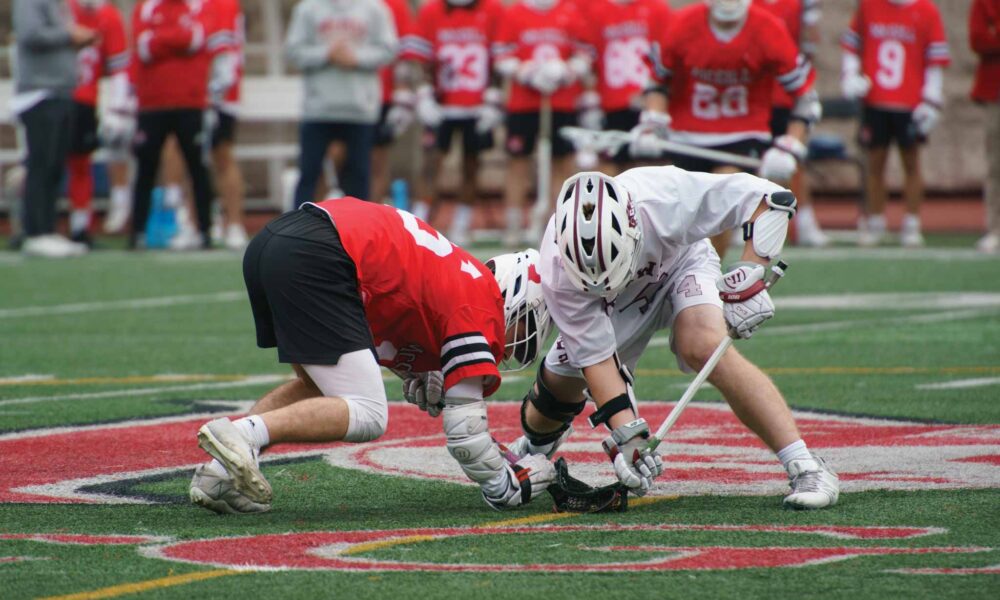
On Oct. 15, the Redbirds lacrosse team (4–2) hosted the University of Ottawa Geegees (0–7) for their annual Homecoming game. The game opened with attacker Isaiah Cree scoring the first goal just four minutes in. The Redbirds peppered the Gee-Gees with shots on net, with midfielder John Miraglia scoring from the top of the crease with four minutes remaining to give McGill a 2-0 lead. Goalkeeper Joseph Boehm made a great save, giving the Redbirds a fast break and allowing Cree to score a final goal to end the quarter 3-0.
In the second quarter, both teams ramped up the aggression and number of fouls as Ottawa scored just 11 seconds in. Midfielder Dylan James scored a shot from the top of the crease in the 11th minute of play. Miraglia netted two more goals within a minute of each other and the half ended with McGill up 7-1.
Play in the third quarter slowed down and midfielder Joshua Jewell scored a goal at the top of the eighth minute before the Gee-Gees buried their second goal. Face-off specialist Samuel MacDonald won the face off and took off down the field to sink yet another goal and with under a minute left James and Miraglia each scored a goal to make it 10-2.
With an eight goal lead, Miraglia scored his fourth goal in the ninth minute of play before attacker Massimo Thauvette buried two shots in the net within three minutes. Attacker Mark Symon made the 15th shot of the game before Ottawa scored their last goal of the game. Face-off specialist Chris Koran scored the final goal after winning the face off, securing a dominant 16-4 win for the Redbirds.
The Marlets will face the Bishop Gaiters (1–4) on Oct. 18.
Moment of the game: After a save, Boehm brought the ball outside the crease, leaving the goal undefended. As an Ottawa player gained control of the ball, Thauvette stepped up and blocked the attempted shot before sending the ball down the field for Miraglia to score the second goal of the game.
Quotable: “A guy that I was really proud of in this game is number 99, Kyle Glick. He’s our fourth long pole so he doesn’t play too much in games. Today [when] his older brother went out with an injury, he went out there and played three and a half quarters. […] He’s just pushing himself up on our roster in terms of guys who should be playing more minutes. It was really fun to see a guy who maybe doesn’t play as much just jump out there and play very well.”
– Head Coach Nicolas Soubry on players that impressed him.
Stat corner: The 16-game win streak over Ottawa spans from 9/6/2014 – 10/15/2023 and is the Redbirds’ longest.