Latest News

McGill, News

Students condemn inaccessible food prices during Let’s Eat McGill assembly

Content warning: Mention of disordered eating

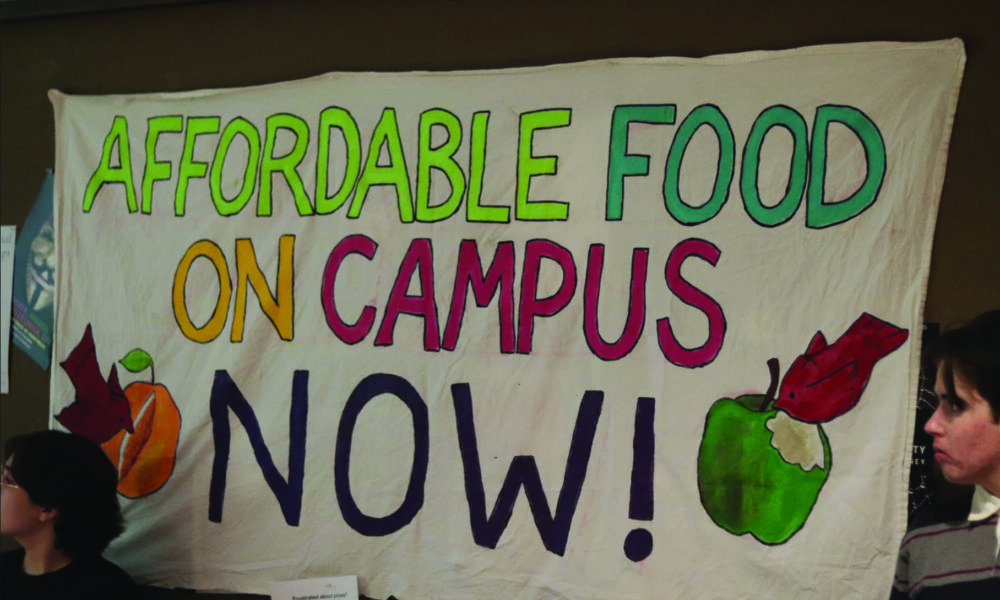
Students filed into Arts W-215 on the evening of March 7 for an assembly on the food insecurity crisis at McGill hosted by the new campaign Let’s Eat McGill. All seats were full by the time the presentation began, which was rife with photos of expensive cafeteria items, such as a $17 caesar salad and a $15 box of raspberries. Throughout the night, snaps turned to banging on desks as students got fired up about exorbitant food prices on campus. 

Moderators discussed the $6,200 per-year fee that McGill requires students living in residences to pay, much of which goes toward food: $4,725 of the fee is dedicated to the mandatory meal plan, $975 is for a meal plan administrative fee, and $500 is put into students’ oneCard accounts for expenses such as laundry and eating at affiliated off-campus dining spots. Many at the assembly said that the plan only covered one or two meals a day, forcing them to find food elsewhere. 

“I was in residence last year [….] I would go grocery shopping to supplement [the meal plan] which is ridiculous, because, […] it’s like $192 a week [….] Where is the money going?” Sadie Cambray, U2 Arts, told the The McGill Tribune.

Roommates Alyssa Abou-Chakra, U1 Science, and Miranda Roberts Nouel, U1 Arts, were similarly shocked that 10 items from Provigo only came out to around $70 because of the prices they were used to paying at McGill’s dining halls and cafés.

Students also shared frustrations about having to resort to unhealthy eating practices to get by, such as under-eating or skipping meals entirely. Many cited a worsening relationship with food after coming to McGill.

“I came into McGill already with […]very much an eating disorder,” Morgane Garrick, U1 Arts, told the Tribune. “So I already had a really strained relationship with food. And yeah, it went downhill […] particularly my first year in New Res because of the food options, because of the prices.”

The university has held a contract with Dana Hospitality, which calls itself a “food service management firm,” since 2019. The firm supplies food to the five residential dining halls and has gradually taken over many cafés on campus, meaning it has a virtual monopoly at McGill. Students also pointed out that at Macdonald campus, the situation is especially dire because of a lack of both on- and off-campus dining options.

Organizers explained that schools like the University of British Columbia and Concordia University have taken steps to subsidize cafeterias in response to high rates of food insecurity on campus and urged McGill to do the same. The administration, however, claimed it does not have room in the budget to subsidize the cost of food at a recent Board of Governors meeting.

Aside from subsidies, the organizers stressed the importance of student-run on-campus eateries, which used to be abundant at the university but have gradually been phased out. Before McGill’s move toward privatization, student associations operated popular dining spots such as the Architecture Café and The Nest, which both provided accessible, affordable food, as well as employment opportunities for students. Attendees discussed how a return to this model could re-envision dining at McGill as a community-building experience, rather than an isolating and stressful one. Many pointed to Midnight Kitchen’s free lunches as an example.

Alex Bluck Foster, U4  Arts and one of the organizers of the meeting, enthusiastically reflected on the assembly after the event.

“The atmosphere was more than I could have hoped for. Everyone’s been really vocal and had great points. And it’s really nice to hear everyone raise things that I hadn’t even thought about, like getting jobs from student cafés,” Bluck Foster said in an interview with the Tribune. “This definitely was intended to be a collaborative thing [rather than] us as this organization coming and telling you our ideas [….] We want to form a coalition with your help.”

McGill, News

Kanien’kehà:ka Kahnistensera speak at McGill while university attempts to lift New Vic injunction

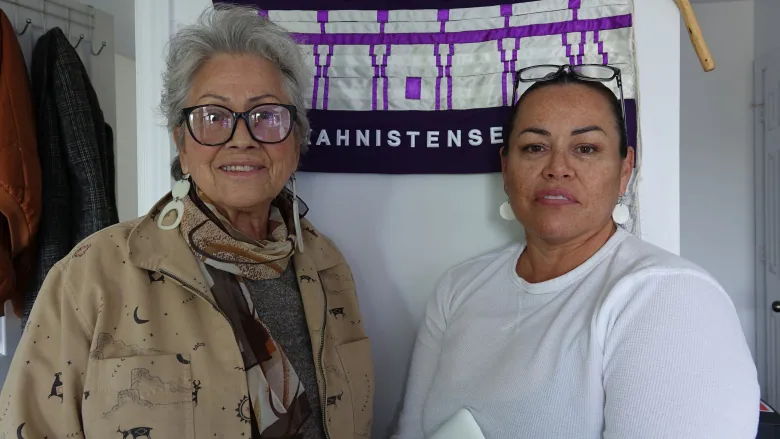
In honour of International Women’s Day, the Kanien’kehà:ka Kahnistensera (Mohawk Mothers) participated in a roundtable discussion hosted by the Students’ Society of McGill University (SSMU) on March 8. The talk, chaired by Nancy R. Tapias Torrado, a human rights lawyer and visiting fellow at McGill’s Centre for Human Rights and Legal Pluralism (CHRLP), touched on the challenges the Mothers have faced in their ongoing lawsuit against McGill. 

On Oct. 27, the Superior Court of Quebec granted the Mothers an interlocutory injunction that halted the university’s New Vic Project over the Mothers’ concerns about potential unmarked Indigenous graves at the site. The order remains in effect until April 27 with the possibility of extension or until both parties, the Mothers and McGill, reach an agreement. 

During their roundtable at McGill, the Mohawk Mothers emphasized the importance of their case in the ongoing fight for land rights. Mother Kwetiio believes that the Canadian settler-colonial state continuously violates Indigenous peoples’ rights, but camouflages these violations using structures such as the reserve system

“It’s still happening to us. Our human rights are still being violated. As my husband would put it, he says that living on our reserve feels like we’re living in a residential school. We’re constantly being monitored. Our rights are constantly taken away from us.” 

– mohawk mother kwetiio during ssmu roundtable

The Mothers stressed that the surface-level, performative activism that institutions and powerful individuals engage in cannot be equated to real advocacy for Indigenous groups. Mother Kahentinetha said that while the cultural genocide of Indigenous peoples has been recognized, no real reparations or next steps have been taken. 

“The Pope said, ‘yes, it is a genocide,’” Kahentinetha explained. “But now what happens? You don’t hear anybody talking about what they want to do. All they want to do is say, ‘well, I’m sorry about it.’ They want us to forgive them for what they did to us, but then they turn around and live a very good life right on top of our unmarked graves.” 

On Feb. 9, McGill filed a motion to lift the injunction on the grounds that while strides have been made during confidential discussions with the Mothers, the two parties still disagree on numerous points, including the Mothers’ methods for archaeological investigation on the site. The motion argues that “the New Vic Project is a legitimate and worthwhile endeavour that is essential to the future of McGill University and is in no way at odds with, or antithetical to, Reconciliation.” 

In an email to The McGill Tribune, McGill media relations officer Frédérique Mazerolle explained that McGill remains committed to positive discussions with the Mothers, but that the university will pursue litigation if there is no resolution before the injunction expires. 

“If such a resolution is not reached, the matter will proceed before the court given that the order issued by Justice Moore on Oct.27, 2022 is in place for six months,” Mazerolle wrote.

The Mothers remain adamant that all archeological work should centre on direction from qualified professionals and adhere to the guidelines set forth by the Canadian Archeological Association (CAA). 

During the roundtable, Kwetiio urged Canadians to show true support for Indigenous communities by researching the atrocities that have occurred in Canada and actively participating in the fight for justice for Indigenous peoples. She would also like universities to revamp their constitutions to properly acknowledge Indigenous history.

“If you learn something and you totally disregard it, then you’re not part of the solution. You’re part of the problem,” Kwetiio said. “It’s harsh to hear that, but if you don’t take the things that you’ve learned and do the right thing, […] you’re part of the problem.” 

McGill’s motion to lift the injunction will be heard on April 20 and 21. Prior to these court dates, there are judicial settlement conferences scheduled for March 22, April 4, and April 6, which will aim to reach an agreement outside of litigation, as recommended by Justice Gregory Moore.

News, SSMU

SSMU spends $1,500 on incoming executives’ PR training, hires publicist

In May 2022, the Students’ Society of McGill University (SSMU)’s Legislative Council passed the Motion Regarding the Adoption of a Media and Transparency Plan. The motion mandated that the Society hire a public relations (PR) advisor by May 2023 to increase transparency and provide media training for SSMU staff. 

According to vice-president (VP) Finance Marco Pizarro, SSMU officially hired a publicist in February 2023 and PR advising will be incorporated into the 2023-2024 SSMU executives’ onboarding.

SSMU President Risann Wright and VP Internal Cat Williams did not respond to The McGill Tribune’s requests for more details about the hiring. Pizarro, however, confirmed that the Society spent $1,500 on the training. 

SSMU hired a PR advisor, whose name and affiliated firm were not disclosed to the Tribune, who will work with future executives and some SSMU staff to establish proper communication networks with students and media. Pizarro did not share details of SSMU’s contract with the advisor or whether the training was outsourced before the advisor was hired. 

“Most training is done with the SSMU team and outgoing Executives; we have a full team of managers and employees who specialize in various departments and share their expertise with the incoming Executives starting May 1 of each year,” Pizarro wrote in an email to the Tribune. “The Executive team typically prepares a month full of training with Commissioners, Staff, outgoing Executives, and groups on campus, including McGill staff, to ensure a smooth transition.” 

The advising will be mandatory for all SSMU executives and a few unelected positions. Pizarro explained that the additional employees who will get the training were chosen based on the likelihood of their interactions with media outlets during their tenure. 

“The rule is that staff cannot speak to [the] media because they are not elected people, and so, it is only positions that can speak to the media [who will receive the PR training],” Pizarro wrote. “But there are some exceptions made, usually when staff is much more qualified.”

Rory*, an SSMU employee, has yet to receive the PR training but believes it is important because it provides some instruction on how to speak comfortably with the public for employees who lack experience doing so. 

“Some people might think about the training in a twisted way, […] but I don’t think about it in that way,” Rory told the Tribune. “I’ve seen the [executive] committee interact with the public, and they seem to be very comfortable and eloquent.” 

Aimy Croner, U4 Arts, thinks the PR training is beneficial to students working for SSMU and the student body at large. As a student who recently started working at McGill, she felt unprepared for certain tasks and believes that this type of  training would help her learn the skills not taught in the classroom setting. 

“I think that [PR training] is a really interesting initiative,” Croner said. “ It would take away that barrier. Like, I know that SSMU is for the students, but some people might [not] really know about it and might think that it’s still part of the institution of McGill. So you have a small barrier there in terms of ‘I don’t want to say something wrong.’” 

Kateri Duranceau, U1 Arts, echoed Croner’s sentiments about the training having the potential to increase transparency, but she worries that SSMU executives would prioritize PR-safe strategies over promptly resolving problems brought to their attention by students. 

“I think it’s important to learn how to communicate with customers [….] But also, I think it could give an excuse to people to just not really do  their job [well],” Duranceau told the Tribune. “So it’s important but in moderation.”

The Tribune did not receive further information regarding the PR training, including the budget set aside for the advisor’s salary.

*Rory’s name has been changed to preserve their anonymity.

Research Briefs, Science & Technology

McGill exoplanet specialist recognized for outstanding work in astrophysics

Last month, the Astronomical Society of India awarded McGill physics professor Eve Lee the 2022 Vainu Bappu Gold Medal for her work in astrophysics. The award honours young astronomers—typically under 35—for their exceptional achievements and potential.

Lee’s work focuses on exoplanets, which are planets that orbit around other stars in solar systems outside Milky Way. Studying the behaviours of exoplanets can provide information about the origin of our own solar system, including the conditions necessary for creating life—something Lee finds particularly fascinating.

“I am very much motivated by all the interesting and unexplained patterns and trends we see in the observed properties of exoplanets,” Lee said in an interview with The McGill Tribune.

Many of the patterns and trends Lee studies manifest in the way planets form, grow, and organize themselves. Relationships between the masses of planets and their host stars, or the chemical composition of exoplanet atmospheres and cores, are just some of the topics that Lee researches.

One of the challenges of astrophysics, however, is building experiments since the systems being studied are too huge and too far away to manipulate in a lab. 

The nearest star, excluding the sun, is Proxima Centauri b and it is over four light-years away, meaning that radio communication of a single message would take over four years. Comparatively, the farthest object ever sent into space, Voyager 1, has travelled less than one per cent of that distance. 

To circumvent this issue and not stall research, Lee and other astronomers depend on telescope observations to gather information. Techniques such as spectroscopy—matching colours of light signals observed by telescopes to the elements known to emit those signals—can be used to gain insights about the material composition of exoplanets that cannot be directly measured. 

Another common technique, called the radial-velocity method, uses the change in light signals from moving exoplanets to determine how quickly planets are moving. This change is quantified by the Doppler Effect, a measurable difference in the light emitted by an object moving away, as compared to an object moving closer. By comparing the light emitted by exoplanets at different parts of their orbit, astronomers can figure out details such as the planet’s orbital velocities and distance from host stars. 

Using data like these, Lee tries to piece together more complex inferences about how exoplanets are formed, what they’re made of, and how they behave.

Lee has conducted her research at institutions across Canada and the United States, including the University of California, Berkeley, the University of Toronto, and McGill, ever since she completed her undergraduate studies in 2011. 

According to Lee, she learned many of her most important research skills as an undergraduate.

“In research, it is important to come up with multiple ways to verify one’s result, and so coming up with various sanity checks is something I tried to build on since my undergraduate years and it is also what I emphasize to the students in my group,” Lee said. “In addition, I would say patience and tenacity in carrying out research is also an important quality that can be built from undergraduate years.”

As for navigating the world of academia and the challenges that she faces as a woman in the male-dominated field of astrophysics, Lee credited support from mentors over the years.

“I was very fortunate to have had numerous mentors throughout my academic career, with whom I still keep in touch. I think having this network of mentorship helped me navigate various challenges I came across,” Lee said.

Lee feels honoured to receive the Vainu Bappu award. 

“Receiving this award is a good opportunity to have students and junior scientists be excited about the research being done in my group and also more broadly to motivate them to pursue what they are interested in.”

Off the Board, Opinion

Accounting for oneself and others 

In my first year at McGill, my academic naiveté made me anxious and self-centred. I was convinced that good writing was a product of genius forged in solitude. When tasked with an essay, a tinge of shame came in reiterating the ideas of other scholars and writers. Citation in those first few months often came at the end of my essay writing process, always an afterthought—the bibliography felt like a confession of my intellectual ineptitude. 

I soon learned that I had missed the whole point. Now, in my last year of university, a long and sprawling “Works Cited” page brings me satisfaction. Citation lays out the constellations of labour and love behind an individual and their work. Any student who has toiled through a research paper knows that before you can say anything of value, there comes the more arduous and vital task of understanding what others have said before you. The personal voice can only go so far. When it gestures and tunes in, rather, to a varied chorus of those who have preceded it, we can find mutual respect and insight in speaking the same vocabulary and echoing one’s own academic and creative investments. 

On the topic of citational practices, I can look to Sara Ahmed, who first wrote on the inequity of citation in academia, or read Moya and Trudy Bailey who first coined the term misogynoir. To learn how to inhabit a shared language, I can reference Fred Moten and Wu Tsang’s collaborative works that quote messages, emails, and edits exchanged between the pair during their creative processes. 

These writers advocate for citational practices that recognize citation as a technology of violence in academia. It is not incidental, for example, that a 2018 survey of syllabuses conducted by The McGill Daily on the Department of Political Science at McGill found that 86 per cent of the 300 authors polled were white and 75 per cent were men. In a 2018 episode of CBC’s Unreserved podcast, Indigenous scholars Kyle Powys Whyte and Sarah Hunt shared that Indigenous scholars are pressured to cite white male scholars and Western academic knowledge in order to legitimize their work. In research-centred universities like McGill, where citation is a measure for tenure, citational practices that obscure the labour of marginalized scholars translate into the material gaps within classrooms and faculty. Ahmed makes this key point: Citation is an act of selection, not a natural mirror of a discipline’s history or its core figures. 

Though most commonly encountered through the bibliography and the university as an institution, citational practice manifests in our habits of engagement with others beyond the ivory walls. If we keep our sources of knowledge institutionally bound, we neglect the vast majority of racialized and lower-income people who don’t have the privilege of being legitimized. I like it when I’m able to quote and give authority to a friend when sharing an anecdote or a piece of advice. I also enjoy learning about my friends’ own sources of wisdom, as this makes me more equipped to converse with them and critique them if I disagree. When shared, knowledge of any kind and the interpersonal networks that uphold it expand in reach only through decisive acts of conversation and commitment with and to one another.

Centring citation as a practice both within and outside of academia has made me more aware of my own agency in the sources of knowledge I choose to engage with and pass on. I’ve become more hesitant to opine hastily, though I no longer see this as a failing. Now in my last year at McGill, when writing an essay or talking with a friend, rather than seeking to immediately share a testament to my own unique knowledge, I think it’s enough to faithfully quote an idea that I see value in, or merely put it in conversation with another. 

McGill, News

McGill bans TikTok on all university-owned devices citing cybersecurity concerns

In accordance with a provincial directive issued on Feb. 27, McGill has banned the use of TikTok on all university-owned devices, including smartphones and tablets for which McGill covers the cost of the mobile service. This decision stems from a federal ban that also prohibits the use of the app on all government-owned devices. All McGill staff who previously downloaded the app on a McGill device must delete it immediately. 

In an email to The McGill Tribune, McGill media relations officer Frédérique Mazerolle wrote that the provincial directive was updated on March 2 to outright forbid public organizations from posting on the platform.

“Public institutions subject to the Act respecting the Governance and Management of the Information Resources of Public Bodies and Government Enterprises [cannot post] any new content to TikTok for any purposes, including advertising campaigns, announcements and recruitment,” Mazerolle wrote.

Marc Denoncourt, Associate Vice-Principal IT and Chief Information Officer at McGill, explained in an interview with the Tribune that TikTok may be used by staff and students conducting research so long as it is the only app running on the device.

“If you still need to do research with a McGill-owned device, we need to isolate TikTok,” Denoncourt explained. “It cannot be [downloaded] on a device with other applications.”

Denoncourt added that although the ban only applies to McGill-owned devices, users ought to be wary of running the app on their personal devices.

“[The ban] is for McGill-owned devices only. So if you do research with your personal device, it does not apply,” Denoncourt said. “Regardless of who owns the device, it is the same risk, but the directive is not asking anybody to stop [using TikTok] on personal devices.”

Politicians are primarily concerned with the app’s alleged collection of user data and the potential for the Chinese Communist Party (CCP) to access said data—the app was first developed by ByteDance, a technology company based in Beijing, China.  

Benjamin Fung, a professor at McGill’s School of Information Studies (SIS) and Canada Research Chair in Data Mining for Cybersecurity, sees McGill’s ban as a response to government action. 

“For the government, I think [the ban] is more like a political message to the general public, saying that this is dangerous,” Fung said in an interview with the Tribune. “Most of the people who use TikTok are the younger generation, students who do not own a McGill-owned device, [and] not every staff [member] has a McGill smartphone, so I think the impact [of the ban] is nothing, it is just following the rules from the government.”

Experts point out that TikTok is not unique—almost all social media companies are culpable of selling or otherwise sharing user data. In fact, Facebook records more personal data than TikTok, and in 2018, was revealed to have exposed millions of user profiles to Cambridge Analytica, a digital consulting firm. Security concerns about TikTok  similarly lie in data transmissions.  

“When you copy a piece of text from one app to another app, every couple of seconds [TikTok] will try to read the clipboard,” Fung said. “By doing that, [it] can read everything you copy and paste. So if you are just copying a link, that is fine, but if you are copying a password, let’s say from the password manager to an app, that is a security concern.”

Fung recommends that McGill students who continue to use the application on their personal devices consider taking extra precautionary measures should they wish to protect against potential threats to their online privacy.

“If you really, really want to watch TikTok videos, you can watch [them on] YouTube, you can still indirectly watch them. Many people just copy and paste [them] to YouTube. I [would] suggest [removing] the app, even for [your] own personal device, but at the end of the day, is [your] own personal choice.”

McGill Recommendations, Student Life

You’ll never walk alone (again?)

Even if the weather is getting slightly more bearable as the days go on, walking to campus every day can take a toll. Thanks to an unfortunate sprained ankle, I’ll be avoiding the trek, but that doesn’t mean I don’t know the frustrating feeling of being so bored of your music that you end up walking to campus alone with your thoughts rather than listening to “Boy’s A Liar pt.2” for the 23rd time that day. Enter podcasts: The undeniable sign that you are becoming an adult. So, keep reading for some recommendations that will last you from Mile Endto McLennan. 

For podcast novices

If you’re a total podcast newbie, welcome—and don’t worry, you are in good hands. A great place to start, and where I personally started with podcasts, is WNYCs Radiolab. Radiolab started as a radio broadcast and is now available in podcast format, exploring various topics related to science, philosophy, and politics. They have some riveting longer series, such as The Other Latif which chronicles Radiolab host Latif Nasser’s attempt to retrace the story of one of the world’s only other individuals named Latif Nasser, who is detainee number 244 at Guantanamo Bay. If you’re not ready to commit to a longer series, they offer really interesting and incredibly random, one-off episodes, such as “The Helen Keller Exorcism,” which is not about an actual exorcism—but will totally change the way you look at Helen Keller.  

For pop-culture fanatics

If you’re interested in popular culture, you should check out Sounds like a Cult. Each week, Isa Medina and Amanda Montell sit down and explore different cultural trends through the lens of a cult to shine a light on the modern-day cults we all follow. A few particularly good episodes were the cult of Trader Joe’s—guaranteed to blow your mind if you’re a frequent shopper back in the States. The cult of Elon Musk was also very insightful. Overall, the hosts’ humour and intelligence mesh wonderfully, making it feel like you’re walking to campus while listening to your friends.

For PoliSci bros

If you’re a PoliSci bro in one of my conferences and have been having a hard time reaching your mansplaining quota of the week, do not worry, the Council on Foreign Relations has got your back with weekly episodes.The World Next Week is a podcast where hosts Robert McMahon and Carla Anne Robbins discuss significant international affairs events and offer important insight into how the international political community functions. The “Why It Matters Podcast” hosted by Gabrielle Sierra also offers important insight and interviews expert guests on topics such as water scarcity or the future of Africa’s population boom

For the aspirationalists

If you’re a student who is on the verge of being the next Bill Gates, Steve Jobs, or Mark Zuckerberg, maybe ABC News’ The Dropout, hosted by Rebecca Jarvis, will make you change your mind. This incredibly well-researched and produced podcast perfectly details the story behind Theranos and Elizabeth Holmes, the alleged youngest female billionaire. And if you want to learn more after finishing the podcast, Disney+ released a miniseries by the same name, which does a great job of bringing the story to life. 

For future fraudsters

If you finished The Dropout and your interest in scammers and fraudsters peaked, allow me to introduce you to Scamfluencers. Hosts Sarah Hagi and Scaachi Koul unpack different stories of the very best influencer-scammers. The Hollywood Ponzi scheme series follows Zach Horowitz as he creates nearly a $650-million-dollar Ponzi scheme involving fictitious licensing deals with HBO and Netflix in order to support his own acting career, and reveals how he eventually gets caught. Bonus points for the Canadian hosts making references to Canadian culture that make me feel like a true Canadian, despite having only lived here for less than three years.

McGill, News

Interfaith panel unpacks impacts of Bill 21 and discrimination in Quebec

On March 10, students and legal professionals convened in New Chancellor Day Hall for a conference titled “Law & Faith: Bill 21 and Religious Discrimination.” The event, put on by the McGill Christian Law Students’ Association (CLSA), the McGill Jewish Law Students’ Association (JLSA), and the McGill Muslim Law Students’ Association (MLSA), was an opportunity for those in the legal field to discuss the implications of Bill 21 for people of faith. 

Bill 21, one of the most controversial Bills currently active in Quebec, prohibits public servants in Quebec from wearing religious symbols. Doctors, police officers, judges, teachers, and prison guards are not allowed to wear visible markers of their religion while performing their duties. Pre-existing religious public structures, however, are not subject to the Bill. 

Frank Schlesinger, who is Jewish, is a lawyer for Spiegel Sohmer and a former judge. He explained that structures such as the cross on Mount Royal, crucifixes around Montreal, and streets beginning with “Saint” are still allowed under the legislation. 

“In a way, it tends to indicate that people other than Christians are not entitled to have visible symbols, [and the government] will keep the old ones,” Schlesinger said in an interview with The McGill Tribune.

Derek Ross, Nour Farhat, and Schlesinger sat on the first panel, which delved into Bill 21. Ross, the executive director of the Christian Legal Fellowship, was the first to speak on the hypocrisy of the Bill.

“[Bill 21] effectively excludes religious people from public service,” Ross said. “Simply saying that a law advances neutrality doesn’t actually mean that it [does].”

Farhat, a Muslim lawyer who wears a hijab, explained that Bill 21 impacts Muslim women first and foremost—women who are already at a heightened risk of being discriminated against and are more likely to be victims of assault. The dangerous implications of the Bill have manifested as an increase in hate-fuelled incidents across the province since its adoption in 2019. 

“Legislations have an impact on how the population reacts to minority groups and marginalized groups.” Farhat said.

A survey by the Association for Canadian Studies found that 78 per cent of Muslim women in Quebec feel less accepted as members of society since Bill 21 was implemented. The same survey found that 53 per cent of Muslim women had heard prejudiced comments about Muslims from the people around them, and 47 per cent of Muslim women reported being discriminated against by an authority figure. 

“It is clear that this law is aimed at a specific group—mainly Muslim women,” Schlesinger added. “If you do not meet the norm of homogenization, you cannot participate fully in Quebec society.”

The second panel centred around being religious in Quebec. Speakers Victor Muniz-Fratcelli, Ted Goloff, and Mariam Hammodi shared their experiences of being people of faith in the legal profession and how their religious identity has impacted them and their careers. 

As the only veiled woman in her program at Université de Montréal, Hammodi explained that wearing the hijab has always come with unsolicited attention and questions.

“We sometimes feel this responsibility to answer questions in regards to religion,” Hammodi said. “I’m pretty sure [certain questions] would not have been asked to a Muslim colleague of mine that wasn’t wearing a veil [….] People [should] not be forced to make a choice between their [religion and profession].”

Andrea Sim of the CLSA, Fatima Beydoun of the MSLA, and Jonathan Zrihen of the JLSA helped organize the panel, and met with the Tribune before the event. 

“This is our fourth interfaith collaborative event together,” Sim explained. “The time was right in terms of shining a light on [Bill 21] [to] come together and focus on highlighting not only the faith-based discrimination, [but also] the legal arguments to not only students but also admin […], such as [Brittany] Williams, [Assistant Dean (Students) and Dean’s Lead, Black and Indigenous Flourishing].” 

Behind the Bench, Sports

A sports defibrillator: Is Full Swing golf’s savior?

Drive to Survive, Netflix’s heavily dramatized Formula 1 series, brought millions of viewers to the sport and reversed its slow, decade-long decline in popularity. With the release of its sister show, Full Swing, on Feb. 15, fans are wondering if the media conglomerate can work its viewership magic once again—this time, with the world of golf. While on the surface, Full Swing is set to have the same success in transforming the sport’s viewership, the show’s first season falls short of the green. 

Based on Drive To Survive‘s model, Full Swing, a Vox Media Studios and Box to Box films production, takes a sport struggling in the public eye and puts the most famous golfers from the Professional Golfers’ Association of American (PGA) tour and LIV Golf on the global stage. The show opens with 15-time PGA tour winner Justin Thomas and closes with PGA golden boy Rory McIlroy. But the show’s absence of women and glossing over of LIV Golf hinders the possibility of increased viewership by failing to delve into the most interesting aspects of golf’s current affairs. 

Not unlike Formula 1, golf is commonly seen as a sport for old, wealthy, white men because of its history of exclusion—the PGA in particular. The growing popularity of the Ladies Professional Golf Association (LPGA) was a golden opportunity for Netflix to draw new viewers in, but the company utterly failed to do so. Just as they did with Drive to Survive, where women speaking accounted for an abysmal 1.54 per cent of season five’s entire runtime, Netflix failed to spotlight women in Full Swing

Despite the rapidly increasing viewership of the LPGA, up 32 per cent from 2021 and 69 per cent from 2020, the show features zero women athletes. The vast talent of the LPGA deserves to be placed at the forefront. In 2022, Minjee Lee beat every PGA pro at every distance in accuracy from the fairway. Lydia Ko has 101 top 10 finishes at only 25 and had 10 LPGA tour wins at the age of 18––five years earlier than Tiger Woods earned his first 10 PGA wins. Nelly Korda, largely regarded as the face of American women’s golf, won five events, became a major champion, and took home an Olympic gold all in the same year. 

Even the PGA is coming to recognize how important the LPGA is to the game with the announcement of the Grant Thornton Invitational in Naples. The talent is there, the excitement is there, the desire to watch is there––but Full Swing had other priorities. 

In an attempt to replicate the reality TV drama witnessed in Drive to Survive, the show created a villain: LIV Golf. The Saudi Arabian-funded golf tour promises an all-men’s championship, a guaranteed paycheck, and an extra $4 million to the winner—unlike the PGA tour where players are paid according to placement. 

Athletes who sign with LIV Golf are accused by their opponents in the show of only caring about money and overlooking Saudi Arabia’s human rights abuses. The Netflix show adopts this criticism, playing Big Bag of Money by G-Eyez in the background when introducing Ian Poulter and Dustin Johnson, two LIV Golf athletes. But while failing to provide any substantive criticism of LIV, Full Swing simultaneously functions as a PGA apologist, ignoring the Tour’s pitfalls and functioning as an eight-episode PGA advertisement. 

Since Full Swing came out just under a month ago, it is unclear what the long-term impact will be on golf viewership. The low ratings for LIV Golf’s debut event prompt some to believe the threat to the PGA is fading and along with it, the potential for dramatization. But one thing is certain: Netflix must do better with season two. Women and the LPGA are vital to increasing viewership, especially in light of the introduction of LIV––a league that wants nothing to do with women athletes. With plenty of time and resources, Full Swing must course-correct if it wants to hold onto viewers and grow the game of golf. 

Features

Remains of Chennai Central

Growing up, I dreaded going to India every summer. The prospect of leaving France to spend two months in the heavy heat, shuttling from one family member to another, and having to speak Tamil brought me nothing but anguish and desperation for cancelled flights. My resentment of my Indian identity extended to every aspect of my life. I would doggedly refuse to address my mom in Tamil, cry for hours to avoid wearing a churidar, and sulk on our way to the temple. Apart from my mom’s cooking, I rejected every link to my Indianness—I just wanted to be a French kid.

Despite my obstinance, one memory from my annual stays remained with me: The Chennai train station. Ironically, I first encountered it in France, on the screen. Among the few Indian movies my parents and I ever watched was Madrasapattinam, a historical romantic drama set in Chennai—then called Madras—at the time of Independence.

I was about six years old when I first saw Chennai with my own eyes. Years later, my memories of that first visit are still visceral, as if it was just yesterday when our cab drove out of the Chennai Central Station and into the chaos of the city. Although modern-day Chennai is far different from the 1940s colonial setting of the movie, the station and its clock tower, where the two lovers fought for their impossible love, stood still in time. Everything was just like I imagined it to be. For the first time in my life, I  recognized a piece of myself in India.

The memory of Madrasapattinam gradually faded as I grew up. What was once my favourite movie and the core of my nascent Indian identity became more and more difficult to grasp. Summers in India went by, each one more alienating than the last as a growing language barrier—an invisible wall—stood between my family and me. Every word I pronounced was tainted with a sharp French accent I couldn’t even notice until I was asked to repeat myself. Slowly, this fear of making a fool of myself, of being unable to prove myself worthy and legitimate of my Tamil heritage, led me to lose it. While my younger self—the one who would dream of roaming the streets of 1947 Chennai—spoke a charmingly flawed but intelligible Tamil, what was once my mother tongue faded to be nothing more than just my mother’s tongue. 

Yet, I remind myself that language preservation is a product of transmission, not a signifier of cultural identity. Growing up with a multicultural upbringing, my Tamil dad and my elder sister both spoke to me exclusively in French, while my mom used a mix of both languages, a sweet in-between that now sounds just like home to me. My own experience is far from unique, and is merely just the reflection of a larger trend among second-generation immigrants across the world. In 2006, a study by Statistics Canada found that only 55 per cent of Canadian children born to immigrants could communicate in their parents’ native language. 

This loss of heritage often goes hand-in-hand with a sense of guilt and resentment. As I look at my mom for help with panicked eyes while her father—my only remaining grandparent—tells me a story that I can only understand in glimpses, I think about all the other ones that will forever remain inaccessible. I can hear the clock ticking, like an invisible hand pushing me to get to work and learn everything before it’s too late—before history gets lost forever. But I’m only human. Instead, I stare at the poems my grandfather writes to me for my birthdays, unable to understand the meaning behind the beauty of the Tamil characters (Tata) carefully traced with colourful ink. All I can do is sit in silence and hold his hand wrinkled by the years, hoping it’s true what they say, that a heart without words is better than words without a heart.

Beyond the Lunchbox essay 

For all these quiet aching moments of powerlessness, I blame French Universalism. The Republican ideals of “Liberté, Égalité, Fraternité” —Liberty, Equality, Fraternity— obscure a darker reality for immigrant communities. Under the guise of Equality, France refuses to see our colours, washing over our individual distinctions. France neglects our identity with such tenacity that it is even illegal to collect statistics indicating directly or indirectly the racial or ethnic origins of persons. By forcing its universalist ideals on communities, France drives cultural loss for second-generation immigrants. Non-white French citizens like me tend to push their ethnic background aside and stress their Frenchness to assert their right to exist in every space and belong in society. In the eyes of many, often white, French citizens, opposing the sacred ideal of universalism—born through the fire of the French Revolution—is synonymous with supporting division within society. 

Having grown up with these ideals, I’ve always considered myself French before anything else. Still to this day, introducing myself by saying, “I am French”, is a daily task, often followed by a subtle, surprised eyebrow raise. But the statement is true: I speak the same language as those whose families have lived in France for countless generations and share almost all the same cultural references. Despite having been a victim of racist micro-agressions throughout my entire life, I was socialized within a privileged white Catholic community. Though I was the only person of colour in my entire high school, I identified with my peers. This brought me to an important realization: In my case, class dynamics overruled race. 

Being born in an upper-middle-class family, money washed over our main cultural differences and fostered my ability to integrate into white society. Being a minority will never be easy, but I remind myself daily that I won the lottery—and my experiences are merely anecdotes compared to the financial struggles endured by many other second-generation immigrants. Like many children of immigrants, I have had my “lunchbox moment”. I made sure to never use my hands when eating with my non-Indian peers—I know the shame and humiliation of being regarded as non-civilized, as “less than.” I have also faced discrimination and have lost opportunities because of my skin colour or my 16-letter last name that I do my best to hide. But I refuse to confine my identity to these incidents. As mortifying as these experiences are, they still arise from a place of relative privilege. We must remind ourselves that the immigrant struggle goes far past the lunchbox. 

Jaime*, a member of South Asian Youth Collective (SAY), grew up with an Indian ethnic background in a country in the Middle East. She has a first-hand experience of class privilege through her family’s integration into Middle Eastern society.

“South Asians are generally considered lower because a lot of labourers would be from South Asian and South-East Asian countries,” Jaime told me. “Financial situation in this case did matter. My family was pretty financially stable and so our experience would differ compared to someone who was less financially stable.”

By limiting representation of immigrant experiences to the lunchbox trope, we risk obscuring differing experiences of oppression in the diaspora conditioned by identities such as class and gender. Jaime explained how the intersection of class and race dynamics in her home country produce racialized divisions of labour.

“A lot of labourers and maids are from South Asian, African or South-East Asian countries, and a lot of these labourers are poor or not as financially secure,” Jaime said.  “It’s extremely problematic and racism is a huge element of it [….] For example, Indians […] are seen as inferior […] as they occupy a significant amount of service industry jobs. You will rarely see someone from more Western countries in these jobs.” 

Rushmi Perinpanathan, U2 Science, grew up in Montreal but still sees the city “through the eyes of a Tamil kid.” She echoes Jaime, having witnessed how assimilating into the dominant culture comes with its own financial and mental costs.   

“When it comes to integrating into a new culture, to be able to go out and experience culture, to partake in activities with colleagues, to be able to look the part, all of this gets harder when you’re not part of the same class because you also need to afford these things, not just in money but in time and energy as well,” Perinpanathan said. 

“When you’re part of the same culture, you’re already in the same boat and it becomes easier to relate to each other.” 

The blessing and curse of multiculturalism

Rushmi’s experience hits close to home: Though I felt integrated into the community I grew up in, I was never fully accepted by my peers, and was always considered “the Indian friend.”

Yet, my parents did not really immerse me in Indian culture and Indian media, nor did they really listen to French music, or watch classic French movies. Rather, some of my earliest memories include road trips in my dad’s car where he blasted The Rolling Stones, Scorpions, and Dire Straits on the speakers, my sister and I mouthing all the words in the backseat. And, although I wouldn’t change this for the world, all these happy childhood memories hide a more alarming reality of biculturalism. 

Many people idealize the melding of two cultures, but such romanticization obscures feelings of alienation. I grew up in an in-between of two cultures, less than half-in-touch with my Indianness, and almost integrated into my French community. Every time I lack the words to sing along to the songs my French friends play, I find myself back in this “cultural void” scaffolded by the bits and pieces I picked up from both worlds. If you asked me today if I’d rather be French or Indian, I would tell you a thousand times that I’d rather be both. But being in touch with both sides of one’s cultural identities as a child of immigrants is not innate. It requires time, introspection, and a little bit of a spark. For me, I found these in  Montreal.

A couple months ago, my best friend and I were cooking baingan bharta while listening to Indian music (at his request).  Everything, all of a sudden, felt as though I were six years old again. My music on shuffle, I did not expect to hear Madrasapattinam’s theme song come out of my speaker, and even less to instantly recognize it, as if it was just waiting for me to remember it this whole time—bringing me back to Chennai Central. Paradoxically, moving away from my Indian household and finding a home in Montreal helped me reconnect with my Indian identity. Switching from French universalism to the Canadian “mosaic” of “diversity”—moving from an exclusively white and French environment to a campus burgeoning with international students—was a milestone in my journey back to my roots. 

Throughout my whole life, until coming here, I had considered myself “black”—noire—and had been racialized as such, as odd as this may seem in North America. Just like in a 1930s monochrome movie, France frames everything in black or white. Moving to Canada, I found a space to exist outside of this binary. For the first time in my life, being “brown” in Canada included me in an in-group, a community of South Asians. I am no longer just the negation of whiteness. 

Montreal triggered a similar experience of self-discovery for Dhanishta Ambwani, U2 Science. Ambwani grew up in New Brunswick with Indian parents, but found more opportunities to commune with her Indian culture here. 

“It’s just so amazing to […] be friends with people with similar experiences […], and with whom I can relate on completely different levels,” Ambwani said. “I think being in university, and in an environment where there are classes […] that focus on my rich cultural history also helped me become more interested to learn more about my culture. I definitely feel more connected with my culture right now than I have ever felt before.”

In Montreal, my feeling of belonging to the Indian community has similarly been reinforced through academia. Being here at McGill gave me the opportunity to explore South Asian politics, studying topics that I would not in a million years be able to learn about in France. One essay at a time, Montreal and McGill bring me closer to my roots and give me the legitimacy to speak about my country—even if it is not in perfect Tamil. My academic interest in India was initially performative—piqued by the conviction that it would differentiate me from my peers. But, as I fell down a rabbit hole of politics and history, a more authentic kinship with my parents’ home country emerged. I found a fascination in studying the 1947 Partition that tore India apart and drenched it in blood, breaking up families and pulling apart lovers, separating Arya and Amy forever in independent Madras.

As unbelievable as this may seem to my younger self, I now look forward to going to India. I may not be as Indian as my blood says, but I will never be as French as my passport declares me to be, either. Stuck in this in-between, I choose not to choose, and to love both. I know that, somewhere in Chennai Central’s clock tower, time stands still—and the little piece it took of me as a child will always remain.

*Name has been changed to preserve anonymity.

Read the latest issue

Read the latest issue