

Latest News

Arts & Entertainment, Film and TV

Montreal International Black Film Festival returns for its 18th year

At the opening night of the 18th Montreal International Black Film Festival on Sept. 20, my friend and I were out of place in our fresh-from-class outfits, contrasting sharply against the crisply pressed suits and vibrant formal wear. Founded in 2005 by the Fabienne Colas Foundation, the festival’s goal is to showcase the best new Black films, while also creating a space to discuss cultural, social, and economic issues that affects the Black community. The Cinéma Impérial was filled with directors from 25 different countries, as well as film students and plebeians like us eager to see the festival’s opening film, Matt Walbeck’s Lovely Jackson.

To say that Lovely Jackson is important is an understatement; it is truly essential given the historical influence of carceral systems in North America. Due to the increased scrutiny on the systemic racism of not only the United States’ justice system, but justice systems around the world, the harrowing tale of an African-American man wrongfully imprisoned for nearly four decades is one that startles, yet informs, audiences. This true story follows Rickey Jackson—who also narrates the film—from before and after his arrest, imprisonment, and eventual release decades later for a murder he did not commit. Ultimately, Jackson ended up spending 39 years, three of which were on death row, in some of Ohio’s most dangerous prisons due to a conviction based solely on the coerced eyewitness testimony of a 12-year-old. Alternating between black-and-white and colour film, it is reminiscent of Alice in Wonderland (1951) with spiralling special effects and an otherworldliness that highlights the film’s tense emotions. After the screening, both Jackson (over Zoom) and director Matt Waldeck (in-person) answered questions during a Q&A.

Jackson said that this film was a truly collaborative endeavour between Waldeck and Jackson, and their understanding and respect for each other was evident during the interview. 

“This whole process was possible because we trusted each other,” Jackson explained.

Jackson went on to say that prison had hardened him emotionally, so it was difficult for him to express his feelings, especially about his experiences. Their close friendship and Waldeck’s hands-off approach to filmmaking, however, allowed Jackson to explore emotions that he had suppressed and then to convey those feelings to a broader audience. 

Waldeck breaks the barriers between what a filmmaker is expected to do when approaching a subject in order to more fully capture Jackson’s struggle. He and Jackson would talk about how each moment in his life had impacted him and then shoot a scene, emphasizing how he wanted the film to come from the heart. He interfered as little as possible, even shooting the film without a formal script. 

“Everything you hear is from Rickey’s mind, spirit, and imagination,” Waldeck said. “[I] wanted an authenticity that was not going to come from my words on paper.”

It would be hard to believe that Jackson, who walked around his house while simultaneously addressing the audience over Zoom, has suffered all he has. His down-to-earth, kind personality, and upbeat attitude struck a chord with everyone in the audience. It was clear that Jackson was deeply humbled by the standing ovation he received. The interviewer asked him how he survived his unjust imprisonment, and he took a breath and sighed.

“Simple word, man: Faith,” Jackson said. “I never gave up. Because I had faith, things just fell into place.” 

He also credited his mother as a significant source of comfort to him, explaining that while she did not say much during his sentence, the words of strength she did give him sustained him through his many years of imprisonment.

At one point during the interview, Jackson started crying and wiped his tears on a brand-new pack of pink socks. It served as an accurate metaphor for his personality and the emotional yet humorous approach to life that defined not only the movie, but the man himself.

One of the most impactful moments in the film is when Jackson, having been declared an innocent man, walks out of the courtroom and into the bright morning sunlight. Towards the end of the Q&A, the interviewer asked Rickey Jackson if he felt vindicated by Waldeck’s film, as if a great wrong had finally been made right. 

“I vindicated myself,” he answered. “I vindicated myself when I walked out of that courtroom.”

Lovely Jackson is Matt Waldeck’s debut film as a director. The MIBFF ran from Sept. 20- 25.

Arts & Entertainment, Pop Rhetoric

Leonardo DiCaprio’s dating life is more than just a punchline

Leonardo DiCaprio, who is verging on 50 years old, has never dated anyone over the age of 25. Thanks to his recent public split with fashion model Camila Morrone—just months after her 25th birthday—DiCaprio’s dating tendencies have resurfaced online as a trending topic. From an onslaught of ridicule on social media to a viral chart made on Reddit and playful prodding during Kenan Thompson’s speech at last week’s 74th Emmy Awards, it seems that no matter their interest in his career, consumers of pop culture are united on this one front. DiCaprio’s uncompromising consistency in dating exclusively young women is strangely comical.

Starting with Gisele Bündchen in 1999—his first publicized relationship—DiCaprio has maintained a strict mould for the women he dates publicly: White, under 25, a fashion model, and often an immigrant to America. As he has grown older, so have the age gaps between him and his partners. Morrone is 23 years younger than DiCaprio, making him more than twice her age when their relationship began. 

While the outlandishness of DiCaprio’s love life produces some degree of humour among members of the public, the lighthearted Buzzfeed articles and tweets obscure a darker underbelly. The women he begins relationships with are certainly consenting adults in the legal sense, and there is no evidence to explicitly state that any of DiCaprio’s relationships were unhealthy. Yet the power dynamic between an older man with his wealth and influence and a young woman entering one of her first romantic relationships is often imbalanced, which raises concerns regarding manipulation, grooming, and conforming to the age-old gender standard of male control and female dependence. These issues should not be normalized through casual jokes. Indeed, if Zendaya’s sheepish reaction to Thompson’s speech proves anything, it shows how uncomfortable it can be for a woman to be seen as just a romantic interest, even hypothetically, and especially as the butt of a man’s joke. 

As many of DiCaprio’s ex-girlfriends are fashion models, they are already viewed largely for their physical appearance and hypersexualized by the general public. Given that many of his partners are immigrants, their exoticization and what it means to be a “foreign” woman in America come into play. This further ensnares women into various oppressive and dehumanizing stereotypes related to their ethnicity. When women of certain identity groups are hypersexualized, this not only reduces them to their appearance value but fetishizes their ‘exoticism.’ Women of different cultures are forced into yet another vessel of comparison between one another, where they are pitted against each other as ‘instruments’ of men. 

If the entertainment industry is a puppet show, then patriarchal conventions are pulling the strings. DiCaprio is attractive, rich, and never settles down. These toxic masculine attributes are expected, if not revered, within Hollywood. The women that famous men sport on their arms must hold an appropriate amount of social capital by being pretty accessories. Accessories won’t complain when objectified for profit, when their paycheque is substantially smaller than that of their male counterparts, when their age negatively correlates with work opportunities, or when faced with workplace sexual harassment. DiCaprio and his dating preferences are a minor constituent within a larger network of misogyny that views women as profitable sexual objects. 

The entertainment industry is the primary source of the media we consume, hinging on the subordination of women and the validation of men. Celebrities and the content they produce act as powerful catalysts for social trends; they influence what is normalized in contemporary cultural discourse. By exclusively dating women who meet a narrow set of social expectations on the public stage, male celebrities such as DiCaprio trivialize relationships with harmful age gaps into comedic exchanges and perpetuate an often unattainable, destructive standard for women to reach. The standards that are glamourized in the entertainment industry have a wider set of consequences than what appears on the surface. This ultimately works to tighten the grasp of patriarchal conditions on the norms of our everyday society. When we joke about DiCaprio’s love life, women aren’t getting the last laugh. 

Soccer, Sports

Redbirds soccer prevails 2-0 against Sherbrooke’s Vert et Or on home turf

On Sept. 25, the beautiful sunny sky and warm breeze made it a perfect day for the McGill men’s soccer team to defeat Sherbrooke’s Vert et Or (0–6). Through passionate play, the Redbirds (2–3–3) snatched a 2-0 victory on home turf.

Sherbrooke got the opening ball and McGill’s offensive game strategy kicked in immediately as fourth-year midfielder Boubacar Ouane quickly regained possession. The Redbirds began by playing a defensive game while Sherbrooke focused on offence. The Redbirds’ goalie, first-year Ludovyck Ciociola, was active in the cage and ready to pounce on the ball when needed.

Throughout the game, the Redbirds slowly reversed their defensive tide, making  considerable progress up the field to the Sherbrooke goal with the midfielders leading the charge. Second-year midfielder Reese Carlow attempted a top-left corner shot, which was unsuccessful but gave some much-needed life to the Redbirds’ attack.

A close attempt from McGill forward and second-year Joseph Getz at 30:04 was followed by attempted shots from Pedro Gulli and Bilal Bouchemella, which were stopped by the Sherbrooke goalkeeper. With their spirit renewed, the Redbirds put continuous pressure on the Vert et Or and played more aggressively for the remainder of the game.

After stepping out of the cage and tackling another player, Ciociola received a red card at 32:59 and had to leave the game. The red card was met with contestation from the crowd, who argued that the Sherbrooke player was off-side. Fifth-year goaltender Chris Cinelli-Faia stepped in to replace Ciociola and Getz subbed out as the team had to now play with only 10 players as opposed to their usual 11.

The Redbirds did not let this inconvenience them and continued to play a strong offensive game with renewed effort from the entire team. Third-year midfielder Gaeten Hamid sent a beautiful shot across the field which ended in a missed header from Gulli in front of the passionate crowd. During his time in the first half, Cinelli-Faia successfully stopped both of Sherbrooke’s scoring attempts and, at half-time, the score was 0-0. 

The Redbirds immediately took charge of the second half of the game, with fourth-year defender Julian Huster scoring at the 47-minute mark and eliciting an abundance of cheers from the crowd and his teammates.  

“It felt amazing, not only for the personal achievement but for what it meant for the team in the moment of the game,” Huster told the The McGill Tribune. “I feel an immense amount of pride in scoring my first goal for McGill especially while we were playing with one man less.”

After the goal, both teams’ play became much less organized and much more aggressive. Thankfully, McGill head coach Marc Mounicot made a series of substitutions that allowed the Redbirds to regain energy on the field.

The Redbirds immediately asserted their dominance over the burnt-out Vert et Or. Sherbrooke put up a tough fight until the very end but unfortunately fouled McGill’s Getz, who was given a penalty kick at 85:39. Getz scored with ease and brought the score up to 2-0, driving an already electrified crowd wild. 

“We should have taken our chances in the first half, but, thankfully, we managed to score two in the second half,” Getz said in a post-game interview with the Tribune. “I’m very satisfied with my goal today, however, I thought I could’ve scored another.”

The game ended with a 2-0 Redbirds victory over the Vert et Or who they will face again on Oct. 23.

Moment of the Game: Julian Huster rewarded McGill’s offensive effort with a goal right after half-time that enchanted the crowd and ignited the Redbirds.

Stat Corner: The red card given to netminder Ciociola is the first red card of the season for the Redbirds.
Quotable: “For the rest of the season, we’ve got to stay focused on each and every game as the league is super tight this year. I’m expecting our team to make the playoffs, and then I’m confident we’ll push through from there.” –Second-year Joseph Getz

Arts & Entertainment, Dance, Film and TV, Pop Rhetoric

‘Dancing with the Stars’ premiere shimmies into the spotlight

Dancing with the Stars (DWTS) is the perfect mix of fact and fiction. Fact: I’m very confident that the majority of viewers that judge DWTS on Twitter could not tell the difference between a Paso Doble and a Jive. Fiction: The promise that all the contestants put the “star” in Dancing with the Stars. DWTS has successfully ruled the reality dance-show genre for over 30 seasons for its messy yet authentic entertainment value, and Season 31 doesn’t disappoint. 

Season 31 is unique for a couple of reasons. The show moved from ABC to Disney+, meaning that there are no more ad breaks to spend tweeting about the show. The show now dedicates its 120-minute run time to dancing, making the live production way more hectic. To compensate, host Tyra Banks now shares her role with 19th-season champion Alfonso Ribeiro and the cast has grown to 16 pairs—the largest cast since Season 9. Make sure to watch out for Jordin Sparks (singer), Charli D’Amelio (TikTok), and Daniel Durant (CODA actor).

So, in case you haven’t watched the first episode yet, but still want to vote (for my favourites), here are some of its best and worst moments:

Best: Selma Blair’s gorgeous Viennese Waltz

Remember Vivian Kensington from Legally Blonde? Selma Blair has always been an icon, but her waltz with pro Sasha Farber might be my favourite performance of hers to date. Diagnosed with multiple sclerosis (MS) in 2018, Blair struggles with balance and coordination, and occasionally uses a cane to walk. But Farber—the brilliant choreographer that he is—created an accessible routine where Blair could highlight her performance strengths. The dance brought the audience to tears, and judge Carrie Ann Inaba praised the star for representing those with invisible illnesses, calling her “a Disney princess come alive.” 

Best: Wayne Brady, a triple threat

While best known for his ‘90s and ‘00s roles, the Whose Line is it Anyways star is timeless. He can sing, he can act, and now we have proof that he can dance. Brady and his partner Witney Carson earned the second-highest score of the night with their Cha-Cha—for good reason. Their energy was unmatched, with Brady ripping off his shirt in tune to “She’s a Bad Mama Jama,” and Carson letting her star twirl just as much as she. There’s a reason why Brady has stayed in the spotlight for so long—he is a true entertainer. I hope to see him in the finals. 

Best: The dance troupe stealing the spotlight

The lack of ad breaks frees up time to bring back my favourite DWTS tradition: The dance troupe. The troupe, which hasn’t been featured since Season 27, is made up of fabulous professional dancers who perform short routines during show transitions. The problem (for the stars, that is) is that these highly trained individuals “re-perform” snippets of the previous dance. They basically expose all the previous performance’s flaws, almost turning DWTS into a dance roast—which I, for one, would pay to see.

Worst: Neon prints are hard to rock

I don’t know about you, but when I think of a neon sparkly fringe leopard-print outfit, I think of a kid’s gymnastics uniform. All I’ll say is that drag icon Shangela should not have been subjected to that nightmare-inducing ensemble. Good thing her energy made up for that flop costume. Halleloo! 

Worst: The crowd booing Len Goodman

Head judge Len Goodman knows more about dance than my collective knowledge during finals. So when he criticized Good Morning America weatherman Sam Champion for his footwork, I’m sure he was trying to be a constructive critic. But with the way the audience booed Goodman, I would’ve assumed he had insulted a puppy. The whole point of DWTS is that the “stars” are not dancers, so of course the first week would feature mistakes. I think Goodman should be meaner to the stars. And you can quote me on that. 

Dancing with the Stars is streaming live on Disney+ on Mondays at 8 p.m.

Campus Spotlight, Student Life

McGill students find the “us” in lettuce

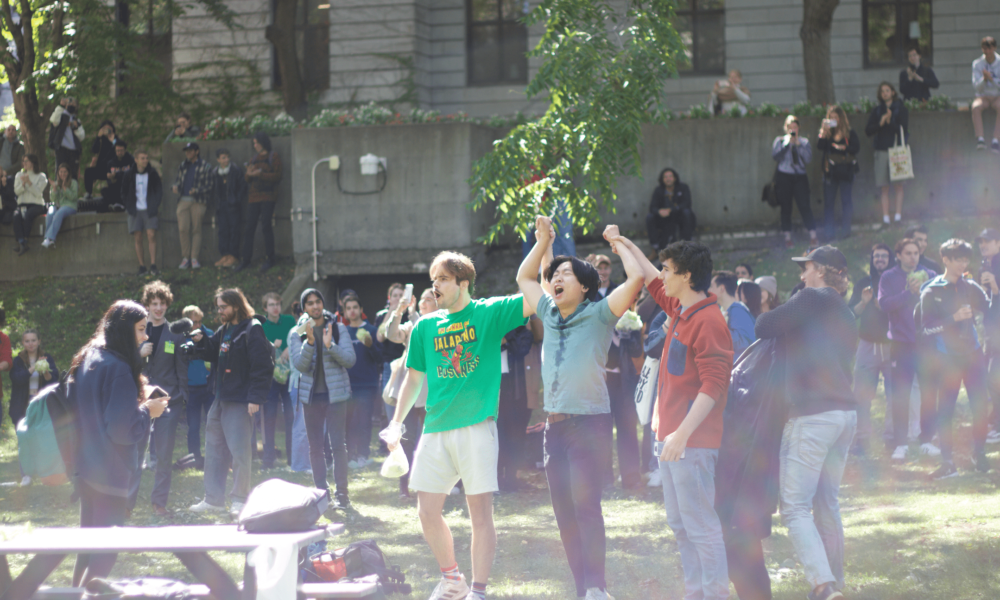
To the disbe-leaf of many passersby on Sept. 23, a circle of students formed––each with two heads: One human, one lettuce. This strange sight was none other than McGill’s second annual Lettuce Club meeting.

Once a year, Lettuce Club members meet with nothing but a 600-gram head of lettuce and an empty stomach. The rules of the game are very simple: Participants have 10 short (or long!) minutes to devour their head of lettuce to the best of their abilities. Although 10 minutes may not seem like enough time to eat an entire head, the real contenders tend to take much less.

To ease this laborious process, competitors can employ any strategy, from dousing the head in salad dressing to adding some seasoning and spices or condensing their lettuce with force—as long as they can prove that they have eaten the entire head of lettuce. The first to finish eating is crowned the Head of Lettuce and is responsible for organizing the next year’s gathering.

McGill’s first Lettuce Club meeting took place last year, organized by Arielle Lok, U3

Management, Bjørn Christensen, U3 Arts, and Joel Conway, U3 Management. In an interview with The McGill Tribune, Lok explained that in 2019, the founders were inspired by viral TikToks about Lettuce Clubs at different schools and thought, “let’s bring that to McGill!” The first-ever Lettuce Club was a huge success, attracting nearly 150 students.

But the success of last year’s Lettuce Club was only the tip of the iceberg. This year, more than 200 people formed a circle around the grassy knoll outside Redpath Museum, ready to compete. Aslan LaCouvee, U3 Arts and Science and last year’s Head of Lettuce, entered the centre of the circle wearing the black cloak awarded to the winner.

“The question remains, who wants to be the Head of Lettuce?” Aslan shouted.

With that, the race was off. Participants dug their teeth into the leaves and chewed eagerly. Scraps of lettuce littered the ground as spectators cheered on their friends.

A mere minute after the race began, Eric Zhao, U1 Science, drew the attention of his fellow competitors, as he neared the end of his lettuce. As Zhao chewed vigorously, the crowd’s focus shifted to various other participants nearing the end of their lettuce cores. Finally, Zhao opened his mouth, revealing his lettuce was gone, and, with relief, yelped in victory. LaCouvee presented the victor with the cloak, crowning him as this year’s Head of Lettuce.

After the competition, Zhao disclosed his technique in an interview with the Tribune. 

“Most people get caught up in chewing. But I have two hands here––they aren’t doing anything! So, what if I hold my lettuce like this,” Zhao said, forming a claw-like grip on his imaginary lettuce, “and give the old lettuce some chew with my long fingernails so that when it gets in my mouth, it can be more of a slush.”

Zhao’s strategy was clearly effective as he managed to devour his lettuce in as little as a minute and 54 seconds.

Participants were left in awe by Zhao’s speed. 

One observer noted, “I’ve been alive 20 years and never seen something like that!”

While he, too, was impressed with this record time, Marlo Nash, U1 Science, was most interested in the team-building aspect of the competition. 

“You know there’s a competition [for the Head of Lettuce], but it’s about the collaborative aspects: The “us” in lettuce,” Nash said.

The ambience of the Lettuce Club gathering is certainly light-hearted, but many participants mentioned the sense of community brought about by the lettuce-eating competition.

“I’m here to be a part of the energy, be a part of something bigger than myself,” Jonas Lehar, U1 Science, told the Tribune.

Arielle Lok explained the mission of Lettuce Club: “To unite students, and address the (lettuce) core of the community.”


A previous version of this article incorrectly stated that Christensen presented Zhao with the cloak. In fact, LaCouvee presented him with the cloak. The Tribune regrets this error.

Science & Technology, Student Research

Predicting and preventing stroke with Sonoplaque

In 2012, Karina Gasbarrino‘s grandfather passed away from an ischemic stroke. Since then, Gasbarrino, a graduate of McGill’s PhD program in experimental medicine, has dedicated her career to understanding and developing early stroke prevention methods. In 2019, she succeeded, launching the digital health startup PLAKK, a cutting-edge tool that helps predict ischemic strokes. Globally, ischemic strokes are the second leading cause of death and the third leading cause of disability, impacting millions of families worldwide.

An ischemic stroke is caused by blood clots in the arteries leading to the brain. This results from the rupture of an atherosclerotic plaque, an accumulation of fat and cholesterol that builds up in carotid arteries in the neck. For now, atherosclerotic plaques cannot be detected with a blood test and, instead, require an ultrasound. Since atherosclerosis is a progressive disease, it needs early screening to provide proper treatment, which does not start until a patient displays symptoms. The most common symptoms include dizziness, mobility issues, and numbness in the facial muscles. 

In an interview with The McGill Tribune, Kashif Khan, McGill medical student and co-founder and CEO of PLAKK, explained that an inaccurate diagnosis is one of the many hurdles to proper stroke care. 

“Inaccurate diagnoses [cause] many patients to be missed by current clinical standards, putting them at a larger risk for stroke,” Khan said. “The limitations cause approximately three million preventable strokes each year.” 

In other words, current diagnostic procedures do not go into the depth required for accurate stroke diagnoses and often are only performed when the patient’s atherosclerotic plaque accumulates to dangerous levels. 

As the chief operating officer of PLAKK, Gasbarrino and her team have worked tirelessly to create a tool that uses artificial intelligence (AI) to accurately identify high-risk atherosclerotic plaques. They have also developed a “stroke-risk score” which would help doctors proceed with the form of treatment that best suits the patient’s needs. The use of such high-tech image analysis, in combination with histology—the study of cell structure—helps with the early detection and prevention of strokes.

SonoPlaque, the revolutionary AI technology that Gasbarrino developed at McGill, overcomes the problems of current diagnostic methods for ischemic strokes by using a variety of clinical parameters, like the plaque composition and flow dynamics of the affected artery, to create an accurate stroke-risk assessment. A combination of blood biomarkers—molecules found in patients’ blood that correlate with high stroke risk—annotated medical images, clinical characteristics, and omics data are also used to create patient-specific algorithms.

The program also uses ultrasound technology to monitor levels of arterial blockage. 

According to Khan, the road to developing SonoPlaque as a patient-ready tool was a collective effort that included contributions from a variety of industry professionals.

“Transitioning from academia to industry was a complicated, but exciting journey,” Khan said. “We sought out to build a multidisciplinary team of clinicians, surgeons, AI engineers, data scientists, and experts in business strategy.” 

Supported by numerous donors and government grants, PLAKK is now being used in clinical settings in Quebec to start testing and validating its software. The company hopes to get Food and Drug Administration (FDA) and Health Canada approval next year.

As for the future, Khan foresees two important milestones for SonoPlaque: The first would be publishing the results of PLAKK’s clinical studies, and the second, to close a seed round of two million dollars for funding future works. 

“Together, the success of these milestones will allow us to achieve regulatory approval in the U.S.,” Khan said. “FDA approval puts SonoPlaque on the map as a valuable stroke-detection technique, and funding helps to propel more essential research forward.”

McGill, Montreal, News

Twenty-first annual McGill Pow Wow celebrates Indigenous life across communities

On Sept. 23, with hundreds of people in attendance, McGill’s First Peoples’ House hosted the 21st annual Pow Wow at Lower Field. It had been two years since the last in-person Pow Wow, so this installment reintroduced Pow Wow to the grounds. Indigenous and non-Indigenous students, faculty, and community members were invited to safely gather and share a site of learning, music, and joy on the sunny and lively lawn. Activities scheduled throughout the day, such as traditional and inter-tribal dancing, Inuit throat singing, and a Maori Haka performance, took place under a large white tent that served as the centre stage.

The event began at 11 a.m. with opening words followed by the Grand Entry. Elder and veteran Ray Deer, chief of the Kahnawake Royal Canadian Legion, carried the Canadian flag amongst others carrying the Haudenosaunee Confederacy flag and an Every Child Matters flag, accompanied by drumming from groups including the host drum, the RedTail Spirit Singers, and the co-host drum, the Ottawa River Singers.

Emcee of the event and journalist Lance Delisle highlighted the importance of the event’s community elements in an interview with The McGill Tribune

“Pow Wow is an opportunity for traditional and non-traditional people––meaning Native and non-Native––to get together and share culture, share ideas, share dances, share celebration,” Delisle said.

Delisle spoke to the Pow Wow being a “homecoming” and a space for sharing, both in the wake of the COVID-19 pandemic and also as a Kanien’kehá:ka person, given that McGill is located on unceded Kanien’kehá:ka land.

“We have been so separated from each other culturally, spiritually, harmoniously,” Delisle said. “We are bringing that warmth by [this] connection, and certainly […] the humanity back. Pow Wow reminds ourselves that we are […] a whole people.” 

Among the many vendors and organizations in attendance was McGill’s Indigenous Student Alliance (ISA). Leon Picha, U3 Management and member of the Kwantlen Nation, got involved with the ISA in his first year as a way to stay connected to Indigenous communities when his own was far away. The Pow Wow reminded Picha of his first introduction to the Indigenous community at McGill, though it will be his last as a student. 

“It is a beautiful close,” said Picha, who will graduate in June 2023. “Aside from the National Day of Truth and Reconciliation, this is the last time that I am going to see the Indigenous community as a whole at McGill.”

Jenni Makahonuk, co-chair of the ISA and member of the Lac Seul Nation, echoed Picha’s sentiments. In addition to educational events hosted by the ISA, Makahonuk leads an Anishinaabe and Ojibwe language study group on Wednesdays and helped design one of McGill’s 400-level Indigenous Studies seminar.

“It’s really hard for me to connect to [Indigenous] culture [here] because I am not from Montreal,” Makahonuk said in an interview with the Tribune. “Having Pow Wow helps me connect back to my values and who I am.”

At around 1 p.m. in the main tent, Nina Segalowitz, an Inuit throat singer, activist, and caseworker at the Centre des femmes de Montréal, took the floor to share stories and songs with the crowd. Throat singing has a long history in Inuit cultures: It was almost erased during colonization after the Catholic church attempted to suppress the practice under the pretense that it was a “form of devil worship.”

When she became a mother, Segalowitz made a pointed effort to incorporate the practice into her children’s everyday experience. Standing with her daughter, Sierra, the two performed a game in which each sang part of a song to see who could sing the longest. 

Singing with close friend Sarah Carriere and telling stories about the Canadian government’s mass killing of Inuit peoples’ sled dogs, Segalowitz and Carriere shared a single microphone so that they could feel each other’s breathing, each other’s heartbeat. 

“We are still resilient. We are still here,” they both said.

Research Briefs, Science & Technology

As ice sheets melt, will Greenland mine?

While many are worried about large swaths of land disappearing under water as global sea levels rise due to melting ice sheets in the Arctic, Greenland finds itself with a different problem: Its coastline is growing. Scientists have observed that when Greenland’s ice melts, it runs down to the ocean, leaving sand and gravel behind that was previously trapped in  ice. This sediment builds up along the coastline—effectively expanding the coast—creating new and highly valuable sand deposits. Mining these deposits could be lucrative for Greenland’s economy, but also carries several environmental and economic risks.

Mette Bendixen, assistant professor in McGill’s Department of Geography, co-authored a recent study surveying Greenlanders’ opinions about potential sand mining operations. She found that more than 80 per cent of respondents were in favour of using Greenland’s sand deposits. 

The researchers surveyed roughly 1,000 Greenlanders, asking whether they would support a mining operation, what kinds of reviews should be conducted first—scientific, environmental, or economic—and how the project should be overseen. They found that while there was widespread support for sand mining, Greenlanders overwhelmingly prioritized conducting economic and environmental reviews so as to understand how these sectors would be impacted by mining activities. Additionally, when asked whether to involve foreign countries, 75 per cent said that the mining process needed to be kept at the national level. Despite these caveats, 76 per cent of Greenlanders were strongly in favour of exporting their sand deposits. 

Over the last several years, Greenland has conducted an economic review of the benefits and drawbacks of mining these sand deposits. Citizens and public officials are concerned about the environmental risks the activity would bring, including the disruption of northern marine ecosystems. But Bendixen found no evidence of large-scale consultation with the people of Greenland.

“No one asked the question—what do the people of Greenland think about this idea?” Bendixen said in an interview with  The McGill Tribune

Sand mining has the potential to be lucrative for Greenland because of the rising global demand for the resource. Sand is used as an ingredient in the construction and manufacturing industries, primarily to produce concrete, glass, and electronic components. 

“We use it in basically everything. It is the key ingredient for modern civilization,” Bendixen said. 

Mining and exporting these sand deposits could give Greenland a way to boost employment and move towards economic independence. Greenland has a population of roughly 56,000, nearly 88 per cent of which are Greenlandic Inuit. The primary industries are fishing and tourism, and although it is politically independent from Denmark, Greenland still relies heavily on the country’s financial support.

Mining sand in Greenland carries grave environmental risks. Many current sand mining operations cause severe environmental damage, including erosion of coastlines and wild habitats, harm to local fishing populations, and a decrease in plant biodiversity. Bendixen believes this is something Greenland’s government should seriously consider before deciding to mine.

“Extracting something from nature will automatically impact nature, no matter what,” Bendixen said. 

Although the amount of sand in Greenland is not enough to overcome the global sand scarcity problem, a carefully overseen mining process does have the potential to fill some of the global demand for sand in a more environmentally conscious manner. 

“It could relieve some of the pressure on where it’s currently being extracted in a fashion that’s not sustainable at all,” said Bendixen. In many coastal regions of India and lake regions in China, sand mining encroaches on human settlements and wildlife, making homes and habitats inhospitable.  

There’s also the risk that sand mining could negatively impact Greenland’s other economies.

“The fishing industry is the largest industry in Greenland. If you start having these huge barges and ships sailing around in these waters, will that affect the fishery? What about the tourism industry?” Bendixen said.

While these questions and more still need to be answered, Greenland’s sand deposits seem a likely target for new industrial development.

Commentary, Opinion

More pedestrianized streets, please

It’s a beautiful day: Birds chirping overhead, cyclists zooming by, neighbours and shopkeepers chatting, people enjoying shawarma and poutine on benches. No, you’re not in a park. You’re in the middle of the Plateau, on Mont-Royal Avenue—and there are no carbon-dioxide–spewing vehicles in sight.

Montreal’s pedestrian-only streets, which can be found across the island from Verdun to Little Italy, create a unique ambience that gives the city its charm, beauty, and grit. Car-free spaces provide significant social and economic benefits, and on top of that, more space for bikes and pedestrians encourages people to ditch their cars, lowering the city’s carbon footprint. Montreal’s pedestrian streets are a great example of smart urbanism, and the city ought to expand the program and make the pedestrian streets a year-round phenomenon. Further, other North American cities should take a page out of Montreal’s book and develop their own pedestrian street programs.

Montreal’s long-term, summer-wide pedestrian streets were initially conceived to provide space for outdoor social interaction during the COVID-19 pandemic. Due to the popularity of the program and its economic benefits, such as increased business activity and rising property values, the city chose to extend it. Mayor Valérie Plante announced in April that the city would be spending $12 million to pedestrianize streets over the next three summers.

Pedestrian streets, along with their aesthetic and environmental benefits, are an economic boon for cities. According to Luc Rabouin, the mayor of the Plateau-Mont-Royal borough, the pedestrianization of Wellington Street last summer brought in 17 per cent more shoppers and visitors. Furthermore, average property values along a street rise as the street becomes more walkable. Compared to the auto-oriented sections of cities and towns, walkable areas bring in more taxes due to a higher rate of economic activity. 

This is only common sense: As streets become safer and more inviting, people choose to shop and walk along them. They spend more time passing storefronts and perusing windows. The streets become social and economic hubs, tying neighbourhoods together. 

Considering their environmental benefits, it’s hard to see why some people might oppose efforts to pedestrianize cities. While critics posit that the reduced space for cars disincentivizes economic activity, studies have shown that travellers that walk or take public transit spend more per month at local businesses than drivers. Critics also argue that pushing cars off main thoroughfares will intensify traffic elsewhere in the city. However, when cities prioritize walking and public transit, people are encouraged to switch from driving to these alternatives, meaning traffic levels in the city should decrease because fewer people are using their cars. This effect has been demonstrated in cities such as New York City and Madison, Wisconsin. 

One concern that’s especially pertinent for Montreal is that, if the pedestrian streets remained open all year round, they wouldn’t see use in the cold months. But just as Montrealers flock to parks when the snow falls with their sleds, skis, and skates, they would take advantage of car-free streets, too. 

Montreal’s pedestrianization pilot program is a step in the right direction—hopefully Toronto and Vancouver will follow suit. But the program should be greatly expanded. First, the pedestrian streets should become permanent parts of the cityscape, not just summer treats. Imagine the convenience and advantages that would come with pedestrian and bike-friendly avenues crisscrossing the city year-round. Projects in cities such as New York City and Boston have transformed ugly and congested streets into mixed-use transit, bike, and pedestrian boulevards. Montreal should also create more public squares, which yield many of the same benefits as pedestrian streets. At some of the most notorious and awkward intersections in New York City where diagonal streets meet the grid, cars are pushed to the side to make way for pedestrian-friendly plazas. It’s fairly cheap to do this: Some new street furniture, lighting, planter boxes, and sidewalk paint or pavers will do the trick.

Considering how easy and beneficial it is to reorient cities from cars to people, Montreal should double down on its efforts and continue to prove that it’s the coolest city in Canada.

Hockey, Sports

Nick Suzuki’s captaincy transcends Quebec language politics

On Sept. 12, the Montreal Canadiens announced the appointment of 23-year-old Nick Suzuki as the 31st captain in franchise history. The standout centre from London, Ontario, joins a decorated list of Habs captains, including hockey legends Maurice Richard and Jean Beliveau. Chosen over his more veteran teammates like Brendan Gallagher,  Suzuki’s age highlights the team’s commitment to a strong young core. The selection also makes Suzuki the youngest captain in franchise history and positions him at the forefront of the changing face of hockey.

As one of the NHL’s founding teams and a member of the Original Six, the Montreal Canadiens provide a beacon of unity for the francophone community within the hockey world. Les Canadiens de Montréal have long been tied to the province’s cultural identity as even the team’s nickname, the Habs or Les Habitants, refers to French settlers in the Quebec region. 

As seen with the recent passing of the controversial Bill 96, Quebec’s administration has further ingrained language laws as a political priority. Since the departure of the Nordiques in 1996, many fans see the Canadiens as the symbolic core of Quebec’s identity in the sports world. As a result, the election of Suzuki, a non-bilingual Ontarian, to Quebec’s highly prized NHL team has been highly controversial. It has been through both congratulations and thinly-veiled criticism of Suzuki’s lack of French-speaking ability that provincial politicians have extended the age-old debate about bilingualism to their hockey team.

With the 2022 Quebec general election coming up on Oct. 3 and candidates on the campaign trail, many leaders addressed the news during their press conferences. Incumbent premier François Legault from Coalition Avenir Québéc not-so-jokingly suggested that Suzuki work on his French. Leaders of the Parti Québécois, Quebec Liberal Party, and Québec solidaire all pressed Suzuki to up his French game, proving the issue to be a sentiment that cuts across party lines.

Regardless of linguistic outcry, a Suzuki captaincy represents a positive step forward for Japanese representation within hockey. With only seven active NHLers of Asian descent in the 2021-2022 season, Suzuki’s new position breaks barriers in the predominantly white sport. In 2020, a group of young Japanese hockey players on the Japan Selects came to Quebec to see Suzuki in action. Their coach, Taro Kurokawa, emphasized Suzuki’s impact on the youngsters, calling Suzuki a “big source of pride” for the Japanese community.

Suzuki understands the magnitude of his presence in hockey and has stressed his desire to be a role model and to help kids reach their NHL dreams in any way he can. While hockey is not yet considered a major sport in Japan, it’s made leaps and bounds over the past decade, with the women’s team qualifying for the past three Olympics and youth hockey programs growing across the country. Suzuki’s new role within the Canadiens organization is diversifying the league and creating a path for other kids of Asian heritage to play at the highest level. 

Hockey culture is characterized by a desire to remain insulated from broader social and political issues. Despite this, Suzuki’s lack of bilingualism has catapulted him into the centre of a highly polarized political debate that he is slowly but surely navigating. Although  Suzuki is still young, he seems poised to ascend to the next step in his career with his newly appointed captaincy. He simultaneously acknowledged the validity of both politicians and Quebeckers’ perspectives on the French language, respectfully addressing his lack of fluency and his desire to improve. Additionally, as the Canadiens’ Hockey Is For Everyone ambassador, Suzuki plays an important role in the drive to foster a more inclusive environment within the sport. 

Only time will tell whether Suzuki’s captaincy will be the change the Habs need to be successful in the 2022-23 season, but his ability to address contentious political issues like language head-on  leaves many looking forward to the young star’s future.

Read the latest issue

Read the latest issue