Multimedia Editors Alex Hinton and Noah Vaton explored Montreal searching for McGill’s favorite pastry. They tried 4 of the best samosa spots near McGill’s downtown campus and offered comprehensive reviews on them all.
On Sept. 10, Grammy award-winning singer-songwriter Kacey Musgraves released her fifth studio album, star-crossed. Focussed on her divorce from Ruston Kelley—whose love story was detailed in her previous Grammy-winning album, Golden Hour (2018)—the album is a stunning project that navigates the non-linear healing process of grief.
While Musgraves’ previous work fused country and pop genres, star-crossed plays with new sounds influenced by disco music. The lyrics foreground ethereal and divine themes, such as in its title-track, painting a bittersweet picture of the album’s heartbreak inspiration.
Other songs detail Musgraves’ desire to escape the present moment, as in the nostalgic rhythms and melodies of “simple times” that transport listeners to the early 2000s, when Musgraves was a teenager. In “if this was a movie..,” the instrumentals and sonic quality of Musgraves’ voice filters reality with rose-coloured glasses, where everything works out. Other songs like “camera roll” and “hookup scene” reveal the regression of healing—most evident is when Musgraves sings, “What a trip, the way you can flip through all the good parts of it, I shouldn’t have done it.” Then, in “hookup scene,” Musgraves details her struggles being single and participating in hookup culture, where she feels that “You get your fill and leave empty, more lonely than before.”
The songs “keep lookin’ up,” “what doesn’t kill me,” and “there is a light” show both Musgraves’ turmoil as well as her efforts at moving on. Musgraves progresses past the pain in “there is a light” when she sings, “There is a light, it’s so bright, but I’ve been hiding it.” In the end, Musgraves seems to realize that she does not need to depend on another person to bring her happiness and fulfillment, because she is enough.
McGill is holding its 10th annual Indigenous Awareness Weeks from Sept. 13 to 24. Among the weeks’ events was an international virtual round table discussing the United Nations Declaration on the Rights of Indigenous Peoples (UNDRIP). The round table featured many prominent Indigenous advocates from around the world, including Claire Charters, co-director of the Aotearoa New Zealand Centre for Indigenous Peoples and the Law at the University of Auckland; Eddie Cubillo, senior fellow at the University of Melbourne’s Law School; June Lorenzo, an Indigenous rights advocate, attorney, and chief judge in Zia Pueblo; Sheryl Lightfoot, North American representative to the United Nations Expert Mechanism on the Rights of Indigenous Peoples; and Romeo Saganash, member of Parliament for Abitibi-Baie James-Nunavik-Eeyou between 2011-2019.
The UNDRIP is a piece of international legislation that enshrines the individual and collective rights of Indigenous Peoples. It is almost unanimously supported throughout the UN: Australia, Canada, New Zealand, and the United States initially voted against the UNDRIP, but years later modified their position and expressed support of it. Ever since the General Assembly passed it in 2007, Indigenous populations around the world have pushed their respective governments to adopt the declaration and represent it in legislation.
Panellists overviewed the various issues facing Indigenous communities in their home countries, and also discussed the challenges of properly implementing UNDRIP.
“We do not have a written constitution in Aotearoa/New Zealand,” Charters said. “So, it is quite an unusual constitutional situation with respect to rights and not having rights being able to be enforced against the legislature.”
Cubillo explained that Aboriginal Australians currently have little sovereignty over their land due to British colonization.
“Australia is the only British colonized country that never formed a treaty with its First Nations peoples when illegally taking [Aboriginal] lands,” Cubillo said. “Australia was claimed under the Doctrine of Discovery, terra nullius […], a Latin term meaning land belonging to no one […], justifying acquisition by the British occupation without treaty or payment.”
Lorenzo noted that although the U.S. has seen some progress in implementing the declaration, it does not compare to the advancements made in Canada.
“[The Biden administration has] not gone nearly as far as Canada has to implement legislation,” Lorenzo explained. “U.S. representatives have just absolutely ignored the UN declaration.”
Through the identification and analysis of almost 200 federal court cases that integrate the UNDRIP into their rulings, Lightfoot’s research team at the University of British Columbia concluded that Canadian courts have made headway in implementing UNDRIP. Saganash pointed to the importance of Bill C-15, a bill passed by the Canadian Senate in June 2021 that requires the government to take all necessary measures to ensure Canadian laws are consistent with the UNDRIP.
“C-15 will set an international precedent in terms of the importance of the declaration,” Saganash said. “It is a big step forward in terms of recognizing that we respect Aboriginal and treaty rights in this country.”
The round table concluded with the panellists’ expressions of optimism toward the future and toward the recognition of the challenges that lie ahead. Yann-Allard Tremblay, round table moderator and professor in McGill’s Department of Political Science, emphasized the importance of acknowledging Indigenous strength.
“You all demonstrate the brilliance of our people,” Tremblay said. “And this is clearly fitting for the theme of this 10th annual Indigenous Awareness Weeks, which is to celebrate Indigenous excellence and resilience.”
In 2020, the Jahani-Asl Lab in the Division of Experimental Medicine at McGill discovered that gene therapy techniques could make certain brain tumours more receptive to radiation treatment. Since then, the team has made yet another groundbreaking advancement—identifying a protein pathway that, when suppressed, could lead to reduced tumour growth.
Glioblastoma is the most severe of all brain tumours; the prognosis is often grim, and treatment typically requires surgery, and a combination of chemotherapy and ionizing radiation. Brain tumour stem cells (BTSCs) are notoriously difficult to manage due to their capacity to self-renew and proliferate.
“Despite these efforts, there are […] brain tumour stem cells that resist therapy and stay in a dormant state […] and then after a while, they regrow and they form a tumour,” Ahmed Sharanek, a postdoctoral researcher and co-lead author of the study, said in an interview with The McGill Tribune. “Finding a therapy that specifically targets these brain tumour stem cells will be a great advance in glioblastoma therapy.”
In a recent study published in Cell Reports, the researchers discovered that the production of galectin-1, a carbohydrate-binding protein, is under the control of the EGFR/STAT3 signalling pathway—a pathway known to promote tumourigenesis. When galectin-1 is being produced, it forms a complex with a transcription factor called HOXA5, and together, they send signals to brain tumour stem cells to stimulate growth.
Sharanek explained how the researchers performed next-generation sequencing and biochemical assays to understand the role of galectin-1 in the oncogenic pathway.
“We tried to tackle the glioblastoma tumours that are dependent on the EGFRvIII pathway,” Sharanek said. “We did this because it is a major pathway that occurs in 40 per cent of tumours.”
A majority of glioblastomas express mutations in the EGFR gene that activates STAT3—and though researchers have been trying to suppress this pathway, they have been largely unsuccessful. The next step was to target galectin-1 and to prevent it from binding to HOXA5. Using CRISPR gene editing and pharmacological techniques, the researchers inhibited the expression of this protein in the cells of animal models to observe its effect on tumour growth.
Given their understanding of the pathway’s mechanism, Sharanek and his colleagues expected there to be reduced tumour growth in the experimental mice that received the galectin-1 manipulation. But what happened was even more promising—for several months, the tumours did not grow at all. In fact, the mice who received treatment lived for 12 months, a significant lifespan by laboratory standards.
“[It was] really startling for us,” Sharanek said. “When we deleted this protein in brain tumour cells and injected them in mouse models, we thought that we were going to decrease the growth of tumours to a certain extent, but what we observed […] was that they simply did not [grow].”
The results were encouraging, especially given that much of the lab work was slowed by pandemic restrictions.
The paper released last year detailed how the deletion of a mitochondrial gene called Oncostatin M could make stem cells easier to target with radiation. Since the galectin-1 protein is involved in a separate oncogenic pathway, Sharanek is hopeful that multiple points of attack could improve patients’ responsiveness to radiation therapy.
“In the response of glioblastoma tumours to therapy, these cells are very smart,” Sharanek said. “If you hit one pathway, […] the [tumours] adopt another pathway to rescue themselves. So if you are hitting two major pathways at the same time, your chance [of eradicating] them is much higher.”
With galectin-1 suppression as a new weapon in the arsenal against tumour cells, along with the lab’s previous work on gene therapy, the lab continues to make strides in the world’s understanding of glioblastoma.
Since the emergence of the COVID-19 pandemic in spring 2020, there have been 14 reported cases of femicide in Quebec. A femicide, sometimes called ‘feminicide,’ is the killing of a woman or girl because of her gender. Despite the recent spike in reported femicides, this kind of gender-based violence has occurred throughout Canadian history.
The term femicide entered into public consciousness after Marc Lépine violently murdered 14 women in Montreal’s École Polytechnique in December of 1989—an event now referred to as the Montreal Massacre. Since then, Montreal, along with greater Quebec, has endured and lived with the weight of the tragedy. The perpetrators behind Quebec’s recent femicide cases are striking mirrors of the rampant misogyny that motivated Lépine 32 years ago. The question remains as to why femicides and other forms of gender-based violence continue to happen, and why they have been increasing in frequency since the onset of the pandemic.
In an interview with //The McGill Tribune//, founding member of Montreal’s South Asian Women’s Community Centre (SAWCC) Dolores Chew explained that the term “femicide” has brought more public attention to the issue . The SAWCC has been pressing for justice for the murder of Milia Abrar since her death in 1998.
“She was murdered in the washroom of […] Angrignon Park,” Chew said. “She was a student at Dawson College, and to date her murderer walks free. Femicides have been happening in our community [and] also in the wider Quebec society, but I think now with the emergence of the term ‘femicide’ it is much more stark, it’s much more gripping.”
The term femicide paints a stark picture, which perhaps helped spark political action, such as the Quebec government’s investment of $222.9-million over five years to help prevent domestic violence. Chew underscored the importance of language when bringing awareness to critical issues like these.
“Words that help us cut through and get to the core of issues [are crucial], and vocabulary is evolving,” Chew said. “Our language evolves to recognize power imbalances, but at the same time to not accept the power imbalances.”
The immediacy of the term femicide pinpoints exactly what is happening: Men are killing women because of the fact that they are women. Kaelyn Macaulay, 3L Law and research assistant with the McGill-sponsored iMPACTS project, underlined that femicides should be understood as multilayered acts of violence that also fall along racial lines . Even though the term ‘femicide’ is helpful in understanding the nature of the violence it describes, Macaulay urges an intersectional approach to using the term.
“These generalizations can be really helpful,” Macaulay told the //Tribune//. “But on the other hand, we have to be really careful to avoid over-generalizing, or allowing these generalizations to blind us to the intersectional nuances that massively influence gender-based violence.”
Gender-based violence is rampant in Canada: Across the country, a woman is killed every 2.5 days. But this violence disproportionately affects younger women and women from marginalized groups. The president of the Federation of Native Women of Quebec (QNW) Viviane Michel emphasized the need for greater awareness of gender-based violence, particularly surrounding the targeted, pervasive violence inflicted on Indigenous women. Recent statistics show that 63 per cent of Indigenous women have experienced at least one instance of physical or sexual violence since the age of 15, while 45 per cent of non-Indigenous women have had those experiences. Further, 61 per cent of all Indigenous women have experienced intimate partner violence in their lifetime.
“The situation of feminicides is very worrying for us,” Michel wrote in an email to the //Tribune//. “Our organization denounces the disproportionate violence that Aboriginal women experience [….] This has to stop and there has to be a real awareness.”
The stresses of the pandemic, which disproportionately affect Indigenous and otherwise racialized populations, have contributed to the rise in gender-based violence. Given the research indicating that unemployment among women contributes to an increase in cases of domestic violence, it is no surprise that instances of gender-based violence have been on the rise—the pandemic has left nearly 500,000 women without work. Further, while social and physical isolation is proven to reduce the spread of COVID-19, these measures can trap people experiencing gender-based violence in unsafe environments. Over the last two years, isolation heightened women’s stress, and made it increasingly challenging for them to seek external aid.
Chew agrees that the recent rise in intimate partner violence is likely due to the situational constraints of the pandemic, such as women being confined to abusive households. When women are cut off from their friends, co-workers, or extended family, it makes it much more difficult to communicate needs and to seek help.
“We [at SAWCC] had said from the first lockdown in the spring of 2020 there will be an increase in interpersonal violence, domestic violence,” Chew said. “We know from working and experience that when people are all together, tension rises and mounts [….] So, we knew that this was going to happen.”
Macaulay explained that the pandemic has exacerbated unequal power dynamics in relationships.
“The pandemic forced women to spend more time with potential domestic abusers,” Macaulay said. “More women are seeing unemployment, which places them at risk for financial abuse [….] The [effects of the] pandemic […] put them at more of an unequal footing in power dynamics and relationships, which is the major risk factor [for gender-based violence].”
Chew believes that the overarching systems of patriarchy are at the root of these femicides––as well as other instances of gender-based sexual violence––and argued educators need to do more to help boys and young men unlearn toxic masculinity.
“I think it’s very important for people to see a performance of non-toxic masculinity in interaction […] and then it can be modeled,” Chew said. “Girls and women can also be frustrated and angry and engage in various mean activities, but we tend not to hit out, and why is that? [….] It is [the] patriarchy which embeds these sorts of behaviours and legitimates certain behaviors.”
The most recent femicide was the killing of Rajinder Prabhneed Kaur, who lived in Parc-Extension (Parc-Ex) with her husband, Navdeep Ghotra, and their two children. After Kaur’s death, SAWCC organized a march this July, bringing the community together to commemorate Kaur and protest against gender-based violence.
“We had this rally […] soon after the murder of Rajinder Kaur in Parc-Ex,” Chew said. “And every single media outlet was there, which was very good because we really wanted the message to go out in the community: [SAWCC is] here, we can assist, we have linguistic abilities [and] cultural sensitivity.”
McGill, too, has a responsibility to support survivors and victims of gender-based violence. To address the issue of gender-based violence in the McGill context, Macaulay believes that individuals should focus on education and accountability beyond //It Takes All of Us//, the online sexual violence prevention program.
“People need to be aware of the impacts [and risks] of gender-based violence,” Macaulay said. “I know that McGill has the mandatory consent training course that you have to take, but I do think that it could be pushed a lot further.”
Macaulay also highlighted the value of holding the people around you accountable when they contribute to the culture of sexual violence, such as the kind that led four women to come forward with reports of sexual violence at Western University this year, and to the many more women at the university who have revealed their own accounts of surviving sexual assault in the past few weeks.
On a national level, as was announced in June 2017, Canada is investing over $200-million over a five- to seven-year period to support survivors and their families, promote adequate and responsive legal systems, and establish a Gender-Based Violence Knowledge Centre. Additionally, Quebec is giving $20-million to organizations, like À Coeur d’Homme, that provide help to men who behave violently as a preventative measure.
In June 2021, Canada launched a National Action Plan to end violence against Indigenous women, girls, and 2SLGBTQIA+ people. But Michel, speaking on behalf of the Federation of Native Women of Quebec (QNW), argues that the National Action Plan is insufficient and lacks concrete action. In response, the QNW is drawing up its own action plan to end violence against Indigenous women.
“For gender-based violence to end, there must be concrete actions taken to address the situation of family and domestic violence experienced by Indigenous women and girls,” Michel said.
The Canadian government needs to provide support to the specific communities who are experiencing disproportionate gender-based violence, which becomes more clear in the context of the Missing and Murdered Indigenous Women and Girls crisis. The report by the National Inquiry Into Missing and Murdered Indigenous Women and Girls, released on Sept. 1, 2016, cites “persistent colonial structures and policies” in Canada as the source of the violence against Indigenous women and girls. While the government has followed up with some of the recommendations contained in the National Inquiry, 2021 continues to see one femicide after the next.
Preventing gender-based violence starts with holding people accountable and reaching out when they suspect or experience intimate partner violence.
“Part of the accountability is just being aware,” Macaulay explained. “And if you see something in your friend’s relationship and the way that they talk about their partner, address it. Because [it takes] understanding that it’s hard for that woman to speak up and get help.”
Resources if you, or someone you know, is experiencing sexual or gender-based violence:
During Montreal’s strict COVID-19 public health measures in January 2021, close friends Sophia Blackburn, U3 Arts, and Carol Altimas, U3 Science, longed for the intimacy and creativity of poetry nights. As a remedy, they started their own poetry group, “Spilt Red Wine Poetry.” Since its creation, writers and listeners alike have congregated monthly over Zoom, and now in person, for vulnerable, raw, and honest poetry nights.
“The name itself symbolizes spilling your blood out into the world, because blood is very near and dear to your body, to your soul,” Blackburn said in an interview with The McGill Tribune. “We just wanted everyone to feel safe to express their soul in the most vulnerable, authentic way possible.”
It is a tradition for poets to simultaneously pour out some of their wine at the beginning of each poetry night. This act represents the vulnerability and honesty of sharing one’s work, and embodies the name “Spilt Red Wine.” When forming the group, Blackburn and Altimas aimed to design a space where people could feel safe, welcome, and at home, and where poets could bond over sharing their art. Central to a supportive environment, Altimas explained, is the idea of “holding space.”
“I feel like [Spilt Red Wine] allows people to have [a space where] we hear their words, and we’re holding them,” Altimas said. “And not necessarily physically, but we are holding space for them emotionally, mentally, and in our hearts.”
Although the group’s poetry nights were hosted over Zoom for the first six months, the last three events have been held in person. This month, over 20 people gathered in Mackenzie-King Park to share and listen to each other’s poetry over snacks and drinks. The atmosphere was friendly and welcoming, and there was no pressure to perform. Performers were celebrated not only for their poetry, but also for the act of being vulnerable. One poet recited a love letter about their favourite stock in the stock market, which was met with many laughs; another recited a poem about coffee.
Going forward, the group hopes that pandemic circumstances will allow for a physical sense of community to continue.
“We do prefer in-person events, because we get to meet everyone in person and connect physically,” Blackburn said. “So hopefully when the weather gets colder [we can move to] a bar or to someone’s apartment.”
On the other hand, Altimas recognized that online poetry nights, too, have the potential to bolster attendance and participation.
“I think if we did virtual events it would be awesome to see some of the friendly faces who can’t attend the in-person events,” Altimas said. “As long as we’re able to connect in person, it’s nice to take advantage of that.”
Spilt Red Wine events are open to all, whether you come alone, with friends, or with family.
“I feel like [Spilt Red Wine] has such a different energy,” Altimas said. “It’s very loving. [It] speaks a lot to the nature of the people that come.”
“You’re very welcome to join exactly as you are in that present moment,” Blackburn added.
Spilt Red Wine Poetry hosts events the first Saturday of every month.
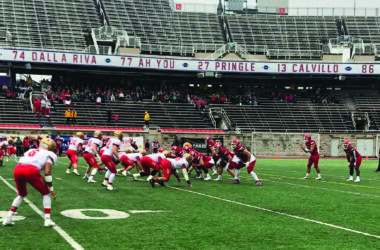
On Sept. 17, the McGill Redbirds (1–2) were defeated in heartbreaking fashion by their long-time rivals, the Concordia Stingers (2–1) at the 52nd annual Shaughnessy Cup. The event sold out quickly, with 3,500 McGill and Concordia students clamouring to get a seat for what turned out to be a high-scoring, action-packed game.
McGill exploded out of the locker room onto the field, dominating offensive possessions in the opening minutes of the game. The team quickly picked up some points when quarterback Dimitrios Sinodinos lofted up a 60-yard touchdown pass to wide receiver Darius Simmons for a quick 7-0 lead with 9:22 left in the first quarter. Both teams played stifling defence for the remainder of the quarter, each forcing the other to take a safety, which brought the score to 9-2 for McGill.
McGill entered the second quarter with the same propulsive energy they brought to the first. Running back Elijah Williams left the crowd in awe with an eight-yard rush toward the end zone that left the Stinger defensive line reeling and the McGill crowd cheering. The Redbirds entered the locker room flying high with a 16-2 lead that seemed nearly impossible to lose.
The Redbirds kept strong momentum coming out of halftime with a 14-point lead. Concordia struck first with a safety, but, less than a minute later, McGill countered with a touchdown by defensive end Joshua Archibald—bringing the score to 23-4. After a Concordia touchdown and a McGill field goal by kicker Antoine Couture, McGill maintained a hefty 26-11 lead heading into the final quarter.
Although the fourth quarter started well for the Redbirds, with a touchdown from tight end Simon Crevier off a pass from Sinodinos, things went downhill from there. The Stingers’ offence, which up until then was passive and lumbering, started chipping away at McGill’s lead, scoring three touchdowns in the last eight minutes of the fourth to equalize from a 22-point deficit.
In a stunning turnaround, the Stingers’ offence pushed the Redbirds back to the 14-yard line and kicker Andrew Stevens sealed their fate with a field goal. The McGill crowd looked on in disbelief as cacophony erupted from the Concordia stands.
Sinodinos expressed his disappointment with the team’s inability to maintain their lead in the latter half of the game.
“I feel like we played pretty well up [until] the fourth quarter,” Sinodinos said. “At the end we just couldn’t seal it. We couldn’t keep our offence on the field long enough. Their offence was on the field for a pretty long time so they got a lot of momentum and were able to overcome a pretty big deficit in not a lot of time. We needed to get at least one more big drive at the end but we couldn’t make that happen.”
Third-year defensive lineman Nassib Hassouna, Jr. was pleased with the team’s performance in the first half and did not want to dwell on the loss.
“For sure, we had some difficulty at the end of the game, but at the end of the day we need to focus on the next game [and] we need to regroup,” Hassouna said. “We will be stronger next week.”
Sinodinos believes the key to victory will be sustaining their momentum until the game’s very last moments.
“It is definitely a question of consistency and being able to finish our game,” Sinodinos said. “So, [we will] continue doing what we did in the first three quarters, all the way to the end of the fourth quarter.”
QUOTABLE:
“The crowd was crazy. From all the teams, we appreciate every single one of you and we will make it up for you.” — Third year Nassib Hassouna, Jr. on the lively crowd in attendance.
MOMENT OF THE GAME:
With less than 30 seconds left on the clock, the stadium waited with bated breath as the Stingers quarterback ran straight into McGill’s endzone to complete a two-point conversion, forcing overtime.
STAT CORNER:
McGill running back Elijah Williams rushed for 94 yards in 13 offensive drives, the most running yards for anybody on either team.
Along with the return to classes, September brought with it the return of in-person athletic events. After more than a year and a half of isolation, students can finally unite behind the university’s talented varsity sports teams. Although the McGill community has welcomed the resumption of athletics on campus, many of McGill’s teams are underfunded and underappreciated—a flippant treatment that rebuffs the enthusiasm and value they bring to the university.
The recent cuts to nine varsity teams undermine the rich history of sports at McGill. Dr. James Naismith, BA 1887 and McGill’s first athletics director, invented modern-day basketball. Likewise, the women’s hockey team played a role in hockey’s gender revolution: From 1921 to 1993, the team took part in one of Canada’s first women’s hockey leagues. As well, McGill’s Hockey Club is the oldest in the world, undoubtedly forging the link between Canadian pride and university athletics. Consider also that McGill boasts 143 Olympians, and has brought home 31 medals since 1904. In the National Football League, the university rightfully celebrates Kansas City Chiefs’ guard Dr. Laurent Duvernay-Tardif, MDCM ’18, who opted out of the league to serve in a long-term care facility during the COVID-19 pandemic. The great successes spawned at McGill raise questions about their support for the current and future generation of athletes. Athletic performances should not need to garner international acclaim to maintain sufficient funding from the administration.
Overzealous, frenzied sports culture is not embedded into McGill in the same way that it is in many American schools. However, the McGill student body still has a sports-friendly attitude—that fact alone should convince administrators to invest in teams. For spectators and athletes alike, sports are one of the more enjoyable manifestations of McGill’s “work hard, play hard” mindset. Given the continued cuts to athletics, though, this culture has become less prominent.
Sports in all disciplines benefit athletes’ psychological development and mental health, and the university cutting funding is paramount to shattering the years of training athletes put toward their sport. With seemingly arbitrary cuts, McGill sent a clear message to young athletes: No matter how hard you work for your sport, you simply may not make it at McGill. The academic environment the university provides does not suffice for the years of effort and career prospects they have foiled. For the athletes excluded and overlooked in sport, like women, racialized people, and lower-income people, lack of institutional support diminishes the unique talents and dreams they bring to their craft. Artistic swimming, for example, a sport dominated by women, got cut this year despite their recent successes and their team’s advertisement in McGill’s jargon-heavy 2020-2025 Athletics Strategic Plan. Fewer sports opportunities means fewer opportunities for an equitable path forward.
To take action, McGill must be transparent about their decisions, and must go beyond the single email justifying the sports cuts. The $200,000 McGill24 campaign for athletics, the million-dollar gift to the now-cancelled lacrosse team from the Généreux family, and the $3.5-million Kerr Family Women in Sport program are much-needed and appreciated contributions from the McGill community. But there remain significant barriers to entry for different teams—like the baseball team stripped of McGill’s name, despite being self-funded. If the Made by McGill campaign can raise $2-billion, the university, following students’ lead, should reinforce the sports that have “made” and continue to make, McGill.
A young lady’s eyes gently sweep across the floor, lost in thought, only to land on the giant sparrow wrapped deep within her arms. She pats and caresses it as if it were her child, with inexplicable worry escaping her lips. This is but one of the many soul-stirring moments that mark Stacey Steers’ Night Reels, an exhibit on display at the esteemed Cinémathèque Québécoise until Oct. 17. Based on her three previous animated films—Phantom Canyon (2006), Night Hunter (2011), and Edge of Alchemy (2017)—Steers adds a new light to her older stories by incorporating giant sculptures and tiny collages, newly imagined astrological instruments, and nearly forgotten Hollywood starlets.
Each of Steers’ three films tell vastly different stories, from a mother sparrow striving to protect her eggs from a giant serpent, to a peculiar woman with a honeycomb crown chased by a sea of giant wasps. What links each story is Steers’ decision to weave together different scenes from classic silent cinema with zoological drawings of different reptiles and insects. The process takes many years, as each film is a mix-and-match of thousands of collages. Slightly static in motion, the films capture subtle microexpressions, like quick smirks or watery eyes, that would otherwise escape even the most attentive of viewers.
“I don’t work very methodically. It’s more of an organic process where I try to freely associate with the work I have already created and move forward in a way that’s cohesive,” Steers said in an interview with The McGill Tribune. “This is why I don’t always know where my story will go, even if looking at the film will give off the impression the story is planned out. It’s very subconscious for me.”
The exhibit itself brings a sense of reality to the films, with their fantastical elements coming to life as sculptures. The stills from the films line the walls, each lending a certain stagnancy to some of the most important scenes, and displaying the silent actresses’ powerful emotions. Steers also created new astrological instruments with steam-punk-inspired designs, which visually distort her films through their strange lenses. One of her most eye-catching sculptures features six bed-frames stacked and melded together—with bed-frames being a motif from Phantom Canyon (2006)—with a projector hidden inside that casts the film.
Resistance is a central theme of these films and the exhibition as a whole, whether against grotesque monsters or one’s own desires. Steers’ work highlights the feeling of helplessness; of fighting against different elements one cannot control. Steers’ protagonists, all maternal figures, counter this effect with a warmth that holds the audience’s curiosity and engrossment.
“I am making this for people who are introspective, [especially] in a world they know they can’t control,” Steers said.
Night Reels’s mystical and dreamlike exhibition continues until October 17 at the La Cinémathèque Québécoise.
The return of the Met Gala marked the return of its most classic staples: Extravagant looks, varying adherence to the yearly theme, twitter commentary, and men in black suits.
Quannah Chasinghorse
For model and Indigenous activist Quannah Chasinghorse, the gala’s theme of “American independence” was an opportunity to remind everyone of the long-standing history of Indigenous cultures prior to settlers’ colonization of the continents. Amidst a troop of red, white, blue, and star-spangled gowns, Chasinghorse stood out, embracing her Hän Gwich’in (Alaska and Canada) and Oglala Lakota (South Dakota) identity. With traditional Hän Gwich’in face tattoos, turquoise Navajo jewelry, and a dazzling golden dress, Chasinghorse’s look was stunning and poignant. Many people on social media commented that she “understood the assignment,” and I couldn’t agree more. Chasinghorse sent a powerful reminder that Indigenous cultures have been, and always will be, the original “American” fashion. Hopefully, Chasinghorse’s Met Gala debut is only the beginning of her fashion revolution.
Alexandria Ocasio-Cortez
From her politics to her Twitter account, U.S. Representative Alexandria Ocasio-Cortez (D-NY) has maintained a consistent message over the year: Tax the rich. The politician, more commonly known as A.O.C., took this stance a step further at the 2021 Met Gala, donning a white floor-length gown with those three words emblazoned in scarlet across the dress’ back. A matching bag with the slogan written in silver accentuated the bold dress, just in case you missed it the first time. Though some have criticized the politician for sporting the message while choosing to attend an event synonymous with opulence, A.O.C. firmly defended both her look and her presence at the gala.
“Ultimately the haters hated,” Ocasio-Cortez said in an Instagram story from September 14. “But we all had a conversation about taxing the rich in front of the very people who lobby against it.”
Whether an indictment of the upper class or an empty, hypocritical comment, the dress and its message were perfectly on-theme for a country whose fashion industry has consistently catered to the rich.
Ciara
Ciara donned a sparkling neon-green, floor-length dress, reminiscent of a football jersey, to the event. On the surface, it appeared to be a tribute to American Football, but upon a closer look, it also referenced American designer Geoffrey Beene’s fall/winter 1967-68 collection. Ciara’s custom dress was designed by Norwegian designer Peter Dundas, who updated Beene’s original look by fitting it, adding a short train, and including cutouts at the waist. As a personalized touch, the dress nods to Ciara’s husband, Russell Wilson, a quarterback for the Seattle Seahawks, through its eye-catching neon-green colourway, and the number three—Russell’s jersey number. Ciara’s look fit the theme to perfection.
Grimes
Canadian music sensation and McGill alumna, Grimes, raised the phrase “slaying the red carpet” to a whole new level this year as she brandished a sword to accessorize a sci-fi-warrior look designed by Iris Van Herpen. Grimes, an experimental musician, was inspired by David Lynch’s 1984 film adaptation of Dune—a seminal novel by American author Frank Herbert. Sporting intricate space-age detailing, a silver capsule crystal ring, an anti-gravity ponytail, and a sword borrowed from the Met’s permanent collection, Grimes’ look packed an ethereal punch—par for the course for the genre petitioner. The sword, based on a Western European weapon from the end of the Middle Ages, was melted down from an AR-15; and what’s more American than that?