Latest News

Features

Across the generations

When I first met Denyse Robertson, she was peering out from behind the barely-open front door to her home with a quizzical look on her face. I could not help but worry that, even with the best of intentions, my volunteering endeavours would meet a dead end if the woman I was matched with did not like me. My fears dissipated as soon as she opened the door wide and greeted me with the loudest “Bonjour!” I have ever heard. It was as if Denyse and I were old friends reunited after decades apart. A year later, I look forward to her “Bonjour!” every week.

OSD Office
McGill, News

McGill OSD replaces note-takers’ financial compensation with volunteer hours

Each semester, McGill’s Office for Students with Disabilities (OSD) recruits approximately 300 students to take notes for McGill courses and share them on MyCourses as a service to 600 other students with  disabilities that hinder their ability to take notes for themselves. In Winter 2019, peer note-takers were paid $50 per class per semester. However, as of fall 2019, the OSD that will no longer continue to be paying any note-takers. 

Instead, students who participate in the program will now be compensated through the addition of 10 community service hours to their co-curricular records, as well as an entry in a draw to win one of several gift cards at the end of the semester. 

Some note-takers who felt taken advantage of by the sudden switch to unpaid work decided to drop out of the program in protest. A Reddit thread posted by a student about the issue encouraged students to email the OSD to express their frustrations, and encouraged anyone who needed the notes to email the student note-takers directly, since they did not want to cause problems for students with disabilities who rely on the service.

Director of the OSD Teri Phillips explained that their policy was changed to follow the footsteps of other schools in Canada.

“[The OSD has] seen, from our peer institutions, that a non-financially driven volunteer model works,” Phillips wrote to The McGill Tribune. “[P]eer note-taking is often a volunteer service at many other institutions, including the University of Toronto, Concordia University, Queen’s University,  University of Alberta, and others.”

While some students are frustrated by this change, Phillips believes it is for the greater good. The money previously used to compensate note-takers is now being put toward funding more services for students with disabilities. 

“Part of this reinvestment includes a collaboration with Teaching and Learning Services to add features to the lecture-recording system with complementary note-taking applications,” Phillips wrote. “Not only do these features specifically address some of the barriers related to attention and focus, they will also be made available to all students. This project should be completed in the near future, with a targeted launch for the Winter 2020 semester.”

Phillips claims that although a small number of students have quit, complaints about the new policy are few and might actually help recruit more note takers.

 “The new model makes it possible to recruit additional volunteers [in one class] to share notes,” Phillips wrote. “This would not have been possible in previous years given the prohibitive costs.” 

The OSD’s note-taker recruitment begins after the add/drop period. Despite the lack of monetary compensation, according to Phillips, 200 volunteers have already been recruited. The OSD is currently on track to recruit about the same number of note-takers as last year. 

Victoria Pittard, a U3 computer science and biology student, has been a note-taker for two years. She raised concerns that uncompensated note-takers might be less motivated to submit high-quality notes.

 “I, personally, if it was going to be [a] volunteer [service], would appreciate more hours being recognized, and at the very least [having known] before the semester that it was now a volunteer position.” Pittard said. “For most classes [that I took notes for], it involved making sure I was taking more detailed notes than I would otherwise and then formatting it in a way that was accessible. For example, my handwriting is questionable, so if it was a math class I’d then type it all up afterwards, which sometimes takes a little time.”

Pittard believes that including some incentives is important to keep note-takers motivated throughout the semester. 

“Some people really would just upload [their notes] right before the exam or even after the exam and almost get lazy with it,” Pittard said. “I think that an incentive is really important. When you cut pay and don’t tell people before they sign up, that really reduces [the incentive to do well]. Even just better enforcement [of quality notes being uploaded on time would benefit the program].”

Editorial, Opinion

“It Takes All of Us” needs more

On Sept. 23, McGill released “It Takes All of Us”, its new mandatory sexual violence prevention training program. Those who do not complete the program—which features modules on sexual violence, consent, bystander intervention, and survivor support—will be unable to register for academic courses in the Winter 2020 semester. “It Takes All of Us” follows from the Quebec Act to Prevent and Fight Sexual Violence in Higher Education Institutions which requires universities to provide mandatory training for students and staff. While the program heeds McGill students’ call to action for improved sexual violence infrastructure, it misses the mark on crucial issues such as power dynamics and leaves gaps in terms of survivor support. Moreover, despite the titular implication that the McGill community is in it together, different completion deadlines for students and staff undermines the sense of equal responsibility.

While the new training program falls short in some ways, it is not irredeemable. “It Takes All of Us”’s thoughtful structure and content demonstrate the care that the developers took when designing it. The program’s use of gender-neutral names and specific statistics on the experiences of women of colour represent small but meaningful steps toward campus awareness of minority issues. 

For programs on serious topics like sexual violence, attentitiveness is paramount. In this respect, the software design of “It Takes All of Us”, especially McGill succeeds in ensuring participants focus on the content. While users can skip over videos, pop-up questions act as a deterrent: If a student tries to bypass a video, the program will launch a content-related question on their screen and bar them from accessing the skipped video to find the answer. Users are also unable to mute the program or switch tabs, which help ensure they remain tuned in, although it is still possible they could simply mute their computer’s volume.

Despite taking certain steps in the right direction, the program’s omission of content addressing power dynamics is both disappointing and unsettling. While the staff version of the course stresses the prohibition of romantic and sexual relations between staff and students under their authority, the student course does not educate on the risks of power dynamics. Given McGill’s recent protests against faculty sexual misconduct in 2018, failing to mention these issues in the student program hinders its potential to protect students. Predatory staff have been an appalling yet very real part of student experiences at McGill. To evade all mention of these scenarios in the student program disrespects those who struggled with such experiences and fought for the development of a mandated sexual violence program that addresses power dynamics. 

On top of the omission of power dynamics, the later program completion deadline for staff shows that faculty and students are being held to a different standard. Following years of sexual misconduct being swept under the rug, McGill needs to hold staff in positions of power more accountable, and by showing that the program is less timely for them, McGill sends the opposite message.

The program should also be updated to be more considerate of its audience. The scenario-based units use fraternity-centric storylines that may not be relatable for much of the McGill population. Selecting situations that more students can relate to—in residence or office hours, perhaps—would increase the program’s effectiveness. 

“Despite taking certain steps in the right direction, the program’s omission of content addressing power dynamics is both disappointing and unsettling.”

Moreover, “It Takes All of Us” needs more recognition of experiences of Indigenous and people of colour in the program. While the program provides statistics on who reports and experiences sexual violence, it overlooks the socio-cultural factors that underlie these numbers. For example, it cites fear of not being believed as one reason why survivors do not report their assault to the police; however, it fails to recognize that for many people—especially people of colour—this fear is grounded in repeated instances of police mishandling victim reports. The program needs to do more to recognize the equity issues that lead to sexual violence and keep survivors quiet.

The logistics of designing a program that will fit all student experiences are immensely complicated. With that said, a third of women will experience sexual violence in their lifetime, and most survivors develop post-traumatic stress disorder (PTSD) or experience symptoms of it, including panic attacks, intrusive thoughts, and dissociation. For survivors, content even partially related to their experience can be triggering, let alone an entire mandated workshop on sexual violence.“It Takes All of Us” strives to accommodate survivors and even features a “feeling overwhelmed” button that allows users to skip over one entire section. However, skipping one section is not likely to ease all symptoms of PTSD and this single feature must be supplemented with a more survivor-conscious framework including more methods for survivors to opt-out of the program entirely. One way McGill could do this is by exempting survivors with psychologist or therapist notes from the course. 

“While the program provides statistics on who reports and experiences sexual violence, it overlooks the socio-cultural factors that underlie these numbers.”

The program also notes that survivors can go to McGill’s Office for Sexual Violence Response, Support and Education (OSVRSE) to find support for completing the program. The OSVRSE staff are trained in active listening and create a safe environment for survivors. However, the office is also understaffed and is realistically unable to accommodate all of the students who might want help with “It Takes All of Us”. With the reality of such high rates of sexual violence, McGill has a responsibility to provide more accommodations for survivors completing this program. Increasing funding and resources for a small office like OSVRSE and developing alternative venues for support would help more students feel safe. Moreover, McGill must an effort beyond “It Takes All of Us”. In order to fully show solidarity with survivors, McGill must continue to improve and enforce its new sexual violence policy

Despite having room for improvement, The McGill Tribune urges students and staff to complete the “It Takes All of Us” program with care. The course gives people an opportunity to reflect on their actions or inactions and consider how they can improve. Even students with previous training who feel confident in their knowledge should be attentive when completing the program. Sexual violence is preventable and every step towards awareness matters; students must not overlook the importance of taking “It Takes All of Us” seriously.


Resources and suggestions for survivors:

Sexual Assault Centre of the McGill Students’ Society [email protected] or 514-398-8500

Office for Sexual Violence Response, Support, and Education [email protected] or 514-398-3954 

Complete the course with trusted friends or attend OSVRSE completion workshops


Football, Men's Varsity, Sports

McGill football tops Sherbrooke at Homecoming game

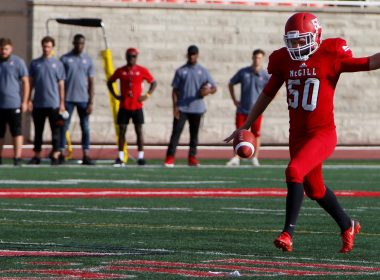
On Sept. 28, two weeks after suffering a heartbreaking defeat at Sherbrooke (1–4–0), the McGill football team (2–3–0) took their revenge on home turf. With a lively Homecoming crowd in attendance, the home side fought their way to a 20–13 victory. 

McGill’s offence was off to a quick start with third-year quarterback Dimitrios Sinodinos dissecting the Vert & Or’s defence on a 76-yard scoring drive. The sequence ended with a five-yard touchdown reception by fourth-year receiver Mathieu Soucy. This was, however, the only time that McGill would be able to reach the end zone for a touchdown during the game. 

“We play against very good players in this league,” second-year tight-end Simon Crevier said after the game. “But if we keep on plugging, stacking, and executing, good plays will eventually come.”

While McGill’s offence struggled for the remainder of the game, the defence flourished. Fourth-year defensive back Jean-Philippe Hudon and third-year safety Tristan Fleury were defensive stalwarts on the field, punishing ball-carriers play after play, while McGill’s defensive backs covered receivers like blankets. In a post-game interview, third-year cornerback Markens Valcourt praised coaches Joe Hagins and Ron Hilaire

“We’ve got to give them props,” Valcourt said. “[The coaches] prepared us very well all week, and we were put in a position to win. All we had to do [was] execute, and that’s what we did. At the end of the day, [Sherbrooke] wasn’t able to move the ball on us.” 

McGill went into half-time with a 10–3 lead. Coming back from the break, the home team looked grim. Sinodinos was strip-sacked, and Sherbrooke recovered the ball on the seven-yard line. On the next play, McGill’s defence caved and the game was back to even. In response, both sides tightened up their defence, leading to an uneventful third quarter.

At the beginning of the fourth quarter, McGill gained a 14–10 advantage thanks to back-to-back safeties. With their lead restored, the home side focused on holding on to it: McGill’s defence swarmed the ball on every play, while the offence finally began to gain some momentum. Late in the game, McGill got into field goal range twice and fourth-year kicker Findlay Brown delivered both times. Brown completed his hat-trick with 1:18 left in the game to bring the score to 20-10. On the ensuing kickoff, Findlay “The Enforcer” Brown made a touchdown-saving tackle to cap off his impressive afternoon.

First-year running-back Laurent Sansalone was a bright spot for McGill’s offence, collecting 63 yards in only nine touches of the ball. Sansalone hopes that his hard work will inspire other rookies on the team.

“I worked my butt off every practice, which gave the coaches confidence in me,” Sansalone said. “Early in the game, they got me the ball, so I ran vertical and got a few first downs.”

McGill will take on the undefeated Montreal Carabins (5-0) at Stade du CEPSUM on Oct. 4.


Moment of the Game:

With the fate of the game still in the balance, fourth-year kicker Findlay Brown hammered home a 44-yard field goal to seal McGill’s victory.

Quotable:

“When we play at our full potential, there is no doubt in my mind that we are the best defence in the league.” – Second-year defensive tackle Thomas Trépanier on the team’s homecoming performance.

Stat Corner:

McGill’s defence only allowed 42 net passing yards: A McGill record under the tenure of Head Coach Ronald Hilaire.

Sports

10 Things: Sports misrepresented on-screen

Stranger Things – Basketball

Indiana is renowned for its Hoosier basketball; however, the battle of Steve “the Hair” Harrington and Billy Hargrove wildly misses this mark. Rather than a 1980s callback to the likes of Larry Bird, this poorly executed game inexplicably features multiple beyond-the-three-point-line postups and a ridiculous through-the-legs layup that undercuts Billy as an antagonist for the rest of the season to come. 

The Room – Football

A spectacular disaster from start to finish, The Room features one of cinema’s worst sports scenes. While there are several moments of aimless football throwing, none is more bizarre than that when a tuxedo-clad group of friends take to an alleyway for an epic contest of underhand throws, near-fumbles, and iconic tripping—all to the sound of a faint tuba and one character saying “pshew” after his throws. 

She’s The Man – Soccer

After removing her wig mid-game to reveal that she is, in fact, not her twin brother whom she had been impersonating, Viola Johnson plays the rest of the match with her hair down. Long-haired soccer players were left questioning why she did not simply take a moment to put it up, knowing how annoying it is to play with hair flying everywhere. 

The Amazing Spiderman – Basketball 

The Amazing Spiderman’s basketball showdown was meant to be a “Revenge of the Nerds”-style redemption scene for Peter Parker, but it wound up being a poorly executed ball-bounce off of Flash’s face. Peter follows it up with a travel violation into an unconvincing backboard-shattering dunk, further undermined by Andrew Garfield’s impressively unathletic  140-pound build.

Blades of Glory – Figure skating

Chazz Michael Michaels and Jimmy MacElroy’s final performance, set to Aerosmith’s “I Don’t Want to Miss a Thing”, has several elements that make real skaters cringe, as well as blatant violations of International Skating Union (ISU) rules. Male pairs are not allowed under ISU competition regulations, and the ISU did not allow competition music with lyrics until 2014. The film was released in 2007. 

Twilight – Baseball 

As far as we know, there is no rule stating that baseball players must be alive, although it’s safe to say that the Cullens’s baseball game isn’t exactly kosher. Normally, outfielders don’t have to dash through the forest to catch a line drive, players wear baseball gloves, and pitchers do not have precognitive powers.

Air Bud – Baseball, basketball, football, soccer, and volleyball

The Air Bud franchise stars a golden retriever who can miraculously play basketball, football, soccer, baseball, and volleyball. While the first movie makes sure to state that there is no rule prohibiting dogs from playing, a last-minute substitution of a player, dog or human, who wasn’t on the roster would never fly. Buddy can drool, but he certainly can’t dribble.

Rookie of the Year – Baseball

Rookie of the Year’s premise, that a 12-year-old can pitch for the Chicago Cubs, is only believable if the pitches are comparable to those of actual professional baseball players. However, no audience could ever be expected to believe the film’s finale, however, in which a professional baseball player strikes out on a tween’s underhanded lob.

Catwoman – Basketball

This scene answers the question, “What if a writer’s room filled with sexually frustrated and physically inactive filmmakers directed a basketball scene?” The ‘90s-themed girlfriend-versus-boyfriend game is riddled with strangely flirtatious eye contact, awkward butt-shaking, defence that wouldn’t stop a cucumber, and a complete disregard for the rulebook, which makes for possibly the single worst basketball scene in the history of film.

Jimmy Kimmel Live – Basketball

The self-dubbed “Blobfish Charity Classic” featured Senator Ted Cruz and Jimmy Kimmel in a sweaty battle to 11 points that would have been more skillfully played by two actual blobfish. In nearly two hours of play, the closest thing to a highlight in this horrifically captivating affair was when the referee reduced the winning score from 20 to 11 for fear of a stroke or a heart-attack.

Science & Technology

Jane Goodall returns to McGill

Jane Goodall began her second Beatty Lecture as she did her first: By saying hello to the audience in “chimpanzee.” Goodall, best known for her work in studying African chimpanzees and her later humanitarian and environmental activism, spoke on Sept. 26 at the 65th anniversary of McGill’s Beatty Lecture series

It had been forty years since Goodall visited McGill in 1979 to give her first Beatty Lecture. Then, still an up-and-coming researcher, Goodall was invited to present a portion of her ground-breaking work on the complex behavioural dynamics of wild chimpanzees. At the time, the event’s organizers feared that she would not draw a large enough crowd to fill a lecture hall. They ended up needing an extra room for the overflow of people waiting to hear her speak.  

This year, speaking to a sold-out crowd of 1,200 people, Goodall recounted the beginnings of her scientific careera journey that took her from the shores of England, to Kenya, and finally to Tanzania, the now famous site of her chimpanzee research. 

Goodall knew from the start of her investigation that chimps held the key to understanding human evolution; they were a vital link between ape and man. 

“The thing that was so striking [to me] was how alike the chimps are to us,” Goodall said. “[Their] postures and gestures of communication, they are the same as ours […] kissing, embracing, sometimes holding hands, begging for food, using tools in many situations.” 

Before Goodall, the world knew very little about chimps, their highly diverse social networks, and their close evolutionary proximity to humans. But with Goodall’s research, the scientific conception of evolution was forever changed. 

“I could spend hours out in the rainforest,” Goodall said. “Sometimes with the chimps, sometimes, just out there in the forest […That] is where I learned about the interconnectedness of all living things, and how each species, no matter how small or insignificant they may seem, has a role to play in this wonderful tapestry of life that we call biodiversity.”

Goodall recalled that it was during that period that she began her lifelong mission of protecting chimpanzees from the dangers of human interference. All around her, she began to see the adverse effects that deforestation, population growth, and destructive agriculture had on chimps. 

After attending a 1986 conference about chimpanzee evolution, Goodall was struck by the conditions in developing countries, seeing parallels between the plight of chimps and that of local communities in Africa. 

“It hit me then […] How can we even try and save the chimps when people are living and struggling to survive?” Goodall said.

Goodall’s speech quickly turned from saving the chimps to tackling issues at the heart of worldwide humanitarian and environmental crises, work that has defined the latter half of her life so far.

“Most people understand the problems of the planet, but don’t do anything because they don’t know what to do,” Goodall said. “And that’s why the most important message is that each one of us can make an impact every single day. We can make a choice as to what we buy, where it comes from, and if it harms the environment.”

Though Goodall admitted that we live in a time that poses exceptional challenges, she offered the audience an optimistic perspective. 

“I’ve seen so much suffering and destruction,” Goodall said. “But my main reason for hope remains with our young people, because when we listen to their voices and empower them to take action, as you know, they can and are changing the world.”

The exhibition “With the world to choose from: Celebrating 65 Years of the Beatty Lecture” is on now at the Rare Books and Special Collections on the fourth floor of the McLennan library. The interactive exhibition gives onlookers a glimpse into the history of the Beatty Lecture including a closer look at some of the world leaders, best-selling authors, and Nobel Prize winners who have graced the Beatty Stage.

Science & Technology

Microplastics: A ubiquitous problem

In 2017, Orb Media, a non-profit media group, sparked public concern after they published research showing that microplastics were present in global drinking water. Since then, research efforts have increased to examine the effect of microplastics on species and find ways to make the removal process more efficient. 

At a lecture at McGill on Sept. 20, Robert Andrews, a lead scientist at the Drinking Water Research Group (DWRG) at the University of Toronto, explained that scientists have not yet determined a universal definition for ‘microplastics.’ However, they are widely agreed to be small pieces of plastic with a diameter ranging from one nanometre to five millimetres. If produced on purpose, these small plastic particles are called primary microplastics. Common primary microplastics include plastic pellets used in large-scale plastic production and microbeads found in cosmetics. Secondary microplastics, which include plastic film from labels and microfibres from laundry, are pieces that have degraded from larger plastic products.

The Drinking Water Research Group (DWRG) is one of the most prominent expert organizations in this relatively new field of study. In 2017, Andrews and his colleague Chelsea Rochman tested water samples from Lake Ontario and found microplastics in them. Ever since, DWRG’s main objective has been to quantify the presence, size, and type of microplastics in the Great Lakes and evaluate and improve the efficiency of current water treatment.

Andrews explained that conventional water treatment processes often add microplastics to the water. 

“If you go to a water treatment plant where everybody dresses in a blue uniform, guess what colour the primary fibres that we find [are]? Blue!” Andrews said. 

The DWRC found that although microplastics ranging from 100 to 500 micrometres were effectively removed by treatment, the number of those ranging from 10 to 45 micrometres increased after filtration.

“Had [the smaller pieces] been broken down by filters [or] by oxygen?” Andrews asked. “We don’t know. But within the next year, we will find out.”

Among the samples collected from Lake Huron, Lake Erie, and Lake Ontario, they found that Lake Ontario had the highest count of microplastics per litre. One explanation is that since Lake Ontario is downstream from the other Great Lakes, plastic particles accumulate. This is concerning for Ontario residents, because Lake Ontario provides nearly half of the population’s water source.

Scientists are unsure whether microplastics cause harm to humans once ingested, which is particularly troubling given recent McGill research showing billions of microplastics in tea. Research shows that plastic pieces can act as contaminant vectors in transporting pollutants and pathogens. Furthermore, the tiny plastics can also be translocated to the circulatory system in mussels and fish, leading to questions of whether the toxic chemicals released from these microplastics will go on to poison the organisms through their bloodstream. 

According to Andrews, medical researchers have also expressed concerns regarding plastic use during medical procedures, specifically the breakdown of these plastics causing DNA damage and genetic mutations. However, a recent report issued by the World Health Organization (WHO) assessed the risk associated with ingesting microplastics as low but acknowledged the insufficiency of available information and the need for further studies. 

“Even though [microplastics] are small, there may not be a whole lot of them [in your body],” Andrews said in an interview with The McGill Tribune. “If you accumulate them over a lifetime, perhaps there is an issue.”

Since the DWRG quantifies microplastics but does not study their effects on organisms, Andrews admitted that their research runs on the basis of the precautionary principle. 

“That’s what we do in drinking water research,” Andrews said. “[We] try and say ‘what’s there?’ and then somebody else can say, ‘is it dangerous?’” 

In the future, the DWRG aims to automate analysis and standardize testing water sampling methods. It also plans to continue examining the process of microplastics removal.

McGill, News

McGill’s second annual Queer History Month holds its opening ceremonies

Sept. 27 marked the beginning of McGill’s second annual Queer History Month and the 17th annual queer homecoming ‘Return of the Rainbow.’ Meryem Benslimane, equity education advisor to the provost and Vice Principal, as well as chair of the Planning Committee of Queer History Month, spoke on the importance of recognizing the difficulties that 2SLGBTQIA+ people may face within their own families and communities. 

“This [month] will be to celebrate [Queer] histories, so the focus is really on learning, on the educational purpose, [and] on raising awareness,” Benslimane said.

The opening ceremony included presentations from those in the McGill 2SLGBTQIA+ community, who shared their personal experiences as well as queer history from McGill, Montreal, and beyond. Afterward, hors d’oeuvres and drinks were served and McGill students, staff and alumni had the opportunity to socialize.

 Organized by student and staff organizations at McGill, Queer History Month is intended to reach out to McGill and Montreal communities with 17 events celebrating various aspects of 2SLGBTQIA+ lives. Coming up this week is a lecture by Sara Ahmed, “Complaint as a Queer Method” on Oct. 4 that sold out within minutes: Staff relocated the event to a larger room in the McIntyre Medical Building to accommodate the large demand. The event concludes with a closing ceremony on Halloween featuring various speakers, artists, and an open mic opportunity.

Shawn McCutcheon, a PhD candidate studying queer history, described his experience as a student in his speech during the opening ceremony. 

“Reading, seeing, [and] hearing testimonies from individuals of the past is akin to an emotional rollercoaster,” McCutcheon said. “Past voices can be almost unbearable, echoing hatreds and despair […] One also encounters beautiful examples of solidarity and love.” 

McGill has a rich history of queer activism, which includes students and staff who have fought for rights, safety, acknowledgement, and the establishment of the Subcomittee on Queer People in 2002 that now plans McGill’s Queer History Month. Juanita Marchand Knight, a Research Assistant and Performer at the Schulich School of Music, described her vision for the month at the ceremony. 

“We can see that the Queer community has accomplished splendid things and those things are celebrated at Mcgill,” Marchand Knight said. “We can see that people remember the times when our rights were limited and acknowledge how wrong it is, and that, moving forward, we are going to keep fighting for those who are still marginalized, together […] It means that, hopefully, others will not waste 20 years wearing a skin that isn’t theirs and is so heavy that they cannot reach those goals and dreams.”

McGill’s first Queer History Month last year was the first of its kind at any Canadian university. The month has grown in scope since its inauguration, and the title has been changed from 2SLGBTQIA+ to Queer History Month to draw on the community’s reclamation and empowerment of a word once used as an insult and slur. 

“Now the acronym that we’re using is 2SLGBTQIA+,” Benslimane said. “To acknowledge that Indigenous people were here on this land first before us and to show solidarity.” 

Though McGill is currently Canada’s only university with a Queer History Month, Benslimane expressed her hope for Queer History Month to continue to grow in popularity. 

“It would be really [nice] to see [a Queer History Month]  in every institution, and not just universities, but in high school, because you see the impact on folks,” Benslimane said. “That would be my dream, to see it happening everywhere and keep happening forever.” 

Science & Technology

Nobel Prize winner in Chemistry inspires McGill students

On Sept. 26, a sea of undergraduate and graduate students packed into the Pollack Hall auditorium. They were there to listen to Martin Chalfie, an acclaimed geneticist and winner of the 2008 Nobel Prize in Chemistry, speak about his discovery of the green fluorescent protein (GFP).

GFP is a bioluminescent tracker derived from the crystal jelly, a species of jellyfish that glows bright green under UV light when activated by calcium ions in seawater. By attaching GFP to a protein, scientists can observe its pathway through the systems of living organisms. Chalfie found the protein particularly interesting because his research primarily concerned nematodes, a type of roundworm with transparent skin, which makes it easy for him to observe GFPs flow. The biological marker allowed scientists to move away from dead specimens and instead work with live ones, since GFP doesn’t hurt or damage the organism.

“[Before], in order to do any of [our] experiments, we had to prepare the specimen, which meant killing it,” Chalfie said. “We were just getting a step of what was going on; we had no idea of what was happening over time.” 

GFP has a vast range of applications that go beyond its original intent. From detecting the HIV-1 virus to locating explosive dynamite in active landmines, the versatility of bioluminescence is impressive.

Chalfie’s talk was not limited to the conclusions of his experiments. He also shared some valuable wisdom with the audience on the true nature of science. According to Chalfie, there are certain traits that society has attributed to scientific success that are blatantly untrue. 

For one, few scientists are actually lone geniuses. This stereotype likely emerged from prodigious pioneers of the past, such as Galileo Galilei or Albert Einstein. Today, however, scientific research is done by teams of devoted individuals, whose passion and hard work negate any need for a photographic memory. Chalfie used his university transcript as an example of this. 

“I showed my transcript at a college reunion after [winning] the Nobel,” Chalfie said. “Everyone came up to me and said, afterwards, ‘Thank you for showing that. I was embarrassed about my transcript.’” 

Chalfie also proposed an amendment to the scientific method based on his experience. The scientific method is a structured manner of conducting an experiment that has long been drilled into the heads of eager baking-soda-and-vinegar science fair students. The six steps begin with a question and end with a discovery. In the modern and professional context of research, Chalfie said, the discovery tends to come before the hypothesis. It is not uncommon for raw data to emerge in an unexpected way that will require scientists to completely rethink their approach. According to Chalfie, science is chock-full of stumbling and failure, and falls short of the exceptionally precise reputation that precedes it. As a result, a great deal of discoveries actually happen by accident. 

“I know people who have had very successful experiments by throwing their parts on the floor,” Chalfie said. “It’s not exactly the scientific method, but it’s something!” 

In fact, the cultivation of the bioluminescence from jellyfish was one such accident. Osamu Shimomura, an organic chemist and marine biologist who shared the 2008 Nobel Prize with Chalfie, noticed that certain elements in seawater activated the glow in the organism because he threw his species into the sink one night before closing the lab. 

Although Chalfie paints a generous picture that attempts to distribute much of the credit of his Nobel Prize to chance and luck, it is clear that his contribution to science lies not only in his team’s discoveries, but also in his unique scientific approach.

Off the Board, Opinion

Social media: The scrapbook of our time

Being a naturally private person, I have never felt social media came easily to me. I’ve often found myself sympathizing with those who criticize my generation for our tendency to overshare online, not because I see it as symptomatic of narcissism, but simply because I don’t share the same impulse. As a result, my  presence online has always felt phony and contrived. My resentment for the practice is only emphasized by the fact that I, like many, feel compelled to stay active on social media, for no other reason than my inability to remember life without it. 

None of this would be so strange if I weren’t such a sentimental person. I’ve always liked taking photos, keeping diaries, and collecting souvenirs, and I’ve always hated throwing things away. In this way, self-documentation has always been important to me, and it’s a practice that runs in my family.  

In August, I visited my grandfather, who more so than anyone I know my own age, is an ardent oversharer. Having always been a prolific writer, my grandfather made a hobby of chronicling family history after retirement. During our most recent visit this summer, he presented me with a manila envelope containing about a dozen printed pages. He explained that it was a condensed history of all the sailors in our family, dating back to the 1850s. The pages contain sophisticated descriptions of boats that our family has sailed, significant voyages they have taken, and even a brief excerpt from a diary entry written by my great grandfather.

“None of this would be so strange if I weren’t such a sentimental person. I’ve always liked taking photos, keeping diaries, and collecting souvenirs, and I’ve always hated throwing things away.”

Having spent many years as a commercial fisherman in Yarmouth, Nova Scotia, my grandfather included some of his own stories as well. He compiled all this information a couple years back, but said that he was reminded of the document when he learned that I had spent the past summer bartending on a commercial cruise ship. He was pleased to learn that I was carrying on the family tradition. 

There’s one section in the document where he describes the cast of characters one might have encountered in a ship’s crew in the 1930s.

“By occupation alone they were hard men, working at a difficult, dangerous job. Individuals might be either gentlemen or the scum of the earth,” my grandfather wrote. 

Reading this made me equally as pleased to have joined their ranks.

A couple years ago, my now 91-year-old grandfather joined Facebook. Like me, he posts infrequently and seems relatively uninterested in the platform, which is a shame; because it would make staying in touch easier and I think he would be great at it. Instead, his preferred method of communication are phone calls—long ones. Unlike me, his reticence to communicate online stems more from a lack of familiarity with the platform than any feelings of self-consciousness. Were he more tech-savvy, there’s no doubt in my mind that he would come up with some excellent content, being such a natural storyteller.

Whether or not I’ll ever successfully get over my own internet shyness, I’ve come to appreciate social media as not only a communication tool, but also a means of cataloguing and recording personal history. Those quick to criticize my generation for oversharing or for being self-involved misunderstand that it’s human nature to want to record one’s experiences. From our grandest adventures to life’s minutiae, stories and storytelling remain an invaluable part of the human experience.

Read the latest issue

Read the latest issue