Latest News

McGill, News

Divest McGill’s efforts spurred by United Nations report

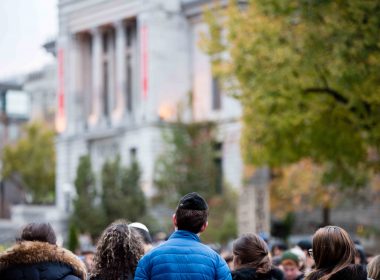
Divest McGill held a rally outside the James Administration Building on Oct. 22 during a meeting of the Committee to Advise on Matters of Social Responsibility (CAMSR), protesting McGill’s ongoing investment in companies involved with the fossil fuel industry. The demonstration comes after the McGill Senate approved a motion endorsing divestment from fossil fuels on Sept. 12, an institutional response several years in the making.

“This campaign has been going on for six years, and every year there are new faces, new interest,”

Morgen Bertheussen, U3 Arts, said. “The campaign isn’t dying down, so it’s nice to see that every new school year there’s a lot of new […] people that are excited about change and the divestment campaign as a whole.”

However, Divest’s campaign isn’t over yet. McGill’s Board of Governors (BoG), the university’s highest authority, decided not to implement the Senate’s endorsement and to leave the divestment decision to CAMSR instead.

“We’re having [the protest] because CAMSR is meeting,” Annabelle Couture-Guillet, U3 Arts & Science, said. “We’re here today to remind them that, despite the bureaucratic barriers that they’re using, we still care, and we are not going away,”

Ehab Lotayef, a member of the BoG, also attended the rally. He stressed the importance of divestment.

“We don’t have time to debate and discuss,” Lotayef said. “The environmental situation is really critical, and I think that McGill should take a leading position in practical steps.”

McGill has aimed to promote sustainability through its commitment to carbon neutrality by 2040 and numerous other initiatives on campus such as the Sustainability Projects Fund (SPF). Nonetheless, Jacqueline Lee-Tam, U1 Arts, explained to the protesters how McGill’s investments in the fossil fuel industry negate these initiatives.

“All of McGill’s [sustainability] initiatives are nullified by the fact that [the university has money] invested in the fossil fuel industry,” Lee-Tam said. “If McGill really wants to be a sustainable and carbon-neutral campus then [we must] divest.”

Christina Lau, U1 Sustainability, referenced the growing support for divestment on campus. Besides the Senate, the Student’s Society of McGill University (SSMU) endorsed divestment in 2012, the Faculty of Arts’ endorsed divestment in 2015, and, on Nov. 8, 2017, the McGill Association of University Teachers (MAUT) Council voted to divest from fossil fuels. MAUT council reorganized $500,000 of its investment portfolios, which included fossil fuel companies.

“A lot of people support the divestment movement so I don’t understand why we haven’t gotten to it yet,” Lau said. “The MAUT council [and] the Senate ruled in favor of [divestment]. There’s a lot of reasons to [divest], and there aren’t a lot of reasons not to.”

Lau explained that the new Intergovernmental Panel on Climate Change (IPCC) report motivated her to attend the Divest McGill rally. The IPCC’s report states that only 12 years remain to prevent irreversible, devastating climate change and it recommends staying below a 1.5°C increase from pre-industrial temperature levels. It also outlines several solutions, including cutting fossil fuel use in half in less than 15 years. Currently, a total of 985 countries, associations, universities, foundations, and religious organizations have committed to divestment from fossil fuels.

“The IPCC report that came out on [Oct. 6] outlined a future that is more dire than any of us are prepared for,” Lee-Tam said. “We are going to see small island nations sink. We are going to see increases in climate catastrophes such as hurricanes, typhoons, and floods [….] We need to act. We need to be bold and fearless in the face of climate change.”

Lee-Tam called on CAMSR to consider the findings of the IPCC report.

“We invite CAMSR to think about all these things. We invite CAMSR to consider that we are living in a day and age where fossil fuels are no longer going to be sustaining us.”

Arts & Entertainment, Books

Drawn & Quarterly celebrates two of its groundbreaking writers

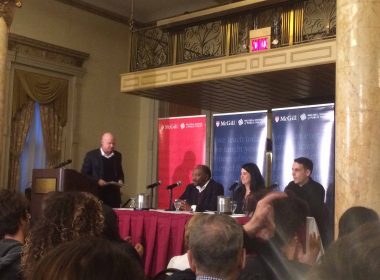
On Oct. 26, a crowd packed into La Petite Librairie Drawn & Quarterly for the launch of two world-class comic books: Julie Doucet’s Dirty Plotte and Jason Lutes’ Berlin.

Beyond its title as the Mile End’s hippest bookstore, Drawn & Quarterly is one of North America’s most influential publishing houses for comic books and graphic novels. Doucet and Lutes are two of Drawn & Quarterly’s earliest authors, and the size and enthusiasm of the audience at the launch was evidence of the success of their collaboration.

A native Montrealer, Doucet was the first cartoonist Drawn & Quarterly ever published; her first comic was released 28 years ago this month. While she has long been retired from cartooning to pursue different artistic mediums, such as silk-screen prints, the publication of the retrospective collection Dirty Plotte: The Complete Julie Doucet is a celebration of both Doucet’s work and her influence.

“It all goes back to Julie,” Chris Oliveros, Drawn & Quarterly’s founder said. “She set the tone for everything at Drawn & Quarterly.”

The Dirty Plotte series, published throughout the ‘90s, was edgy, feminist, and ahead of its time. In an interview at the launch with feminist scholar Martine Delvaux, whose essay “My Secret Julie Doucet” is included in the newly-published collection, Doucet described the joy of re-reading her earliest works.

“It was complete freedom,” Doucet said. “It was so fresh and so energetic.”

When Doucet first began publishing, she was one of the first women to break into the  comic book world’s boys’ club. Her frank and feminist depictions of graphic sexual content only magnified the division between Doucet and her male peers.

“I guess it surprised them,” Doucet said, laughing.

Her male counterparts may have been surprised at the time, but Doucet paved the way for the next generations of female cartoonists.

 Jason Lutes’ Berlin strikes a stark contrast in tone and content to Dirty Plotte: It is a 22-chapter historical epic retelling the story of the Weimar Republic.         

In an engaging presentation, Lutes traced his own personal history, beginning with a childhood spent hunched over comics in the corner of a magazine shop in Missoula, Montana. His early obsession with superheroes and Westerns was augmented by a love for Tintin, encouraged by his father, a French professor at the University of Montana. After attending the Rhode Island School of Design to study ‘real art,’ specifically drawing, he came to realize that comic books, rather than a childhood triviality, were an equally valid vehicle for expression. Comic books could be relevant to eager children and thoughtful adults alike.

“Comics [are] an art form for anyone, no matter what kind of story you want to tell,” said Lutes.

After graduating in 1991, Lutes got a job creating a serialized comic strip for the Seattle-based indie magazine The Stranger. Recalling that Tintin had also begun as a serialized strip in Belgium, Lutes turned the job into his own “self-education in comics.” This work was eventually collected into his first book, Jar of Fools.

 Berlin, Lutes’ most ambitious endeavour, was born from a chance encounter with a collection of Bertolt Brecht’s paintings. Envisioning a historical work, Lutes plunged into the history of the Weimar Republic.

Starting when he was just 26, Lutes planned a six-hundred-page work and estimated that he would finish it by the time he turned forty. As it happened, he was fifty by the time he completed Berlin’s 22nd and final chapter this year.

“I missed some deadlines,” Lutes quipped.

The result of nearly twenty-five years of work, Berlin is a comic magnum opus on an unprecedented scale, tracing the lives of more than a dozen characters during the rise of Nazism. It is one of the fullest expressions yet of the narrative and artistic potential latent in the comic book form.

The same can be said for Doucet’s Dirty Plotte, which, in its collected, newly-republished entirety, rivals Berlin in length. Thursday’s book launch was a celebration of the growth of the comic book as an art form, and of two of its greatest and most artful exemplars. It was also a celebration of the seminal role that Drawn & Quarterly has played in this growth of the form, the results of which are already echoing far beyond the island of Montreal.

Arts & Entertainment, Books

Interpreting Shakespeare’s sonnets

David Schalkwyk, a professor of Shakespeare Studies at Queen Mary University of London, delivered a lecture on Oct. 23 on William Shakespeare’s sonnets, focusing on the development of Shakespeare’s dramatic voice. The dramaturge is best known for his plays, meaning that his poetry is sometimes overlooked in popular culture.

Schalkwyk’s lecture was organized by McGill English Professor Paul Yachnin and funded by the Lang family, which awards a scholarship to one Arts student each year to encourage interest in plays and theatrical texts. In his lecture, Schalkwyk argued that Shakespeare’s use of pronouns effaces his voice as a poet in his sonnets. Schalkwyk highlighted that contemporary scholars and actors have used the absence of an obvious speaker, as an opportunity for finding different approaches to Shakespeare’s sonnets.

“The actors are remedially trying on the sonnet,” Yachnin said. “‘How does it fit me? Does it look ok?’ That’s their job. Whereas we, scholars, sort of dig into the language and see what’s going on in the language.”

The contrast between the scholarly analysis of voice and an actor’s interpretation illustrates how complicated it is to approach Shakespeare’s sonnets, but also exemplifies a different method for literary examination.

“What we found when we put our heads together is that the students brought this really interesting degree of attention to the language that was very helpful for the actors, and the actors brought a kind of immediacy and investment in the sonnet that was very helpful for the students,” Yachnin said.

Schalkwyk argued that Shakespeare’s use of language in his sonnets doesn’t evoke one particular perspective, but rather brings to life the voices of various characters.

“Shakespeare shadows [the narrative voice in his sonnets],” Schalkwyk said. “[Those personas include] a servant, poet, dramatist, actor, father, husband, lover, ambitious member of the upcoming middling sort, ageing man overwhelmed by the fragility of human things and the inexorability of time.”

Elsasoa Jousse, U2 Arts, wants to write her honours research paper on Shakespeare and went to the event to try to find inspiration.

“I try to go to everything related to Shakespeare really,” Jousse said. “[The lecture] was interesting, something that I’m not completely unfamiliar with, so I could follow, but there were a lot of ideas I hadn’t considered before.”

Chloe Holmquist, U2 Arts, reached a similar conclusion and appreciated the lecture’s new approach to the study of Shakespeare.

“Last semester, I read all of Shakespeare’s sonnets so I was very intrigued by the concept of coming up with a voice by analysing all these sonnets,” Holmquist said. “I thought [the] subsection on pronouns was really interesting, and I never considered analysing the sonnets that way before.”

Kateryna Fylypchuk, U2 Arts, is studying Drama and Theatre and believes it is important to study other facets of Shakespeare’s art.

“It’s very eye-opening to see the fact that different voices can be heard,” Fylypchuk said. “When we think of Shakespeare as having a very male-dominated outlook, especially in terms of drama [as] actors were all male, it’s very interesting to think that there is no particular voice attributed to the actors, the texts, and Shakespeare himself.”

In addition to the lecture, Yachnin was also involved in the planning of an Infinitheatre production entitled Shakespeare’s Sonnets: Transforming the Voices of Montréal from Oct. 22 to 27.

“[Film and theatre director] Guy Sprung and I started talking about two years ago about doing the sonnet show at McGill,” Yachnin said. “I direct the Early Modern Conversions Project here, and […] then the English department came into it as well. So the Infinitheatre, the English Department and the Conversions Project are partners with what Guy and the actors are doing at the Moyse Hall.”

Student Life

Beyond the gates of Montreal’s cemeteries

Montreal’s historic cemeteries inter the area’s most famous figures. This week, The McGill Tribune reviews the historic personas laid to rest around the city.

John Redpath (1796 – Mar. 5, 1869)

Redpath was a businessman and philanthropist who helped industrialize Montreal in the early 19th century. He was also involved in major city projects including the the construction of the Lachine Canal in 1825 and the Notre Dame Church in 1829. These contributions made Montreal a central commercial trading hub and popularized Redpath’s success among city dwellers. After his death in 1869, he was buried in Mount Royal Cemetery.

Jocelyn Gordon Whitehead (25 Nov. 1895 – July 5, 1954)

Buried in the Hawthorn-Dale Cemetery, Whitehead gained infamy for delivering a sucker-punch that led to magician Harry Houdini’s death. He was a McGill student and an amateur boxer in the early 20th century. According to witnesses, on October 22, 1926, Whitehead visited Houdini in his dressing room before a Montreal performance and asked the magician if it was true that he could withstand punches to the abdomen. He then delivered several blows to the magician’s stomach as he was laying down. Over a week later, Houdini died on October 31, 1926 of severe appendicitis. Whitehead was never charged with a crime, but he did have to sign an affidavit for Houdini’s widow, Bess Houdini, recounting the events of that night.

David Ross McCord (18 Mar., 1844 – Apr. 12, 1930)

McCord was not only a Montreal native, but also a McGill law graduate and eventual magistrate. McCord, who is interred in Mount Royal Cemetery, gained national praise and fame by advocating for the rights of indigenous peoples in Canada. He later lobbied for the creation of a national museum dedicated to Canadian history in 1878. On Oct. 13, 1921 he got his wish when the McCord Museum opened its doors with a collection of 15,000 artifacts from McCord’s personal collection.

Sir John Abbott (Mar. 12, 1821 – Oct. 30, 1893)

Abbott was the third prime minister of Canada, serving from 1891 to 1892. Another McGill law alumnus buried at Mount Royal Cemetery, Abbott began his career as an attorney, and soon became one of Montreal’s most prominent lawyers to date. He later returned to the university as a professor of law and earned a doctorate in civil law. Before his prime ministership, Abbott rose to national attention for successfully defending the perpetrators of the St. Albans Raid and for advocating for greater language diversity in Quebec by promoting the interests of Anglophone Quebecers.

Charles Meredith (Dec. 17, 1854 – Jan. 7, 1928)

Meredith, who is now buried at Mount Royal Cemetery, was a banker and president of both the Montreal Stock Exchange and the then-prominent Canadian brokerage firm, C. Meredith & Co.  In 1910, he became the president of Hillcress Collieries Ltd. and was director of the British & Colonial Press Service while sitting on the Montreal Board of Trade. Additionally, Meredith co-founded the Mount Royal Club and once owned the land on which the Ritz-Carlton Hotel was built. The Charles Meredith House, Meredith’s home located in the Golden Square Mile, is now used by McGill’s Faculty of Medicine, which houses the Departments of Epidemiology, Biostatistics and Occupational Health.

mascots
Sports

10 things: Spooky mascots

Sometimes, a lovable mascot does not turn out the way a team’s management had imagined. With Halloween just around the corner, The McGill Tribune ranks the top-10 most terrifying mascots in the world of sports.

10. Buster Bronco (Western Michigan University)

Western Michigan University introduced Buster Bronco in 1988 but came out with a new look for him last fall. The new Buster is a slim, athletic creature with the most intimidating glare that a giant, fuzzy horse head can give. The change is a sharp contrast from the old, goofy Buster: His eyes were half open, he had a confused grin, and the colour contrast between his head and his snout was comically unnatural. Many students found him endearing and it took less than two weeks for 1,600 people to sign a petition to bring back the old mascot. Unfortunately, the university kept the updated, scary Buster regardless.

9. Wenlock and Mandeville (London 2012 Olympic and Paralympic Games)

The tall, pale cyclopes known as Wenlock and Mandeville look more like what would happen if Kang and Kodos from “The Simpsons” got left out in the sun for too long. Their eyes are the problem: Wenlock appears to have their brow scrunched to look determined and competitive, but it comes across as angry and menacing. Meanwhile, Mandeville’s wide eye gives the impression that they are afraid of the children who come to take photos with it. Whether angry or scared, it doesn’t matter—they are both very, very eerie.

8. Mr. Redlegs and Rosie Red (Cincinnati Reds)

At first glance, Cincinnati Reds mascots Mr. Redlegs and Rosie Red look like smaller, knock-off versions of New York Mets mascot Mr. Met. However, upon closer examination, Mr. Redlegs’ strange eyes and creepy stare become obvious while his disingenuous smile is hidden behind an oversized Stalin-esque mustache. Rosie Red, often at Mr. Redlegs’ side, is harder to pin down. If Flo from the Progressive Insurance commercials had her head enlarged to three times its size and then turned into a baseball, Rosie Red would be the end product. Simply put, Mr. Redlegs and Rosie Red are not the family-friendly couple to watch a ballgame with.

7. The Stanford Tree (Stanford University)

As the official mascot of the Stanford University marching band, the Stanford Tree goes wherever the band goes. In 1981, the school declared that all sports teams would be represented by the colour of cardinal in place of the Tree, but the band kept the tree due to its popularity, which persisted despite its distinctly off-putting appearance. The misshapen tree is a sight to behold. Its large buck teeth and eyes that look in opposite directions are very weird, and they bring to mind childhood nightmares of monsters under the bed.

6. WuShock (Wichita State University)

The Wichita State University sports teams are called the Shockers because students used to earn money in the summer ‘shocking’—or harvesting—wheat in the fields of Kansas. Naturally, the school wanted a mascot that both honoured their harvesting history and depicted them as tough competitors. Thus, WuShock was born. WuShock was intended to be a muscular, intimidating bundle of wheat. Unfortunately for the Shockers, there is no way to put a face on a bundle of wheat without it being strange. WuShock’s menacing scowl brings to mind the nightmare in which murderous scarecrows chase you down in a cornfield.

5. Purdue Pete (Purdue University)

Pete is not the official mascot of Purdue University, but he is honoured as such for how he hypes up the crowd at sporting events. His caricatured image dates back to 1940, but the costume has since undergone several major modifications. None of these changes got rid of his creepy features. In 2011, the university considered a makeover to downsize Pete’s head so as not to scare children. The proposition was met with backlash, though, and, so, his bizarre human face and large, ghoulish eyes still haunt sports fans today.

4. Friar Don (Providence Friars)

It’s incredibly difficult for any team to pull off a successful human mascot. Providence College’s Friar Don is no exception. Given their team name, Providence opted for the obvious mascot choice: A friar. Ultimately, that led to the monstrosity that is Friar Don. He is haunting and ghoulish with his “The Scream”-like face. The proportions of his facial features and costume elements are completely off-base; they definitely don’t match anything approaching reality.

3. Gritty (Philadelphia Flyers)

Gritty was introduced to Flyers fans in September 2018, but the fuzzy creature claims to have been hiding in the stands at the Wells Fargo Center for much longer. He’s gained many fans from the publicity that came following his introduction, but the reality is that he is a terrible mascot. No one is all that sure what he is supposed to look like; what is sure is that Gritty is absolutely terrifying. His giant googly eyes and wiry, unkempt hair give him an air of derangement while his orange-and-black colouring scheme gives off a distinct Halloween vibe.

2. Pierre the Pelican (New Orleans Pelicans)

The Pelicans brought Pierre to life in 2013, and his design was immediately met with criticism for his horrifying non-pelican-like features. His creepy, clownish face and giant, chicken-like body were a better fit for a low-budget horror movie than courtside at a professional basketball game. The Pelicans came out with a new design later that season, citing a broken beak as the reason for his reconstructive surgery. The lack of clown makeup in the new costume did wonders for his appearance, although he still looks more like a chicken than a pelican.

1. King Cake Baby (New Orleans Pelicans)

Somehow, Pierre wasn’t bad enough for the Pelicans. New Orleans has two spooky off-court talents: Pierre the Pelican ranked number two on our list, and King Cake Baby now takes the number one spot. The inspiration for the team mascot is the traditional king cake, a Mardi Gras custom in which people hide a small baby figurine inside of a ring-shaped cake. King Cake Baby is easily the most terrifying child found outside of horror films like The Shining. The team’s main mascot, Pierre the Pelican, was already scary enough, but the terrifying King Cake Baby made him look as friendly as Big Bird from Sesame Street.

Science & Technology

United Nations stresses climate conundrum

It was a mild morning in London, England when the United Nations Intergovernmental Panel on Climate Change (IPCC) released its groundbreaking report in May 1990. By proclaiming that the Earth’s gradual warming is unquestionably man-made, it became the first international body to state so.

The report was concise: “Unless emissions of carbon dioxide and other harmful gases [are] immediately cut by more than 60 per cent, global temperatures [will] rise sharply over the next century, with unforeseeable consequences for humanity.”

Despite these dire warnings, the world has remained relatively indifferent, continuing to back competitive oil markets, build more factories, and ignore the pleas of the overwhelmingly unified scientific community.


An International Dilemma

Earlier this month, the IPCC released its special climate change assessment report, reiterating many of the same proposals it had asked world leaders to consider almost three decades ago. Titled “Global Warming of 1.5˚C,” the report states that the earth’s temperature increases must be kept  below 1.5˚C of pre-industrial levels, or else risk disastrous consequences to our social and ecological systems. Irreversible changes to world climate are expected as soon as 2030, by which time the world is expected to have exceeded its carbon budget.

“A lot of the focus prior to the Paris Agreement had been on  2.0˚C of warming,” Kirsten Zickfeld, a lead author on the IPCC special report, said in an interview with The McGill Tribune. “However, many vulnerable nations, such as small island states and nations in the developing world, are more vulnerable to the effects of climate change.”

Their desperate call for action prompted the IPCC to reevaluate their recommendations, leading to the publication of this most recent report. After over a year of research, the IPCC concluded that 2.0˚C of warming was too generous an estimate for island nations and countries with coastal infrastructure.

“Two degrees is something that many of these countries could not adapt to,” Zickfeld said. “The effects would be too serious.”

The 1.5˚C threshold is an aggregated measure based on the findings of various studies. It represents the IPCC’s best estimate for the point at which there will be devastating natural phenomena beyond human control. Unfortunately, according to Nigel Roulet, professor of geography and director of the Global Environmental and Climate Change Research Centre at McGill, many places, such as Afghanistan and Kuwait, are either nearing or have already surpassed this threshold.

“Even if we completely stopped carbon emissions now, we would expect more warming to occur,” Dáithí Stone, a researcher at the National Institute of Water and Atmospheric Research, said.

Meanwhile, it takes time for the effects of climate change to play out, meaning that the highest risk areas will likely get worse despite their best efforts.


Canadian Catastrophe

Many of the impacts of climate change can already be observed right at Canada’s doorstep. In 2018, British Columbia experienced not only one of the hottest wildfire seasons by average temperature on record, but also saw a massive number of active wildfires burning at a single time, second only to 2017.

In an interview with the CBC, Chilliwack fire ecologist Robert Gray stated that the

prevalence of wildfires has drastically exceeded previous climate models.

“What we thought was going to be an average condition in 2050, we’re starting to see those conditions coming a lot sooner,” Gray said.

Gray’s concerns are echoed in the IPCC report. The committee warns that changes in climate, which were thought to occur gradually over the next century, are happening at an exceedingly amplified, if not alarming, rate. Increases in the number and ferocity of B.C.’s wildfires are directly related to the climate conditions in the region; as average temperature rises in the summer and spring months, so does the probability of emergent wildfires. In Alberta, some climate models predict a 20 per cent increase in the frequency of extreme river flow events over the next century. These models are a stark reminder of the catastrophic flooding which submerged large parts of the province in 2013.

The number of large-scale extreme weather events in the country is on the rise, driven largely by climate change, which is only expected to worsen over the next century.

“If we do not do anything, we’ll assume massive costs caused by the damages of sea levels rising, longer and hotter heat waves, and increased flooding,” Zickfield said.

The Alberta flooding epidemic was, at one time, the costliest disaster in Canadian history, with insurable damages amounting to $6 billion. This record was only surpassed in the 2016 Fort McMurray Wildfires, which displaced almost 100,000 people and cost $9.5 billion in damages.


Keeping the Great North Green  

Rising water levels pose a particularly significant risk to Canada, which has the longest coastline of any country in the world. With 6.5 million residents living along the ocean as well as the country’s proximity to the Arctic, coastal disturbances caused by melting ice present a looming risk for Canadians.

“Sea ice changes affect the energy balance of the Arctic Ocean,” Roulet said. “[Changes in sea ice distribution] have consequences on weather conditions throughout the Northern hemisphere.”

Flooding aside, a 2016 report on the marine conditions of Canada’s changing climate found that climate disturbances in the Arctic region could significantly affect the distributions of key species such as salmon and seals. These changes pose an immediate problem for northern communities that rely on marine wildlife as a primary food source. Indigenous communities, in particular, which disproportionately lie within potentially-affected coastal regions, could see the most substantial consequences emerge from ecological disturbances.

The Trudeau government has made significant improvements to Canada’s policy on curbing human-induced climate change. The guiding document on these changes, “The Pan-Canadian Framework on Clean Growth and Climate Change,” published in 2016, is a broad plan to reduce Canada’s ecological footprint. To help offset the financial burden of shaping the Canadian economy to a more-climate friendly model, the government has allotted $1.4 billion to provinces and territories that have adopted the Framework. However, while comprehensive, the Framework is made obsolete by the most recent climate models and international guidelines, such as those in the IPCC’s October report.

“The Liberal government, and all governments we’ve had in Canada, have been very good at talking the talk about greenhouse gas emissions,” Roulet said. “But when it comes to substance in reducing [greenhouse emissions, their response] has been weak.”

Roulet believes the Liberal carbon tax, announced on Oct. 23, to be a good baseline for how the country should proceed in addressing our carbon emissions. The carbon tax is a federal policy which, if implemented nationally, would place additional tariffs on the sale of fossil fuels. As of 2018, provinces are responsible for legislating carbon taxation.

“The bigger challenge is to not only enact short-term measures like using renewables for new power generation capacity,” Stone said. “The challenge is also to shift long-term measures, like decommissioning existing coal power plants.”

While Canadians must face the implications of climate change at home, they also have a responsibility to set an example for the rest of the world. With their notably-high carbon emissions per capita, Canadians have a moral obligation to reduce their ecological footprint and provide relief to the many countries, mostly in the developing world, on the verge of climate disaster.

McGill, News

Quebec elections reveal fractures among electorate

Quebecers headed to the polls for the provincial election in October, which resulted in the Coalition Avenir Québec (CAQ) forming a majority government. The election sparked noticeable resistance on McGill’s campus, prompting the former vice-president external of the Students’ Society of McGill University (SSMU), Marina Cupido, to condemn the party as ‘racist’ and ‘xenophobic.’

Clayton Ma, a Master’s student at Concordia University who researches voting preferences among visible minorities in Canada, is concerned about several platform promises made by the CAQ. A law proposed by the CAQ during its campaign would bar public servants from wearing religious symbols, while another hopes to expel immigrants who fail a government-administered ‘values test.’

“If I had to implore them to not do certain things, I would implore them to not touch the religious items for public servants and to not implement that really ridiculous values test that they are suggesting,” Ma said. “It shapes the narrative [regarding immigrants] in a very poor way. Minorities are continuously stigmatized because of who they are and are continuously viewed as a possible threat.”

Research suggests that younger voters, including university students, are less inclined to vote. SSMU Deputy Electoral OfficerIsaac Levy, who implemented a mock poll to gauge students’ political preferences, is inclined to agree.

“In general, the younger cohort of voters are typically on the lower end of the turnout,”  Levy said. “In particular, students are very busy. There’s a lot on their minds, so there is a dip of engagement with respect to that, and a lot of students just don’t become engaged. And if some students do [become involved in politics], they are probably specializing in that.”

According to Levy, the poll demonstrated that McGill students are generally left-leaning in their politics.

“Quebec Solidaire got about a quarter of the votes in our poll, but, at the same time, the riding that we are in is extremely liberal, so the Liberals came [out] on top,” Levy said.

This phenomenon of left-leaning engaged youth is not unique for urban places like Montreal. Éric Bélanger, a professor of political science at McGill who specializes in Quebec politics, thinks that the relatively-liberal mindset of the youth electorate has to do with the disparity between students’ progressive politics and a perennial conservative nationalist constituency in the province. He characterizes the CAQ as the party of a generation ago, built on constitutional disputes that no longer exist.

“To understand what happened, I think the national question [of Quebec sovereignty] is still quite useful,” Bélanger said. “Environment and diversity are the concerns of the new generation. In a changing context where issues of diversity and immigrant integration are fertile ground, I think there’s still this conservative, nationalist constituency that [has] finally found itself a new vehicle to get the sovereignty debate [on the table].”

Bélanger believes that overcoming apathy among young voters may be possible by reframing the national project in terms that are more in line with young people’s values.

“If you start showing that Quebec can be sovereign [while still addressing modern problems], that Quebec can leave this oil-producing country that Canada has become, then you start offering a different way to see sovereignty and to see the relevance of the sovereignty project that may be more appealing to younger voters,” Bélanger said.

McGill, News

SUS hosts by-elections for vacant executive position

Following the resignation of its Vice-President (VP) External Michelle Guo, the Science Undergraduate Society (SUS) went over the details for its upcoming by-election. Councillors also discussed future events, the possibility of new study spaces during the final exam period, and equitable selections of executives between student departmental associations.


VP External by-election

Guo reportedly left her position for personal reasons, with her resignation taking effect on Sept. 26. The SUS approved dates for a by-election to fill her position and SUS President Reem Mandil has delegated the VP External’s responsibilities to other councillors in the meantime. Mandil encouraged students to run for the vacant VP External position and participate in the democratic process.

“[Running for VP External] is a great opportunity for students who are looking to get involved in SUS,” Mandil said. “If there is only one or fewer candidates running [for VP External] by the Oct. 29 nomination deadline, the whole election process has to be extended.”


Plans to increase available space for studying

Mandil will be meeting with the Dean of Science, Bruce Lennox, on Nov. 1 and hopes to discuss study space and scholarships. She is currently looking into opening additional study spaces on campus during final exams and encouraged departmental representatives to poll their constituents on the subject. Mandil also plans to convince the Faculty of Science to offer financial support for the SUS Scholarship Fund. The scholarship recognizes McGill Science and Arts & Science students who demonstrate leadership in their community.

“Everyone has had the experience of not finding seats [in the library…] so I’ll be compiling a small report [for Lennox] so that we can have more study spaces,” Mandil said. “[And], when [the SUS Scholarship Fund] is implemented, we can hopefully draft a formal application.”


Evaluation of SUS finances proposed

SUS VP Finance Dylan Wong suggested hiring an accountant to evaluate the society’s financial status and account information, like the Arts Undergraduate Society already does. Wong will assess the costs of accounting services before finalizing his proposal.

“For an organization of [SUS’s] size, it is very important to do financial accounting,” Wong said. “[Proper accounting] is something that a science student without official CPA [Chartered Professional Accountant] training can’t really do.”


Constitutional changes proposed

At the most recent SUS Constitutional Affairs Committee (CAC) meeting, SUS VP Communications Ianna Folkes assigned two committee members to meet with each of the 19 SUS departmental associations, including the McGill Environment Students’ Society (MESS) and the Freshman Undergraduate Students’ Society (FUSS). The CAC, which reviews constitutional changes for departmental councils, hopes to synchronize which executive roles are paid, elected, and appointed between departments to ensure equitable council member selections.

“I know that it’s uncomfortable to make changes [to departmental constitutions] but the changes [have been] suggested for a good reason,” Folkes said. “We are trying to get departments as [to be as equally-represented] as possible.”


Science Games to implement increased regulations

Council deliberated regulations for Hype Night, a social event held in anticipation of Science Games with historically minimal registration restrictions. This year, SUS VP Internal Zlata Plotnikova informed Council that registration for Hype Night is limited to only McGill students for increased safety and accountability.

Plotnikova also oversees Science Games itself, a four-day social event that features drinking competitions between Science Departments. She held a meeting on Oct. 22 for the 119 students interested in being Science Games captains and finalized the 16 Science Games teams on Oct 26. To ensure a safer Science Games, the Office for Sexual Violence Response, Support, and Education (OSVRSE) will train Science Games captains on how to respond to disclosures of sexual harassment.

The next SUS Council meeting will take place on Nov. 1.

Read the latest issue

Read the latest issue