


Latest News

Arts & Entertainment, Music

Noumoucounda Cissoko’s strings of memory and resistance shine at Nuits d’Afrique

With summer drawing to a close, one festival remains a highlight of the season. For nearly two weeks in July, the streets of Montreal pulsed with the rhythms of distant homelands. From July 8 to 20, the city became the summer’s cultural epicenter, hosting the highly anticipated Festival International Nuits d’Afrique. This annual event celebrates the musical heritage of Africa, the Caribbean, and Latin America by bringing together artists from around the world to perform in the heart of the city. Organized by Productions Nuits d’Afrique, the festival seeks to share the diverse cultural legacies of these regions with Québec, Canada, and the world beyond.

The festival’s performances spanned a variety of venues across the city, including outdoor stages, concert halls, and private clubs. One of the most outstanding was Noumoucounda Cissoko’s intimate performance at Club Balattou. A staple in Montreal’s world music scene for over 35 years, the venue is known as the ‘base camp’ of the festival. It’s a must-visit spot for anyone passionate about global musical traditions.

Noumoucounda Cissoko is a master of the kora, a 21-stringed harp-lute central to West African music. From a young age, Cissoko was steeped in the griot tradition of his native Senegal, where storytellers have passed down oral histories through music for centuries. The kora—which is more than an instrument—serves as a vessel for these oral histories, making Cissoko both a musician and a modern-day griot. His mastery of the kora allows him to narrate the political, social, and cultural history of Senegal through song.

Cissoko’s sound is a powerful blend of traditional Senegalese rhythms and modern influences, creating a rich, evocative atmosphere that felt both ancient and immediate. His music is at once rhythmic and meditative; fluid arpeggios ripple out from the kora, cascading like water over a shifting bed of jazz, hip hop, and reggae-inflected beats. Each pluck of the strings carries a silken clarity, while layered percussion and subtle electronic textures give his sound weight and momentum. The music wasn’t just beautiful; it was charged. The audience could sense the tension between past and present, between preservation and change, vibrating in every rhythm. It was as if Cissoko was translating something too complex for words—something political, personal, and profoundly human.  

This engagement is especially evident in his 2019 album Noumoukan Wilila, a deeply intimate project that explores ideas of development, education, and the role of women in African societies. Through this work, Cissoko broadens the scope of his griot lineage, amplifying stories that are often unheard—particularly those of women whose voices have been historically marginalized. The album advocates for gender equity and access to education as essential components of progress, framing these not just as social issues but as cultural imperatives. Tracks from the album range from delicate, introspective solos to expansive, groove-driven arrangements, always centered on the fluid, expressive voice of the kora. 

Through his kora, Cissoko doesn’t just preserve his ancestors’ stories; he reinterprets them for a modern audience, layering traditional melodies with modern rhythms and lyrics that speak to today’s challenges. In doing so, he bridges generations, honouring the past while actively participating in the cultural conversations of the current moment. 

Noumoucounda Cissoko’s artistry is a testament to the enduring power of cultural expression. His performance during the Festival International Nuits d’Afrique offered a rare chance to engage directly with the musical roots and living traditions of Senegal. Cissoko is more than a musician: He is a storyteller, a keeper of history, and a cultural commentator whose music bridges the past with the present.

Festival International Nuits d’Afrique ran from July 8 to 20 at various venues across Montreal. For details about the event or its upcoming edition, visit the official website.

Behind the Bench, Hockey, Sports

Hockey Canada on thin ice as it continually fails survivors of sexual violence

Content warning: Sexual violence

On July 24, Ontario Superior Court Justice Maria Carroccia found five Hockey Canada players not guilty of alleged simultaneous sexual assaults of 20-year-old E.M. Though disappointing, Carroccia’s verdict is not surprising: It is one in a long line of Hockey Canada-related failures to protect sexual violence survivors in service of gold medal gains. 

In June 2018, while the Canadian Junior hockey team was in London, Ontario, for a Hockey Canada gala celebrating their world championship win, E.M. met player Michael McLeod at a bar. After he bought her drinks, the two went back to a hotel, where they initially had consensual sex—though E.M. was inebriated throughout their encounter.

This interaction was followed by E.M.’s gang sexual assault at the hands of McLeod’s teammates, whom he surreptitiously invited to the hotel room without asking or informing E.M. E.M. remembers feeling scared and humiliated as the other men—Alex Formenton, Cal Foote, Carter Hart, and team captain Dillon Dubé—joined. She described having to operate on “autopilot” to avoid the discomfort she felt and to protect herself from further harm. “I made the choice to dance with them and drink at the bar,” E.M. would later testify. “I did not make the choice to have them do what they did back at the hotel.”

Immediately after the assaults, McLeod requested E.M. film two statements consenting to the sexual activities. McLeod and his teammates also texted about what story to provide if they were asked about what had happened that night. “What can you do to make this go away?” he messaged E.M., whose mother was working to file a police report against the players.

Thus ensued a lengthy legal process: One civil suit resulting in a settlement to E.M. that Hockey Canada tried to keep hush-hush, and one criminal trial commenced in 2024 following public outrage at London Police for having initially closed their investigation into E.M.’s experience in 2019. 

During E.M.’s eight days on the stand, supporters waited in solidarity outside the courthouse while she testified. Lawyers for the accused took issue with this allyship, arguing that jurors walking into court would be influenced towards E.M. Foote’s lawyer Julianna Greenspan even claimed that the crowd had formed as “an act of intimidation” against the defendants—only one of whom actually testified.

But the true acts of intimidation of the trial lay in Greenspan and other lawyers for the Hockey Canada affiliates’ attempts to wear E.M. down, employing age-old stereotypes about sexual violence to invalidate her. McLeod’s lawyer David Humphreysuggested” to E.M. that what had attracted her to McLeod was his status as a “loaded” and “elite hockey player.” Formenton’s lawyer Daniel Brown characterized E.M. in her drunk state as “fun E.M.” to attempt to paint her as a wild, irresponsible party girl. These kind of remarks reflect how survivors become the ones on trial in their own sexual violence cases.

Carroccia’s final verdict—not guilty on all counts due to her doubts about E.M.’s credibility—reinforced E.M.’s public villainization, and protected the five accused players. While this broader legal system must stop mocking and questioning all survivors of sexual violence, Hockey Canada particularly must face a reckoning in its culture: One that allows the many cases of sexual assault the organization has helped its players hide to be brought to light. Sponsors must fully pull their support from Hockey Canada until their money stops going towards the institution’s secret fund for addressing allegations against its players. Rather than protect and facilitate alleged perpetrators’ careers, Hockey Canada must help blacklist them from professional play to finally put justice for survivors before the on-ice success of the program. 

In light of E.M.’s fight, it is no wonder that only six per cent of survivors of sexual violence pursue legal action: As viewed from the sidelines, what could ever make this form of retraumatization and dehumanization worth it? 

Rugby, Sports

Redbirds rugby opens 2025 season with 28-14 win over Dartmouth

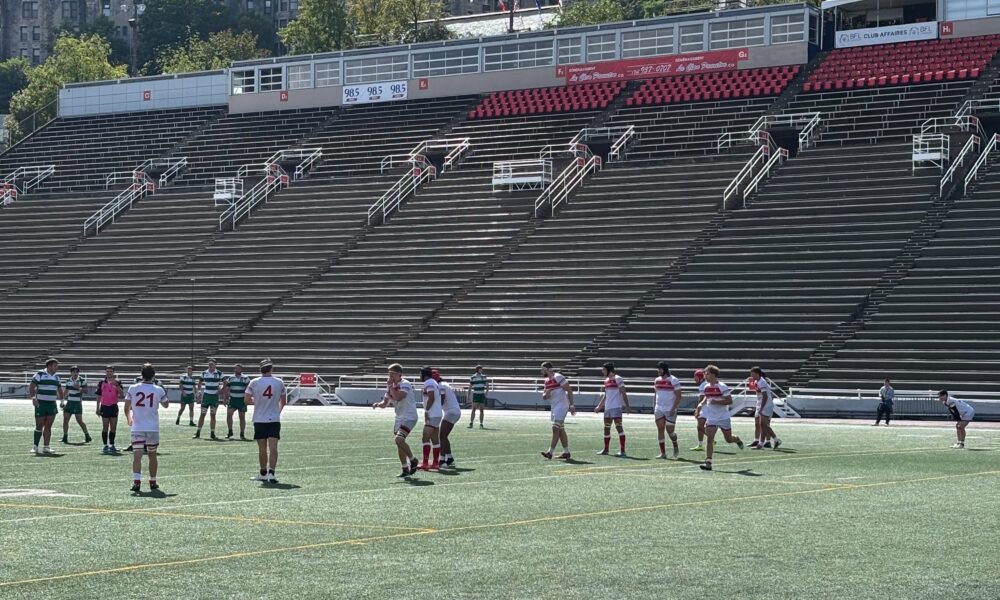
On Aug. 30, the Redbirds rugby team kicked off their 2025–2026 campaign with a convincing 28-14 preseason victory over Dartmouth’s Big Green at Percival Molson Stadium. The team bounced back from their 17-26 preseason loss of Fall 2024, setting an early tone of discipline and intensity heading into league play in front of a small but mighty contingent of fans who braved the day’s rain.

The contest began under a light drizzle that soon turned into a steady downpour, making ball handling treacherous for both sides. Dartmouth came out firing early, but McGill used tactical kicking and disciplined territory management to ultimately control the opening half. 

“When it’s raining, kicking puts way more pressure on the other team,” explained veteran flanker Elliot Descarreaux, MSc Physical Therapy, in an interview with The Tribune. “Going for the kicks and attacking the zone benefits us, instead of getting stuck in a pattern of constant scrums.”

McGill struck early in the 11th minute when centre Raphael Seigner broke through Dartmouth’s defensive line and, with a tackler in his way, made a smart pass to winger Henry (Harry) Corkum for the opening try. Fullback Martin Laval converted to give the Redbirds a 7-0 advantage.

The Redbirds kept their foot on the gas, carrying their momentum through the first half. In the 29th minute, number 8 Ian McDowell, PhD Neuroscience, finished a well-read lineout sequence with a try, doubling McGill’s lead. Just five minutes later, McGill extended their lead with a crisp passing sequence that ended in a try. Laval remained flawless from the tee, slotting his third straight conversion to give McGill a commanding 21-0 lead.

The physicality of the match boiled over just before halftime in a heated scuffle near the McGill end, but the Redbirds entered the break with both the scoreboard and momentum firmly in their favour.

Dartmouth responded early in the second half, breaking through in the 48th minute with a front-row try to cut the deficit to 21-7. The Big Green continued to press in the scrums, where McGill struggled to maintain control. Another Dartmouth try in the 64th minute narrowed the score gap to 21-14, briefly raising tension among fans as the visitors ramped up intensity. 

But McGill’s composure and grit ultimately secured the win. The Redbirds used deep territorial kicks from the back line to disrupt Dartmouth’s structure and force errors. A final try by McGill in the 80th minute sealed the game’s 28-14 result, sending the team off the pitch under clearing skies with their first victory of the year.

For McDowell, the win reflected the team’s maturity in tough situations. 

“We faced intense pressure in our zone, forced Dartmouth to turn the ball over, and immediately cleared it,” he said. “Moments like that really fire a team up. Our attitude and intent were on today. We stayed aggressive in defence, made the right decisions, and stayed connected as a team.”

Head Coach Ian Baillie credited his squad’s decision-making and composure as key factors in the win. 

“[Dartmouth] came out very strong and had the majority of possession early, but our guys made smart territorial decisions,” Baillie noted. “Our handling skills remained strong despite the conditions, and our kick game worked very well.”

Beyond the tactical execution, Baillie highlighted the team’s resilience in the face of injuries. With some players sidelined, the Redbirds relied on their deep bench and veterans. 

“We’ve got a next-man-up attitude,” Baillie said. “Everybody believes the guy stepping forward can do the job, and that’s how we conduct ourselves.”

As for lessons for the Redbirds to carry into the regular season, Descarreaux kept it simple. 

“Keep playing as a team,” he said. “Stay tight together.”

McGill will open its regular season at home on Sept. 4 against the Carleton Ravens, aiming to build on the confidence gained from their preseason performance that blended smart rugby with collective energy.

Football, Know Your Athlete, Sports

Know Your Athlete: Eloa Latendresse-Regimbald

Eloa Latendresse-Regimbald, U3 Education (Physical & Health), has been a standout on the Redbirds football team from the moment he stepped on campus. After winning the Réseau du sport étudiant du Québec (RSEQ)’s Most Outstanding Player award and being selected for Vanier College’s CEGEP Division 1 All-Star Team, Latendresse-Regimbald continued his success at McGill, becoming the university’s third football player to win the Peter Gorman Trophy, awarded to the U SPORTS Rookie of the Year. 

The lefty quarterback is a Montreal native whose football origins trace back to his time as a youngster in Saint-Laurent. 

“I started at seven, eight years old […] in small community ball,” Latendresse-Regimbald said in an interview with The Tribune. “I [played] many positions, tried different things, especially […] in city ball, [where] you need to play offence and defence, and it’s only in high school where [quarterback] became my main focus.” 

This experience playing multiple positions helped Latendresse-Regimbald excel when he eventually played quarterback full-time, as he is now a dual-threat quarterback who can make plays both running and throwing the football.

Following Latendresse-Regimbald’s last season at Vanier, he was faced with the daunting decision of choosing where his university football future would lie. Being able to play weekly in his hometown, in front of friends and family, ended up being a major factor in his decision to join the up-and-coming Redbirds.

“When I did my recruiting process […] I thought about leaving, but then I was like, ‘Why leave when I can play with some guys from Montreal, some people I’ve met before, and my family’s always there?’” Latendresse-Regimbald said.

Since starting with the Redbirds, Latendresse-Regimbald has thrown for almost 5,700 yards, ran for nearly 2,000, and posted 44 total touchdowns. He broke Thomas Barbeau’s 46-year-old school record for rushing touchdowns in a 38-22 victory over Sherbrooke Vert & Or on Aug. 22. This came as news to Latendresse-Regimbald.

“I actually didn’t know I broke [the] record till after the game […] but it’s a huge milestone,” he shared. “It’s been a couple of decades back, which is pretty cool [to be able to] break this and bring it back to the present.”

Latendresse-Regimbald also emphasized that this accomplishment would not have been possible without the people around him.

“Every touchdown is a team effort,” Latendresse-Regimbald stated. “My teammates were there to block, […] coaches were there to make a small play [in the] play calling, and at the end of the day, it’s all about the execution. So it’s a huge personal milestone, but [there’s] also a good team aspect to it.”

In a few short years, Latendresse-Regimbald has risen from Rookie of the Year to an unforgettable player in Redbirds program history. He has grown both in his on-field role as quarterback, and in his role as a team leader off the field.

“You need to build a strong connection as a quarterback, because there’s only one quarterback on the field […] you want to get to know everyone,” Latendresse-Regimbald told The Tribune. “[My teammates] know that [my] door is always open for them to come up and to chat about anything and everything [they] want. You want your teammates to feel supported.”

The Redbirds face a challenging slate of games this season, and are looking to improve on their fortunes from the past few years. Despite Latendresse-Regimbald’s individual success, the team is a combined 5–20 in his time at McGill. He is confident that this year, the tide of the program can turn.

Coach [Alex] Surprenant is really, really [pulling] some strings out there and […] it’s really coming together,” Latendresse-Regimbald reported. “It’s really amazing to see what it’s like, to be part of [building a program], and really having the chance to see and witness everything and be a pillar in it.”

McGill, News

Negotiations continue over QPIRG and McGill’s MoA

In January 2025, McGill Interim Deputy Provost (Student Life & Learning) Angela Campbell issued a notice of default of McGill’s Memorandum of Agreement (MoA) with the Quebec Public Interest Research Group (QPIRG) at McGill. The university warned QPIRG that it will suspend the student funding that QPIRG receives if the organization continues to support Students for Palestine’s Honour and Resistance (SPHR).

SPHR is one of QPIRG’s 17 working groups, which are collectives of students and community members selected annually by QPIRG to receive financial and administrative support from the organization. 

In an interview with The Tribune, Nelly Wat, an outreach coordinator at QPIRG, explained that McGill issued QPIRG a notice of default because McGill views SPHR to have breached the university’s Code of Student Conduct.

“[McGill is] saying that by [QPIRG] supporting SPHR […] by providing funding and resources, we are effectively also in breach of the Code of Conduct, and therefore in breach of our Memorandum of Agreement with McGill,” Wat said.

Wat then described QPIRG’s attempts to negotiate with Campbell and McGill’s Dean of Students, Tony Mittermaier, after McGill issued the notice of default. They reported that two student representatives of QPIRG met with McGill twice in a non-legal setting. According to Wat, both meetings ended in a stalemate.

“[McGill was] saying that […] [we] have to cease providing any funding to SPHR, [that we] have to notify them in writing and provide a read receipt that they have, in fact, received this, that [we are] no longer supporting them,” Wat said. “And until [we] do this, [QPIRG] cannot book events on campus. That was a consequence that [McGill] invented to impose on us, to give us a bit of a sense of urgency, or to pressure us.”

Carl Bystram, a community research and working groups coordinator at QPIRG, explained to The Tribune that the next step QPIRG is taking is to contest the notice of default through arbitration.

“McGill can’t say we’re in breach of contracts, and they can’t declare that unilaterally,” Bystram said. “This actually has to be […] found by an arbitrator or judge. On top of that, there has been a fight to just get McGill to stand by, to obey the [MoA]. So now it is also a procedural issue.”

Bystram also shared that the legal costs of arbitration will be a challenge to QPIRG.

“Arbitration costs $950 [CAD] an hour,” Bystram said. “Bringing small, grassroots social justice groups into court is a way of paralyzing them financially. So regardless of the outcome of the actual arbitration, even if it goes into our favor, we will have lost an enormous amount of resources for this.”

As a result, QPIRG has launched a legal fundraiser, aiming to raise $15,450 CAD to support their legal efforts. As of Sept. 3, they have raised $10,559 CAD, with major donors including Queer McGill and The Association of Graduate Students Employed at McGill.

In a written statement to The Tribune, McGill’s Media Relations Office (MRO) reiterated that SPHR is unaffiliated with McGill and that the university supports rightful protest on campus, despite its decision to issue QPIRG a notice of default.

“The QPIRG MoA was terminated because of its [expression of] support, including financial support, for SPHR,” the MRO wrote. “[….] To be clear, McGill is firmly committed to freedom of expression and has no issue with lawful activism and protest regardless of the cause.”

In an interview with The Tribune, former Students’ Society of McGill University (SSMU) Vice President External Affairs Hugo-Victor Solomon pointed out similarities between QPIRG’s and SSMU’s respective conflicts with McGill.

“This fight that QPIRG is going through is identical to the fight that SSMU went through,” Solomon said. “In the default letter that [Campbell] sent to QPIRG, she actually […] just sent a copy of what she had sent [SSMU] [….] It’s unsettling to say the least.”

Bystram also noted a pattern of McGill exercising legal tactics against student groups. 

“Court cases aren’t things that necessarily a lot of universities do, like the kind of constant threat over [MoAs], it’s actually quite McGill-specific,” Bystram said. “This is a part of a financial weight that they add on student resources. It is also an extremely expensive procedure on their end, and they keep on doing this while they claim to be broke.”

Bystram further outlined how QPIRG will proceed if they are to be found in default during arbitration. They mentioned how McGill is exploiting its policies to target student activist groups.

“There [would be] a procedure where we [would have to] restructure the organization until it is in compliance with the contract,” Bystram explained. “We have interpreted this as meaning that we would have to drop SPHR [as a working group] [….] [McGill’s] Code of Conduct is not meant to be used against a group. They’re really changing the rules so that they can have exceptions where they’re able to repress political action on campus.”

Solomon highlighted QPIRG’s dedication to social and environmental justice, and its important place in life at McGill.

“Oppressing student mobilization on baseless claims should never be tacitly accepted or normalized,” Solomon said. “[QPIRG has] become an invaluable part of the fabric of this community. It’s not the first time that McGill has tried to go after them [….] The fact that they’ve been around for decades is a testament to how invaluable their presence is.”

Research Briefs, Science & Technology

Bad balance? Blame your concussion

Concussions: Either you have had one, or you know someone who has. These injuries are incredibly common—particularly in high-contact sports such as football, hockey, and rugby—and they can leave lasting, debilitating impacts. Yet, despite their dangers, concussions are hard to objectively identify by a third party, making them difficult for coaches and sports medicine professionals to manage. 

However, a paper recently published in Medical & Biological Engineering & Computing by orthopaedic surgeon and McGill Professor Paul Martineau shows that concussion symptoms may not be as unidentifiable as they are currently perceived.

This article came about in a very roundabout way; some might say it was a happy accident. As an orthopaedic surgeon, concussions are outside of Martineau’s specialty. His research centres on the knee and preventing ACL injuries, with his current project focusing on ACL injury prevention through the use of an AI prediction model.

The AI model was trained with data collected from McGill varsity athletes over the course of a decade. However, what Martineau was expecting to be two data sets—high-risk athletes versus low-risk athletes—turned out to be three: There was a mystery third group of athletes who were neither high nor low risk, they just jumped differently.

“The third group that popped up that the AI model found, when we looked back, turned out to have a history of concussions [rather than] a present concussion, a concussion they are supposed to be fully recovered from,” Martineau said in an interview with The Tribune.

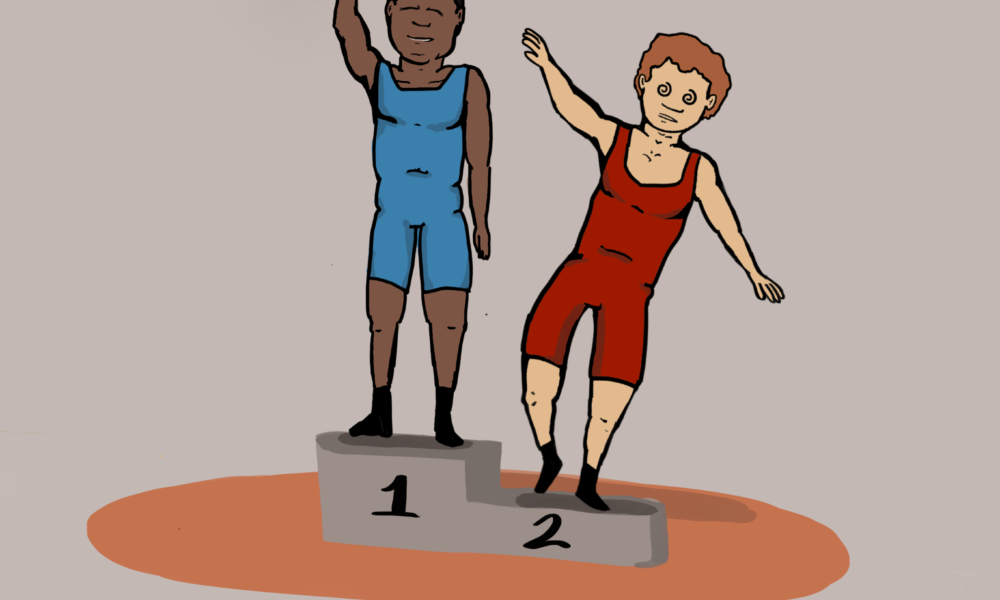
This third group of previously concussed athletes had empirically worse balance than their non-concussed peers. They took longer to regain their balance after doing a single-leg jump on their non-dominant leg, with a mean difference of 0.35 seconds.

The significance of this data is twofold. First, it shows that concussions have negative impacts on athletes years after they are sustained. Whether these effects are caused by the concussions themselves or simply concussion treatment protocol is still to be determined, but the cause of the change is less pressing than the change itself. 

“These findings show [previously concussed athletes] are not jumping like their healthy, elite teammates anymore,” Martineau explained.

Secondly, this data shows that the impact of concussions is measurable. Current sideline concussion assessment techniques rely on rapid screening: Reading, memory, and eye-movement tests. These tests can be effective, but they are unfortunately not foolproof.

While athletes recognize the health dangers of a concussion, they often see a concussion as nothing more than time spent on the bench. Because of this, many athletes “sandbag” their baseline concussion tests: They purposely get low scores, meaning that if they sustain a concussion, the impacts are less noticeable. 

“Concussion history is less objective because a player may not voluntarily tell you, because it may lead to that player being taken out of play or not being cleared to play,” Martineau told The Tribune. “So there’s this concept and this literature behind, you know, sandbagging your concussion history.” 

Sandbagging is a dangerous practice, but has been considered unpreventable. Martineau’s study has the potential to change this. 

“These were preliminary findings, but we’re continuing to delve into them and properly tease them out,” Martineau explained.

Martineau is hopeful that the ACL injury prevention app he and his team have developed for athletes will eventually incorporate some concussion history analysis. 

“We’re not including any concussion-related features to start, just because all of this was preliminary data and stuff like that,” Martineau said. “So right now, [the app] is really ACL injury prevention specific, and then we’ll continue to work behind the scenes and see how [concussion-related features] can be included in future iterations.” 

Ultimately, Martineau’s findings have begun to shed light on the previously hidden impacts of concussions. The detrimental effects concussions have are now shown to be correlated with long-lasting balance issues—something well worth avoiding if at all possible.

This being said, if you have been concussed in the past and you happen to have notoriously bad balance, Martineau’s findings have given you the excuse you have been looking for: You hit your head when you were twelve, and now you struggle to stand on one leg. 

Arts & Entertainment, Film and TV

The biblical mediocrity of The Phoenician Scheme

Wes Anderson is widely distinguished for his aesthetic style—features ranging from striking symmetry to eye-level points of view, pastels to vibrant hues. Highlighting ordinary objects in otherwise distinctive ways, viewers have even begun to excavate these aspects in their everyday lives. @Accidentalwesanderson on Instagram has amassed nearly two million followers, featuring photo submissions that echo cinematography seen in Anderson’s films. However, as his audience continually praises his work for its visuals, does Anderson risk relying solely on aesthetics?

The Phoenician Scheme, Anderson’s most recent film, tells a simple tale of a jaded tycoon confronting the reality that one day—and very soon—he will die. The film begins poignantly, featuring cinematography and colors reminiscent of a stereotypical Coney Island, with expressions almost straight from a stop-motion animation. Within the first five minutes, the protagonist, Zsa-zsa Korda (Benicio del Toro), survives a plane crash: His first near-death experience of the narrative. With an abrupt shift from Anderson’s typical retro and pastel coloring, the film skips ahead to a Lynchian-style purgatory. Now, in black and white, Knave (Willem Dafoe) materializes, sporting an overgrown, darkened beard within a clouded backdrop, a side character whose sole purpose in the narrative seems to be to provide a sense of turmoil and unrest.

Following his first flash of purgatory, Korda reaches out to his only daughter of ten children, a nun named Leisl (Mia Threapleton), to take over his business in the likely case that he gets assassinated. Sister Leisl acts as a symbol of hyperbolized purity, providing a stark contrast to her father and ultimately cheapening an already plain plot. In the scene, Korda is seen ruthless, covered in blood, staggering about while holding his guts in. In comparison, Leisl arrives head-to-toe in white, adorned in a bright red lipstick that matches her lengthened nails. Anderson is known for characters who are stylistically cartoonish and poignant, but in The Phoenician Scheme he fails to write his characters beyond aestheticism. Leisl is an esoteric Halloween costume at best. 

As the film progresses, her morals quickly crumble. At the first sign of conflict, she whips a knife out from under her habit, one she says she picked up right before they left for the venture. When offered a beer, she promptly says she has never had hard liquor in her life. Korda’s assistant, Bjorn (Michael Cera), reminds in his Norwegian accent that beer is not hard liquor. Without skipping a beat she turns to the waitress: “Two beers please.” She soon picks up pipe-smoking, eventually switching out her plain, white pipe for a bejeweled one. The ease with which she is convinced to sacrifice her morals feels parallel to asking your alcoholic friend to have a drink: “Okay, fine, I guess I’ll go out.” 

The film is hilarious—but it is not profound, no matter how hard it tries to come across as such. The viewer understands that life cannot be separated into good and bad, so what else? As the film continues, those binaries flatten. The tycoon and the nun meet each other in the middle, at the sea level of morality. Anderson shows us that a nun can wield a knife and a murdering tycoon can adopt catholicism, reducing the film to a shallow cliché. 

Beyond diving into—or skimming—the grey area between morally superior and inferior, and the confrontation of what makes the balance tip in either direction, The Phoenician Scheme lacks any unique take on an overused theme. The Phoenician Scheme is neither extraordinary nor horrendous, but the grey area between the two: Mediocre. 

McGill, News, Recap

McGill to charge students for Fall Convocation guests, despite spring backlash

On May 8, Interim Deputy Provost (Student Life and Learning) Angela Campbell emailed graduating students that they must pay $25 CAD to bring two guests to the Tomlinson Fieldhouse Spring 2025 Convocation ceremonies. This update, along with ceremony timing changes, sparked outrage amongst attendees, who expected the four free guest tickets and Lower Field graduations that McGill has historically provided. Students whose guests had already booked travel to Montreal scrambled to obtain extra tickets.

The next day, Campbell sent another email to affected students, announcing that McGill would waive ticket costs and reinstate the four guest allowance. Campbell also acknowledged the university could have managed Convocation planning “more effectively.”

Henry Olsen, a Spring 2025 Faculty of Arts graduate, called McGill’s initial decision to charge students for guests “money farming” in a written statement to The Tribune.

“Even when [McGill] had to rent out the Bell Centre [in 2024], a building they didn’t even own, the [graduation] tickets were free!” Olsen wrote. “It’s obvious they’re trying to fix their financial books.” 

In a written statement to The Tribune, the McGill Media Relations Office (MRO) explained why Convocation was not held on the Lower Field.

“The decision to hold Convocation at the Fieldhouse in Spring 2025 was made after considering a number of elements, including the significant construction work underway on campus,” the MRO wrote.

Olsen posited that McGill only reversed changes to Spring Convocation when some incoming alumni pledged to withhold future university donations.

“It’s only when the brand name ‘McGill’ is hurt by publications of their incompetency […] that they change,” Olsen wrote.

An upcoming McGill graduate who wished to remain unnamed shared in a written statement to The Tribune how disappointing they found McGill’s renewed decision to charge students for guests at Fall 2025 Convocation, held at Salle Wilfrid-Pelletier.

“In light of the reaction for the Spring Convocation, this feels like a slap in the face,” the student wrote.

News, The Tribune Explains

The Tribune Explains: Pregnancy care for McGill students 

This article serves as an informational resource only and does not provide medical advice. Please consult a medical professional for more information on pregnancy care in your community.

Following an exploration of childcare services on campus and a guide to abortion access for McGill students, The Tribune finds it vital to publish a Tribune Explains on access to pregnancy care. Although the tiny, cramped seats of Leacock 132 do not paint a pregnancy-friendly picture of campus, there are several avenues for specialized pregnancy care at McGill. 

Where can students find emergency pregnancy resources on campus? 

The McGill University Health Centre (MUHC) has an Obstetrics department designed for high risk pregnancies. Accessing pregnancy care at the MUHC requires a referral from a physician, which patients can obtain at a walk-in clinic. However, for a pregnancy that is not high risk, the department will direct patients to a different obstetrician. 

For early pregnancies, the MUHC provides specialized care through their Early Pregnancy Rapid Assessment Clinic (EPRAC), which supports pregnant people under 18 weeks experiencing abnormal symptoms like bleeding or severe cramping. The appointment slots at the EPRAC are first come, first served on a daily basis, open Monday through Friday mornings. 

For pregnancies past 18 weeks that require emergency support, students can access the MUHC’s Birthing Centre. Emergency circumstances include a patient’s water breaking, vaginal bleeding, or other worrying symptoms as listed on the MUHC’s website. Patients can contact The Birthing Centre by phone 24 hours a day, seven days a week. 

What other resources does the MUHC provide? 

Aside from the numerous clinics within the MUHC’s Obstetrics department that provide care in cases of extreme or complicated pregnancies, the MUHC also offers educational resources for those experiencing a first-time pregnancy. These resources outline how to register as a patient—with the MUHC or an outside hospital—how to support newborn diets, and how to breastfeed. Recognizing the intense changes pregnancy can bring about, the MUHC provides resources for mental health support during pregnancy, support following miscarriages, and legal contacts for cases of domestic violence. 

Where can I go for pregnancy support in greater Montreal?

For most pregnancies that are past 18 weeks and not high risk, one must seek an obstetrician beyond McGill. For example, Centre hospitalier universitaire Sainte-Justine is one of the top pediatric hospitals in North America, situated behind Mont Royal on Decelles Avenue. Sainte-Justine provides patients obstetric care from the beginning of pregnancy to the end, with specialists available. 

How can I access accommodations as an expecting parent? 

McGill has a set of accommodation guidelines to assist with pregnant students’ needs. The guidelines note that pregnant students are responsible for reaching out to their department’s Student Affairs Office, whose specific Undergraduate Program Director will meet with the student to decide in advance where they can make accommodations. The student must provide medical documentation of pregnancy to the Office.

Where can I find financial support? 

Patients can apply for financial reimbursement through most health insurance plans, including McGill-provided international health insurance, after they have paid for treatment. 

If a pregnant student is employed, applying for the Quebec Parental Insurance Plan during pregnancy can help ease the financial load of taking care of a newborn baby. In order to apply, one must be a Quebec resident, and have either stopped working or expect to experience a 40 per cent decrease in income following the birth. 

For more information on resources for pregnant students, visit the MUHC website. If you need urgent medical support, call 911.

Science & Technology

Montreal day camp fosters feelings of belonging among refugee children

Summer camp is a quintessential Canadian experience, whether you find yourself sleeping in a log cabin deep in the woods or roaming around the city visiting different museums and monuments. Camp allows individuals to build lifelong friendships and create lasting memories, all while immersing themselves in Canada’s natural and man-made wonders. 

It is no surprise, then, that summer camps provide an excellent means of cultural and social integration for newcomers to Canada. For asylum seekers, summer camps offer a low-stress environment to learn about and adapt to a new place, incorporating fun and community bonding throughout the process.  

In a recent study published in the International Journal of Intercultural Relations, Hend Alqawasma, a PhD student in McGill’s School of Social Work, explored how newly arrived Syrian and Palestinian refugee children experienced a sense of belonging at Camp Cosmos, a summer day camp in Montreal. 

“Belonging is an important component of social integration,” Majorie Aude Rabiau, assistant professor in McGill’s School of Social Work and co-author of the study, said in an interview with The Tribune. “I see belonging as the connection to others, the story we tell ourselves about who we are in the community, and how we fit into the community.”

The overarching goal of the study was to discern what facilitated feelings of belonging among refugee children and families in a recreational context. Throughout their interviews with the children, their families, and the camp counsellors, the researchers found that three primary concepts were involved in fostering a sense of belonging: Inclusion, relationships, and environmental mastery.

Refugee children worked together to improve their language abilities, which ultimately increased community bonding and their sense of inclusion. The camp staff and campers formed meaningful relationships, as the staff ensured the children’s voices were acknowledged. Additionally, the camp included many activities that explored Montreal’s cultural offerings and its transportation systems. Consequently, the campers felt they had a better handle on the city by the time the camp had ended. 

Camp Cosmos gave the researchers a unique opportunity to observe how positive experiences in a recreational setting affect social behaviours, namely because of the ethos on which the camp is built: It was specifically designed to ensure these children feel welcomed.

“By default, there was an anti-oppressive philosophy or approach to the way the camp was set up [….] The counsellors also have similar lived experiences, they are also refugees,” Rabiau said. “This aspect of shared experiences or shared languages, I feel like it really gives a secure base for the kids to have an initial feeling of belonging and inclusion, where they can then explore and grow more language skills and mastery.”

Another crucial component is that these programs are accessible regardless of economic status. Camp Cosmos uses a sliding scale payment system, adjusting the costs based on family financial capacity, thereby reducing economic barriers. 

The camp sets itself apart from other settings—such as school—in that it teaches the campers about Montreal’s cultural norms while celebrating their own cultural backgrounds. The environment is explicitly designed to be conducive to both learning and having fun. 

 “Their own cultural background is celebrated in that space, which I don’t think is necessarily felt all the time in other spaces [….] It offers a place where they do feel, from the beginning, accepted, respected, and valued, and then they can grow their confidence and their mastery of different skills, including language and making friends and understanding how the city works, for example,” Rabiau noted.

PhD Student Alqawasma, who led the study, drew motivation from her personal experience to study how refugee children experience belonging.

“As a Palestinian woman whose parents were exiled and who was always worried to lose my Palestinian status, I always wondered what helps us feel like we belong to a certain place or a community, and what would support my sense of belonging to Montreal,” Alqawasma wrote in an email to The Tribune.

Ultimately, this study underscores the need for culturally sensitive recreational programs such as Camp Cosmos for facilitating social integration and belonging among newcomers.

Read the latest issue

Read the latest issue