

Latest News

Art, Arts & Entertainment, Fashion

Romancing Medievalism in the modern world

Candlelight contours and illuminates the deep reds of opalescent stained glass, the candle’s bearer traversing the vacuous shadows of the castle’s towering walls. Its gothic portals and stone arcades stand overgrown in twirling vinery and moss. Inside hangs a pastoral tapestry of enchanting animals: Unicorns, leopards, and quails. Dress fabric so sumptuous that one could get lost in its drapery as if traversing a tall meadow. The jewel-toned brocade, acanthus, floral, and vegetal pattern, accentuates its meticulous ornament with gilded needlework. An extension of the feminine face, the hennin, covers the hair, elongating the smooth forehead to new heights in its pointed, upward length. Metal clanging of chainmail helms, jewellery, and armour. Templar knights, serene maidens, glistening swords, flower crowns, a lute. The romance of the Middle Ages has been reborn once again, with the visual lexicon of Medievalism continuing to project its idyllic vision into the contemporary world.

In the past several months, Medieval Aestheticism has found its way into popular culture. Chappell Roan, the acclaimed singer and “Midwest Princess,” walked the VMAs red carpet in a loose-fitting, gauzy dress, faded green velvet robe with embroidered borders, and armoured leg plates. Carrying a sword and later donning full armour for her performance, she embodied the role of a medieval warrior. Earlier this year, she even wore a hennin—typical of the medieval feminine elite—to accept her award at the Grammys. Though not entirely Chappell’s doing, her historically situated fashion sense likely influenced Pinterest’s 2025 “Castlecore” trend forecast. 

However, fashion aesthetics have not been the only modern utilization of the Medieval; there is clearly a widening interest in the overarching themes of this early past. In January, director Baz Luhrmann opened Monsieur, a medieval-themed bar in New York’s East Village, to great acclaim. This is a clear departure from more playfully adapted historical venues such as taverns with barrelled beer taps and suburban castle-restaurants for combinatory joust-eating. Instead, Luhrmann adapts a more sombre style—dramatic candlelight, ornamental tilework, and vaguely religious imagery.

In a whole new realm, the Swedish electronics company teenage engineering released the EP-1320 medieval, a sampler loaded with, according to the website, “magical melodies, sultry songs and bubonic beats.” With gothic script and a beige frame, as if a parchment transmitting melodies to its beholder, the EP-1320’s release indicates a monumentally diverse appropriation of the Middle Ages—one that fuses technological modernism with the sobriety of an illuminated manuscript. 

In the essay collection, Whose Middle Ages?, academic medievalist David Perry writes, “We allow periods to take shape in our cultural imagination when they serve a purpose when we use them to define a present against its various pasts, whether through assertions of affinity or otherness.” The choice to embrace certain aspects of the Medieval past is indicative of the current state of the world, for society adopts—and thus adapts—the past as a way of imbuing cultural agency into its history. The notion of a revival can never reenact the full truth, for culture selects certain historical elements which aid it in understanding itself in its contemporary present. This can result in a serious abridging of the past, upholding its lexicon of historical inaccuracy resulting from romanticization, eclecticism, and systemic erasure. With limited documentation of the Middle Ages, the projections of its world as one of fantastical, pastoral, and even biblical proportions have altered its modern perceptions. The past as a venue for contemporary interpretation, though implemented on certain levels as a false construction of Europe’s “whiteness” and a self-aggrandizing myth of origin, is allowing the Middle Ages to be reclaimed as landscapes for feminine agency.

There has been a greater emphasis on the gloomy, more gothic aspects within the Popular Medieval. Dior exhibited their 2025 Cruise Collection in the garden of a Scottish medieval castle. With dark tartans and armoured bustiers, the collection retreats into the ruinous shadows of looming stonework, the muddy soles of handmade leather shoes, of a maiden, eternally condemned to a cloistered life in a tower. These garments are indicative of a growing resurgence of the aesthetics of warfare and the craft of chainmail. In putting feminine figures into structured garments, reminiscent of a soldier’s impenetrable armour, they rewrite the medieval history of masculine fortitude into a narrative of feminine authority. 

Chainmail has entered popular culture as a status symbol of power, dominance, and resolve. The practice of its creation has even resumed, growing alongside the rising popularity of Joan of Arc’s status as a divine source of feminine agency. For multidisciplinary artist Amy Lang, her exploration of the chainmail medium has allowed a greater reflection on the history of the craft itself. 

“It was about trying to figure out if the process of doing or making art can help us understand a little bit more about the art itself,” Lang stated in an interview with The Tribune

Lang has searched the past, adopting this early blacksmith technique into modern styles, such as chokers, jewellery, and skirts. The craft acts both as a study and escape, as Lang weaves new meaning into its wire, centuries after its use in the Middle Ages. Her metalworks are astounding examples of this cyclical reconception of the Medieval, through reinterpretation, cultural reassertion, and a new imbuement of meaning.

“I think there is generally a turn towards escapism in whatever small ways you can get,” Lang said. “I tend to find there’s this Neo-Luddite return to simple crafts […] for the purpose of making ornament that makes you feel like you’re part of a slower time.”

In exploring these traditional crafts and adopting the aesthetics of the past, society seeks a desire to feel connected to one’s belongings, now considerably reproduced in our post-industrialist world. The Victorian revival of Medievalism came at a time directly following the Industrial Revolution. A sense of disenchantment with mass production and placelessness among the steel frames of the new world led artists to retreat into the past to placate these plain landscapes of modernism. Pre-Raphaelite artists explored through history painting the notion of the pastoral medieval identity—one at peace with the natural landscape, living amongst the opulent flora, engaging in chivalric love affairs. They interpreted medieval tales and conventions, like The Lady of Shalott—adapted from a Tennyson poem of the Arthurian story—and La belle dame sans merci, drawing from the eponymous Keats work. These pieces, almost otherworldly in their natural beauty, were perhaps a physical projection of the self into luscious nature, as the public longed for an escape from enforced modern identity.

Michael Van Dussen, professor in McGill’s English department, and a medieval scholar and specialist in manuscript studies, spoke with The Tribune about the production of medieval manuscript culture.

“There’s this connection with the people who produced it. You have no idea who they are, or necessarily were, but you know that a human being delicately did [this],” Van Dussen noted, describing a laid-out 15th-century Book of Hours

Adorned with heaps of page-caressing marginalia, the vegetal motifs illuminate its gold leaf adornments, shifting with every stroke of light. It’s wonderfully powerful to witness up close, with its hundreds of pages hand-drawn by a workshop of artisans.

“When it’s all bespoke, like this—you could have 500 copies of the same text—every single one would be different. It would be utterly and numerically unique,” Van Dussen said. “That’s because every element is produced by hand. People make mistakes or they make different choices. They’re all going to be unique.”

The contemporary retreat into medievalism, I propose, is again, a direct product of the modern disenchantment with industrial practices that have rendered artisans powerless in the state of machine-reproduction. With the emergence of machine-based practices, such as AI art and fast fashion, our world feels an inexplicably lost chasm of the self, as we’ve drifted even further from pastoral connection since the Industrial Revolution. Perhaps these aesthetic adoptions are symptomatic of the temporal resemblance to a post-plague reimagining of newness and hope; or perhaps it’s the way modern people oppressed by billionaires in the American political system mirror peasants’ suppression by feudal landowners with absolute control. This retreat into the medieval, while simultaneously an insertion of feminine and queer narratives into the past, is a cry for help. 

To feel disillusioned with the world is to feel disillusioned with the self. This romanticization of underconsumption—a cyclical resurgence—is hypocritical in its capitalization on pre-industrial aesthetics. We wander imaginative open fields in loose-fitting costumes, with chivalric loves, because modern society’s shortcomings have made this a fantastical impossibility.


Sports

McGill hosts 2025 Jesters Canadian University and College Squash Championships

McGill University Squash made history on March 14-16 by hosting the Jesters Canadian University and College Squash Championships, an event that shattered previous participation records and showcased the university’s growing influence in collegiate squash. 

The three-day tournament, organized by McGill Men’s Captain Mo Kamal in partnership with Squash Quebec, drew 77 participants from across Canada, nearly tripling last year’s attendance of 25 players. This turnout blew the 2023 tournament—which got cancelled due to lack of interest—out of the water. Most impressively, this year’s event featured both men’s and women’s draws at the Open, A, and B levels. This is a significant improvement from last year when no women’s category was offered.

“We had players from [Prince Edward Island], Manitoba, [University of British Columbia], everywhere,” Kamal said in an interview with The Tribune. “Some schools sent their coaches too, and there were people watching—it was truly a spectacular event.”

The tournament proved triumphant for McGill, with three students claiming national championships in their respective divisions. Kamal captured the men’s open title, Sarah Aki won the women’s open category, and Aly Gaber secured the men’s B division championship. This marked the first time in tournament history that players from the same school won both the men’s and women’s open divisions. 

For Kamal, who recently began competing on the professional circuit and is currently ranked 495th in the world, the victory was particularly meaningful. 

“It’s my first national title since I was 12, so it also meant more because I was able to win it at home,” Kamal said.

Women’s Captain Chloe Stoneburgh emphasized the importance of the tournament’s inclusive structure, particularly its offering of categories beyond just the elite circuit competition. Making it open to all levels drew more participants, more matches, and more even contests. 

“It was rare to have that many people to play against who are your level,” she told The Tribune. “I’ve never had so many evenly-matched matches in a weekend. It was such an amazing experience.”

Stoneburgh noted that the unprecedented women’s participation was especially impressive. 

“There were so many women playing, which is rare not only for university squash but for any level of squash,” she said. 

Beyond competition, the event strengthened relationships between Canadian university squash programs. Representatives from other schools expressed support for McGill’s ongoing efforts to join the Ontario University Athletics (OUA) conference, where many Canadian university squash teams compete. This past season, McGill Squash has been fighting for recognition by McGill Athletics to qualify for the OUA. With all of their successes in both the league and the weekend’s event, they are heading into next season with significant momentum. 

“Having coaches and alumni from other universities coming to us and asking how they can help us get into the OUA was really great networking,” Stoneburgh explained. “People were saying, ‘We will vouch for you,’ and honestly, that means the most to us.”

The tournament featured multiple social components, including a banquet that fostered connections between competitors. 

“Everyone was thrilled. There was such positive energy,” Kamal reflected, describing the atmosphere throughout the weekend. “The vibes were really high on and off the court.” 

Even beginners found success at the event; Kamal highlighted how one participant who had only started playing after a McGill introductory workshop this January finished third in her division.

With its record-breaking attendance, unprecedented participation from women athletes, and strong McGill performance, the tournament’s success offers promising momentum for the university’s squash program. 

The presence of coaches and supporters from established OUA programs at the event created valuable advocacy channels. These connections could provide McGill with formal endorsements when petitioning university administration and athletic governing bodies for recognition.

Kamal shed light on the emotions of the tournament’s conclusion.

“It was phenomenal, you know, the buildup of emotions plus the team cheering me on—it was special,” he said. “It just shows how far we have come and what we can continue to do.”

Campus Spotlight, Local Stories, Student Life

McGill’s Refugee Parliament: A collaborative effort to amplify migrant voices

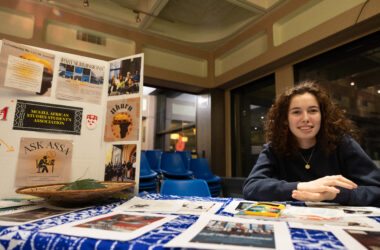
On Saturday, March 15, the Refugee Parliament, in partnership with the International Development Studies Student Association (IDSSA), The Refugee Centre, and the McGill Refugees Research Group, hosted the Refugee Parliament Conference. Created in Fall 2022 by Alessia Mottet, Maria Radu, Saadet Serra, and Shona Moreau as part of their SWRK 400 (Policy and Practice for Refugees) course project, the conference’s first edition took place in 2023, with this year marking its second iteration. 

The event focused on drafting two resolutions addressing the political inclusion and civic participation of refugees and migrants in Quebec, as well as ways to strengthen their integration into Quebec’s francophone culture and their access to higher education. The event featured collaborative discussions and workshops from 10 a.m. to 5 p.m.. Levon Sevunts, Communications Officer for the United Nations High Commissioner for Refugees (UNHCR), delivered a speech at the beginning of the event discussing the importance of these spaces and the contribution of immigrants to Quebec and Canadian society.

Mikaël Lam-Lussier, U2 Arts and Vice President of Outreach and Finance for the Refugee Parliament, highlighted McGill’s large immigrant population, emphasizing that the conference resonates with many students in an interview with The Tribune.

“A good amount of the McGill population are immigrants, and because of that they should also be represented in both McGill as a school and also in the Quebec and Canadian governments,” he said.  “Even though maybe they don’t have voting rights […], they’re still people that are in our society, and they are also contributing. Maybe some of them are going to become citizens in the future. Maybe they’re going to stay in Canada, or they’re going to get employment. So because of that, we really want them to be represented at various different levels and to integrate well.”

Out of the over 20 attendees, most of whom were students, several told The Tribune that their motivation for attending stemmed from personal experiences as refugees, migrants, or allies to these communities.

Anastasiia Yemets, MA3 Education, shared her reason for being present at the event.

“I decided to come because it’s very much related to, first of all, my personal experience,” she said. “[The] second thing is that I’m working with refugees and doing my research on refugees’ experiences [and] I’m an immigrant myself. I do really love that this initiative […] is happening. I feel it’s very much important to talk and be here, especially in the context of the global refugee and immigrant crisis.”

Additionally, Sofia Figueredo Prieto, U2 Arts and an immigrant to Canada, highlighted the lack of similar events in postsecondary institutions.

“As an immigrant here in Quebec, I have barely seen this type of event taking place especially in postsecondary institutions like McGill or my Cégep,” she stressed. “I think learning about experiences and opinions of the immigrant community here, in Quebec and in Canada in general, is really important, not only to address important issues concerning immigration, but also important issues concerning Quebec and Canadian society.”

From another perspective, Susana Baquero Salah, U3 Arts, shared how her interest in the refugee experience had been heightened by humanitarian crises in the Middle East, particularly the Syrian refugee crisis. The conference provided an opportunity for her to learn more about the struggles refugees face in Quebec.

“I feel like this Refugee Parliament conference was a great opportunity to be able to exchange more ideas about what it means to be a refugee in Quebec, more specifically, like applying it to the local context,” she said.

An essential aspect of the conference was its inclusion and discussions of the distinct challenges faced by refugees and immigrants from the Global South. Their reasons for migrating to Quebec often contrast with those from developed countries, making it crucial to incorporate their perspectives and create a safe space for them to share their concerns.

“It’s also helpful to understand the context behind an immigrant, say whether they are an economic immigrant or a refugee, or asylum seeker,” Prieto told The Tribune. “I’ve noticed that it’s harder for people from developed countries to empathize or relate with experiences of people from developing countries.” 

The conference aims to impact policy change, with draft resolutions that will be shared with Quebec policymakers in the coming weeks. As Baquero Salah explained, refugees are directly impacted by the policies being discussed, which makes their input crucial.

“We have to listen to refugees’ perspectives and what they bring to the table when we’re making policies that affect them directly,” she said.

 Jasmine Zhao, President of the Refugee Parliament Conference club and co-founder of the conference, emphasized the importance of sharing these concerns with policymakers.

“[Having] the power to at least make a little change or let the policymakers know what we think about the existing laws or how we could be better integrated into this country, [is] something that’s very much needed,” she added. “We can not only voice our concerns, voice how we are feeling about things, but also establish a sense of community, unity, inspire each other and bring new resolutions to these matters.”

Zhao also explained that while the McGill community offers tremendous support with several professors and student organizations fighting for refugee and migrant voices to be heard, McGill as an institution could support its students in more practical ways.

“What universities can do better is to actually actively listen [to] their students’ voices and have more surveys or student bonding groups or club events that are tailored towards the refugee or migrant group,” Zhao stated. “[When it comes to] visas, tax forms, [students] need a lot of guidance on these kinds of issues because the policies are usually very different from their home countries.”

Many attendees also suggested ways McGill could improve its support for refugees and migrants.

“They could give a larger list of either tools that could help, such as access, for example, to healthcare and access to legal help, more help finding housing, especially for people that are just coming over and aren’t fully proficient in either French or English; that can be very difficult,” Lam-Lussier explained.

Looking ahead, the organizers aim to increase the conference’s reach and continue advocating for migrant and refugee rights through policy engagement and increased student involvement.

“We hope to expand [the conference] to have more participants, refugees, and migrants joining in every year to amplify their voices and to find their sense of community. We are supported by the UNHCR, the Montreal Refugee Centre, the McGill Refugee Research Group, many McGill professors, as well as the IDSSA. We hope to get more support in the future […] and more outreach in the coming years,” Zhao said.

Find the Refugee Parliament on Instagram to help support more of their events.

McGill, Montreal, News

Divest McGill protests RBC’s fossil fuel investments

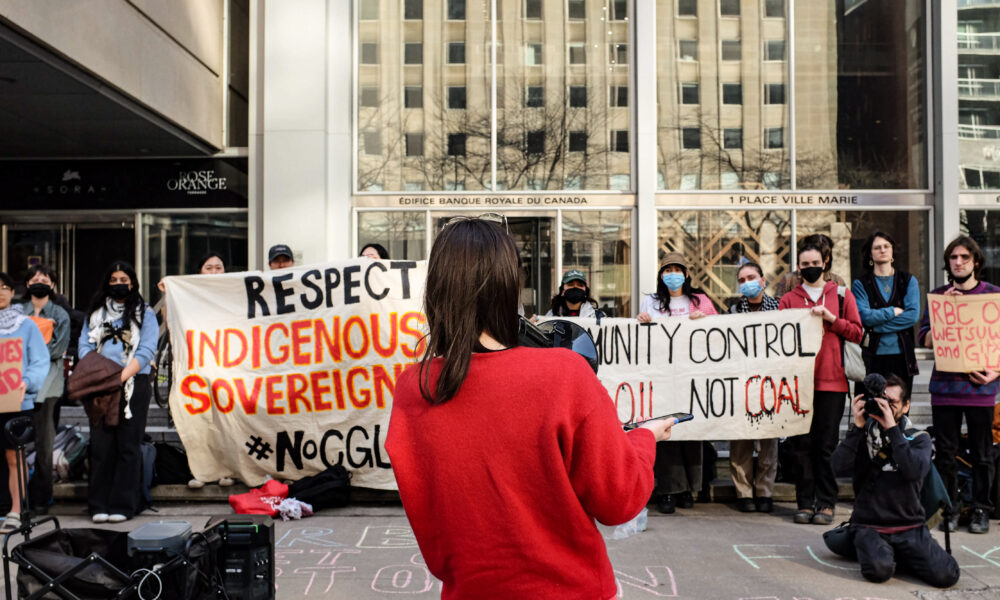
On March 20, Divest McGill, Climate Justice Montreal, and other local climate activist organizations held a protest as part of Change Course’s National Day of Action, demanding that Canada’s “Big Five” banks remove their presence on Canadian campuses until they meet several conditions. Among these are the cancellation of finances for pipelines like the Prince Rupert Gas Transmission (PRGT), a commitment to avoid financing future fossil fuel projects, and a promise to gain free, prior, and informed consent from Indigenous groups before any future financing decisions concerning resource extraction. 

The protest, which gathered several dozen people, departed from the Roddick Gates at 4:30 p.m. and travelled along Boulevard Robert-Bourassa until reaching the Montreal headquarters of the Royal Bank of Canada (RBC). There, protestors played music, chanted, and wrote messages in chalk on the sidewalk as RBC employees and clients walked around them to make their way to their cars or offices. 

Nicola Chevallier, a representative from Climate Justice Montreal, spoke to The Tribune about the importance of calling out the environmentally harmful actions of banks like RBC. 

“We’re here to tell RBC and all the banks that they shouldn’t fund fossil fuels, and that includes liquified natural gas, which might not sound as terrible as oil from the tar sands, but is just as bad in its process of production and its production of methane,” Chevallier said. “Today, we’re hoping to have some visibility around RBC and make it clear that they are not a clean company, neither on climate nor on human rights or Indigenous rights.”

Chevallier added that the protest was targeting RBC specifically because of the bank’s marketing towards students, for instance with their on-campus ATMs.

“[These initiatives] make it seem as if they are there for the youth, but in reality, they are the biggest funder of fossil fuels in so-called Canada,” Chevallier said. “So how could they be there for the youth when they are actively destroying the environment and our futures?”

An attendee of the protest who wished to remain unnamed commented on the outcomes of RBC funding fossil fuel projects like the PRGT, which would transport liquefied natural gas 800 kilometres from northeastern B.C. to the province’s northwestern coast. 

“This has terrible repercussions for Indigenous peoples who still inhabit their land, as most pipelines go through unceded territories and reservations,” they told The Tribune. “We’re trying to show here today that we want them to get off these lands and stop profiting from the oil and gas industry.”

In a speech in front of the RBC building, Tamara Ghandour, U3 Science and a Divest McGill representative, called out six specific strategies that large banks use to ensure that funding for projects like this continues, including working with the Royal Canadian Mounted Police (RCMP) to apply pressure against protestors, lobbying the government for weaker climate measures, and increasing the efficiency of technology to extract resources. 

Divest McGill achieved one of its foundational goals when McGill committed to divest from their direct holdings in publicly traded fossil fuel companies on the Carbon Underground 200 list in February 2024. But the March 20 action made it clear that the organization will continue to take action against environmentally destructive investments, both on campus and in broader Montreal. 

“For many generations, the people of this land have endured physical and cultural violence at the hands of settlers,” Ghandour said during their speech. “We continue to witness the repression of Indigenous peoples across Turtle Island with ongoing pipeline projects that seek to erase Indigenous livelihoods by extracting from their lands and suppress their voices by criminalizing land defence.”

Campus Spotlight, Student Life

March 29 Relay For Life event aims to fundraise for cancer research and support

According to the World Health Organization (WHO),  an estimated 20 million new cancer cases and 9.7 million cancer-related deaths occurred globally in 2022. These numbers are expected to increase in the coming decades, increasing the need for resources to be allocated to cancer research and support. 

Worldwide, organizations such as the International Agency for Research on Cancer (IARC) work to promote collaboration in cancer research and raise awareness about the causes and consequences of the disease. More locally, McGill faculty members also conduct basic and translational research in cancer at the Gerald Bronfman Department of Oncology. Alongside these groups, the McGill Students’ Cancer Society (MSCS) is a student-led organization on campus dedicated to making a difference for Canadians whose lives have been touched by cancer, working in close partnership with the Canadian Cancer Society. The organization is committed to organizing fundraisers throughout the year to raise money to help fund cancer research and patient support initiatives.

Initially, the club was created to offer help and assistance to cancer patients and survivors across Canada through fundraisers—which remains the essence of MSCS today. For many club members, joining MSCS was motivated by witnessing a loved one’s battle with the illness. According to Mayumi Wong, one of the three Co-Presidents of MSCS, the role of the club—beyond raising money—is to create a supportive and safe space for anyone affected by cancer in one way or another.

“I initially joined MSCS back in 2021 as I wanted to support this very important cause, since I had witnessed some members in my family fight this disease,” she wrote in a statement to The Tribune. “[Our main goal] is to create a space that allows individuals who have been touched by cancer or who want to support this important cause to come together.”

The club’s activity primarily relies on fundraising events organized throughout the year, notably their annual flagship event: Relay For Life. Every March, MSCS organizes a large fundraising event that brings together community members to celebrate advocacy for cancer research and support. The event is structured with booths, performances, and games that reinforce community ties and help raise money. Since its first Relay For Life in 2013, MSCS’ Relay for Life has raised $354,916 CAD. Wong wrote to The Tribune that this year’s event is on the right track to reach its aim.

“Our goal is to raise $45,000 [CAD] for the Canadian Cancer Society this year, and so far, we have already surpassed $38,000 [CAD]!”

The 2025 edition will take place on March 29 from 4 p.m. to 10 p.m. at the Tomlinson Fieldhouse where therapy dogs, team games, and other activities can be expected, with food provided by MSCS. The walkathon is also an important feature of Relay For Life.

“Cancer doesn’t sleep, and neither do we—this is symbolized by our walkathon where team members take turns walking around the track all night long, to symbolize how our support for affected individuals is ongoing,” Wong wrote. “The walkathon is interspersed with exciting performances, activities, and moments to reflect for an overall unifying experience.”

Besides fundraising and donation-based initiatives, MSCS also hosts an annual cancer research panel for students known as “Cancers & Answers” where cancer researchers speak about their current research. Louis Ghaleb, an MSCS committee member and a Master’s student in cancer research mentioned state-of-the-art advancements in a written statement to The Tribune.

“Cancer research has come a long way in recent years. Instead of a one-size-fits-all approach, treatments are now becoming more personalized, designed to match the unique features of each person’s cancer,” he wrote. “New therapies can target the specific changes that make cancer grow or help the immune system fight it more effectively”

The McGill Students’ Cancer Society provides an avenue to be part of the progress toward a hopeful future while recognizing the suffering of those affected.

McGill, News

‘Gaza as a Compass for Thinking’ talk explores Palestinian resistance amid targeted attacks

Content warning: Mentions of genocide, death, and dismemberment.

The eighth event of Quebec Public International Research Group (QPIRG) McGill’s Spring into Action series, “Gaza as a Compass for Thinking,” took place on March 21. It explored the theme of “home” through accounts of Palestinians reclaiming their towns that had been reduced to rubble. 

Keynote speaker and professor in McGill’s  Department of Philosophy, Alia Al-Saji, drew upon her years of research regarding the Israel-Palestine conflict to discuss how the Israeli state has systematically debilitated the infrastructure of Palestine’s healthcare system. Al-Saji described how this action has maximized the harm done by targeted bombings, using the dismemberment of civilians as a means of colonization. 

Al-Saji began the talk with a history of how Palestinians have experienced qahr—which refers to the impact of colonial duration in Palestine—over the last few years. She first critiqued how the West paints Palestinians as either perpetual victims or vengeful terrorists. Al-Saji stated that it is critical to outline the logic of Palestinian resistance to understand that Palestinians’ rational agency is what motivates people to work against the actions of the Israeli state.  

“What does it mean not to pity, but to bear witness to Palestinian resistance in returning to live on the land that Israel has made ‘uninhabitable?’” Al-Saji said. “For that matter, what does it mean to call the land ‘uninhabitable’ or ‘unlovable?’ For whom and by which standards of humanity?”

Carl Bystram, QPIRG McGill’s community research and working groups coordinator, emphasized the importance of platforming talks that raise awareness for advocacy in Palestine in an interview with The Tribune.

“We want to give a platform to educators that are speaking out about resistance to colonialism,” Bystram said. “When you’re looking at a place that is in the media, mainly through this horrific process of victimization, you’re not able to really pay attention to the experiences of people and how they understand themselves.”

One of the event organizers, Yasmine Mkaddam, U2 Arts, highlighted how the talk exemplified Spring into Action’s goal of spreading awareness through education. The high attendance showed the importance McGill students place on student activism.

“Social media holds such a big space in decolonization and awareness, but I think that for true advocacy, we need to protest, educate, and advocate,” Mkaddam said. “It goes beyond simply a post.”

Al-Saji continued the talk by explaining how the Israeli government creates Ashla’a—meaning dismembered body parts—every day in Palestine. She described how strategic bombings or hellfires are routinely used to debilitate citizens in Gaza, especially those who show active resistance. Dismemberment is not a side effect of these targeted strikes, but the intended effect, Al-Saji argued. 

“It matters how one dies dismembered under the rubble, how amputation takes place without anesthesia, and what care is available to the disabled body thereafter,” Al-Saji said. “The prognosis of maiming is no longer disability, but debilitating pain and slow death through infection and sepsis when the healthcare system has been shut down.”

Al-Saji noted that few news sources cover the aftermath of severe bombings and attacks beyond the body count. For Al-Saji, this lack of care shown to those grieving speaks to the dehumanization of Palestinians. In one such case on Aug. 10, 2024, Israel dropped 39 U.S.-made bombs on the al-Tabin school in the Daraj district in Gaza, which Israel justified by claiming it to be one of Hamas’ headquarters. This theory was proven false after the attack, at which point over 100 civilians, who had been using the school as a shelter after being displaced by Israel, were killed. Paramedics were unable to discern whom the dismembered body parts belonged to, and allotted bags of dismembered remains by weight for burial. 

Al-Saji stressed that following Israel’s violation of the ceasefire on March 18, McGill students ought to stay up to date on Palestinians’ acts of resistance. 

“Since Tuesday, the genocide has not so much resumed as intensified,” Al-Saji said. “And while the past hurts, histories of the present are excruciating.”

A previous version of this article misspelled Carl Bystram’s last name and misquoted his statement. The Tribune regrets this error.

Science & Technology

Addressing perinatal mental health disparities among immigrant parents in Canada

Pregnancy and postpartum can be emotionally overwhelming, and for first- and second-generation immigrants, these challenges are often intensified by cultural barriers, discrimination, and limited access to mental health resources. According to Statistics Canada, nearly 23 per cent of Canadians were born outside of the country, making it essential to address the unique struggles immigrant parents face during this critical period. 

In a recently-published study in the journal BMC Pregnancy and Childbirth, Monica Vaillancourt, a PhD graduate in experimental psychology at the Research Institute of the McGill University Health Centre (RI-MUHC), researched the key factors affecting mental health among first- and second-generation immigrant parents in Quebec. 

Vaillancourt employed qualitative methods, noting that traditional quantitative approaches may fail to capture the unique experiences of minority populations. She conducted semi-structured interviews with 16 women and 10 men, highlighting differences in perinatal experiences based on gender, cultural expectations, and healthcare access. 

“Given that I was looking at minority populations, it’s important to have a qualitative component [….] Scales have been developed in quantitative [research], and they’ve been developed in the general population—[They] won’t necessarily translate to other cultures,” Vaillancourt explained in an interview with The Tribune

Migration can be a major stressor, influencing parents’ mental health during pregnancy and postpartum. Vaillancourt found that first-generation immigrant parents may be at a higher risk for perinatal distress due to factors such as discrimination, acculturation difficulties, and systemic social healthcare barriers. 

In contrast, second-generation immigrants reported feelings of relief due to greater familiarity with Canadian culture, however still similarly faced barriers due to discrimination. Participants felt pressured to follow heritage cultural traditions concerning parenting practices, which have contributed to distress in some. 

Another key finding was the disparity in perinatal resources available to fathers. Many fathers reported feeling sidelined in prenatal and postnatal care, contributing to stress and uncertainty in their new roles.

“There aren’t a lot of resources for men […] They would go to these prenatal classes, [and] there’d be maybe one slide about dads. There wasn’t so much on helping dads through this transition.”

The study also emphasized the importance of perinatal interventions from healthcare providers and social workers in shaping long-term family well-being. Effective interventions can help mitigate stressors by providing culturally sensitive support, expanding paternal mental health resources, and addressing systemic barriers in healthcare access. When parents receive adequate mental health support during this critical period, it fosters better emotional bonding, strengthens family relationships, and enhances child development outcomes. 

Early interventions can also reduce the long-term societal costs associated with untreated perinatal distress, including healthcare burdens and economic productivity losses. By prioritizing these interventions, healthcare systems can build more resilient families, ultimately leading to healthier communities.

“You get your biggest bang for your buck if you do interventions during [the perinatal] period,” Vaillancourt said. “If you have an influence on the parents, that influences the baby.”

Effective interventions can help mitigate stress by providing culturally sensitive support, expanding paternal mental health resources, and addressing systemic barriers in healthcare access.

Despite its strengths, the research faced limitations, particularly linguistic barriers. 

“I wasn’t able to get a lot of asylum seekers or refugees [….] It’s difficult because I could only have my questionnaires and my questions in English or French,” Vaillancourt noted, advocating for more inclusive research to better capture vulnerable populations.

This constraint may have excluded some of the most vulnerable population from the study, emphasizing the need for more inclusive research approaches in the future. 

Overcoming perinatal obstacles demands policy reform, improved healthcare access for all, and increased access to mental health services for both parents. With further research and systemic change, immigrant families in Canada can receive the resources they need for a healthier transition into parenthood.

Behind the Bench, Sports

“Money’s nice, championships are better:” Eagles’ banner year battered by big departures

Since ​​Super Bowl LIX, many National Football League (NFL) fans are questioning their team’s plan for the next season, namely the reigning champions, the Philadelphia Eagles. After a rough and defeated exit during the 2023-2024 season, General Manager Howie Roseman saw the importance of the offseason, marking one year since signing star running back Saquon Barkley and drafting both rookie cornerbacks Quinyon Mitchell and Cooper DeJean. These significant pickups certainly proved their worth, turning a former 11-6 team into stars, bringing home the second Lombardi Trophy to Philadelphia

Hearing all this may suggest that the Philadelphia Eagles dynasty is in the works; however, ask any fan, and it might sound like they just came off of the worst season in history. Showcasing a strong blow-out to the Kansas City Chiefs brought attention to many underrated players from the Eagles. Barely losing a game all season, and always scoring in the draft, fans have become accustomed to a winning culture in Philadelphia. So far, the Eagles have lost 13 players from their Superbowl roster due to contracts expiring and a lack of franchise salary space. The Tribune recaps the loss of four players that taught Philly fans that the NFL is strictly business.

Milton Williams

Williams entered the offseason as one of the top targets after the Super Bowl, generating a 12.5 QB pressure percentage, the type of talent that gets paid in free agency. Despite not playing as a starter in Philly, the defensive tackle was able to land a four-year, $104 million USD contract, including a $24 million USD signing bonus and $51 million USD guaranteed. This comes after numerous signing rumours elsewhere, with the Patriots overthrowing a deal Williams almost finalized with the Carolina Panthers

Josh Sweat 

Josh Sweat was one of Philadelphia’s most unsurprising losses. As a fourth-round pick in 2018, Sweat spent his entire career with the Eagles. Returning to his former Defensive Coordinator, now Head Coach of the Arizona Cardinals, Jonathan Gannon will get his star edge rusher back. Although fans are probably happy to see Sweat get his well-deserved $76.4 million USD contract, his return to Gannon surely is sour given the tampering disputes after his departure as coach. 

C.J. Gardner-Johnson 

Marking one of the most devastating losses for the Eagles was the unexpected trade of safety C.J. Gardner-Johnson, who for many embodied the grit and underdog mentality of the team. After leaving for a year, Roseman brought Gardner-Johnson back knowing that he would rejuvenate the lethargic and uninspired defense. Gardner-Johnson lived up to expectations, however, some believe that it was the attitude and the drama he generated outside of the sport itself that led him to the trade block. The Eagles will miss their safety to the Texans, as there has to be more to the story here, given the lack of replacements in the league presently. 

Darius Slay Jr. 

After releasing CB Darius Slay Jr. to save $4.3 million USD in salary cap, Eagles fans expected the veteran to either return to his tenured Philadelphia or to where he was drafted in Detroit for his supposed final season. Slay, rather, signed a $10 million USD deal with the Pittsburgh Steelers, but given the success of both rookie corners, his departure was no surprise overall. Slay left with sentiments for the young stars, however, not including fan-favourite Eagles quarterback and Superbowl MVP Jalen Hurts in a conversation regarding the NFL’s Elite Quarterbacks. This certainly altered how Slay will be remembered in Philadelphia.  

As Hurts famously said while signing his modest five-year, $255 million USD contract: “Money is nice, championships are better.” Eagles and other NFL fans should remember that players who ‘chase the bag’ often do not have their team’s best interests in mind in the first place, making their departures a little easier to swallow. Like it or not, the Eagles are going to look a lot different next season.

McGill, News, SSMU

SSMU Legislative Council postpones Midnight Kitchen funding debate

The Students’ Society of McGill University (SSMU) held its fifth Legislative Council meeting of the semester on March 20. The council discussed discretionary funding for the Midnight Kitchen, a SSMU food pantry initiative, and proposed amendments to the Policy on Harmful Military Technology

The first hour of the meeting was devoted to discussing discretionary funding for Midnight Kitchen, a campus initiative that provides free meals to McGill students. Midnight Kitchen members raised concerns about Director of Clubs and Services Hamza Abu-Alkhair delaying approvals for the funding and the negative impact on Midnight Kitchen’s operations.

Midnight Kitchen staff member Danya Gilday expressed the urgency of resolving the funding issue, emphasizing the increasing demand for meals and the limitations imposed by a small kitchen. 

“We have infrastructural challenges. We have a very small kitchen. Most of the food programs that we have spoken to around the country […] they’re continually impressed with how much we do, considering how few staff we have,” Gilday said.

Abu-Alkhair elaborated that he delayed additional approvals due to concerns regarding whether Midnight Kitchen was meeting its mandate of hosting an adequate number of free lunch services.

“So with discretionary funding, what I understood is you’re serving students or organizations who are on McGill campus and not necessarily organizations that are outside the campus,” Abu-Alkhair said. “There’s also the issue of the services per week. I believe you were doing two services per week. In my knowledge, it’s five in the mandate.” 

SSMU President Dymetri Taylor clarified that the initial approval of Midnight Kitchen’s discretionary funding in 2021 authorized a 20 per cent discretionary fund allocation. The Council ultimately postponed further discussion of the issue until their next meeting due to a lack of context on the procedural intricacies of issuing discretionary funding. 

Next, the Council introduced a motion to create a permanent food pantry to address growing concerns about food insecurity on campus. SSMU is currently running a pilot project where a fridge and shelves of free food are open to students at all times in the ECOLE building at 3559 Rue University. Vice President (VP) External Affairs Hugo-Victor Solomon presented the motion, highlighting the shortcomings of past food insecurity initiatives on campus and the success of the pilot program.

“So far, we’ve had truly positive feedback. The food that we put in the fridge has been taken on a regular, gradual basis. It was clear that it’s not being taken all at once,” Solomon said.

Another focal point of the meeting was a Notice of Motion to Amend the Policy on Harmful Military Technology, specifically to remove its moratorium on referendum questions related to ancillary fees, which are non-opt-outable student fees that fund self-funding units of McGill, such as McGill Athletics. This moratorium had been in place for several years, previously under the Climate Justice Policy, as a tactic to pressure McGill’s Board of Governors to divest from various causes such as fossil fuel investments. After reviewing the moratorium and its historical impact, Solomon concluded that while the moratorium was an effective strategy in the past, there may now be other ways to pursue action against harmful military technology.

The meeting ended with reports from various committees. The Environmental Committee’s report detailed several initiatives, including the upcoming McGill Environment Student Society Gala on March 28, and the launch of Terra, an environmental journal. 

Moment of the Meeting:

The Council discussed a motion regarding the SSMU Policy Against Antisemitism, which a judge recently issued a safeguard order against. Solomon announced a restart of the adoption process for the Policy, which would be updated to address community concerns from several student groups on campus more directly. 

Soundbite: 
“I think it’s totally inappropriate that Midnight Kitchen was prevented from giving funds to the community for months without any explanation. I would like to move the Legislative Council mandate the Director of Clubs and Services to approve all discretionary funding requests from Midnight Kitchen and the Legislative Council to issue an apology to Midnight Kitchen.” — VP University Affairs Abe Berglas expressing support for Midnight Kitchen.

Out on the Town, Student Life

Know your neighbourhood: Little Portugal

When Montreal’s winter becomes too harsh, a temporary escape to Little Portugal offers a charming refuge. The neighbourhood exudes the warm, laid-back atmosphere of southern Europe, even as snow piles up and plows roam the streets. Situated in the western portion of the Mont-Royal Plateau, Little Portugal stretches along several blocks of Blvd Saint Laurent, between Ave des Pins and Marie-Anne St. Given that Montreal is home to a thriving Portuguese community with over 40,000 residents, Little Portugal is filled with many shops, cafes and restaurants reflecting the country’s rich and unique culture. 

According to Joaquina Pires, author of “Empreintes Portugaises,” a book highlighting the marks left by the Portuguese community in Montreal, the first wave of Portuguese immigrants arrived in 1953. As Canada and Portugal strengthened political and diplomatic ties, many Portuguese men immigrated to Montreal in search of better opportunities. By the 60s and 70s, they started to bring their families, leading to successive waves of immigration, primarily from the Atlantic islands of the Azores.

“Most people came to Montreal from the Azores due to the political and economic situation of the country. They were looking for better living conditions and opportunities,” Maria do Céu Castanheira, owner of the local business Coco Rico, explained in an interview with The Tribune. “A lot of families also came to Montreal in the 70s, especially after the 25th of April revolution in Portugal.” 

In an interview with The Tribune, Pires elaborated on why the Portuguese community settled in this particular area of the Plateau.

“They mainly established themselves in this area of the Plateau because houses and real estate were decaying and cheaper. The community mobilized to repair the houses and 

was able to restore them,” Pires explained. 

As Portuguese culture flourished, many immigrants opened businesses, shaping the neighbourhood’s identity. Castanheira’s father opened the first Portuguese business in the area, Castanheira do RibaTejo, after immigrating to Montreal in the 1960s. Over time, the neighbourhood became visibly multicultural while maintaining many strong elements of Portuguese culture. 

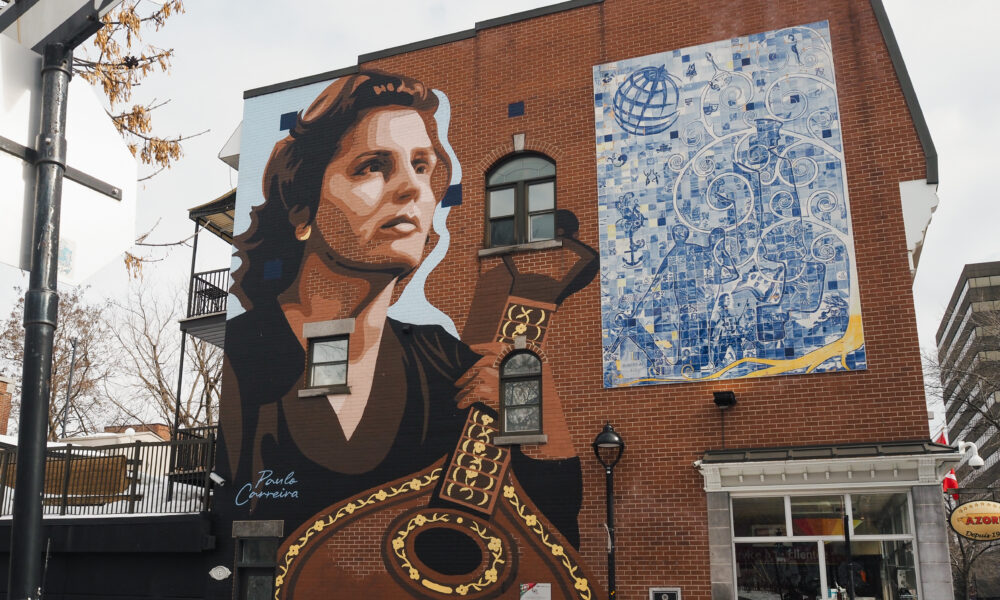
In 1975, the Parc du Portugal, located on Blvd Saint Laurent between Marie-Anne St. and Vallières St., was renamed to honour the Portuguese community of Montreal. This key feature of the lively neighbourhood was designed by the landscape architect Carlos R. Martinez in 1980. It features many colourful tiles inspired by Portuguese architecture. One of the city’s standout features is the Azulejo Mural, visible from Parc du Portugal. It was made by community members, involving the work of retired Portuguese citizens and art lovers, under the direction of Paulo Jones, Maria do Céu Castanheira’s husband. 

“The mural was made in honour of the Portuguese community in Montreal but also to thank Canada for welcoming us. It was a gift from Portugal to the city,” Castanheira elaborated. 

From the park, visitors can also spot an impressive painting of Portuguese singer Amalia Rodrigues. It is a tribute to the famous fado artist, a traditional musical genre in Portugal. 

“It was a community project that was made under the direction of Paulo Carreira but made by the people of the neighbourhood,” Pires highlighted. 

In addition to its architectural charm, Little Portugal is home to numerous traditional Portuguese restaurants that bring the rich and flavorful essence of Portuguese cuisine to Montreal. Pastéis de Nata, Portugal’s famous custard tarts, can be enjoyed at Coco Rico after a delicious roasted Portuguese chicken. Casa Minhota offers a classic Portuguese menu that includes sardines and bacalhau (cod). 

Due to its proximity to the McGill campus, Little Portugal is also home to many McGillians who have decided to adopt the Plateau lifestyle and embrace Portuguese culture. 

“I love this Portuguese bakery that’s really close to where I am called Patisserie notre Maison. It’s probably my favourite part of the neighbourhood,” Steph Doerksen, U1 Engineering, told The Tribune. Little Portugal is an essential part of Montreal, as a vibrant and living representation of the city’s immigrant story. This rich cultural enclave makes Little Portugal a must-visit and an unforgettable part of Montreal.

Read the latest issue

Read the latest issue