Latest News

a, Opinion

Renovations threaten what it means to be a McGill Student

School spirit is traditionally displayed at homecoming games and by students donning their university’s insignia. McGill instead possesses a unique type of school spirit, binding students together in a way that no football game or homecoming party ever could: Coping with the school’s decrepit and aging facilities. But with the recent round of renovations—the Arts Building portico stabilization project, replacing and remodelling the Students’ Society of McGill University lounge, and the Fiat Lux library plan—this shared experience is being threatened.

I first realized the universality of the McGill experience when I saw Eric Schreiber’s photo essay Ugly McGill. It was the realization of the feeling that students all seem to have when walking through the downtown campus, a beautiful amalgam of an Orwellian nightmare and the ice planet Hoth. The feeling that this place is ugly and falling apart, and its frequent lack of sense—why can’t we use the Redpath library doors again?—defines the student experience, and makes it our own.

As my graduation nears, it seems ever more likely that the McGill that I have come to love is on the precipice of extinction.

But renovations threaten this unique McGillian experience. Fiat Lux offers natural light and additional seating space—concepts wholly foreign to the McGill experience. The portico stabilization project will restore the pristine and historical façade, but do away with the inconvenience of circling a construction zone. The SSMU couches, with their multiple stains a living metaphor of the melting pot of McGill, will be replaced. Is the addition of modern, shiny library, some new couches, and a portico that is safe to walk under really worth losing the essence of being a student at McGill?

Despite the lack of traditional school spirit, the shared McGill experience bonds students together more tightly than a shared team or matching leather jackets ever could. Lumpy and stained SSMU couches; the soul-sucking brutalist behemoth that is the McLennan library; the thrill of the knowledge that a chunk of the Arts Building could fall and crush you at any moment—these are the experiences that define student life at McGill.

Whether in Arts or Engineering, every McGill student knows the trials and tribulations of McGill’s construction zone. For one student, this experience could be the long walks through the fluorescent halls of McLennan during exam season, circling successive floors in search of that elusive empty seat and wondering where Ferrier even is. For another, it may manifest while watching prospective students and their parents snapping pictures of the Arts Building, temporary structural support beams artfully hidden by a screen with a printed image of the original portico. Mention such experiences to another student and, though the details may vary, they are guaranteed to have similar tales of their own. While this may not quite qualify as pride, there is a definite sense of camaraderie in this knowledge.

As my graduation nears, it seems ever more likely that the McGill that I have come to love is on the precipice of extinction. The Arts Building’s probability of collapse is on the decline. McLennan-Redpath is slated to lose its fluorescent allure. If I return to McGill in 20 years and find the campus filled with shiny new buildings, designed to properly cater to the needs of students, I will not smile. Instead my heart will be filled with sadness, for it will no longer be my McGill. My McGill will always be ugly, it will always be decrepit, and I wouldn’t have it any other way.

Zachary Carson is a fourth year joint honours political science and international development student. He enjoys listening to Canadaland podcasts, watching Last Week Tonight with John Oliver, and dogs.

 
a, Editorial, Opinion

SSMU Winter 2016 Special Referendum Endorsement

SSMU Membership Fee increase: "Yes" with reservations 

The Tribune endorses a “Yes” for this quesetion insofar as it will improve the Students’ Society of McGill University’s (SSMU) financial sustainability and maintain its ability to provide services for students; however, the presentation of the motion is currently too ambiguous. If SSMU wants to convince students to vote “Yes,” the executives must distribute more information regarding the allocation of the proposed new funds.

More details must be provided over the remainder of the campaign period in order to ensure that students know what they will be paying for. At the moment, the most detailed expense  plan using the increased base fee are in a rudimentary chart. It is unclear what the scope of the categories is. For example, $5,000 for ‘Mental Health’ is certainly commendable, but it is unclear what this will pay for—there is a difference between building a ‘mental health space’ and providing happy lights.

Although a fully detailed report on the minutiae of how the additional fees will be spent is not essential at this moment—the fee increase will be a continuous portion of the SSMU budget to be allocated according to the priorities of each year’s executive—students cannot be expected to give SSMU a blank cheque.  Given how tumultuous this year has been, the numbers must demonstrate how this will be a sustainable increase rather than a reaction to the volatility, which many students currently believe it is. A degree of instability and change is to be expected year-to-year, but student trust in SSMU has been continually eroding. 

Voting “No,” however, is not going to help. Students should bear in mind that unless the referendum passes, President Kareem Ibrahim has said that SSMU “will need to make approximately $100,000 in cuts” to next year’s operating budget. The consequence would be reduced student staff positions, reduced salaries, and deterioration in service. A “No” vote would be of detriment to both students and the society; but before voting “Yes,” students require as much specificity as is possible. Once this is done, students must support the SSMU in its endeavours, despite the seemingly steep price tag. 


Restructuring Executive Portfolios: "Yes"

Adding another executive portfolio and restructuring executive portfolios is an essential change. SSMU executives regularly work up to 100 hours a week in order to fulfill the basic service requirements of their duties and the nature of the society has changed considerably since it was last restructured in the mid-2000s. As such, the Tribune therefore endorses a “Yes” vote

Streamlining executive portfolios will ensure that each executive can continue to work to improve the provision of services for students. It will also improve the efficiency of executive portfolios by eliminating wasteful overlap. The responsibilities of the executive have expanded greatly in the last few years. By reallocating responsibilities in a new position, the VP Finance, VP Operations, and VP Student Life, which would replace what is now the VP Clubs & Services position, will be able to work on campaign promises. 

Yet the referendum question does not explicitly address the issue of high turnover. While this year is an anomaly due to the contiguous resignations of the general manager, VP Internal, and Daycare director, turnover is a problem that each incoming executive needs to address. Any restructuring that does not take steps to address this issue is incomplete.

Moreover, the new position raises concern regarding the role of student support staff within SSMU. Students, particularly those who are unable to work in Quebec due to language barriers, will feel the potential impact of fe wer student jobs. At the moment, the impact of the new position on student employment is ambiguous. 

It is not uncommon for executive positions to be flexible and redefined. Though it has not happened for some time, the restructuring of executive portfolios is well past due. The referendum is, therefore, a necessary move forward for an unsustainable executive structure. 


Full Disclosure: The Tribune Publication Society holds an interest in the outcome of the SSMU membership fee increase, as it is an independent student group tenant in the Shatner University Centre.

Virtual Reality
a, Art, Arts & Entertainment

21st century challenges: Centre Phi’s virtual reality exhibit brings you closer to the news than ever

Artistic mediums are generally defined or even created by the technologies that facilitate them. Virtual Reality (VR) stands as the next ‘big thing’ to fundamentally alter the way humans visually interact with almost everything. Taking a stroll through your favourite tourist destination, watching movies that unfold around you, or even seeing political debates from a front row seat are just the tip of the futuristic iceberg that is VR. Centre Phi’s latest exhibit, “21st Century Challenges (Les Enjeux du 21e Siecle),” sets out to demonstrate the awesome potential of VR, and the result is an intimate and powerful look at socio-political problems facing our world today.

Focusing on key contemporary issues, such as the Syrian refugee crisis and the Ebola epidemic in Liberia, the “Virtual Reality Garden,” offers museum patrons the chance to get as close as most will ever get to these regions. The exhibit features four documentaries, filmed and mastered specifically with VR in mind, that attempt to bring these potentially remote, or perhaps forgotten, issues closer to home, by placing viewers right in the midst of the action. Each film is displayed on a Samsung Galaxy Note 4 that is paired with a Samsung Gear VR headset. While VR technology has historically been surrounded by much skepticism in regard to its ability to fully immerse viewers, Nintendo’s infamous Virtual Boy stands as a case in point. The standard of technology today, coupled with the relatively low cost to produce it, has finally made it possible to feasibly approach that immersive sensation VR enthusiasts have been craving.

“Waves of Grace,” a United Nations-commissioned project directed by Chris Milk and Gabo Arora, makes masterful use of 3D spatial sound audio tracking to portray Liberia during the recent Ebola crisis. This method is captivating  and allows the audience to face the tragedy head on. As the documentary traverses from schoolyards riddled with the sound of children’s play, marketplaces full of the cries of commerce, and hospitals overrun with incoming patients, all of the sounds of the film are adjusted according the positioning of the viewer’s head. This ultimately provides a much more ‘real’ experience than any newsreel could deliver. The viewer and the virtual world interact with each other in a powerful way. Their curiosity is engaged as they  attempt to absorb what they can from the 360 degree scene evolving around them. As a result, a more personal and emotional attachment to the issues at hand becomes possible. 

Perspective in the virtual world is crucial, as objects can feel intensely close or remotely distant just like they do in real life. “Nomands: Maasai,” directed by Felix Lajeunesse and Paul Raphael, brilliantly takes advantage of this phenomenon when depicting the vibrant heritage of the Maasai tribe. There are a few scenes in which the viewer sits face to face with some of the tribe’s members for an extended amount of time under an emerging canopy of stars far more numerous than any member of industrial society is used to. These scenes convey the most intimate moments  in a way that regular cinema cannot. Staring into a real person’s eyes in such a way, while seeing every miniscule detail on their faces and the surrounding landscape, provides for a level of intimacy so palpable that it was almost awkward. 

“Clouds Over Sidra,” also by Milk and Arora, provides a look into the daily life in a Syrian refugee camp from the perspective of Sidra, a 12-year-old child. This documentary, alongside “Inside Impact: East Africa,” which follows former U.S. president Bill Clinton’s endeavors for social development in East Africa, often place the viewer in a child’s perspective, behind a school desk, for example. These scenes provide a pleasant shift to a smaller perspective. 

Ultimately, the Centre Phi’s VR Garden highlights the massive potential of virtual reality, all whilst bringing audiences face-to-face with important social questions in a powerfully intimate way that will surely become ingrained  in one’s memory. The only way to understand the aforementioned films is to experience it for yourself.

“Twenty First Century Challenges” runs from Jan. 18 to Mar. 31 at the Centre Phi (407 Rue Saint-Pierre). Admission is free. 

a, McGill, News

Senators discuss research misconduct, divestment

Faculty members and students will now face new procedures when accused of research misconduct. At its meeting on Jan. 13, the McGill Senate approved a new research misconduct policy, discussed the university’s climate change policy, and heard annual reports from members.

Research misconduct policy revisions

Senate passed a research misconduct policy following a period of modification.  Provost Christopher Manfredi introduced the document, which prescribes the manner of disclosure and investigation of alleged research misconduct. Professor Abraham Fuks, research integrity officer and member of the Biomedical Ethics Unit, was invited to answer questions regarding the latest revisions to the policy.

Medicine Senator David Benrimoh questioned whether members of the McGill community are obliged to aid the investigation if called upon, or if they are free to disassociate themselves if they so choose.

“The language of the policy states that all members of the McGill community must cooperate with an investigation, so where along [the way] the word cooperate becomes forced, we’ve never tested that, happily,” Fuks responded.

A previous question posed by Benrimoh entailed examining the proceedings of a misconduct investigation if three or more allegations were put forward, instead of just one. Fuks acknowledged that while such a situation has never been encountered, it would lead to the formation of a committee in order to examine the situation further.

“It really isn’t meant to be a plea bargaining for television, it’s meant to accept the self-evident and get on with life,” Fuks said.

Divestment from fossil fuels

Arts Senator Erin Sobat put forth a question regarding McGill’s divestment from fossil fuels. Sobat addressed the administration when asking if failure to take such course could potentially tarnish the reputation of the university.

“Has the administration considered how not taking action on this issue might affect our reputations as a research institution and given the current political, economic and environmental moment, is this an opportunity for McGill to swear our vision as a sustainability leader with the actions needed to prevent catastrophic climate change?,” Sobat asked.

In response, Principal Suzanne Fortier stated that she felt that this was not the case.

“There’s no evidence actually that it has any impact on [the] reputation of universities,” Fortier said. “A thorough assessment of the question is what is expected of [the] University, and anything less than that may probably affect our reputation.”

Sobat followed up his first question by asking what McGill should do proactively in the field in response to the change in funding on behalf of the newly-elected federal government. Fortier clarified that competition for new funding had yet to begin

“[The government] intends to invest in research in sustainable technologies and intends to launch five or six chairs in sustainable technologies,” Fortier said. “We have been following progress on this, and as far we know, these competitions have not been launched yet, but we certainly are tracking progress there and are hoping to participate.”

Annual reports

Deputy Provost (Student Life and Learning) Ollivier Dyens provided the annual report of the Student Life and Learning department. The presentation included the latest advancements of McGill’s response to sexual assault. This notably included the newly-launched Sexual Assault Awareness and Prevention website, which features awareness initiatives, tools for reporting an incident of sexual harassment or assault and advice for survivors.

“We will soon bring, through the dean of students, a sexual assault policy recommendation to Senate,” Dyens said.

The annual report for Research Performance and Innovation was presented by VP (Research and International Relations) Rosie Goldstein, and included the announcement of the position of associate VP of Innovation and Partnerships.

“We’re recruiting McGill’s first associate [VP] of Innovation and Partnerships with the goals of building on the momentum in this area and bringing more cohesion to the services,” Goldstein said.  “Part of the role of this person will be to […bring] together many units that are currently engaged in the process of transformation, and really [foster] a culture to improve the support to innovation and partner entrepreneurship.”

The new position drew the attention of Medecine Senator Kenneth Hastings, who queried the creation of a position given the current period of budgetary constraint.

“This is a new position, however it is part of a reorganization of office of Partnership of Innovation,” Goldstein responded. “There will be, in the end, less managers rather than more.”

a, Basketball, Martlets, Sports

Basketball: Injury-riddled Martlets squeak by Stingers in overtime

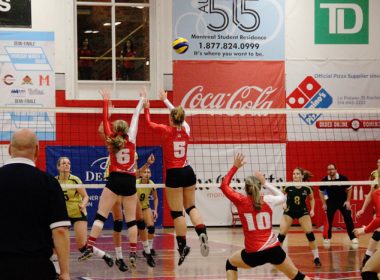
Despite trouncing the Concordia Stingers (2-8) 64-49 last Thursday, the McGill Martlets (7-1) barely beat their rivals Saturday, winning 72-70 in a nail-biting overtime performance.

McGill—sporting pink uniforms in honour of Pink Weekend, where the team aims to raise money for breast cancer research—fell six points behind Concordia in the first quarter. A quick race to regain their lead before the end of the first half followed, with the scoreboard showing 26-25 for McGill at the buzzer. The rest of the game consisted of back-and-forth action between the two teams, leading to an edgy and high-fouling second half as tensions heightened; the Martlets seemed uncharacteristically uneasy as the match progressed.

“We’ve got to be more disciplined and understand what we’re looking for,” Head Coach Ryan Thorne said on the team’s shaky performance. “I think sometimes when there are pressure situations it becomes frantic, and they just run around, and are uncertain, and will give [the ball] to anybody.”

Before this weekend, the Martlets have had to get by without two of their top players: Senior point guard Dianna Ros, who is out with an ankle injury, and senior forward Marian Sylla, who only just got back onto the court after a week absence due to a leg injury.

“[Ros has] been out for a couple weeks,” said Thorne. “[Sylla] hasn’t played for a couple games either; she didn’t play last Saturday and she didn’t play Thursday. We’re just reintegrating her into the whole thing […] limiting her minutes, just making sure she gets back okay.”

Sylla spent only 18 minutes on the court, but made efficient use of her playing time, putting up 10 points. Meanwhile, junior centre and former NCAA player Alex Kiss-Rusk took control of the game, scoring 28 points for the Martlets, a game-high.

“Right now Alex is dominating, but the last two games where you see the real domination she’s playing against smaller post players,” Thorne explained. “Starting next weekend she gets in against some post players who are more her size, so we’ll be able to gauge that better once we see it.”

[URIS id=42633]

Despite recent injuries, the Martlets have maintained strong control over the top of the RSEQ, only losing once this season to UQÀM (6-2). While Sylla and Ros’ injuries have undoubtedly hurt the team’s stats the past few games, their maintained dominance over the RSEQ is good news for the team’s future.

“The good thing is we’re winning games without [Sylla and Ros], so that’s positive,” Thorne said. “I think [freshman guard] Gladys Hakizimana played a really good game today, she did a really good job offensively[….] I was happy with the overall team play.”

Quotable

“It was a great opportunity. That’s just a great cause, so for us to do something like that we wanted to make it a little special [….] The girls just loved it. It was an honour to do something like that.” — Head Coach Ryan Thorne on filming an ad in preparation for Pink Weekend.

Stat Corner

The Martlets out-rebounded the Stingers 45-16.

Play of the Game

With time winding down at the end of the fourth quarter and the scores tied, Stingers senior forward Marilyse Roy-Viau drove to the basket for a chance to win the game. Fortunately for the Martlets, her layup did not fall.

a, Arts & Entertainment, Theatre

Conspiracy! is about more than just theories

History is a black box where nobody in the present can ever really know what happened in the past. Lies become truth through force of attrition, and truths are lost forever to the erosion of records. This unsteady ground is the foundation of Chocolate Moose Theatre Company’s production of Conspiracy!, a play that spins its themes of ambiguity into the realm of paranoid absurdity.

Written by Co-Director Martin Law, the play follows two siblings: The uptight, perpetually-worried Richard (Dakota Wellman), and the headstrong Jane (Alexandra Petrachuk), who has just been released from prison on a treason sentence. They end up in front of Queen Elizabeth I, who tasks them with faking the murder of famous playwright Christopher Marlowe for reasons that are never made entirely clear. What follows is a deceptively shaggy series of humourous incidents that seem designed more to pit clashing personalities against each other in comedic ways than to advance the plot. But in a fashion typical of Elizabethan theatre, multiple plotlines converge in the final act. Soon it becomes apparent that the play has been carefully laying the groundwork for several layers of revelation to occur.

[URIS id=42570]

The play seems to come to a poignant resolution about the power of creating a false historical narrative. It then completely eschews any sense of resolution, settling on a defiantly anachronistic ending that is as terrifying as it is hilarious. Just as the characters have been fooled by each other in various ways throughout the play, the biggest trick turns out to have been played on the audience.

Despite the fact that the script could have easily been 20 minutes shorter, it maintains a consistent level of energy throughout, rapidly tossing off Shakespearean wordplay and making pithy observations about the era in a way that leans on the fourth wall without pushing it over. What’s perhaps most impressive is how well it draws Christopher Marlowe (Kenny Streule)—a historical figure who has been accused of being everything from a spy to a warlock to the real author of Shakespeare’s plays—as a collection of the myths that surround him rather than settle on one simple interpretation. The result is a character who literalizes the themes of the play in a way that both creates a complex character and brings an extra level of focus to the production.

The acting is top-to-bottom fantastic with the caveat that some performances relish a little too much in their broad loudness. Every single put-on British or Scottish accent is delivered believably, with some actors playing multiple dialects, which is an anomaly in today’s Montreal theatre scene. The Bull siblings have believable chemistry and manage to keep the cast grounded amidst the boorish anarchy of Marlowe. Particular standouts in the supporting cast include Katherine Turnbull as a delightfully unhinged Scottish militant, and Harry Burton as a servile attendant to the Queen. In an inspired casting choice, almost all actors play double roles which invites a number of fun parallels that can be drawn, and contributes to the play’s general atmosphere of paranoia.

Law and Hannah Kirby (who also directed Players’ Theatre’s excellent Round Dance last year) are able to convey a lot despite their limited space and minimal set dressings. The set is very simple—a table, some chairs, and some black wooden boxes make up almost the entirety of the props. But they’re mixed into an endless number of imaginative permutations—for instance, some boxes and a lighting filter are enough to make a convincing moonlight burial scene. Scenes of bloodshed are usually preceded by the stage gradually becoming cast in red light, contributing to the play’s tone of heightened reality.

The lack of a direct tether to an objective historical truth could alienate some more traditional viewers, but the play makes the point that such a thing never existed in the first place. When Napoleon said that “history is a lie agreed upon,” this is probably not what he meant, but also, it kind of is.

a, Arts & Entertainment, Film and TV

Growing up is hard to do: Welcome to F.L.

From unrequited love to acne to peer pressure, adolescence isn’t always particularly easy-going. Geneviève Dulude-De Celles’ new documentary, Welcome to F.L., follows a group of Québécois high schoolers tasked with photographing each other to decorate the dull, grey exterior of their school. The film alternates between talking head interviews and fly-on-the-wall footage of the teenagers in their day-to-day lives, as they deal with realities of bullying, popularity, and social class imbalance. The film therefore alternates between being insightful and relatable to oftentimes tedious and redundant.

The students in Welcome to F.L. discuss what many consider to be the generic tropes of feeling invisible, wanting to fit in, and searching for identity and purpose in life. One student points out the parallels between movies and real life, since cliques in her school really do exist—there are the smokers, the jocks, the rich kids, and the not-so rich kids. The takeaway from this film is that despite the conflicting social groups, they all want to belong. This might seem like a contrived and generic conclusion to reach, but childish ramblings can reveal a truth that goes deeper than the speaker’s intentions.

“Many filmmakers portray teenagers as immoral and ignorant, with pursuits that are pretty base,” coming-of-age filmmaker John Hughes said in a 1985 interview with the Chicago Tribune. “They seem to think that teenagers aren’t very bright. But I haven't found that to be the case. I listen to kids. I respect them. Some of them are as bright as any of the adults I've met.”

Although the documentary includes many scenes that speak more directly to the human condition, the best parts were the quietest ones, where nothing is said at all. In one instance there was a boy climbing a building to find the perfect view of the sunset, in another scene he strums his guitar. Listening to such a silence means grasping the complexity that is adolescence, when one’s hopes and dreams are so much greater than one’s confidence. These quiet moments can often be the most teachable. Welcome to F.L. understands these complexities we’ve all faced at some point, as the students reveal their visions of the world with surprising introspection, humour, and candor.

The documentary also cleverly illustrates the hidden beauty that can be found within life’s everyday banalities, from laughing with a group of friends to walking home from school while smoking a cigarette. But it also treads a very fine line between beauty and tedium. A large chunk of the documentary seems to act as mere filler rather than offering an insightful commentary on the journey of growing up. The audience doesn’t really need to watch minute after minute of someone applying makeup for their prom or running around doing Parkour stunts. These filler sequences come across as substitutes for the film’s lack of more meaty and profound material.

Ultimately, however, Welcome to F.L. redeems its shortcomings with a refreshingly candid portrayal of today’s youth, as the students face relatable trials and tribulations before entering the next stage of their lives. While teen angst may seem overdone and cliché, the audience can’t help but feel a nostalgic connection to the students and the universal dilemmas they share. After all, growing up is not always easy to do.

a, Football, Sports

NFL Conference Championship Predictions

AFC: New England Patriots at Denver Broncos

Last weekend, the No. 1 seeded Denver Broncos managed to slide past a crippled Pittsburgh Steelers team missing its two best players. Rather than the dominating victory normally seen under future hall-of-fame quarterback Peyton Manning’s tenure, the game raised more questions than answers. The normally stout Denver defence allowed over 300 yards against a Ben Roethlisberger whose arm is held together with tape at this point. The Bronco’s offence looks even worse with a 39-year-old Manning whose play makes noted draft bust Blaine Gabbert look like a MVP. On the other side of the field, this is the best the Patriots offense has been in weeks. Number one receiver Julian Edelman is back and tight end Rob Gronkowski is getting healthier every week. Their running game is still an issue, but Head Coach Bill Belichick and quarterback Tom Brady have no qualms passing the ball on upwards of 50 plays per game, as shown by their victory over the Buffalo Bills in which Brady threw 59 times.

Defensively, the Patriots have the personnel to go toe to toe with the Broncos offence. Corners Malcolm Butler and Logan Ryan are both having solid seasons, the defensive line did not regress after losing Vince Wilfork and the linebacker corps is deep in talent. While they may not get the same recognition as Arizona or Seattle, the Patriots present a solid defence week in and week out. Unless Manning borrows Michael Jordan’s secret stuff from Space Jam, the Broncos offence has no chance of putting up more than 13 points. That’s just not enough against New England.

Prediction: Patriots 28 – Broncos 13

NFC: Arizona Cardinals at Carolina Panthers

The NFC Conference Championship game should be one of the most exciting football games in years. It features two high flying offenses and turnover hawking defenses. The Panther’s offence relies on quarterback Cam Newton’s ability to take over as both a runner and a passer. To win this match, Newton needs to have his best game yet. The Arizona Cardinals' defence is extremely disciplined—penalized the second least in the NFL—a result of Head Coach Bruce Arians’ meticulous game planning. Newton shouldn't be able to run or break the pocket as much against Arizona as with other teams. The Cardinals know their assignments and will rarely over-pursue during read options and roll outs, taking away a major part of the Panthers offence. Last week against the Green Bay Packers, Arizona managed to keep quarterback Aaron Rodgers in the pocket for most of the game and the team will probably adopt a similar strategy here. This puts more pressure on the receivers who need to beat the Cardinals defensive backs and get separation, something they are pretty terrible at doing considering their No. 1 receiver is a kick returner. The Cardinals play very aggressively which usually leaves every receiver single covered. The only Panthers player that may be able to get open on a consistent basis is tight end Greg Olsen, who will need to do his best Gronk impression and take over the game.

Defensively, the Panthers may meet their match against the Cardinals. This is a team built on deep passing with an elite quarterback in Carson Palmer who can make every single throw on the field. The Panthers have no one besides Josh Norman who can keep up with any of Arizona’s first five wide receivers. If Norman covers Larry Fitzgerald, that leaves Michael Floyd, John Brown, and JJ Nelson against an overmatched opposition. Expect Arizona to play a lot of five wide formations and use running back David Johnson as a pass catcher more often than as a runner. The overwhelming firepower of the Arizona offence might be too much for Carolina to handle, and will propel them to a victory. 

Prediction: Cardinals 35 – Panthers 31

Justin Trudeau
a, Opinion

An endeavour for a representative and legitimate Parliament

Canada’s electoral system is in need of a reboot. It discourages people from voting by the simple fact that a majority government may be formed without a majority of the popular vote. Andrew Coyne, columnist for The National Post, summed the system up, saying that it sustains “false and exaggerated majorities, discriminates among voters, rewards regionally divisive parties,” and wastes votes. Fortunately, Prime Minister Justin Trudeau has promised that the 2015 federal election is the last under the first-past-the-post system.

Trudeau should set aside partisanship and strategy, even if it means having less power, to prove that he is committed to Canadians’ interests and to the improvement of democracy.

Although Trudeau’s promise of electoral reform is a good measure, it is not etched in stone. Politicians’ promises often fall through once in office for one reason or another, such as a realization regarding the logistics of a policy—as is the case with the Canadian government’s response to the refugee crisis—or conflicts and delays due to political partisanship.  The fact that Trudeau won a majority government because of the flawed electoral system undoubtedly reduces his incentive to change the system. For two consecutive elections, Canadian parties have won majority governments with approximately 39 per cent of the popular vote. Since the Liberals have a majority government, one could say that more than 10 million Canadians’ votes were wasted on other parties. A system that includes greater proportional representation is needed.

If the Liberals do follow through with electoral reform, their plan to not hold a referendum on a new voting system is a good choice. Ensuring that the entire field of eligible voters is properly educated on a matter of this gravity and complexity would be a tall order. During the Ontario electoral reform referendum in 2007, 47 per cent of those polled said they knew nothing at all about the proposal, and only 12 per cent said they knew a lot. Although reform is often argued along partisan lines, reform itself should not be an ideological or partisan issue; it is simply reform for Canadians to be represented more effectively. Furthermore, Canadians who voted for the Liberals endorsed the campaign promise of all-party consultation as an alternative to holding a referendum. Any reform that is undertaken will thus be done in concert with the other parties. This plan to consult Canadians was confirmed by the Liberal House leader Dominic LeBlanc, who said that it has “always been [their] plan” and that there is no reason to think that’s been changed.

At this point, the Liberals could either sustain the current system by becoming complacent to change, implement an electoral system that could boost their dominance in Parliament, such as ranked ballots, or they could follow through with the all-party consultation. Without strong actions from the federal government to undertake electoral reform, the opposition parties, the media, and civil society must take the lead to push for reforms and monitor them closely. Rather than criticizing the Liberal party for not promising a referendum, there must be pressure to ensure that electoral reform is taken seriously by all those involved in the consultation. Voters must express their preferences to their Members of Parliament, and the debate must be vigorous beyond Parliament Hill. Media must emphasize the issue; Andrew Coyne’s column is one example of how this can be done, but other journalists and personalities must follow suit.

Electoral reform is ultimately a question of how equality will be defined in Canadian democracy. Thus, the particular machinations of the people in government, and the various power plays that may go into the reformed policy must be framed in terms of the overall goal. While the government must be held up to scrutiny, commentators, and citizens must bear in mind the ultimate objective—a system that is more representative, where all may participate fairly and equally.

a, Arts & Entertainment, Theatre

La vie Boheme: AUTS’ RENT sheds light and darkness on New York’s starving artists

Sentimental is a term that is often used in a derogatory way in criticism. Strong emotions are juxtaposed with a more savvy and self-aware, or clear-headed and objective approach to human issues. ‘Sentimental’ is a label frequently applied to musicals, and this year’s Arts Undergraduate Theatre Society (AUTS) production, RENT is no exception.  The musical is firmly rooted in the lifestyle of the bohemian New York City artists of the time, and thus tackles the effects of the AIDS epidemic, gentrification, and drug abuse. Despite these dark themes, the work is undeniably earnest: The ideal of the bohemian is romanticized, and the themes presented are to live life in the moment and not abandon your passions.

In a world where Alphabet City has been gentrified beyond recognition, the success of a show like RENT is thus grounded in the ability of the cast and director to make these themes seem real and relevant rather than trite and nostalgic. Daniel Austin-Boyd, the director of the show, did an excellent job by taking the source material in a more abstract direction. RENT is traditionally performed as a rock opera, with very few dance numbers. For RENT,  Austin-Boyd chose instead to enlist the help of experienced choreographer Debbie Friedmann. He uses a variety of dance numbers until the end of the first act, accentuating the fantastic and optimistic elements of the source material. This stands in contrast to the more tragic second act, where dance takes a back seat. Beyond the musical numbers, the show is full of stylistic flair, using silhouette and tableau in ways that punctuate the show’s themes within the show.

Friedmann’s choreography is worth special mention. The show features a diverse array of dance styles, including waacking, contemporary, tango, burlesque, and street dance.

“Every movement is thought out both conceptually and in movement,” Friedmann explained. “When you put that much thought into the choreography, [the audience] gets the idea behind it.”

It takes a moment to adjust to the elaborate dance performances, which come close to overcrowding the stage at times, but it pays off in moments like “Contact,” a raw and sexual number that concludes with the entire ensemble forming a writhing mass in the middle of the stage. Waacking and other dances that originated in black queer subcultures are used in “Today 4 U” to great effect, bringing the fantastic camp of drag shows to light.

The protagonist, Angel (Jordan Pollock), is central to the work: Their death represents the cost borne by the queer community in New York during the AIDS epidemic. Pollack holds this role down well, performing in and out of drag, showcasing both his excellent voice and an appreciation for music. Collins, Angel’s partner who is portrayed by Zachary Sykes, has a fantastic bass voice which serves as a strong anchor throughout the show. The chemistry between the two actors is not particularly steamy, but they both do an excellent job portraying their roles. A chemistry which works very well is between Mark (Olivier Bishop-Mercier) and Roger (Jack Ball), who are friends outside of the production and have a natural ease and familiarity with each other on stage. Roger’s romance with Mimi (Theodora Metechiuk) exhibits clear sexuality. Her portrayal oozes sex appeal, though there could have been more done to emphasize the weakness and fear that Mimi feels.

An especially enjoyable performance comes through in Sophie Doyle’s Maureen, a character whose reputation is built up for a long time before she takes the stage. Doyle perfectly captures the complications in the figure of the bourgeoisie bohemian: She is so passionate in what she does that she lacks self-awareness. Her performance of “Over the Moon” is over-the-top and hilarious, serving as a hint at some of the hypocrisy in bohemian communities as she takes centre stage to speak for experiences she doesn’t really understand. Overall, the casting fits the characters, and the additional members of the ensemble bring comedy as well as terrific voices to the production.

It’s impossible to talk about RENT without mentioning the music, which is superb throughout. As in previous productions at Moyse Hall, there are some issues with the wireless microphones, but the issues are relatively unobtrusive. The voices were nicely balanced, and the live band is talented. The powerful, delicate harmonies create shiver-worthy musical moments. In the end, this music seems to be the answer to the question of sentimentality, the feelings that it produces, combined with the stylistic touches, and performances makes the performance feel true.

Austin-Boyd and the cast and crew do a good job of bringing out meaning and nuance in their production of RENT. By nodding at some of the fantastical elements of the bohemian lifestyle, they make the harsh realities of it seem current. That said, this is still a very fun and enjoyable show to watch, with lots of laughs. The range of the performance makes it definitively a worthwhile production to see.

RENT will be performed in Moyse Hall from Thursday Jan. 28 to Saturday Jan. 30 at 6:45 p.m. Visit www.autsmcgill.com for ticket information.

Read the latest issue

Read the latest issue