Latest News

a, News, SSMU

SSMU Council passes motion of support for Fall reading week

On Nov. 5, the Students’ Society of McGill University (SSMU) held its fourth Council meeting of the year, with discussion on a proposed Fall reading week, SSMU representation at the provincial level, and reforming the executive positions within SSMU.

Fall reading week

The proposed Fall reading week was debated at council. According to Arts Senator Erin Sobat, the proposal received a large amount of positive feedback from students.

”[This project] was proposed to the university, [and when] Enrolment Services did a survey of students in April, it got over 5000 responses,” said Sobat.  “[This indicated…] that students were in favour of some sort of Fall reading break, and […] that, given some of the tradeoffs that would have to happen in terms of the academic calendar, the preferred model was to add two days to the Canadian Thanksgiving holiday weekend to give the five day break”

Vice-President (VP) University Affairs Chloe Rourke noted that there has been some stagnation at the faculty level.

“There’s been a little bit of pushback from faculty members.” Rourke said. “Mostly […] some administrative concerns that we think can be resolved. Just some aversion to change, a little bit of concern over whether or not this is helpful for students, whether or not a majority of students were in favour of this.”

The motion of support for the proposed reading week passed with a majority.

New student federations

VP External Affairs, Emily Boytinck, presented her work on joining two proposed provincial student federations: The Association for the Voice of Education in Quebec (AVEQ), and the Union Étudiant du Québec (UÉQ).  She began with an overview of the history of SSMU’s involvement in creating the new, Quebec-wide student bodies following their disaffiliation from the Fédération Étudiante Universitaire du Quebec (FÉUQ) last spring.

“Spring was a time of really really great flux and change for the student movement because  FÉUQ, which was […] the major university federation, actually collapsed in on itself,” Boytinck said. “So that left around 20 student unions disaffiliated from any association. This […] April, we actually all met at SSMU and it was apparent at that meeting that there were two sort of different visions for how the student movement will go forward, and that is where UÉQ and the AVEQ formed and started on their separate paths.”

SSMU has not yet officially affiliated with either of the student federations.

“We did not give any money to any association,” said Boytinck.

According to Boytinck’s presentation, joining  AVEQ would require levying a fee of $3.50 per student per semester, while joining UÉQ would require $4.50 per student per semester.

Structure of SSMU

The meeting also drew discussion on a potential restructuring of SSMU executive positions aimed at decreasing stress.  As SSMU President Kareem Ibrahim stated, changes to portfolios have led to a problematic structure.

“Over the past decade, SSMU has seen enormous growth,” Ibrahim said. "Just the executives alone, there have been [positions] added, additions to our portfolios. Our roles have extended from not only political roles […] but also managerial roles; it’s made it to be quite unsustainable.”

Ibrahim brought forth a solution to alleviate some of the pressures associated with SSMU executive workloads.

“Something that we are proposing […] is the addition of a seventh executive,” Ibrahim said. “This year especially, the issue behind the workloads of each executive are amplified due to the resignation of our general manager, [and] the absence of our daycare director. In our contract it stipulates that we work 70-hour work weeks. It can often be 80.”

a, McGill, News

AUS Council approves referendum question on new VP Finance selection process

On Nov. 4, the Arts Undergraduate Society (AUS) Legislative Council held their bimonthly meeting, during which they approved questions for the Fall referendum and voted to support a proposed Fall reading week.

Referendum Questions

AUS Councillors were presented with three options for a referendum question pertaining to changes in the Vice-President (VP) Finance application procedure. A straw poll was held to determine which option would be presented to AUS members in the general vote. The options included a selection committee to screen candidates before they could run in a general election, a similar screening process with AUS Council making the decision of who was eligible to run, and hiring an outside bookkeeper to track expenses. The first option, a selection committee to screen candidates, was approved for referendum.

“Basically the idea here that we're trying to accomplish is to make sure that future [VPs  Finance…]  meet some sort of criteria,” AUS President Jacob Greenspon said. “Whether or not they meet that criteria will be determined by a two thirds vote of the screening committee [….] So what we’ve done in this [question] is actually allowed for the ability for council to have a say in what criteria […] they have to meet to be able to [run] in the general election and the membership of the committee as well.”

Council also approved a referendum question to amend the description of the Arts representatives to the Students’ Society of McGill University (SSMU)  position via referendum. If passed during the general vote, changes would be made to the constitutional outline of representatives’ responsibilities.

The changes would include Arts representatives in the executive council as non-voting members, increasing their contact and cooperation with AUS executives .It will also call for representatives to sit on more committees. The motion was first presented because current representatives felt the description of their position in the AUS Constitution did not properly reflect their actual duties.

“We came up with this recently [because] after being in this position for a few months, we noticed that in the constitution we are supposed to take a much more passive role rather than an active role, and we felt that certain [changes] needed to be made,” Arts Representative Lexi Michaud explained.

Also approved for referendum were questions regarding a renewal to the Arts Undergraduate Theater Society fee—a student group that stages a major theatrical production every year and the Arts Undergraduate Improvement Fund fee, which provides Arts-focued improvements to campus such as the Arts Lounge. A question regarding a change in the dates of the AUS fiscal year from June 1 through May 31 to May 1 through April 31 to better align with annual AUS activity and McGill’s fiscal calendar was also approved for the referendum.

Support of Fall reading week

Council was presented with a motion to endorse the creation of a Fall reading week, an idea that was first presented by student senators to the student body in a survey during  the 2014-2015 school year, with the intention of reducing stress levels among students. While a proposal based on the survey results was first presented to the McGill Enrolment and Student Affairs Advisory Committee this Fall, there has been little progress towards implementing the change, which was projected to take effect by the 2017-2018 school year.

“What we're seeing right now is some pushback from faculty members who I think are having a little bit of trouble I think conceptualizing [ the break…] and there are some things that we need to work out which I think are minor,” Arts Senator Erin Sobat said. “Right now, we're just looking for a little further endorsement from students to help push this along.”

The motion to endorse was approved by Council.

a, Martlets, Sports

Basketball: McGill Martlets pull away in fourth quarter during tight match against Laval


McGill Martlets
69


Laval Rouge Et Or
60


Following a silver-medal finish at the CIS Championships last February, the goal for the McGill Martlet basketball team (1-0) was clear: Win the first National Championship in the program’s history. During their season opener  on Friday night against the Laval Rouge et Or (0-1), the team seemed inconsistent. Playing a tight game throughout, the Martlets only managed to pull away in the fourth quarter, winning 69-60.

“[It was] our size inside, and that’s what we did, we banged it inside, got some opportunities, and then kicked out,” Head Coach Ryan Thorne said of the team’s success in the fourth quarter. “Our size allows us to make [the defence] collapse, and when they collapse, we just got to be ready to knock down shots, and we did.”

It was a slow start for the Martlets, who were able to take an early 21-17 advantage in the first quarter, but then lost their lead after a series of turnovers on poor entry passes in the second. Despite their sloppy play on offence, the Martlets were able to keep the score separated by one to two points throughout the second due to a stingy defence.

“We can be a little more aggressive,” Thorne said. “Today the overall set-up for Laval, [because] they’re all small, [was to] be a little more controlled rather than being aggressive.”

Junior centre Alex Kiss-Rusk was the ‘it factor’ throughout the second and third quarter, registering six blocks and scoring all 10 of her points. Kiss-Rusk, who previously played in the NCAA at Virginia Tech, is the tallest player on the team at 6’4.”

“It’s very rare to have someone of Alex’s height and ability here in Quebec,” Thorne said. “Usually they’re in the NCAA, so definitely we want to take advantage of that.”

Kiss-Rusk was automatic on the night, making 83 per cent of her shots and scoring 10 points for her team. She has shown considerable improvement in her three years with the Martlets.

“[Kiss-Rusk has been] getting more confident, a little more aggressive,” Thorne explained. “She knows she’s one of the biggest girls in the conference, so a lot of [things] are going to go through her […]I’ve definitely seen some improvement there.”

Kiss-Rusk, senior point guard Dianna Ros, and senior forward Mariam Sylla combined for 40 of McGill’s 69 points. Sylla finished with 20 points and 14 rebounds, dominating throughout the game. For Laval, senior guard Gabrielle Girard carried the team, putting up 29 of their 60 points.

“[Girard] spent the summer really working on her game,” Thorne said. “She has improved. She’s playing at an All-Canadian level [….] For us [we] can live with one person going off and controlling the rest [of the team] as opposed to everyone doing a great job.”

McGill will head to Lennoxville to square off against the Bishop’s Gaiters (0-0) next Saturday, Nov. 14 at 6 p.m. as they continue their quest for post-season glory.


Quotable


“I thought that was a great opportunity for us just to bond. I thought the ladies, especially the freshmen, got to know each other and I thought we got to play some great competition early in the season, which was awesome.” —Thorne on the team’s pre-season experience in Greece.


Moment of the game


The Martlets went on an eight-point run over two minutes early in the fourth quarter to pull away from the Rouge et Or


Stat corner


McGill’s bench had 21 more points that Laval’s.

[URIS id=38308]

a, Men's Varsity, Sports

Rugby: McGill cruise to 15th straight RSEQ finals


McGill Redmen
50

ETS Piranhas
0

The McGill Redmen (7-0-1) routed the ETS Piranhas (2-6-0) 50-0 in the RSEQ semifinals at Molson Stadium on Friday, despite having three Redmen leave the field injured and entering plays one man down due to yellow cards.

The victory marks the 15th straight time McGill has reached the final of the RSEQ Championship, and the team was in a celebratory mood after the match. Five Redmen received awards after the game. Fly-half Augustus Hill, senior second row Tommie Larochelle, junior second row Bernard Kaminski, and senior flanker Rhys McRae-McKee were named RSEQ All-Stars, while number eight Sebastien Boyer was named Rookie-of-the-Year. Head Coach Ian Baillie was also awarded with the Coach-of-the-Year plaque.

“Ask him if he wants me to sign his Coach-of-the-Year award!” joked Assistant Coach Matt Garston during Baillie’s post-game interview.

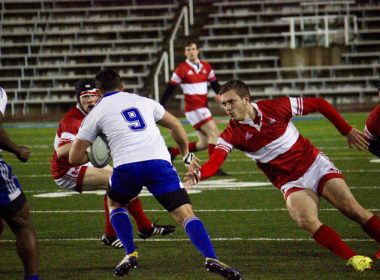
McGill’s hard running was on display all game. Senior centre Thomas Stokes recorded four tries and opened McGill’s scoring in the third minute. He swiftly followed with a second try just seven minutes later, and scored his third at the end of the first half. McGill entered the break leading 22-0.

“We have a couple of guys who can really take the line, and you saw that today,” Baillie said, “We had a number of line breaks.”

McGill’s passing was something to behold, moving the ball down the line with a frictionless ease. Hooker Mitchell Cuillerier was excellent in attack, anchoring many of the dummy switches McGill employed to keep the ETS defence off-balance.

The best of McGill offence, however, was on display in the 52nd minute—at the 50-metre line, Hill broke a tackle with a dummy pass, and then effortlessly off-loaded the ball to the rampant Stokes who scored in the corner.

McGill, who had to contend with two yellow cards, tackled in a disciplined and relentless fashion. McRae-McKee was particularly active against a pesky ETS rucking side.

“Defensively, we were very strong,” Baillie said. “We gave them a couple of penalties at the breakdown […] but we were very strong in the tackle, and we turned them over quite a bit.”

Worryingly, Hill was injured by a late tackle in the 65th minute. He was helped off the field, and his status for the Finals is presently uncertain.

“We will have to wait and see,” Baillie said. “He took a pretty good knock. So we’ll get him looked at, follow all the protocols obviously.”

McGill will face the Montreal Carabins next week in the RSEQ Finals. McGill beat Montreal on a last-second play in their previous matchup, but the Redmen are favorites in the upcoming game.

“[Montreal is a] class side—on their day they can take it to anyone,” Baillie said. “The league is getting more and more parity [.…] It will be a tough game.


Quotable

“We have a very good back three and we’ll kick counter with anyone. I think we will tend to win [a kicking battle] just because we have very good rugby players from a kicking perspective.” –Baillie on McGill’s response to opposition tactics that attempt to pin the Redmen back with the kicking game.

Moment of the game

In the  47th minute, McRae-McKee froze his defender at the McGill 30-metre line with an audacious spin move. He then proceeded to drag four defenders 15 yards before being brought down.

Stat corner

McGill have now outscored opponents 197 to 43 when playing at home.

[URIS id=38310]

a, Opinion

One week on: The Impact of WUSC’s mock refugee camp controversy

Controversy stirred last week after the World University Service of Canada (WUSC) announced an event called, “Mock Refugee Camp on Campus.” While  similar events have been held at other Canadian universities, some members of the McGill community saw the event as an insensitive way to portray and trivialize a very complex and serious issue. In response to this criticism, as well as the creation of a Facebook group to protest the event (since taken down), the WUSC renamed and restructured the event into an info session.

Social media was the forum for the debate, but the online discussion led to tangible change in the nature of the event. Despite the controversy, WUSC’s handling of the criticism ultimately helped them to accomplish their goal of increasing student awareness about forced migrations and refugees. But the discussion cannot remain limited to the event itself; the final compromise of the event must be taken as an opportunity for students and organizers alike to be self-critical of the presentation of future events around sensitive issues.

WUSC initially decided to use tents to capture people’s attention as well as  to create an interactive space that would allow students to better engage with the experience of refugees in refugee camps. While it may not have been what the organizers intended, the extensive  debate generated a lot of interest for both the  event itself as well as the refugee crisis as a whole. Active participation in the dialogue about how to best present the humanitarian crisis engaged students in ways that the event itself could not have achieved; in previous awareness events hosted by WUSC, only a handful of students attended. Whether they were furious at the WUSC or stood in support of them, McGill students were at least made aware of the event. It must be taken as the starting point to find more places to engage students in the issue of refugees and ways that the McGill community can support international crises.

The discussion helped develop an understanding of the role of emotional responses behind political and social issues. The result was a productive adaptation of the event that accommodated the concerns of students without compromising the purpose of the event, which was to make information about the refugee crisis accessible. Many of the executives of WUSC and the students that initially raised their concerns about the event are refugees, or children of refugees themselves.  One student who was against the mock tent expressed that the event commoditized refugee people’s experiences, and mentioned that the event could trigger traumatic memories.  Some WUSC executives are refugees themselves, and contended that such an event would be productive to bridging McGill students to their experience as refugees.This helps paint the emotional complexity of the issue; these individuals have each gone through unique experiences involving forced migration, which has affected their emotional response to the issue in varying ways.   Rather than marring the event, such differences were recognized and taken into consideration.

Ultimately, WUSC addressed the problems people expressed with the event and changed it accordingly by choosing not to use tents, as expressed in their statement on the matter. This lends a lot of credibility to the group and makes it easier for people to understand their purpose and goals. More importantly, it is a step towards building a positive and open relationship with the student body, particularly the people who stepped forward with their concerns. Going forward, WUSC must tap into the interest garnered by the controversy in order to continue the conversation about refugees on campus.

a, Men's Varsity, Sports

Lacrosse: Redmen overcome tenacious Badgers to make fourth straight CUFLA finals

The McGill Redmen (14-0-0) overcame a late rally by the Brock Badgers (11-4-0) to win the CUFLA Baggataway Cup semifinals 7-5 on Saturday evening.

McGill raced to a 4-1 lead in the first quarter, with goals coming from senior midfielder Anders Bjella, junior midfielder Emile Sassone-Lawless and senior attackman Jake Gutman. McGill would continue with a dominating scoreboard lead until the fourth quarter—they entered the fourth leading 6-2.

“We were really proud of how our offence played today,” Head Coach Tim Murdoch said. “We were able to use multiple players in the same position [….] We are not always counting on the same players to win the game for us. That is one of the hallmarks of our game this year—lots of depth.”

McGill, however, did not replicate their offensive proficiency in the second half.

“We really struggled with our shooting in the second half,” Murdoch said. “Our players were not shooting where we told them to shoot and consequently their goalie was making a couple of saves.”

Brock made a late surge in the fourth quarter, scoring three goals in quick succession. McGill’s standout goalkeeper William Waesche was very active and pulled out some stunning saves to help maintain McGill’s lead.

“Luckily for us our goalie had an outstanding game,” Murdoch explained. “He made some outstanding stops at the end of the game to preserve the win for us.”

Murdoch was impressed by Brock’s tenacity.

“This is a very talented Brock team […] this will be a very dangerous team in the future,” Murdoch said, “But I just think that our maturity and our poise and preparedness paid off. We took a nice lead […] and they fought back well gave us a bit of a scare [at the end].”

Despite the victory, there will be no celebrating tonight for McGill.

“Our goal is to win the national championship, not the national semifinals,” Murdoch said. “We are looking forward to playing Western in the National Championship.”

The Redmen take on the Western Mustangs  at 1:00 p.m. on Sunday, Nov. 7 in a rematch of the 2012 CUFLA National Championship. In that game, McGill emerged victorious in overtime to lift its first ever Baggataway Cup. Some Redmen such as Bjella and Gutman, who were freshmen on that championship winning team, will  be looking to bring back some of that magic.

NFL Fantasy Football
a, Football

Fantasy Football: Week 8 takeaways

Few fantasy football owners escaped a devastating Week 8 unscathed, as stars such as Steve Smith Sr., Matt Forte, Le’Veon Bell, Keenan Allen, Brandon Marshall, and more were injured. However, with injury comes opportunity; a bevy of backups will now be thrust into the spotlight, making for some intriguing waiver wire additions. Let's turn our attention to some key takeaways from the Week 8 action :

Bye bye, Bell

Undoubtedly the worst injury to come out of Sunday’s bloodbath, Pittsburgh Steelers All-Pro running back Le’Veon Bell suffered a season-ending torn MCL against the Cincinnati Bengals. Further evaluation at the hospital confirmed the severity of the injury, which fortunately did not damage his ACL. Bell has been dominant since his Week 3 return, amassing 692 total yards and three touchdowns. Back up running back DeAngelo Williams is slated to assume the starting job and is the top waiver wire add after filling in admirably for Bell earlier in the season.

Duel in the dome

In a game that saw 13 offensive touchdowns, the New Orleans Saints edged the New York Giants 52-49, thanks to a 50-yard field goal in the final seconds. Brees, who lost his spot in the circle of fantasy elite this year, threw for a career-high 511 yards and a record-tying seven touchdowns. Eli Manning tossed for six touchdowns in the loss, three of which went to the superb wideout Odell Beckham Jr.. With a soft schedule remaining, Brees should be able to repay his fantasy football owners for his lacklustre past performances.

Austin’s powers

Following two highly underwhelming seasons, St. Louis Rams wideout Tavon Austin is finally making a name for himself in both the NFL and fantasy football. The West Virginia product went off for 119 all-purpose yards and two touchdowns in the Rams’ win over the 49ers. Austin has now had two multi-touchdown performances this year and has reached a career-high six scores. Proving to be a dual-threat player in the pass and run game, Austin is a viable fantasy starter going forward; however, the Ram’s volatile offence will make consistency difficult to achieve.

Saint Mark

Most fantasy football owners lost confidence in Saints running back Mark Ingram after three consecutive sub-1000 yard seasons, writing him off as a perennial bust. The Heisman Trophy winner then began to show signs of life last year, accumulating 1109 total yards and nine touchdowns. With half of the 2015 season now in the books, Ingram has rushed for 530 yards and five touchdowns and become a focal point in the passing game. A season ending injury for goal-line vulture and change-of-pace back Khiry Robinson will only lift Ingram’s fantasy ceiling further. He is a top-10 play at running back every week.

Carr-ying the team on his back

Torching the New York Jets for 333 yards and four touchdowns, Raiders signal-caller Derek Carr continues to impress in what has been a breakout season for the sophomore quarterback. Carr has five multi-touchdown games on the year and has led the Raiders to a 4-3 record. The Fresno State product has demonstrated confidence in the pocket and a nice touch on his passes. Finally it appears as though the oft-struggling Oakland Raiders have found their long-term answer at quarterback. Carr is a worthwhile fantasy starter in a plus matchup against the Steelers in Week 9.

a, Men's Varsity, Sports

Soccer: Redmen fizzle out in season finale

The McGill Redmen (3-9-1) fell 3-1 against the Montréal Carabins (8-3) on a cold, rainy Sunday at Molson Stadium. McGill, already disqualified from the post-season after their loss to Laval on Friday, nevertheless began the game with an ambitious effort to walk away with the victory.  

During the first half of the game, the Redmen kept constant pressure in the Carabins’ half; however, their continual shots on net were not easily let go by the Carabins’ goalie, Samuel Dufort, who found dynamic ways to keep the Redmen from scoring.

“We’re a young team so the progress has been consistent all year,” said Montréal’s Head Coach, Pat Raimondo. “Our goalkeeper’s been good, our rookie centre back has been good […] every game we’re getting a little bit better.”

Raimondo sat on McGill’s bench in from 1994-2000 as McGillès head coach. During his seven years at McGill, he led the Redmen to victory in four conference finals and helped them secure a national title in 1997.

Down by a goal going into the break, the Redmen came back onto the pitch with a burst of energy. Rushing up the field, Roberto Bonalumi, an exchange student from Italy, assisted the ball to Henri Ashe-Taylor. Ashe-Taylor, dribbling the ball up the left side of the turf, found the back of the net with a powerful strike to tie the game back up just six minutes into the half. Montreal rushed the McGill zone immediately after the goal and set up a chance to score when junior goalie Max Leblond stopped the ball dead in its tracks.

Despite McGill’s attempts at the start of the second half, Montréal came back strong in what remained of the second half. Continually rushing McGill’s defensive end. Their efforts paid off with two more goals; one in the 67th minute and the other in the 88th minute of the game. Their efforts defeated the Redmen, leaving the score 3-1 Montréal.

When reflecting on the season, Redmen Head Coach Marc Mounicot described a downward trend in the team’s performance.

“The second half was more difficult,” Mounicot explained “Finishing was a problem and we tried to address this at each practice.”

The season is over, but Mounicot and the Redmen are already facing some big changes for next year.

“Next season we are losing six players because of graduation,” said Mounicot  “We need to recruit a lot and change a lot of things including the roster.”

Sound Bite

“[There was] low emotion which is very odd [in] McGill-Montreal games, especially because I was on the McGill bench for seven seasons, so there is always a little bit of extra special meaning [in] these games.”- Raimondo on gameday emotions between McGill and Montreal

Moment of the game

Roberto Bonalumi’s assist to Henri Ashe-Taylor at the start of the second half demonstrated his quick reactions and good awareness.

Stat corner 

McGill lost three games on home turf in the past month.

a, McGill, News, PGSS, SSMU

Joint Senate-BoG meeting addresses making a smart campus for the 21st century

Designing a smart campus for the 21st century was the topic of discussion at this year’s annual joint meeting of the McGill Senate and Board of Governors (BoG). The governing bodies gathered this past Tuesday to discuss ways in which McGill could adapt its facilities to suit the needs of both current and future students.

Principal Suzanne Fortier opened the meeting with a description of what it means to be a smart campus.

“I believe that a smart campus […] is not simply about having state-of-the-art digital structures,” Fortier said. “It is rather, about how we can reimagine what we do in all aspects of campus life and learning, and in research and administration, taking advantage of the state-or-the-art technologies that are available to us [….] Our goal is to be more efficient and […] do what we do better, and at the same time save money—that’s the sweet spot that we’d always like to reach.”

The meeting was structured  along three points of discussion: Community engagement, technology, and the physical campus related to face-to-face learning. Senate and BoG members were seated at one of 10 tables, with each table assigned one of the three topics during a discussion period.


Community engagement

Students’ Society of McGill University (SSMU) Vice-President (VP) University Affairs Chloe Rourke summarized her group’s findings on how to foster community engagement within McGill.

“The first [suggestion] was to open McGill up to the global community,” she said. “MOOCs and online learning would be an important tool to facilitate that, but also opening our physical campus to the Montreal community through ways like allowing information that is available on campus to be seen through a mobile device, or [having] open lectures.”

Rourke additionally emphasized a need to properly prepare students to contribute back to the community upon graduation.

“In order to allow students to succeed in this changing global environment, you need to provide a supportive environment [for students] to personally develop and grow while at McGill,” she said. “That’s everything from addressing mental health issues to finding opportunities for experiential learning.”


Physical campus and face-to-face learning

Post-Graduate Students’ Society of McGill (PGSS) President Danielle Toccalino suggested the adaptation of McGill classrooms into a more blended and fluid space—a concept that has not traditionally been implemented in the past.

“[This includes] using [classes] as a way to collaborate with peer-based learning and teaching, and taking the actual content of the class to more of an online setting, so you learn outside of the classroom and then come and discuss, collaborate and extend your learning in more social setting,” she said.

Toccalino additionally outlined a need to increase social spaces for students in campus.

“[We should increase] the amount of space that we have on campus where people can come to collect to diffuse after a day in lab or at school and where there’s the opportunity to spark collaboration,” she said.


Technology

SSMU Education Senator Parvesh Chainani highlighted the importance of implementing technology in the classroom.

“Our teaching and learning practices should reflect what students do outside the sphere of the classroom,” he said. “When we go outside we are always on our phones, […] so why not apply that mode of communication into the classroom? Why not use text messages as a medium for students to participate in class?”

Chainani then brought forward an idea to create virtual labs in place of physical ones.

“There isn't much funding to create more laboratories, so why not [have] several universities comes together, pool resources, and create a virtual lab,” Chainani said. “It could be used in the classroom as well because these days in the science classroom, […] your professors teach theory, and they don’t teach how the theory is derived. With a visual medium the students would be able to gain the practical data and apply that to the theory that they learn.”

a, McGill, News

Divest McGill meets with BoG to discuss investment freeze

On Oct. 22, Divest McGill met with the Committee to Advise on Matters of Social Responsibility (CAMSR), a sub-comittee of the Board of Governors (BOG), to discuss the future of McGill’s assets invested in fossil fuel-related industries. In their presentation, Divest McGill proposed to the committee a freeze on any future fossil fuel investments.

Joey Broda,  U4 Engineering anda  long-time member of Divest McGill, is committed to ensuring that Divest’s message is heard by the McGill administration.

“This was the third meeting we’ve had [between Divest and CAMSR] but this meeting was specifically to talk about the idea of a freeze,” Broda said. “That would require getting CAMSR to recommend to the Board of Governors that they discontinue future investments in fossil fuels until they’ve examined social harm that might be caused by fossil fuel investment. The idea being that […] if there is social harm involved with fossil fuel development, then they shouldn’t be expanding that harm until they’ve made the decision yes or no.”

Divest McGill presented their plan during an open portion of the CAMSR meeting, which was followed by a closed session in which the committee decided not to vote on immediately freezing future fossil fuel investments. Jed Lenetsky, U1 Environment, was disappointed by the outcome of the meeting.

“I was really impressed with how [the meeting] went,” Lenetsky said. “I thought we controlled the dialogue very well, and I thought we were able to pressure the administration fairly successfully, so it was a little disheartening after the meeting when we found out that, in the end, [the] good execution of our plan didn’t really come through.”

On the other hand Kip Cobbett, the chairman of the BoG felt the meeting was a success. .

“The meeting was very useful,” Cobbett said. “The Divest McGill people explained to us, in great detail, with a lot of supporting documentation, as to why they thought it was important for CAMSR to issue an immediate order freezing any further fossil fuel investments. The committee is now considering what decision we should render on the request for us to issue an immediate freeze.”

There has yet to be a full meeting for CAMSR to properly analyze the information presented by Divest McGill, and so the issue of freezing future assets is  on the agenda for the next meeting on Nov. 11; however, that still leaves the overarching issue of total divestment unanswered, something that both parties hope to answer quickly.

“I am hopeful, I’m not going to say that I have an expectation, but I’m very, very hopeful that we will have a decision [on divestment] in the first quarter of next year,” Cobbett explained.

According to Broda, this deadline is due to outside pressure from alumni and donors of the university.

“There is a group of alumni that are going to return their diplomas if McGill hasn’t divested [by March 30],” Broda said. “There is also a campaign that is growing rather fast, to hold donations until [McGill divests], which is something that the university is really responding to.”

Between now and then, the CAMSR committee, once it has finished its deliberations, will make a recommendation as to the course of action to the Board of Governors. That recommendation will then either be accepted or rejected.

“It has been a very thorough process, we’ve had a lot of very good information provided to us by the divest people, and we’re working away at it,” said Cobbett.

Read the latest issue

Read the latest issue