Victor Alinka is sitting alone at the table, focused on his meal. Apprehensively, I approach him and ask if I can join. He flashes a hesitant smile, and I take that as my cue to sit across from him as he continues to eat.
The room is bustling with activity, filled with people handing out food or taking their breakfast. The majority of the people in the room are homeless—most are carrying everything they own in sacks or backpacks. Victor is imposingly tall, with matte brown hair and a look of weariness permanently etched onto his face.
“I’m from a small town a few hours away from Montreal,” he tells me. Victor is 23 years old and has been homeless episodically since the age of 18.
Homelessness in Canada is a constantly evolving and complex issue. The number of homeless persons in Canada has been under heavy scrutiny and debate, but federal estimates are at 200,000. On any given night, 30,000 to 50,000 persons are homeless across Canada.
Despite it being an issue that confronts us every day, many of us choose to ignore the faces of suffering that fill in the cracks of our society and streets. Every person in Montreal has seen the manifestation of inequality on our sidewalks, whether it is the solitary homeless person next to the gleaming windows of Provigo, or a ragged sleeping bag in a park filled with slow breathing
The public debate about the causes of homelessness is divisive. Traditionally, homelessness has been attributed to the individual—laziness and an inability to ‘work hard’—but the factors responsible for those who live homelessly are far more nuanced than they might appear. While mainstream opinion has progressed towards accepting the systemic causes of homelessness, the actions that we take to prevent and reduce homelessness still leave much to be desired.
Alain Spitzer, Executive Director at the St. James Drop-in Centre—an organization that offers hot meals and other resources to the homeless—believes there needs to be a more well-rounded perspective when looking at these issues.
“The most common misconception that people have about homelessness is that most people who find themselves in this circumstance are in it for predictable reasons,” Spitzer explains. “Homeless folks are not always people who had a difficult upbringing, poor parents, and abusive relationships. Homelessness can occur […] often because of circumstances that we do not directly control. At St. James, we have people who are homeless that were in the army, had high positions in the banking world, [who] served in the police force, and others who [actually] worked in social work before ending up on the streets themselves.”
I call the shelter where I met Victor a few days later to see if I can arrange another meeting. The staff member calls him over and passes the phone to him and we agree to meet the next day.
We walk into Tim Hortons together and I ask him if he would like to eat anything. “Timbits,” he says, his eyes locked onto the glowing LED menus. We sit down at one of the tables with a box of a dozen chocolate Timbits.
“I didn’t grow up poor, but we weren’t that well-off either,” he says as he bites into a donut. “My dad left me and my mom when I was 12.”
Victor can still clearly recall his father’s interactions with his mother when he was growing up.
“He would come back home […] wasted, and I would hear nothing but yelling coming from their room all night,” he continues.
When Victor was 12 years old, his father left the family home. “I think my mom was relieved that he left, but him leaving couldn’t erase all the shit that he put her through. She was drinking a lot before he left, and it only got worse after he was gone.”
By the time Victor was 14, his mother’s excessive alcohol consumption and acute liver failure led to her death.
“I had to go live with my uncle [Marcel] after that,” he says. “I remember when the cops told me that he had arrived and I had to pack up everything I had in 30 minutes. I was in Montreal by the next day.”
I try to ask him about his time living with his uncle, but Victor shakes his head and tries to move the conversation along.
After two years of living with Marcel, social workers took Victor and placed him in a foster home in Montreal’s West Island with a middle-aged couple called the Harringtons. Without any immediate or extended family outside of his uncle and missing father, his social services worker opted for non-kinship foster care independent of his relatives.
“The Harringtons,” he says. “They were great people. For the first time in my life I felt like I was living with people that weren’t total fuckheads.”
Victor smiles as he reminisces about the camping trips that they would take, and the barbeques in their backyard during the summer. According to Victor, the greatest gift that the Harringtons were able to give him was the gift of normalcy, such as the ability to come back home on a Friday night without fearing for his personal safety.
While his time at the Harringtons was a positive experience, Victor could never alleviate the nagging feeling of being an outsider in a stranger’s home.
After two years, Mr. Harrington accepted a new position with his firm in Paris, and Victor was shuffled into a group foster home.
“When I look back on it, I don’t think they would have wanted to adopt me,” he says. “Sure, they liked me, but that wasn’t enough for them to make me their son.”
When I ask him if he’s bitter about their departure, he gives me a terse response. “Nah man,” he says. “I wouldn’t have adopted me if I were them. Imagine if [social workers] send [you] a 16-year-old stranger to take care of—are you supposed to feel like he’s your son the next day? I wasn’t happy when they left, but I didn’t expect anything like that from them.”
The various provinces and territories in Canada have differing ‘ages of protection,’ which is the maximum required age that a child must be placed under a guardian’s custody. In Ontario and Quebec, the age of protection is 16 and 18, respectively.
After two years of living in the group foster home, Victor was out on the streets. Unable to find employment, and with the foster home no longer legally required to care for him, Victor was forced into homelessness.
A few days later, I meet Victor near the gazebo in a park, which according to him is his preferred “spot.” Surrounding his faded backpack are two empty bottles of beer. He nods when I ask if those are his, and I follow up with asking him how often and how much he drinks. In reply, he shoots me a look that encapsulates both his amusement at my naïveté and his reluctance to give a clear answer.
Studies of alcohol and drug abuse among the homeless have never resulted in concrete statistics. However, there is a general consensus within studies that homeless persons have much higher rates of substance abuse than the general population of Canada. In a study conducted within the Greater Vancouver Regional area by Goldberg et al, 48 per cent of all homeless persons interviewed reported some dependence on narcotics or alcohol.
Victor himself has stayed off narcotics, preferring to drink instead, mainly due to seeing other homeless persons go ‘over the deep end’ with substances such as heroin. According to Dr. Evan Wood from the University of British Columbia, heroin is seeing a resurgence in Canada and is cheaper and more readily available than ever before.
Victor is aware of his alcoholism, but is also abjectly defeatist. He tells me that he obviously realizes the contradiction of knowing the consequences of alcoholism and being an alcoholic, but drinking is an easy way to relax.
Substance abuse among the homeless has been the frequent target of government social policies in previous years. However, the Canadian government has done little to address the issues in a truly adaptive manner. Due to a lack of focused initiatives, government efforts lack consistency and long-term perspectives.
“Different people need different interventions,” Spitzer says. “But the social system is becoming increasingly inflexible and attempts to impose structures that are designed as ‘a one system fits all.’ Policymakers need to recognize that the ‘one [system] fits all’ philosophy is dead.”
Homelessness can be a dehumanizing experience. If a person is homeless, they are at the bottom of the socio-economic ladder. Furthermore, they are a low priority for legislators and other citizens, especially in the face of other issues that call out for our attention. The dehumanization occurs when indifference is the main stance of pedestrians towards the homeless. How many times have we all walked by homeless persons, too plugged into our phones and our music, not even willing to give a glance or a nod? Victor adds that small talk, or some other form of acknowledgement, is preferable to treating him as a dusty object on the street—even if the person doesn’t give him money or food.
Many of us, especially at higher academic institutions, don’t come from broken homes or struggle to find shelter each night. However, this fact doesn’t excuse the apathy, the lack of effort to at least enter into a conversation—especially when we have the time to—with those who live on the very streets we tread everyday.
Interactions with non-homeless persons in our daily lives are commonplace, but when encountering the poorest and the downtrodden, we often steer clear in order to expunge their situation from our minds. Worse yet is when our apathy turns into annoyance, when we deride them for sleeping on the premises of our institutions or being in our way as we walk on the sidewalk.
In June 2014, a store located on Saint-Catherine street installed spikes on a ledge in front of the store, which was criticized as a method to deter the city’s homeless population from loitering. While the media and many locals were quick to decry the spikes and called for their removal, it is troubling to see that certain members of our community would go so far as building these spikes. Such reactions only further contribute to the dehumanizing experience of homelessness. Even small interactions with those living on the streets, however trivial it may seem to us, are the foundation for our own progression as mindful citizens. Bringing the homeless into our hemisphere of thought can contribute to our own development of compassion and empathy. While small interactions are not the solution to solving homelessness, they are a stepping-stone to understanding the larger systemic inequalities.
I meet Victor again six days later. Victor asks me for a cigarette, so I light one up for him and myself. We both look together towards his former home. We’re in a sleepy suburb street in the West Island, where the front lawns are meticulously manicured, and the only sounds in the air are fallen leaves rustling in the wind.
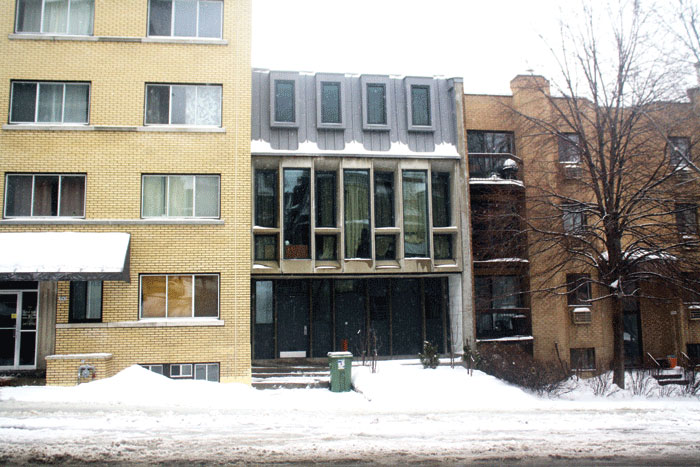
Although we only view it from the outside, the Harringtons’ former home immediately exudes an aura of comfort and warmth through its pleasant brownstone exterior, its tall tree in the front lawn, and its rope swing swaying from one of the branches in the breeze. I turn towards Victor, wanting to ask him more about his experience living with the Harringtons.
Then, I immediately regret asking him to come back here.
While the rest of his face doesn’t betray any of his inner thoughts, his eyes add to my already mounting feeling of regret and shame. Though he stares at the house with an unwavering glance, the sentiments in his eyes are the furthest thing from happiness. I glance back and forth between him and the house, trying to summon up words to combat the awkwardness of the situation. My shame turns into anger—anger at my own stupidity of convincing someone to relive his past and not realizing how painful that can be.
When I originally asked Victor to take me to his old foster home, it seemed like a good idea. Many other actions we take towards the homeless, such as dropping spare change into a homeless person’s cup, seem kindhearted and make us feel good, but they do little to alleviate the overall issue. A comprehensive recognition of the homeless as people—instead of just as subjects of an article or the recipients of our spare change—can help us recognize that in these actions, we’re not treating them on an equal level, and that they only help to serve our own emotional interests.
“The greatest challenge that many homeless people struggle with is not just economical—it is relational,” Spitzer says. “They need for people around them to see value in them as people. To esteem them is to give them a chance to move forward in a positive way.”
Victor finishes his cigarette and wordlessly walks away, leaving behind a place that seems so normal to any passerby, but haunts only him with the question: What if things had been different?