Latest News

a, Arts & Entertainment, Music

Album Review: Ryan Hemsworth – Alone For the First Time

Ryan Hemsworth’s Alone For the First Time follows his well-received Guilt Trips (2013) to constitute the Canadian producer’s third studio album. The record immediately offers a unique, somewhat melancholic tone with the opening track “Hurt Me”—something that remains present throughout. The minimalist electronic beats, coupled with a grounding percussion, mix well with the tracks’ slow-paced vocals, all of which are distorted wonderfully to give the album a mellow rhythm that serves it well.

Unfortunately, the album does not build upon this foundation and instead chooses to maintain its slow tempo—a decision that wouldn’t be as maddening if not for the feeling of wasted potential that lingers throughout the album. More baffling still is the short track listing, which would have worked well had its sparse composition climaxed into something greater, but in reality, it leaves the listener wanting more. The whole affair breeds musical style not unlike The Weeknd’s House of Balloons (2011), but whereas that gelled into a complete experience, Alone For the First Time fails to emerge as a satisfying whole, even though tracks like “Snow in Newark” bring it close. Hemsworth’s latest may offer a rich atmosphere and a well executed bare-bones style, but for some, that may not be enough.

a, Opinion

Commentary: The portrait of a terrorist

The portrait of a terrorist is often painted by the media as such: A radical jihadist with a calculating and deliberate plan to bring down the West. (more…)

a, Arts & Entertainment, Music

Deep Cuts: Classical pieces that everyone should know

Eine kleine Nactmusik, K525

Composer: Wolfgang Amadeus Mozart

Composed: 1787

You’ve heard the famous first movement maybe a million times: In movies, TV shows, commercials, and on stages time and time again—maybe you even played it with your middle school orchestra. Translated quite literally to “A Little Night Music,” this serenade has been noted by critics as the most enduringly popular of all of Mozart’s works. Interestingly enough, unlike the majority of his work, there is no record of it being commissioned by any one person or institution. Albert Einstein hypothesized that Mozart wrote the piece to fulfill a personal need—something otherwise unheard of for the prodigious professional.

Symphony No. 9 in D minor Op. 125

Composer: Ludwig van Beethoven

Composed: 1824

A list of popular classical music wouldn’t be complete without Beethoven. Symphony No. 9, which Beethoven wrote while completely deaf, is not only considered the composer’s greatest work, but is arguably the best piece of music ever written. The hour-long symphony features “Ode to Joy” in its fourth movement—the most famous musical manifestation of human happiness that exists in the Western world. 

https://www.youtube.com/watch?v=rHuGktVssdc

Orpheus in the Underworld: Infernal Gallop

Composer: Jacques Offenbach

Composed: 1858

Practically anyone can whistle the “can-can” on command. But how many people can tell you where it comes from or how they even know it? Embodying pure joy, this small—but erroneously dubbed—melody is part of a much greater story. In fact, it is only a tiny segment of the first-ever full-length classical operetta. Written by the great romantic-era composer, Jacques Offenbach, the music serves as an accompaniment to Offenbach’s scathing satirical plot, which was not originally well-received thanks to its vulgar scenes and rather ruthless parodying of well-respected composers.

Rhapsody in Blue

Composer: George Gershwin

Composed: 1924

Commissioned by Paul Whiteman to create a “jazz concerto,” American pianist George Gershwin composed the exuberant masterpiece known as “Rhapsody in Blue” while on a single train ride to Boston. An intricate fusion of classical and jazz styles, this seminal piece was originally created for solo piano and jazz band, but in 1942, its scores were also published for symphony orchestra. Gershwin has referred to the piece as the “musical kaleidoscope of America” and it seems to capture the essence of America’s conceptual ‘melting pot’ and characteristic national pep with its perpetual movement, innovative harmonic structures, and heightened contrasts.  In popular culture, this piece is notoriously associated with New York City (Fantasia 2000, anyone?), which is certainly an appropriate coupling due to the piece’s bouncing, metropolitan feel.

a, Editorial, Opinion

Fall 2014 Referendum: Endorsements

The Tribune gives its endorsements for the Students’ Society of McGill University’s (SSMU) Fall 2014 Referendum.

(more…)

a, Opinion

Commentary: To be heard, or not to be heard

“The smart way to keep people passive and obedient is to strictly limit the spectrum of acceptable opinion, but allow very lively debate within that spectrum….”  – Noam Chomsky

(more…)

a, Arts & Entertainment, Film and TV

Pop Rhetoric: A missed opportunity for The Newsroom

For those convinced of the self-absorption of the American “media elite,” the hoopla that surrounded the debut of Aaron Sorkin’s The Newsroom in 2012 was an excellent case-in-point.  (more…)

a, Science & Technology

Uber simple, Uber convenient, Uber ruthless

Uber taxi service has recently blown away its previous valuation in a $1.2 billion financing round—making the taxi company worth a staggering $18.2 billion. According to Business Insider, the company is rumored to have made $2 billion of total profit, and Travis Kalanick, the CEO of Uber, claims that profits are doubling at least every six months. However, profits being realized in only five out of the 130 cities in which the company operates, according to Insider.

“Uber is revolutionizing the way taxis work,” stated William Nairi, an Uber spokesperson.

Uber is a transportation service that, according to its website, offers a “one-tap” alternative to a taxi. The entire process, including paying for the ride, happens within the app, much of it automatically through algorithms. The sleek user interface is easy to use, making getting a taxi simple and accessible. The company promises a ride within minutes, with five levels of service, including everything from fast and cheap transportation—UberX—to limousine-style travelling—UberLux. With 4.4 stars on the iTunes App Store and four out of five stars on Google Play, the app is gaining considerable traction even here at McGill, Uber has many fans.

“Uber has completely replaced taxis in my life,” says Maddie Dean, U3 Arts.

“It is way faster than a normal taxicab,” added Evan Thomas, U0 Arts.

And that’s the appeal. The company provides cheap, convenient, and fast transportation for the masses. It goes further than that, explained Nairi.

“Uber has a dual purpose: Providing a new way for consumers to travel, and providing the app economy’s first job market,” Nairi said.

If Kalanick’s claims that Uber hires 50,000 new drivers every month are true, it will be one of the first examples of an app mass-producing jobs.

Despite all of this success, however, Uber has many detractors. Many accuse Uber of undermining taxi company livelihoods. In Europe, particularly in France and Germany, taxi unions have staged multiple protests against the company, some of which have even turned violent.

Allegations about the company’s questionable practices are also increasing. The company has been accused of decreasing drivers’ fare revenues at will—in one case lowering fares from $2.10 to $1.10 per mile over a year—causing protests in several cities.

Furthermore, according to The Verge, there are allegations of Ubers anti-competitive behavior against rivals, such as Hailo—which uses established taxi companies in offering Uber-like services, and Lyft—a ridesharing service similar to Uber, whose drivers sport pink polyester mustaches on their cars. This summer, as Lyft was launching in New York City, Uber launched an office known as SLOG (Supplying Long-term Operations Growth), where employees ordered Lyft rides and tried to convince drivers to join Uber, in a story broken by The Verge,  or if not, cancel rides—causing slower times for Lyft customers.

Uber is spearheading a revolution by replacing a service consumers use daily with an app. But whether or not one should use Uber over other competing solutions is another matter. Lyft and Hailo are companies who claim to provide the same convenience, offer compelling alternatives, and are not surrounded in a cloud of scandal.

However, the company still remains one of the most reliable ways to get cheap and fast transportation in Montreal. It has the best location-tracking algorithms, the most drivers, and the shortest waiting times. Despite the allegations and the ruthlessly competitive nature of the market, Uber may still be the wisest choice. Only when more ethical counterparts catch up to Uber in accessibility and ease should users consider switching to a different service. For now, at least, Uber remains king.

a, Arts & Entertainment, Music

Sloan turns it up to album 11

There are few bands that posses both the longevity and commitment to collective songwriting that Sloan does. Each member of the Halifax four-piece—consisting of rhythm guitarist/vocalist Jay Ferguson, bassist/vocalist Chris Murphy, lead guitarist/vocalist Patrick Pentland, and drummer Andrew Scott—has contributed significant material since the band’s debut in 1992. However, according to Ferguson, this process hasn’t always sat well with everyone.

“Maybe in the early days it was a bit of a detriment to us,” he said. “When we were signed to Geffen [Records], I think they were maybe pushing more for Chris to sing all the songs just so there was a frontman and it was easier to market, even though some of the the biggest bands in the world had multiple singers and songwriters.”

After 22 years and 11 albums, the formula has proven to be a winning one. Sloan has garnered both critical and commercial acclaim for its quintessential brand of power pop.

“Even before Sloan started we were all in bands where we were songwriters,” Ferguson explained. “So it kind of made sense for us, and especially for Andrew who’s a great drummer but also a great guitar player and a great singer. After a few albums […] it sort of became our identity. Everybody has an outlet, no one’s frustrated.”

Despite its experience, Sloan is intent on continuing to find new ways to provide this outlet. Ferguson suggests that this is the key to keeping the band honest and fun after so long.

“Challenging yourself always sounds so cheesy,” he said. “What could we do with our eleventh album? I mean, we could have just made a record where everyone sings and writes three or four songs and it’s sort of staggered. We decided on this record to just sort of carve it up and make it a real double record. Everybody kind of gets their own side to do what they want. I think that’s a new template for a new band like us. It’s a way to keep things fun and engaging.”

That 11th album, Commonwealth, marks yet another chapter in Sloan’s extensive history. Divided into four sides—Ferguson’s “Diamond”, Murphy’s “Heart”, Pentland’s “Shamrock,” and Scott’s “Spade”—the album gives each member a chance to express his individual ideas for a longer amount of time than the two to four minutes of a typical Sloan song. The band took different approaches to this challenge.

“Not all of us rose to the challenge of necessarily having to stream all our songs together on our particular side,” Ferguson explained. “Andrew took it to the extreme and made one giant song that is essentially six to seven mini-songs strung together. Patrick didn’t really stream his songs together at all—which isn’t a bad thing, it’s just what he chose to do. It’s about having your own side to do what you want. The actual recording of the songs wasn’t that different from a typical Sloan record. It was up to us to make our sides as interesting as we wanted.”

With Commonwealth, Sloan is a band looking to the future, but the group has also been looking to the past. Following this past year’s reissue and tour celebrating the twentieth anniversary of its 1994 classic Twice Removed, Ferguson hinted that Twice Removed won’t be the last Sloan album to be revisited.

“I think the next big thing we would do is plan another reissue box-set,” he said. “We might do it for our third album, One Chord to Another (1996). That will probably come out early 2016, ballpark anyhow.”

Between new albums, reissues, and constant touring, it’s a wonder how the band ever catches its breath. Maybe after 22 years, they don’t need to.

Sloan performs at La Sala Rosa (4848 Saint-Laurent) on Thursday, Nov. 27 at 8 p.m. Tickets are $22.50.

a, McGill, News, SSMU

Conference discusses historical, cultural impact of French Quebec bilateral agreement

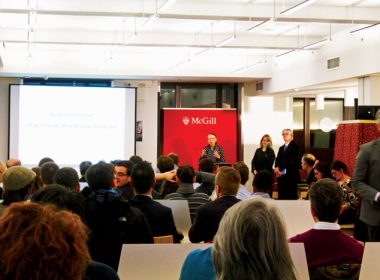
Last Monday, the McGill Commission on Francophone Affairs hosted a conference discussing the effects of the bilateral agreement between France and Quebec on education. The event was also co-hosted by the Department of French Language and Literatures, Le Délit, the Department of Political Science at the Université du Québec à Montréal (UQÀM), and Standpoints, a Montreal-based student-run think tank. Samy Mesli, a professor at the Department of Political Science at UQÀM, spoke to the history of the bilateral agreement, which was signed in 1965 and allowed for cooperation between Quebec and France for issues, such as education, under provincial jurisdiction.

“It was a founding act […] in the domain of international law,” Mesli said.  “This agreement of Feb. 27, 1965 also marked the beginning of Quebec’s foreign policy [….] The 1965 agreement opened the door to bilateral cooperation, first in education and then in culture. Now, it touches almost every aspect of economics sectors—health, social, economics, and more.”

Melsi also highlighted the opportunities that the agreement provided for Quebecois students going to France.

“[There are] 5,000 Quebec [students] in France at the moment,” Mesli said. “[The] majority of Quebec students will return back to Quebec and maintain an intellectual lifestyle [….] Conserve these intellectual lives.”

The Quebec government is planning to change the tuition rates for French citizens who currently pay the same rates as Quebec residents. In response to the Quebec government’s recent announcement that the stipulations of the bilateral agreement are under review, Mesli stressed the importance of approaching the issue with a historical and cultural context in mind.

“In these troubled or uncertain times, the decision made by the Quebec government of increasing the tuition imposed to French students the is a mistake,” he said. “It [considers] a short-term view instead of taking [into] account the entirety of the […] positive impacts for the Quebec universities [with] the French students’ presence.”

With additional reporting by Domitille Biehlmann, Laurie-Anne Benoit

Read the latest issue

Read the latest issue