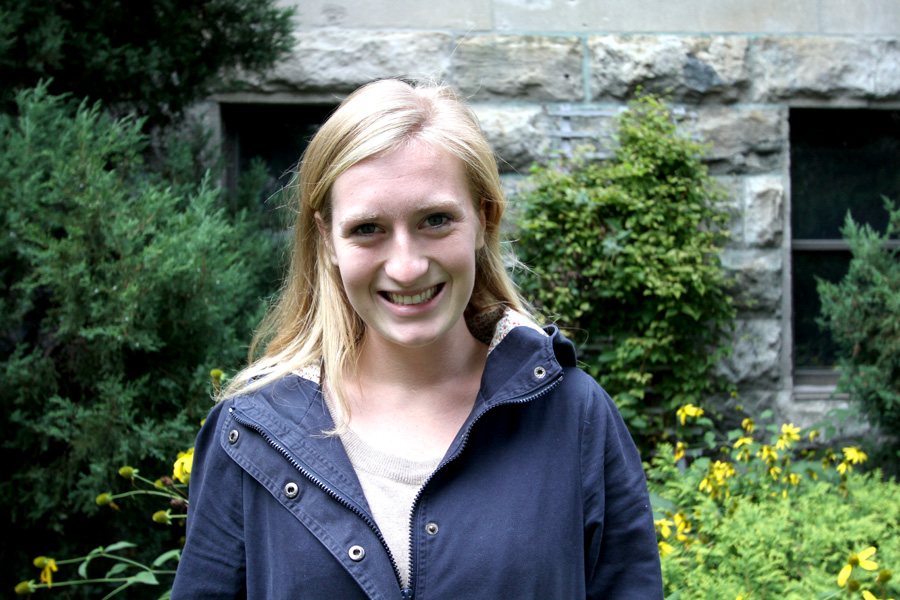
This week’s Student of the Week was nominated for her role as the founder of It Is Well, a charitable initiative raising money for the construction of a well in Utoo, Kenya.
Kinsey Brockie was working at an orphanage in Kenya after her first year at McGill when she started thinking about ways she could continue to help the community after she had returned to Canada. With so many possible ways to provide support, she settled on a project that will protect what she thinks is a fundamental right—providing clean drinking water.
“There was a well at the orphanage where I worked, but it was polluted and you’d have to pull worms out of your drinking water before you could drink it,” she says. “I witnessed a lot of kids get very sick. So I thought—these people have water, but it’s not even safe, let alone people in further rural communities who don’t have any water. It’s […] something that everyone can understand and relate to.”
Having also volunteered at World Vision, Brockie was familiar with the kind of behind-the-scenes work that goes on at a charitable organization.
“It started really small—I talked to some of the people I met in Kenya, [and asked] how much it [was] going to cost, and figured out what we would need to do on this end,” she says. “They’re taking care of the drilling and everything, so it was just me rallying together some friends who were interested in the cause and passionate about it, and getting the word out on campus.”
To date, It Is Well has about 30 members and has raised $14,000, which they have sent over to Utoo in increments. According to Brockie, her previous involvement in Kenya means that she still has personal contact with the people who are building the well. For example, the director of the orphanage where Brockie volunteered is supervising its construction.
While it can be challenging to convince students to donate money, Brockie says the key is to emphasize that every little bit helps.
“I think that we’re all so privileged—relatively speaking—and everybody has spare change in their wallet,” she says. “If you donate 50 cents and take a brownie or a cupcake or a coffee, it makes a difference. People are looking for something to get involved with, or [are] looking for something that is bigger than themselves. This is just a really easy way for people to be able to feel like they’re part of something that is positive.”
With other demands on her time like schoolwork and her job as a floor fellow at Varcity515, Brockie says life can be hectic, but that she loves being busy.
“I just have all these things that I want to do and I care equally about all of them,” she says. “That’s what helps me get through school—by doing things that I’m passionate about and studying what I’m passionate about, and spending the time that I’m not studying doing things that I love. It’s hard to find a balance, but once you do it’s a great balance to have.”
McGill Tribune: If you could only eat one food for the rest of your life, what would it be?
Kinsey Brokie: Prime rib.
MT: If you could change one thing about McGill what would it be?
KB: I would like to have more ‘pick-up’ sports on campus—anyone walking by could just join in and play for a couple minutes. Everyone just comes and goes when they want to!
MT: What’s your least favourite word?
KB: “Stuff.” I hate when people say “stuff” because […] obviously they mean more than just “stuff,” and then you don’t get the full picture.
MT: What was your dream job as a child?
KB: I wanted to be a waitress at Swiss Chalet. It’s my favourite restaurant!
MT: What’s your ideal ice cream sundae?
KB: Lots of cookie dough. Probably Moose Tracks ice cream, fresh fruit—Just every topping that they have!
MT: Who would you meet if you could go back in time?
KB: Indira Gandhi– India’s first and longest serving woman prime minister. Despite extreme political turmoil and threats to her life, her dedication to serving her people, and the well-being of her country never wavered.
This week’s Student of the Week is Cosmo Kramer, a U1 anthropology student . He was nominated for his entrepreneurial spirit, athletic prowess, and for being an active presence around campus.
MT: You’ve started all sorts of initiatives around campus. Which has been the most successful?
CK: Well, last year in residence, I got funding to start the Douglas Hall beekeeping society. We had some good times in that club—lots of really nice characters, when they weren’t trying to sting you—and we sold some honey for profit on the side. It got a little out of hand though, and ended up starting the infamous Douglas Hall bee infestation. That’s why they’ve got students over in Varcity515 this year, you know.
MT: Have any of your other ventures gone differently than expected?
CK: Well, I’ve noticed that students around campus are always dehydrated, especially after a night out, so last January I decided to start a business selling students water. This was going to be a big operation, mind you, so I had to go straight to the source. I went up to the reservoir and tapped into a water main—one of the big ones. I’m not really sure what happened, but next thing I knew, I woke up soaking wet way down in Old Port.
MT: At this point, have people been approaching your new ideas with any amount of skepticism?
CK: Absolutely. I don’t understand it! For example, at the beginning of this term, I wanted to have a welcome party for [incoming Deputy Provost (Student Life and Learning)] Ollivier Dyens up on the sixth floor of the James Administration building. There’s lots of room up there, and I thought putting it close to his office would minimize the inconvenience for him. I brought balloons and cake, but they wouldn’t even let me inside.
MT: You were briefly on the Redmen cross-country team. Why did you quit?
CK: Well, the team’s first meet of the year was up on Mount Royal. I was doing well, feeling good—real limber, you know—when I saw a berry bush. Now on long runs, you never know when you’ll need emergency sustenance, so I decided to stock up before
somebody else got to them. When I got back on the path, I must have taken a wrong turn, and ended up spending two weeks lost on the mountain, just wandering. On the plus side, when I finally found my way back down, it was the only time I’ve ever been early to a class at the McIntyre medical building.
MT: What was your ‘welcome to McGill’ moment?
CK: Probably the time I showed up at 11:30 p.m. to line up for the Midnight Kitchen. They should really give it a new name.
Inhabiting a unique spot at the crossroads of modern indie rock and backcountry American folk music, Ha Ha Tonka has delivered yet again with their fourth, highly anticipated album, Lessons. More introspective and instrumentally complex than their previous work, this multilayered set of tracks has far-reaching appeal, but rewards those who enjoy analyzing lyrics.
With four-part harmonies and instrumentals comparable to other indie rock acts Beirut and Spoon, the most striking element of the uplifting album is its messages—or, as the title implies, lessons. It’s replete with mature themes; such as the disillusionment that accompanies the process of growing up and the futility of pursuing the American dream.
Among noteworthy tracks, “Colorful Kids” is an upbeat but wistful reflection on simpler childhood years. The lyrics reference the fictional American icon, Huckleberry Finn, spurring notions of adventure, freedom, and playfulness. Complemented by the highly textured, fast-paced melody, the track evokes an overwhelming, but enjoyable sense of nostalgia.
At the heart of the album, the title track, “Lessons,” throws down a slow-burning, groovy beat—which is sonically a bit of a departure from the folksy tone of the first five tracks. The repetition of the line “I can’t keep learning the same lessons over again” is chanted, like a mantra, over an imaginative bass line. The anguished lyrics seem to have created the scaffolding for the angsty emotional trajectory of the album.
Although the album is great for the passive listener, Ha Ha Tonka’s originality stems more from their meaningful lyrics than their raw musicality. With messages stretching throughout, Lessons calls for an active audience committed to deciphering complex themes.
In the vast landscape of the indie-folk genre, Young Benjamins would lie at the intersection of better-known acts Born Ruffians and Mumford & Sons. Their repertoire features mostly frenetic foot-stomping tracks, with some laid-back tunes mixed in. Relative newcomers to the music industry, the four-piece Saskatoon group only released their first LP, Less Argue, this past spring. The band has equal gender representation, composed of two men (guitarist and drummer) and two women (bassist and violinist/keyboardist). Though they’re still somewhat raw, their versatility and exciting melodies provide glimpses of the high ceiling Young Benjamins has. The presence of the violin really strengthens their sound, and makes for an interesting dynamic when it interacts with the edgy electric guitar. If you’re looking for a lively show that strikes a balance between dancing and artistic enjoyment, look no farther than Young Benjamins.
Young Benjamins performs at LeEscrogriffe (4467 St. Denis) at 9 p.m. on Friday Sept. 27. Admission is $10. Other acts will follow.
Plants and Animals
Playing in POP Montreal is nothing out of the ordinary for Plants and Animals. The Montreal-based trio has been playing shows in the city for years, and their discography even includes a record titled Parc Avenue. They play a style of indie/alternative music that they like to label as ‘post-classic rock,’ and it’s easy to hear traces of classic bands, like The Velvet Underground, and newer acts, like The Black Keys, in their music. Their three-piece set alternates between the standard guitar-bass-drums combo and guitar-guitar-drums. The End of That(2012) is the most recent release from the band, which has been playing together for over a decade. It shows in their music, which is polished and cohesive. They even have some mainstream success to their name, as evidenced by their two Juno nominations in 2009 for Alternative Album of the Year and New Group of the Year. Going to see these established veterans is a safe bet at this year’s festival.
Plants and Animals perform at Breakglass Studio on Thursday, Sept. 26. Doors open at 6 p.m. and the show begins at 7 p.m. Tickets are $10. Jennifer Castle plays as well.
– Max Berger
Diana
One of 2013’s buzz bands, Toronto’s DIANA flirts with a wide range of sounds, from electronic, to jazz, to pop and finally to rock. After releasing their debut album Perpetual Surrender on Aug. 20 and embarking on a North American tour with fellow Canucks Austra over the summer, DIANA will either sink or swim in the next year. Most notably, they have gained considerable interest from UK-based electronic producer and DJ Four Tet, who remixed their album’s titular track this summer. With a 7.0 rating of Perpetual Surrender on notoriously picky hipster music website Pitchfork, it looks like DIANA are here to stay—at least for a while. Either way, it’s worth finding out if this band lives up to the hype.
DIANA performs at Sala Rosa (4848 St. Laurent) at 8:30 p.m. on Wednesday, Sept. 25. Tickets are $12 in advance.
Mozart’s Sister
Mozart’s Sister, comprised solely of Montrealer Caila Thompson-Hannant, is no stranger to the Montreal music scene, but she’s definitely worth checking out at POP this year. Despite a poppy, upbeat sound, Thompson-Hannant manages to make her music quirky in the vein of Grimes— Kate Bush-esque vocals: check; unusual song lyrics: check—but perhaps without as much artsy pretension. One of the biggest selling points for seeing Mozart’s Sister live is that Thompson-Hannant hasn’t released any new music in quite a while. You’ll hear more live from this up and comer than you can find on Youtube. Wondering exactly what Mozart’s Sister sounds like? Google her biggest song entitled, well, “Mozart’s Sister,” and judge for yourself.
Mozart’s Sister performs at L’Olympia (1004 St. Catherine) at 8:00 p.m. on Friday, Sept. 27. Tickets are $40 in advance. Also performing are The-Dream and Team Rockit.
– Diana Wright
Look Vibrant
Look Vibrant is a project founded by Matt Murphy, an electroacoustics major at Concordia, and Justin Lazarus, a cognitive science student at McGill. The name of their latest single, “Plateau,” refers to both the band’s birthplace in Montreal and an uncertain time in Murphy’s life after his move to Montreal following an extended trip to Dublin, Ireland. Despite the name and a narrow range of frequencies mostly recorded through a Macbook microphone, their sound is anything but flat. Rather, ‘Plateau’ is full of screeching, ecstatic guitar riffs and charmingly sing-songy vocals, both of which translate surprisingly well live. In each of the bands’ two showtimes at POP, Murphy and Lazarus will play with the support of McGill students Alex Rand, Eli Kaufman, and Michael Go, replicating their ‘no-fi’ production with a layered chorus of guitars.
Look Vibrant performs at Little Italy Park (Clark and St. Zotique) at 12:00 noon on Friday Sept. 26, for free, as part of BBQ POP. They also perform the next day, Sept. 27, at Casa del Popolo (4873 St. Laurent), at 8:00 p.m. Tickets are $10 in advance.
Pearson Sound
As a DJ, dubstep producer (under the alias Ramadanman)and co-founder of electronic label Hessle Audio, David Kennedy, a.k.a Pearson Sound, is at the forefront of a unique UK electronic sound, where elements of garage, dubstep, and house blend into smooth, danceable mixes. Well-known in the London electronic scene, Pearson Sound’s claim to fame in North America is probably opening for Radiohead in New York. At POP Montreal, he appears as part of a Hessle Audio label showcase, an imprint that has released singles from the likes of James Blake, and fellow UK producer Untold.
Pearson Sound DJs at Le Belmont (4483 St. Laurent) at 11:30 p.m. on Wednesday, Sept. 25. Tickets are $10 before 11 p.m., and $15 afterwards. Pangaea and Ben UFO also perform.
Stakes too high to legalize student association opt-outs
Quebec university students Laurent Proulx and Miguael Bergeron are challenging provincial legislation that mandates that every student in Quebec must be part of a student association, arguing that the current law infringes on students’ right to association.
If Proulx and Bergeron are successful, students will no longer be required to pay membership fees to student associations, such as the Students’ Society of McGill University (SSMU). At the first SSMU Council meeting of the year, SSMU Vice-President External Sam Harris announced that SSMU will contribute $10,000 to the court case. This announcement prompts further consideration by McGill students of the issues at stake. We believe that the law should remain unchanged in that all students should be required to be part of a student association.
Perhaps the most important function of student associations is that they legitimize student representation in front of university authorities. In the case of SSMU, the six executives elected by the student body represent undergraduate students at a high level in the university. For example, the SSMU President is the only undergraduate to sit and have voting power on McGill’s Board of Governors. Similarly, the vice-president University Affairs sits in the committee that elects the new principal, and also coordinates the different faculty student representatives who sit on Senate.
If students had the possibility of opting-out, the student representatives’ ability to credibly speak on the behalf of the student body would decrease considerably. By opting-out of their student association, students would also forfeit the representation in front of the McGill administration. How these students would make their concerns heard is a question that remains to be answered.
Some students, including those filing the case, argue that a major reason why students should not be obligated to be members of a student association is that the positions taken by student associations often do not represent them. For example, the plaintiffs are concerned that their student fees were used to support the student movement in favour of free tuition, which they did not support. However, it is important to remember that student associations are organized as democracies, and that all students have the opportunity of participating in them.
In the case of SSMU, all students have the option of running for executive positions themselves, voting for the executives that best represent their political views, attending SSMU Council meetings concerns, or debating and voting in General Assemblies. Although ultimately not all students may feel represented by their student association, this shortcoming is inherent to the nature of the democratic system.
Student associations are also valuable because they provide services that fill in the gaps left by the university’s administration. For example, the Sexual Assault Centre of the McGill Students’ Society (SACOMSS), WalkSafe, and the SSMU Daycare provide services that otherwise would be absent from the university. SSMU provides an infrastructure for the creation and legitimacy of these student initiatives. As student-run ventures, they are more in touch with student needs and more adaptable to change than if they were run by the university.
While we believe that there is value in the fact that all students are required to be members of a student association, the lawsuit provides a valuable opportunity for students to discuss ways in which student associations are failing their members. We believe that student associations need to be held accountable to their members and face periodic review both from individuals and groups. This will ensure that they adapt to changes in needs and technology and that students dollars are managed efficiently and transparently. If students do not feel their associations represent them, it is worth working to improve them rather than shutting them down completely.
DISSENT: To preserve constitutional rights, allow opt-outs
The university students’ association, at first glance, seems like a static entity—immovable, unassailable. However, a current court case filed by two students earlier this year raises fundamental questions about the legal basis for these entities. Should students be obligated to join a student association, as the law currently requires them to? We consider such a statute, at least as it’s currently constructed, to be an infringement on freedom of association.
Their specific contentions point to five provisions of the act, including one which mandates that only one student association exist for each type (undergraduate, post-graduate, etc.) of student on campus, another which mandates that any student who is represented by a student association is automatically considered a part of that association, and one which states that any student registered at a university has to pay the dues of the recognized student association.
Mandatory membership in these associations can be problematic. Oftentimes student associations take strident political stances on issues—both internal and external to campus—that are, at best, highly contentious amongst the students they claim to represent. The most obvious example from the recent past was the Quebec student strike, where many student associations—though neither SSMU nor PGSS at McGill—throughout the province voted to boycott classes. These strikes at many universities meant picketed and cancelled classes as well as lost terms, and were the specific catalyst for the current lawsuit.
The rationale often given for mandating students to be members of university student associations is that, just as one can’t opt-out of a national government because of specific policies they dislike, students should not be able to opt-out of their “government” simply because it takes stances with which they disagree with. While at first glance there is some sense to this logic, it misses the essential difference between the contract one enters with a university and with a nation. The citizens are understood to enter a social contract with the nation they reside in, giving up certain freedoms for protection and a livelihood. The “contract” that constitutes being a university student starts and ends with a tuition bill and a basic code of conduct.
We feel that constitutionally guaranteed freedoms, such as the right to association, should be upheld first and foremost. However, having the legal right to opt-out of student associations does not mean that this is necessarily the right course of action for everybody. Student associations offer students resources, many of which we feel are absolutely crucial to fostering a culture of healthy and well-rounded student life on campus. It is vital that, if given the right to opt out of associations, students make a responsible and informed decision.
Political association at the university level ought to be taken seriously, and should not be mandated by legislation. If this lawsuit is successful, the financial future of student associations across the province will be put into students’ hands. We urge them to take into account all that their student associations do for them and for those around them, before writing them off completely.
Mayaz Alam, Alexandra Allaire, Max Berger, William Burgess, Ben Carter-Whitney, Wendy Chen, Jacqueline Galbraith, Alessandra Hechanova, Abraham Moussako, and Emma Windfeld participated in this dissent and agree with the views presented.
This past summer, it dawned on me that I am no longer an enjoyable person to watch sports with. I have stopped asking too many questions, and I don’t scream advice or profanities at the pixels on the screen, nor am I the know-it-all preacher who imparts his ‘knowledge’ on those watching with me. What I am however, is impatient towards horrible commentators and analysts, many of whom are former athletes.
As a successful athlete’s career winds down, the natural curiosity of what lies beyond the realm of professional sports takes centre stage. If these athletes ooze any sort of personality, the immediate reaction is to move to television and become a media personality. Shaquille O’Neal, the future NBA Hall of Fame centre, is one such infamous example of a television transition gone awry.
When Bleacher Report ranked the worst commentators and analysts of the past 10 years, six of the 10 names on the list belonged to former athletes. Sports Illustrated recently listed the top 20 sportscasters of all time. Unsurprisingly, just one former athlete made their list: John Madden, who was ranked no.20.
To clarify: I’m not under the impression that I know more than any of these athlete-turned-analysts. Top-tier athletes are just like professionals in any other industry—they have an intimate knowledge of both the broad concepts and minor intricacies that foster success. Yet, when it comes to explaining something on air, they face unmatched difficulties.
In March 2013, ESPN announced that former Baltimore Ravens legend Ray Lewis would join its network. Lewis’ talent was enormous and his personality was even larger, but it will be a surprise if he thrives in his new career. As an interviewee, he was known for his absurd responses and even his former teammates have admitted that they have a difficult time understanding him when he addressed the team. Simply put, Ray Lewis was trained to play football, not to speak about it.
I haven’t always been unforgiving of athletes-turned-analysts, but what pushed me over the edge was an incident involving former pitcher and current MLB Network analyst, Mitch Williams. I have nothing against Williams. In fact, as a Toronto Blue Jays fan, he holds a special place in my heart—he was the pitcher on the wrong end of Joe Carter’s World Series-winning home run in 1993.
The incident I’m referring to is a comment he made on MLB Tonight. While a clip of Diamondback pitcher Brandon McCarthy being hit in the head by a line drive played, Williams declared, “If you don’t pitch in, this is what’s going to happen.”
McCarthy was very nearly killed by that line drive and was not amused by Williams’ analysis, tearing into him on Twitter. The point Williams was likely trying to make was that if you throw outside, a hitter is more likely to extend his arms and hit a ball back up the middle. This is baseball knowledge that most casual fans probably don’t have.
The problem here, however, is that Williams’ wording makes it seem as though throwing outside is a dangerous strategy, which it isn’t. I have a hard time believing that a trained reporter with the same knowledge would muddy up his or her message the way Williams did.
Just as playing and coaching are two separate skills, knowing something and being able to explain it are not the same either. This should be abundantly clear to university students, as we’ve all had brilliant professors who nonetheless struggle as teachers.
Perhaps someday networks will smarten up and make sure the athletes they hire actually have something worthwhile to say. Until then, I guess I’ll just have to learn to enjoy watching sports with the television muted.
A crowd stops dead in their tracks, fixated on the window display of a modest Plateau-Mont-Royal hair salon. The scene has been a common one at Salon MOOV ever since they started employing a powerful yet unconventional marketing strategy. Though Salon MOOV offers quality salon services, it’s not quite the hairstyling that mesmerizes the onlookers, but a litter of newborn Bengal kittens.
“I specialize in cat-vertising,” explains co-owner Jean-Marc Richer.
Richer purchased the salon together with partner Yves Pednault in 2010 during a tough economic period for new businesses. Despite offering a special no-tax discount to students for hair services, the salon struggled to distinguish themselves in the competitive Plateau-Mont-Royal market. ‘Cat-vertising,’ a term coined by Richer, was the solution to that problem.
‘Cat-vertising’ refers to the salon’s choice advertising method of strategically placing kittens at the forefront of the salon, directly in front of the window display. As pedestrians stop to ogle the kittens, Richer shamelessly plugs his salon services.
It all started by chance when Richer was assigned babysitting duty for a girlfriend’s newborn kittens. Fearing that they would become lonely at home, he decided to bring them to work.
“I turned around and there was a crowd of people taking pictures,” he says. “In my head I’m like, ‘Bam! I just found an oilwell!’”
Richer worked quickly to capitalize on the kittens’ popularity, starting by increasing the salon’s social media presence.
(Wendy Chen / McGill Tribune)
“When people would meet us outside, after I’d inform them about the cats, I would give them the card and say ‘go look at our Facebook page. We’ve got beautiful pictures of our cats and the cuts,’” explains Richer. “They look and see the beautiful girls with long hair and they call back for an appointment [….] They see baby cats, and they’re already won over. It’s like shooting fish in a barrel.”
Richer stressed that the comfort of the cats is a top priority. Each of the Bengal kittens is borrowed from, and later sold by, a licensed breeder. Before and after work hours, the kittens are free to roam around the salon, including an enclosed outdoor patio.
With an estimated 80 per cent increase in customers since the introduction of their adorable advertising team, Richer claims his salon would have faced closure were it not for his furry co-workers.
“I never put in one penny, no paid ads, nothing,” he says. “I banked a lot on social media. In the last seven days, we had 7,000 people look at our Facebook page. We have 1,917 ‘likes.’ So far not a dollar put in here—just a two-man operation.”
Beyond zootherapy (the use of animals for physical and emotional healing), Richer and Pednault hope to offer more than just the traditional salon experience, by hosting events such as after-hours barbecues for both clients and passersby. In addition, the salon also offers free haircuts each Tuesday to local women’s shelters as a means of giving back to the community.
However, they have faced some criticism from the community.
“I find it irresponsible for Salon MOOV to be advocating Bengal cats when we have so many homeless cats in this city and province,” wrote Shelley Schecter, President of Educhat, an organization concerned with animal welfare, in a letter to the Montreal Gazette.
Though an unorthodox means of attracting clients, ‘cat-vertising’ is a brazen, yet effective means through which small businesses like Salon MOOV can leave their mark in a highly competitive market. As Richer puts it, “In business today, it’s not enough to only have a good product or service. You need to have an extra edge that other people don’t have.” Their edge just happens to be soft and cuddly.
Salon MOOV is located at 163 Ave. Duluth. Telephone (514) 223-2229.
It’s easy to imagine Chevalier Avant Garde’s new LP, Resurrection Machine, providing the backdrop to a modern day sci-fi film, in the vein of Blade Runner.
The vocals are buried deeply behind synthesized sounds, making it hard to distinguish individual lyrics. However, the intimate, husky, whisper-like voice is irresistibly spellbinding—at times it seems the singer is speaking in an exotic language.
This is especially true in “Nowhere” and “When We Meet.” The haunting gravelly vocals on the tracks have certain qualities that bring back memories of The Moody Blues’ “Nights in White Satin” with a much darker edge.
That dark edge grows throughout in the album. Songs like “Killing Fields” invoke images of industrial abandonment and cold mechanisms of machinery. It is slightly jarring when they are juxtaposed by the more seductive sounds of “When We Meet” and “Rose Rider.” The shorter preludes interspersed between the longer songs, like “Five of Cups” and “Temenos” follow a similar pattern, wherein the listener is jolted awake from the stupor of the previous song.
The album moves into a strong ending with “Rose Rider,” a short but powerfully potent song. The haunting voice emulates the monophonic sounds of plainchant, most commonly performed by monks at churches. Rather than a religious image, however, Chevalier Avant Garde evokes a clearly dominant sexuality.
In Ressurrection Machine, Chevalier Avant Garde organically capture the dichotomies of nature: birth and death, vulnerability and strength, pain and pleasure, love and hate. It cannot be married to one particular genre, though it can be said that a new revival of ‘trip hop’ (the genre of groups like Portishead and Sneaker Pimps) has begun. Catering to a myriad of fantasies and emotions, Chevalier Avant Garde have crafted an album that delivers a complete bodily listening experience.
Colin MacDougall, guitarist and co-founder of Ottawa-based indie-electro outfit Fevers, has loved music ever since he developed fine motor skills.
“I’ve been playing music since I could bang notes out onto a piano,” he says. “My faith in wanting to be a musician has never died, and being in FEVERS has given it a boost.”
MacDougall and fellow band members Sarah Bradley (vocals, keys), Martin Charbonneau (keys, guitars), Jim Hopkins (bass), and Mike Stauffer (drums, sampling) all brought this devoted attitude to their debut album released last month, No Room for Light, as well as their own refreshing brand of the ubiquitous electro-rock sound.
FEVERS will unleash their musical stylings at POP Montreal this week, with a show at Club Lambi on Friday. For MacDougall, a McGill Management graduate, this is a chance to return to Montreal—the city that he playfully says casts a “shadow of cool” on Ottawa—and the place he originally relocated to because his songwriting collaborator moved there.
While living in Montreal—a time that coincided with the meteoric rise of the city’s indie darlings Arcade Fire—MacDougall explored the its music scene, played gigs at Barfly, and admired the cultural variety of McGill’s student body.
“You kind of go in with a conception of what type of person is going to be studying business […] I went in thinking I would be the token liberal lefty, […but] I was really impressed with the diversity of the students studying there.”
These days, MacDougall and the rest of FEVERS are dedicated musicians who support themselves by working outside the band. According to MacDougall, this is mostly due to Canada having a somewhat less than hospitable environment for musicians who wish to earn a living playing their songs.
“[Canada is] a small market,” he says. “[It’s] really far apart, and you have to spend a lot of money to get from city to city.”
Despite these difficulties, MacDougall remains enthusiastic about making music, and is unafraid to admit that the band sounds exactly how it is often classified: indie-electro. Similarly, he humbly welcomes the frequent comparisons to fellow Canuck band Stars.
“I’ll take that any day of the week,” claims MacDougall. “They’re a very inspirational band […and] they’ve put the Canadian music scene on the map internationally.”
Although he admits that touring is integral to a fledgling band’s success, MacDougall’s heart currently lies in in-studio production, rather than live performance.
“My favourite part used to be getting up in front of the crowd, rocking the house,” he says with a laugh, “But right now, album writing and recording is what excites me the most.”
Thankfully, he’s good at it too. When “No Room for Light” was released this summer, it was met with positive critical attention. FEVERS released a music video for the main single “Pray for Sound,” which chronicles the relationship between a young woman in an unhappy straight relationship, and her much happier lesbian lover.
For the time being, “proud Ottawa boy” MacDougall will remain based in the nation’s capital, which he says enables the band to delve into Franco-Canadian realms more frequently (a couple members of FEVERS are bilingual), and maintain a strong connection between both of Canada’s current music centres—Toronto and Montreal.
As for FEVERS’ future? “We’re taking it in three month chunks at a time,” explains MacDougall [.…] As long as I can keep writing records and putting them out there, and playing shows whenever we can, I’ll be a pretty happy dude.”
FEVERS performs at Club Lambi (4465 St Laurent) at 10:00 p.m. on Friday, Sept. 27. Tickets are $8 in advance, and $10 at the door.
This summer, researchers from McGill University and the Montreal Neurological Institute (MNI) made headlines when they revealed the world’s highest resolution 3D model of the human brain in the June 20 issue of the journal Science. The model, which took nearly a decade to develop and is composed of one terabyte of data, has been dubbed the “BigBrain atlas.”
The atlas is a technical milestone in the field of human brain mapping because of its micron-scale resolution, which scientists achieved by using a microtome to meticulously slice the post-mortem brain of a 65-year-old woman into 7,404 slices—each 20 microns thin. This extensive process was led by Dr. Katrin Amunts, a researcher from Jülich, Germany. Her team stained and digitized each slice with a high-resolution scanner before sending the data to researchers in Montreal.
Dr. Alan Evans, co-developer of BigBrain and a McGill professor at the MNI, led the venture to statistically analyze each slice and reconstruct a comprehensive 3D model of the brain. He explained that this was the slowest part of the whole process.
“You have 7,404 slices of saran wrap all wrinkled, crinkled, ripped and torn, and somehow you have to take all of that data and stitch it back together again into a coherent three dimensional entity that is useful,” Evans said.
The reconstruction process was possible due to advanced statistical and computational tools. Evans’ team developed new software in order to clean, reconstruct, and register their data in 3D. One platform, called CBRAIN, allowed the group to manage their terabyte-sized data set and granted them access to the network of High-Performance Computing (HPC) facilities distributed across Canada. Without the use of these supercomputing facilities which allow large datasets to be processed on multiple computers in parallel, the project would have taken several more years to complete.
Researchers at the MNI can browse the BigBrain atlas on a large computer screen made up of four screens placed together. The database was also made publicly available online in order to promote research and the development of new neurological tools. Data is streamed on-demand to clients all over the world using a program called Atelier3D, which has previously been used to visualize works of art—including the Mona Lisa—in three dimensions.
“BigBrain […] can be used to redefine traditional brain maps that date back to the 20th century.”
The atlas will, in all likelihood, become known as the world’s most detailed reference brain. All brains are slightly different in shape and size, so neuroscientists use reference brains to compare data collected from different individuals on a standard template. Current templates, however, were acquired using Magnetic Resonance Imaging (MRI) and are limited in their resolution to the millimeter scale. This means that once zoomed in, each pixel will be equal to 1 x 1 x 1 mm of real life brain space. If the same is done with the BigBrain atlas, however, the pixel dimensions are 20 x 20 x 20 microns, which is smaller than the diameter of a strand of hair. This level of resolution allows neuroscientists to visualize brain structures at a near-cellular level.
The advantage of having such a high-resolution mapping template is that data from a wide range of sources can be integrated and modeled at a a highly detailed level. For instance, molecular, genetic, and cytochemical data can be modeled in addition to low-resolution data acquired by modalities such as Positron Emission Tomography (PET) and functional MRI (fMRI), which acquire functional information about the brain as opposed to structural information.
Erin Mazerolle, a post-doctoral fellow in the McConnell Brain Imaging Centre at the MNI who uses MRI data in her research, explained the benefit of having a high-resolution brain template.
“It’s important for us to consider that the structures and functions we observe at the scale of millimeters with MRI actually result from much smaller structures,” she said. “BigBrain is an important step towards linking MRI findings to the microscopic scale, so that we can start to appreciate the underlying complexity that is otherwise not accessible with MRI.”
Another significant implication of the BigBrain atlas is that it can be used to redefine traditional brain maps that date back to the 20th century, such as the Brodmann atlas. This atlas, which was published in 1909 by German anatomist Korbinian Brodmann, is still the most widely used method of delineating the human cortex. However, it was limited by the technology of the era and was therefore based on properties of cells that could be seen through a microscope. The BigBrain atlas, in comparison, could be used to develop any number of brain maps based on structural or functional criterion extracted using computational methods.
Evans said he was pleasantly surprised by the feedback from the neurosurgical community. He described the reaction of Dr. William Feindel, a 95-year-old pioneer in the field of neurosurgery based in Montreal, when he first saw ‘BigBrain.’
“He was sitting in front of the screen exploring the amygdala and the hippocampus and saying he had never conceived of being able to do this because he was used to looking at a two-dimensional plate of the hippocampus,” Evans explained. “Now he’s moving backwards and forwards and up and down and it was delightful to see the reaction of someone of his stature.”
Feindel explained that the BigBrain could eventually aid neurosurgeons by allowing them to precisely implant depth electrodes, which are small electrodes used to record electrical activity from the brain to localize the focal point of a seizure or stimulate the brain to provide therapy for conditions such as Parkinson’s disease or clinical depression. Currently, neurosurgeons use a stereotaxic atlas—a mathematical map of the brain—as a guide when implanting electrodes. However, stereotaxic atlases are not three-dimensional.
“You have three dimensions available, but not simultaneously, so you look at a horizontal section of the brain or a sagittal section or a coronal section, but you can only do that separately. With […] BigBrain you can see them all together at the same time, so you have a confluence of information that you just can’t get on the other atlases. That’s why [this technology] represents a big advance.”
Since the BigBrain atlas was created using a single brain, as opposed to other reference brains that were created by averaging together hundreds of brain maps, a commonly asked question is whether it can be used to capture differences between brains. Evans responded that with the high-performance computational strategies possible today, the atlas can be warped into any statistical brain space.
Scientists use a microtome to create thin slices of the human brain. (Courtesy of the Brain Imaging Centre, Montreal Neurological Institute and Forschungszentrum Jülich)
“You can superimpose it on the average brain so that it is sitting in a statistical space that represents a population, but it retains the high-resolution detail that’s in the brain. You can get the best of both worlds at that point.”
Evans mentioned that there is still work to be done in the continuous refinement and spatial registration of the data.
“When you look at the BigBrain data set at the level of MRI, it looks fantastic. When you go in finer, you start to see the imperfections in the alignment of the individual slices.” These imperfections were caused by rips and tears that occurred during slicing as well as differences in the amount of staining across slices.
Evans’ group will continue to work on improving their current data set while they begin collecting data for future brain atlases. Potential projects would be to create 3D brain atlases for different types of brains such as a male brain, a young brain, and a diseased brain. There is also the potential to create a BigBrain atlas demonstrating the white matter tracts of the brain. Although the first data set took a decade to produce, future data sets will be finished much quicker because the technologies required to do so are now in place.
The BigBrain atlas is part of Europe’s Human Brain Project, a €7 billion venture to model the brain. Although the Human Brain Project predates Obama’s Brain Research through Advancing Innovative Neurotechnologies (BRAIN) initiative, both projects will take advantage of the latest computing technologies to collect and integrate data about the human brain, and are indicative of a growing trend in neuroscience in which large-scale supercomputing has become indispensible to research. As new technologies continue to be developed, BigBrain will only become more useful as a tool for neurosurgery, teaching and research. For now, it represents a major technical achievement in its own right, and a giant step forward in the quest to model and simulate the human brain.