

Latest News

a, Arts & Entertainment

Jenny Hval: going out on a musical limb

Jenny Hval is a busy woman. As I reach her in her hometown of Oslo, Norway via Skype, she is about to set out on a North American tour in support of her newly-released fourth LP, Innocence is Kinky, which will bring her to the Church of St. John the Evangelist on Thursday, Sept. 26, for POP Montreal. In the meantime, her creative output shows no signs of slowing down. Hval’s video feed is turned off, and, as our interview begins, she quickly explains why. “I’ve just walked in the door from doing a [live performance] project last night, so I’m a bit tired and […] video is probably best left off,” she laughs.

Hval’s inexorable productivity does not come as a surprise, given her wide range of accomplishments at the modest age of 33. Besides boasting a Master’s Degree in Literature from the University of Oslo, Hval is also a prolific music journalist, poet, and fiction writer whose published works include two free-form novels. But it is her music that has attracted the most attention worldwide, with critics praising her striking, ethereal voice and unconventional songwriting. On Innocence is Kinky, Hval appropriates a dizzying array of genres and moods, often within a single song. “Oslo Oedipus,” for example, transitions from a pastoral lullaby, to a brooding choral soundscape, to a thought-provoking spoken word poem, all in under three minutes.

Just as striking are Hval’s lyrics, which probe complex and contentious issues that musicians rarely address.

“When you discuss topics like sexuality in academic writing,” she says, “You’re very guarded, very controlled, and you have to make a point. With music, I’m able to take a more spontaneous, and maybe more honest, approach.”

Hval’s frankness is apparent in her lyrics—Innocence is Kinky  begins with the words “Last night I watched people [having sex] on my computer”—but it strikes her how poorly critics misinterpret her intentions. “I’m surprised people think [Innocence is Kinky] is [just] about porn. It’s about everything, all types of images […] how everything, especially on the Internet, is ‘pornified.’”

At the same time, Hval says she wants to work on letting her music develop more naturally. She credits her producer on the album, long-time PJ Harvey collaborator John Parish, with helping her to avoid getting too cerebral in the studio.

“[John] was very focused on exploring each song, which to me was fantastic because I tend to get hung up on the concept of an album, the idea that ‘all these songs belong together.’ It’s good to kind of get away from that, to not think so much about the brainy part of things and just perform the music.”

In fact, Hval sees performing live as having a dynamic role in the creative process. “I like to play things live before I know what they are. The audience appreciates it because they get to see something that I don’t understand yet. They become part of the process of [developing] it.”

Accordingly, she informs me that on her upcoming tour, she will be trying out brand-new material on stage. “I never rest,” she laughs.

Whether live or in the studio, Hval is determined to never stop exploring new musical territory, especially with her voice. “I notice whenever I sing with professional singers that I can’t really do that kind of genre stuff that a lot of the more trained [professionals] can do. So I try to do things I can’t do, and it sounds different from what I wanted—but interesting. That’s central to my music, going into those awkward situations and seeing what you can find there. Going out on a limb, in a way.”

Jenny Hval performs at the Church of St. John the Evangelist (137 President Kennedy Ave.) at 11:00 p.m. on Thursday, Sept. 26. Tickets are $16 in advance, and $20 at the door.

a, Science & Technology

What determines your drinking gene?

As an equal mix of Chinese and Irish, I had a 50/50 shot at enjoying the stereotypical Irish drinking culture. Unfortunately, I was never able to fully participate due to my inability to handle a large amount of alcohol. Curiously, this has a little less to do with my lifestyle, and a lot to do with my Asian ancestors’ solution to clean water hundreds of years ago.

Alcohol flush response (AFR), more familiarly known as the ‘Asian glow,’ affects as many as half of all people of East Asian descent according to Sharon Moalem, a researcher and doctor at New York’s Mount Sinai School of Medicine, in his book Survival of the Sickest. From rising temperatures to a bright-red face, this bodily response to alcohol makes it difficult for some to consume even one alcoholic beverage.

Evident from its nickname, AFR is most prevalent within East Asian communities. However, it is actually highly uncommon in just about every other population group. The discrepancy begs the question: what determines our ‘drinking gene’?

Although people blame factors such as weight, dehydration, or lack of nourishment, the main cause of the Asian glow lies not in our diet but in ancient water purification systems.

When people drink alcohol, the body detoxifies alcohol and extracts calories from it through a complex process that involves multiple organs and many different enzymes. The majority of these reactions occur in the liver, and it is here where our ‘drinking gene’ plays a role.

After alcohol consumption,  your liver takes several steps towards metabolizing your drink by converting it into a chemical known as acetaldehyde. This process is facilitated by the enzyme alcohol dehydrogenase. A second enzyme, acetaldehyde dehydrogenase, converts the acetaldehyde into acetate. Finally, the acetate is converted into fat, carbon dioxide, and water.

The culprit behind the redness is the second enzyme in this series of reactions. Most people who experience AFR have a genetic variation, ALDH2*2, which causes them to produce a less powerful form of acetaldehyde dehydrogenase—one which cannot convert acetaldehyde into acetate as effectively. As a result, these people accumulate acetaldehyde up to 10 times the normal concentration. Considering that acetaldehyde is 30 times as toxic as alcohol, any accumulation can result in a reaction, where one of the symptoms is, of course, the flushing response.

However, a red face isn’t the only side effect of this genetic variation. One drink is all an ALDH2*2 carrier needs to experience heightened heart rate, headache, extreme dizziness, and nausea.

So, it’s clear that the cause of AFR is a less powerful form of the enzyme acetaldehyde dehydrogenase, but what is the link between flushing when you drink and clean water?

As humans began to settle in cities and towns in ancient times, clean water became a challenge. According to Moalem, some theories suggest cultures came up with different solutions to purifying their water.  In Europe, the solution was fermentation. This method was based on producing alcohol to kill the microbes contaminating drinking water. On the other side of the globe, people in East Asia boiled water to produce tea as their main mode of purification.

“As a result, there was evolutionary pressure in Europe to have the ability to drink, break down, and detoxify alcohol, while the pressure in Asia was a lot less,” explains Moalem.

Based on this theory, it was necessary for Europeans to develop a better ‘drinking gene’ than those of Asian descent, as their water purification system required them to frequently break down alcohol while having a drink—and not just the alcoholic type.

While AFR makes consuming excessive alcohol a challenge, Moalem points out an upside to ALDH2*2. “You’re highly resistant to alcoholism,” he says. “It’s just too unpleasant to drink!”

a, Sports

Martlets falter in first loss of the season

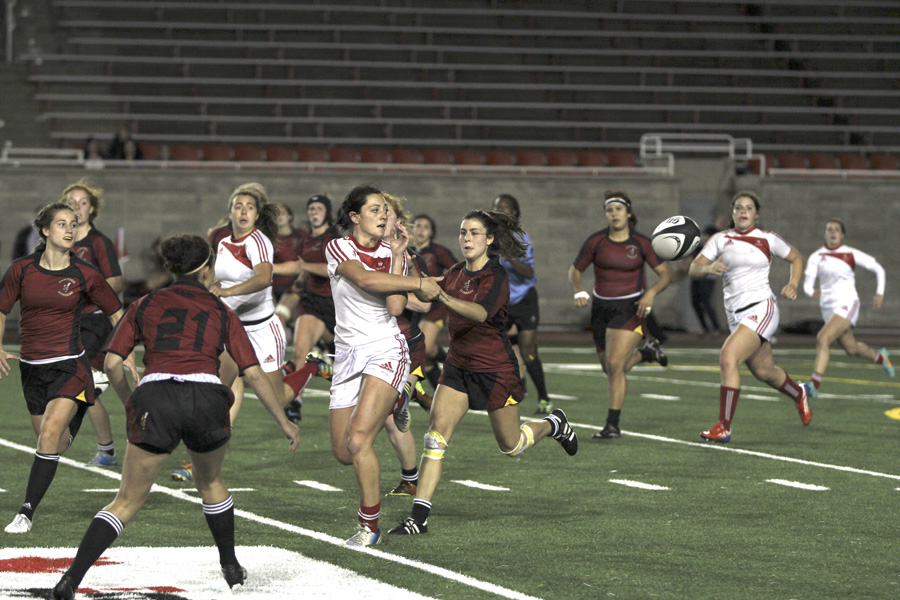
The No. 7 ranked McGill Martlets played the No. 4 ranked Concordia Stingers in the annual Drummond Cup this past week. The match is named after the late Kelly-Anne Drummond, a former Concordia rugby player who lost her life in an incident of domestic violence in 2004. The contest now serves as a fundraiser for WomenAWARE, a local group that serves to support victims of domestic violence. This year a total of $1,824 was raised in donations for the cause at the match.

The heavyweight matchup between the two top 10 squads lived up to its lofty billing with a tight score of 17-15 that was only decided deep into the second half.

Throughout the game, two separate units dominated the course of play. For Concordia, the game plan centered on their physically imposing group of forwards. The Stingers’ pack was dominant in their rucking game, enabling them to control the ball for long periods of play while wearing out their opponents. Off of penalties, the visitors were also able to use superior technique and power to control scrums, winning nearly every contest.

Concordia fly-half Dara Brunnete was the only back who gave the Martlets trouble. However, she was able to command the game and had multiple runs where she broke through the line and sparked the offence.

McGill responded with its talented and quick group of backs who spread the ball wide and were able to take advantage of their speed routinely. Despite this, it was clear that the visitors had the upper hand as the game wore on. The game’s winning try came off of a maul in which the two forward packs went head to head with Concordia’s pushing back their opponents for 10 yards before the ball touched the ground.

“It was our first real test of the season, and I’m glad we had it at this point,” Stephens said. “I feel as though we will be able to use this game as a real learning point and learn from our errors and improve.”

Star fly-half Brianna Miller effortlessly controlled the flow of the game once again as she led the McGill scoring effort with 10 points. Audrey Marcotte, a sophomore prop, also scored a try.

Both squads used their kicking games in order to control field possession as real estate was hard to come by. The most impressive instance of footwork occured on Miller’s try. Miller was faced with multiple tacklers after she broke through. Rather than attempt to break the tackles, she placed a perfect diagonal kick over the heads of the oblivious Concordia backs before retrieving her own kick and taking it all the way to the try line. To top it off, Miller connected on a very difficult conversion to tie the score at 12-12.

(Luke Orlando / McGill Tribune)

The waning moments of the game provided excitement that left fans sitting at the edge of their seats. McGill elected to kick for a penalty goal rather than attempt to go for a try with the score at 17-12. After Miller’s attempt sailed through the uprights, the match turned into a back and forth affair where the Martlets marched deep into Concordia territory multiple times. Sophomore fullback Deanna Foster had a game-saving tackle in the last minute that denied the visitors a chance to extend their lead. However, Foster was unable to follow up as her knock-on penalty iced the game indefinitely for the hosts.

Stephens stressed the importance of rest following the game.

“The game against Carleton will test our depth and our stamina. We have to make sure to rest up […][because] it will be our third game in seven days.”

The Martlets recovered and bounced back in dominant fashion on Saturday as they shut out the visiting Carleton Ravens 41-0. Foster was named MVP of the game and was one of four Martlets to score a try.

McGill now looks to continue its bid to sit atop the RSEQ leaderboard as they host Bishop’s on Sunday Sept. 29 at 1:00 p.m. on McGill’s Macdonald campus.

a, Sports

Point counterpoint

In recent months, the National Collegiate Athletics Association (NCAA) and member institutions have been under scrutiny as a rash of scandals have rocked college athletics. The nature of these issues stem from the debate surrounding student athletes maintaining their amateur status as there have been calls to allow schools to pay their players. Two contributors weigh in on whether the NCAA should pay student athletes. 

College athletes should be paid

According to the NCAA, there are now more than 450,000 student athletes competing in various leagues and conferences across the United States. While the NCAA emphasizes that most students athletes tend to be focused on the former half of their title as opposed to the latter, it often seems as though the opposite is true.

Many NCAA athletes train on a level that is at or near that of a professional athlete. These are not regular students. While there are caps on the number of hours that a team can play, practice, or train on any given day, they do not account for the time an athlete will spend training on his or her own. But for all the time that they commit to their sport and their school, student athletes cannot be compensated under current NCAA rules. In fact, they can’t even make money off of their own name—although both the NCAA and the schools are able to.

The argument is often made that student athletes are ‘paid.’ According to some, their scholarships plus access to top quality facilities account for enough, but the vast majority of NCAA athletes are not Johnny Manziel. They aren’t on full scholarship, and they couldn’t sell autographs even if they tried. In fact, a comprehensive report from the National College Players Association called The Price of Poverty in Big Time College Sport concluded that 86 per cent of college athletes live below the poverty line. Unlike regular students, student athletes can’t hold a part-time job during the school year.

College sports are a billion-dollar industry. It makes sense that the people driving the industry should receive fair compensation. Paying student athletes a salary would be a huge boost for those who aren’t on full scholarship.

For the past few years, the NCAA has run a commercial explaining that most student athletes “will be going pro in something other than sports.” For those that do go pro, large salaries are commonplace. Often, especially in football and basketball, these players have not been properly equipped to manage this money. According to a Sports Illustrated article from 2009, about 60 per cent of former NBA players declare bankruptcy within five years of retirement. There are a number of factors that contribute to this, but a lack of experience handling money is certainly a part of it.

In response, schools—or even the NCAA—could set up programs to help players learn about how to take care of their money. This experience would be invaluable—not just for future professional athletes, but for those entering other fields as well. Perhaps with such a program, we would see fewer retired professional athletes in the news for negative reasons.

A system where student athletes receive a salary would require a lot of thought and certainly won’t appear for at least a couple of years, but it is high time that these top-tier athletes get paid what they’re truly worth.

– Wyatt Fine-Gagné


Maintain amateur status

For years, there have been highly vocal members of the sports community who believe that NCAA Division 1 student athletes should be paid for their integral role in the multibillion-dollar college athletics business. With athletes such as Johnny Manziel and Anthony Davis taking the nation by storm with their captivating play, this argument is once again at the forefront of sports discussions. In addition, the Ed O’Bannon lawsuit and the rash of scandals involving illegally  paying athletes gained this issue enough traction that it has the potential to reshape the NCAA. I hope to put this argument to rest once and for all by advocating that student athletes in the NCAA should not be paid.

It is important to remember that all NCAA athletes are student athletes, with ‘student’ coming first. No matter which school they attend, athletes are still enroled at an academic institution dedicated to higher learning. Colleges need to treat their athletes as students and not as assets, like their professional counterparts do. By paying their athletes, colleges would be sending the message that playing sports is more important than getting an education; this is a message that we cannot afford to send to the future generation. With less than two per cent of college athletes going on to play professionally, colleges must ensure that their student athletes focus on getting the best education possible so that they are prepared to succeed in whatever career path they choose after earning their degree.

In addition, what some fail to realize is that the majority of student athletes are already being paid for the work they do. Student athletes who are attending college on a scholarship are receiving free tuition, books, housing, and meal plans. On top of that, they receive professional level coaching, strength and fitness training, as well as support from athlete trainers and physical therapists. The sum of the costs of this total package can max-out at anywhere between $50,000 and $100,000 per year. It is clear that the benefits NCAA student athletes receive indeed constitute ‘payment.’

A final point to think about is the message that colleges would send to other students by paying their athletes. If American colleges began paying their student athletes, they would be belittling the work of every other student in the institution. What sort of message is being sent when a quarterback on the football team gets a paycheck for throwing touchdowns, while other students labour through all-nighters studying for MCATs in order to fulfill non-athletic dreams without getting paid? It is certainly not fair to reward only athletic achievements with monetary compensation while ignoring the achievements of others.

NCAA student athletes are not professional athletes. They are students, some of them barely out of high school. Colleges have to recognize that student athletes are still learning valuable life lessons, such as how to manage money. That is why NCAA athletes should not be paid.

– Drew Allen 


Editors’ pick: pay the students

Although long-standing tradition dictates that college athletes should maintain their amateur status, college athletics have developed into a wildly lucrative industry. However, the system still operates on a flawed business model that assumes little to no revenue. Therefore, colleges must be willing to adapt to the realities that institutions and students face today.

a, Opinion

Cultural appropriation in pursuit of a noble cause

This past week, several professors from McGill donned some of the religious symbols that the Parti Québécois  (PQ) has deemed ‘ostentatious’ in protest of the proposed Quebec Charter of Values. This charter would forbid public sector employees, including university professors, from wearing such symbols. Among those falling under sanction are turbans, hijabs, kippahs, and large cross necklaces­­—small jewelry, however, would be allowed. Last week, political science professor Catherine Lu organized a campaign with University of Montreal professor Marie Joelle-Zahar that called for professors to wear these symbols in classes starting on Sept. 12

Many lauded the decision of their professors’ statements—in professor Rex Brynen’s Developing Areas: Middle East class, students broke out into applause when he announced that he would be wearing a kippah the following Monday.

Nevertheless, some criticized the decision of these professors, on the grounds that it amounted to ‘cultural appropriation.’ Cultural appropriation, which can be described as the adopting of ethnic or religious symbols by a different cultural group, is a topic that has drawn considerable attention in the past few years. From H&M’s Native American “hipster headdresses” to the Christian cross trend, to Lady Gaga’s new single “Burqa,” the fashion and entertainment industries have been widely criticized for making light of symbols of identity culture.

Most recently, the topic was addressed when pop star Miley Cyrus’ hyper-sexualized music video and VMA performance of her song We Can’t Stop notoriously included scenes in which she appropriated elements traditionally associated with black hip-hop culture, surrounding herself with black dancers whose sole purpose was to admire her “twerkfest” from the periphery. In this case, there is nothing about Miley Cyrus’ mimicry of black culture that is commendable. It’s a patronizing, self-serving, mockery of what she likely perceives to be a temporary trend. As many have pointed out, unlike those that she is so crassly imitating, she can choose to remove this persona whenever she grows tired of it, while her African-American counterparts do not have that option.

It is instances like this that create such a negative perception of cultural appropriation, but there is a vast difference between this kind of adaptation and the kind that McGill professors have chosen to undertake. While Hollywood and the fashion industry ham-handedly use cultural appropriation for visual aesthetics, our professors have used it as an act of solidarity, a dissent to a proposition that would undermine minority rights at our university. Professor Lu, in particular, has spoken directly to the issue of sensitivity, stating: “I […] take it off once I leave the classroom, so in no way am I adopting a religion and pretending to be someone who is faithful to a religion.”

Lu, whose research interests include several topics that link global issues and ethics, made it clear that she is aware that some may question her form of protest. However, sometimes the most effective protest is not only verbal, but visual. While by ordinary standards it might seem that Lu, who can remove her hijab upon leaving the classroom, is the essence of a privileged outsider, her circumstances are far from ordinary and ought not to be treated as such.

The reason cultural appropriation has earned such an ignoble reputation is because it is rarely implemented in the pursuit of noble causes. Sometimes, however, we have to pick our battles. Our professors are not Miley Cyrus. They are standing in solidarity with people who will be affected by the Charter of Values, and they are fighting a good fight. Sometimes, it really is that simple.

Continuing the campus conversation, hear what Stefan NovakovicYoucef Rahmani and Nathan Gibbard have to say.  

a, Sports

National League Awards

CY YOUNG: Clayton Kershaw

Clayton Kershaw has put an end to all questions about the race for the Cy Young award with his stellar output this season. This should be the third year in a row for the 26-year-old that he places in the top two of Cy Young voting. His 224 strikeouts in 230 innings, ERA of 1.88, and WAR of 7.5 have cemented the left-hander as the undisputed best pitcher in baseball.


Rookie of the Year:  Yasiel Puig  

The NL is loaded with young talent, but the one rookie that stood out in the crowded field is Dodgers’ outfielder Yasiel Puig. Although Puig began his MLB career two months late, he immediately lit a fire underneath baseball’s most star-studded team.  Since his arrival, the Dodgers have gone a blistering 64-32 after their measly 23-32 start to their season.  The 22-year-old from Cuba has been more valuable in a reduced time frame than most rookies playing a full season.  All he has to do now is keep his brash attitude in line for the rest of the season, and make space for the first major award of what should be a lengthy and noteworthy career.


(Bleacher Report, The Star, Fan Cloud)

Manager of the Year: Don Mattingly

The Los Angeles Dodgers were amazing this season and much of their  success can be attributed to the steadying hand of Manager Don Mattingly. The third-year manager has guided his team through a tumultuous season that has seen them lose key players to injury. At the same time, Mattingly has been maintaining a balancing act with all the diverse attitudes and outlandish personalities in the clubhouse. At this point, anything shy of a World Series will be a disappointment for an organization that has invested heavily for a chance to win it all.

MVP: Andrew McCutchen

The name Andrew McCutchen is slowly becoming a household name in North America.  Some call him a WAR (7.7) hero for keeping the Pirates at bay from elimination, and finally giving them their first winning season since 1992.  Others call him the future NL MVP.  With a batting average of .319, fourth in the NL, and .404 on base percentage, the star centerfielder is looking more like a monster than a pirate. Pittsburgh would not be in second place without their franchise player.


Dark Horse: Clayton Kershaw

Only two pitchers have won the CY Young award and MVP in the same season.  Clayton Kershaw could be the next. Kershaw’s fantastic season has been outlined above, but it shows how well this 25 year old is playing. Los Angeles is a city of stars and big names, but this season Kershaw has shone the brightest.

a, News

McGill rescinds fee for Mental Health Services

On Thursday, Ollivier Dyens, Deputy Provost (Student Life and Learning), announced that McGill has removed its one-time $20 registration fee for students using McGill’s Mental Health Services. Students who have already paid the fee at the beginning of September will be reimbursed.

Dyens and Executive Director of Student Services Jana Luker cited the growing importance of Mental Health Services as the reason for rescinding the fee. The statement released last Friday assured that eliminating the fee would not result in a reduction of services.

“Given the pressing and growing need for these services, we will take steps to reallocate resources within Student Life and Learning and will try to improve the service, even without the fee,” Dyens wrote in the statement.

Initially, the fee was implemented in order to keep up with the demand for mental health services. This has been outpacing enrolment rates, meaning that costs for mental health services are increasing. The fees would be used exclusively to pay for staff and services offered to students.

The $100 fee for students seeking help for eating disorders, which was implemented at the same time as the Mental Health Services registration fee, has also been rescinded.

On Oct. 11, the office of Student Life and Learning  (SLL) will meet to discuss how to compensate for the fee by reallocating funds from SLL and Student Services. Providing support for Mental Health Services has been pinned as one of the office’s main priorities this year.

Luker outlined a number of plans to increase the efficiency of Mental Health Services. One possibility is reducing the maximum number of sessions that a student can attend with a Mental Health Services therapist. The maximum number is currently 16.

Rather than completing all the sessions with a Mental Health Services therapist, Luker said students would be referred to therapists in the community, reducing pressure on McGill therapists and student services.

“We’re looking at the preventative, the proactive things, so people can be seen before they get to a more acute state,” Luker said.

This could also include the creation of programs such as peer-to-peer sessions, support groups, and even online programs.

“Maybe we’ll start to do Skype intake,” Luker said. “We’ve got this online program—we got a big grant from Bell to do some sort of pre-therapy triage. If we can do some [therapy] in a group, then maybe we can reduce the need for one-on-one.”

Luker also noted that wait times are currently significant. Typically, students must wait two weeks to see a therapist, and up to six weeks during exam periods.

According to Robert Franck, director of Mental Health Services, the office’s main goal this year is to reduce waiting times so that students can access therapy sessions more quickly. Franck said one in five McGill students sought mental health services last year.

“Our goal for this year is to ensure that no student is waiting more than two weeks to obtain therapy sessions,” Franck said. “Our focus is to hire new therapists for ongoing sessions, and not counsellors for initial consultations.”

Over the next few months, there will be several events being hosted at McGill focusing on student mental health. On Oct. 5, the Students’ Society of McGill University (SSMU) will be hosting its first-ever student-run conference on mental health to address important issues such as support, advocacy, and self-care. On Nov. 12, there will be a joint meeting  between the  Board of Governors and the Senate with the purpose of discussing the issue of student mental health.

a, Arts & Entertainment, Music

Devon Sproule and Mike O’Neil – Colours

Ontario natives Devon Sproule and Mike O’Neil—formerly of the pop combo The Inbreds—have come together to create a record sitting somewhere on the line between upbeat pop and low-key folk. Colours is a collection of warm indie pop tracks that nicely combines Sproule’s folksy tone with O’Neil’s tendency for catchy pop.

The two initially met when O’Neil submitted a song to Sproule’s previous project, “Low-key Karaoke,” in which she spliced videos of herself and other musicians singing together to create remote duets. They realized their potential and continued recording remotely together, he from Halifax and she from Austin.

Opening track “You Can Come Home” reels you in straight away, with a catchy guitar and bass riff that makes you want to tap along; a hint of synthesizer towards the end of the song adds an interesting wrinkle. This song does a good job of setting the tone for the record—mellow and relaxing, but not dull.

The title track “Colours,” is indicative of the interesting contradiction between the record’s mostly upbeat sound and slightly darker lyrics. Appropriately, Sproule sings “I can be gentle when I’m trying to sell / generous when it serves me well / I hide my colours.” Each track of the record ties together smoothly while still having its own individual feel.

All in all, Colours is a lovely record that gets better with each listen. The subtlety of the tracks begs a second listen in order to fully appreciate how the album unfolds–but it’s well worth it.

a, Sports

Sports Briefs

Baseball

The McGill Redmen took on the John Abbott College Islanders this past weekend for a Saturday afternoon double-header. The star for the Redmen was senior outfielder Channing Arndt, who nailed three home runs and batted in seven runs over the two games. McGill came out roaring in the first match, running away with a score of 7-0 by the second inning. The Redmen dominated the Islanders 15-5 in the first game, and polished off John Abbott 14-3 in the evening finale. The Redmen will play the Islanders once more on Sept. 26 at Gary Carter Field.

McGill followed up their Saturday dominance by traveling to Kanata, Ontario to take on the Carleton Ravens. After splitting two games with the Ravens on Sept. 15, the Redmen once again drew even with Carleton in a Sunday afternoon double-header.

The two teams played a close first game, with the Ravens winning by a narrow margin of 3-2. Likewise, the last affair was a near contest as well, as McGill won 8-7 to keep their record at an even-keeled .500.


Soccer

On Sunday, Redmen soccer made the short trip to UQAM (3-1-1) to face off against the Citadins in RSEQ league play. McGill (1-3-1) was unable to build off of a strong showing last weekend and is struggling to find any sort of offensive rhythm as they lost 3-0. First-year forward Massimo Di Ioia, the reigning CIS and RSEQ Player-of-the-Week was held scoreless and picked up yellow card. The Citadins had a 9-5 advantage in shots and were far more successful in their attacking moves. The Redmen play at home against Laval (2-1-2) on Sept. 27 at 8:30 p.m. as they look to turn around a disappointing start to the season and make the playoffs.

The Martlets followed up later in the afternoon with a 2-0 victory over the hosts. Sophomore forward Daphnée Morency and Junior forward Rebecca Green led the effort for McGill. This was the second game and second win of the weekend for the Martlets, who have turned around their season after a slow start. On Friday, they dominated an over-matched Bishop’s squad 6-0 in Lennoxville on a night where six different players found the back of the net. The squad faces a tough test this week as they play undefeated league leaders Laval (6-0) on Friday Sept. 27 at 6:30 p.m. in Molson Stadium.


Lacrosse

The Redmen (7-0) lacrosse team stretched their season’s winning streak to seven this past weekend, beating the Trent University Excalibur (1-3) in a lopsided Saturday evening affair at Molson Stadium. McGill blazed to an early lead from the opening whistle, finishing off the first quarter leading 9-1 before polishing off their opponents with a final score of 19-7. There were a number of standouts for the Redmen team, most notably third-year attackmen Alexander Rohrbach, who scored six goals in the affair. Adding on to the scoresheet was U2 Science major Connor Goldwin who collected nine points, as well as midfielder Tayler Sipperly who netted a hat trick.

McGill has dominated its conference so far., with minimal challenge from any of its CUFLA East opponents. The Redmen have averaged 16.0 goals per game to lead the league, as well as posting the second best defence, allowing an average of 5.83 goals per game.

McGill is set to face the Concordia Stingers on Tuesday evening at 9:00 p.m. at Molson Stadium.

a, Sports

American League Awards

CY Young: Max Scherzer

Despite Detroit’s loaded rotation, Max Scherzer’s statistics still shine on a staff where all five members have logged over 150 innings with an Earned Run Average (ERA) of 3.44.  It might even be safe to say that Detroit would still be a contender without their ace.  However, even if you ignore his MLB leading 20 wins, Scherzer clearly edges the rest of the competition. The only other pitchers worth consideration are Felix Hernandez and Yu Darvish, who both trail Scherzer in innings pitched and don’t come close to his sparkling 0.965 WHIP.


Dark Horse: Chris Sale 

Arguably the only bright spot in what has been a depressing season for the White Sox, the 24-year old Sale has managed to build upon his breakout 2012 campaign this year. Although his 11-13 record isn’t pretty, Sale has been quietly terrific this season, posting a 2.97 ERA with 221 strikeouts. Sadly, due to an anemic level of run support from his team, Sale’s otherwise impressive season will be overlooked by voters who still over-value the win as a statistic.  Look for him to seriously contend for the Cy Young in 2014.


Rookie Of The Year: Wil Myers

The AL ROY award is a one-horse race this year.  In what has been a weak season for young talent in the American League, especially compared to the National League, 22-year-old Wil Myers of the Tampa Bay Rays has blown the competition away.  Since being called up mid-June, the outfielder has posted a .291/.352/.480 line with 13 home runs in over 80 games.  His spot in the heart of the Rays’ batting order shows the respect he has earned from veteran manager Joe Maddon. His numbers will only continue to improve as his already prodigious power develops over the next few years.


Manager Of The Year: John Farrell

Farrell has done a fantastic job righting the ship in Boston a year after Bobby Valentine steered the team to a fifth-place finish through a sea of controversy. The former skipper of the Toronto Blue Jays’ skipper has helped the storied Red Sox franchise rekindle its former glory by clinching their first division title since their championship season in 2007. The Red Sox currently own the best record in baseball, as Farrell has turned a team of off-season and pre-season has-beens into a legitimate threat to win the World Series.


(Duane Burleson / Getty Images)

Dark Horse: Joe Girardi

With less than half a month of baseball left to play, the New York Yankees are still in the thick of the Wild Card race.  Yes, this is the same team that has witnessed its aging core be decimated by injuries.  The pitching staff, including ace C.C. Sabathia, has posted a lackluster collective effort. Girardi has managed a team-record 55 players over the course of the season, and yet, without making any excuses, he has kept the team’s off-field issues separate from what really matters: winning games. Girardi’s no-nonsense professionalism and savvy managing are sure to pull in some votes.


MVP: Miguel Cabrera

Despite opinions from the sabermetric community, Miguel Cabrera will defend his MVP title in 2013.  Cabrera has been considered the clear favourite for the award since the All-Star break. At the plate, the superstar infielder has put up outlandish numbers that cement his status as the most feared hitter in the league.  Cabrera leads the league in many of the traditional categories, including batting average (.349) and RBIs (136).  If we look at the more advanced offensive metrics, we find that Cabrera still leads the pack—his 195 wRC+ means he created 95 per cent more runs than the league average. When the statistics are coupled with the Detroit Tigers’ impressive record atop the American League’s Central Division, Cabrera’s case is iron-clad.

Read the latest issue

Read the latest issue