
Latest News

a, Arts & Entertainment

This is PFFR

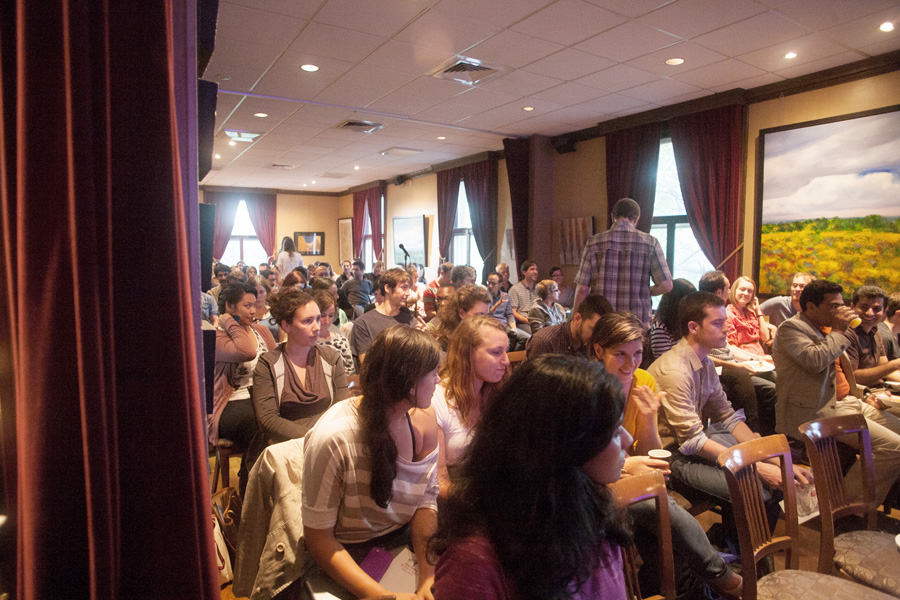
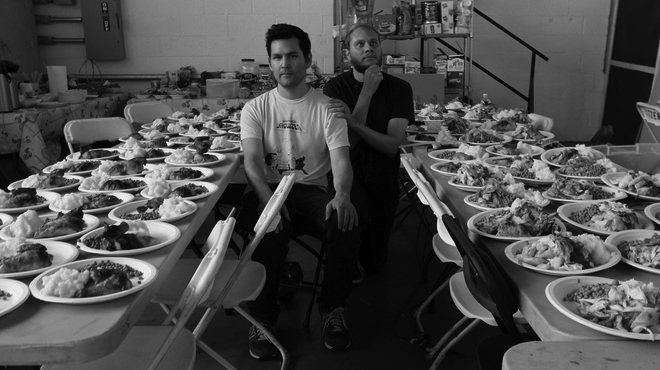
Known for their absurdly irreverent comedies, produced for MTV2 and Cartoon Network’s sister channel Adult Swim, writers/producers/comedians John Lee and Vernon Chatman are showcasing several special video clips, and holding a Q & A during POP Montreal this weekend.

First achieving recognition for their program Wonder Showzen, the duo continued creating daring comedies for Adult Swim. In accordance with some like-minded comedians, they formed a collective called PFFR, which is currently producing the show The Heart, She Holler on the same network.

When I spoke to the odd couple over the phone, they clearly demonstrated a steadfast devotion to their unique comedic style through endless nonsensical asides and fabrications; however sincere the question, every response revealed no perceptible trace of truth. The responses illustrated improvisation comedy at its best, with both speakers building on each others’ lies quickly and effectively, creating scenarios in which the two would lose themselves amid endless embellishment.

They will not disclose the inspiration behind the title PFFR, but Lee does clarify that the second ‘F’ in PFFR is silent  “just to be confusing.”

Such creative decisions characterize the offbeat humour of their programs. I asked them to explain how people typically respond to their work—curious to find out if they had rubbed some sensitive viewers the wrong way.

“Going too far?” chuckles Lee indignantly. “We would love for people to get mad at us but it never happens. Anger is still a form of attention. We’re terrible little children looking for attention in the worst ways, but it just doesn’t work.”

PFFR is best described as a comedy production, art collective, and electro-rock band ensemble. Like their comedy shows, the music is quite jarring and arrhythmic. When I began to inquire about their music, Chatman quickly redirected me.

“It is unqualified to be called music in italics. When presented to the music committee they would not accept it as music […] PFFR actually stands for nine hairs shy of music.”

Without gaining any information about their band, I asked more specifically about what to expect at the upcoming POP show.

“You know that feeling of going to a mall after eating an entire box of Lucky Charms?” says Lee. “We’re trying to come as close as possible to recreating that. In fact, you will not be allowed into the show unless you bring proof that you ate a box of Lucky Charms that day.”

They continued to discuss their recent investment in the Lucky Charms stock and ulterior motives to increase its market share for several minutes before I attempted to get them back on track by asking what they specifically will be doing at the show, as performers.

“We will be throwing up at this disgusting display of cereal ingestion,” replies Chatman. “Vomiting out of glee because our stocks are going through the roof. But in all seriousness, the show will mostly be showing clips from Glee—the hidden original episodes from the 70s. That show used to be really [messed] up, really transgressive, you know that real in italics [material].”

Looking for at least a shred of real information about this event, I concluded the interview hoping for them to give a reason why people should come to the show.

“It will be a defining moment of Canada,” offers Chatman. “Or at least, what was known as Canada. After this show, only God knows what it will be called.”

After hearing everything they had to say, I shouldn’t have expected anything less.

PFFR’s showcase and Q&A session takes place on Saturday, Sept. 28 at 3 p.m. It takes place at Film Box (3450 St. Urbain). Tickets are $8.

a, Opinion

True neutrality cannot be imposed

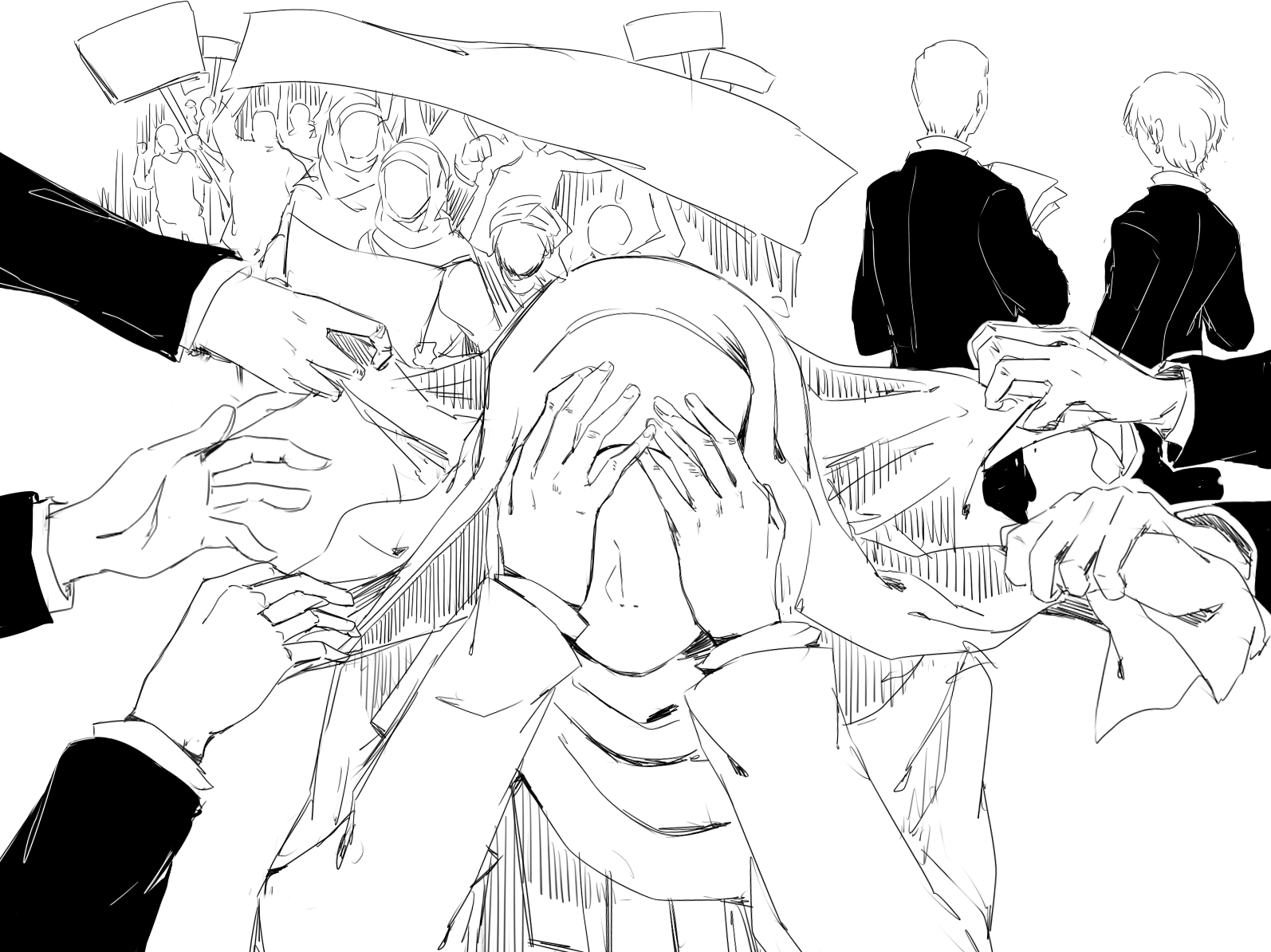
At first glance, there may be much to applaud in the “Charter of Values.” Its claims to reinforce gender equality and religious state neutrality are commendable. In such a culturally diverse society, remaining neutral prevents the state from favouring any particular group over others, allowing it to view all faith groups and communities on equal footing. In this sense, the state upholds its principle of freedom of religion, protecting and preserving the beliefs and rights of expression of its citizens regardless of faith or lack thereof. In addition, providing equal job opportunities for both men and women, with equal pay and benefits, will improve social justice and bolster the economic well being of Quebec families and individuals.

Yet under further scrutiny, it becomes clear that the charter’s values have serious flaws. The charter argues that in order to maintain state neutrality, its representatives must themselves be neutral. This seems like a reasonable statement, for how could a state be neutral towards different beliefs if its agents are not? But herein lies the focal point: what makes a state representative neutral? Of course, the agent’s behaviour and work ethic are the ultimate determinants, but according to the charter, prohibiting state representatives from wearing conspicuous religious symbols will help maintain neutrality. Thus, neutrality must be expressed both internally and externally to truly take effect.

However, the measure seems to defeat its own purpose. If the state aims to be neutral in order to guarantee freedom of thought and religion, it cannot do so by precisely limiting said freedom. By legislating such measures, Quebec’s government is reflecting an image of non-tolerance to the world, as well as to its own citizens. Canadians are critical of Saudi Arabia and Iran for completely imposing the Islamic veil on its citizens, so why should they themselves allow the complete prohibition of this veil many Muslim women freely choose to wear?

By imposing a dress code, Quebec runs the risk of ostracizing many well integrated citizens. Indeed, many civil servants will have to face an uncomfortable dilemma, being forced into either stepping down from their positions, or discarding their personal beliefs. This coercion will be perceived by many communities as Quebec taking a stance against their belief, and so in their eyes the state will have failed its mission to remain neutral. Rather than reinforcing social cohesion, the measure will actually fracture it. In France, the very same measure bolstered sectarian identity, dividing the indivisible Republic.

As for the charter’s other aim—the establishment of full equality between men and women—the imposition of a dress code will work against this as well.  Many women upholding the Islamic veil will not have equal job opportunities in contrast to Muslim men, who do not have a dress code as obvious as their counterparts. The lack of equal job opportunities in the many professional sectors affected by the measure will result in many faith groups being unable to integrate into the workforce, ultimately leading to serious social grievances within Quebec.

This is why the essence of state neutrality lies in the state’s agents’ dealings and decisions, not in their appearance. The charter claims that Quebec is a pluralistic society, so why should its government not reflect this pluralism? An individual living in a state protecting his or her freedom of thought and religion thanks to the principle of neutrality will strive to enact this neutrality in all his or her dealings. In short, it is not neutral to impose a prohibition on external religious signs. Rather, true neutrality on the part of state representatives lies in cherishing impartiality as a fundamental element within their profession. This ideal is exemplified in the Qur’an, which beautifully states: “O you who have believed, be persistently standing firm in justice, witnesses for Allah, even if it be against yourselves or parents and relatives. Whether one is rich or poor, Allah is more worthy of both. So follow not [personal] inclination, lest you not be just. And if you distort [your testimony] or refuse [to give it], then indeed Allah is ever acquainted with what you do.” Surat An Nisa (The Women) [4: 135]

Youcef Rahmani is the VP External of the Muslim Student Association. 

Continuing the campus conversation, hear what Helin Azizoglu, Stefan Novakovic, and Nathan Gibbard have to say.  

a, Opinion

Charter represents state-sponsored social division

A Protestant colleague of mine recently noted that the proposed charter seems to fly in the face of a crucial lesson we hope all children learn: thou shalt not judge by one’s appearance. Hopefully one doesn’t judge others at all, but especially not by what they look like. This is precisely what the proposed charter asks us to do. We are called to look at a Muslim woman wearing a hijab, a Jewish man wearing a kippah, and think “I know you; I know that you are not smart enough or moral enough to be able to serve me the same as your fellow co-religionists. Therefore I fear that you, without knowing you, are secretly working against the cohesion of society.” In Christianity, we are reminded to avoid such actions: “Judge not, lest you be judged.” In secular society the same idea takes a different form: “innocent until proven guilty.”

Certain members of the Parti Québécois (PQ)—though not all—state that they want a civil debate on the issue that does not descend into hyperbole. They are right to insist upon such a debate. They are even right to insist upon some form of secularism enshrined within the state. At their recent meeting, the Assembly of Quebec Catholic Bishops made the same point. However, the head of the Assembly, Msgr. Pierre-Andre Fournier also noted, “The more you try to have an identity by pushing back others, the more you create ghettos.”

“For by their fruits you shall know them” is part of the Christian Bible, but also functions as a general principle.  In a reasonable debate about public policy questions must be asked not only about why such a proposal is being put forward, or the intended consequences, but also what might be the unintended consequences. Some of the unintended consequences of the proposed charter include the ‘ghettoization’ of immigrants—especially visible minorities—who will be targeted simply because they look different. Evidence of these consequences can be seen in the vandalization of a Turkish bath and an Anglican church on Wednesday and Thursday, simply for attracting people who appear different. These attacks have little to do with religion or a secular state.  As the PQ proposes, let us look to France for an example: an aggressive secularism there has marginalized immigrants with resulting race riots that rocked that nation in 2005 and 2012.  Is this one of the unintended fruits of a proposed charter that singles out certain groups of people for exclusion? A reasonable debate on the issue has to look at the possible consequences, as well as those already occurring.

Let us continue to look at France. The Stasi Commission was set up to look into the issue of religious accommodation.  The French history of laicité is very different from that of Quebec, despite many trying to fit the Quebec experience into a French mould. In France, polls have consistently shown greater support for a clear separation between church and state. There, laws to this effect were proposed to formalize structures and beliefs already held by a large majority.  Whether one agreed with the laws or not, one can conceive that they were founded on the principle of fostering social cohesion. In Quebec, the PQ’s charter largely ignores the recommendations of the Bouchard-Taylor Commission on Reasonable Accommodation, as well as polls that at the very least indicate that the proposed charter is not an instrument of social cohesion, but rather state-sponsored social division.  A reasonable discussion must include these elements as well.

In a way, the proposed charter has indeed served as a force for social cohesion.  Anyone who attended the tens-of-thousands strong rally on Sept. 14 against the charter will have seen Muslims, Sikhs, Jews, Christians, secularists, from every colour, size, and shape march together. They marched to underline the simple fact that the proposed Charter of Values does not reflect our values.

Nathan Gibbard is the Director of the Newman Centre of McGill University. 

Continuing the campus conversation, hear what Stefan Novakovic, Helin Azizoghu, and Youcef Rahmani and have to say.  

a, News

News in brief

The Quebec Superior Court has granted approval for a class action lawsuit to proceed to trial, in a case against the city of Montreal for the alleged abuse and mass arrest of more than 500 student protesters during a university tuition demonstration on May 23, 2012.

The case was filed by Jean-Pierre Lord, a student at the Université du Québec à Montréal (UQAM), who was one of 508 students arrested and detained at the demonstration that night. He asks for $7,500 per arrested student—$2,500 each for arrest, detention, and human rights violation.

In the demonstration in question, police herded a large group of protestors into 17 buses at approximately 1 a.m. Lord claims that the conditions of their detainment were unpleasant.

“Eight hours […] of detention, in the bus, the window’s closed,” Lord told the CBC. “It was extremely hot; many people were sick.”

The motion also says each protester was forced to have their hands tied behind their back and denied access to water or bathrooms. Upon their release, each protester received a $634 fine for conducting an illegal protest.

The City of Montreal argued that Lord’s lawsuit was groundless since the protest was declared illegal. A protest can be declared illegal if the organizers do not report it to the police beforehand or have their route approved by city officials.

The court dismissed the city’s claim, calling it “frivolous,” and permitted the lawsuit based on the mass arrests, the detention, and the conditions of detention.

According to Vice-President External of the Students’ Society of McGill University (SSMU) Sam Harris, SSMU could theoretically provide support—for example, financially—for the lawsuit if their members were involved, but they have no current plans to become involved.

“We haven’t had SSMU members come up to us asking for any help in this regard, so I don’t know if we would get involved in any way,” Harris said. “Obviously, we condemn police abuse, but we also need to let the court case play its course.”

While he does not know of any McGill students who were arrested in that protest, Harris believes that some must have been from McGill.

The trial will begin in early 2014.

a, Science & Technology

Science fiction: Jurassic Park

Two velociraptors stalk through the kitchen as the children crouch. What little light there is shines upon what should be the feathers of these mysterious predators. Somehow, dinosaurs have returned from extinction.

Jurassic Park’s portrayal of dinosaurs is not without its flaws. However, the film succeeded at introducing the technology that may bring extinct species back to life. The techniques used to create ‘saurians’ is not radically different from the de-extinction concept (the ressurection of species through genetic and cloning technology) developing today. The film was also a trailblazer in the field of computer-generated imagery (CGI). Although most of the dinosaurs in the movie were animatronics, the raptors were entirely digital—a breakthrough for CGI in the ’90s.

De-Extinction

In the film, CEO John Hammond brings dinosaurs back to life after he discovers dinosaur DNA trapped in mosquitoes preserved in amber. Alhough the DNA is incomplete, Hammond fills in the empty gaps with frog DNA, creating all varieties of dinosaurs to populate his theme park: Jurassic Park.

Such manipulation of species’ DNA was a difficult concept in 1993. Techniques used to determine the details of an organism’s DNA were just starting to see the light of day. DNA is written in a code of four molecules called nucleotides (A, T, C, and G). By sequencing DNA, scientists can determine what order the nucleotides are in, allowing them to gain further understanding of the function of the code.  In the early ’90s, however, genetic sequencing was still slow-moving. The entire genome of the influenza bacteria—a minute fraction of a dinosaur’s genome—was only completely sequenced in 1995.

The technology necessary to recreate species is so complex that scientists have just started contemplating the possibility very recently. Since 1983, various projects have emerged to restore animals such as the passenger pigeon, the Tasmanian tiger, as well as woolly mammoths and sabre-toothed tigers.

The project to revive North America’s passenger pigeon is headed by expert Ben Novak and evolutionary molecular biologist Beth Shapiro at University of California Santa Cruz. Novak and Shapiro have been collaborating since 2012 in efforts to bring back the species that last flew in 1914.

The team uses a technique called gene sequencing to analyze the genome of the pigeon. The genome they assemble is then compared to the bird’s closest evolutionary relative, and any pieces that are different are compared and removed at the Harvard lab.

This new genetic code is then inserted into germ cells—special cells that eventually become ova or sperm. The hope is that the cells will successfully proliferate in the womb of the host species and develop into the pigeon.

It sounds simple, but most of the procedure involved is untested and still being researched. Genetics is a complicated field with many factors that are not completely understood. Still, there are hopes that extinct species may once again roam the earth.

Computer Generated Imagery (CGI) 

Special effects have played an integral part in movies for years. With CGI so omnipresent in today’s films, it is hard to imagine a time when movies were made without animation. Jurassic Park paved the way for graphics with its computer-generated velociraptors in the concluding scenes of the film.

Thanks to CGI, the velociraptors moved with a grace that would have been difficult to approximate with physical models. For the first time, a fantastical element like a dinosaur was not a close-up shot of a lizard or a stop-motion figure.

The technology used to create these dinosaurs was based on a logical evolution from filmmaking of the past. Similar to physical figures, artists made small models of dinosaurs that were subsequently copied with a laser onto a computer.  The animators then added joints and moved the model around on screen.

The digital dinosaurs offered an advantage over the physical models of the past: there were no limitations to the movement of the figure—previously restricted by wires and rods—allowing for more life-like motion.

Despite failures in CGI such as 1982’s Tron, filmmakers began to take advantage of the technology after Jurassic Park. Films like Casper and Jumanji improved upon the concept that was first introduced in Jurassic Park. Toy Story was the first completely computer-animated movie to appear in theatres. The rest was, as they say, history.

a, News

Students, staff discuss ongoing changes to libraries

On Sept. 19, approximately a dozen members of the McGill community gathered at a Town Hall meeting to address students’ concerns regarding past and future changes to the libraries. Hosted by the Students’ Society of McGill University (SSMU), the meeting was prompted by both budget cuts and the ongoing changes in libraries due to technological advances.

“It’s not merely because of budget cuts that we’re going through these changes,” Dean of Libraries Colleen Cook said. “The most significant thing is that libraries as a whole in North America, [including] big research libraries, are changing, and we’re changing in terms of what higher education is doing as a whole.”

With the recent merging of several collections—Life Sciences Library with the Schulich Library; Education Library with the Humanities and Social Sciences Library—the Town Hall provided a platform to discuss future plans for the libraries.

According to Cook, the merging of collections at McGill follows the lead of many research libraries in North America.

“UBC has merged their science and medical libraries, just as we have; Johns Hopkins has actually shut down their Medical Sciences Library [.…] This has been a change since forever,” Cook said. “Libraries across North America and around the world are changing from warehouses of books to spaces that are very student-centered and [provide] a lot of spaces for informal learning.”

Other changes to the library this year have included the end of the Laptop Lending Program in August. The end to programs such as these have raised other concerns for students like Sarah Southey, science representative to SSMU Council.

“I’ve heard the Laptop Lending Program has been cancelled,” she said. “What [is] going to happen with all the laptops?”

“If they are owned by the CIO [Chief Information Office], they are reusing those laptops, and they are accessible from 688 Sherbrooke for teaching and learning,” said Diane Koen, senior director of Planning and Resources and McGill Libraries. “My understanding is that it’s not for undergrads; it’s for visiting profs and for support teaching.”

Koen outlined the newly renovated student spaces of the Life Sciences Library, which include three 80-seat active learning classrooms, and an additional eight 14-seat classrooms.

Over 450,000 items have been moved, affecting all six floors of the Schulich library, which will be completely accessible by the end of September.

Materials that, after the merging process, will not remain on shelves but rather in storage at Currie Gymnasium, will be obtainable by students within 48 hours of placing a request.

“Material that has not been circulated in the last five to 10 years is being moved to […] storage,” Koen said. “An interesting statistic, though, is [that] 42 per cent of books in the entire McGill library system haven’t been circulated in 20 years.”

SSMU President Katie Larson expressed concern that those making these decisions keep in contact with students.

“If students find that they might be experiencing something, what’s the best way they can bring it forward?” she asked.

Cook encouraged students to voice such concerns.

“Call me, email me, talk to Diane [Koen], talk to someone at the service desk in any of the branches, if you are hearing any disruptions of anything,” Cook said. “Just let us know and you will get a response.”

Professors at McGill wearing religious symbols
a, News

Quebec Charter faces opposition in McGill community

The Parti Québécois’ (PQ) proposal to ban public sector workers from wearing religious symbols in government workplaces has faced criticism this past week, including an opposition campaign run by several McGill professors, protests in Montreal, and criticism from political leaders across Canada.

If enacted, the Quebec Charter of Values would ban public sector workers from wearing religious symbols in government workplaces, including turbans, kippahs, and large crosses.  Public sector workers who may be affected include provincial court justices, teachers, civil servants, university staff, health-care workers, and municipal employees.

In addition, the Charter would require that one’s face be uncovered when providing or receiving a state service—a clause which could include students, although exact details have not yet been released.


Effects on McGill

As a university, McGill would have the opportunity to opt out of the ban every five years, which could be achieved through a vote in Senate. Although Principal Suzanne Fortier addressed McGill’s stance on the issue on Tuesday, she did not directly identify the course of action that McGill will take in response to the proposition.

“The university must remain a place for the free and full exchange of ideas,” she said. “The proposal to prohibit our professors and staff from wearing visible religious symbols runs contrary to our principles. The wearing of such symbols in no way interferes with the religious and political neutrality of McGill as an institution.”

According to the Vice-President University Affairs of the Students’ Society of McGill University (SSMU), Joey Shea, McGill can address the Charter in several different ways.

“[The Senate] can comment publicly on the legislation, they can officially oppose it via their internal governance processes or they could do nothing at all,” she said. “For example, a motion could be brought forth to Senate by a senator asking the Senate to officially denounce the legislation. However, Senate deals with the academic activities of the University, so such a motion would have to be framed within these terms.”

Shea said she expects Fortier to mention the issue at the first Senate meeting of the semester on Sept. 18.

Since the Charter’s official announcement last Tuesday, the proposal has stimulated debate from  both professors and students on campus. If McGill does not opt out, professors and university staff would be unable to wear certain forms of religious symbols to work.

On Saturday, many McGill students participated in a Montreal-wide protest against the Charter.

“McGill’s got to fight this,” said Thomas Leenders, a PhD student in religious studies who attended the protest. “McGill as an institution has to have the interest of its employees and its students at heart, and […] fight this policy of discrimination against religious minorities.”

According to SSMU’s constitution on General Assemblies (GAs), SSMU cannot take an official stance on an external policy that does not directly affect the acitivites of students. However, according to Samuel Harris, Vice-President External, SSMU can find other ways to take a stance on the issue.

“Council can mandate the VP External to write a letter to the Quebec Government or a letter to the City of Montreal, expressing a certain point of view,” Harris said. “I see it as a good opportunity to go to the GA to actually debate [the Charter], because nobody I’ve talked to doesn’t want to take a strong position on this.”


(Hayley Lim / McGill Tribune)

Professor organizes campaign  to promote awareness

Catherine Lu, a political science professor at McGill, started a campaign last week that calls on professors to wear visible religious symbols to classes and lectures as an act of protest and to create awareness for the issue. Lu, who identifies as an atheist, wore a hijab to her classes last week and said she plans to continue wearing it next week to  raise awareness and generate discussion in her classes.

“I also take it off once I leave the classroom, so in no way am I adopting a religion and pretending to be someone who is faithful to a religion,” she added. “It’s clearly a kind of instructive act and a kind of protest because of the context of the proposed charter, which says people should not be wearing such things in the context of a classroom.”

Several professors from McGill have expressed support for Lu’s campaign, including Rex Brynen, Benjamin Forest, and Darin Barney, who have all agreed to participate in the campaign. However, Lu has also received some criticism.

“Some people who actually do subscribe to certain religious practices and beliefs […] worry that this kind of idea might lead to a kind of trivialization of religious belief and practice, so they worry […] that maybe some people would just make fun of it, or find it comical because obviously I’m not Muslim,” Lu explained.

However, Lu said that she does not think that McGill should opt out of the legislation if it passes, saying that this action would legitimize the bill.


The Charter

While it has already been met with opposition, the Charter has a long way to go before it can pass as legislation. The PQ is a minority government, which means that they need support from other parties in order to pass it. The Charter will be tabled by the PQ at the National Assembly and ready for debate within the next couple of months.

According to Bernard Drainville, the National Assembly minister in charge of developing the Charter, the purpose of the proposal is to enforce Quebec’s secularism.

“If the state is neutral, those working for the state should be equally neutral in their image,” Drainsville said at a press conference last Tuesday.

However, there are certain aspects of religious life that the Charter would not affect—for example, religious symbols that are considered part of Quebec’s cultural heritage, such as crosses in the Quebec Legislature or the cross on top of Mount Royal. It would also still allow public sector workers to wear small religious symbols, such as jewelry, and opening prayer would continue at municipal council meetings. Additionally, the charter wouldn’t remove property tax exemptions for religious buildings such as mosques.

The Charter has been popular among many Quebecers, with 66 per cent of residents in support, according to survey firm SOM. However, many political leaders in Montreal and across the country have denounced it. On Wednesday, the mayors of the municipal districts of the island of Montreal unanimously voted to condemn the Charter.

“To reach unanimity like that, east-to-west in Montreal, is exceptional,” Philippe Roy, mayor of Mount Royal, told The Globe and Mail. “But we’re all sending the same signal to Quebec—this is not representative of what Montreal is.”

At the federal level, members of all three major parties have criticized the Charter.

“The PQ government’s plan is divisive, negative and emotional,” Liberal Party Leader Justin Trudeau told media. “It is designed to be that way. Quebecers will reject it.”

Conservative Multiculturalism Minister Jason Kenney said that the federal government would make an effort to review the Charter of Values to identify whether it violates the Canadian Charter of Rights and Freedom.

“If it’s determined that a prospective law violates the constitutional protections to freedom of religion to which all Canadians are entitled, we will defend those rights vigorously,” Kenney said.

—Additional reporting by Erica Friesen.

a, Sports

Redmen ground Ravens in dominant fashion

This past Saturday, the McGill Redmen (4-0) lit up the scoreboard in a 16-4 victory against the visiting Carleton Ravens (0-3) in an Eastern Division matchup held in Molson Stadium.

Over the past few years, Head Coach Tim Murdoch has turned the program into a powerhouse, overwhelming opponents with superior depth and skill. This overt dominance was on display throughout the length of the affair, as McGill proved  outstanding in all facets of play.

Sophomore midfielder Christian Barker attributes the strong start to a renewed sense of focus and intensity following a rigorous pre-season.

“I think that we avoid complacency because of the depth of our team. Even when we put out the third or fourth lines, the guys are always hungry to get out there and play,” Barker said.

With the exception of a spirited first quarter in which the score was 4-2 in favour of McGill, the Ravens were muzzled in their attempts to move the ball up and down the field. The Redmen employed a zone defence that stretched the entire length of the pitch, and looked to contain any fast break opportunities in hopes of decreasing the likelihood of any easy goals.

McGill was able to combine a stout defence with patient attacking play that exhausted their opponents’ backline. In his first year playing for the Redmen after transferring from Lehigh University, attackman Kevin Donovan led the charge with a whopping six goals, pushing his points tally for the season to 14 and landing him at the top of the CUFLA points leaderboard.

With the way the Redmen have played to start the season, no team has emerged as a viable threat to challenge their reign as Baggataway Cup Champions. It appears as though the only way the team will falter is if they succumb to mental errors. After imposing their will on Carleton to begin the game, McGill conceded two goals in the final three minutes of the first quarter. From there, the crisp and precise passing  featured early in the game devolved into ground balls and turnovers as time elapsed.

In one such instance, in the middle of the fourth quarter, Carleton capitalized on a Redmen miscue and raced up the field. The Ravens, led by Bryson Goodman and Jay Gallant, established a fast break and were able to score in transition with Gallant firing it into the net for his second marker of the night.

Co-captain Alex Rohrbach was able to shift momentum back in McGill’s favour as he responded quickly with a wrap-around goal—his third point of the night—squashing any hope of a desperate comeback.

With the exception of Gallant, the visitor’s midfielders were unable to create opportunities for the rest of the team. This was primarily due to the play of the duo of McGill captains manning the middle: Brandon Maclean and Ossie Long. Maclean, last year’s Baggataway Cup MVP, dominated the faceoff circle, ensuring that possession was consistently in McGill’s sticks. Long set the physical tone for the squad, but ended up conceding four penalties.

The last quarter also reaffirmed to the rest of CUFLA that the program is in good hands. The lineup, primarily consisting of freshmen and sophomores, was able to extend the final score despite playing significant time with a man down.

The game against the Ravens was McGill’s second of the weekend and the first leg of a double-header that took place in Molson Stadium. The squad made the short trek to Concordia prior to Saturday’s contests and blanked the Stingers in a 22-0 victory.

The defending national champions capped off a dominant weekend by brushing aside Nippissing 20–2 in an exhibition game. The victory is the 14th straight win for the Redmen dating back to last year’s regular season loss to Bishop’s University. McGill has an opportunity to avenge the defeat on Sept. 19 as they travel to Lennoxville to take on the Gaiters in a heavyweight showdown between the past two Baggataway Cup winners.

a, Student Life, Student of the Week

Student of the week

This week’s Student of the Week is Tricia Olson, a U2 double major in biology and computer science. She was nominated for her involvement in a wide range of McGill clubs. Some of her roles in clubs this year include vice president of Gamers’ Guild (a club about board and card games), advertising executive of the Symphonic Band Club, member of Epilogue Book Club, and member of the McGill Mafia Club (a club for the party game known as Mafia or Werewolf).


McGill Tribune: Do you have a favourite part about one of the clubs you are in? 

Tricia Olsen: Playing in wind quintet through band was loads of fun. I really liked getting to play in a small group, and I [didn’t have] the chance [to do so] in high school.


MT: Do you have a favorite piece of music that you’ve played with the band?

TO: [Anton Reicha’s] Op. 91, No. 4, the woodwind quintet, mostly because I felt we had it well polished by the time we got to the concert.


MT: What is your favourite game to play with the Guild?

TO: If we’re talking board games, probably Dominion, a deck building game.


MT: What is your dream job? 

TO: I like to think I could get into artificial intelligence research with my degree, but we’ll see. I could also be a trophy wife or wealthy heiress, if the opportunity arose.


MT: You’re having a good day. What would be your theme music? 

TO: The entire works of Bonobo—kind of a jazz-influenced electronic artist. It’s excellent music, but pretty low-key so I could concentrate on other things.


MT: Sherlock or Watson? 

TO: BBC’s Sherlock, the character, is great—clever, rude, and hilarious. That show is so well done; I love it.


MT: Favorite place to study on campus? 

TO: Hiding in the Gamers’ Guild office in SSMU.


MT: If you had a superpower what would it be? Would you be a hero or a villain? What would your name be?

TO: My superpower would be the ability to apparate*. I would be a minor villain who apparates into bank vaults and people’s houses to steal small amounts of money, so no one notices. But, I would still go by Tricia Olson because having a villainous name would likely attract attention.


MT: What website do you procrastinate on the most, excluding Facebook? 

TO: Reddit, by far.


MT: What would be your choice of weapon in the zombie apocalypse?

TO: A terrible virus to extinct humanity, because if there are no humans left, the zombies will all die of starvation from lack of brains! There are no flaws with this plan.


*For those not versed in Harry Potter terminology, apparating is a method of transportation akin to teleportation.

Read the latest issue

Read the latest issue