

Latest News

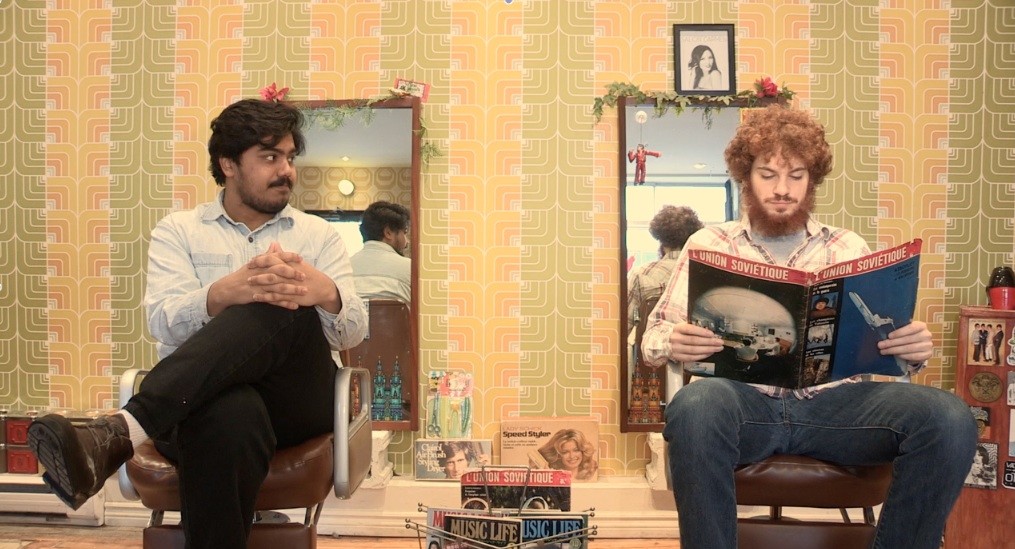
Still from Salon Carmen, one of Fokus’ official selections. Directed by Alex Cherney. (Courtesy of TVM)
a, Arts & Entertainment

Now playing: homemade McGill movies

A few weeks after the Oscars, Student Television at McGill (TVM) is returning with its own annual film festival—albeit on a much smaller scale. The Fokus Film Festival, now in its seventh year, comprises of a series of events, including a 72-hour filmmaking competition and the screening of the submitted films, which will take place at Cinema du Parc on Mar. 21. Thrown into the mix is a viewing of Salt of the Earth (1954), which is the sole connection to this year’s theme of blacklisting and censorship in a Red Scare-era film industry.

Unlike the era’s House Committee on Un-American Activities, TVM does not reject many of its “crowdsourced” films. This brings in mixed results both in the films’ cohesion to a central theme, as well as their overall quality, although a few outstanding pieces are bound to carry the festival.

“We usually play most of what we get,” says festival director Molly Bower. “Most of the films we get are really well made; a lot of thought is put into them. And so we’re always proud to show them.”

Fatal Occupation, the project of students Sarah Leitner, Hannah O’Rear, and Emma Baker, began as an assignment for their class in the study of cinematic horror. The film was conceived during the student uprisings in Montreal—a time when ‘occupation’ described a type of protest more often than a type of employment. The movie’s antagonist works as a security guard; a serial killer with a flashlight as a murder weapon and a penchant for student protestor homicide. The short film follows him across the campus, making reference to both horror movie tropes and McGill in-jokes, and works by making satirical jabs in the right places as well as taking a neutral political stance.

Less than half of the films were shown at Fokus’ press screening, and the 72-hour filmmaking competition took place while this article was being written, so perhaps the best is yet to come. But the most impressive film so far is Ruffle, by Alexander Kasstan. Set to “New Error,” by German band Moderat, and shot in reverse motion, the work chronicles the brief journey of a man walking through a park in France. The chosen track, which advances as steadily as the man’s gait, is featured prominently, and gives the impression of a music video. Although Kasstan didn’t have this concept in mind originally, he has since contacted Moderat, and hopes to get an endorsement from the band.

Much like CKUT, or the McGill Tribune, one of the mandates of TVM is to educate students in the production of a medium that is not widely embraced by a specific McGill department. Fokus realizes this goal by providing a vehicle for students to get their films seen by a broader audience, and encourages those who wouldn’t normally show their films publicly to participate.

“TV McGill is a really great source for learning production,” says Leitner. “That’s where I learned everything, and their equipment is amazing.”

“It’s a skill that takes a long time to develop,” adds Bower. “For the people that are able to learn it while they’re here, without any program at all, it’s a miracle.”

TVM’s Fokus Film Festival runs this Thursday, Mar. 21 from 6 to 9 p.m. at Cinema du Parc (3575 Avenue du Parc). Admission is $6 in advance and $7 at the door.
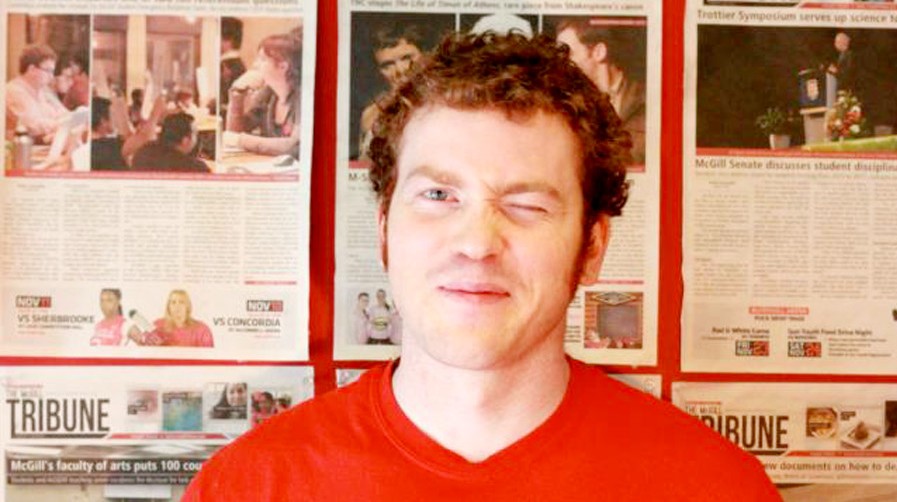

Owen Nelson, Jazz Performance, U4 (Sacha Pereira da Silva / McGill Tribune)
a, Student of the Week

Student of the Year

Owen Nelson – Jazz Performance, U4


McGill Tribune: Has it been at all difficult to balance your time between a performance major and a business minor, given how different they are?

Owen Nelson: For sure. Music takes a lot, a lot, a lot of time in your schedule. You have to do rehearsals that are two to three hours; a lot of times, students are in two or three combos in a semester, and they’re in a big band or a choir. So you have to budget your time really well. Being in business, it’s definitely been a challenge making time for music and academic courses. Because a lot of times, music students, they don’t spend time in the library, you know? They’re focused on that one degree. So for me, I’ve focused a lot of time on business.


MT: In arts courses, the standard set up is: midterm, paper, final. Is there any sort of standard format for most of your music courses?

ON: It really depends on the class. For jazz performance, we have to do music theory, and that’s more written. We have to do composition classes, where we learn how to write music, so that’s more ‘you have to write basically a song every week, and then you have to perform it in front of the class.’ And then there’s an improvisation course, where you learn how to improvise over songs. So that’s really performance-based; you basically create your own melody on the spot, over a song.


MT: Do you have a favourite course or professor that you’ve worked with?

ON: I think so far, my favourite professor has been Gary Whittaker, in the business school. He taught an entrepreneurship course, and it was really cool because he’s not an academic; he’s a real businessman—a successful businessman. It was really cool to learn from someone who has actually been successful in business. He taught us how to write a business plan, and how to make business deals and how to negotiate. That was by far the best course I’ve taken.


MT: Can you tell me about the music competition you recently won?

ON: Yeah, I’m in a band called Static Gold, and we just played a battle of the bands at Le National, and the winner of the competition gets—I think—35 hours in a recording studio, a free music video, a show in Toronto, and promotion or something. We get to play a show at Club Soda on May 19, so we won, and we’re going to be playing there.


MT: And what about your plans to play in Ibiza this summer? Can you elaborate on those?

ON: I met a DJ when I went travelling to Spain, two summers ago. My heart was broken, and I just bought a ticket to Madrid. I was playing my saxophone in the streets for money, and having an adventure, and I met a DJ who invited me to a party on top of an apartment building. So we played all night, until like 5 a.m. on top of this building, and we’ve stayed in touch ever since. So we’ve been recording together, and he got a residency at a club on the island of Ibiza, and he asked me to come play with him.


MT: So how long are you planning on staying there?

ON: I’m planning on being there for a couple of months, and then I got a job [lined up] in Palm Beach, Florida, after, so I’m moving [there].


MT: How did it come about that you are going Atlanta to record with Pastor Troy? 

ON: Pastor Troy is one of my childhood idols. I was bullied pretty badly in high school, and I would listen to his music for inspiration. A couple of months ago he was on the radio, and I called the radio station and asked them if I could talk to him. So I did, and he asked me to send him my music. Now I’m talking to his manager about…. going down there. It’s in the works, I’m crossing my fingers, and really hoping it works out.


MT: What did you guys talk about when you first called the radio station?

ON: I basically told him that his music helped me get through a lot of things in my life, and how much I appreciated him. We talked about martial arts, and he told me that he wanted me to teach him some kickboxing, and that I should send him my music.


MT: What’s been your favourite event or activity that you’ve taken part in at McGill this year?

ON: Probably when my band played at Open Air Pub [OAP]. It’s always awesome to do that.


MT: What’s your lucky charm?

ON: I guess when I play the saxophone, I have a power stance, and I feel invincible. Actually, I have two. It’s like my turbo-mode.

Irish Stew. (Images from www.babble.com, www.missigs.com)
a, Recipes, Student Life

Irish stew with dumplings

Stew with dumplings – Serves 6-8. A genuine Irish family recipe to help alleviate your post-St. Paddy’s Day blues. This quick recipe is easy to prepare, and will definitely fill you up. Reheated leftovers are also delicious! 


Stew:

2 cups cooked meat, diced (any of

lamb, beef, pork, etc.)

2 cups water

4 onions, sliced

4 potatoes, diced

1 carrot, diced

½ cup cabbage, chopped

¾ tsp. salt

Dash of pepper

Dash of mace (spice)


Cook meat thoroughly (method will vary depending on which type of meat you use). Then, fill a deep stew pot with water and the cooked meat. Bring water to a gentle boil, then lower to medium heat. Chop vegetables and stir into pot along with seasoning. Simmer gently for 30 minutes. About 15 minutes before serving, add dumplings without stirring, and cover pot tightly. Cook for an additional 15 minutes; serve immediately.


Irish Dumplings. Irish Stew. (Images from  www.babble.com, www.missigs.com)
Irish Dumplings. Irish Stew. (Images from www.babble.com, www.missigs.com)

Dumplings:

2 cups sifted all-purpose flour

½ tsp. salt

3 tsp. baking powder

¼ tsp. baking soda

3 tbsp. margarine or shortening

1¼ cups milk


Sift together flour, salt, baking powder, and baking soda. Cut in margarine or shortening. Add milk. On a floured cutting board, gather dough into a ball and knead 20 times. Roll out dough about ½ inch thick and cut into circles with a floured cutter. Place on greased cookie sheet. Bake at 450 degrees Fahrenheit for 12 to 15 minutes.

a, Student Life

A handy new way to think about your John Hancock

How do you take notes in class? On your laptop right?

Most of us learned to print the alphabet the same way, using the same models, and often the same,  techniques. Although there is a universal model for handwriting, the way we form letters varies greatly among individuals. That’s because we all approach the process of writing in different ways. In fact, the way you write may say a lot about your personality.

Handwritten class notes have gotten uncreasingly uncommon, and the less we write by hand, the more out of practice we become. As laptops, tablets and handheld mobiles are becoming our media of choice, some are saying that handwritten text is becoming an irrelevant method of communication altogether. In this context, graphology—the reading of an individual’s personality structure through the analysis of their handwriting—shifts some focus once again to an increasingly esoteric habit.

Graphologists like Toronto’s Annette Poizner, author of Clinical Graphology: An Interpretive Manual for Mental Health Practitioners, believe that handwriting can be useful for a variety of purposes other than communication. Most importantly, they tout the use of handwriting samples by mental health specialists to gain insight into patients’ personality traits and emotional dispositions. The practice may have positive implications for university health centres looking to broaden access to counselling and mental health.

An interview with Poizner provided plenty of insight into the scientific theory behind graphology and its uses. Handwriting, which Poizner describes as “the written trace of each individual’s preferred rhythm, style and habitual manner of moving,” is used in what is called projective personality assessment. In the assessment, psychologists evaluate subtleties such as the length of pen strokes, the size of writing, the shape of letters, which side of the margin is left wider than the other, and the fluidity in penmanship. According to Poizner, these attributes can tell a graphologist with a sharply trained eye a great deal about someone with whom they have never even spoken. If graphology was implemented into traditional counselling and psychology services, a patient could conceivably send over samples to be analyzed, and allow professionals a considerable understanding of the patients’ personalities even before their first face-to-face appointment. Analysis of drawings and written material can be used in this manner as well.

Is this tactic truly scientific or just a ruse, in the vein of fortune telling or tarot reading?  Can it really produce scientifically accurate and meaningful results?

Poizner cautions that graphology is more of a “therapeutic tool” than an empirical scientific measure, and emphasizes that graphology should always be used alongside other more traditional assessment methods. However, she underlines that previous research participants in observational studies examining graphology done at the University of Toronto have reported positive experiences with handwriting analysis. In general, researchers found that participants were more eager to participate and respond openly to therapeutic evaluation after first encountering these more unconventional method. Knowledge gleaned from graphological analysis were used to help guide discussion in subsequent face-to-face appointments. Notably, these  insights were particularly useful in the context of family and marital therapy, as they provided substantial context about patients’ personalities and communicative differences.

Even if students remain skeptical about the true effectiveness of graphology—as does this author—Poizner thinks students should recognize the field’s growing relevance. Recently, studies and publications on graphology have been well-received by the Canadian Psychological Association, and the Canadian Association of Spirituality and Social Work. Although graphology is not currently widely-practiced in North America, it could be an up-and-coming influence on the practices of psychiatry, psychology and social work. Professionals and students alike may find it worthwhile to give handwriting and graphology a second look, as a means of getting to know themselves a little bit better.

a, Student Life

Ask Tribby

Dear Tribby,

I decided to move in with three close friends from residence, but over the course of the year, I’ve realized that we really shouldn’t have been roommates. I still value my friendships with all three girls, but I only want to live with one of them in the upcoming year. That being said, I’m not sure if she still wants to keep living with the other two, although I do know that they get on her nerves as well. Should I just stick it out, and try to get her to find a new place with me, or start from scratch with completely new roommates?

Ready for a change


Dear “Ready for a change,”

Roommate problems can have long-term repercussions which you may have to deal with on a daily basis. If you want to move out and find a new place, I suggest that you follow your instincts rather than act out of the fear of ruining a friendship. These girls are clearly important to you, but you’ve got to consider what you’re willing to put up with. A lease is a full 12 months, meaning you’ll have to live another uncomfortable year with the three of them should you decide to stay.

My advice for you, is first, to communicate. Talk it out with the girl that you want to live with. You may be nervous about her reaction, but it’s worth it to be honest with her—wanting to explore other living arrangements doesn’t make you a bad person! Just open up a light conversation with her to see where she stands. If you two happen to be on the same page, then great! You can then bring it up with the other two girls. However, if she had no intentions of moving out, then don’t waste time including her in your plans for next year. You can find other potential roommates, or start house hunting on McGill Classifieds, housing groups on Facebook, and Craigslist.

Next, you need to be proactive. The biggest problem right now is that you are racing with time! The faster you decide your living plans for next year, the faster you can find new roommates and begin the apartment hunt.

Don’t rush your decision, but don’t waste time guessing what people are thinking, either—just ask. The sooner you decide, the easier you’ll make it for your currrent roommates anyway. They can either find a new roommate, or search for a new house of their own. Good luck; I hope you find something that’s the right fit for you!

Yours truly,

Tribby


Dear Tribby,

I’m worried a good friend of mine may be suffering from depression, or even contemplating suicide. I’m afraid to confront them about it directly, but I feel like I need to do or say something. What should I do?

Worried Friend


Dear “Worried Friend,”

Since you mentioned that you are good friends with this person, have you tried talking to him or her about it? Chances are if this friend trusts you enough and is the type of person that is willing to share, he or she may tell you how they’re feeling and why. If, however, this individual is more reserved with their emotions, then obviously don’t start your conversation with, “You look horrible, do you want to talk about it?”

Some people may feel like you are trying to force them into telling you why they’re feeling down.  Instead, try to indirectly figure out what the issue could be,  by spending more time together and observing their behavior in different settings. With many coffee shops around campus, you could go out on a Saturday afternoon and just hang out. This way, you might be able to figure out if anything big just happened in their life, such as the loss of a family member, a breakup, or bad grades. Through casual hangouts, you can better gauge if a serious problem exists, or if you were just getting worried over nothing.

However, if you do realize that something really is wrong, and your friend is reluctant to open up about it, you can bring up the McGill Nightline. Whether as a direct suggestion that they might like to talk to someone anonymously, or mentioned casually in passing, make sure they know that is a resource available to students (McGill Nightline: 514-398-MAIN [6246] 6 p.m.-3 a.m., during the school year.) Or, at the end of the day, if they tell you that they’ve been feeling very depressed lately but don’t want to talk about it, you can give them the number to the McGill Counseling Service as well. They offer counseling appointments, group therapy sessions, and emergency crisis drop-in hours. The drop-in hours go from 9:00 a.m. – 4:00 p.m. Monday to Friday in the Brown Student Services Building, and counseling sessions are by appointment.

The bottom line is to pay more attention to this friend. If you receive any weird texts or phone calls from them, seek help immediately. After all, it’s better to go through a false alarm than to ignore your instincts and let the situation deteriorate.

Yours truly,

Tribby


Got problems? E-mail [email protected]

Adam Gopnik, literary titan and art connoisseur. (thewalrus.tumblr.com)
a, Arts & Entertainment

Celebrated author Adam Gopnik dishes advice

When Adam Gopnik was growing up in 1970s Montreal, he chose to steer clear of CEGEP. Instead—like Will Hunting—he simply went to the library and read. The choice appears to have paid off. Since completing his BA in Art History, the McGill alumnus (’80) has become an esteemed author, with three National Magazine Awards and a George Polk Award for Magazine Reporting to his name. His essays in the New Yorker magazine, where Gopnik is a staff writer, deal with a wide range of topics. From art, to science, to anthropology, they remain edifying without verging on the pedagogic, imbued with a light, measured humour. After his recent Macnamara lecture on learning and mastery at McGill, the Tribune spoke to Gopnik about the process which led to his literary success.

MT: You came to writing through art criticism. How did you develop the interest to write on other topics?

AG: I don’t know that I ever did, really. It’s like the matrix—more of a three dimensional illusion of erudition than the real thing. The truth is I never really wanted to be an art critic in particular, it just was an accident of my own personal history that I found myself in New York City with a scholarship to do graduate work in art history. It was a way of getting from Montreal to New York. Once I’d done that, I had a certain expertise in art … that was a very natural thing for me to be writing about. But the art history was much more instrumental to my ambitions as a writer, than writing was instrumental for my desire to be an art historian, or an art critic.


MT: Did it provide a base of historical context and a cultural awareness, or is it just the fact that you read so much?

AG: Yes, it did—I got my basic training in … research [when] doing academic work in art history, but the simple truth is I think I would’ve done exactly the same things that I picked up in art history. The real foundational moments in the making of my own mind came from going into a library when I was 16 or 15. I think those were really the crucial years, and the experience of digging deep in a library and taking pleasure in it, finding that it’s a reliable source of pleasure for me—that shaped my mind. My mind worked better at that age than it has since, and to the degree that I’m able to do good work now, I really feed off the capital that I’d accumulated in those years.


MT: What is a key piece of advice for someone who wants to write?

AG: There’s a piece of practical advice I always give. The key to actually writing things is taking the mental task of writing, and transforming it into the physical task that your mind and intuitions are invariably smarter and truer than you are. It always happens to be that the things that people like best or enjoy the most in my own writing are things I was scarcely aware of when I was writing them. It just seems to be the seamless, the obvious, the self-evident way. So the trick with writing is to trust your own mind, and to simply put the words down on paper, or in pixel form, and the only way to do that, that I’ve found in 30 years of doing it, is to simply centre it not in your head, but in the pit of your stomach, and make it a task like riding a stationary bicycle at a health club. And when you succeed in making it a physical task, you can astonish yourself in spite of the relentless and never-ending exasperations and aggravations of the task of writing. Just as if you go to the gym every day and ride the bike for 40 minutes, your lungs expand; if you sit and simply try and write as though you were riding a bike, your work expands. It’s the same advice that every writer always gives, that you just have to apply yourself to it; but I mean it in a more encouraging sense: you don’t have to apply yourself to it intelligently, you just have to apply yourself. If you have anything to say, if you have any reservoir of wit or feeling in your mind, it will be expressed.

MT: What is the most important thing for students to get out of their university experience?

AG: Nobody knows what will prepare you for the work you’re going to do, and the work you’re going to have. I did art history, and that turned out to occupy a very small part of my life. It’s part of my pleasures, because I love going to museums and galleries, but it’s not what I ended up writing about. All of that effort—memorizing lists of post-impressionists, or the iconography of the Pergamon Altar—was wasted. But of course, in another way, it wasn’t, because what’s at the core of education is accomplishment—that is, mastering something, whether it’s a system of guitar chords, or magic tricks, or the name of post-impressionists, or the iconography of the Pergamon Altar. Once you’ve demonstrated to yourself that you’re capable of mastery, then any kind of mastery you tend to approach in life tends to yield much more easily to you. The thing I would tell any student is master something; really learn it, whether it’s the piano, or the history of science.


Adam Gopnik’s latest book, The Table Comes First: France, Family, and the Meaning of Food, is available in stores now.

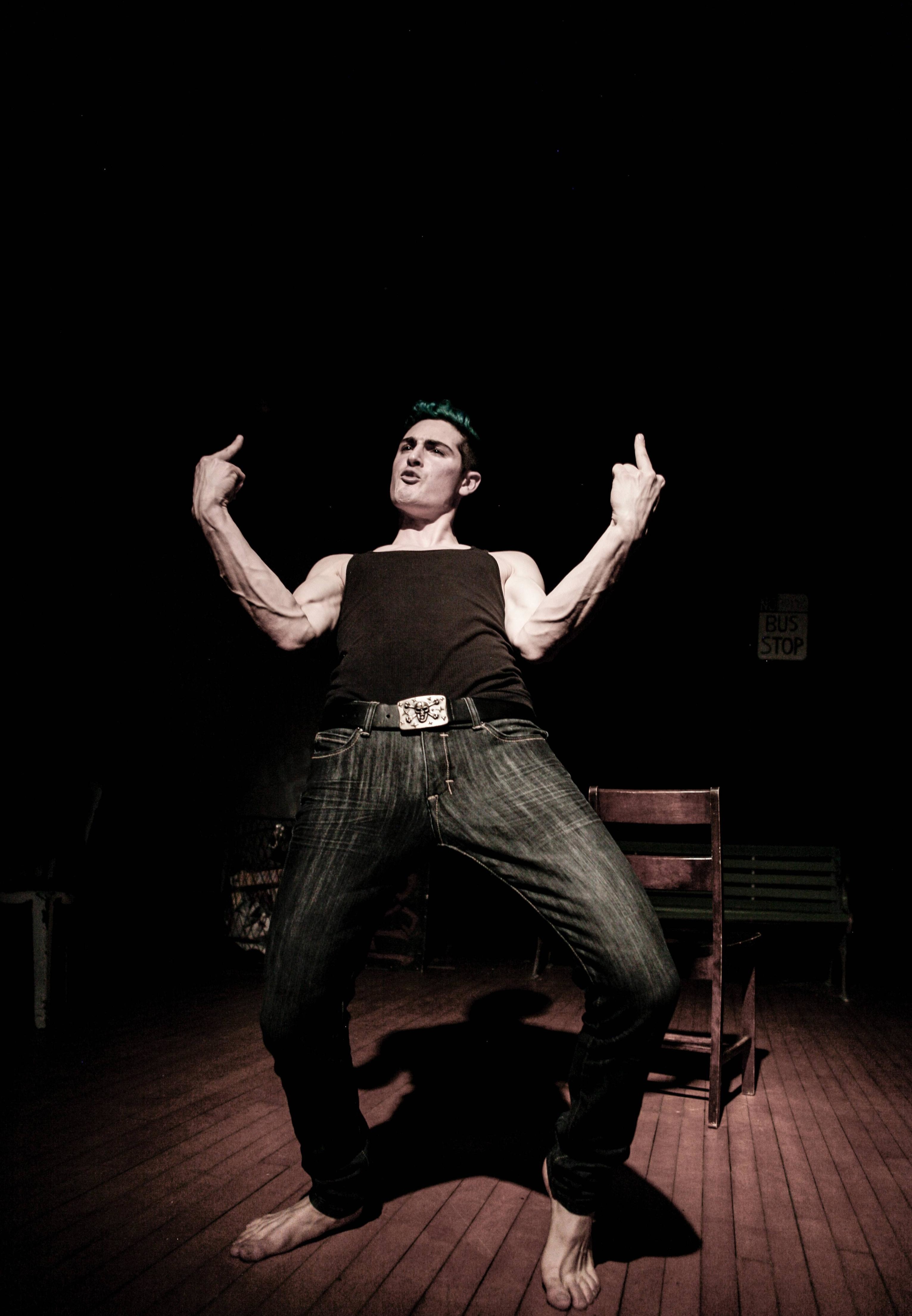
Troubled youth indeed. (Courtesy of Victor Tangermann)
a, Arts & Entertainment

TNC Theatre’s latest production hits close to home

Highly character driven, Based on a True Story follows the lives of ‘troubled’ youths and the biases attached to their lifestyle. Director Isaac Robinson and his talented ensemble examine human problems in this piece of devised theatre, as the cast animate semi-fictional characters that they each helped to write.

The audience is first thrust into Danny’s (Justin Lazarus) mind, who begins the play by breaking down the fourth wall and staring down the audience members. Indeed, the entire script boasts an awareness of the audience with its use of confessional monologues. Lazarus dynamically reveals the world through Danny’s drug-influenced eyes, and his perception of how others view ‘people like him.’ He captures the audience’s attention with his frantic energy, interspersed with glimpses of his softer side, as he talks about the love of his life, Camille (Kim Drapack). After overcoming some early nerves, Lazarus’ ability to shock the audience with Danny’s highs and lows is stunning. He is crazed, calm, vulnerable, and desperate, sometimes all in one breath—and leaves the audience wondering, “Who would Danny be if he wasn’t high?”

Opposite the erratic Danny is the hilariously loveable Stevie (Cara Krisman), his faithful second in command. Together, the two feed off  of each other on the stage. Krisman’s physical performance is scene stealing, whether she is fumbling around with her much loved wine bottle, searching for “the thing that tastes like what she wants,” or espousing her desire to stay sober so that she can be an artist. She presents Stevie’s struggle with care, uncovering the layers of her character.

Caught in between Lazarus and Krisman, Drapack is sometimes lost. Her character Camille acts as a calming influence on Danny, but points out that he only ever listens to Stevie anyway. As a result, it is difficult to find a purpose for Camille, other than that her world revolves around Danny. The writing for this character is weaker than the others, as her development is left until the end of the play, and reveals more about Danny than her.

The performances of Emily Doyle, playing Judge Parks, and Michael Ruderman, as Officer Davis, are notable. They bring depth to characters who could have easily been conveyed as two-dimensional villains trying to maintain an unjust order. Like Danny, an imperfect hero, Parks and Davis are both sympathetic, staying true to Robinson’s determination to show no clear right or wrong. Ruderman is striking. His honesty is evocative, and it is hard to condemn his character’s excessively violent arrests.

Set designer David Costello captures the stark contrast between the two battling worlds, simply by breaking the stage in two. He uses the intimate space wisely. Judge Parks’ courtroom and Officer Davis’ police station claim one side of the stage, neatly decorated with poster boards, while the other is cluttered with beaten up chairs and graffiti, the latter painted by art director Vanessa Chazelle.

Although the writing is weak in some areas, causing the play to drag, the well-directed acting provides a strong backbone for this ambitious collaborative project. Based on a True Story takes a hard look at its characters, and reinforces the fact that everyone has their own demons to confront.

TNC Theatre’s Based on a True Story runs from Mar. 20 to 23 at 8 p.m., Morrice Hall (3485 McTavish). Student tickets $6.

Suuns: Images Du Futur
a, Music

Suuns: Images du Futur

Suuns’ lead singer Ben Shemie refers to the environment in which his Montreal band recorded Images du Futur—the Quebec student protests of last year—as, according to the press release, “a climate of excitement, hope, and frustration.” But if the album is a political statement, it would be best described as resigned apathy.

Shemie has occasional bouts of angsty singing through his gritted teeth, as on album opener “Powers of Ten” where his vocals gain momentum from an anxious guitar riff. On the rest of the album, however, Shemie tends to mumble and croon, channeling a muddier Thom Yorke.

Shemie’s voice is quite beautiful, which is why it’s a shame he throws it away so easily. Three quarters way through the album, Suuns sounds tight on “Bambi,” with a throbbing, randomly arpeggiated bass and a sharp, insistent guitar melody, punctuated by a strong snare drum. Over his band’s excited noise, he sighs, “To want to can’t you feel / Maybe you can see / To want to can’t you see / Maybe they be.” On some parts of this album, one simply wishes that Shemie would just spit it out.

The rest of the band has a refined post-punk sound that has obviously been carefully moderated to provide enough space for a rhythm that lopes along with confidence. “Edie’s Dream,” with its mellow, laissez-faire beat, is a perfect example of this—a highlight of the album. Images du Futur, as a sophomore effort, contains snapshots of brilliance. But for this to have been a fully realized soundtrack to Montreal’s uncertain future, Shemie should have worked harder to see eye-to-eye with the rest of his band’s vision.

BrightonMA: Oh Lost
a, Music

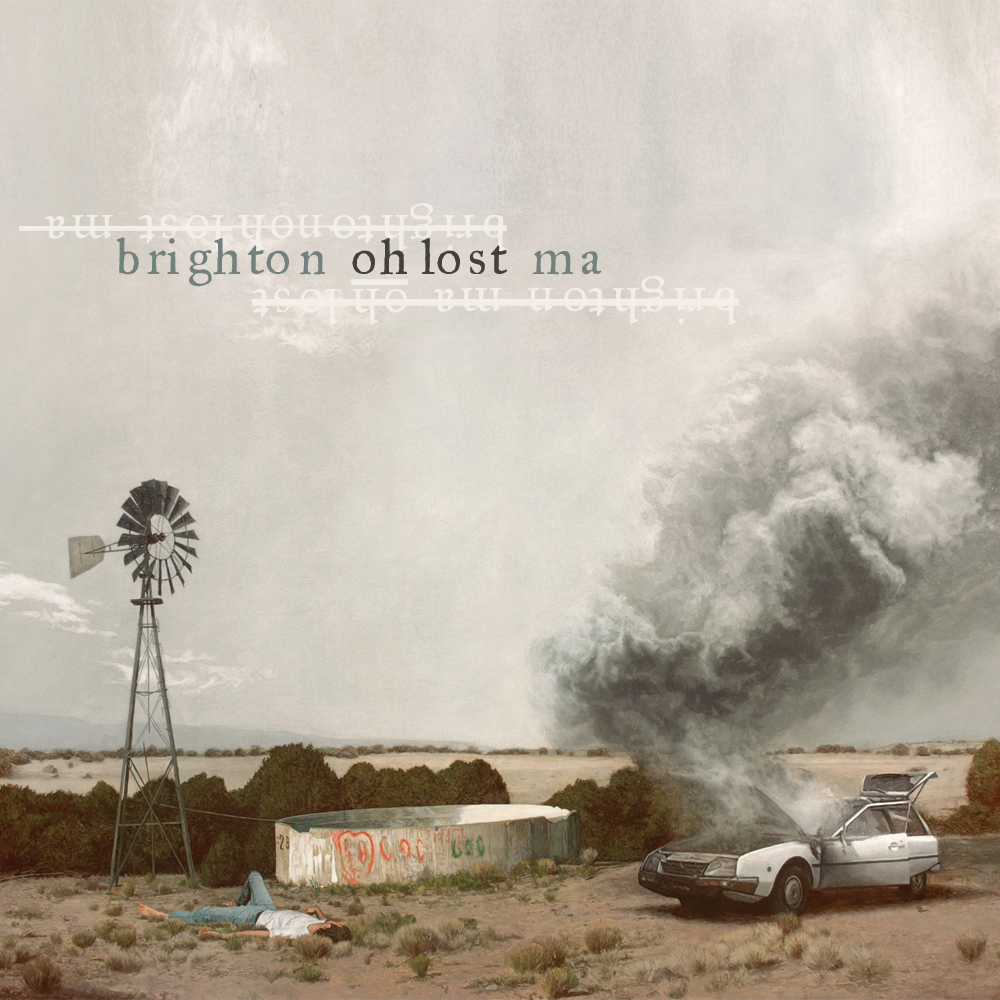
Brighton MA: Oh Lost

“We weren’t built to last; we were built to explode,” croons Matt Kerstein. The lead singer of Chicago-based quintet Brighton MA delivers the line evocatively in “Bulletproof,” the opener for the group’s sophomore release Oh Lost—and at first, one is tempted to believe him.

Unfortunately, the sonic vitality seen in “Bulletproof” is the exception rather than the rule on an album largely in the same mold as the indie-rock multitude. The shimmering, trembling guitar chords soon give way to pedestrian soundscapes—forgettable at best, and sagging at worst.

A low point comes during “Thirst,” when awkwardly syncopated notes steadily drill into one’s skull, like maggots feasting into carrion.

That said, Oh Lost is not devoid of merit. “Sweet Delusions” is a standout, with its smoky bass line and guitar solos that rip its chords to shreds. “Good Kind of Crazy” channels a calm, rustic sweetness, charming listeners with clear instrumentation, and lyrics about the “summer breeze” and “swinging through the back porch screen.” Perhaps the most valuable asset for Brighton MA is Kerstein’s vocals, which are front and centre in nearly every track (and for good reason). Kerstein’s voice is nuanced, raw, and weathered, cutting through often listless arrangements with power and confidence.

In this day and age, it is not enough for indie-rock bands to simply push vague themes of ‘youth’ and ‘rusticity.’ Oh Lost’s melodic and lyrical mediocrity is not a death knell for the group—but it certainy is a wake-up call.

Foals: Holy Fire
a, Music

Foals: Holy Fire

With Foal’s newest release, Holy Fire, the British indie rockers have succeeded in producing a multitude of tracks that emphasize their unique sounds. Although it does not quite reach the sheer magnitude of their masterpiece “Spanish Sahara” from their previous album Total Life Forever, they have still created a fantastic arrangement of tracks. Altogether, Foals have begun to create a darker atmosphere with their music, quite different from the unencumbered productions they’ve made in the past.

The album opens with “Prelude,” a melange of rock percussion and gritty but ethereal lyricism. The second track and single “Inhaler” drives catchy beats towards a climax of lead singer Yannis Philippakis’ yearning call for “space.” The most anthemic track is certainly “My Number”—frustratingly catchy and difficult to stop listening to. “Bad Habit” provides a little bit of contrast with the rest of the album, as it’s more electronic in nature. It also features some of Philippakis’ more emotionally vulnerable performances. “Milk & Black Spiders” may have an enigmatic title, but it’s a straightforward expression of commitment for a person. The album comes to a close with “Moon” which seems to be similar in format to the band’s hit song “Spanish Sahara.” It sedately winds down without some of the edginess that characterizes the rest of Holy Fire.

Foals have clearly demonstrated their growth as a group. They’ve incorporated new inspirations and experiences to create an impressive third album. Philippakis noted that some of the band’s inspirations are “voodoo, the swamp, sexuality, byzantine iconography, and music … the decline of the bee populations, hip hop, and stoner rock”—and they’ve certainly amalgamated these elements into something admirable.

Read the latest issue

Read the latest issue