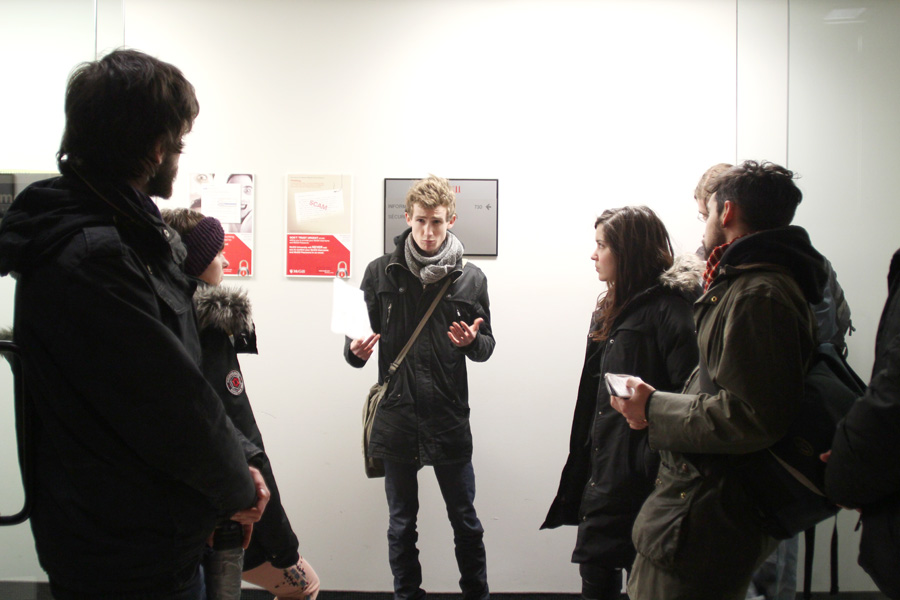
On Mar. 14, a dozen McGill students and recent graduates gathered outside the Students’ Society of McGill University (SSMU) Building to participate in the Military Research Walking Tour.
The walking tour was organized by Demilitarize McGill, a student-run group aimed at ending military research at the university. Kevin Paul, a first year law student and member of Demilitarize McGill, led the hour-long tour which covered three locations on campus, including the Institute of Air and Space Law, the Macdonald Engineering Building, and the seventh floor of the 688 Sherbrooke building.
According to Paul, the purpose of the event was to spread awareness about McGill’s academic and financial participation in military research.
“[We want to] share information on what connections McGill has to weapons development in a way that addresses the lack of transparency the university has shown,” Paul said.
The tour’s first stop was the Institute of Air and Space Law, where Cadence O’Neal, U0 women’s studies, spoke about a collection of law school graduates’ theses which thank the U.S. Air Force for funding their education at McGill.
“We do know some things for sure,” O’Neal said. “These military organizations are paying for their members to come study here and produce academia that they can use to further their own interests. It is unacceptable to me, and to Demilitarize McGill, that our university is instrumental in the production of these laws that serve these institutions.”
Isaac Stethem, who graduated from McGill with an arts degree earlier this year, discussed the denied ATI requests made by students—including some Demilitarize McGill members—to the university on various subjects.
“It’s not just that those 14 people—or anyone they can be associated with—who can’t file any more [ATI] requests, but also the McGill Daily and The Link,” Stethem said.
SSMU Vice-President External Robin Reid-Fraser is one of the 14 students who filed an ATI request. She said she is not satisfied with some of McGill’s reasons for denying her ATI request, which concerns military research at the university.
“Part of the excuse [McGill is] making is that answering all these [ATI] requests requires a large amount of resources, and basically, it’s impossible for them to function because they have all this extra work due to these requests,” Reid Fraser said.
After visiting the Institute of Air and Space Law, the tour walked to a basement lab in the Macdonald Engineering Building, where the topic of discussion was the Faculty of Engineering’s history in military research dating back to the 1960s, as well as their alleged lack of transparency about weapons development. Today, the Shock Wave Physics Group and Computational Fluid Dynamics (CFD) Lab are two McGill groups which still engage in aircraft engineering and the study of detonation phenomena.
A statement on the CFD Lab website does not mention involvement or funding from the military.
“The primary objective of the McGill CFD Lab is to develop advanced numerical technologies in multidisciplinary aerodynamics in order to allow for an integrated aircraft design approach through concurrent engineering,” the website states. “Research funding is primarily contributed by the federal as well as the provincial governments through the following agencies: NSERC, CFI, FQRNT; and industries such as Bombardier, Pratt & Whitney, Bell Helicopter, and a large number of private companies.”
Demilitarize McGill claims that much of their research benefits military endeavours.
“At this moment, McGill is developing the technologies that the U.S. military will use to kill more efficiently, at the same time as profiting from various military interventions which mean new research opportunities for the CFD Lab and the Shock Wave Physics Group,” said Paul.
The tour ended at 688 Sherbrooke, where discussion turned to drone research.
“Through the industry-sponsored CFD Lab, McGill is involved in the development of technology for lethal attack drones, which are being deployed by the United States in an increasingly borderless war with no end in sight,” said Paul.
Paul emphasized Demilitarize McGill’s mandate, which is to end weapons research at McGill.
“Allowing military research at McGill to continue means allowing the university to remain complicit in war. We don’t need a policy review or a consultation forum, we don’t need more bureaucracy, we need to end military research at McGill,” said Paul.
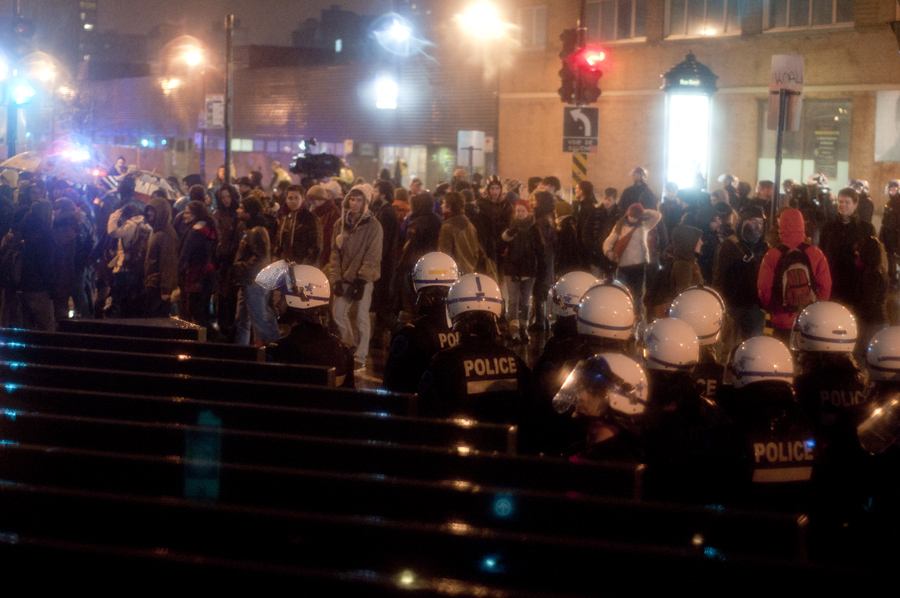
Students and activists assembled under the rain in downtown Montreal to protest the tuition indexation announced by the Parti Québécois (PQ) at the two-day Summit on Higher Education held in late February.
In comparison to the protests of thousands that occurred more immediately after the Summit—which ended in violence and multiple arrests—last Tuesday’s demonstration featured fewer protestors and was peaceful through its entirety.
Protestors assembled at Place Émilie Gamelin at 8:00 p.m. before starting their march west along Sherbrooke. The protest then turned down Aylmer, and east on President Kennedy, before dispersing at the intersection of de Maisonneuve and St. Denis.
(Simon Poitrimolt / McGill Tribune)
The planned demonstration was closely regulated by a large police force that shepherded the protestors away from side streets. The Service de Police de la Ville de Montréal (SPVM) outnumbered the protestors along the route, and accompanied the march on horseback, on bikes, and in riot gear, while closely containing the crowd.
This protest was the second of what is planned to be a program of weekly marches against tuition increases, or what some are calling the “Printemps Érable 2.0.”
Students who took part in the protest expressed concern for the impact of the proposed indexation, and the prohibitive cost of education.
“Let’s say if I didn’t have the money to attend college and buy books and such, as some people won’t if the indexation goes… society will dumb down and I’m definitely against that,” Andery Kolesov, a second-year fine arts student at Dawson College, said. “I think we’re supposed to progress and go towards new horizons.”
Other students, like Meloée Prud’homme, who is completing a Master in Biology at the Université de Montréal, fears that the financial impact the indexation could have on their daily lives.
(Simon Poitrimolt / McGill Tribune)
“I have two kids, I’m alone, I have to [do] my master’s degree, and I have difficulties making ends meet, so [indexing tuition is] not a solution,” she said.
A feeling of disappointment with the PQ pervaded the march.
Prud’homme said she predicts that the PQ will now begin to act like the former Liberal government in their responses to protests last year.
“[The PQ is] going to pass us off as villains while we’re here marching passively,” she said.
Certain charges to students’ fees are to be reviewed by the Students’ Society of McGill Unviersity (SSMU) and faculty members.
A motion presented at the SSMU Winter General Assembly (GA) on Feb. 27 called upon SSMU to “conduct a thorough review of all tuition and fees charged in all faculties or schools to which its members belong.” The motion was passed as a consultative forum—as the GA did not meet quorum—and was brought to Council for debate.
SSMU Political Campaigns Coordinator Christopher Bangs, who moved the motion at the GA, spoke to Council on Thursday evening, explaining that his recent experience with unclarified fees in one of his classes motivated him to bring forward the motion. Bangs clarified that he drafted and presented the motion as a regular McGill student, and not as the Political Campaigns Coordinator.
Science Representative David Chaim asked for clarification on who would enact the review, which led to an amendment of the motion. The following clause was added: “Be it resolved that the SSMU Vice-President (VP) University Affairs office undertake the aforementioned review on behalf of the student association SSMU.”
The motion originally passed with seven in favour, five opposed, and 12 abstentions, but it was later brought back to the table after Inter-Residence Council Representative Sarah Southey motioned to reconsider the document on the grounds that the high number of people abstaining indicated the need for further discussion.
Councillors went on to discuss the role of faculties in reviewing tuition and fees. Senate Caucus Representative Moe Nasr pointed out that since faculty associations have more direct ties with the course fees in question, they should be the actors involved in the review.
Other councillors supported a joint project between SSMU and the faculty associations.
“It has to be done by [faculties] … but it should be done as a joint project between SSMU and the faculty associations,” SSMU VP University Affairs Haley Dinel said.
SSMU VP Clubs and Services Allison Cooper proposed an amendment for SSMU to act in accordance with faculty associations, which was added to the motion. The motion passed with a vote of 21 in favour, zero opposed, and two abstentions. SSMU VP External Robin Reid-Fraser later commended the members of Council on actively resolving the motion’s unaddressed problems.
The Fate of SARC
Dinel presented a report on the Student Advisory Resource Committee (SARC) to councillors. SARC’s purpose is to help students navigate the McGill bureaucracy so that they can have their voices heard to a greater extent within SSMU and the administration.
SSMU Council allowed SARC a trial run over the 2012-2013 academic year to see if it would be an effective committee. The trial run ended on Mar. 15.
In her report, Dinel advised that SARC be kept as a committee, but that, in the interest of stabilization and institutionalization, it should be merged with the SSMU Policy Committee.
David Benrimoh, who is in his second year in the Faculty of Medicine, and Raphael Uribe Arango, U2 arts, are representatives of SARC. They gave a report on the Committee’s progress over the course of the academic year.
“SARC’s been bringing together students to make policies that affect all of us, that benefit all students, that also help individual students have a voice and have an impact on campus, which a lot of students didn’t feel they could because they didn’t know how to go about writing proposals, or working with SSMU,” Benrimoh said.
Following the presentations, Council adopted Dinel’s report.
Funds’ and Services’ Fees Up for Renewal
Councillors also approved three questions that will be voted upon during the special SSMU referendum period, which lasts from
Apr. 5 to Apr. 13. The Charity Fee of $0.50, the Sustainability Projects Fund fee of $0.50, and the SSMU Environment Fee of $1.25 are all up for renewal from the period of Fall 2013 to Winter 2018.
Conflict Minerals Screened as Negative Investment
Council discussed a motion that called for SSMU’s Financial Ethics Research Committee (FERC) to be “mandated to include conflict minerals as a ‘Negative Screen,’” which would then allow for SSMU to consider conflict mineral-free investments. FERC is a committee that aims to establish sustainable and ethical policies and practices for SSMU.
The motion passed with 22 in favour, zero opposed, and two abstentions.
Hundreds arrested at Montreal anti-police brutality protest
Last Friday at 4 p.m., a crowd gathered outside Montreal police headquarters on the corner of rue Saint-Urbain and rue Ontario to participate in the 17th annual march protesting police brutality.
During the two-hour event, more than 250 people were arrested, mainly for concealing their identity and failing to inform police of their itinerary—actions which are both considered illegal under municipal bylaw P-6. In addition, over 150 fines of $637 were handed out for participating in the protest.
The police overseeing the march were dressed in riot gear, and employed gas bombs to disperse the protesters. Two police officers were taken to a hospital with minor injuries.
Last year’s march saw 226 protesters arrested.
Ford conflict-of-interest case to go to Supreme Court
On Mar. 15, Toronto resident Paul Magder brought the Divisional Court ruling that allowed Rob Ford to maintain his position as mayor of Toronto to the Supreme Court of Canada. However, it could potentially be months before the Supreme Court decides whether or not to take the case.
Magder filed a conflict-of-interest complaint against Ford in March 2012, alleging that the Toronto mayor violated the law by participating in a vote in which he had a financial stake of the outcome. Magder brought the lawsuit to the Ontario Superior Court, where the trial began in early September. The Superior Court ruled on Nov. 26 that Ford be removed from mayoral office.
Following the trial, Ford took the case to the Divisional Court, which overturned the Ontario court’s decision. In late February, Ford also filed documents requesting that Magder cover his legal fees.
Magder claims that this case brings up new questions about “powers of municipalities to govern themselves and to hold public officials to account,” the CBC reported.
Canada slips in UN human development rankings
Based on the annual United Nations’ human development index report that was released on Mar. 14, Canada now ranks as the 11th most developed country, which is one place down from last year. In contrast, Canada ranked as the most developed country in the world in the 1990s.
When numbers are adjusted to consider gender inequality, Canada occupies the 18th spot.
The NDP blames this decline on the Conservative government, who have been in power during Canada’s biggest falls in the rankings.
“I think it’s really sad to see that we’ve dropped so far under the Conservatives,” NDP deputy leader Megan Leslie told the CBC. “And I think it reinforces what the NDP … and organizations like the Conference Board of Canada have been saying, about the fact that there’s a growing income inequality gap in Canada …. That gap creates serious problems, and I don’t think the Conservatives have been taking it seriously.”
Former Nova Scotia cabinet minister pleads guilty to fraud
Russell MacKinnon, a former Nova Scotia cabinet minister, pleaded guilty to accusations of fraud and breach of trust last Friday.
Following this disclosure, MacKinnon was given an eight-month conditional sentence, which will be served “in the community,” according to The National Post. After this conditional sentence, he will face four months of house arrest, and then a year of probation.
Two years ago, MacKinnon was charged alongside former Liberal politician Dave Wilson, former Progressive Conservative cabinet minister Richard Hurlburt, and Independent member Trevor Zinck, after the province’s auditor found evidence of foul play in constituency allowance spending following an investigation.
Wilson and Hurlburt have since been sentenced, and Zinck awaits trial in June. Wilson received nine months in prison for defrauding the public of $61,000, and Hurlburt was put under house arrest for a year as a result of similar findings.
On Wednesday, Mar. 6, United States Senator Rand Paul conducted a 13-hour filibuster in response to the Attorney General’s refusal to provide a clear answer to the question of whether the President has “the authority to use a weaponized drone to kill an American not engaged in combat on American soil.” Paul’s impressive feat of stamina was praised by partisans on the Left and Right alike, and caused Attorney General Eric Holder to declare the next day that under no circumstance would drones ever be used to kill American citizens on American soil. While sympathetic to the thrust of Paul’s complaints, it seems that there was a large amount of irrationality surrounding his question, bringing clearer into focus the overblown fears about drones in general.
To put it simply, Paul’s question to Holder was ludicrous, revealing the paranoia surrounding drone technology. Imagine a Senator asking the same question to the Attorney General, but substitute the word drone with “helicopter,” “gun,” or “F-35”—the Bill of Rights clearly defends citizens’ right to live, and it is correspondingly obvious that the President is not granted the power to kill citizens by the Constitution. The only conclusion one can draw from this episode, then, is that drones are singularly unsettling in the mind of the average American.
This sense of fear was evident during the police manhunt for the fugitive ex-LAPD officer Christopher Dorner. As Dorner fled into the mountains, the police department made use of drone technology in its search for him. Predictably, the news media fixated on this fact, as if these drones were equipped with Hellfire missiles, ready to assassinate Dorner from the sky. How the use of these drones was in any way different from the police using a helicopter, besides being much cheaper and effective, was left unanswered.
Rand Paul spoke for thirty hours against Jones. (ronpaul.com)
All of the above is unsurprising, considering that supposedly well-informed technological magazines like Wired consistently warn their readers about the rise of the drone age. On the cover of a June magazine, Chris Anderson warned Wired’s readers of a future where people will spy on their neighbors with drones, and spouses will spy on one another to sniff out infidelity. Lost in these scare tactics was a simple point. Namely, you need someone to operate a drone for it to be of any use. Do we really expect a future where people are spending all day sitting on their couch, avoiding work, so that they can spy on their neighbour with a drone? Moreover, how is this any different from hiring a private investigator?
Indeed, it is this fear of machines that likely underlies the basis of Paul’s questioning, and people’s fears of drones in general. Roboticist Masahiro Mori coined a concept in 1970 called the uncanny valley, a term he used to describe the drop in comfort level that we experience when seeing machines replicate humans. While not a perfect analogy—drones are not acting like humans, but are merely replacing human functions—Mori’s term still seems to apply. Humans are largely comfortable with people piloting flying instruments of death, but an autonomous agent replicating the same actions still causes distress. This does not mean that we should let our fears get the better of us. Drones will probably be increasingly used in domestic contents, and they will likely have very positive utility. What would have really been something to cheer about was if Paul’s 13-hour filibuster targeted something that may truly be a breach of the President’s powers—the President’s endorsement of the increased use of drones to wage war abroad.
This week, as you are bombarded by emails and Facebook invitations to vote in the SSMU executive elections, you may come up with a number of excuses for why you can’t, or don’t want to vote. Some of these might be legitimate, but if you say that it takes too long, that you just don’t care, or that SSMU doesn’t matter, you are sadly misinformed.
Would you entrust an operational budget of over $1.5 million to someone you have “no opinion” about? Based on finances alone, the decision is a heavy one. Ask an Arts student at McGill how they felt when the AUS had $12,000 in cash stolen, and the same year, spent well beyond its budget—all due to an executive with little financial experience. Students have every right to be upset with the executive, but those who did not vote in that election certainly share some of the burden. While the bulk of responsibility rests upon the shoulders of the elected officials, the electors are not inculpable when things go awry, particularly if there was a better option available.
Another reason this election is important to you, us, and the rest of the McGill community is that SSMU is our main representative to the administration. In 2013-2014, SSMU will likely still be engaged in negotiating the lease on the SSMU building, the hub for student life on campus. Were that process to go off the rails, students might be made to pay exorbitant fees to continue using the building, and in a worst case—though highly unlikely—scenario, lose the building entirely. With inevitable budget cuts looming, who will defend the interests of students at the highest levels of power within the university? If this election doesn’t matter, that would mean the people responsible for negotiating the lease don’t matter, and neither do those tasked with making sure the cuts don’t affect integral parts of student life and learning. But these things do matter, and so does the election.
SSMU has also been one of the first points of call during on-campus emergencies. When riot police injured students on campus and when others were hurt in protests, SSMU arranged to take care of their medical needs. Just this semester, President Josh Redel took control when a pipe broke and flooded McTavish, making sure that students were safe and out of harm’s way. The executives care about you. You should care about who they are.
With inevitable budget cuts looming, who will defend the interests of students at the highest levels of power within the university?
There are more reasons to vote, however, beyond a fear of incompetence. Past SSMU executives have created lasting legacies that affect our daily lives even now. Have you enjoyed having a longer winter break the past two years? Is it helpful to be able to access the library 24 hours a day? How about having the student lounge in Shatner? All of those initiatives stemmed from the SSMU executive. That same executive is responsible for the operations of Gert’s, and will eventually make the final decision on newly available space in Shatner, which could possibly become a student-run café. What will next year’s executive do to improve our lives? Read their platforms and vote for the one you think is best, because it will make a difference.
But maybe you don’t think your vote matters because you are simply one out of 30,000 undergrads voting in this election. Sadly, your vote has more power than you think; you will likely be one out of only 5,000, judging by typical voter turnout levels. If that ratio is still too insignificant for you, consider that Redel won last year’s presidential election by just 23 votes—roughly the size of this editorial board. Your vote counts; your vote matters. This election matters; SSMU matters. Vote.
Last month, South Korea began its largest national ban on Japanese goods in history. The ban comes in response to the Japanese government’s Feb. 22 celebration of Takeshima Day, commemorating Japan’s acquisition of the disputed islands in the Sea of Japan through the 1952 Treaty of San Francisco. All in all, around 600 million Korean business enterprises boycotted Japanese goods to challenge Japanese claim over the islands.
As a Hong Kong native, island politics is not an unfamiliar topic to me. The Baodiao movement is a social movement in China, Taiwan and Hong Kong, which asserts Chinese sovereignty over the Diaoyu Islands (“Fishing Islands”), despite Japan’s control over the territory. These islands were owned by other Asian countries prior to Japanese acquisition during WWII.
The Diaoyu and Takeshima disputes are not trivial matters of who gets which fishing island. Sovereignty over the islands involves the possession of oil reserves in the Pacific Ocean, but on the civil level, sentiments towards the islands represent a form of nationalism fueled by residual resentment of past foreign aggression—especially that of the WWII.
Caroline Rose’s article in Japanese Forum, “Patriotism not Taboo,” describes how contemporary Asian nationalism has emerged as “state and cultural nationalism” rather than “ethnic nationalism.” Since the 1930s, governments have evoked patriotic rhetoric as a means to garner the people’s support for its economic and foreign policies. We understand nationalism as a collective consciousness united by a language, culture and geographical boundaries; yet it also points to the understanding of the homogeneous ‘other’—a collective enemy. This can potentially give rise to racism.
Controversies such as island disputes, the alteration of Japanese history textbooks on WWII, and visits of Japanese heads of state to the Yasukuni Shrine perpetuate the perception of the ‘antagonistic other.’ The internet has given rise to anti-Japanese “trolling” on Chinese and Korean forums, which often evoke WWII atrocities. The first time I felt patriotic as an ethnic Chinese was during high school history class, when we learnt about the appalling human experiments conducted in Unit 731, a biological warfare research unit formed by the Japanese military in Northeast China during the early phases of WWII. In retrospect, I see my anger and surge of empathy for my countrymen as a form of nationalistic sentiment.
Is such patriotic anger socially progressive? There are instances where ‘civil’ nationalism is beneficial. The Chinese May 4th movement in 1919 was not unlike the Korean ban on Takeshima Day: a nationwide boycott of Japanese imports took place in response to the Japanese acquisition of the Shandong province. The movement sparked a renaissance, which facilitated the emergence of contemporary Chinese culture in politics and literature.
This article may raise more questions than answers on the huge topic of nationalism, but I emphasize that we should recognize the potential dangers of what seem like perfectly benign sentiments towards one’s home country. I do support the Korean ban on Takeshima Day, but one must learn to separate politics from personal grudges against another culture or race. Martin Luther King once said, “Hate cannot drive out hate; only love can do that.” We may be a long way from achieving ‘love,’ but learning not to hate is a positive first step.
With the rise of social networking as a viable medium for debate, political messaging has changed the way we view public opinion. Companies, for example, have strategies for increasing “engagement” and “brand awareness” on social networks, and media organizations often troll Facebook and Twitter for everything from sources to story reaction. Lost in all of this is a realistic evaluation of exactly who is online, commenting and tweeting their reactions to the news.
The seemingly swift success of the Arab Spring uprisings, specifically in Egypt, aided in some measure by social media platforms like Twitter and Facebook, led to pronouncements by thinkers, academics, and ‘public intellectuals’ that social media was not simply an accelerant on an already-sparked fire of revolt, but rather the spark of revolt itself.
The backlash against these pronouncements was swift, and began a sort of meta-debate about western reaction to the uprising, but the idea that social media was a transformative force in the realm of politics and public opinion was cemented. What both sides of this debate seemed to have forgotten was that social media plays, at best, a supplementary role to social movements, not a primary one. The “Green Revolution” protests following the Iranian elections in 2009 are a great example of an uprising fueled by social media that ultimately failed to effect the meaningful change it was intending.
Closer to home, the presidential election in the US last year provided another case study in how social media has skewed our perceptions of public opinion. The election cycle, which began on the Republican side just after 2010 midterm elections, featured a long, grueling series of debates. Each of these, from the primaries to the general election, was accompanied by a lively conversation on social media; politicians and their surrogates trying to spin the results in real-time, and journalists talking amongst themselves.
The real-time nature of the conversation, reacting to the debate, however, did not actually prove more enlightening as to what “people” were thinking of the debate. Oftentimes, all the Twitter element added was a quickening to the formation of the conventional wisdom; reporters piggybacking off of their colleagues, themselves often shaped by the political partisans and operatives that flooded the medium during debates.
The major issue with relying on the “voice” of social media is that even when there isn’t a set-piece event tailor made for political reaction, such as a debate or a speech, the audience on these platforms is highly unrepresentative of the public at large. A study by the Pew Research Center on the reaction on Twitter to various political and policy events found that the general tone on the site was often at odds with surveyed responses.
This is not particularly surprising; Only 16 per cent of American internet users are also on Twitter. Even discounting the fact that those 16 per cent are likely not representative of the American public, there is a probable selection bias when it comes to who tweets what; because one has to take the initiative to post on social media about an issue, those who feel strongly about the issue are the ones talking loudest.
What should we take away from this? There is some truth to the alleged transformative effect of social media; stories certainly move faster, and debate often occurs in several-hour long bursts over relatively trivial mini-conflicts. Even so, it is important to remember that the vast majority of these stories fizzle out before they even reach the average citizen. Getting a handle on what “the public” thinks about any issue is difficult, even with the best of methods. The true value of social media lies in using it as a sort of “colour” to the story; a detailed look at the thoughts of what a very narrow, self selected slice of the public thinks of an event.
Although he is running unopposed, the Tribune was unwilling to endorse Stefan Fong for the position of VP Clubs and Services. While he brings the perspective of somebody who has experienced the SSMU clubs & services system first-hand, Fong lacks any experience in student representation. Although he is undeniably passionate about clubs at McGill, and very aware of the challenges that students face on a regular basis, we do not find him to be qualified or prepared for this position.
Our most serious concern is Fong’s near complete lack of concrete plans or strategies. When asked about things that he would change if elected, he was quick to identify issues with SSMU’s interactions with clubs, but struggled to come up with any tangible solutions to these problems. Although he clearly has the best interests of McGill’s clubs at heart, his lack of institutional knowledge and experience may prevent him from properly guarding these interests.
Nonetheless, Fong did bring forward some good ideas for the portfolio—he wants to better use the Clubs & Services Representatives and have them engaging directly with the clubs, and is also proposing a trial budget system which would help clubs who are planning to apply for service status.
If Fong fails to achieve a majority ‘Yes’ vote, there will be another nomination and campaign period, to which he would not be disqualified from re-applying. We would see this as an opportunity for him to bring forward a stronger platform with more specific objectives, and demonstrate exactly how he plans to use his passion as an asset in this position. If not, it may provide an opportunity for someone more experienced to join the race.
VP Finance and Operations – Tyler Hofmeister
For the position of VP Finance and Operations, the Tribune endorses Tyler Hofmeister based on his extensive experience and evident enthusiasm for the job. We feel that he is very well-equipped to work closely with the other execs, and to guide SSMU through what are increasingly uncertain times.
What really sets him apart from his opponent is his direct experience managing high-level budgets, for which he was extremely accountable. With the possibility of negotiations over the SSMU building’s lease spilling over into next year, and SSMU’s tight budgetary situation, the importance of competency in this realm cannot be overstated.
Hofmeister’s experience working with McGill organizations is also an asset, both with the MUS and McMUN. His level of engagement with student life at McGill gives him the tools and perspectives necessary to best represent the interests of his fellow students in his work.
VP External – Sam Harris
Running uncontested, Samuel Harris has the Tribune’s endorsement for the position of VP External. He is running on a strong platform which looks to raise McGill students’ awareness of external groups such as TaCEQ, inform students of political issues on the provincial level that influence us in an ongoing way, and better integrate McGill into the communities around the school. Also taking into account his experience with the SSMU External Affairs Committee, we feel that Harris is a strong candidate
There were some discussions amongst our editorial board as to the implications of Harris’ own political leanings, and whether they will allow him to be representative of the student body as a whole. However, the VP External position has traditionally been a fairly political one. Robin Reid-Fraser, who currently holds the position, brought forward similar concerns from our editorial board last year, but has gone on to do a fntastic job, staying aware of the opinions around campus, and representing them faithfully. We believe that Harris will follow the precedent that she has set in this respect.
While we were not impressed with his performance at the debate, where he seemed nervous and lacking in conviction, his individual interview with us left a markedly better impression. Hopefully he will quickly grow into the role, becoming more consistent and confident in his interactions in order to represent the views and interests of more than 20,000 students.
VP University Affairs – JoeyShea
We were very impressed with both candidates for the position of VP University Affairs. Gregory and Shea each hold impressive lists of qualifications for the job, and both have assembled comprehensive platforms that place an emphasis on positive but effective relations with the administration, and renewed efforts towards student engagement. Both are personable and approachable, and we truly feel that either candidate would be well-equipped to serve the students of McGill for the coming year.
However, thanks in part to her ambitions to do more with the UA portfolio than has been seen in the past, the Tribune’s endorsement goes to Joey Shea. Her plans to work closely with the VP External to build continuity in SSMU’s interactions with the administration and its partners outside of the university are impressive. We also believe Shea’s past experience working with administrators will prove to be an asset, especially in a year where multiple high-level personnel changes at McGill could present an opportunity to reinvent the students’ relationship with the administration.
With that said, we also hope to see Gregory continue to work with SSMU, and look forward to his candidacy in future elections. In this campaign, he has proven himself as a true contender with good ideas and a strong work ethic. As he is only completing his second year at McGill, we feel that with a little more experience, he will be an invaluable member of a future year’s executive team.
VP Internal – Julia Kryluk(with reservations)
The Tribune endorses Julia Kryluk, with reservations. Her spirited enthusiasm, and her vision of an inclusive Frosh are both very strong points of her platform. We also greatly support her ideas for the communications aspect of the job, including a greater amount of communication with SSMU’s clubs and services, and ensuring that their announcements are heard, through the creation of a comprehensive, user-friendly, and accessible events calendar. The latter of these has been discussed for years, and we urge Kryluk, if elected, to see this initiative through.
While she does have extensive experience planning and carrying out events, we are not convinced that Kryluk is fully prepared for the high-level nature of the position, including the level of crisis management skills that will be required of her. Since the most demanding part of the VP Internal’s job takes place right at the beginning of the year, there is very little time to acclimatize.
As for Brian Farnan, his Simplify McGill initiative, although a noble objective, doesn’t seem entirely thought through. We were not convinced of its feasibility, and the way in which it would be practically implemented was unclear. One very good idea that his platform does identify is the establishment of an Equity Chair who would be consulted in the planning process of all events, and given the opportunity to identify concerns in matters relating to equity.
Finally, we were disappointed to see that neither candidate has a concrete plan for SSMU’s listserv communications, which are in desperate need of an update.
President – Chris Bangs(with reservations)
After lengthy discussion and consideration, through much of which our editorial board was almost evenly split, the Tribune endorses Chris Bangs for President of SSMU, with reservations. We see Bangs as a nearly ideal candidate, with extensive experience in SSMU, and exceptional organizational skills. Most of all, we commend his clear vision for McGill, his detailed and specific platform, and the passion he puts into everything does.
This passion, however, is also the source of our reservations. Through his highly visible social activism over the past few years, Bangs put himself at odds with both the administration in the past, with his involvement in the Independent Student Inquiry into the events of Nov. 10, 2011, the website McGilliLeaked, and most recently, Divest McGill. We hope that he will make concerted efforts not to further distance himself from the administration, and that any past tensions will be put aside by both sides in favour of a constructive working relationship.
Bangs has also seen criticism from students, especially regarding a video recorded a year ago that has recently surfaced, showing him and other students interrupting a class in protest of the planned tuition hikes. Should he get the position of president, Bangs will need to actively demonstrate that he is representing the collective interests of McGill students, and not just advancing his own political goals. As for his actions in the video, we hope that he will hold himself to a higher standard as an elected representative.
We have seen Bangs go to great lengths in the past to support causes he believes in. Assuming that he is able to put aside his personal views and do what is right for students, we feel that having such a devoted individual working tirelessly to realize his vision of equitability and sustainability is something that can only be good for SSMU.
The VP External Affairs represents the Society off-campus at the provincial and federal levels.This individual communicates the Society’s policies and stances to external bodies and agencies and must develop projects and initiatives that advance the interests of SSMU members beyond the Roddrick gates.
Sam Harris
Samuel Harris
McGill Tribune: How does your experience qualify you for this position?
Samuel Harris: Well, I’ve been on the external affairs committee of SSMU all year. I’ve gone to TaCEQ meetings. I’ve also had extensive discussions with this year’s VP External, Robin Reid-Fraser. I feel [that] I have a very good knowledge of what the position entails. Also, I’m fluently bilingual, so I think that’s an important communication skill, especially for this position.
MT: You said that it’s important that the VP External is someone who bridges the gaps. How do you think you’ll be able to do that?
SH: I mentioned that I’m fully bilingual, which I think is a big help. I’m Montreal born and raised so I think I have a unique perspective. As somebody who has grown up here my whole life, I’ve been immersed in Quebec politics, society, etcetera.
MT: What’s your overall vision of the VP External portfolio?
SH: I see it as generally all relations external to McGill undergrads, more specifically what that means is relations with the government, with other universities, and even with the Montreal community and specifically, Milton-Parc. [At] each of those levels, we want to strengthen and build on those relationships. One thing I haven’t mentioned so far is that I want to have discussion workshops with other Montreal universities, especially the francophone ones, but even Concordia. We’re very geographically close to them, and yet we don’t have [close relationships]…. Last spring we had different opinions, but why didn’t we ever sit down together to discuss them?
MT: If you had a superpower, which one would you have?
SH: Levitating, so that I could lie down anywhere with enough resistance that I could basically just sleep anywhere.
Click here for the full interview with Samuel Harris.
VP Clubs & Services
The VP Clubs and Services manages all relations between the SSMU and the university’s numerous clubs, publications, and services. This person is in charge of communicating SSMU’s policies to these groups, as well as of providing them with support.
Stefan Fong
Stefan Fong
McGill Tribune: What experiences do you have that have prepared you for this position?
Stefan Fong: When I joined McGill, I knew right away that I was going to be a part of a student group because that’s what I had done since high school and following on through CEGEP. I found The Musician’s Collective by pure chance, and it so happened that the semester that I joined McGill, they were looking for four new executives. I joined as a new executive, and since then, I’ve just been part of that student group at McGill. I’ve been president of The Musician’s Collective for a year now and before then I was VP External and VP F inance. I’ve been juggling both roles because they have never done finance before and I started doing that for them.
MT: What would you bring out of that experience to the portfolio?
SF: A great thing about my group is that it’s an overarching network of musicians. And so, part of my job as External when I joined was communicating with other groups and because of that, I’ve gotten to know what other groups have to face. Especially this year, because we’ve got an office and we share the office, I hear everyone’s grievances. I’ve gotten to know a lot of different clubs. I get to talk with them and see what sort of issues they have been dealing with. My job was to talk to Carol Frasier, who used to be the VP Clubs and Services, and also talk to Shayam Patel ,who used to be the VP Finance. This year, I’ve been working a lot with Alison because we just turned into a service. And so, interactions with SSMU have taught me what’s going on.
MT: So given your experience, how would you change as VP Clubs and Services?
SF: one of the things that I find unfortunate is the fact that there are three C&S reps … but as clubs, we were never told that these three students are there to help us and to represent us … I think that Alison gets overwhelmed by so many emails from clubs because, as soon as they have a problem, they think that Alison will be able to help them. And it’s true that it’s her job, but 300 clubs sending emails daily, it’s a lot to go through, and some of that work could be shared with the C&S representatives so that everyone would be able to share their responsibility. In that sense, the C&S reps would better be able to represent students on council because they’d be more familiar with the issues that a lot of the clubs are facing.
MT: How would you work to address those issues? Specifically?
SF: Each club is like its own island, You have to be flexible and be able to deal with a range of issues. I know one other thing that Alison is working on this year is what is it called Clubpedia. It’s important to make sure that clubs have easy access to this kind of [financial and administrative] information and Clubpedia is a fantastic way of doing it by putting everything in one place. You can go on the website. You can fill out the form directly there. You don’t have to submit it in person.
MT: If you could have a superpower, what would it be?
SF: Oh my goodness … I think that it would be really cool to be able to control the elements. That would be pretty insane.
Click here for the full interview with Stefan Wong.
VP Finance and Operations
The Vice-President Finance & Operations (VP FOPS) manages the society’s finances and is in charge of setting up and making revisions to the SSMU’s annual budget. This person works directly with executives and student groups on the funding, financial planning, and budgeting of their operations.
Thomas Kim
Thomas Kim
McGill Tribune: What experience do you have specifically that qualify you for this position?
Thomas Kim: I did communications and PR for a legal clinic in Ontario. I was responsible for PR for the campaign, so contacting media, and media relations, and outreach. I was also responsible for soliciting corporate and individual sponsorship and donation for the clinic, and was successful in doing both. I have experience in Montreal with event planning. Part of that [involves] coordinating things with other people, working around multiple peoples’ schedules, creating a budget, revising that budget to maximize profits … as well as promotion and PR …. So, I’ve had a lot of experience working with financial details but also working in outreach initiatives, and that’s what I’m really basing my platform on.
MT: What are your tangible, concrete plans for a student-run café?
TK: Well … it’s very difficult to have a tangible plan, given that there is still the lease negotiation going on …. However, what I can say, after the lease negotiation is done, and we are aware of what the contract is and how much money SSMU is required to pay, the step would be to look at the five-year financial plan, and to see if the money allocated for the student-run café is still feasible to allocate. After you examine how much money can be allocated, then you need to take that money and create a budget. Once you have that budget, you take that budget and create a business plan. They have already set a menu—that was researched last year. This year, I hear that they’re in the process of researching equipment and details like tables and chairs. So, assuming that those two things are done, the next step would be the lease and the business plan.
MT: So, beyond the student-run café, what specific plans do you have for next year that you’d like to input?
TK: Well, one of my [plans] is long-term financial sustainability. [I want to] look into creating a committee to examine the possibility of SSMU opening an alumni relations office. And that office [would be]incorporated as a charity and a distinctive entity to that of SSMU, so that SSMU can use that office to broaden its revenue input through soliciting individual donations, and be able to give those donors tax receipts—something that SSMU is unable to do given that they’re not a charity, they’re a non-profit.
MT: What were you for Halloween?
TK: What was I for Halloween this year? I didn’t dress up ‘cause I was studying in the library that night, and I ended up going out later, so I just said that I was a professor and dressed up really nerdy.
Tyler Hofmeister
Tyler Hofmeister
MT: What experience do you have, specifically that makes you ideal for this position?
TH: I co-chaired MUS Carnival. It’s an event that has a budget around $100,000 .… I oversaw a committee of 16 people to make sure it went well and I think it went very smoothly. I was chief of staff for my faculty Frosh. I oversaw 32 Frosh staffers for that. I’ve had numerous involvements in business competitions. I was sent to West Point last year when I was a director on McMUN chair. On top of that, before I came to McGill, I worked in a bar. I was a manager and I oversaw well over $100,000 of sales and inventory. I took care of daily sales reports. This is right along what I’ve been doing for a long time. I really think the skills I’ve developed over the past four-plus years are going to translate well to this position.
MT: Do you have any particular visions on projects you will bring to McGill?
TH: I think my focus is going to be getting tangible things done …. Things like the student-run café. [Also] currently, there isn’t a formularized method to determine the order of how the committee goes through all the funding applications. So I talked about formalizing a triage process for that and actually publicizing the process .… I think this will help it significantly, specifically for events that have deadlines which require that funding. The second thing was looking at [having] multiple deadlines [for funding]… [so that] Instead of one giant pile of funding applications, they will come in a more manageable pace.
MT: What are your plans with the student-run café and the other space that is becoming available?
TH: I’m kind of putting the café on hold because that will depend on whether or not students want that. After looking through the survey results … the first step would be going over the current business plan, which would break down exactly what needs to be done into a series of steps. For example, going to the Architecture Student Society and getting them to draw out floor plans. Then looking at what the overhead would be, so what would it actually cost, what supplies we need …. This would allow me to fast track it and make sure that it does happen.
MT: What were you for Halloween?
TH: I was originally Max from Where the Wild Things Are, but I had the wrong jumpsuit, so I traded with a friend of mine for Tintin. He had the little dog and the safety pinned it to his shoulder, and I had the similar coloured shirt he wears so it was really great.
VP University Affairs
The VP University Affairs, manages the relations between SSMU and the McGill administration. This person organizes represents the Society on all committees and subcommittees of Senate, university selection committees for deans and directors, and through meetings with University representatives.
Sam Gregory
Sam Gregory
McGill Tribune: How does your experience qualify you for the position of VP of University Affairs?
Sam Gregory: [There are] two experiences which I bring to the table that I think qualify me the best: The first is this year I’m working as … an ombudsman … for McGill food and dining services. McGill Food and Dining Administration recognized me as someone who was able to work and both represent students and understand where the administration was coming from …. Secondly, this year I’m working at SSMU as the Senate and Committee Secretary General for Haley Dinel, the current VP UA…. I’m in the office almost every day, I know the key issues, I know the methods to address them. I’ve got a very good understanding of the university and the different communities that exist, what they do, and what they’re supposed to address.
MT: In your opinion, what is the significance of consultation fairs and how do you see getting more to students to go?
SG: We need to bring the consultation fairs back to the university-wide level. I think there are two ways we can make it more effective … we can have a day with two consultation fairs, one where students can just attend, and a second where students are invited by the administration to bring their points of view, and maybe the administration selects student of lower academic rankings, higher academic rankings from each faculty, so that they can get a broad perspective of students, and so they can move forward on issues like that. The second thing is move consultation fairs to a much more accessible location. What about the new group study area in Redpath? Locations that are open to students and where students who are just walking by in their day-to-day life can come in and partcicipate in the consultation fair.
MT: What do you think is the most important part of the UA portfolio?
SG: I think it’s hands down being the student representation on Senate, and representing students on Senate. There’s lots of other very important parts of it, and like equity’s a key part of it, and libraries—I think the VP UA portfolio is responsible for everything to do with the libraries at the university. But Senate is where a lot of the issues are debated, and where a lot of the decisions are made. And so ensuring that students are represented there, and that we’re representing everyone’s interests.
MT: And what were you for Halloween?
SG: I was a palm tree. I had this big thing on my head and hula stuff.
Joey Shea
Joey Shea
MT: What experiences qualify you for the position?
JS: I’m the VP Academic for the PSSA, and last semester I chaired two of the hiring committees for the new political theory prof and the new international relations prof, and the new comparative politics prof. So, on a faculty level, I think that experience directly relates to being able to deal with administration, and also represent student interests.
MT: Your platform discusses professionalizing SSMU in a sense. How, specifically, is this going to strengthen the link between students and administration?
JS: The Internship Offices Network is the network that coordinates internships for sciences, agricultural sciences, arts, management and engineering. I want to coordinate with them so that students can do academic internships at SSMU. At the last GA, one of the really good motions that was passed was one on conflict minerals by the girls in the STAND club, and it was a really good motion, really well researched. I want to have the opportunity to have those really well researched motions at SSMU, and so I think coordinating with the internships office would not only be providing students with internships at SSMU, but it would also be [a way] to have more policy documents on the desk of the administration, and strengthen our policy that way.
MT: What were you for Halloween this year?
JS: Oh my God. I was so many things for Halloween. Halloween is my favourite holiday. I was Carrie, if you’ve seen the horror film, the ’70s Steven King: the one where she’s covered in blood. I was Nietzsche on Oct 31, which was a Wednesday. I had an existentialism exam on Nietzsche so I dressed up as Nietzsche, it was pretty cool. I was like the only one actually dressed up on campus. I dressed up as the Cheshire Cat from Alice in Wonderland.
VP Internal
The VP Internal oversees activities for SSMU members, and coordinates faculty, clubs, and student associations to facilitates communication between them.
Brian Farnan
Brian Farnan
McGill Tribune: What tangible experiences do you have that qualify you for the position?
Brian Farnan: Going into this year, as VP External for [the Faculty of] Arts working with an executive team. With regards to frosh and events planning, I’ve coordinated Arts Frosh, which was one of the biggestfaculty Froshes. Being both an executive and a coordinator, we cleared $17,000 profit …. I knew that I was running for this position since September, so [I’ve been] figuring out logisitics … talking to Mike Szpejda since the beginning of the year, and then attending the working groups that he sits on as well as the larger Orientation planning groups.
MT: So, based on all these experiences you have, what professional and personal skills have you developed in that time that will prepare you for SSMU VP Internal?
BF: First, it’s dealing with people. I think that’s a skill I’ve just grown because it’s a skill that you realize you need. It’s being approachable. It’s being open-minded … The other aspect is kind of just like breaking with tradition .… With my External position this year, we [were] in charge of philanthropy. So in years past, it’s been like a charity week … a five-day long, isolated event … I took issue with that at the beginning of the year. So what I did was I changed it, so that I created a committee, it’s called the Arts Community Engagement Committee, and so just doing that job throughout the year, in smaller, more focused ways.
MT: What projects would you want to implement next year that are different?
BF: Well, the Simplify McGill is a huge one for me, because I think that these are little, simple things you can do that don’t take a lot of man power, they don’t take a lot of resources…. The Equitable Events Protocol is something that the equity commissioners are working on, that I would really like to get solidified and get included because it kind of links to this other thing that I want to do, which is create a chair on every events committee or at least have a step that is purely consultative before an event gets off the ground …to go through the Equity and Sustainability Chair and just see what their thoughts are.
The other thing … is implement a system that essentially makes the application process for Orientation staff and leaders a lot more thorough …. I would love to [create a] certificate program for Orientation staff and Frosh leaders … essentially just adding more credibility to these positions …. Setting that tone and setting that expectation right away works because… when they think that they are something important, then they usually reciprocate with behaviour that reflects that
MT: What were you for Halloween?
BF: I was a baby. I wore a man diaper and stuff. It was great. Hopefully that picture doesn’t make it into this issue.
Julia Kryluk
Julia Kryluk
McGill Tribune: Why are you a good candidate for this position?
Julia Kryluk: I work extensively with the current VP Internal, and I was at the Student Programming Network Committee, which is the main committee that the VP internal oversees, so it plans SSMU’s events. And so, I planned all the events for last year and this year. Also, I’ve done a lot of events for the Science [faculty]. I was a Frosh coordinator this past summer. I was also the Science Carnival coordinator last January. I also sat as the Science Councilor coordinator so I have a lot of experience within SSMU. I’ve seen all the exec reports, what it’s really like to be an Internal. And also working with all the events, having coordinated them before gave me firsthand experience of actually doing these events, as opposed to opposed to only observational experience.
Also part of my platform is integrating all ages events because each year there are many students that can’t participate because they are underage …. So I introduced the idea of an all-ages Frosh at the same time as faculty Frosh run by SSMU that would alleviate the pressure of faculties to decide to plan all these different events where there’s no drinking on top of their other events.
MT: You mentioned that equity is a big part of your platform.What specific ideas do you have to promote equity on campus?
JK: Definitely educating students about what is equity and what is an equitable event. That includes first and foremost educating events leaders and coordinators because they are the ones who interact one on one with the students … they are the point of contact with the students …. What matters is to make the average student familiar with that term.
MT: You mentioned during last Wendnesday’s the debate having a calendar of events. How are you planning to move this forward?
JK: The first step would be deciding the format… deciding the information we need from science, arts, clubs, and athletics and asking them “do you want to be included in this? ….There’s someone already at SSMU who does things like these and who works on the interactive calendar for Frosh where students can pick the events that they want to go to …. Often, students don’t know what’s going on. [They] cannot find it in the listserv, or the website had no information …putting it all in one place, and making it inclusive and accessible [would make everything easier].
MT: In what way is this better than the listservs? Because at least in the listservs you get everything in your inbox. With the calendar you’d have to go and find it.
JK: The listervs are a good tool, but also people don’t always read them. Also, especially this year they aren’t really regular …. I think that having a second tool is very useful, and where everything is in one place, can also become a primary tool in the future.
MT: What were you for Halloween?
JK: I was Wonder Woman.
SSMU President
The President acts as the coordinator executive of the SSMU. As spokesperson of the Society, this person represents SSMU members at the University Senate and Board of Governors, and maintains relations with the university’s administration, faculty and student associations. Furthermore, as Chair of the Executive Committee, is also in charge of coordinating and overseeing the process of the Council’s agendas.
Chris Bangs
Christopher Bangs
MT: Why do you think you are qualified for the position?
Chris Bangs: I started my career working with SSMU as the founder of the Independent Student Inquiry …. We were a completely autonomous student group; we worked closely with the VP UA, and VP Clubs & Services [and] Alison Cooper was another founder, so I had this perspective as an outside student group that worked for SSMU support, and worked for students that way. Now, I’m Campaigns Coordinator for SSMU, I work with Equity, Sustainability, Environmental Commissioners etc… I’ve worked with all six portfolios to get things done, and I’ve been very lucky to build these strong connections across [the] university. Also, I’m on the by-law review committee, so we are re-writing the constitution right now, getting into what the SSMU governing documents actually are.
MT: Based on this experience in the last year, what’s the biggest issue that you think you’ll have to deal with next year?
CB: The lease. I don’t have any more information than the average student, so I hope that’ll get resolved this year, and they say that it will.
MT: They said that last year too.
CB: Yeah, it’s been three years now, so we’ll see, it could be a glaring issue. But I think the largest one, and the one that’s on students’ minds the most is these budget cuts and this tuition hike. The combination of them, I think, is really disastrous for McGill, for McGill students, and for the university system as a whole.
That’s something I really want to work with: [trying] to stop the hike and the cuts, and then working within McGill to make sure [that] if we have to have the funding cuts, they’re done in an equitable and fair way .… I want to make sure [that] that the cuts, if they have to go through, are maybe more confined to expenses like lawyers’ fees and administrators […] not [necessarily] contributing to student life or faculty on campus.
MT: Last year, as you said, you were a big part of the Independent Student Inquiry. How do you foresee actually working with the administration, rather than maybe creating something that’s separate from their own policies?
CB: Clearly, the Independent Student Inquiry was independent of McGill, but it wasn’t independent in the context of opportunities to engage. As we worked with the VP UA, we met with the principal, we met with the Deputy Provost Student Life and Learning [Morton J.] Mendelson, Dean Manfredi, who was conducting a review of the provisional protocol, to talk about it with them .… I am working very closely with the Board of Governors right now, with Divest McGill, and I probably, as President, would sit on the Board of Governors, and [be] the student, outside of the students on the Board of Governors right now, who has the most experience actually dealing with the body. And so I think that I have very strong allies there, I’ve worked closely with them, and I think that I’m going to approach it with cautious optimism, especially in the context of the new principal and the new DPSLL.
MT: What are the most important ways that your platform differs from your opponent’s?
CB: She has a focus on mental and physical health, and I think that’s really great. I think that what I’m most excited about is how to translate these vague ideas into very concrete things. So when I’m talking about mental health, I [have] two very concrete things I want to do:
The first one would be to have a 13 cents per semester mental health fund, so that would raise $6,000 a year, and that could go to fund things that come out of this program, but also things like student research and conferences, puppy petting in the library, special support for students with disabilities, or disadvantaged students, etcetera. The other idea is, a motion, or a referendum question [because] student services are paid for entirely by students, McGill doesn’t pay for it at all … they don’t provide any direct funding. And so they charge about 1.5 per cent of the money that students give to student services … and they’re going to try to raise that by a couple percentage points, and half the money that we are giving to student services is going straight to James Admin, instead of things that we need …. I’d want to give the choice to support these really great frontline services [without increasing the] percentage fee that [the university is] charging.
Katie Larson
Katie Larson
MT: How has your experience working with SSMU qualified you for the position of President?
KL: I have been working with SSMU for a very long time now, around three years. The second year I started as VP external of Music Undergraduate Student Association, and so I sat on SSMU Legislative Council. And then last year, as President, I worked with Maggie and the other student Presidents. This year, I’m back as Legislative Councilor and Internal again, and I’ve put a lot more time into committee work, doing events, Steering Committee, external affairs, and funding. So it’s been a really good experience. The first time I did the SSMU thing, I was working a lot for Clubs & Services …. And then I worked there this summer as one of the culture/project coordinators. So I have a pretty good grasp on how it works day-to-day and what really goes on and where it is really going.
MT: What’s your vision for SSMU?
KL: Something that I see as a challenge but also as an opportunity is to really try to get more face time with students, both with SSMU executives as they’re representing so many different students …. [And I will] try to have as much of an open door as possible.
I also really want to keep the push going towards collaboration between the student associations, [and] the student groups on campus. Since I’ve been here working in them, I’ve seen it really go from the first year I did it … and since that’s where my background is, I’d like to bring that forward and see how we can get services involved in that.
Within the university, I [also] think that the things that the university should be really looking towards are from the student services perspective. Mental and physical health [are] always an issue here. [There are] ways to improve that, not necessarily from a budget perspective [only]. I think having to commit to better communication about it or just keeping the website updated; just little things to make sure that everybody knows how to help themselves, even possibly asking each other how to partner or work with other things around the community to increase those services would be interesting.
On the academic side, two things that we have discussed at length with Professor Mendelsson, [are] advising and course evaluations, that is [deciding] when [course] evaluations [should] happen. [And also] making sure professors are following the rules about the syllabi. We’ve discussed different ways that it could be remedied. It’s just something that needs to be pushed through the channels, especially at Senate and at academic policy committee. I think that could happen next year.
Within SSMU, I’d really like to review the way that we do student staffing executive positions, because as President, I’d be in charge of Human Resources, [I would be] looking for other sources of funding, whether it be government or provincial grants to come in, to have us increase student staff hours or jobs if we can. And for the executive positions, they need to be more clearly defined in the constitution and by-laws so that the mandates can be clear and people can have more of a way to feel that they’re really empowered by legislation for the job to move forward with it.
MT: Do you have any plans to bolster GA participation, or do you have any plans for the GA now?
KL: It’s absolutely a necessity to have [a GA] when we need it. So for example, last year there were 1,000 people at a GA because there was a serious issue, which was on going on strike or not. So that’s an example [that if] people really want to make a strong decision, the platform needs to be available for it to happen. However, I don’t think that it’s necessarily productive or helpful if we’re just telling people, “Oh, come to the GA. Make a motion because we have to have a GA motion.” There’s not really any substance behind it. It’s not really helping anybody.