


Latest News

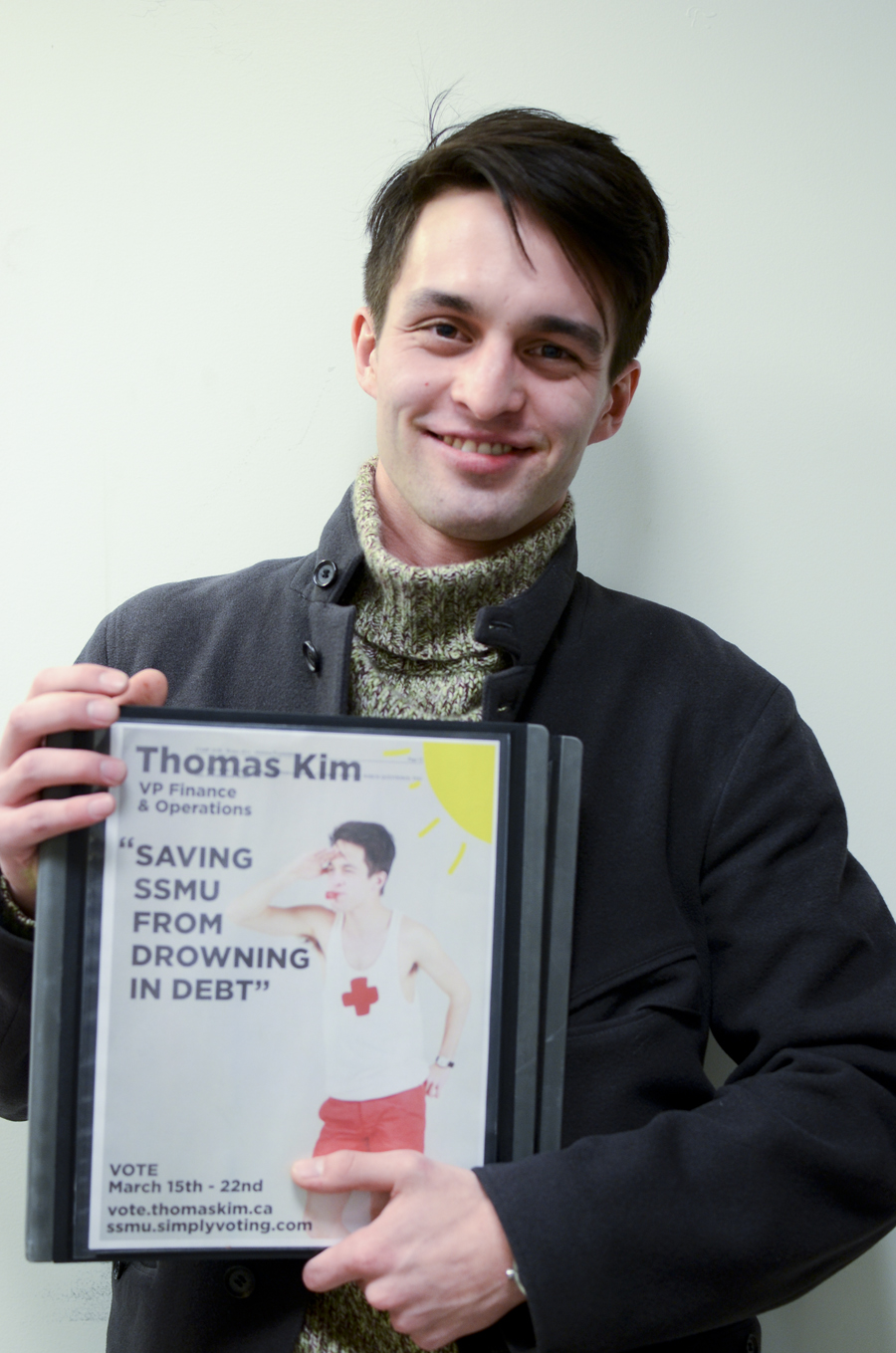
Thomas Kim (Sam Reynolds / McGill Tribune)
a, SSMU Elections 2013

Thomas Kim, candidate for VP Finance and Operations

McGill Tribune: What experience do you have that makes you apt for this position?

Thomas Kim: The brand managing position that I had at Fullum and Holt is quite relevant to the position. Beyond that, I did communications and PR for a legal clinic in Ontario. I was responsible for PR for the campaign, so contacting media, and media relations, and outreach. I was also responsible for soliciting corporate and individual sponsorship and donation for the clinic, and was successful in doing both. I also have experience in Montreal with event planning, and so part of that is coordinating things with other people, working around multiple peoples’ schedules, creating a budget, revising that budget to maximize profits… as well as promotion and PR, soliciting sponsorships again, checking out different venue spaces. So, I’ve had a lot of experience working with financial details but also working in outreach initiatives, and that’s what I’m really basing my platform on.

MT: Do you have concrete plans for a student-run café?
TK: Well, like I said [during last week’s] debates, it’s very difficult to have a tangible plan, given that there is still the lease negotiation going on…. However, I can say that after the lease negotiation is done, and we are aware of what the contract is and how much money SSMU is required to pay, the step would be to look at the five-year financial plan, and to see if the money allocated for the student-run café is still feasible to allocate. After you examine how much money can be allocated, then you need to take that money and create a budget. Once you have that budget, you take that budget and create a business plan. They have already set a menu—that was researched last year. This year, I hear that they’re in the process of researching equipment and details like tables and chairs. So, assuming that those two things are done, the next step would be the lease and the business plan.
MT: Beyond the student-run café, what specific plans do you have for next year that you’d like to input?
TK: Well, one of my [priorities] is long-term financial sustainability. And what I want to do with that is look into creating a committee to examine the possibility of SSMU opening an alumni relations office. And that office would be incorporated as a charity and a distinctive entity to that of SSMU, so that SSMU can then use that office to broaden its revenue input through soliciting individual donations, and being able to give those donors tax receipts—something that SSMU is unable to do given that they’re not a charity, they’re a non-profit. And being a charity and a non-profit are two distinctive things—a non-profit cannot issue a tax receipt for donations. So, that’s in the long-term plans.

One of the things that I also want to do is try to find someone who is willing to chair… a case competition for students to put forward ideas for student-run businesses in SSMU … and then SSMU can use that business to, again, outreach to the community and increase their operations, which hopefully would increase their revenue.

MT: How would you differentiate yourself from your opponent?
TK: I think that given my experience in the private sector and not-for-profit, especially with the legal clinic… perhaps I have a stronger legal background than he might. And I think that’s important, especially when considering SSMU is [not only] a corporation, but it’s a non-profit corporation, and there are a lot of rules regarding its non-profit status. So even though we have these great ideas, they’re not always necessarily financially feasible given the rules that govern non-profits.

MT: Last night, you talked a bit about visibility and engaging more with SSMU constituents. Out of the six executives, it might be easier for a position like VP Finance to stick within the office. What ideas do you have to make yourself a presence in the SSMU Building, and engaging with clubs and services and other students?
I want to hold weekly office hours in Gert’s. And the reason that I want to do that is … I find the process of speaking to the executives sometimes to be somewhat tedious … it’s a little bit intimidating and at the same time it makes [the executives] feel like they’re removed from campus when really, they’re working for you, or they’re working for us rather, and people can kind of forget that they are the stakeholders. So that’s something that I think would be new, and would be a little more engaging.

MT: What were you for Halloween?
TK: What was I for Halloween this year? I didn’t dress up because I was studying in the library that night, and I ended up going out later, like after I was, so I just said that I was a professor and dressed up really nerdy.

See TVM’s interview with Kim here.

Samuel Harris (Sam Reynolds / McGill Tribune)
a, SSMU Elections 2013

Samuel Harris, candidate for SSMU VP External

McGill Tribune: How does your experience qualify you for this position?

Samuel Harris: Well, I’ve been on the external affairs committee of SSMU all year. I’ve gone to TaCEQ meetings. I’ve also had extensive discussions with this year’s VP External, Robin Reid-Fraser. I feel as I have a very good knowledge of what the position entails. And also, I’m fluently bilingual, so I think that’s an important communication skill, especially for this position.


MT: Based on your interaction with Robin Reid-Fraser over the course of the year, what would you say is the most important part of the position?

SH: I think that that would be somebody who can bridge gaps, who can really connect the reality of McGill undergrads to the rest of Montreal and Quebec society. It’s a pretty broad thing, but I think that’s generally the most important thing.


MT: How do you think you’ll be able to ‘bridge the gaps?’

SH: I mentioned that I’m fully bilingual, which I think is a big help. I’m Montreal born and raised, so I think have a unique perspective. As somebody who has grown up here my whole life, I’ve been immersed in Quebec politics, society, et cetera. I’ve sort of been an outsider from McGill for most of my life, but now I attend McGill, so I’m an insider; I’m more involved with SSMU, so I feel like a have a good understanding of  [the issues] inside SSMU and outside SSMU.


MT: You are running unopposed for this position. Why should students vote for you anyway?

SH: Well, I think that I’m qualified, for the reasons that I’ve mentioned above. I decided months ago that I was running, so regardless of the fact that other people decided not to run or decided to run and then retracted their nomination, that has nothing to do with me. I think that regardless of me running unopposed, I have the qualifications.


MT: What’s your overall vision for the VP External portfolio?

SH: I see it as generally all relations external to McGill undergrads, more specifically what that means is relations with the government, with other universities, and even with the Montreal community and specifically, Milton-Parc. I think that on each of those levels, we want to strengthen and build on those relationships. One thing I haven’t mentioned so far is that I want to have discussion workshops with other Montreal universities, especially the francophone ones, but even Concordia. We’re very geographically close to them, and yet we don’t have [close relationships] … last spring we had different opinions, but why didn’t we ever sit down together to discuss them?


MT: If you had a superpower, which one would you have?

SH: Levitating—so that I could lie down anywhere with enough resistance that I could basically just sleep anywhere on air. (more…)

Stefan Wong (McGill Tribune)
a, SSMU Elections 2013

Stefan Fong, candidate for SSMU VP Clubs & Services

McGill Tribune: What experience do you have that has prepared you for this position?

Stefan Fong: When I joined McGill, I knew right away that I was going to be a part of a student group because that’s what I had done since high school and following on through CEGEP. I found The Musician’s Collective by pure chance and it so happened that that semester that I joined McGill, they were looking for four new executives. And so, I joined as a new executive and since then I’ve just been part of that student group at McGill. I’ve been president of The Musician’s Collective for a year now, and before then I was VP External and VP Finance. I’ve been juggling both roles, because they have never done finance before and I started doing that for them.


MT: What would you bring out of that experience to the portfolio?

SF: A great thing about my group is that it’s an over-arching network of musicians. And so, part of my job as [VP] External when I joined was communicating with other groups and because of that, I’ve gotten to know what other groups have to face. And especially this year because now we’ve got an office and we share the office and so I hear everyone’s grievances. I’ve gotten to know a lot of different clubs, even while campaigning, I get to talk with them and see what sort of issues they have been dealing with. My job was to talk to Carol [Fraser], who used to be the VP Clubs and Services, and also talk to Shyam [Patel], who used to be the VP Finance. This year, I’ve been working a lot with [current VP Clubs & Services] Alison because we just turned into a service—which is exciting. And so, interactions with SSMU have taught me what’s going on.


MT: So what would you change as VP Clubs & Services to address the issues you are familiar with, being a club executive?

SF: One of the things that I find unfortunate is the fact that there are three [Clubs and Services representatives to SSMU] … but as clubs, we were never told that these three students are there to help us and to represent us. So, when I joined The Musician’s Collective—[which] had become a new group the year before and had just been granted full status as a club—we didn’t know how to do many things. It’s a shame because clubs really do need to know that these people are there to help. I think that Alison gets overwhelmed by so many emails from clubs because, as soon as they have a problem, they think that Alison will be able to help them. And it’s true that it’s her job, but 300 clubs sending emails daily [is] a lot to go through. Some of that work could be shared with the C&S representatives so that everyone would be able to share their responsibility. In that sense, the C&S reps would better be able to represent students on council because they’d be more familiar with the issues that a lot of the clubs are facing.


MT: As VP Clubs & Services, you have so many different people to answer to—all the clubs, all the services, all the independent groups. How do you make yourself a presence for all of those different people? How do you make yourself accessible to all of those representative groups?

SF: I think it’s really important to make sure that people find you accessible and open. It’s important to reserve time for the clubs and I think that to have office hours outside the office is a good idea, and to hold them somewhere public where students can approach you with any issues. I think that if we were to do that, the clubs lounge would be an ideal place. And so I might definitely consider having my office hours in the clubs lounge so any club can come and see me at any time. Another thing that a lot of clubs have been telling me is that they send a lot of e-mails and they don’t always get a reply as soon as they’d like, so I think it’s important to touch base [with] clubs.


MT:  I know that creating budgets for clubs is a big problem, filing tax returns, getting audits and stuff like that. How would you work to address those issues specifically?

SF: Each club is like its own island, You have to be flexible and be able to deal with a range of issues. I know one other thing that Alison is working on this year is what is it called Clubpedia. It’s important to make sure that clubs have easy access to this kind of [financial and administrative] information and Clubpedia is a fantastic way of doing it by putting everything in one place. You can go on the website. You can fill out the form directly there. You don’t have to submit it in person.


MT: If you could have a superpower, what would it be?

SF: Oh my goodness, um, if I had a superpower…I think that it would be really cool to be able to control the elements. I think that would be pretty insane.

Click here to see the Tribune’s endorsements.

(Alexandra Allaire / McGill Tribune)
a, Sports

Playing on Sunday: Martlets claim consolation final

After cruising to an RSEQ championship and securing a berth in the CIS Final 8 for the second consecutive year, the McGill Martlets arrived in Regina, Saskatchewan looking to make some noise and win their first ever Bronze Baby trophy. Although the Martlets fell short of their title aspirations, they proceeded to notch a respectable fifth place finish amongst an extremely talented Final 8 after winning the consolation finals 71-50 over the Ottawa Gee-Gees.

The sixth-seeded Martlets kicked off the tournament Friday evening against the hometown favourite Regina Cougars in front of a raucous crowd. However, it was clear that the Regina’s home-court advantage was a non-factor for McGill, as they remained composed and stretched their lead to six points in the second quarter after a three-pointer by fourth-year guard Diana Ros. Ros was named McGill’s player of the game after compiling a team-high 13 points, five rebounds, and five assists. The Martlets entered halftime with a 28-23 lead.

The contest remained evenly matched in the third frame, with the two teams trading blows en route to a slight 40-39 Regina advantage. However, the fourth quarter was a different story for McGill. They had a few lapses on the defensive end, giving up rebounds and turning the ball over. The Cougars went on a furious 10-0 scoring run halfway through the final quarter to take a 59-48 lead with 2:55 to go. It was too late for the Martlets to mount a comeback, and the game ultimately ended in a 68-53 Regina victory.

The Cougars’ defensive tenacity was problematic for the Martlets all game, as McGill shot just 29.5 per cent from the field, and were dominated on the glass 46-25.

(Alexandra Allaire / McGill Tribune)

“We had a good start and over the first three quarters, we were basically executing our game plan,” Martlet Head Coach Ryan Thorne said. “Defensively, our help was there … but then they made some adjustments and we tried to adjust, but I don’t think we followed through on what needed to be done. … We just gave up too much in the fourth, defensively.”

The Martlets took to the court on Saturday to face the Fraser Valley Cascades and their star player Kayli Sartori in the consolation semi-finals. Following a pedestrian first quarter, McGill’s offence exploded in the second and third frames, outscoring Fraser Valley 46-24. Unlike the game against Regina, McGill shot 40 per cent from the field, and an impressive 81.5 per cent from the line, which was markedly different from their embarrassing 59.1 per cent free throw shooting the night before. The Cascades never recovered from the scoring onslaught, as the Martlets claimed the 70-52 victory.

McGill dominated thanks to great scoring balance led by veteran forward Anneth Him-Lazarenko and guard Francoise Charest, who both recorded 12 points in the contest. Standout rookie forward Mariam Sylla also tallied a double-double with 11 points and 13 rebounds. She was honoured in the pre-tournament awards ceremonies with the Kathy Shields Award for CIS Rookie-of-the-Year. She’s had a stellar debut year, and was ranked first in offensive rebounds and second in defensive rebounds across the CIS.

Despite the previous night’s loss against Regina, the Martlets never lost focus on their goal: to play on Sunday.

“The reality is that we told the team when we arrived that our goal was to be playing on Sunday, so we haven’t moved away from that,” Coach Thorne said. “There’s the consolation side and the championship side. Either way, when you come into this tournament, you want to be playing on Sunday.”

McGill tipped off against the Ottawa Gee-Gees on Sunday morning in the consolation finals. Early on, it was apparent that the Martlets would dominate the game, as they jumped out to a quick 8-0 lead. By the end of the first half, McGill’s second-year guard Gabriela Hebert had 12 points on 5-5 shooting to give the Martlets a 40-24 lead heading into the half. Hebert would end up recording 19 points on perfect shooting, going 7-7 from the field and 3-3 from three-point range. She was also awarded the Player of the Game.

“Gabriela is a [streak] shooter and you have to let her shoot until she cools off, but she just didn’t cool off today,” Thorne said.

(Alexandra Allaire / McGill Tribune)

Aside from a third quarter scare, McGill led after every quarter and ended up dispatching the Gee-Gees 71-50. Sylla was solid inside once again with 14 points and 8 rebounds in the winning effort, while Ros tallied six assists. The Martlets finished the weekend in fifth place with the victory.

The real winners of the weekend, however, was the University of Windsor, who took home the CIS championship after beating the favoured Cougars in the gold medal final. Saint Mary’s University won the bronze after beating the University of Calgary Dinos 83-73.

Sunday’s win marked the end of the university career of Him-Lazarenko, a five year team veteran. She recorded 1545 points and 858 rebounds over her career, and has her name cemented in McGill’s history books as the all-time leader in both categories.

The Martlets have a bright future ahead of them, with the majority of this year’s team returning for next season. The added playoff experience has been invaluable, and this year’s dominance once again puts them in prime position to be the RSEQ favourite for the 2013-2014 campaign.

Maurice Richard statue. (wikimedia.org)
a, Sports

Behind enemy lines

“Hey Boston Bruins, get out of the way!” yelled a gruff Quebecer, laughing at my dad posing in black and gold next to a statue of Maurice “The Rocket” Richard outside the Bell Centre. He had insisted we pose next to the Canadiens legend, which would not have been so bad if my mother knew how to work an iPhone camera. She finally got the picture she wanted, and I waved a hand in silent embarrassment at the now long queue of Montreal fans, waiting to get their picture taken with the statue. We walked toward the main gates to watch the Penguins-Habs game on Hockey Night in Canada.

Several months ago, when I knew my parents were going to be coming to Montreal for the first weekend of Reading Week, I offhandedly suggested to my dad that we try to get Habs tickets. Each year I’ve been at McGill, I’ve managed to go to one game. I had already seen the Canadiens beat Winnipeg earlier in the season, but knowing my dad’s affinity for hockey, and inability to resist the prospect of experiencing true Canadian culture, I thought I’d propose the idea. We looked at the schedule and saw that the Penguins were coming to town. The thought of seeing the greatest modern hockey player—Sidney Crosby—on my mom’s hometown team was enough to convince them both to purchase tickets. Through some glitch in Stub Hub’s system, we scored four tickets for the price of three, closer to the ice than the original seats we had tried to buy.

The Bell Centre was a sea of red, white, and blue with a surprising amount of black and gold peppered throughout. Enthusiastic staff members in yellow shirts greeted us with loud cheers as we took the escalator up to our seats. It turned out our “better seats” were only about ten rows from the nosebleed section in the Best Buy Family Zone. It didn’t matter; from that angle, we could see the whole rink.

After a long-winded intro, where every Habs player was given equal share of the highlight reel, came the performance of the American and Canadian national anthems. “The Star Spangled Banner” always causes my chest to swell with patriotic pride, but it doesn’t feel like a proper hockey game without a hearty rendition of “O Canada.” The performance was definitely less awkward than the last game I attended, when the Quebecois separatist next to me booed throughout the entire song.

The game turned out to be the highest-scoring game I’ve ever seen live. When the Habs scored, the stadium erupted; everyone jumped out of their chairs, high-fived, and cheered. When the Penguins scored, my mom was the only one in our section to let out a belated whoop and fist pump.

Going into the game, Crosby had tallied 31 points on the season, but the superstar was barely noticeable on the ice. Nonetheless, he seemed to always be in the right position and tallied two assists and a goal off a rebounded shot by Kris Letang. Ultimately, the Pens’ Brandon Sutter scored the overtime goal—his second of the night—to claim victory for the Pens, causing the Habs fans to silently file out of the stadium.

Walking out onto Avenue des Canadiens-de-Montréal, I heard a mixture of voices speaking in French and English, talking about the game. I smiled to myself, as we walked past the statue of Richard, feeling somewhat closer to the habitants of Montreal.

a, Sports

March Madness Preview

10 Tips to Making Sense of the Madness

Each year, pundits, die-hards, and average fans struggle to fill out their NCAA March Madness brackets. The tournament of 68 is always unpredictable  so here are 10 tips to  help you get through the fun, but stressful process:

1. When deciding whether or not to pick a team through to the next round, examine thier record closely: not just overall, but particularly in their last 10 games. Pay special attention to how they performed in their conference tournament, as a team that’s riding a wave of momentum may have the upper hand. In addition, remember that some conferences are better than others; 23-8 in the Big East is probably better than 26-7 in the Big South.

2. Don’t pick all the No.1 seeds to advance to the Final Four. It’s only happened once in the 75 years of the NCAA Tournament, and with the amount of parity this year, don’t count on the supposed heavyweights to all reach Atlanta.

3. It’s usually advisable to have a No. 1 seed win the entire tournament. However, this year is different. Nearly all the potential No. 1-3 seeds are fairly evenly-matched.

4. Even though Duke and Missouri both lost last year as No. 2 seeds in the first round, take this as a statistical anomaly. You should be able to slot your No. 1-3 seeds into the round of 32 without any qualms.

5. Choose one Mid-Major team to fall in love with and ride them to the Elite Eight. It’s generally better to avoid sending more than one through, as by the later stages of the tournament, the majority of Cinderella stories will have struck midnight.

6. Be on the lookout for experience-laden teams who return numerous key players from an NCAA tournament squad last year. This time of the year brings an enormous amount of pressure on the student athletes, and these teams will have the invaluable experience required to stay cool, calm, and collected in the most pressure-packed moments.

7. Long gone are the glory days of the giants who commanded non-stop attention in the paint. College basketball has become a guard’s game, and teams with two or more talented guards should be expected to have the ball-handling and shot-making required to make noise.

8. Choose at least one No. 5-12 first round upset. I don’t know what it is about this classic matchup, but every year it seems as though one No. 12 seed shocks their higher seeded opponent in the first round.

9. Try and see which teams have a regional advantage in the early round games. Higher seeds have the Selection Committee on their side when they end up playing games only a few hours from campus, but some lesser schools can get lucky. This makes a huge difference, as more of their fans will attend the games, lending the teams a home-courtesque advantage.

10. Choose teams whose head coaches have been proven winners in March and April. Candidates include Michigan State Head Coach Tom Izzo and Butler Head Coach Brad Stevens, who have each proven time and time again their ability to take less talented squads to the final two weekends.

Mayaz Alam


March Madness Spread

Midwest

Favourite – Louisville

Darkhorse – Saint Louis

Bracket Buster – Valpraiso

Overrated – Duke

West

Favourite – Ohio State

Darkhorse – Wisconsin

Bracket Buster – Belmont

Overrated – Gonzaga

South

Favourite – Kansas

Darkhorse – VCU

Bracket Buster – South Dakota St.

Overrated – Michigan

East

Favourite – Indiana

Darkhorse – Butler

Bracket Buster – Davidson

Overrated – Syracuse

Justin Marleau spoke for teaching union. (Elizabeth Flannery / McGill Tribune)
a, News

Arts forum addresses TA concerns about budget cuts

Students, union members, and administrators came together to discuss the Quebec government’s announced budget cuts at a student-led Faculty of Arts forum last Thursday. Topics covered during the forum included teaching assistants’ (TA) concerns with regards to the budget cuts, and the removal of 101 arts courses for the 2013-2014 academic year.

The forum, which took place in the Madeleine Parent Room in the Students’ Society of McGill University (SSMU) Building, featured several speakers, including Dean of Students Andre Costopoulos, Jaime MacLean, president of the Association of McGill University Support Employees (AMUSE), and Justin Marleau, chair of AGSEM—McGill’s teaching union which represents TAs employed at the university.

Marleau presented first, and explained to the 30 attendees that TAs have been facing financial difficulties since 2007. Marleau said that while the university’s operating budget increased by approximately $200 million between 2007 and 2012, TAs have actually seen a 0.04 per cent decline in the revenue allocated to them. He claimed the TA funding should have increased by two million dollars.

Marleau explained that this underfunding, coupled with increased undergraduate enrollment, has resulted in a decline in the number of hours that the average TA can offer to undergraduates. He expressed concern that the Parti Québécois’ budget cuts will only worsen TAs’ financial reality.

“What we’ve heard from the administration already [is] that they’re seeking across-the-board salary freezes,” Marleau said. “A teaching assistant with a full teaching load in one semester makes about $4500 for that course. That’s not a lot of money, especially when you have to pay tuition.”

MacLean also expressed concern that, as a result of the budget cuts, the McGill administration might ask AMUSE to delay pay increases promised in collective agreements, or that AMUSE members—many of whom are students working part-time—might be at a greater risk of losing their jobs with little notice, in comparison to other McGill employees.

Marleau offered several alternative ways in which the budget cuts could be made in the next few years without hurting TAs and other unionized employees, such as cutting the salaries of senior administrators, which Marleau believes would not directly impact the quality of education and research at the university.

Following Marleau’s presentation, Costopoulos pointed to the cuts to arts courses piloted by Dean of Arts Christopher Manfredi—undertaken to get rid of low-enrollment courses—which are hoped to address the ongoing pressures felt by TAs.

“[Having] fewer very small classes … [and reducing] the size of the largest classes by distributing the students more evenly in the classes … in a sense, results in more classes for which a TA is needed,” Costopoulos explained.

Associate Dean of Arts (Academic Administration and Oversight) Gillian Lane-Mercier, who was in the audience, reinforced Costopoulos’s statement, and confirmed that TAs will receive increased funding by September.

“[Dean Manfredi] … is very adamant about wanting to increase the TA budget by this process,” she said. “We now … have the actual statistics. There will be exactly 101 less courses on the 2013-2014 offerings, and the TA budget has been upped by 16 per cent.”

Mercedes Sharpe, vice-president internal of the Anthropology Students’ Association (ASA) and co-organizer of Thursday’s forum, asked Costopoulos whether student input would be considered in the re-organization of arts courses.

“[The] Curriculum Committee, [the] Committee on Student Affairs, [and] various working groups set up by [Dean Manfredi] … are [all] part of this planning exercise,” Costopoulos responded. “Students are represented on all those bodies.”

Costopoulos encouraged participants to use their voices in university and faculty governance, and to ensure that student seats on important committees are filled.

Following the  forum’s conclusion, several student participants said they were pleased by what was discussed at the event, and by what they learned from the afternoon’s discussions.

“I think it was good … to talk about how these cuts will affect labour on campus,” Sheehan Moore, vice-president publications of the ASA and co-organizer of the forum, said. “I think there is a tendency to talk about, ‘What is the student quality of life going to be?’ and … a tendency to forget that McGill employs thousands of people and that they are also [affected by the budget cuts].”

“Being able to understand the parallels between the uncertainties felt by upper administration, felt by the labourers, felt by students … to see how that’s impacting everyone, and being able to have very consistent dialogue about it, I think was very helpful,” Sharpe said.

Looking at the big picture, however, Moore said he believes there needs to be an overarching change in how consultation occurs at McGill.

“[Dean Costopoulos commented] about how … when people do talk, they are listened to. And I don’t think it’s that simple,” Moore said. “I think [that] if you have that many people saying that they don’t feel heard, then there is a culture of people—of employees and students and faculty—not being heard. And so … I would really like to see McGill making concerted efforts to change that, and not just say, ‘Look, we made a committee’ [to discuss the situation].”

a, News

Industrial relations program to be redesigned, “modernized”

McGill’s industrial relations program, which was in danger of being terminated earlier this semester, will face re-structuring that will allow the program to continue to exist within the Faculty of Arts.

The industrial relations program is an interdisciplinary program that allows students to study labour-management relations. The program includes courses in both the Faculties of Arts and Management, although  students are officially registered in the Faculty of Arts.

Lucyna Lach, associate dean of arts and professor in the School of Social Work, is working on the re-structuring process with Robert Hebdon, re-appointed chair of the Industrial Relations program and current associate dean and professor in the Faculty of Management.

Lach noted that this is a critical time to think about what the program should look like heading into the future, and how to make those changes. One of the reasons the program was at risk of being cancelled was due to agreement that what was being taught in the classroom was out of touch with the reality of the industry and the workforce.

According to Lach, changes to the program will take into consideration the drastic shift in issues faced in the workforce since the program was established in 1945.

Lach noted that in 1945, strikes were a common issue in the workforce, whereas now, issues revolve around different matters, such as gender.

“There’s a perception that the program has been around for a long time, [it] was designed in a different time, and that it would be really interesting to sit back and reflect on how to modernize it, if you will,” Lach said.

Hebdon agrees that the pro

gram needs to be updated to survive. Hebdon noted that many of the professors who taught and who currently teach in the program are of retirement age.

“A program can’t run on its own, it needs faculty to teach it and look after it, and there’s a sense now that many faculty that were committed to industrial relations have retired or are about to retire,” he said. “So [the program] definitely needs a remake. It’s now just a matter of setting up a process to make that happen in the most effective way.”

Hebdon noted that he would like to see the program maintain an interdisciplinary approach by continuing to integrate courses from different departments in the Faculties of Arts and Management.

“That’s how industrial relations started really—it was a commonality, an interdisciplinary approach to solving a workplace problem [such as] strikes,” he said. “Now I think the issues [are] different and they’re new, but I think there’s a similar kind of interest [in an interdisciplinary approach] that I see.”

Despite a current lack of faculty and advisors, student interest in the industrial relations program has been steadily increasing since 2003, according to Hebdon.

“When I started, enrollment was in the [mid-seventies],” Hebdon said. “It hovered around that for a few years, and … around 2003, it went down. It’s low point was 55 … but it’s almost doubled [since].”

The McGill Industrial Relations Association (MIRA), which represents the students enrolled in the program, expressed concerns to the Arts Undergraduate Society (AUS) about the possibility of the program’s discontinuation earlier this semester.

“We were just told by upper-level administration within [the program] that there was potential for the program to be cancelled,” MIRA President Benjamin Kershman said. “There were people that either didn’t want the responsibility that was attached to heading up the program before Hebdon received the head position, or it may have been something do with the fact that … big budget cuts [were announced], and this was one of the smaller programs.”

Kershman informed Justin Fletcher, vice-president internal of the AUS, that the program was at risk of termination. As a next step, Fletcher and Kershan submitted a motion to the Feb. 18 AUS General Assembly (GA). The motion intended to galvanize AUS support for maintaining the industrial relations program within the Faculty of Arts. It was passed by a consultative forum, as the GA failed to reach quorum.

“It’s important that the Faculty of Arts offer[s] a variety of programs,” Fletcher said. “Industrial relations has a lot of management, sociology, and economics [courses], and interdisciplinary studies are really important because you [acquire] skills… you get exposed to so many different areas.”

Even though the program is no longer facing the risk of discontinuation, discussions on changes are ongoing, and will include students, according to Hebdon.

“The [MIRA] know that they will have input on [redesigning the] program,” Hebdon said. “We plan on having students formally on the committee … student input is vital.”

Joyce Murray
a, News

Exclusive interview with: Liberal leadership candidate Joyce Murray

Joyce Murray has been considered a “dark horse” in the Liberal Party of Canada leadership race since the start of the campaign period on Nov. 14, 2012. She recently received a celebrity boost as a result of endorsements from Canadian environmentalist David Suzuki, and several advocacy groups, such as Avaaz and Leadnow.ca. 

One week before the final leadership debate, the Tribune spoke to Murray, a former Cabinet minister in the B.C. government, about her vision of a sustainable society, electoral cooperation, and what young Canadians want from their political representatives today.


McGill Tribune: In your platform, you propose that the Liberals form a one-time agreement with the NDP and the Green Party in order to defeat the Conservatives in the 2015 federal elections. Why do you think none of the other Liberal leadership candidates have proposed electoral cooperation?

Joyce Murray: I want to just connect the dots between that strategy and the purpose behind it, which is electoral reform. I strongly believe that our current first-past-the-post system is not only non-representative … [but it] is contributing to the polarized, divisive tone of working in Ottawa, which is counter-productive to addressing the conflicts [and] policy challenges of today. So, I believe we need … a more proportional representation-style system, but in order to do that, we have got to defeat Stephen Harper.… That’s what the one-time electoral cooperation is all about—it’s to avoid the vote splitting. And I was surprised that none of the other candidates support that. The majority of Liberals support that, according to a forum research poll on Feb. 6 … the majority of NDP supports it, and the majority of Greens support it.


MT: Justin Trudeau has been described as a candidate who appeals to younger voters. What are the defining parts of your platform that target youth and students, and that distinguish you from Trudeau?

JM: Many of the people that have signed up to support me are young Canadians, and they’ve signed up to support me for three separate reasons, I would conjecture. One is because young people have no patience for this divisive and negative posturing that goes on in Ottawa.… It turns them off and makes them apathetic, and they’re hungry for a change in our system, where [Members of Parliament] and parties work more collaboratively together. So … the whole cooperation strategy and electoral reform strategy has attracted tens of thousands of young people to my campaign. Secondly, is … my vision of a sustainable society. I think young people … become apathetic when they see representatives make short-term decisions … that don’t contribute to the long-term well being of our society and our country. So, I think they’re looking for a more integrated vision with policies that would move us forward in that direction of a sustainable society.… Some [young people] will of course gravitate towards Justin Trudeau. I’m not going to pretend that he doesn’t have a celebrity status—that’s very appealing. At the same time … people want to make sure that whoever becomes the leader of the party actually has a track record of delivering on leadership. And I have that. People know that [I have] a track record of tough decisions, of strategic decisions, of facing difficult situations and solving them successfully—both in the private sector and in government. So … my experience demonstrates that I’m the right person to lead the [Liberal Party].


MT: What is your reaction to Mark Garneau’s recent withdrawal from the leadership race? How does this change the nature of the race?

JM: Well, first I was surprised, and then disappointed. Because, we’re in a race to win, but we’re also in the race to bring forward ideas, to invigorate the Liberal Party through reaching out to Liberals and supporters, and I think … there was a lot that Marc could contribute over the coming months, even though he had reached a conclusion that there was no pathway to success for him. How will that change the race? I think a lot of the people that were supporting Marc were people that were looking for experience, leadership and substantive policy, and that’s exactly what I’m offering. So, I’m optimistic that many of them will take a look at me and put their support behind me.


MT: Your platform focuses heavily on sustainability, ranging from climate change policy, to food security, to digital access. Why do you think there’s been resistance to “sustainable” policy-making in the past? Do you see this changing in the next decade?

JM: Perhaps Canadians were not as aware of some of the risks of inaction [around environmental issues], and some of the economic costs of inaction. And … from a climate change perspective, [it] certainly has become more and more clear to … the public that there’s major costs and risks [to] human well being … The other side of it is that the opportunities of stimulating innovation and solutions to reducing our footprint will be lost if green investment passes Canada by … and there’s uncertainty, because we have a federal government that hasn’t made [environmental policy] a priority. So, I do see it changing. I think that Canadians are … starting to see the whole picture together: a focus on long-term, environmental sustainability is crucial for our economic and social sustainability as well.


—This interview was edited and condensed by Bea Britneff

a, News

Concordia’s full-time faculty union ready to strike

In the midst of difficult and on-going negotiations with the administration, the Concordia University Faculty Association (CUFA)—the union that represents all full-time faculty members at Concordia, including professors and librarians—voted 74 per cent in favour of a strike mandate on Mar. 9. The mandate allows CUFA to go on strike with 48-hours notice.

CUFA has been negotiating its collective agreement with Concordia for the past 15 months. The vote for a strike mandate is the furthest CUFA has ever gone towards a strike while negotiating their collective agreement with the university.

CUFA President Lucie Lequin  expressed frustration over the progress of the negotiations and said that the union will evaluate whether or not it will go on strike following meetings this week.

“It takes two to tango,” Lequin said. “In a way, we are not deciding when the strike will take place. In a way, the administration is deciding that.”

Lequin noted that if the Concordia administration makes no concessions this week, a strike would become an appealing option for the union. The union’s actions depend on how the administration handles their demands on non-monetary issues and monetary issues alike, according to Lequin.

One of the non-financial issues the union is most concerned about is the workload of people hired by Concordia on “extended-term” and “limited-term” contracts. These are non-permanent faculty members most of whom have three-year contracts and teach courses at the university. CUFA wants the university to reconsider how many courses these workers have to teach in a year.

“Some teach seven courses in a year, and we feel that is too much if they are different courses,” Lequin said. “We would like to do something for them, so they can have a fair workload.”

Lequin noted that Concordia has offered no compromise on that issue.

Another non-monetary aspect involved in the negotiations over the collective agreement deals with the autonomy of Concordia librarians, Lequin explained. Librarians are contractually obligated to complete research while also performing their library duties. However, CUFA wants librarians to have more decision-making power over what hours  they conduct their research.

CUFA is also asking for a 2.2 per cent salary increase each year for five years, which is how long the collective agreement would last.

“We are not expecting our way on all these issues,” Lequin said. “Of course, we are willing to move, but [the administration] also [has] to be willing to move. It’s a give and take [situation].”

Chris Mota, director of media relations at Concordia, said that the administration cannot say much while the negotiations are still ongoing. She noted that a government conciliator was brought into the negotiations in December. She also said that the administration made its latest offer to CUFA on Mar. 1.

“Concordia deposited a global offer of settlement for the renewal of the collective agreement with the Concordia University Faculty Association [CUFA],” Mota said.

Lequin said that she has not seen any tensions arising on campus between professors and students as a result of the vote.

Concordia Students’ Union (CSU) Vice-President External Simon-Pierre Lauzon said the only informaiton he had is that a potential strike would not affect students, referring to a letter CSU received from  the CUFA executive.

“Our students are our #1 commitment and we will do everything we can to avoid disrupting classes and delaying the submission of grades,” the letter reads.

“Unfortunately, given the bullying tactics of the Employer at the bargaining table and Concordia’s poor history of labour relations in general, we may have no choice but to resort to job action,” the letter continues. “We sincerely hope this does not come to pass but it a possibility.”

Lauzon said the CSU plans to meet with Lequin but this meeting has not yet occurred.


Read the latest issue

Read the latest issue