


Latest News

Campus Spotlight, Student Life

McGill’s Indigenous Awareness Weeks return virtually

Song and dance filled McGill’s Lower Field again on Sept. 18, as the First Peoples’ House’s (FPH) Virtual Pow Wow launched the university’s 10th Annual Indigenous Awareness Weeks (IAW), focussed on showcasing Indigenous cultures and traditional perspectives on wellness. Every September since 2001, Indigenous community members across Canada have united at McGill to contribute to the Pow Wow ritual. Previously two weeks long, the events of IAW 2020 were shortened to take place over the span of under a week to adapt to the virtual limitations. 

Most people watched the Pow Wow live from FPH’s social media accounts, while others gathered at a safe distance from one another around the performance on Lower Field and donned masks. The Red Tail Spirit Singers drum group accompanied dancers of all generations, including Don Barnaby, Marian Snow, and Ray Deer and his family. Basked in sunlight, Barnaby addressed the audience. 

“It was supposed to rain, but the Creators said, ‘You know what, they need to go out and put some medicine out there, so I’m not going to literally rain on their parade,’” Barnaby said.

Behind the dancers, the Hiawatha Wampum Belt flag was raised on the McCall-MacBain Arts Building to recognize the land that McGill occupies as the traditional territory of the Haudenosaunee and Anishinabeg nations. The flag emphasized the university’s growing, but still limited, space for Indigenous expressions. 

In his virtual welcome to the Pow Wow, Christopher Manfredi, McGill’s Provost and Vice-Principal (Academic), spoke on the importance of celebrating Indigenous cultures. 

“While [this] cluster of events each September is an important opportunity to welcome Indigenous community members to our university to share in celebration and to raise awareness of Indigenous teachings, cultures, and customs, we are also working hard at ensuring that Indigenous experiences, forms of knowledge, and ways of teaching are integral to the academic fabric of the university,” Manfredi said. 

The final event of this year’s IAW was a virtual discussion on Sept. 24 featuring Healers Geraldine and Mike Standup. The presenters shared their traditional knowledge on the connection between mind and body, highlighting how this bond can improve overall well-being. With the year’s many uncertainties, this wisdom comes at a time when achieving inner reflection and peace is crucial but difficult. 

The team at the FPH have worked to facilitate the expression of distinctly interactive Indigenous cultures through the limitations of a screen. Terry David Young, McGill’s Indigenous Student Advisor, recognizes both the constraints and opportunities created by this new online reality and describes the connection created by face-to-face and hand-to-hand exchanges that is integral to Indigenous culture.

“For Indigenous peoples, there’s always a component of social interaction that’s a part of our cultures,” Young said. “[It’s] a very interactive, hands-on experience [of] dancing, singing, and creating.” 

The loss of these tangible, mutual forms of connection is especially difficult for new Indigenous students at McGill. In previous years, the Pow Wow provided a celebratory space for Indigenous students to feel recognized and welcomed. With this event shifted to an impersonal cyberspace, Young mourns the inability to meet new and returning students face-to-face. 

Despite their constraints, however, virtual platforms have allowed the FPH to engage with and learn from people they would not have been able to before. 

“We’ve accessed Elders from across the country,” Young said. “Adapting online has both widened and limited our reach.”

The image of community may look different for the FPH this year—a grid of faces on Zoom, a sparse Lower Field once crowded with students now dispersed across the country—but moving forward, their team plans to continue expanding the potential of virtual methods to express Indigeneity and nurture friendships among community members. 

“I look forward to next year,” Brady said in his welcome to the live Pow Wow. “Hopefully things will be better, things will be changed, and there’ll be more people because we dance with the people.” 

Students can keep updated on FPH’s events and programs through their social media or website.
 

Campus Spotlight, Student Life

Campus Spotlight: #TakeJamesDown

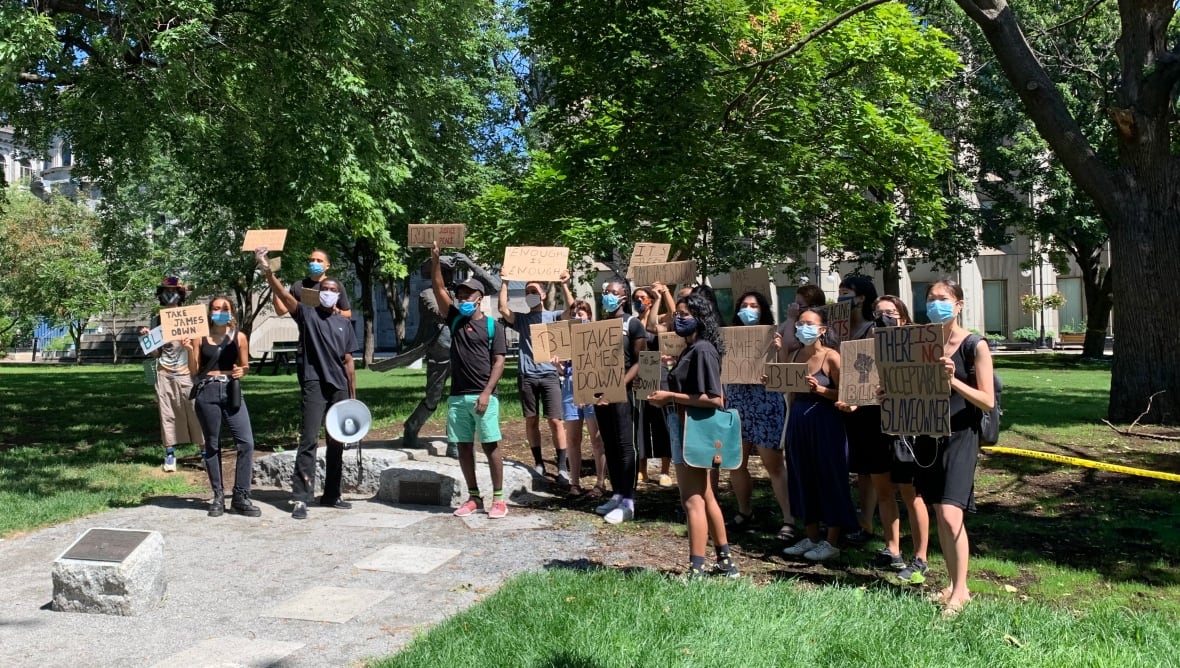
Anti-Black racism at McGill is institutionalized, and the work of Black student activists is vital in demanding systemic changes on campus. A summer of Black Lives Matter protests sparked by the continued police brutality and murders of Black people have brought increased visibility to Black activism around the globe, including at McGill. The Take James Down movement, along with the continued efforts of McGill’s Black Students’ Network (BSN), is pressuring the university’s administration to reconsider their flimsy commitment to racial justice, specifically in addressing anti-Black racism. 

The Take James McGill Down movement was co-organized by Mohammed Odusanya, Sarah Ragab, and Ayo Ogunremi, alongside other volunteers. The movement’s letter to McGill’s Board of Governors, entitled “Enough is Enough,” outlines McGill’s failures to adequately serve its Black community, highlights the university’s negligence towards funding a proper Black or Africana Studies program and condemns the administration’s continued refusal to critically examine James McGill’s history of enslaving Black and Indigenous peoples. Further, McGill has continued to celebrate James McGill’s legacy without acknowledging the enslaved and oppressed people whose land and labour were essential to the founding of the university. 

Among the movement’s demands is the removal of the statue of James McGill near the Roddick gates, and that the administration properly address its namesakes’ history. McGill enslaved at least five people and voted against the abolition of slavery.

Odusanya called on the McGill administration to increase representation of Black people in McGill’s faculties, and make meaningful amends for its role in upholding racist practices. 

“#TakeJamesDown [is] calling for McGill University to meaningfully respond and recognize its role in perpetuating anti-Blackness and excluding Black students, staff and faculty from leadership roles in this university,” Odusanya wrote in an email to The McGill Tribune. “The statue is a symbol of the university’s valorization of certain people and histories at the expense [of] Black people.” 

Despite the movements’ efforts and public support, Odusanya believes that the administration has been passive.

“In response to a CBC Montreal interview we did in August, McGill said they would not be removing the statue, amongst other things,” Odysanya wrote.  

The administration’s refusal to remove the statue sends a conflicting message: Despite championing a commitment to equity, they have ignored clear statements from their Black student population on how to be more equitable. 

BSN has been involved in the oversight of the Take James Down movement and organized the Aug. 1 protest for the removal of the statue. Currently, they are focussed on reiterating the demands expressed in the Take James Down open letter to the administration. Iyanu Soyege, BSN Vice-President Political, emphasized the importance of recognizing the university’s colonial past. 

“We have come to a moment in time where it is imperative to question the symbols that are upheld and what they mean to marginalized ethnic and racial groups at McGill and in the larger Canadian society,” Soyege wrote in an email to The McGill Tribune.

Founded in 1970, the BSN provides valuable resources and platforms for McGill’s Black communities. For decades, their advocacy work has gone largely unaddressed by the administration. This failure to respond to its Black students’ needs has highlighted the McGill administration’s disinterest in dismantling institutional racism within the university. 

“The BSN has been advocating for different things such as the increased recruitment of Black students from Montreal, the creation of a Black Studies [or] Africana Studies department and increased Black faculty [members] at McGill,” Soyege wrote. “Most of these demands are not new.  Considering that most of these demands have not been fulfilled, it is reasonable to surmise that the administration has historically failed to take the BSN’s requests seriously.” 

Students can support the movement by signing TJD’s letter through this form

Divest McGill Illustration
McGill, News

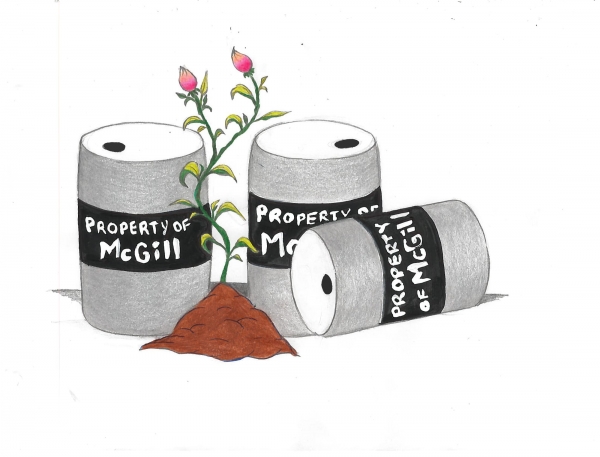
PGSS panel argues for a fossil-free future for McGill

On Sept. 23, the Post Graduate Students’ Society (PGSS) and their Environment Committee hosted an online discussion and panel titled “Divestment from Fossil Fuels at McGill.” The panel presented arguments in favour of McGill divesting from fossil fuels, examined what divestment might look like, and delved into the broader implications of divestment.

The three panelists at the event were Dr. Greg Mikkelson, a former professor at McGill who resigned in Jan. 2020 in response to the administration’s refusal to divest from fossil fuels, as well as Dr. Jen Gobby from Climate Justice Montreal, and Talia Martz-Oberlander of Divest McGill.

Martz-Oberlander, a graduate student in experimental physics, presented on behalf of Divest McGill. The organization was founded in 2012 and is composed of students, faculty, and staff at McGill who are calling for the university to withdraw their financial investments in fossil fuel corporations. Martz-Oberlander described Divest McGill’s goals and demands to the audience of 25 individuals. 

“Divest McGill is solidarity-minded, aiming to support Indigenous land defenders,” Martz-Oberlander said. “[We want McGill to] withdraw direct holdings from the top 200 fossil fuel companies, as ranked by reserves of oil, coal, and natural gas. [We call for] immediate divestment from direct holdings in TC Energy, in solidarity with Wet’suwet’en peoples.”

Martz-Oberlander continued to highlight the impacts of McGill’s financial investments in the fossil fuel industry on its community. 

“It’s not just that we have money invested,” Martz-Oberlander said. “This is someone’s home, this is someone’s access to their culture and their people, [threatened by companies] that we’re directly investing in.”

The panellists also criticized McGill’s decision to pursue “decarbonization” rather than divest from fossil fuels completely. 

“The problem with decarbonization is that it directly supports the fossil fuel industry in shirking its responsibilities for climate change and the damage that they’re wreaking with the harms of its products and operations,” Martz-Oberlander said. “Suncor […] is invested at the most primary level in having fossil fuels be burnt, but under ‘decarbonization,’ McGill is still allowed to invest in them.”

Gobby spoke on behalf of Climate Justice Montreal (CJM), a grass-roots organization founded in 2009. CJM pursues climate justice and stands in solidarity with Indigenous communities through direct action and education. Gobby reiterated the importance of committing to taking meaningful action against climate change.

“Divestment is absolutely necessary at this scale and in these institutions if we are going to address climate change in any meaningful way,” Gobby said. “The kind of change necessary is unprecedented.”

Gobby also challenged the notion that investment is a passive enterprise, arguing that through decarbonization, McGill fails to adequately address the environmental impacts of the fossil fuel industry. 

“What [the administration is] doing is making this statement that being invested in an industry that is killing people and putting the future of their students at risk [is] natural and inevitable, instead of seeing it as a social construct meant to benefit the ruling class,” Gobby said.

Along with Martz-Oberlander and Gobby, Mikkelson condemned McGill’s inaction, emphasizing that the administration has failed to fulfill their moral obligations.

“What should make all universities divest are […] moral, political, and financial arguments,” Mikkelson said. “It’s just deeply morally repugnant, morally outrageous, and morally unacceptable to claim credit for trying to reduce your own fossil fuel consumption, but at the same time bank on or otherwise promote the expansion of fossil fuel production.” 

Speaking to the importance of immediate action, Mikkelson drew attention to the fact that climate change is already well under way. 

“It’s happening, we’re in the thick of it,” Mikkelson  said. “It’s only going to get worse unless we deeply transform what we’re doing, and deeply transform our society.”

Addressing the concept of decarbonization that Martz-Oberlander brought up earlier in the event,  Mikkelson shared his thoughts on McGill’s decarbonization efforts.

“I think there’s nothing wrong with decarbonization, I just don’t think that what McGill is doing [is enough],”  Mikkelson said. “Because, as [Martz-Oberlander] pointed out, according to the definition [of decarbonization] that McGill is using, they are only counting the greenhouse gas emissions created by a company in producing their product. But they are completely letting companies off the hook for what happens to their product afterwards.”

News, SSMU

SSMU’s legislative council passes motion on communication practices

The Students’ Society of McGill University (SSMU) held their second legislative council meeting of the Fall 2020 semester on Sept. 24. With the online semester in full swing and COVID-19 safety measures continuing to affect in-person meetings, SSMU met via Zoom to debate and vote on the approval of five new motions. Despite a few technical difficulties at the start of the session, the council was able to proceed with the evening’s agenda smoothly.

The Motion Regarding Equitable Communication Practices was the only motion debated at length during the meeting. Brought forward by Vice-President (VP) University Affairs Brooklyn Frizzle, this amendment seeks to revise SSMU’s Equity Policy to ensure accessibility in SSMU’s communication practices.

“This motion is arising from some concerns that were raised over the past few years regarding the reoccurrence of tone policing and general inaccessibility in SSMU politics,” Frizzle said. “Since 2016, there have been repeated articles in the Tribune and the Daily citing concerns [in] emails from female SSMU representatives concerning the pattern of tone policing.”

The amendment to the Equity Policy would add a clause to protect individuals’ ability to express themselves using their preferred word choice and tone, so long as it does not violate SSMU’s Equity Policy, which prohibits hate speech, harassment, discrimination, and abusive language. The motion was approved, with 15 SSMU representatives voting in favor of the amendment.

“I think it’s a great initiative put forward by the VP University Affairs,” Arts Senator Darshan Daryanani said. “[Student politics] has in the past been very inaccessible for BIPOC and other marginalized communities. I think it is the council’s responsibility to ensure that we are able to provide a safe space in the right manner, while still upholding SSMU’s values and ensuring freedom of expression.”

The meeting came to a close with councillors from five faculties summarizing the work of their respective representative bodies. SSMU President Jemark Earle, along with other SSMU executive team members, presented their reports to the council to highlight their achievements from this year so far.

Moment of the meeting:

As SSMU continues to adapt to the virtual meeting format, Speaker of the Council Lauren Hill reminded councillors to refrain from using the chat as a means of communication during the meeting due to its informal nature. Councillor Daryanani engaged in “virtual cross-talk” during the council’s Approval of Minutes, leading to the subsequent disabling of the chat by Speaker Hill to avoid future disruptions. 

Soundbite:

“I appreciate the background of [the Motion Regarding Equitable Communication Practice], particularly when it comes to contextualizing the public side of SSMU [….] I am concerned […] about the context in which profanity is used and perhaps a greater need for precision in delineating where profanity is actually appropriate, […] where it can actually be used to further silence other members. I myself have been in many workspaces where I have seen male co-workers target profanity in rather disturbing ways at femme-presenting co-workers of mine, and it’s important to me that we bear in mind the contexts in which we approve of or disapprove of the use of profanity.” – Jake Reed, Engineering Representative to SSMU

McGill, News

Academic panel presents perspectives on environmental racism in Canada

While recent demonstrations such as BLM marches, the Scholar Strike, and environmental protection protests call for a racial reckoning, many scholars have been prompted to explore the link between environmental degradation and racial injustice. On Sept. 24, McGill’s Research and Sustainability Network (RSN) hosted a panel of academics to discuss environmental racism in Canada. 

The panel, titled, “An Academic Perspective on Environmental Racism in Canada” featured Dr. Ingrid Waldon, an associate professor at Dalhousie University; Dr. Dayna Scott, an associate professor at York University; Dr. Deborah McGregor, also an associate professor at York University; and Larissa Parker, L3 Law.

The panel opened with the speakers outlining various research strategies that are currently used to examine instances of environmental racism in Canada. Deborah McGregor, Canada Research Chair in Indigenous Environmental Justice, explained the importance of using multidisciplinary research approaches.

“We need interdisciplinarity,” McGregor said. “When [we]’re trying to respond to the real world and the real things that are happening, they are not nicely disciplined in the way that academia is set up. We have to respond in these different ways, at different scales, to different people.”

Waldon, who researches the ongoing environmental racism patterns affecting the Mi’kmaq and Black communities in Nova Scotia, pointed out the importance of distinguishing between environmental justice and environmental racism.

“While [conducting] my research, I noticed that there was a preference [for] the words environmental justice and a hesitance to name race,” Waldon said. “It made people uncomfortable. Justice is what we need to get to […], but we also have to look at the illness. To me, environmental justice is the medication. If Indigenous communities across Canada and Black communities are disproportionately impacted, then race must have something to do with it. You’ve got to centre the idea of race because then it makes people more aware of the problem.”

The panellists also highlighted the current systemic structures that perpetuate environmental racism.

Parker drew upon her experience as a law student and environmental activist to describe her experience with racism embedded in the Canadian legal system.

“It’s a mix of power and privilege,” Parker said. “The legal system is built on who holds privilege. These things dictate where polluting activities will be placed. You see these privileges, not only in our legal system but in all of our institutions.”

Scott, Canada Research Chair in environmental law and justice in the green economy, emphasized the importance of recognizing the current policies that uphold racist outcomes.

“When I think about the air pollution regime, it’s not like you could read Ontario’s Environmental Protection Act and racist doctrine is going to spring off the page,” Scott said. “You have to understand how that regime works in practice and see where environmental disparities are falling in practice. Understanding structural racism is recognizing that the current structure produces racist outcomes.”

Waldon stressed both the crucial role of polices, and the current institutions that fail to acknowledge environmental racism.

“How can the environment be racist? It’s policy that can be racist,” Waldon said. “It’s an environmental assessment that doesn’t take into account issues impacting these communities that can be racist. Policy comes out of ideology, and there [is] a lack of understanding of how racism was embedded [by racist ideologies].”

At the end of the discussion, the panellists made a statement regarding transformative change and the role of community groups and grassroots movements in demanding environmental justice.

“Relying on the government to address environmental racism is problematic because it is not truly transformative,” Waldon said. “[Structural inequality] is about profit, and you can’t fully rely on those who are benefiting off the current system to make transformative change. You need both legislative action and demand from the streets.”

Soccer, Sports

Larger rosters and greater physical demands are reinventing football in Europe

The past decade has seen a dramatic transition in the English Premier League and European Football in general. The worldwide popularity of the game has made football clubs, especially those at the top, wealthier. For example, the operating revenue for Manchester United FC has increased from 518 million euros in the 2014-2015 season to 711 million euros in the 2018-2019 season. The desire to win prestigious titles like the Premier League and Champions League has led clubs and leagues to make significant investments and changes in selecting players and hiring managers.

The plethora of cup and league titles to compete for has prompted clubs to expand their rosters. Chelsea FC, one of the most prominent English clubs, currently has 29 players on their squad for the 2020-2021 season. In a recent interview with Chelsea TV, club manager Frank Lampard highlighted the importance of a larger squad. 

“It’s always a tough element of the job at this moment at this level, because we need a big squad because we are going to be competing on so many levels, and players want to play week in, week out,” Lampard said. “I need those options. It’s a long season and we need different ways of breaking down teams.” 

While more competitions present more opportunities to play, they also come with more opportunities for injury. Larger squads are necessary to allow for more options while competing  and to give players the chance to recover. Current Premier League champions Liverpool FC has a squad of 35 players for the 2020-2021 season.

Another recent trend, hiring young ex-players to fill management positions, is also popular with several top clubs in European leagues. Examples include Zinedine Zidane for Real Madrid, Frank Lampard for Chelsea, Ole Gunnar Solskjær for Manchester United, and Mikel Arteta for Arsenal. Owners of top clubs are putting more faith in players-turned-managers than the conventional choices available to them. Recent ex-players are more in tune with the demands of the contemporary game and can understand players better, allowing them to lead their teams to perform at the highest level possible.

European football has also become more physical over time, as managers expect higher levels of fitness from players. Cesc Fabregas, an extremely technically gifted player, reflected on the preference given by managers to physically strong and agile players over technically gifted ones in an interview with BBC Sounds

“When Antonio Conte [manager] first came to Chelsea, I didn’t really play the first three months,” Fabregas said. “He made it clear that he wanted another type of midfielder, [someone] strong and physical. They signed another player [and] I didn’t play the whole season. I had an injury as well and didn’t really feature at all. ” 

A large squad for teams can lead to more interesting formations in different competitions. Managers who were once players can be more empathetic towards current players about the challenges of the modern game. A more physical game can make the already existing rivalries between clubs more riveting. This transition in European football will hopefully lead to a more exciting future for the world’s most popular game. 

Hockey, Sports

Highlights from the NHL Bubble

As the 2019-2020 NHL season comes to a close, it is worth reflecting on lessons from a playoff season that will surely be remembered for years to come. 

Other professional sports leagues, such as the MLB, demonstrated that without a “bubble” to compete in, professional sports seasons would never last in the COVID-19 era. However, the process of creating a bubble is much more difficult than it may seem on the surface. Organizing 12 teams to play on one rink without coming into contact with each other off the ice takes rigorous planning and adaptability. To minimize travel and the risk of contracting COVID-19, the NHL playoffs were constrained to two hub cities: Edmonton and Toronto. Locker rooms and team benches were thoroughly sanitized between games to prevent transmission from team to team. Extraordinary circumstances require out-of-the-box thinking. 

While the situation may not have been ideal, with many players away from their families and no in-person game attendance, players were excited for the opportunity to play again—and the fans were even more excited to watch. In an attempt to energize the silent, empty arenas, broadcast teams used fake noises to simulate the presence of fans. To keep the mood upbeat, the NHL also put electric fans in some of the seats as a joke. When Connor McDavid scored a hat-trick in Game 2 of qualifiers against the Chicago Blackhawks, the league had staff threw hats on the ice to compensate for the missing fans. Despite this, some critics were concerned about the effect that the absence of fans would have on the energy in the arena and the players’ performances. While there was a noticeable lack of fans and crowd energy, it only minimally affected players’ intensity and focus. With the help of some upbeat music, encouragement from teammates on the bench, and the allure of the Stanley Cup, players brought high caliber competitive play every night. Each game, whether it was a blowout or a five-overtime thriller, was exciting to watch.

The lack of a crowd did not stop each player and team from playing the kind of hockey that kept fans on the edge of their couches. Facing elimination, the Toronto Maple Leafs were down 3-0 to the Columbus Blue Jackets in game four of the series. With just 23 seconds left, they tied the game, forcing an overtime that kept them in the playoffs. 

In the Stanley Cup Finals, the Dallas Stars, also facing elimination, came into game five determined not to go home that night. After a gruelling game and two overtime periods, the Stars won the game, avoiding elimination and keeping their Stanley Cup dreams alive. 

As for how the next season will proceed, there are still many unknowns. The bubble playoffs were successful because travel was unnecessary and teams were isolated from the public. Having teams go back to their home cities and forcing travel across the continent for games could lead to major issues regarding player and staff health. The NHL pulled off the 2020 playoffs; now, the challenge will be safely bringing the sport back outside of bubble cities.

Creative, Podcasts

What’s open at McGill? (Podcast)

Features

My big, fat online identity crisis

I was 11 years old when I created my Facebook account. That was over 10 years ago,  and since then, I have been broadcasting a highlight reel of my life for the world to see. Undoubtedly, beginning the moment that I clicked the green ‘Sign Up’ button, being constantly plugged into social media for nearly half my life has shaped who I am today. Social mediaand its influences on mehave evolved through time and place, manifesting on new platforms, but have remained a constant presence. My time and attention was, and still is, a product being sold to the companies behind advertisements on these platforms. The more user data that the algorithms of these sites collect, the more revenue they can generate by accurately predicting what content will keep users engaged. My social media use has become a habit, a natural part of everyday life, and I barely remember a time without it.

Research Briefs, Science & Technology

A new approach to addressing urban homelessness

The homelessness epidemic continues to affect over 235,000 Canadians each year, most of them in major cities. Despite some efforts from municipal governments and charitable organizations to address the staggering number of unhoused Canadians, this figure has continued to rise annually since the late 1980s. However, a new study published by researchers in McGill’s Department of Psychiatry showed that an unconventional, cost-effective strategy could help overcome a number of persistent roadblocks in finding long-term housing for individuals.

The study evaluated the cost-effectiveness of the “Housing First” strategy, which consists of finding permanent housing for individuals in addition to providing a rent supplement, prior to addressing other concerns such as physical and mental health problems. McGill researchers sought to test this novel strategy alongside existing programs, such as Assertive Community Treatment (ACT), and compare their outcomes with these conventional methods.

“The aim […] was basically to find out to what extent did delivering ‘Housing First’ services reduce the use of other services,” Dr. Eric Latimer, a professor in the Department of Psychiatry at McGill, said in a phone interview with The McGill Tribune.

This study was part of a larger ongoing research project, At Home/Chez Soi that aims to provide practical, meaningful support to Canadians experiencing homelessness and mental health problems. The four-year national research project found that the “Housing First” approach was more conducive to helping unhoused individuals secure long-term housing in comparison to more conventional housing and support services. 

“You help the person get an apartment and you keep on supporting them for as long as necessary so that their lives move forward,” Latimer said.

From Latimer’s perspective, providing ongoing support for unhoused Canadians sets the “Housing First” model apart from prior initiatives. 

“[The goal is] to really be there for them, to help them not only get an apartment initially, but to remain housed, and furthermore […] to progress in their lives and move ahead with goals that are meaningful for them,” Latimer said.

This continuous support strategy can be realized with the aid of an Intensive Case Management (ICM) team for people with moderate needs who encounter fewer barriers to rehabilitation. Individuals needing more intensive assistance can follow ACT plans. ACT teams, which are more specialized, cost significantly more than ICM.

Latimer and his colleagues showed that investing in a “Housing First” approach is cost-effective, particularly when assisting high-need individuals experiencing acute mental illness. This strategy reduces the cost of interventions and decreases reliance on more costly public services like emergency shelters.

Unfortunately, despite the clear advantages of implementing the “Housing First” strategy along with existing ACT teams, many cities and provinces are reluctant to adopt the model.

“When the government decided to fund these ‘Housing First’ services, they were only willing to fund it for moderate-needs individuals,” Latimer said. “ACT teams fall too clearly [within] provincial jurisdiction.”

Though the federal government has left it up to individual provinces to fund the new strategy, it has provided little to no financial incentive for municipalities to do so. According to Latimer, cities and provinces often fail to provide adequate services and funds for high-needs individuals. 

“In Montreal, only one team serves people who would be considered high-need [under] the ‘Housing First’ [strategy], but it does so without rent supplements and in a time-limited way, so it is not ideal,”  Latimer said.

The results of the At Home/Chez Soi research project could inject new vigor into the nationwide campaign to end homelessness in Canadian cities.

Read the latest issue

Read the latest issue