

Latest News

McGill, News

Meet the federal election candidates

Lianna Canton Cusmano, Green Party of Canada

For Cusmano, a spoken word poet, writer, and arts educator, the Green Party isn’t running on a one-issue platform. While the Greens’ focus on the environment is important to them, Cusmano was primarily motivated to run because of the experiences they have had living within Montreal. 

“I think [the Greens] have the most ambitious and comprehensive plan to achieve the change that we need,” Cusmano said in an interview to The McGill Tribune. “The climate crisis has been building for a really long time. The other thing is that I’m an underemployed university graduate, who is a feminized, trans, non-binary person living in the gig economy, who lost their job [and] their apartment. So all of these issues affect me personally. And I’m one of the more privileged ones.”

For example, Cusmano finds the Greens’ emphasis on housing an important key to reducing the high number of Inuit people affected by homelessness. In Montreal, Inuit peoples represent 10 per cent of the Indigenous population, but close to 45 per cent of the city’s Indigenous homeless population.

“When you look in this riding in particular, we’re [seeing] places [becoming] gentrified,” Cusmano said. “So in terms of policy, the Green Party will appoint a Minister of Housing to strengthen the National Housing strategy and make [housing] a legally protected, fundamental human right. [We will also commit to] regional increased housing investment, rent assistance, eliminating first-time home buyer grants, and finding nonprofit housing cooperatives and organizations, which [are] especially helpful for vulnerable communities like students and seniors.”

None of this comes at the expense of the Green Party’s environmental platform, which Cusmano believes is one of the most important issues of the campaign.

“I think the first [goal is] stricter targets,” Cusmano said. “We’ve seen other parties that target and promise [….] and fail to hit targets, and what the Green Party is proposing is to set a target of a 60 per cent reduction of greenhouse gas emissions by 2030 so that we reach net zero emissions by 2050. And you accomplish this by setting [lower] legal emission limits for industries [and] by setting carbon fees, [while] making sure that everybody at the municipal, provincial, and federal level is doing everything that they can do reduce emissions, so that we don’t put profit ahead of the environment in our future.”

Marc Miller, Liberal Party of Canada

The Liberal Party has faced plenty of blowback for their decision to purchase the Trans Mountain Pipeline in May 2018, but for Liberal incumbent Marc Miller this doesn’t negate their environmental priorities going into the 2019 federal election. 

“So the Trans Mountain Pipeline [included] a flawed process that, namely, did not take into account proper consultation with Indigenous [communities],” Miller said. “And so we revamped the process by which these projects are approved. And we were at a point where we had to make a decision as to whether to purchase it or not. But when you take a step back, Canada is one of the largest net [exporters of] petroleum products in the world, [so] the responsible decision was to purchase that pipeline, knowing that those petroleum products would get to market through other means, including rail cars, which [are] much more dangerous.”

To mitigate some of the environmental damages, Miller said that proceeds from the pipeline, if the government decides to sell it, will be reinvested into green initiatives.

He also spoke to the benefits of diversity in relation to driving economic development, which he said will benefit economies suffering from labour shortages, like that of Quebec. 

“[Immigration is] a cornerstone [of] our economy, and our diversity makes our country better,” Miller said. “Because it’s a split jurisdiction, we are currently trying to encourage our partners in the [Quebec] government to be more generous. So this is [of] a particular concern [not only] to the diversity of the country, but it’s also a concern in the job market, because there is [an] over [one] hundred thousand person labor shortage in Quebec.”

With four years in Parliament under his belt, Miller remains inspired by individual Member of Parliament’s ability to make a difference.

“It has been a comforting revelation to me [that when you’re part of] an ambitious government that is forward-looking and cares about the people they represent, you can make [a difference] individually as a Member of Parliament,” Miller said. “We [made a] number of lofty promises in 2015 and you’ll see a number of others come out in our platform [this year]. And I think there’s a lot more work to do.”

Sophie Thiébaut, NDP

Having represented Saint-Henri-Est–Petite-Bourgogne–Pointe-Saint-Charles–Griffintown as a City Councillor for the past 10 years, Thiébaut is no stranger to Montreal or its people. She was initially drawn to the NDP because of their ambitious environmental platform, and said that the final straw was when the Liberal government purchased the Trans Mountain Pipeline. For the NDP, this begins with recognizing the science behind climate change and acting accordingly.

“We want to be carbon-neutral [and] to reduce our greenhouse gases completely by 2060 in a situation [so we can] keep the temperature rise under 1.5 degrees,” Thiébaut said. “We don’t want to put any more money in the fossil fuel industry. We want to put money in the for these workers to go into training [for] new industries, [such as] construction.”

Another promise that was attractive to Thiébaut was their attitude to racial discrimination and hate speech. 

“I think that, in Canada, we have the chance to have a beautiful society with a beautiful diversity and the NDP wants to show that everybody has a place in this society and everybody can do what they want,” Thiébaut said.

The NDP has proposed a national strategy for protecting communities against online abuse.

“We want to speak about the reality of racism [in Canada, and we] would like to fight against that,” Thiébaut said. “We would like to have a [law regarding] what you can [say] on the internet, because [right] now, anyone can say anything and there is no recommendation to impose that [would make someone take] responsibility. [We would like]to remove these kinds of bad words. It’s impossible to accept that in our society, so we will work on that.”

Michael Forian (Conservative Party of Canada)

Given that Forian is currently finishing up his Bachelor’s degree and on the verge of beginning a Master’s, he can relate to many of the issues that students in Montreal face. For example, he plans to advocate for homeowners and renters who are currently facing a rising cost of living by eliminating the financial burden that energy bills pose.

“What we can do as a government [….] is to remove the GST [….] off [of] home heating bills and home energy costs,” Forian said. “This will immediately […] alleviate the blow [to] homeowners and renters once we’re in power. So by eliminating the GST, I feel confident that [we] can help families, students, individuals be able to have more money in their pocket. And I think that’s a better thing at the end of the day, because we have individuals [who are] are able to spend your money better than the government can.”

Forian also believes in the Conservative’s plan for health care. By gradually increasing the Canadian Health Transfer (CHT) and Canada Social Transfer (CST), he said that Canadians will be able to rely on steady health services.

“So if we look at the numbers, the two transfers are providing $55 billion to provinces and territories for health and social programs. So under our Conservative government, Canadians will be able to count on us being able to ensure that there is stable and increased [funding for] health and social programs.”

One of Forian’s main priorities is to bring a young, conservative voice to Ottawa.

“I’m somebody [who has] worked in government previously, but on the provincial level, [so] I know the riding very well,” Forian said “I know the people [who] are the major stakeholders, I’ve met with the student leadership before, and also I feel that it’s important to have a voice that has these connections and is able to ensure that those those stakeholders are heard.”

Students who are eligible to vote in this year’s election should have received a voter information card, which indicates their assigned polling station. Electors that did not receive a card should check their registration status at elections.ca; no matter their registration status, all voters are required to present identification before casting their ballot.


McGill, News

Inaccurate SSMU French translations pose issues for Francophone students

The Students’  Society of McGill University (SSMU) has been facing backlash for inaccurate French translations of its weekly email newsletters. Translation errors made certain emails incomprehensible, such as suggesting that Gerts’ cups were throwing trash onto the Lower Field. The translations were met with disapproval by many francophone students.

Sanchi Bhalla, SSMU Vice-President (VP) Internal, explained that SSMU cycles between two student translators who translate the Listservs from English to French. One of them was preoccupied with academics and decided to use a machine translator for this particular email. 

“[The] translator came clean and they were brought in for a meeting with [Human Resources],” Bhalla said. “We also sat down with the Francophone Commissioner and we realized that [francophone] students would rather have no French than [incorrect] French. We felt like we weren’t doing our duty as a union to represent all of our students.”

After the first error was found in an email sent on Sept. 8, an apology email sent out on Sept 16 also contained mistakes which were pointed out by several students on Reddit. The text was  translated from English literally, without consideration for consistent gender agreement, idioms, and overall flow, and structure. The translations improved until Oct. 7 listserv, in which the similar errors resurfaced.

SSMU’s Francophone Commissioner, Juliette Chesnel, has the job of protecting the  rights of francophone students on campus. She spoke to The McGill Tribune about her response to the email’s aftermath.

“After the first bad translation happened, one of the VPs asked me, ‘What should we do about this?’” Chesnel said. “I [felt] like the best option [was] to issue a statement saying that [they are] about [this] and that [they’re] going to work on it. That’s why they issued a statement [by email], but there were also mistakes [there], which was a bit confusing and disappointing. I’ve been meeting with the communications manager and we’ve been working on [the issue].”

Chesnel reflected upon her own experiences as a francophone student at McGill.

“One of the main issues I wanted to work on, because I’ve experienced it [myself] is the submission of papers in French because it’s something that McGill really advertises,” Chesnel said. “When I got to McGill, I submitted my first paper in French and it took the professor two months to correct [it]. [The class] needed the assignment [so that we could work on] the final [project] and the whole class had two months for it while I had two weeks [….] Even though we’re an anglophone institution, we’re still in Quebec.” 

Mary Anne Poutanen, a professor in McGill’s Quebec Studies Program, weighed in on the faulty translations.

“I’m not saying [poor-quality translations are] an issue just in Quebec, you see this all over [North America],” Poutanen said. “You have large populations of people who speak a [minority] language, whether it’s [the hispanic population] in the United States or Francophones in other parts of Canada [….] There’s a carelessness of institutions not tuning to really reliable sources to make those translations. The question is, this carelessness, how do you interpret that?”

Poutanen also reflected on how she would have approached a similar situation.

“I know myself that I wouldn’t put anything out there publicly without it being corrected out of respect,” Poutanen said. “Every day is a learning experience, so if I make a mistake I want to know about it.”

As a result of the criticism, Bhalla reported that SSMU will now outsource their translation work to an external company alongside the student translators to prevent against future mistakes. 

“What we’ve moved on to now is we have a student translator but we also have an external company that we use as a proofreading source,” Bhalla said. “The two work in conjunction to provide the best translations they possibly can. We are working with professionals as well, because, while we do authorize student jobs and want to provide students a place to work on campus, we understand that sometimes you are preoccupied as a student and there are things that slip through the cracks.” 

Bhalla reaffirmed SSMU’s commitment to serving McGill’s student body.

“Hold [SSMU] accountable,” Bhalla said. “When you hold us accountable when things happen, we do change, and we’re always striving to be better.”


Martlet Volleyball
Martlets, Sports, Volleyball

Martlet Volleyball stumbles against Saint Mary’s Huskies

Martlet Volleyball (8–4) hosted the Saint Mary’s University Huskies (2–2) on Oct. 11, losing in three sets. Despite close scores in every set—21–25, 21–25, and 30–32 respectively—the Martlets were unable to close out a single set against the punishing play of the Huskies.

In the first set, Saint Mary’s started strong, maintaining their lead throughout. However, the Martlets closed the 10–1 gap before giving up the set by four points. Despite a slow start, two kills from second-year middle blocker Charlene Robitaille picked up the pace for the Martlets. 

McGill came out hot in the second set, maintaining a lead thanks to the dominant play of fourth-year hitter and captain Rowan Fletcher, fifth-year hitter Clare Nishikawa, and second-year Libero Catherine Vercheval. The trio continuously contested the Saint Mary’s attack, scoring repeatedly on blocks. The Martlets stayed persistent and narrowed Saint Mary’s lead to 19–18. They continued to compete and looked to have found their rhythm, but the Huskies ultimately pulled away, winning the set 25–21. 

“We’re trying to make sure our serve-receive is more stable because when we started to pass well, the game was different,” Head Coach Rachel Béliveau said. “We do have to put more pressure when we are hitting; […] the difference between the two teams is that they can hit fast, and we are not as fast and powerful as they are [….] It is a good preparation for us.”

The crowd was on the edge of their seats for the entirety of the third set as the Martlets found themselves in a win-or-go-home situation. The home side put up another strong defensive performance and a lengthy late-game rally brought the best out of both teams, making for an exciting match with the score tied 28–28. An exceptionally executed kill was the decisive point in the Huskies’ win.

“I think it was our first game home so we needed some time to adjust,” fourth-year power hitter Elisabeth Perault said. “We really need to watch the middle on the other side, so we are going to make a new game-plan against that.”

Despite the loss, the Martlets put up a solid performance lead by impressive play from Fletcher and  Robitaille. This game’s lineup saw many new players play exceptionally well, including first-year right-side hitter Clara Poire and first-year power hitter Victoria Iannotti.

The Martlets came back strong in a second match against the Huskies on Oct. 12, winning in straight sets to close out preseason play. They begin their regular season on Oct. 17 when they host Laval (7–5).


Moment of the Game: 

Near the end of the third set, with the teams tied at 28–28, fifth-year middle blocker Myriam Robitaille hit an incredible kill down the heart of the Saint Mary’s defence to put McGill in the lead. 

Quotable: 

“We have a lot of new parts, so I think we need to work on the team chemistry together. I think that is what’s missing, […] knowing the girl who’s playing beside you, knowing whose responsibility it is to take the ball.”- Third-year hitter and captain Rowan Fletcher on where the team is looking to improve over the season.

Stat Corner: 

The Oct. 11 game saw the return of fifth-year middle-blocker Myriam Robitaille after a year-long hiatus. It was a strong comeback, as she managed eight kills, one dig, three stuffed blocks, and a pair of assisted blocks in the match. 

McGill, News

SSMU passes moratorium on auxiliary fees to achieve divestment

In the third Legislative Council of the year, the Student’s Society of McGill University (SSMU) debated the Motion Regarding Policy on Moratorium on McGill Fees Until Fossil Fuel Divestment the longest and most extensively. While SSMU has already issued a statement in support of fossil fuel divestment, it has yet to take direct action against the administration. By passing the motion, SSMU aims to exert its influence by vetoing the creation or increase of student auxiliary fees.  

SSMU to withhold the creation of any new student fees until McGill divests 

The first motion on the agenda, the Motion Regarding Policy on Moratorium on McGill Fees Until Fossil Fuel Divestment, passed with 22 in favour, four against, two abstaining. The motion prevents the creation of new auxiliary fees and increases to existing fees, which are collected from students to be used by the McGill administration for various projects and departments. By withholding the creation or increase of these fees, SSMU hopes to financially constrain and pressure the McGill administration into divesting from fossil fuel companies. This motion was the most dramatic action taken against the administration for the divest campaign. 

During the question period, Beatrice Mackey, Law representative, voiced a constituent’s concern over whether it is smart to politicize student services. Vice-President (VP) University Affairs Madeline Wilson responded by emphasizing how the administration uses student fees. 

“Student Services have always been politicized,” Wilson said. “A lot of Student Services are self-funded units [meaning] a lot of the money to fund these services already exists. In the case that [the motion passes] and fees from students are not on referendum questions in the future, there are other sources for this money to come from.”

Council members also expressed concerns about the effectiveness of the moratorium and its implications for the study body. Sebastian Duckett, the proxy for Senate representative Andre Lametti, voiced the SSMU Senate’s opinion over the motion. 

“At our most recent senate caucus meeting, this motion was discussed in detail and the response was overwhelmingly against it,” Duckett said. “Firstly, we believe that the moratorium on student fees will simply remove the student voice from the student process. Currently, the University allows [SSMU] to approve or deny any fees before being put to referendum. [….] If the administration is forced to circumvent SSMU to run referendums on fees, they will do so and it will become the new norm.”

In response, supporters of the motion emphasized the power of SSMU to represent students’ stance against fossil fuels and take direct action against the administration. 

“As students, the biggest power that we have is money at this university,” Wilson said. “We pay an exorbitant amount of fees to the university. When we go on strike, that is because we are intellectual workers and our inability to comply with the university is a form of direct action. When we pass a moratorium, that is showing that our money is where our mouth is.”

Quote

“[SSMU] is able to do our part in obtaining climate justice. Over the past few weeks in office, we’ve been working with Divest McGill to help uplift their campaign and work in solidarity with them. We can use the power that we have as students, 23,000  strong, to send a message to this administration that divestment is our top priority,” SSMU President Bryan Buraga said.

Moment of the Meeting

Members of Divest McGill funneled into the room for the debate portion of the motion to pass a moratorium, attempting to encourage the Council to adopt the motion. They were able to bring extensive knowledge about the history of divest campaigns and their successful impact on other issues.   

McGill, News

World Bank President delivers speech ahead of Annual Meetings

The Faculty of Arts and the Desautels Faculty of Management hosted World Bank Group President David Malpass on Oct. 7 in the Strathcona Music Building. Malpass addressed topics related to the institutions’ policy agenda, which include pro-market liberalization and addressing climate change, setting the tone for the World Bank Group and International Monetary Fund Annual Meetings being held this week in Washington, DC Oct. 14–20.

Malpass was nominated to head the World Bank by US  President Donald Trump after having served as his senior economic advisor during the 2016 election campaign. After his tenureship as the American Under-Secretary of the Treasury for International, Malpass’ nomination was unanimously approved by the Bank’s 25-member executive board this year on Apr. 5. This marked the beginning of his responsibilities as the leader of one of the world’s largest providers of development loans to governments.

Following an introduction by the Dean of the Faculty of Arts Antonia Maioni and McGill Principal and Vice-Chancellor Suzanne Fortier, Malpass spoke about the important role that technology plays in lifting people out of extreme poverty by enabling growth and reducing inequality.

“We’re almost at the point of having secure systems that would allow poor people to electronically receive remittances, foreign aid, and social safety net payments, as well as their earnings, and then be allowed to save and transact freely,” Malpass said. “That [will] be revolutionary, because it [will allow] people the freedom and opportunity they need to improve their living conditions.”

The World Bank estimates that the global labor force will grow to 620 million people from 2020 to 2035, while economic growth worldwide is predicted to taper off.

“With most of the growth in the poorest countries, employment is the best safety net,” Malpass said. “With global growth slowing, it’s paramount that countries carry out well designed structural reforms to ignite domestic growth.”

Malpass also spoke about the challenges posed by climate change, which risk hindering the organisation’s mission of ending poverty and promoting global prosperity.

“In November [2018], the World Bank announced a $200 billion five-year target to help the countries address climate challenges, [stressing the importance of the implementation of both adaptation and mitigation strategies],” Malpass said. “At the recent United Nations General Assembly meetings in New York, I [also] joined Germany in announcing PROGREEN, a fund that will address a range of climate and environmental problems.”

Following Malpass’ speech, Dean of the Desautels Faculty of Management Isabelle Bajeux-Besnainou moderated a short Q&A session between the guest speaker and the students in the audience.

However, the event left some students disappointed by the message that David Malpass delivered. Alexandre Caillon, U3 Arts, was concerned about the implications behind the institution’s focus on using economic indicators for assessing development.

“Without surprise, [Malpass] promoted the role of private actors and alleviating barriers to trade to boost development and tackle social issues, which isn’t necessarily a bad thing,” Caillon said. “I’m just worried about the overly pro-market, pro-US, pro-[trade] liberalization ideology it may hide.” 

Many students were unsatisfied at the end of Malpass’ talk due to his ambiguous responses to their questions. 

“[It] was slightly unsettling to see in person how an important policy and development leader on the international stage could be quite vague in response to pointed questions asked specifically by students,” Shannon Greisman, U2 Arts, said. “A lot of his answers seemed to me a little bit evasive or vague. This is what we’ve come to expect of our political and global leaders [but] it was a new and unsettling experience for me to see it in person.”

McGill, News

Black Student Network aims to pass ‘Black students’ Bill of Rights’

McGill’s Black Student Network (BSN) is working to pass a motion this year through the McGill Senate that would establish several rights that Black students would be entitled to on campus. The BSN aims to shed light on the distinct experiences and barriers that Black students face at McGill. The motion, titled the ‘Black Students’ Bill of Rights,’ hopes to ensure an institutional support framework in which Black students will be able to advocate for their needs on campus.

The Bill, which will be proposed at the last McGill Senate meeting of the Fall 2019 semester, will be composed based on findings from the online consultation form, in addition to data gathered from previous surveys circulated by the BSN. 

An online consultation form for the proposed legislation was created to collect feedback from Black students concerning their experiences at McGill. The poll includes several links on what motivated the idea for the bill, such as the history of James McGill as a slave owner, the growing reparations movement, and the recent establishment of  Georgetown University’s Black Students’ reparation fund, which repays descendants of slaves sold by the school.

Chloe Kemeni, Vice-President of Advocacy for the BSN at McGill conceived the idea for the Bill of Rights. Kemeni explained that, to this date, there have been no institutional systems in place to support Black students.

“I [wanted] some sort of institutional bill in place that [was] similar to a call to action, which [the university would be] forced to confront,” Kemeni said. “The university is [making its] commitment to equity through the Bicentennial, through strategic planning [and] long term planning [….] you have these big five core goals for the university, and one of them is to expand diversity.” 

Kemeni stated that suggestions for the bill will be put forward by Black McGill students at a Town Hall taking place on Oct. 17. While the online form will be instrumental in developing a draft of the document, Kemeni also has several ideas about what resources she would like to see on campus for Black students. Her main concerns are the recruitment of Black counselors, discrimination-free classrooms, as well as sustained funding that will allow [the BSN] to run initiatives benefiting Black students.

“Ideally, the bill would be divided into multiple sections; [….] what Black students are entitled to in academia and in classrooms, [….] what Black students are entitled to when it comes to services, [….] what Black students are entitled to in residence, [and] what Black students are entitled to in the admissions process,” Kemeni said. “So then I see distinct pools based around that.” 

Kemeni expressed concerns about the lack of racialized professors and counselors at McGill.

“What does it look like to recruit more racialized and Black professors? What does it look like to make sure that your services can be able to support Black students? Why is it that [there are] counselors for your international student or Francophone, or  Indigenous or queer [students], but then there’s nothing for [those who are] racialized?” Kemeni said. “So then it once again puts the burden on students to fill the gaps that the university, in my opinion, should be providing”

Christelle Tessono, former President of BSN, agreed that the proposed Bill of Rights would benefit Black students.

“I believe that the Bill of Rights presents itself as a good opportunity to hold the institution accountable to the specific challenges related to anti-Black racism,”  Tessono said. 

VP External Affairs for the Arts Undergraduate Society (AUS) Darshan Daryanani agreed that the implementation of the bill is long overdue. Daryanani expressed that his only concern with the Bill would be ensuring that it wholly captures the gravity of the issues of racism on campus.

“It is good that the [online consultation] form is there because it is getting students to discuss their feelings concerning their experiences [on campus],” Daryanani said. “My hope with a form of this nature [that will provide data for the bill] is that […] it is representative of all the [students’] concerns because something as formal as a bill should not miss out on anything.”

Student Life

Brain games for study breaks

As exams rapidly approach, individuals are often overwhelmed and struggle to keep their focus while studying. Research suggests that brain games can make for a more productive study break as these activities keep the mind active, while offering a comforting way to de-stress. Whether it be a crossword, a jigsaw puzzle, or sudoku, mind games have been known to improve memory, cognitive function, attention span, and other brain functions vital to student success. 

For most students, retaining complex information can be challenging. A study conducted at the University of Exeter and King’s College London found that participants who frequently played crossword and sudoku puzzles demonstrated sharper performances across several tasks. These tasks were specifically designed to assess memory, attention, and reasoning. The study also suggests that playing such games helps keep the brain younger as one ages, reducing the likelihood of later developing advanced stages of dementia or Alzheimer’s disease. 

Additionally, students who often play brain games find that they help with focus, since their mind is working to find a solution in an allotted amount of time. While some like to save these puzzles for a relaxing study break, others choose to start or end their day with a brain game. For Corrina Greenler, U3 Arts, starting her morning with a crossword puzzle helps her productivity throughout the day. 

“I love how doing a crossword is something to keep my mind active but isn’t school work,”  Greenler said. “[It] gets me thinking and motivated [Once I finish one], I’m ready to work on my other tasks.” 

This satisfaction from solving a puzzle is a motivator to challenge oneself with these activities. Many individuals who partake in brain-stimulating games see this form of entertainment as exercise for the brain. A study published in the International Journal of Geritatic Psychiatry suggests that, in seniors, crosswords and other such puzzles strengthen the brain, almost like physical exercise does for the body. 

Focusing on a non-academic task for a set period of time allows students to take a break without letting their minds idle. Meredith Charney, U3 Arts, finds that doing crossword puzzles can help balance everyday stresses.

“I do the crossword almost every day,” Charney said. “I have a lot of anxiety, and when I’m doing a crossword, it diverts that mental energy elsewhere.” 

McGill psychology professor Dr. Richard Koestner connects brain games with the concept of flow as defined by psychologist Mihaly Csikszentmihali. 

“[Flow is] associated with pursuing interesting and challenging activities where there is a specific goal and feedback,” Koestner said. “Games and puzzles […] are designed to produce the conditions that lead to flow.” 

In contrast to watching TV and surfing the internet, which provide minimal structure to divert our attention from our anxieties, brain games allow us to spend more time in flow.

“[Research supports the idea that] increasing the number of flow activities we do each day can greatly enhance our personal well-being,” Koestner said. “I think [brain games] are more likely to produce flow [than these activities, but] we have to keep increasing challenge and skill so that the activity continues to produce flow.” 

Since high stress levels can lead to numerous health concerns, it is important to find enjoyable and productive ways to relax the mind and body. A University of Toronto study suggests that giving the mind a break allows one to return to a task with more energy and a new perspective. The results found that effective relaxation techniques vary from person to person, but for many students, crosswords and other puzzles can be a worthy means both to de-stress and to challenge oneself. Referencing Mihaly Csikszentmihali, Koestner recommends that students challenge themselves through brain games in order to reap the mental benefits.

“[With any flow activity] we [should] set goals, monitor our performance, and [aim to] increase the challenge level so that we stay in the flow channel. Sometimes we have to increase our skills so that we can manage our challenges.”

Science & Technology

The strongest-ever hurricane in the northeast Atlantic

After developing off the coast of West Africa in late September, Hurricane Lorenzo took 11 days to reach the west coast of Ireland and the UK. In addition to record-breaking heavy rainfall, Lorenzo wrought major damage on the British Isles and other places lying along its path, like the Azores. Hurricane Lorenzo is the strongest recorded storm to have made it so far east in the northern Atlantic Ocean.

Kai Melamed-Turkish, a Master’s student in the Department of Atmospheric and Oceanic Sciences at McGill, explained that there are two main criteria for hurricanes to develop.

“One of the major factors that you need for a hurricane to form are warm sea surface temperatures […] of about 27 degrees Celsius,” Melamed-Turkish said in an interview with The McGill Tribune. “You also need relatively weak winds in the upper part of the atmosphere. You don’t want the winds to be too strong, or to be changing direction too much.”

In the case of Hurricane Lorenzo, the warm sea surface at its tropical development location provided it with ample energy for surface water evaporation. Once a hurricane has formed, it can only last if high sea surface temperatures and the jet stream, a concentration of relatively strong high-altitude winds in the atmosphere, carry it through its course. 

“Normally in the Atlantic, we would have a pattern that tends to direct storms further west and at more southerly latitudes until they reach about the Caribbean or North America, and then they would start to make a turn towards the North,” Melamed-Turkish said. “But in the case of Lorenzo, that wasn’t quite the pattern. The wind pattern in the upper atmosphere allowed Lorenzo to make the turn towards the North and further east.”

Melamed-Turkish added that throughout Lorenzo’s northbound path, the sea surface temperatures remained above normal, which allowed the hurricane to build up energy and maintain its strength at latitudes further north than usual.

As the ocean surface in the Northern Hemisphere reached its warmest month in 140 years this past August, more extreme weather events are likely. Kevin Bloxam, a PhD candidate in the Department of Atmospheric and Oceanic Sciences, advised against directly attributing the longevity of Hurricane Lorenzo to climate change, however, drawing an analogy of steroid doping in baseball games.

“It’s hard to actually separate which [home run] was hit because of the [player’s] natural ability from which one was caused by the amplification [of drug use],” Bloxam said.

While scientists cannot say for sure what is to blame for a single extreme weather event such as Hurricane Lorenzo, climate change will certainly increase the frequency of such events. As a recent study in Nature found, higher temperatures in the Arctic can cause variations in the jet stream in certain parts of the world. This weakening of the jet stream produces meteorological extremities such as unusual intrusions of cold air from the Arctic into the middle latitudes, as well as prolonged heat waves and dry conditions. 

With both rising sea levels and increasingly frequent extreme weather events, Melamed-Turkish expressed concern for populations along coasts.

“With a rise in sea level, it makes it easier for these storms to bring water from the ocean into major coastal cities,” Melamed-Turkish said. 

Meanwhile, Bloxam urges both adaptation and mitigation in protecting coastal cities. 

“We have to collectively reduce our carbon emissions and also protect the people who are most vulnerable to climate change at this moment,” Bloxam said.

Out on the Town, Student Life

Pointe-à-Callière: Where history meets modernity

Tourists and locals alike usually flock to Old Montreal for its quintessential cobblestone streets, cafés, and boutiques, but anyone hoping to learn more about the history and architectural origins of Montreal should look no further than Pointe-à-Callière. Montreal’s Archaeology and History Complex sits in the heart of Old Montreal. The museum consists of seven buildings and structures on top of authentic historic sites, all of which tell stories about the origins of Montreal.

What most distinguishes Pointe-à-Callière from other history museums is its modern approach to design. The museum draws upon multimedia and modern technology to engage visitors and bring history to life. With authentic archaeological digs as the foundation for the complex, visitors can walk through these sites or view them from above through transparent glass floors.

Pointe-à-Callière’s permanent exhibitions focus primarily on the history of Montreal. The very first exhibit, “Generations Montreal,” is a fast-paced multimedia show that provides an immersive glimpse into the history and birthplace of Montreal. The show was internationally recognized as an immersive live experience at the 2019 Muse Creative Awards.

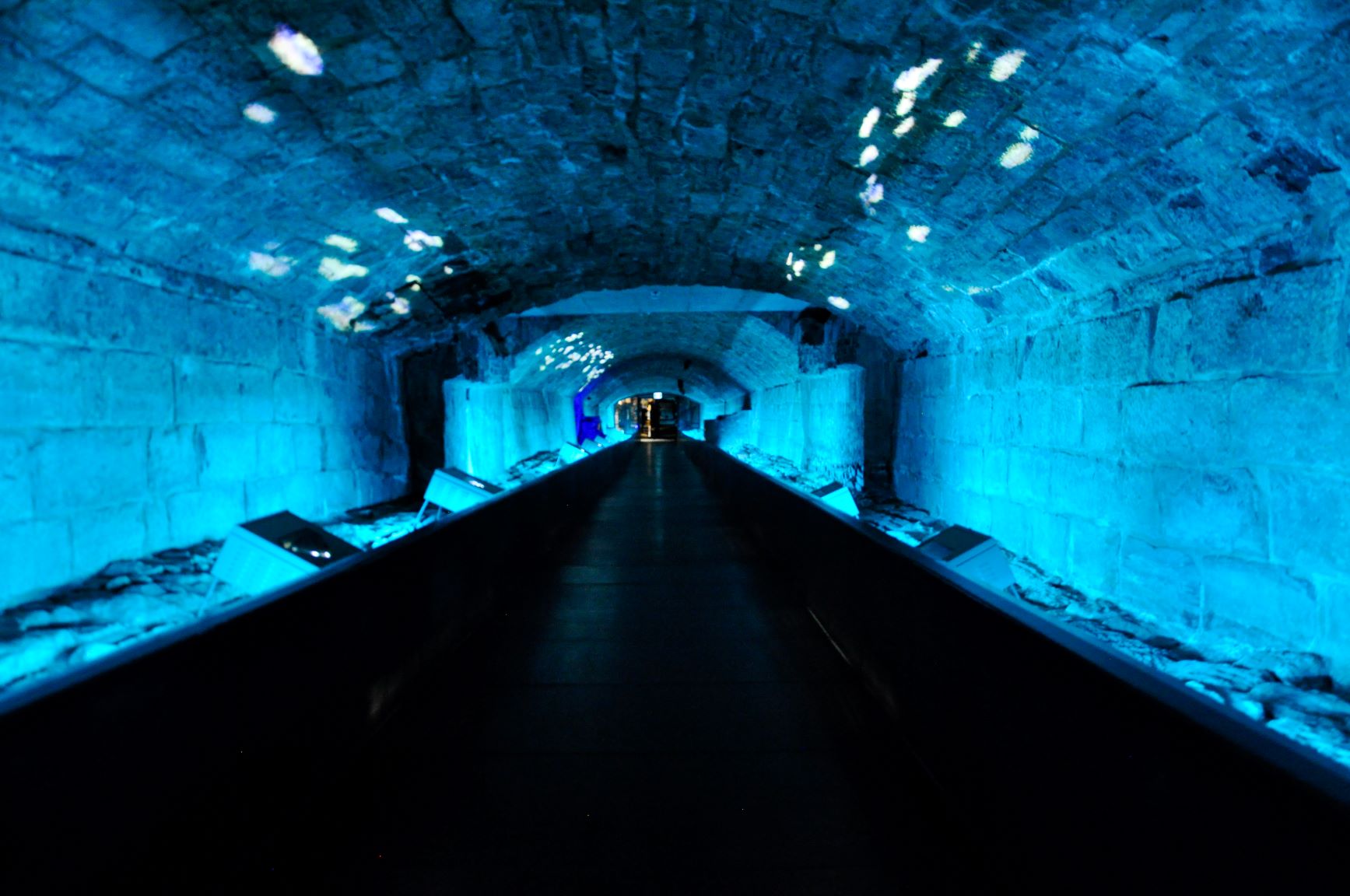
Memory Collector” is an underground light installation projected onto the stone walls of North America’s first collector sewer, and was a feat of civil engineering and urban infrastructure when it was first built in Montreal in the 1830s. “Where Montreal Began,” a newer exhibit, is a sleek, interactive design studio built over the very first settlement in Montreal, Fort Ville-Marie. The space is designed to pay tribute to the pioneers of the colony and their desire to establish a new society. Visitors can place their hands on shapes along a wall and see the names of the people who played a role in founding Montreal appear. In another room, a map and guide outlines a brief history of First Nations villages, but Indigenous history and culture is otherwise largely missing from the overall narrative of the museum, as settler-colonial interactions are discussed in mainly Eurocentric terms.

Building Montreal,” another permanent exhibition, highlights key moments in the timeline of Montreal’s history from 1350 to the present. Finally, “Crossroads Montreal,” the last permanent exhibition, begins in the ruins of Ville-Marie’s first Catholic cemetery, dating back to 1643, and continues onward from there. Archaeological traces help to guide the history of the site, beginning with the Indigenous peoples and ending in the 19th century.

In addition to the permanent exhibitions, the museum also presents three to four temporary exhibits every year. Dinner is Served! The Story of French Cuisine” delves into the history of France’s culinary culture, and “Into the Wonder Room” brings together objects from the collections of the Musée des Confluences in Lyon, France, as well as hundreds of items from museum collections across Quebec and Canada and from private collectors.

Starting on Nov. 27, a new exhibit called “The Incas, Treasures of Peru” will be on display, which explores the world of the Inca and Andean culture from prehistory to the contemporary era. In the style of Pointe-à-Callière’s other exhibitions, “Treasures of Peru” is set to include immersive projections, authentic architectural elements, and a model of a contemporary market.

Though the museum primarily lays the foundation for the story of Montreal’s history from a settler-colonialist perspective, the complex nonetheless provides a starting point for visitors to discover the history of the city. Montreal has a rich history, and Pointe-à-Callière has uniquely allowed archaeological traces of Montreal’s birthplace to become accessible to the public. 

Off the Board, Opinion

Mental health requires more than hashtags and hotlines

Content warning: Mentions of self-harm and suicide. 

People are uncomfortable talking about sadness. Discussions of tragic events are often met sympathetically, with ‘I’m sorry,’ if not ignored. Perhaps out of knee-jerk politeness, people are reluctant to exercise empathy. We would much rather turn our backs on the pain of others, or watch from afar and be thankful for our own conditions. Public obsession with celebrity divorces and breakups stems from this reluctance to engage with people in our own lives, and even represents a tendency towards finding entertainment in others struggles. Negativity, including talking about personal struggles or one’s own mental health, comes with the price of social isolation.

Mental health is a topic that people are uncomfortable to talk about; if mental health is talked about, the discussion is centred around the most common mental illnesses: Depression and anxiety disorders. Personality disorders, schizophrenia, and obsessive compulsive disorder, to name a few, go widely undiscussed. Public reluctance to discuss painful topics encourages individuals conceal their struggles and emotional pain. 

The unwillingness to address the darker side of personal struggles is exemplified in social media culture, as mental health is treated as another platform for shallow and ineffectual virtue signalling. Awareness campaigns are co-opted by hashtag activism—lists of hotlines mixed with soccer mom-like platitudes posted to garner retweets. Much is owed to these campaigns, including promising starts to destigmatization, but addressing mental health requires more than just a tweet. Hotlines and mental health organizations are impartial resources, but they require people to have the courage to reach out to get help in the first place. Seeking help requires addressing topics that continue to be ostracized in public discussion, all while confronting the real threat of involuntary loss of agency through hospitalization. One day per year, even one month per year, devoted to mental health is not enough. 

Moreover, large corporations’ attempts to address mental health are tone-deaf at best. On Twitter, people can now report tweets talking about self-harm or suicide to Twitter’s “safety” partner program. This results in an email to the user containing a (notably devoid of Canadian or international resources) list of crisis hotlines. Implementing a reporting system for mental health treats the issue with the same level of scrutiny as punishable actions or crimes. Furthermore, it represents the general public’s aversion to confronting mental health issues as health issues instead of punishable offences: Platforms such as Instagram and Facebook have adopted policies to ban users or hide content that relates to self-harm or suicide altogether.

There is a balance to be struck between recognizing that mental illnesses require professional help and realizing that we all have a part to play in helping others. Destigmatization requires confronting the uncomfortable and looking out for those around you. The burden cannot fall on the mentally-ill to reach out when the path to reaching out is littered with hurdles, when the words “get help” are used interchangeably with negative and positive intentions. Mental illness continues to be used in everyday ableist vernacular as a way to silence individuals, whether it be through describing your annoying neighbour as ‘psychotic’ or attempting to diagnose Donald Trump and describe his actions as a result of poor mental health.

We need to become comfortable with asking if others are okay. Only a few words are needed to check up on others and give them the opportunity to open up and, to show that you care. Placing bans on content and hiding mental illness from our private lives will not get rid of its existence. Facebook and Instagram had good intentions in drafting their policies, recognizing the need for those in distress to express themselves, but it is individuals and communities that must learn to listen to the mentally ill, not large corporations with hashtags and hotlines.

Read the latest issue

Read the latest issue