


Latest News

Off the Board, Opinion

Love at first bite

We set the scene on a Sunday afternoon. Dinnertime is approaching and my family has elected to order in. We shuffle through a list of options, and settle on Eastern Twist, a sandwich shop a couple of blocks away that sells barbecue chicken wraps—a form of Americanized roti, an Asian fusion hybrid that we can not live without—and spicy fries. The fries are fine: They are hollow for some reason, but still ridiculously tasty. We call to place an order. We have to pick up from Eastern Twist but they are close enough that someone will walk the dog or hop in the car for a short drive. We forgot that Eastern Twist is closed on Sundays, so we settle for something inferior.

We set the scene on a Thursday evening. Dinner is still undecided and we settle on Eastern Twist once again, since it feels as though it is a no fuss-kind of option. For a family with a lot of diverging tastes, it is remarkably easy to agree on it. We walk the dog, Vader, and pick up our sandwiches and fries and walk home. It is around the corner after all. It takes maybe 10 minutes to eat. 

We set the scene on a game night. The Raptors are playing, and everyone’s eyes are going to be glued to the television. We have to pick dinner. There are maybe nine people coming over; how are we supposed to decide? It feels impossible. Our solution: Eastern Twist.

We set the scene on my train ride home to Toronto in April, at the end of last semester. I’m sitting there looking out of the window. I feel reflective; it feels like one of those movie scenes when the rain comes down hard and your hand is on the glass and some beautiful music is playing. The thing is, it is not raining and my hand is not on the glass: Train window glass is probably really dirty. I am listening to Fleetwood Mac, though, and Fleetwood Mac rules.

“Well, I’ve been afraid of changing,

‘Cause I’ve built my whole life around you

But time makes you bolder, even children get older 

And I’m getting older too

Oh, I’m getting older too.”

I return home to a family dinner, and I got to choose the restaurant. We placed a call to Eastern Twist, prepared to order our barbecue chicken wraps and our spicy fries; the specific craving had hit not long before exam season ended and I was excited to be home. The restaurant didn’t pick up the call, and it was not Sunday. 

We tried several more times over the summer to no avail. We drove by one time late in the evening, and the walls had been papered up. Our beloved Eastern Twist had closed its doors. 

Time to be honest: I fibbed a little bit earlier in the name of narrative flow. I was listening to Fleetwood Mac, but I wasn’t listening to the song “Landslide” off of their namesake album. I was listening to “The Chain” off of their album Rumours. But, “Landslide” works better here anyway, because my family has quite cheesily built its life around Eastern Twist. I used to be a picky eater, in part because I was a child who enjoyed chicken fingers, and in part because of allergies. But as a family, we found a place that all of us liked. We introduced friends to it and they liked it too. I honestly do not know anyone who did not fall in love with Eastern Twist at first bite. 

As I grew up, I was raised alongside chicken wraps and spicy fries—I cannot tell you the number of times my lips lost feeling and I persevered for more. It was truly an addictive food, in the best way.

But, Eastern Twist is gone now. I guess you could say I was afraid of changing, kind of like how Stevie Nicks was. The little sandwich shop on the corner of Bathurst St. and St. Clair Ave. is a sandwich shop that my family built its dinner life around. Time has made me bolder and a more adventurous eater. And anyway, a lot of the restaurants that I like are open on Sundays too.


 

Commentary, Opinion

Gentrification falls on university administrations too

Urban universities take up a lot of space, and their presence has a profound impact on local neighborhoods’ economies. When universities such as McGill, Concordia, or the University of Montreal (UdeM) expand their properties or develop new ones, property values in the surrounding area tend to increase and developers pressure landowners to sell their properties. This is one example of gentrification, and it is directly abetted by Universities who fail to take preventative measures. 

UdeM recently came under fire for gentrifying the Parc-Extension area with its Montreal Innovation Laboratory project (MIL). While the project’s goal of turning Montreal into a hub for the growing AI industry is entirely legitimate, it has had unintended consequences. Vacancy rates in the ParcEx this year hit an unprecedented low, and some residents of the area have cited the recent UdeM development as the cause for rising rents. 

ParcEx is one of the most ethnically-diverse neighbourhoods in all of Canada, and it is also relatively low-income. Working-class families in the neighborhood lack the financial means to retain their properties under the economic pressure created by the development of a UdeM campus in the area. Residents have already been seeing rising rates of evictions. Unless the university takes action now, people remain at risk of losing their homes. UdeM has argued that the project is a ‘lifeline’ for the struggling neighbourhood, and that increasing its attractiveness will improve the quality of life for its residents. However, as evictions have continued and expensive new condos have been established, it has become increasingly evident that the project is inaugurating a dramatic demographic transformation in the community.

Instead of improving the quality of life for the current residents of the area, the project forces them away from Parc-Ex and replaces them with higher-income residents. Individuals who have been forced out face significant obstacles to finding affordable housing again: Montreal is currently experiencing a housing crunch, and housing vacancy rates in Parc-Ex are at an all-time low, leaving evicted residents without many options. The gentrification in Parc-Ex poses an existential threat to a neighbourhood in Montreal. McGill students should be particularly concerned about this issue because they also contribute to gentrification.

While students are a vital economic asset to the city of Montreal, entire districts of the city have turned into de facto residence areas for students. Students have different needs than full-time residents that are satisfied by different enterprises, and they do not use government services that regular residents pay for with tax dollars. Neighborhoods like the Plateau, Saint-Henri, and the Gay Village have become increasingly expensive to live in, as “studentification” has grown. This is cutting some Montreal residents off from potentially affordable housing, creating “student ghettos” that are not well integrated into local communities, and ultimately diminishes the quality of life for non-student residents.

MIL might not even be the most economically viable project for the UdeM according to an article by UdeM Professor Emeritus Jean-Claude Marsan, in à babord! This fact notwithstanding, it would not be difficult for UdeM to curb gentrification resulting from its project anyway. Research has shown that universities can harness their economic power to foster inclusive growth in local communities. The University of Toronto has launched an “Anchor Strategy” for its campus in Scarborough, which, like Parc-Ex, is one of Canada’s most multicultural areas. The strategy is geared to bring more diverse and local enterprises onto its campuses and to increase employment opportunities for nearby residents. Similarly, Drexel University in Philadelphia demonstrated that its Hire Local campaign led to decreased turnover rates among staff.

University administrations have the most control over gentrification, but this does not exonerate students of responsibility. McGill students are a key factor in the issue and are therefore morally responsible for safeguarding the area’s unique atmosphere and accessibility. By spreading awareness on social media platforms, protesting with the residents of Parc-Ex, and petitioning the local government and university administrations, students can take action. University of Montreal’s failure to employ a strategy like UofT’s or Drexel’s is reprehensible, and we must hold McGill to a higher standard.

Editorial, Opinion

Construction is inevitable, accessibility barriers are not

The McGill experience would not be complete without campus construction. However, while some campus improvements are necessary, construction should not bar students or faculty with disabilities from participating in classes and campus life. Able-bodied people may see construction as damaging to the campus’ aesthetics, but for disabled McGill students, construction on campus can seriously threaten their academic experiences. McGill has a responsibility to improve accommodations during construction and prioritize accessibility in future construction plans.

As long as construction impedes accessibility on campus, McGill needs to provide sufficient resources for the Office for Students with Disabilities (OSD). The OSD aims to support the inclusion of diverse learners and is responsible for tasks like finding note-takers, getting students testing accommodations and offering technological resources like computer labs. When building closures limit students’ mobility access and access to resources, the OSD is responsible for finding accommodations. This fall, the OSD stopped paying note-takers, meaning some students with disabilities might be left with lecture notes they desperately need. Responsibility falls on the McGill administration to make up for the lack of funding at the OSD and ensure students have the resources they need.

In addition to notes, lectures should be recorded and offered with closed captioning. Having lecture notes and recordings easily available will allow students who might have to miss class due to construction, health, or other reasons, to be able to stay on track. The decision to record lectures is currently left to professors’ discretion, but for students with auditory or visual impairments, these recordings should not be considered an asset but a necessity. Having the option to listen to or watch closed-captioned recordings could significantly improve students’ ability to succeed in a class, especially when construction makes noise disruptions commonplace. 

Construction in big cities is inevitable. Many of McGill’s buildings, including Leacock and the William Shatner University Centre, were built at a time when asbestos was a common construction material, resulting in mandatory asbestos abatement now that its danger has become apparent. A Quebec government study found that 73 per cent of McGill’s buildings on its two campuses are in poor or very poor shape. Construction at McGill is also uniquely challenging because McGill lacks adequate government funding: If the Quebec government allocated funds proportionally based on university populations, McGill would receive an additional $26 million per year. Underfunding means that construction projects get put off or take longer than they otherwise might. This fact, combined with the reality that many buildings on campus require refurbishing, makes construction at McGill an ongoing and seemingly never-ending process.

If the administration hopes to effectively support the student body, McGill’s construction and development planners need to be able to coordinate and plan ahead with the OSD. Being kept up to date about new accessibility barriers would allow the OSD to plan accommodations in advance and help them ensure disabled students have the necessary resources. For example, if a class gets moved to a less accessible area due to construction, the OSD can plan in advance to get note-takers for that course in order to accommodate students with mobility impairments.

Many students on campus also live with invisible disabilities including mental illness, arthritis, and autoimmune disorders that can make attending class significantly more challenging. For example, attending class in a building under construction may be difficult for a student who needs unimpeded access to exits or bathrooms. Lecture recordings and notes would allow students to focus on handling their illnesses or conditions without having to navigate campus on their bad days.

While some accommodations can be made right now, accommodation planning must accompany every step of construction at McGill. Loud construction, which can be triggering for people with mental illnesses and challenging for people with hearing impairments, should be planned outside of class time. Planning also means accommodating professors with disabilities so that they are well equipped to teach their courses; a professor in a wheelchair should not be assigned to a room with an inaccessible podium, for example. 

Currently, McGill has an accessibility working group, however, the group does not explicitly reserve a space for students with disabilities. McGill should invite students with disabilities to give their input and participate in planning accommodations. Student’s who experience accessibility obstacles on campus firsthand are in the best position to suggest how those obstacles might be overcome, therefore, it is imperative that the administration consider their input.

Construction is a part of campus life but it should not stop students with disabilities from participating in the McGill community. McGill must take immediate steps to provide accommodations for students with disabilities and be more thoughtful when planning future construction projects.

Contact (514)- 398-4555 to report accessibility and safety issues on campus.

Commentary, Opinion

It’s time to abandon fast fashion

 Over the last five years in the fashion industry, an area dominated by gratuitous marketing, social media, and online shopping, consumers have increasingly rewarded brands that can keep up with rapidly-evolving trends. This phenomenon, dubbed “fast fashion,”  refers to cheap clothing that becomes popular because of its accessibility and trendiness. On Sept. 29, popular clothing retailer Forever 21 announced that it would be closing all of its 44 Canadian stores. While some shoppers are mourning the loss of the inexpensive brand, the downfall of Forever 21 and other fast -fashion retailers should be cause for celebration because of their poor labour practices and harmful effects on the environment and Forever 21’s closures should provide an impetus for people to rethink their purchases and avoid fast fashion. 

There are many hidden costs behind the deceptively cheap pieces produced by brands like Forever 21. For one, producing cheap clothing requires cheap labour, which means that the manufacturing of these items is often outsourced to other countries that lack sufficient labour protection laws, leading to workers stuck in factories with sickening conditions and low wages. What’s worse is that some of these workers are children. These conditions are not unique to countries overseas either. In 2012, Forever 21 was accused of producing clothing in US factories with “sweatshop-like conditions.” 

Fast fashion also wreaks havoc on the environment. Cotton, which requires an incredible amount of water and pesticides to produce in bulk, and polyester, which sheds microplastics when washed, which then get expelled into our oceans, are among the most popular fabrics for these brands. The dyes commonly used in brightly-coloured clothing can also be toxic to the environment when dumped into bodies of water. Further, textile production leads to more carbon emissions than both shipping and aviation combined. 

It’s important to note that the ‘fast-fashion’ phenomenon isn’t solely the fault of the average consumer. The fashion industry is part of a culture of mass consumerism, in which people are always surrounded by ads crafted to convince us to buy things and shame us if we don’t. Among fellow McGill students, one would be hard pressed to find someone who doesn’t use Amazon or a comparable service. These kinds of services, which both provide a platform and fuel the culture that supports fast fashion, have massive registration rates with post-secondary students because they specifically cater to them. Even in an academic environment, mass-consumer culture is never far away. Still, what keeps these industries in business is the demand for their products. If enough people stop buying fast fashion, brands like Forever 21 will continue to go out of business.

There are many alternatives to fast fashion, including sustainable brands that use fabrics that are less harmful for the environment and have more transparent labour practices. Useful examples include the the website Good On You, which rates brands based on their environmental and labour practices. Ultimately, thrifting is the most sustainable way to shop. Not only does it give clothing a new life, it also avoids creating more waste. Thrifting can be more affordable for quality pieces and should be especially appealing for students on tight budgets. However, students must keep in mind that many low-income families rely on inexpensive thrift stores to make their purchases and be prudent when buying thrifted clothing. The rise in popularity of thrifting has led to a sort of gentrification, whereby wealthier shoppers seek to find the best deals and the best pieces even when they don’t need to.

Considering that the average Canadian family throws out 46 kilograms of clothing per year, shoppers should consider donating clothes to thrift stores to make up for what they buy. Some shops will accept donations while others will pay you or offer store credit when you bring in your clothes. Many McGill clubs and associations, like SynesthAsia and UNICEF hold clothing swaps or drives throughout the year, which can be another way to reduce waste, contribute to a good cause, and acquire new items. Students should not underestimate their power to make a difference through seemingly small changes.  It is crucial that McGill students continue to educate themselves on fast fashion and do what they can to avoid purchasing this kind of clothing. 


News, SSMU

Indigenous student leaders call for SSMU VP Internal’s resignation

Indigenous students are calling on Students’ Society of McGill University (SSMU) Vice-President (VP) Internal Sanchi Bhalla to resign in a letter after allegedly failing to support Indigneous students. The letter asserts that she has failed to fulfill her mandate by declining to allow Indigenous students to use SSMU’s Listserv to advertise an upcoming protest.

The email, which was sent to Bhalla on Oct. 18, referred to a motion presented at the Oct. 10 SSMU Legislative Council meeting regarding the federal government’s recent decision to appeal a ruling that would compensate First Nations children harmed by the child welfare system. SSMU Indigenous Affairs Commissioner Tomas Jirousek presented a motion condemning the government’s action and requested Legislative Council’s support in organizing a demonstration to protest the appeal. The letter states that Bhalla failed to provide support to Indigenous communities, as outlined in her mandate, by being reluctant to use the Listserv to mobilize students.

“[Our mobilisation efforts] require [that] the VP Internal [allow] us to use the Listserv,” Jirousek said. “She was notified both at Legislative Council, [was mandated to do so] at the same council, [and] she was previously reminded in private messages between members of the executive committee. [Her actions] largely led to a breakdown in mandated allyship from the executive team. It threatens our ability as the Indigenous student community to mobilize on a rapid basis.”

In the letter, which was forwarded to The McGill Tribune, Jirousek threatened to resign from his position if Bhalla does not step down due to her lack of support for Indigenous students. Additionally, the letter states that Indigenous students will not be reapplying for the position of Indigenous Affairs Commissioner and will withdraw their support for the Indigenous Affairs Committee.

“By failing to provide timely allyship to Indigenous students, VP Bhalla demonstrated a lack of respect towards the issue as well as the labour that Indigenous students had applied,” the letter reads. “The VP’s lack of support for Indigneous students also demonstrated a lack of respect for the issue of First Nations’ children who have been displaced by the child welfare system.”

Indigenous student leaders cited Bhalla’s alleged lack of support as part of a larger structural issue within SSMU, as Indigenous groups that work under a SSMU portfolio rely on executives to provide them with both financial and organisation support. Catie Galbraith, co-chair of the Indigenous Students’ Alliance, explained that this reliance on external bodies places excessive amounts of strain on the students running them.

“I think it’s representative of this bigger issue of Indigenous students and Indigenous student groups being in such a precarious position all the time,” Galbraith said. “It’s very stressful and it’s very harmful.”

Jirousek agreed, attesting to the importance of having reliable institutional support.

“We do a lot of labour,” Jirousek said. “We’re a small community, and Sanchi and her actions right now are taking away our ability to focus on other issues. You now have three Indigenous students [working in SSMU], all that could be doing work in other regards whether personal, or [academic], or [….] professional. Instead we’re here focused on Sanchi because she’s become a problem for our community.”

Update: The SSMU Executive team has sent a response to the Indigenous student signatories regarding their letter.

Features

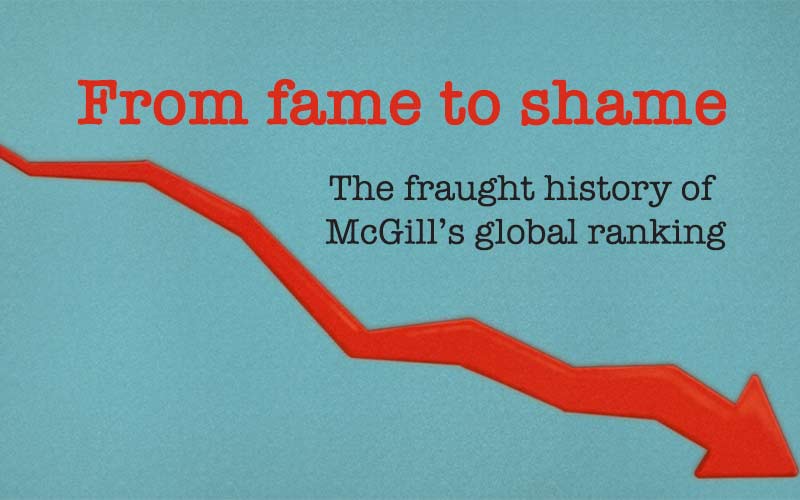
From fame to shame

In 2006, Tom Traves, then-president of Dalhousie University, formed a coalition of 11 schools, nine of which were among the top 15 research universities in Canada. The 11 presidents of the represented universities signed an open letter addressed to Maclean’s Magazine, denouncing their method of producing university rankings for their annual Education issue. These schools refused to participate in the Maclean’s questionnaires, which gathered administrative data about schools’ student bodies and opinions of other institutions.

Martlets, Sports

Martlet cross country take bronze at RSEQ-UNB

The McGill cross country team competed on Oct. 12 in the RSEQ-AUS Interlocking Meet, hosted by the Université du Québec à Montréal (UQAM) at Parc Maisonneuve. A total of 316 runners representing 15 teams competed in the men’s and women’s eight–kilometre categories. The nationally-ranked Martlets finished third overall with fourth-year runner Elizabeth Hirsch claiming an individual second place. 

The Martlets were impressive in the season’s first eight–kilometre run. Hirsh, McGill Athlete of the Week, capped off a 29:16.5 effort with a podium finish, her third over the last four races. Accompanying her in the top ten was third-year Sandrine Veillette, who finished with a time of 30:19.00, fourth-year team captain Chloe Fleurent-Gregoire (placed 14), and third-years Laura Carlton (19) and Brianna Mendes (28), taking home a total of 68 points for McGill.

“The first [eight-kilometre race] of the season is: c’est impressionnante; it’s not [necessarily] a struggle but requires focus,” Fleurent-Gregoire said after the race. “[The] first [four-kilometres are] okay, the [next two] you can fall asleep [because] it’s four repetitive laps. But the last [two-kilometres], [you] step it up and show what [you] have.” 

Despite missing out on what would have been their fourth successive first-place finish, the Martlets put on a competitive display against the nation’s top teams. They fell just short of the Laval Rouge et Or, who recorded 67 points, and the Queen’s University Gaels, who took 49.

The McGill Men’s team, however, endured a tough loss as the team failed to build upon an improving trend of overall finishes. First-year Henry Wellenstein, who finished in 39th place, fifth-year Simon Bernier (58), first-year Noah El Rimawi-Fine (63), second-year Oliver Cyr (79), and third-year Jeremy Obrand (117) combined for a total score of 250 to finish in  tenth place at the meet. 

Wellenstein, who has been McGill’s brightest spark for a fourth successive race, was enthusiastic about his performance. 

“This is my first year [on the team], so I’m kind of just going with the flow,” Wellenstein said. “A lot of work goes into running at the race-pace. We do a lot of interval [runs] where we’re slower than the race-pace [and] faster than the race-pace, […] but its [also] about pushing hard physically and mentally [to win].” 

The team, coached by 32-time conference Coach of the Year Dennis Barrett, remains positive about improving their times ahead of the provincial championships. 

“It’s my first [eight-kilometre race] since last year so it was definitely more difficult, but Coach [Barrett] is always on me about improving my cadence, to take more steps per minute,” Hirsch said. “He wants us to start out in the front [and] be confident about it [….] That is what I did today. It was scary, but [we] need to challenge ourselves.”

The cross-country team’s next challenge will be the provincial championships in Quebec City on Oct. 26, followed by the highly anticipated Nationals in Kingston on Nov. 9. 


Moment of the Meet:

Fourth-year runner Elizabeth Hirsch started the race at the front of the pack, displaying confidence as she kept control throughout the run to eventually take home the silver medal. 

Quotable:

“[We’re] a very different team compared to last year, […] but what’s cool about McGill is that we have a lot of depth. It’s not just three [or] four girls but ten girls that are all strong [runners], so we’re always competitive. We’re really hoping to win it this year.” – Martlet captain Chloe Fleurent-Gregoire on improving upon the team’s fifth place finish at last year’s Nationals. 

Stat Corner:

The Martlets (68 points) narrowly missed out on the second-place finish to their rivals, the Laval Vert et Or (67). 

NBA Preview
Basketball, Sports

NBA Preview: The new fan’s guide to 2019-20

Let’s face it: Montreal isn’t the best city for basketball fans. However, the Raptors’ Championship win may have spurred the genesis of basketball-fandom across the country. Thousands of first-time fans packed into the Jurassic Park on Peel Street to watch the improbable dark-horse squad headed by Kawhi Leonard thrash the Warriors, and in the process, fell in love with basketball. 

When the NBA season starts on Oct. 22, fans without a team will have to choose where to place their loyalties. There’s no lack of excitement coming into the 2019–2020 NBA season with everyone on the all-star starting lineup, including Leonard, playing musical chairs. The McGill Tribune compiled a list of the most thrilling teams to support before the bandwagons leave the stations.

The Philadelphia 76ers

Even those that question the value of the team-building process can’t deny that the 76ers are looking impressive this year. Joel Embiid lost 20 pounds over the summer, which is sure to make him better defensively and lighter on his feet. Ben Simmons may have learned to shoot, even draining his first ever three-pointer in a preseason game. Furthermore, the off-season addition of veteran Al Horford will add to their depth and defence. Without Kawhi Leonard in the Eastern Conference to stop them, the 76ers will be contenders this coming season.

Los Angeles Clippers

The recent addition of Leonard and Paul George to an already elite Clippers’ roster has Lakers and Warriors fans concerned. Hot off one of the greatest playoff runs in NBA history, Leonard is now on an even better team, he’s ready to cement his legacy, and it’s time for the battle of LA to return.

Denver Nuggets

The Nuggets’ roster has remained mostly unchanged, unaffected by free agency. They are the only top team with any continuity, an undervalued aspect in building team chemistry. If Nikola Jokic continues with his unique take on the centre position while being surrounded by exceptional shooters and highly anticipated rookie Michael Porter Jr., they just might be in the mix to win it all this year.

Los Angeles Lakers

With the recent addition of Anthony Davis, the Lakers have catapulted into championship contention. By pairing Davis with Lebron James, holding on to Kyle Kuzma in the Davis trade, and landing valuable shooters like Danny Green, the Lakers are looking to prove that they still own LA.

Dallas Mavericks

Dirk Nowitzki retired last year, but this year’s Mavs roster isn’t any less European. Former Rookie of the Year Luka Dončić paired with recent 7’3” addition Kristaps “The Unicorn” Porzingis should make for a deadly combination.

New Orleans Pelicans

This might be the most exciting assembly of young talent to ever grace the NBA. Zion Williamson, possibly the most talked about NBA prospect of all time, will be paired with Lonzo Ball, a talented playmaker no longer suffering from a weird jump shot. The two should make for a flashy and explosive duo, churning out highlights on a nightly basis, and potentially propelling their team to the playoffs.

Houston Rockets

The Rockets have been hovering in finals contention for the last three years, but the Warriors have stopped them at every turn. The blockbuster trade of Chris Paul to Oklahoma City for Russell Westbrook might be what gets them through the blockade though, with the Warriors now weakened by Klay Thompson’s injury and the loss of Kevin Durant. With both James Harden and Westbrook setting all-time records for ball possession in the last few years, however, it’s unclear how both teammates will share the spotlight.

If there has ever been a year to get into the NBA, this is it. Nearly every team has been reshaped by free agency and trades, and there’s no clear frontrunner. Anything could happen, and fans have a fantastic chance to choose a team.

Science & Technology

Searching for the Fountain of Youth

Montreal community members crowded into the Redpath Museum Auditorium on Sept. 27 for a Freaky Friday lecture. In the talk, Professor Joe Schwarcz, Director of the McGill Office for Science and Society, discussed humanity’s historical attempts to delay aging. 

“Nobody looks forward to getting old,” Schwarcz said. “Historically, there has been this search for the Fountain of Youth, and, over the years, many anti-aging regimens have been developed.”

One such regimen consisted of bathing in sour donkey milk and was practiced by Queen Cleopatra in the first century BC. Modern science suggests that, since sour milk contains lactic acid, the remedy could have had a slight rejuvenating effect. Lactic acid belongs to a class of compounds called alpha hydroxy acids (AHAs) that speed up the turnover of skin cells and are now marketed in cosmetic face creams. 

In the 19th century, physiologist Charles Brown-Séquard observed that eunuchs suffered from medical problems and hypothesized that a substance present in the testes was the key to health and longevity. He injected himself with extracts from dog testes, inspiring other researchers to further investigate gland transplants. 

This tradition continued into the early 20th century when John Brinkley, a charlatan without medical credentials, made a fortune by transplanting the testicles of goats into the scrota of aging men. 

“He had very few complications because he never connected the goat testicles to anything, but he had plenty of men saying how happy they were, […] undoubtedly due to the placebo effect,” Schwarcz said. “Although we look back on these ventures as being virtually comical, […] this really was the beginning of hormonal therapy.” 

Attempts to exploit the gullibility of the public persisted, even as legitimate science advanced. Human growth hormone (HGH), the production of which declines as a person ages, became a widely promoted remedy after a 1990 study observed that HGH treatments increased lean mass and bone density in elderly men. 

“HGH, at the time, was very difficult to come by,” Schwarcz said. “But there were clinics that popped up […] that were offering HGH injections for much less than [the expected price], so no one knows what they were actually injecting.”

 When public awareness caught up, companies instead began marketing an HGH ‘secretagogue,’ a substance that supposedly stimulates the secretion of raw materials to form HGH proteins inside the body. However, HGH levels decline because of the reduced activity of enzymes that assemble raw materials into proteins, not because of a shortage of raw materials.

“Supplying these secretagogues is like supplying bricks and windows and doors and hoping that they will assemble themselves into a building, which will not happen because the builder is missing,” Schwarcz said. 

Schwarcz also noted that the manipulative tactics of advertisers are present in many modern anti-aging products. 

“Marketing very often uses clever words such as ‘It may help’ […] and, as soon as you do that, you are protected legally,” Schwarcz said.

Some companies push this principle above and beyond. Based in Arizona, the Alcor Life Extension Foundation specializes in cryonics, a pseudoscience that insists on freezing human corpses in the hope of resurrecting them in the future. 

“It [costs] at least $100,000,” Schwarcz said. “This is of course nonsense. When you are cold and dead, you are dead.” 

While some make expensive bets on futuristic technologies, Schwarcz’s recommendations for prolonging life are a lot less flashy. Okinawa Island in Japan is home to more centenarians than any other place in the world. The lifestyle of this population is characterized by a high consumption of fish, vegetables, and fruit, a low consumption of red meat and processed food, and high levels of activity. 

“Eating a proper balanced diet, […] exercise, and [genetics] are a few keys, but these are not highly marketable,” Schwarcz said. “There constantly are these miracle solutions, but there are no miracles.”

Read the latest issue

Read the latest issue