


Latest News

Off the Board, Opinion

Cancel political stan culture

I have mixed feelings about the discourse that inevitably surrounds election seasons. Though I enjoy a good Scheer-centric takedown as much as the next person, I find myself unnerved by the surface level engagement on social media where stan culture intermingles with politics. 

Stan is shorthand for ‘stalker fan’ and is named aptly after the Eminem song. To be a stan, or to stan someone, is to obsess over a celebrity and provide nearly unequivocal support, regardless of their behaviours or values. Stan culture is heightened on social media, where interactions between celebrities and their fans, as well as fan communities that arise, can create echo chambers of preoccupation. While stan culture remains mostly harmless, involving real world actors into this lore becomes morally tricky: It is fine to write erotic fanfiction involving Gilmore Girls characters, but it is invasive, inappropriate, and above all, really weird to write about Donald Trump, Vladmir Putin, and Hillary Clinton having a threesome. It is crucial to recognize that by treating politicians, and politics, as fictional characters and narratives, we remove the ability to see them as whole beings capable of failure. 

 In 2015, shortly after Justin Trudeau was elected as Prime Minister, there was no shortage of thirst articles. An unofficial calendar entitled “Justin Trudeau, My Canadian Boyfriend 2018 Wall Calendar” was sold on Amazon. In light of current criticisms against Trudeau for his lack of climate action and the resurfacing of multiple photos of him in blackface, these posts expressing undying adoration have not aged well.

This hyper-sexualization of politicians taps into another weird aspect of this “stan” culture — the infamous horny tweet about Democratic Presidential candidate Beto O’Rourke for instance, shows how lusting typically reserved for Bachelor in Paradise contestants emerges in this new political discourse. This vantage point positions politicians as objects of admiration to be fawned over, not elected officials with agendas. 

Similarly, there is a concurrent trend were politicians are equated to protagonists from popular media: A uniquely bizarre tweet that photoshopped O’Rourke, along with other Democratic presidential candidates Elizabeth Warren and Pete Buttigieg as the main characters from Harry Potter circulated earlier this month. Framing politics within theses imaginary worlds, and placing politicians as protagonists fated to triumph over “evil” shows a stark disconnect with the realities of federal bureaucracies. 

Conceptualizing politicians as virtuous saviours is also an unsound way of expressing admiration. Because of the incredibly high standard admirers hold them to, when these public figures inevitably misstep, their error is fundamentally incompatible with the conception of forgiveness, or growth. 

People’s disengagement from the unglamorous, mundane realities of political systems is vapid, entirely self-serving, and irresponsible. Of course, popular culture offers useful vehicles for critiquing political structures: Satirization of Trudeau’s blackface scandal, Amazon’s mistreatment of workers, and the rise of the conservative right may prove to be insightful. However, it is important to accept the fact that, not every aspect of our lives exists as an item of consumption, and instead we should meaningfully engage in political discourse and hold ourselves and others accountable for the real world effects of political actions. It seems redundant to say, but a politician is not an entertainer. They are an elected official who is supposed to serve your interests. 

 

Hockey, Private, Sports

McGill Men’s Hockey drops tight affair to Ottawa

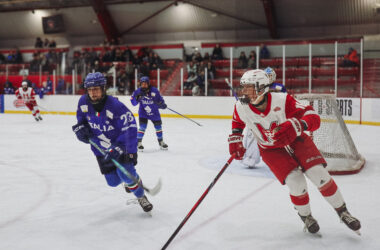
The McGill Men’s hockey team (0–1–0) opened their OUA regular season at home on Oct. 3 against the Ottawa Gee–Gees (1–0–0). Despite the enthusiastic crowd, the home team came up short, losing 3–2.

The game started at a fast pace, with good puck movement and checking from both sides. McGill took an early slashing penalty in the neutral zone one minute in; however, their solid penalty kill unit, who has given up one power play goal in their last three games, showed up to shut down Ottawa.

A few minutes into the first period, with McGill’s offence pressing, third-year forward Antoine Dufort-Plante buried his first goal of the season from just outside the crease. The momentum continued in McGill’s favour as Ottawa took two penalties in the next two minutes, giving the home side a critical five-on-three powerplay.

McGill’s powerplay unit moved the puck beautifully and took multiple shots on net. Ottawa’s goalie and defence stood strong though, and McGill was unable to increase their lead. Losing this offensive opportunity would prove costly: Minutes later, immediately after McGill killed another penalty, Ottawa outnumbered the home side in the offensive zone and capitalized on this opportunity, barely squeezing the puck past fourth-year goalie Louis-Philip Guindon to tie the game at 1–1.

In the second period, the home team struggled out of the gate. Ottawa took advantage of the opening, scoring within the first minute to take a 2–1 lead. The Gee-Gees continued to press in McGill’s end, and again, Ottawa found the back of the net, finishing a beautiful cross-crease goal to extend their lead to 3–1.

Third-year forward Michael Cramarossa, currently co-leading the team in points this year, was frustrated with this tough stretch of the game.

“We didn’t play a full 60 minutes,” Cramarossa said. “That was our game plan from the beginning, and I think we left that, after their first [goal] and in the second [period].” 

In the third period, McGill came out with a new energy, outskating the Gee-Gees and creating chances to put themselves back into the game. Five minutes into the period, second-year forward Ryan Penny buried on a rush, narrowing the goal difference to one. The home team continued to control play in the offensive end, especially as time became scarce. With Guindon pulled to give them another attacker, McGill came extremely close to tying the game, even hitting the post. Ultimately, McGill fell short by a final score of 3–2.

McGill’s season continues with a tough opening stretch, as they go on the road for five of their next six games. Penny, who scored his ninth point of the season, is focused on what the team needs to do in order to bounce back in this next stretch.

“Just play simple,” Penny said. “Just stick to our game plans and pull out some road wins to get some confidence to begin the season.” 

McGill plays The University of Windsor Lancers on Oct. 11. 


Moment of the Game:

Antoine Dufort-Plante scored McGill’s first goal of the game and regular season right near the crease, sending the McGill home crowd to their feet.  

Quotable:

“Statistic wise, it doesn’t really matter [to me]. I just care if we get the win.” – Third-year forward Michael Cramarossa on his current team co-lead in points.

Stat Corner:

Fourth-year goaltender Louis-Philip Guindon saved 41 shots, a season-high for the netminder.


Creative

Montreal Climate March | September 2019

On September 27, as part of a series of worldwide climate protests, Montreal held its second march for climate justice. The McGill contingent was organised by Climate Justice Action McGill (C-JAM), garnering around 3,000 students. 16-year-old Swedish climate activist Greta Thunberg joined the greater Montreal rally, addressing a crowd of over 500,000 people.

Video by The McGill Tribune’s Multimedia Editors, Sarah Ford and Aidan Martin.

Creative

19th Annual McGill Pow Wow

On September 20, members of the McGill and Montreal community gathered on Lower Field to participate in the 19th Annual Pow Wow hosted by the First Peoples’ House. The celebration was part of the 9th Annual Indigenous Awareness Weeks which was organized by the McGill Indigenous Education Program.

Video by Sarah Ford and Aidan Martin

Artistic Swimming, Commentary, Letters to the Editor, Opinion

It’s time for equal treatment of female athletes and their sports

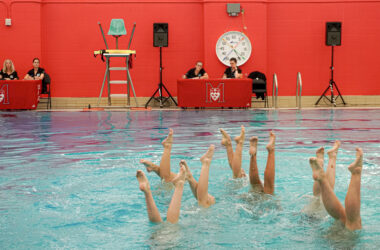
I joined McGill Varsity Artistic Swimming (AS) in 2018 after 11 years of practicing the sport on a national and international level. McGill AS’s 2018-19 season was one of the most successful in the team’s history. We won Nationals after an undefeated season and brought home the coveted Geraldine Dubrule Trophy, awarded to the school with the highest number of points at the end of each season. In light of these accomplishments, we were thrilled to be nominated for the Team of the Year Award at the 2019 Varsity Gala. 

To our surprise, we lost the award to another team. After more than a decade in artistic swimming, I am used to my sport not being recognized as a “real sport.” What was most disappointing, however, was to lose this award to a men’s team whose success we undoubtedly matched on paper, especially in light of the efforts McGill Athletics claims to be making to better support their women’s teams. It is time for these words to become concrete actions. 

The women I swam with during this season are strong, smart, and driven. They balance studying in demanding programs with practices finishing as late as 10:30 p.m. multiple times per week. The coaches who run McGill AS volunteer their time to train the athletes on top of their full-time jobs outside of the university. Our head coach Dr. Lindsay Duncan, is an associate professor and researcher in McGill’s Department of Kinesiology and Physical Education and has been managing the team for six consecutive years on a volunteer basis. Together, these women make McGill AS a true leader within McGill’s athletic community. They are the reason McGill Artistic Swimming has won 15 National Championships in the last 17 seasons. 

“After more than a decade in artistic swimming, I am used to my sport not being recognized as a “real sport.””

As McGill Athletics and Recreation Executive Director Marc Gélinas highlighted that the university is taking steps to level the playing field for its female athletes in his opening remarks at the 2019 Varsity Gala. In September of 2018, thanks to a generous donation by alumni Sheryl and David Kerr, McGill Athletics launched the Kerr Family Women in Sport Program with the goal of supporting female student-athletes and increasing the number of full-time female coaches. After hiring two female assistant coaches and­­ appointing a women’s sports advocate as a steward to the new program, McGill Athletics wants to know what services female athletes would benefit from and how it can better support them in their athletic pursuits. 

As a varsity athlete in an all-female sport, I offer a simple answer: Begin by supporting, promoting, and most of all recognizing traditionally women’s sports in the same way they do sports such as baseball, hockey, and football. The stronger each individual team is, the stronger we are together as athletes representing our university. Therefore, it only makes sense to provide the necessary funding to appropriately compensate coaches across all teams, give all sports the same visibility on McGill Athletics’ social media, and level the financial cost of being a varsity athlete for those competing in less well-known sports. This new school year is the ideal time to move forward with these concrete actions and bring real change within its varsity teams. I commend McGill Athletics for actively searching for ways to achieve equality for their female athletes. As a way to substantiate these efforts, I ask the committee overseeing the attribution of the annual Varsity Awards to commit to celebrating the success of under-recognized sports, particularly all-female ones. I invite them to rise to the challenge of honouring female teams and coaches who quietly but consistently collect national titles over the span of nearly two decades, despite being next to unknown in the McGill community. Only by making this commitment will McGill Athletics truly be able to offer equal opportunity for its strong women to proudly wear its colours. 


Features

Across the generations

When I first met Denyse Robertson, she was peering out from behind the barely-open front door to her home with a quizzical look on her face. I could not help but worry that, even with the best of intentions, my volunteering endeavours would meet a dead end if the woman I was matched with did not like me. My fears dissipated as soon as she opened the door wide and greeted me with the loudest “Bonjour!” I have ever heard. It was as if Denyse and I were old friends reunited after decades apart. A year later, I look forward to her “Bonjour!” every week.

OSD Office
McGill, News

McGill OSD replaces note-takers’ financial compensation with volunteer hours

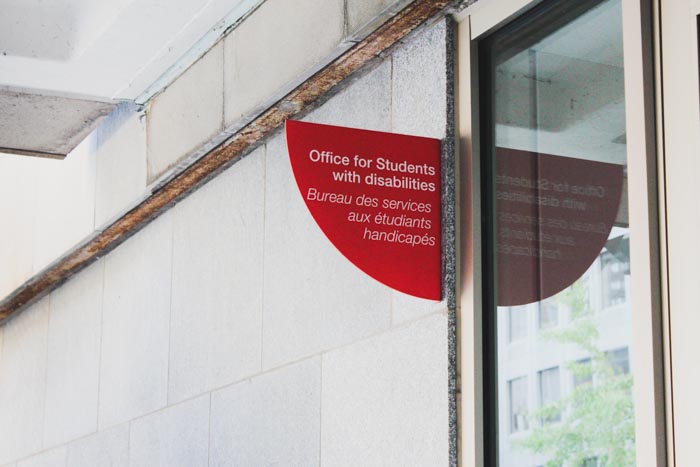
Each semester, McGill’s Office for Students with Disabilities (OSD) recruits approximately 300 students to take notes for McGill courses and share them on MyCourses as a service to 600 other students with  disabilities that hinder their ability to take notes for themselves. In Winter 2019, peer note-takers were paid $50 per class per semester. However, as of fall 2019, the OSD that will no longer continue to be paying any note-takers. 

Instead, students who participate in the program will now be compensated through the addition of 10 community service hours to their co-curricular records, as well as an entry in a draw to win one of several gift cards at the end of the semester. 

Some note-takers who felt taken advantage of by the sudden switch to unpaid work decided to drop out of the program in protest. A Reddit thread posted by a student about the issue encouraged students to email the OSD to express their frustrations, and encouraged anyone who needed the notes to email the student note-takers directly, since they did not want to cause problems for students with disabilities who rely on the service.

Director of the OSD Teri Phillips explained that their policy was changed to follow the footsteps of other schools in Canada.

“[The OSD has] seen, from our peer institutions, that a non-financially driven volunteer model works,” Phillips wrote to The McGill Tribune. “[P]eer note-taking is often a volunteer service at many other institutions, including the University of Toronto, Concordia University, Queen’s University,  University of Alberta, and others.”

While some students are frustrated by this change, Phillips believes it is for the greater good. The money previously used to compensate note-takers is now being put toward funding more services for students with disabilities. 

“Part of this reinvestment includes a collaboration with Teaching and Learning Services to add features to the lecture-recording system with complementary note-taking applications,” Phillips wrote. “Not only do these features specifically address some of the barriers related to attention and focus, they will also be made available to all students. This project should be completed in the near future, with a targeted launch for the Winter 2020 semester.”

Phillips claims that although a small number of students have quit, complaints about the new policy are few and might actually help recruit more note takers.

 “The new model makes it possible to recruit additional volunteers [in one class] to share notes,” Phillips wrote. “This would not have been possible in previous years given the prohibitive costs.” 

The OSD’s note-taker recruitment begins after the add/drop period. Despite the lack of monetary compensation, according to Phillips, 200 volunteers have already been recruited. The OSD is currently on track to recruit about the same number of note-takers as last year. 

Victoria Pittard, a U3 computer science and biology student, has been a note-taker for two years. She raised concerns that uncompensated note-takers might be less motivated to submit high-quality notes.

 “I, personally, if it was going to be [a] volunteer [service], would appreciate more hours being recognized, and at the very least [having known] before the semester that it was now a volunteer position.” Pittard said. “For most classes [that I took notes for], it involved making sure I was taking more detailed notes than I would otherwise and then formatting it in a way that was accessible. For example, my handwriting is questionable, so if it was a math class I’d then type it all up afterwards, which sometimes takes a little time.”

Pittard believes that including some incentives is important to keep note-takers motivated throughout the semester. 

“Some people really would just upload [their notes] right before the exam or even after the exam and almost get lazy with it,” Pittard said. “I think that an incentive is really important. When you cut pay and don’t tell people before they sign up, that really reduces [the incentive to do well]. Even just better enforcement [of quality notes being uploaded on time would benefit the program].”

Editorial, Opinion

“It Takes All of Us” needs more

On Sept. 23, McGill released “It Takes All of Us”, its new mandatory sexual violence prevention training program. Those who do not complete the program—which features modules on sexual violence, consent, bystander intervention, and survivor support—will be unable to register for academic courses in the Winter 2020 semester. “It Takes All of Us” follows from the Quebec Act to Prevent and Fight Sexual Violence in Higher Education Institutions which requires universities to provide mandatory training for students and staff. While the program heeds McGill students’ call to action for improved sexual violence infrastructure, it misses the mark on crucial issues such as power dynamics and leaves gaps in terms of survivor support. Moreover, despite the titular implication that the McGill community is in it together, different completion deadlines for students and staff undermines the sense of equal responsibility.

While the new training program falls short in some ways, it is not irredeemable. “It Takes All of Us”’s thoughtful structure and content demonstrate the care that the developers took when designing it. The program’s use of gender-neutral names and specific statistics on the experiences of women of colour represent small but meaningful steps toward campus awareness of minority issues. 

For programs on serious topics like sexual violence, attentitiveness is paramount. In this respect, the software design of “It Takes All of Us”, especially McGill succeeds in ensuring participants focus on the content. While users can skip over videos, pop-up questions act as a deterrent: If a student tries to bypass a video, the program will launch a content-related question on their screen and bar them from accessing the skipped video to find the answer. Users are also unable to mute the program or switch tabs, which help ensure they remain tuned in, although it is still possible they could simply mute their computer’s volume.

Despite taking certain steps in the right direction, the program’s omission of content addressing power dynamics is both disappointing and unsettling. While the staff version of the course stresses the prohibition of romantic and sexual relations between staff and students under their authority, the student course does not educate on the risks of power dynamics. Given McGill’s recent protests against faculty sexual misconduct in 2018, failing to mention these issues in the student program hinders its potential to protect students. Predatory staff have been an appalling yet very real part of student experiences at McGill. To evade all mention of these scenarios in the student program disrespects those who struggled with such experiences and fought for the development of a mandated sexual violence program that addresses power dynamics. 

On top of the omission of power dynamics, the later program completion deadline for staff shows that faculty and students are being held to a different standard. Following years of sexual misconduct being swept under the rug, McGill needs to hold staff in positions of power more accountable, and by showing that the program is less timely for them, McGill sends the opposite message.

The program should also be updated to be more considerate of its audience. The scenario-based units use fraternity-centric storylines that may not be relatable for much of the McGill population. Selecting situations that more students can relate to—in residence or office hours, perhaps—would increase the program’s effectiveness. 

“Despite taking certain steps in the right direction, the program’s omission of content addressing power dynamics is both disappointing and unsettling.”

Moreover, “It Takes All of Us” needs more recognition of experiences of Indigenous and people of colour in the program. While the program provides statistics on who reports and experiences sexual violence, it overlooks the socio-cultural factors that underlie these numbers. For example, it cites fear of not being believed as one reason why survivors do not report their assault to the police; however, it fails to recognize that for many people—especially people of colour—this fear is grounded in repeated instances of police mishandling victim reports. The program needs to do more to recognize the equity issues that lead to sexual violence and keep survivors quiet.

The logistics of designing a program that will fit all student experiences are immensely complicated. With that said, a third of women will experience sexual violence in their lifetime, and most survivors develop post-traumatic stress disorder (PTSD) or experience symptoms of it, including panic attacks, intrusive thoughts, and dissociation. For survivors, content even partially related to their experience can be triggering, let alone an entire mandated workshop on sexual violence.“It Takes All of Us” strives to accommodate survivors and even features a “feeling overwhelmed” button that allows users to skip over one entire section. However, skipping one section is not likely to ease all symptoms of PTSD and this single feature must be supplemented with a more survivor-conscious framework including more methods for survivors to opt-out of the program entirely. One way McGill could do this is by exempting survivors with psychologist or therapist notes from the course. 

“While the program provides statistics on who reports and experiences sexual violence, it overlooks the socio-cultural factors that underlie these numbers.”

The program also notes that survivors can go to McGill’s Office for Sexual Violence Response, Support and Education (OSVRSE) to find support for completing the program. The OSVRSE staff are trained in active listening and create a safe environment for survivors. However, the office is also understaffed and is realistically unable to accommodate all of the students who might want help with “It Takes All of Us”. With the reality of such high rates of sexual violence, McGill has a responsibility to provide more accommodations for survivors completing this program. Increasing funding and resources for a small office like OSVRSE and developing alternative venues for support would help more students feel safe. Moreover, McGill must an effort beyond “It Takes All of Us”. In order to fully show solidarity with survivors, McGill must continue to improve and enforce its new sexual violence policy

Despite having room for improvement, The McGill Tribune urges students and staff to complete the “It Takes All of Us” program with care. The course gives people an opportunity to reflect on their actions or inactions and consider how they can improve. Even students with previous training who feel confident in their knowledge should be attentive when completing the program. Sexual violence is preventable and every step towards awareness matters; students must not overlook the importance of taking “It Takes All of Us” seriously.


Resources and suggestions for survivors:

Sexual Assault Centre of the McGill Students’ Society [email protected] or 514-398-8500

Office for Sexual Violence Response, Support, and Education [email protected] or 514-398-3954 

Complete the course with trusted friends or attend OSVRSE completion workshops


Football, Men's Varsity, Sports

McGill football tops Sherbrooke at Homecoming game

On Sept. 28, two weeks after suffering a heartbreaking defeat at Sherbrooke (1–4–0), the McGill football team (2–3–0) took their revenge on home turf. With a lively Homecoming crowd in attendance, the home side fought their way to a 20–13 victory. 

McGill’s offence was off to a quick start with third-year quarterback Dimitrios Sinodinos dissecting the Vert & Or’s defence on a 76-yard scoring drive. The sequence ended with a five-yard touchdown reception by fourth-year receiver Mathieu Soucy. This was, however, the only time that McGill would be able to reach the end zone for a touchdown during the game. 

“We play against very good players in this league,” second-year tight-end Simon Crevier said after the game. “But if we keep on plugging, stacking, and executing, good plays will eventually come.”

While McGill’s offence struggled for the remainder of the game, the defence flourished. Fourth-year defensive back Jean-Philippe Hudon and third-year safety Tristan Fleury were defensive stalwarts on the field, punishing ball-carriers play after play, while McGill’s defensive backs covered receivers like blankets. In a post-game interview, third-year cornerback Markens Valcourt praised coaches Joe Hagins and Ron Hilaire

“We’ve got to give them props,” Valcourt said. “[The coaches] prepared us very well all week, and we were put in a position to win. All we had to do [was] execute, and that’s what we did. At the end of the day, [Sherbrooke] wasn’t able to move the ball on us.” 

McGill went into half-time with a 10–3 lead. Coming back from the break, the home team looked grim. Sinodinos was strip-sacked, and Sherbrooke recovered the ball on the seven-yard line. On the next play, McGill’s defence caved and the game was back to even. In response, both sides tightened up their defence, leading to an uneventful third quarter.

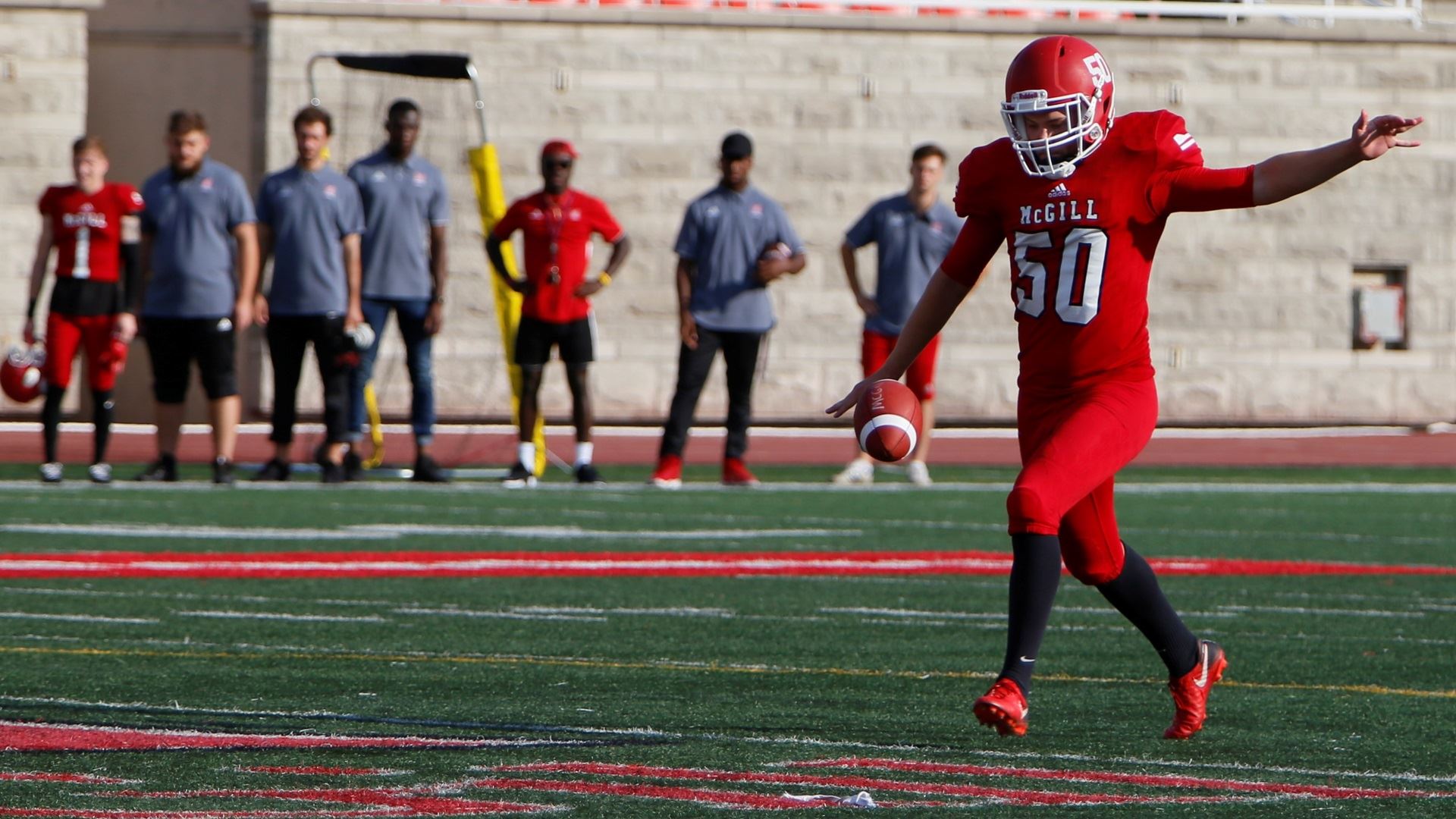
At the beginning of the fourth quarter, McGill gained a 14–10 advantage thanks to back-to-back safeties. With their lead restored, the home side focused on holding on to it: McGill’s defence swarmed the ball on every play, while the offence finally began to gain some momentum. Late in the game, McGill got into field goal range twice and fourth-year kicker Findlay Brown delivered both times. Brown completed his hat-trick with 1:18 left in the game to bring the score to 20-10. On the ensuing kickoff, Findlay “The Enforcer” Brown made a touchdown-saving tackle to cap off his impressive afternoon.

First-year running-back Laurent Sansalone was a bright spot for McGill’s offence, collecting 63 yards in only nine touches of the ball. Sansalone hopes that his hard work will inspire other rookies on the team.

“I worked my butt off every practice, which gave the coaches confidence in me,” Sansalone said. “Early in the game, they got me the ball, so I ran vertical and got a few first downs.”

McGill will take on the undefeated Montreal Carabins (5-0) at Stade du CEPSUM on Oct. 4.


Moment of the Game:

With the fate of the game still in the balance, fourth-year kicker Findlay Brown hammered home a 44-yard field goal to seal McGill’s victory.

Quotable:

“When we play at our full potential, there is no doubt in my mind that we are the best defence in the league.” – Second-year defensive tackle Thomas Trépanier on the team’s homecoming performance.

Stat Corner:

McGill’s defence only allowed 42 net passing yards: A McGill record under the tenure of Head Coach Ronald Hilaire.

Read the latest issue

Read the latest issue