
Latest News

Creative, Video

McGill Minute – February 14, 2022

Staff Writer Tess Pilkington brings you the top stories of the week in the Tribune’s weekly news segment, “McGill Minute”.

Art, Arts & Entertainment

‘Food for Thought: Riddles and Riddling Ways’ explores whimsical culinary rituals

As of Feb. 1, McGill’s McLennan Library has become home to Food for Thought: Riddles and Riddling Ways, the newest exhibit presented by the Rare & Special Collections, Osler, Art, and Archives (ROAAr) branch. The exhibit—dubbed The Riddle Project—was curated by English professor and associate dean of McGill Library Nathalie Cooke and her team.

Centring on “the intersections of culinary and riddling practices” in North America and the United Kingdom during the 18th to 20th centuries,  the display features a collection of joke-books and riddles printed on dishes and menus. This playful and charming exhibit invites students and faculty into the library with its beautiful, old manuscripts and riddling items that remind the observer of the joys and bizarre traditions of communal meals during the Age of Enlightenment.

The discovery of a collection of menus that describe dishes through riddles, called “Enigmatic Bills of Fare” prompted the idea for The Riddle Project. These items were initially made with the intention to liven up dinner parties for centuries using riddles and puzzles. A “blog post” accompanies each item in the collection explaining the object’s origins and elaborating upon its connection to the larger purpose of the exhibit.

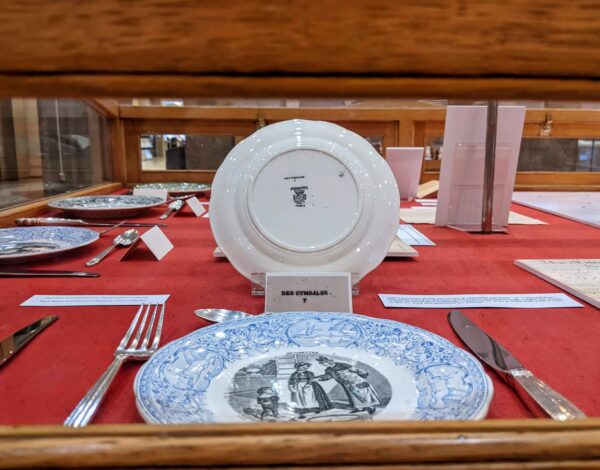
Upon first glance, the collection appears rather insignificant, with only a dozen small objects on display. But upon future inspection, it becomes apparent that each object is multifaceted: They not only perform their intended use, but also act as entertainment and as conversation starters. For example, the exhibit boasts an impressive collection of plates dating back to the 1850s. Though at first the plates appear rather boring, a closer look reveals that what is actually printed only on the front is a riddle, with the answer written on the back. One plate depicts an image of two men, one dressed in regular clothes and the other in a strange wizard costume. The riddle at the bottom on the plate reads (in French) “What is the day of the year that no one has ever seen?,” while the underside reads “tomorrow.” 

Several manuscripts featured in the exhibit contain pages of cartoon-like illustrations accompanied by short riddles that are a treat for any fan of vintage cartoons and comic books. The colourful drawings and images stand out against the black and white texts. The catch is that all the riddles have a food-related answer. The exhibit maintains the perfect balance of hilarious, colourful riddles and games, as well as explanations to hold the viewer’s attention as they make their way through the collection. 

Though it is being housed in the library, the collection is also available online. Moreover, the online version contains a myriad of interactive world maps that show the viewer where and when many of these objects originated. 

Food for Thought: Riddles and Riddling Ways breaks bread with riddles in order to find their connection to shared culinary history. Filled with whimsical figures painted on plates and into books, these artifacts come to life as the viewer unravels the mystery behind their hidden games. The exhibit solves the puzzles of early 18th-19th century riddles and may just even inspire your next dinner party. 

Know Your Athlete, Sports

Know Your Athlete: Emma Hawko

As the new captain of McGill’s sailing team and a qualifier for the 2022 Lightning World Championships, Emma Hawko has found remarkable success in both collegiate and club sailing. In 2021, at only 21 years old, she was named the Canadian Intercollegiate Sailing Association female crew of the year. Since she began sailing 12 years ago, Hawko has used a large variety of sailboat classes like Lightning, Etchells, and Laser. She started at McGill three years ago and has excelled both on the water and in class, where she studies international development.

Sailors form teams with their crews for a multi-person boat but work as a single unit toward a spot on the podium. Although usually boats from the same clubs or countries do not form a team, collegiate regattas differ in that a team has multiple boats sailing, instead of just the one. In an interview with The McGill Tribune, Hawko detailed the differences between her time sailing with her club, Lake Champlain Yacht Club, and with the McGill sailing team.

“The biggest difference is that in McGill’s team it’s very much as a team,” Hawko said. “You send two boats of people to a regatta and you have to work as a team to do well, whereas the rest of my sailing, it’s more of an individual [effort].” 

Collegiate sailing provides the unique opportunity to step away from the familiar functioning of national and international regattas and embrace new team-based dynamics. Reflecting on these differences, Hawko revealed that she did not have a favourite between the two. 

“I like them both,” she said fondly. “They’re both good challenges and good learning opportunities.”

Another marked difference between club sailing and collegiate sailing is the presence of women, nonbinary, and genderqueer people. Hawko has noticed this discrepancy both in her time at the local club and while working toward qualifying for the World Championships. 

“[It is] a little bit jarring, thinking, ‘huh, there are only five other women here,’” Hawko said. “Most of the people I interacted with were men at [the] North American [Championships].”

Though this paints a bleak picture of sailing as a male-dominated sport, Hawko insists that this is no longer the case. 

“I think it’s getting better, especially with collegiate sailing and Title IX,” she said. “There are no mens-only teams, but there are women-only teams. You’re not allowed to have a team that is designated as men only.” 

Title IX stipulates that collegiate teams are representative of their student populations and increases opportunities for women in sports where they previously were limited. 

McGill’s team is unique in its composition, with women actually outnumbering men.

“On the McGill team two-thirds of our team are women, it’s pretty awesome,” said Hawko. “It’s not a common thing for a team to have mostly women, so we’re pretty proud of it too.”

As the sport moves toward a more inclusive future, the McGill sailing team finds itself in a unique position to break the mold of traditional sailing culture. 

Hawko is not anticipating ending her sailing career anytime soon. She hinted at the future possibility of working with either U.S. Sailing or Sail Canada, but for now, she has her sights set on Lightning Worlds.

“As long as I am able to keep sailing at a fairly competitive level, I am going to be pretty happy wherever I end up,” Hawko said. 

Hawko will be competing at the Lightning Worlds in May and intends to train as hard as she can to earn a high standing.

Editorial, Opinion

The convoy should truck off

On Jan. 15, the federal government implemented a vaccine mandate for all cross-border essential workers, including truckers—meaning that unvaccinated drivers would have to quarantine for 14 days, and self-test after the eighth day whenever they enter Canada. Backlash has been fierce ever since, marked most obviously by the self-proclaimed “Freedom Convoy” that arrived in Ottawa on Jan. 28. Despite the fact that approximately 90 per cent of truckers are fully vaccinated and groups such as the Canadian Trucking Alliance have spoken out against the protests, this reactionary coalition has received intense and growing support. 

From the over $10-million amassed in GoFundMe donations, to support from both provincial and federal conservative politicians and international actors like Fox News and former U.S. President Donald Trump, the convoy has managed to cut across wide swaths of the population. Granted, the movement has every right to criticize and organize against what they believe to be misguided and overreaching measures by the federal government, as is guaranteed in the Charter of Rights and Freedoms. However, this campaign has quickly devolved into a disturbance of peace, where minority concern over government mismanagement is lost to the violence of the movement, including their desecration of national monuments and tombs, along their affiliation with white supremacists and anti-Semites.

A multitude of factors are responsible for the rise of the protests: Unclear restrictions, poor government messaging, political theatre, citizen apathy, the polarizing effects of Big Tech, and a Canadian tendency to forget local, fascist histories, are but a few. The truckers should cede ground, acknowledging that they have a damaging effect on public safety. Until then, government officials must push to address the root causes of the proliferation of this anti-science, false oppressive, and fascist-adjacent movement.

It is possible to raise concerns about COVID-19 measures in productive, pragmatic, and democratic ways—take efforts by small business owners and unions that have organized and spoken to the government as examples. This fringe minority group of truckers, on the other hand, perceives vaccine mandates as a restriction on individual liberty, hence their use of the rhetoric of “freedom.” Valid skepticism about government overreach, though, should not employ anti-science language. Had the truckers chosen to protest vaccine mandates in good faith, they would not have allowed such extremist, anti-science angles to debase their initial legitimate concerns.

But in a world where social media algorithms group like-minded individuals together and confine them to reductive echo chambers, it is unsurprising that individuals mobilize in the absence of critical thought. The kind of groupthink exemplified within the convoy normalizes the idea that one’s individual rights and liberties supersede the health and safety of the general public. The movement pushes the rhetoric of individual liberty to the extremes: To fabricate a sense of oppression over a public health issue is to make a false equivalency with systemic and structural racism.

Though Nazi and Confederate flags appear throughout the rallies, some high-profile supporters, like newly appointed interim opposition leader Candice Bergen, argue that onlookers should not let these extremists’ opinions distract from the “real” problem. These protestors should take umbrage in how anti-racist movements face relentless criticism when they rightfully hold governments to account. Consider the hypocrisy of police, politicians, and mainstream media during the Black Lives Matter protests: When millions walked peacefully in the streets, these powers sensationalized a minority that vandalized and took down monuments of perpetrators of genocide and Confederate “heroes.” 

In the eyes of the government—and certainly in the eyes of the police—white protestors continue to be treated as more human and more deserving of the right to protest, even as their movement fails to recognize actual threats to liberty, like wealth and racial inequality and settler colonialism. In reality, the trucker convoy itself threatens freedom, harassing people in shelters and small businesses. The protestors’ scrupulous focus on a specific kind of individual liberty does not and cannot fix far more pressing collective struggles.

The truckers show no sign of slowing down. When celebrated on the right as “freedom fighters” and met with next to no police intervention, they have good reason not to. Solutions remain tricky: Though Prime Minister Justin Trudeau has said that he will not negotiate with convoy participants, the Liberals’ absence feeds the flame and puts society at large at risk. But to really fix the problem, governments must be far more clear and transparent in communicating public health restrictions, while also cracking down on how Big Tech polarizes, brainwashes, and recircuits citizens’ engagement with each other. Doing so will not just tamper the protests, but protect Canadian democracy.

Science & Technology

Fishing for diversity: Understanding the lake trout’s genome

Faced with the sharp shifts of climate change and continuous human expansion, animals must adapt to survive—an ability that depends largely on a species’ genetic diversity. Professor Ioannis Ragoussis, head of genome sciences at the McGill Genome Centre, is studying this diversity by sequencing the genome of species native to Canada, including the lake trout.

The lake trout is a glacial relic that has commanded a widespread presence in North America since the Wisconsin glaciation event ended 11,000 years ago. Flourishing in deep, cold waters from Alaska to New England, the trout is the top predator of the Great Lakes. Its abundance made it a major food source for many Indigenous communities, from Inuit in Northern Quebec to the First Nations in Yukon.

Throughout the 19th century, overfishing by colonial powers, corporate pollution, and invasive species predation devastated the trout population. By the 1960s, the lake trout population had plummeted in many lakes it had previously thrived in. A significant consequence of this major decrease in population size was a loss of genetic diversity.

“Fish and other organisms try to maintain some form of genetic diversity that will allow them to adapt to different conditions,” Ragoussis said in an interview with The McGill Tribune. “If the genetic diversity is lost, then the ecological diversity is lost at the same time [and] they don’t have the tools to adapt to a changing environment.”

Genetic diversity allows species to adapt to changing conditions, like the increasing global average temperature and ecosystem perturbations caused by climate change. Greater variety within the gene pool is crucial for repopulation and also helps ensure that individuals can survive in many different conditions—if a disaster arises and all the fish are genetically similar, then the population is at greater risk of extinction.

Genome sequencing serves as an essential tool for the many hatcheries working toward lake trout repopulation. A species’ genome can also provide insight into its evolution and serve important strategic purposes.

“Once we establish the required diversity using science, we can make a much better argument to governments and environmental organizations [about] the need for maintaining certain numbers of species,” Ragoussis said. “It will be a tool that will allow us to have a better leverage in establishing environmental protection and conservation efforts in Canada.”

The lake trout genome was sequenced as part of CanSeq150, a collaborative initiative by the Canadian Genomics Enterprise to assemble the genomes of 150 species through a network of Canadian research centres. Following the initial success of this program, the Canadian BioGenome Project seeks to sequence the genomes of 400 species crucial for biodiversity and conservation in conjunction with the Earth BioGenome Project. The work will be shared by McGill Genome Centre, the Michael Smith Genome Sciences Centre in Vancouver, and the Centre for Applied Genomics at the Hospital for Sick Children in Toronto.

“There are committees that are deciding who will go into Noah’s Ark, but due to the financial pressure, this time it can only include 400 species,” Ragoussis said. “We want to select the ones that are more threatened or very important to Indigenous communities. There is priority given to the needs of Indigenous populations and communities, like the sequencing of the genome of the muskoxen.”
The interdependence of ecosystems places great importance on the survival of each of its members. This project will sequence the genome of species from every level of animal life, from insects and fungi to fish and mammals. Understanding and preserving the genetic diversity of the animal kingdom will be crucial for a future of prosperous and resilient natural environments.

Features

When it comes to drugs, McGill is still stuck in the past

According to a 2020 Prison Policy Initiative study on mass incarceration, one in five incarcerated Americans are in prison because of a drug-related charge. In the U.S., there are approximately one million drug-related arrests each year, and six times as many arrests for drug possession as there are for drug sales. I myself have loved ones who have faced incarceration, familial ostracization, and travel restrictions because of petty drug charges. A somber weight bears down upon me at the thought of how many people continue to experience the brunt of these punishments. In Canada, new legislation such as Bill C-5 and the proposed Bill C-22 may appear progressive by repealing mandatory minimum drug sentences for drug offenses, but these reforms do little to address the systemic impacts of drug prohibition.

There are many reasons why public and legal tolerance of drug use is slow to develop. Stigma, anti-drug campaigns in schools, federal and state laws, racism, and no-tolerance drug policies at institutions like McGill continue to privilege out-of-sight, out-of-mind approaches to drug use that are rooted in racist and colonial value systems. By prohibiting and punishing drug use, such policies enact undue harm upon people, especially marginalized and minority communities. These attitudes, at a policy level, feed into the prison-industrial complex by justifying the incarceration of nonviolent offenders, and giving law enforcement more reason to harass and persecute. Certainly, using drugs comes with inherent risks, including physiological and psychological harm. But zero-tolerance drug policies have deleterious effects of their own. For one, they prevent scholars and researchers from asking serious questions about how drugs have affected human history, and how they could positively impact the future. And even worse, these policies can force people to hide their drug use. Fearing legal consequences, users are less likely to access services such as drug testing and safe-use facilitators that reduce said dangers. 

There is a long history of political movements using drugs as symbols to scapegoat minority communities. For example, in the early 20th century, the U.S. Federal Bureau of Narcotics commissioner Henry Anslinger promoted propaganda campaigns that used the Spanish word “marijuana” rather than “cannabis” to forge an association between cannabis use and Black and Latinx people. Aslinger’s campaign made xenophobia and anti-drug legislation one and the same. Later on, U.S. President Richard Nixon famously termed drug use “Public Enemy Number One” and initiated a “War on Drugs” that has resulted in the disproportionately high incarceration of Black and Latinx people, who are significantly more likely to receive harsh sentences for the same drug-related crimes as white people. 

The criminalization of drug use is often associated with the U.S., and for good reason: The U.S. holds less than five per cent of the world’s population, but nearly 25 per cent of the world’s incarcerated people. However, targeting minorities by policing drug use isn’t limited to the U.S. In 2012, Stephen Harper’s Conservative government enacted Bill C-10 (the Safe Streets and Communities Act), which amped up legal consequences for minor drug offenses. It increased the maximum possible penalty for the production of Schedule II drugs—substances which included marijuana at the time—from seven to 14 years. Since the 1980s, Black communities in Canada have been systemically targeted by a kind of low-level war on drugs, as the Act facilitated intensive policing, racial profiling, and disproportionately high rates of incarceration for Black Canadians. 

In an interview with //The McGill Tribune//, Alexandra Holtom, a knowledge mobilization specialist with the National Safe Supply Community of Practice (NSS-CoP) at the Canadian Association of People who Use Drugs (CAPUD) explained that this pattern of targeting minorities through drug policies continues into the modern day.

“When we’re talking about criminalization and prohibition, what we actually see is that people of colour, people who are racialized, people with disabilities, queer and trans folks, Indigenous folks all suffer disproportionately highly compared to white individuals, or people of higher class or status,” Holtom said.

CAPUD aims to empower and inform drug users by pushing for drug policy reform and giving drug users a voice in the creation of policies that affect them. At NSS-CoP, Holtom works to facilitate the development of medicalized safer supply models, which provide drug users with known quantities and qualities of legal pharmaceutical-grade drugs in an effort to prevent overdoses. 

After decades of drug-related fearmongering in news and classrooms, the veils of confusion and apprehension that surround drug use are understandable, although I hesitate to use the term “natural.” Opioid overdoses, addiction, extreme paranoia, and psychosis are truly scary. But despite the harsh reality of these effects, not all illegal drugs induce these symptoms. Some illegal drugs could even potentially be used in therapies for certain conditions. Recent research into the therapeutic potential of psychedelic drugs––also known as entheogens or hallucinogens––suggest it might be a good idea to turn away from treating drugs as public enemy number one. One small study involving Johns Hopkins Medicine researchers found that two doses of psilocybin, the main active hallucinogenic chemical in a variety of fungi commonly known as “magic mushrooms,”, rapidly relieved depressive symptoms in adults with major depression. The drugs were given in combination with supportive psychotherapy. 

Commentary, Opinion

Anti-Black racism has no place in Nowruz celebrations

Every year, Persians meticulously celebrate the exact second that the sun passes the celestial equator, as the spring equinox marks the start of a new year, Nowruz. Nowruz, and most of the traditions that accompany it, have direct roots in Zoroastrianism, one of the oldest religions in the world. Yet, there is one practice with a backstory that remains disputed within the Persian community.  

Haji Firuz is a folklore character who heralds the holidays, wearing a red minstrel costume and most notably, a blackened face. Now, ahead of the coming Nowruz and especially in honour of Black History Month, Persians must admit that Haji Firuz is a racist caricature and must finally acknowledge the forgotten history of slavery in Iran. 

On the eve of the last Wednesday of the year, Persians celebrate a Zoroastrian practice called Chaharshanbe Suri by jumping over fire to cleanse themselves of sickness and evil. Traditionally, Haji Firuz is believed to have dark skin from the soot of this fire. Yet, this superficial explanation ignores the nuances of his persona that have direct links to slavery. 

The man dressed as Haji Firuz carries a tambourine and sings a popular jingle: 

“My Master, greetings!

My Master, hold your head up!

My Master, why don’t you laugh?

It’s Nowruz, it’s one day a year!”

Not only does this rhyme reflect his status as an enslaved jester, but Haji Firuz hails from Siah-bazi theatre, which is itself a racist form of entertainment. Siah-bazi, which translates to “playing  black,”  is no different than the minstrel shows in the United States. Much like how stock characters in those shows mocked enslaved people, characters in Siah-bazi perpetuate a lewd and clownish caricature of Black people.

Those who deny this anti-Blackness continue to excuse Haji Firuz as a centuries old beloved icon who spreads joy during the festivities. Some defenders of Haji Firuz reference misreadings of the famous Persian epic, Shahnameh, as the literary source of the character. Not only do these claims lack factual and historical backing, but they are also tired attempts at erasing Iran’s involvement in slave trade during the Qajar dynasty. 

Throughout the late Qajar period, historians estimate that one to two million people from East Africa were enslaved and brought to Iran, where slavery remained legal until Reza Shah of the Pahlavi dynasty finally abolished it in 1929. There exists a temptation to repaint slavery in Iran as a form of mild domestic servitude that was not based on race, especially in comparison to the United States. Yet, even if it may threaten the national pride of some Persians, racialized forced labour existed in Iran in multiple forms, including eunuchism and concubinage. It would be an absurd irony to talk of Iran’s history devoid of any reference to slavery. Haji Firuz is a product of Siah-bazi, which itself is the aftermath to years of racialized slavery. Appreciating Iran’s rich history and criticizing its wrongs are not and should not be mutually exclusive.  

Along with the erasure of slavery, the Black Iranian community has often been overlooked. The media’s lack of Afro-Iranian representation has led to an illusion of racial homogeneity in Iran. In 2015, German-Iranian photographer Mahdi Ehsaei created a series featuring photographs of Black Iranians in the Hormozgan province. The name of the collection, Afro-Iran: The Unknown Minority, is enough to demonstrate the neglect experienced by this community. Even so, while the Afro-Iranian community continues to be perceived as less Iranian, their cultural contributions are often viewed as Iranian products. Bandari music and dances, for example, are repeatedly stripped of their Afro-Iranian origins. If Persians enjoy Afro-Iranian art, they must also recognize the presence of Afro-Iranians; they must stand up against anti-Black racism, and they must denounce Haji Firuz and other forms of blackface like Siah-bazi. 

So, as you prepare your Haft-Seen arrangements this year, celebrate Chaharshanbe Suri, and play Bandari music during Sizdah-be-dar, remember and remind others that anti-Black racism has no place in our Nowruz festivities or anywhere else in our culture. 

Know Your Athlete, Sports

Know Your Olympic Athletes

Liam Gill

Among the many talented athletes at the 2022 Olympics is 18-year-old snowboarder Liam Gill. Gill represents the Dehcho Dene as a member of the Łı́ı́dlı̨ı̨ Kų́ę́ First Nation and is the only First Nations athlete on the Canadian Olympic team. 

Gill, who was originally an alternate for the snowboarding team, will be replacing Derek Livingston who was injured during training. Gill feels the weight of responsibility associated with competing in the place of an athlete for whom he has so much respect.

“Derek has been my mentor and idol in my journey of training in halfpipe this past year, and replacing him makes me want to make him proud,” Gill wrote in an email to The McGill Tribune. “I really want to land a run for him, [because] I know he will be cheering me on.” 

Livingston’s injury came just two days before the team was set to leave for Beijing. Gill remembers the moment he received the news—he immediately had to start packing and preparing to leave given the quick turnaround. 

“It was late morning the day before the snowboarding team had to leave. My mom woke me up and told me the news that Derek had been injured and I was going to replace him,” Gill wrote. “My first reaction was honestly being sad for Derek. I said, ‘No no no no.’ I knew how much Derek wanted to go and was hurting for him. I called Derek right away and talked to him while packing.”

The next day, Gill was on his way to his first Olympics, set to be the second-youngest member of the snowboarding team. Although he has never competed at the Olympic level, Gill has had other experience on the international stage.

In 2020, Gill represented Canada at the Winter Youth Olympic Games, where he finished eighth in the big air category, 11th in slopestyle, and 13th in halfpipe. During the 2020-2021 season, Gill was selected for both the slopestyle and halfpipe junior national teams, and this season, he moved up to be on the senior national halfpipe team. While he enjoys both events, he found his groove on the halfpipe.

“I always competed in both [halfpipe and slopestyle], but I was progressing very quickly in pipe and was motivated to catch up in my halfpipe skills compared to my slopestyle and big air skills,” Gill wrote. 

Ever since he shifted his focus to the halfpipe, his skills developed rapidly.

“Learning new tricks was motivating and progression came quickly,” Gill shared. “Halfpipe is a challenge, doing runs is terrifying and you really respect the riders that do it for that reason.” 

This year’s snowboard halfpipe event will run from Feb. 9 to Feb. 11 and will consist of two qualifying rounds and three finals rounds. Gill hopes to use this opportunity to try to land more advanced tricks. 
“I want to land a clean run, and then I also have a couple bigger tricks that I would like to put down, maybe one or a couple double 1260s,” Gill wrote. “[But] I don’t feel like I have to look out for any specific athlete, as we all try to cheer for each other and want each other to put the best runs we can down.”

(Liam Gill / Instagram)

Even with the strict COVID-19 restrictions put in place, Gill’s time at the Olympics has been both busy and rewarding so far. Though he enjoys going to the Olympic village to participate in the games or activities, nothing compares to the feeling of competing alongside his teammates.  

“My favourite part overall has to be being on snow with the rest of the Canadian team,” Gill wrote.

As the only Indigenous athlete on the snowboarding team, Gill hopes his performance will serve as a source of inspiration and pride for his community.

“I’m honoured to represent First Nations and Indigenous people in sport and hope to make them proud,” Gill wrote. “Hopefully I can inspire the youth up north in Liidlii Kue and all the Dene and other Indigenous communities to follow their passions and do what they love.”

Lilah Fear

London-raised Lilah Fear took up skating the moment she could walk. Currently a U3 Arts student at McGill, Fear will be representing Great Britain in ice dancing at this year’s 2022 Winter Olympics, competing with her partner, Scottish ice dancer Lewis Gibson

Speaking with The McGill Tribune, Fear looked back on the upbringing that steered her toward the ice rink. 

“Both of my parents are Canadian and there is a history of figure skating and ice hockey in my family,” Fear said. “I started group lessons in primary school, going to Queens Ice Rink in London weekly with my friends.”

Quickly, Fear turned her focus to ice dancing, where skaters dance on ice with a partner, and no jumps or throws are allowed. In contrast to figure skating, ice dancing pairs emphasize fluid, ballroom dancing-like motions, without the adrenaline overload of flying through the air on skates. 

“I did both free skate and ice dance, but always gravitated toward ice dance,” Fear said. “I didn’t love jumping and really didn’t love falling!”

Living in London afforded her a wealth of opportunities to pursue her talents

“Great Britain has an amazing solo ice dance circuit which allowed me to work on the technique and performance side on my own until I was lucky enough to find a partner,” Fear said. “I had one partner before teaming up with Lewis.”

A powerful and dedicated dancer, Fear also brings her work ethic to her studies. A part-time student studying psychology and social entrepreneurship at McGill, Fear believes that with good time management, it is possible to be both a world-class athlete and a university student.

“I have really enjoyed my studies and learning, and feel that having both aspects in my life is really enriching,” Fear said. “Sometimes [my studies feel] like a heavy load, especially during the competitive season, but […] I have also met some wonderful friends through McGill and am so thankful for these connections.”

Spending time in Montreal has allowed Fear to further hone her skills. She explained that her group training at the Ice Academy fosters unconditional support rather than rivalry.

“Within the realm of ice dance, we are lucky to train at the Ice Academy of Montreal, where we are surrounded by many of the top teams in the world,” Fear explained. “Not only are we inspired by them, we have an incredible coaching team that works to bring the best out of all the skaters.”

(Jonathan Nackstrand / AFP)

Like many athletes, making it to the Olympics had been a lifelong dream for Fear. She will be joining McGill alumna Tina Garabedian in the ice dancing category, who is competing for Armenia with her partner Simon Proulx-Sénécal. In the competition, each pair of dancers must execute several elements, including a lift, spin, step sequence, and turn sequence. There are also time limits, and dancers lose points if they exceed them. 

Every athlete, Fear explained, is going into this year’s Olympics with their own unique goals in mind. Many have been working toward these aspirations for months, and even years. Team spirit and morale has remained high across all events, and Fear plans to cheer for Great Britain in competitions like bobsled, speed skating, and curling.

Reflecting on her own goals, Fear hopes to highlight the spark between her and Gibson, and to deliver an emotional performance as ice dancing partners. 

“At these Olympics, we are aiming to deliver two performances that reflect how hard we have worked and the training that is in place,” Fear said. “We want to soak up the electric atmosphere, to share in this journey with athletes from around the world.”

Football, Sports

The legacy of Tom Brady: His impact on the past, present, and future of football

Amidst the excitement of the National Football League (NFL) playoffs, rumours began to circulate about the retirement of one of the most talented players to ever step foot on the field: Tom Brady. To the shock of many fans, the announcement was made official on Feb. 1, when the quarterback confirmed his retirement from the NFL via Instagram

Brady wrote a heartfelt message to his fans, teammates, and anyone else who had an impact on his career in an eight-page post.

“I’ve done a lot of reflecting this past week and have asked myself difficult questions,” Brady wrote in his announcement. “And I am so proud of what we have achieved. My teammates, coaches, fellow competitors, and fans deserve 100 [per cent] of me, but right now, it’s best I leave the field of play to the next generation of dedicated and committed athletes.” 

Anybody who knows anything about sports knows Tom Brady. The debate over the greatest athlete of all time is always a heavily contested one; however, most football fans staunchly believe it to be Brady. Being held to such a high standard is both a blessing and a curse: Brady has shown up year after year dominating the NFL, but this level of success does not come easy. Any sport, especially at a professional level, is gruelling on both the body and the mind, and his accomplishments only add extra pressure to maintain his stellar record. Perhaps, after 22 years, Brady wanted to end on a strong note with the most passing yards in the league this regular season—a whopping 5316—or perhaps he just wanted that monumental pressure lifted off his shoulders. 

Since being drafted by the New England Patriots in 2000, Brady has never given less than his absolute best for the teams and organizations he’s played for. With his countless accolades, it is difficult to make a valid argument denying Tom Brady as the greatest athlete to ever play the sport of football. The statistics are there to see: 15-time pro bowl competitor, three-time all pro team member, three-time MVP, and perhaps most notably, seven-time Super Bowl champion. Adding on, over the span of the 20-year Brady-Belichick era, when the Patriots were playing at home in the regular season and leading at halftime, their record was 106-1. 

Brady’s impact extended past the football world, bringing the athlete up to role model status. Patrick Domsa, U1 Management, felt that though Brady’s initial entry into the NFL was met with many doubts, his perseverance and dedication to his craft propelled him forward. 

“He came into the league not really having anything going for him besides the underdog mentality and his drive to succeed,” Domsa said. “He wasn’t an insane arm talent, [and] he couldn’t run like Steve Young or Randall Cunningham, but he still ended up proving everyone wrong, […] which is a pretty great message for kids.”

Nobody has dominated the game like Brady, especially at his age, with his last Super Bowl win at 43 years old. Winning the same number of Super Bowl titles in his twenties as he did in his forties, he’s demonstrated that skill does not necessarily decline with age. 

Brady has been met with nothing but support from the world of football after his decision to retire. Fans like Luke Dawick, U1 Education, continue to celebrate the talented player’s accomplishments. 

“When thinking of Tom Brady, you think of a winner, a leader,” Dawick wrote to the Tribune. “Someone that not just athletes but anyone can look up to. He broke almost every record that a quarterback can have. There will never be another Tom Brady to play in the NFL.”

With his passion for the sport, it is likely that Brady will continue to be involved with the industry in other respects. Whether it be in analytics, management, or another position, many doors remain open for the football veteran. 

Tom Brady is not only the most decorated athlete in football, but one of the most decorated athletes in the history of sports. His retirement is well earned, and his legacy will continue to make an impact on both football and sports as a whole for many years to come. 

Off the Board, Opinion

Back to the tailor

No matter where I live or how old I get, I never escape that one ill-fated afternoon every two weeks when my family declares that we are going to the tailor shop. As a toddler, a trip to this seemingly mundane part of town was an uphill battle––one where I turned into the poster child for restlessness. I fidgeted near the head tailor’s standing desk, which was always covered in a coarse beige cloth. While my mother discussed her latest fashion fixation with the head tailor, I always found the sights frustratingly boring and whined about wanting food or water. 

Childhood irritation fed by five-hour wait times and custom-made pieces soon came to an end as I gave in to the grandeur of the Indian tailor shop. With my toddler days behind me, my clothing preferences developed from multi-coloured ghagras with mirrors sewn into them to lavender blouses embroidered with flowers. For every new phase, my friendly neighbourhood tailor and his team of artists were ready to embrace change and create a new masterpiece.

Growing up, my local tailor shop had two floors, with the second hidden away from the customer’s gaze. Influenced by years of reading fantasy novels, I imagined a large sewing machine at the centre of the room surrounded by the desks of tailoring wizards who lorded over their personal projects. 

While they may not harness magical powers, or own abnormally large machines, tailors have been a vital presence in Indian communities due to a commonly held belief that ready-to-stitch fabrics are better than fully stitched garments. Tailors were a staple in Indian neighbourhoods because they served every social class and religion, exempting their profession from the rigid hierarchies of Indian society. Unlike the gradual disappearance of independent tailors in Western countries, India has a rich network of small-scale tailor shops that serve the local clientele.

Local tailor shops create special bonds that blossom when two people are inside the establishment. I found a friend in every little girl who stood behind her mother while she haggled over the price of stitching a new sari or fixing an old outfit. Meanwhile, mothers shared quick looks of exasperation at their cranky children and the increased tailoring costs. Although I never spoke to my younger companions, their presence was enough to remind me that this is a communal experience. 

Across South Asia, bespoke tailoring has made its way into the closets of millions of wedding-goers. In India, for example, the tailoring industry boomed, courtesy of a decentralized garment industry with no universal sizing chart. While the clothing industry has experienced a rapid increase in production, tailoring still remains at the heart of creating unique Indian traditional clothing for marriages and milestones alike. 

With its origins in making clothes accessible to different body types, the tailoring industry encourages customers to alter and customize their clothes instead of seeking out weight loss programs and diets. As South Asia continues to grapple with the aftermath of colonization, media representation constantly works against this message and prioritizes thin and fair-skinned bodies in its conception of beauty.

Tailoring is a refreshing escape from the cultural obsession with imagining an ‘ideal’ body type. When the restrictive nature of the fashion industry caught up with me, my admiration for the beautiful patterns on the shelves of a tailor shop became distorted. I felt an overwhelming sense of dread toward stuffy dressing rooms, measuring tapes, and my reflection. 

Luckily, fixing my relationship with my body is a life-long journey, and it began as soon as I stopped attaching moral judgment to the fact that my body will never mirror the sizing chart of stores with “ready-made” traditional clothing. It might have gone underlooked in the past, but tailoring is more than just a commercial venture or a hub for social connection—it stitches together a better reality where clothes fit the body, and not the other way around.

Read the latest issue

Read the latest issue