Latest News

Commentary, Opinion

Facebook’s blackout should inspire us to reevaluate our relationship with the internet

On Monday, Oct. 4, at approximately 11:30 a.m., the entirety of Facebook shut down due to an internal malfunction. Its 3.5 billion users were denied access for approximately six hours, resulting in global panic and complaints. With WhatsApp, Messenger, Instagram, and all the other Facebook-owned platforms also down, many of McGill’s clubs and student-run organizations were left scrambling to find alternative methods of communication. Despite the temptation to surrender to the simplicity of remote learning, the outage served as a reminder that students and instructors should stay grounded in tangible learning, like taking handwritten notes rather than typing, and attending in-person lectures rather than watching the recorded ones. 

The outage was a stark reminder of our dependence on social media. In a boom of online school and work, the pandemic has become a turning point: Society has now entered an irrevocable interdependent relationship with the internet. 

Within four hours of the shutdown, Twitter’s official account tweeted about the influx of new users migrating to their platform from Facebook. Within hours, the tweet amassed over 2.4 million likes. Many news sources were providing live updates throughout the incident, the first serious outage Facebook has had since 2019. As the software came back online, Facebook apologized in a tweet, and CEO Mark Zuckerburg also issued a statement in a post. However, already exposed was the terrifying reality that Facebook dominates our lives. 

Billions of people use Facebook every day, relying on it for communication of all sorts. Outside of North America, WhatsApp is the main platform for communication. With over two billion users worldwide, it was estimated to generate between five and 10 billion dollars in revenue for Facebook in 2020 alone. Added to Facebook’s monopoly on advertising and user data, the company has immense control over its users’ behaviour and encounters. At McGill, students use Facebook to chat with classmates and discuss course material—a now-normalized version of study groups. But many clubs and student-run activities at McGill also rely on Facebook’s apps for communication purposes, especially over the pandemic. 

But many clubs and student-run activities at McGill also rely on Facebook’s apps for communication purposes, especially over the pandemic. With many operations now fully online, social media and the internet permeated into nearly all aspects of life. This rapid switch from analogue to digital prompted the development of online softwares designed to ease the transition, propelling platforms like Zoom to see an unprecedented boom in popularity. The internet is convenient and efficient, and as the world slowly opens up and normalcy returns, society is left with a growing—and potentially permanent—dependence on online technologies. 

However, as much as society needs the internet, the internet also needs society. The outage resulted in Facebook shares plummeting 4.9 per cent—their biggest drop in almost a year. There is heavy corporate reliance on the customer base, and Facebook depends on their users to generate revenue. A self-sustaining cycle is created: The internet and social media are made popular by society and society uses them due to their popularity. This growing reliance on technology suggests the internet will continue to remain a crucial part of everyday life, but such a codependent relationship could have disastrous consequences, leaving society’s future entanglement with technology uncertain. 

Luckily, the majority of McGill’s coursework is distributed through myCourses, which is not a Facebook platform, but we can rest assured that if Zoom were to go down in a similar way, it would certainly result in campus-wide panic. With no alternative way to deliver online classes, McGill will need to confront post-pandemic academia as roughly half of the academic schedule would be thrown off course dramatically.

Hockey, Sports

McGill men’s hockey drops close contest to Concordia

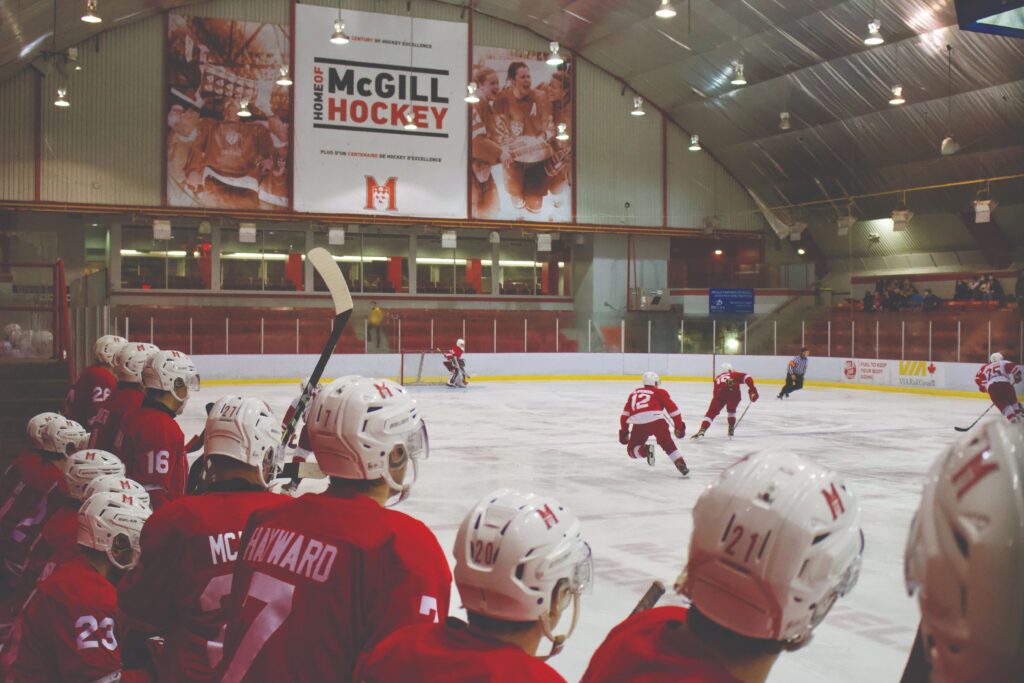
The McGill men’s hockey team (2–2–1) continued their preseason on Oct. 23 against the Concordia Stingers (2-2), dropping a 1-0 overtime affair. 

The game started at a fast pace, with solid puck movement and strong physicality from both teams. Early in the contest, McGill had multiple opportunities to strike first, after Concordia took two minor penalties in the first 10 minutes. However, Concordia’s penalty kill successfully squashed both chances for the Redbirds, and the game remained scoreless. 

After seizing early momentum with a pressing forecheck, McGill forward Andrew McIntyre took a tripping penalty, swinging energy toward the away team. Thankfully for the Redbirds, this was not an issue, as their penalty kill unit began their game-long dominance with an early shutdown of the Stingers’ power play. 

Following a strong showing at the end of the first period, McGill immediately hurt themselves again at the start of the second period, taking a head contact minor penalty, with an additional ten-minute misconduct given to the offender, Jordan-Ty Fournier. Again, the penalty kill unit stood tall, defending their own end phenomenally for two long minutes.

“I think that our penalty kill played really well. The forwards and defensemen were consistently in great position, especially considering it was a pre-season game and we have so many new players on the team,” first-year goaltender Alexis Shank said. 

Along with the penalty kill unit, a bright spot for the Redbirds was the rookie netminder. Shank stopped 41 shots, standing on his head at many points in the game, particularly during the second and third period when he faced 30 shots over 40 minutes.

Speaking to his fantastic performance, Shank remained humble, crediting his teammates for the success.

“I think my teammates have helped my confidence both on and off the ice,” Shank said. “They limited many chances throughout the game last night, and have made me feel comfortable as a young rookie on the squad.”

Following a scoreless second period that concluded with serious tension between the benches of the rival teams, it was evident that the first team to put the puck past the outstanding netminders would win the contest. 

In the third period, both teams had excellent opportunities in their offensive zone. The Redbirds continued their strong defensive play, exemplified by a crucial sliding block by first-year forward William Poirier to prevent an attempt on goal. 

After a tense final two minutes, in which McGill successfully killed the majority of yet another Concordia power play, the two downtown rivals were off to overtime to find a winner in the extremely defensive contest.

Just a few minutes into the electric, back-and-forth 3-on-3 overtime, Concordia buried a top corner goal on an odd man rush, winning the game for the Stingers. Despite the unfortunate result, the Redbirds played solid defence and have much to build on as the team heads into the regular season.

McGill begins their OUA season at Concordia on Nov. 3, followed by a “Friends of McGill Hockey Homecoming” match up against 2019-2020 national finalists, the Ottawa Gee-Gees.

Moment of the Game:

First-year netminder Alexis Shank makes a fantastic set of saves late in the third period to maintain a shutout during regulation time.

Stat Corner:Alexis Shank saved 41 of 42 shots, the highest season total of any McGill netminder this year.

Basketball, Sports

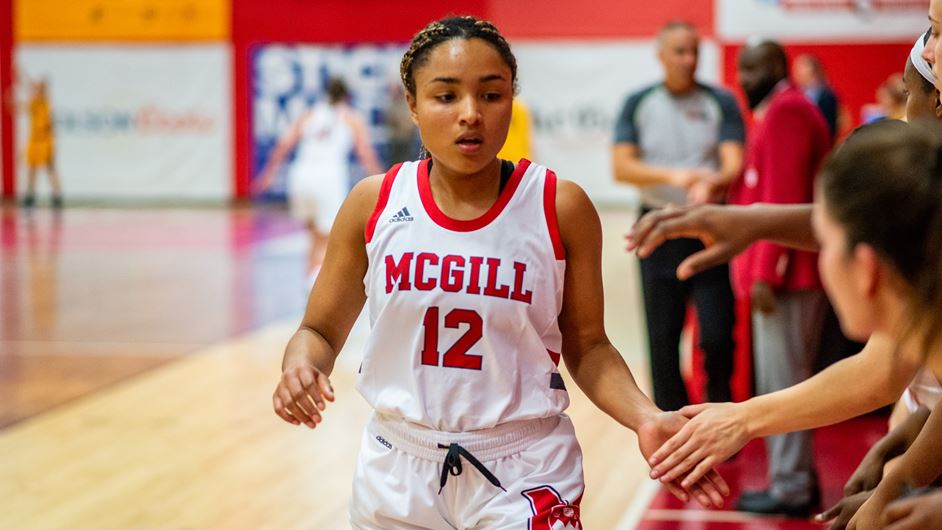
Martlets fall in Gee-Gee 61-38 shoot-out

On Oct. 23, the McGill Martlets (0–1) faced off against the University of Ottawa Gee-Gees (2–1) in their second game of the pre-season. Emerging from a loss to the University of Windsor Lancers, the Martlets failed to end their losing streak coming out of the long COVID-19-induced pause of the 2020-2021 athletic season. 

Over 100 fans gathered to attend this tête-à-tête at the Love Competition Hall for what proved to be a poignant loss for McGill fans.

The game opened at a leisurely pace, with both teams playing a hyper-effective full court press, suffocating any attempts at coordinated offensive play. The Martlets only managed 11 points to the Gee-Gees’ 15 in the first quarter, on only 29.4 per cent shooting from the field. 

The second quarter began much the same as the first, with minimal scoring chances for McGill and a never-ending wave of offensive drives to the paint by Ottawa. By the end of the quarter, McGill made only eight of their 38 attempts from three, and weren’t much better from inside the arc. First-year guard Emma-Jane Scotten was a bright spot amidst an otherwise fruitless quarter, making two of three three-pointers and ultimately leading the team to score 13 points, six rebounds, and two steals. 

A quick three-pointer from Scotten and jump shot from Jessica Salanon heartened the largely uneasy McGill crowd for a fleeting moment like a beacon in the distance. But the Gee-Gees were quick to stamp out any spark of McGillian hope with an onslaught of defence and dominance in the paint. For the rest of the quarter, McGill kept pressure high, contesting every shot and guarding with enough tenacity to scrap up six turnovers. Their defensive efforts came up short, however, as the Gee-Gees continued to make shots. Headed into the final quarter of the game, the score stood at 47-27 in favour of the Gee-Gees.

While the 20-point lead seemed insurmountable in the final 10 minutes of play, the Martlets never relented on defence, and even had flashes of greatness from first-year forward Charlotte Guerin, who tallied eight points, seven rebounds, and six steals over the course of the game. In the final moments, Guerin did not let up, getting her final steal with 12 seconds left on the clock. 

While a final score of 61-38 will leave many chalking the loss up to poor play by the Martlets, the developing team is only just spreading its wings. Under the direction of new head coach Rikki Bowles, the rookie-dominant roster has lots of potential to grow as they head into the regular season. While the team shot only 19.4 per cent from behind the arc this week, this won’t always be the case—as soon as the shots start falling, so will McGill’s opponents.

Guerin is optimistic about the future of the team and how they plan to approach their next game against Queen’s University on Oct. 30.

“I think Queen’s is on the same level as Ottawa, and I think that every week we really do get better,” Guerin said. “Every week we’ve played, we’ve gotten better against the next team. Hopefully by the time we get to the regular season we’ll be able to win consistently.”

Stat Corner:

First-year forward Charlotte Guerin earned a game high six steals with a suffocating defensive presence that was felt throughout the game.

Creative

McGill’s Lettuce Club: The Inaugural Meeting

Multimedia Editor Noah Vaton documents the thrilling inaugural McGill Lettuce Club Meeting. He outlines a complete history of how the event came to be, the excitement surrounding the event amongst McGill students, footage live from the event, and post-meeting interviews with both the original founder and this years winner, the ‘Head of Lettuce’.

Science & Technology

Reading for meaning: A new intervention for children with hyperlexia

Children diagnosed with autism spectrum disorder often have difficulty thriving in a modern education system that is not designed for their needs. Developing language skills, in particular, can be challenging for these children. 

Between 6 to 21 per cent of children with autism have a syndrome called hyperlexia, where they demonstrate a strong interest in letters and words from a very young age and learn to decode what they are reading very quickly—but generally have trouble associating words with their meanings. Children with hyperlexia also have a harder time developing certain literacy skills—specifically reading comprehension—compared to neurotypical children.

Reading comprehension development typically relies on certain precursors such as phonological awareness, the ability to identify and manipulate sounds, and phoneme-grapheme correspondence, the ability to understand the relationship between letters and sounds. Dianne Macdonald, a lecturer at Concordia University and speech-language pathologist, seeks to investigate the importance of these precursors for children with autism.

“These kids are not taking the same route as typically developing kids, they are following their own pathway,” Macdonald said in an interview with The McGill Tribune. “They don’t need those precursors in order to read words like typically developing kids.”

Despite displaying a below-average ability in tasks related to common pre-reading skills, children with autism, both with and without hyperlexia, showed advanced word-reading abilities. Contrary to neurotypical children, these precursor abilities were not necessary for them to decode and read words.

According to the Simple View of Reading, a widely accepted theory in literacy research, reading comprehension results from a combination of decoding skills and language comprehension. Although children with hyperlexia display very strong decoding skills, they lack essential language comprehension skills—essentially, they need practice understanding what they can already read.

In a follow-up study, Macdonald and her team designed a tablet app intended to help bridge this comprehension gap. Based on the dual coding theory of literacy, the app pairs written words with their corresponding images. The key idea was to expose children to the concept that the words represented the accompanying pictures, to help them practice assigning meaning to words.

Children with autism, both with and without hyperlexia, as well as a control group of neurotypical children all showed increased listening comprehension following time with the app. In addition, those in the hyperlexic group showed a significant increase in reading comprehension. Although expressive language skills did not see improvement, Macdonald remains optimistic, noting that hyperlexic children’s receptive fluency improved, a skill that precedes expressive fluency.

“If we can start focussing on reading comprehension really early for them then […] they get into school potentially better prepared language-wise,” Macdonald said.

The results show promise for the efficacy of such early-age interventions. Many participating children actively enjoyed using the app, and some parents requested to have their child continue using it after the completion of the study. 

Macdonald emphasizes that significant progress can be achieved by focussing on children’s strengths while tailoring interventions to fit their needs. By taking into account the skills and interests of children with autism, educators and parents can help them learn and grow in a positive environment.

“If we can find that sweet spot where we are incorporating the real talents [of kids with exceptionalities] and their interests and their strengths to support their challenges, I think that we can make really great gains,” Macdonald said.
Macdonald has made a web-based version of the app freely available online, and hopes parents and children will make use of the resource. She is currently looking to make the app open-source to allow other people to contribute and help tailor the app to more children’s needs.

Basketball, Sports

McGill men’s basketball falls to Ottawa despite inspiring comeback attempt

The McGill men’s basketball team (1–2) began this season’s back-to-back schedule on Oct. 15 with a heartbreaking defeat, losing 70-64 at home to the University of Ottawa Gee-Gees (2–0) despite an inspiring second-half comeback performance. 

The Gee-Gees started the game off strong with an effective full-court man-to-man press, preventing McGill from establishing any sort of offensive rhythm. Ottawa’s suffocating defence put heavy pressure on McGill throughout the quarter, forcing six early turnovers that translated into extra points for the Gee-Gees. McGill ended the frustrating first quarter trailing by 11 points.

The second quarter was more of the same: Ottawa’s full-court press continued to force more McGill turnovers for easy Gee-Gee baskets at the rim. While McGill’s defensive intensity kept fans from leaving the game before the half ended, McGill consistently failed to build up any offensive momentum throughout the quarter. The halftime score was 39-20, with Ottawa dominating the paint throughout the half.

The halftime break served as a much-needed reset for the Redbirds. Fifth-year guard Sam Jenkins explained that during the intermission, his coach gave the team a pep talk about working more cohesively.

“Coach Thorne’s message at halftime was to play our game on both sides of the ball,” Jenkins said in an interview with The McGill Tribune. “[To play] as a team rather than five individuals.”

During the third quarter, McGill breathed life back into the home crowd. The Redbirds took better care of the ball, leading to far better offence in the third quarter—McGill were one point shy from scoring as much as they did in the entire first half. However, despite McGill establishing a great offensive flow, the third quarter ended with the Redbirds trailing 52-39 going into the final frame.

Despite the disappointing result, third-year guard Cameron Elliot was impressed with his team’s effort in the second half of the game.

“I thought we had a great second half, making a big comeback after a slow start,” Elliot said. “We did a lot of good things that allowed us to compete with one of the best teams in the country.”

Fifth-year guard Sam Jenkins agreed with Elliot, citing Coach Thorne’s directives as crucial for their success.

“On offence, we slowed down and started sharing the ball,” Jenkins said. “Coach stresses playing for your teammates first rather than looking for our own [opportunities], and I think that was reflected in our [second] half assist numbers.” 

With momentum on their side, the Redbirds started the fourth quarter with intensity as Jamal Mayali hit a huge and-one three, bringing the crowd to a frenzy as he stepped up to the line for a four-point play. McGill would go on to give the Gee-Gees a taste of their own medicine, launching their own man-to-man press which helped them force turnovers in consecutive defensive possessions. McGill looked poised to make an unbelievable comeback as the Gee-Gees were only up by six with eight minutes to play.

However, Ottawa’s top performer Maxime Boursiquot killed any hope left within McGill’s crowd. Finishing with 20 points on a perfect nine for nine from the field, including a huge corner three to stop the bleeding, Boursiquot put the Gee-Gees back up by eight. The home crowd was only further stunned by crafty guard Kevin Civil, who finished a tough running layup through traffic, pushing the lead to double digits.

With their backs against the wall once again, McGill’s mental toughness shined through, keeping the game close with intense defence and timely shot-making. Once more, Sam Jenkins kept McGill in the game with a barrage of three-pointers throughout the fourth quarter, capping off an excellent performance and finishing with a game-high 29 points on an efficient 12-19 shooting from the field. While a costly turnover with 48 seconds left would effectively end McGill’s inspiring comeback attempt, McGill’s effort and resilience brought a loud roar of approval from the home fans as the final whistle blew.

Moment of the Game:

Fifth-year guard Jamal Mayali hit a tough and-one three at the nine-minute mark, sparking a mini McGill run early on in the fourth. This play helped McGill cut what was once a 20-point lead to six.

Stat Corner:

Ottawa was clearly the more successful team near the hoop, holding a 40-22 advantage for points in the paint.

Quotable:

“To be a competitor means you always want to be the best. If you don’t believe you can beat the team you’re lining up against, you never stand a chance. I think we have a chance to beat every team we play. It’s not going to be easy but I think we can be one of the best teams in the country.” —Third-year guard Cameron Elliot on the upcoming season

Features

The darker side of pre-med

For many pre-medical students, dreams of practising medicine have been playing through their minds since they were children. It’s the allure of being able to save someone’s life, help a person feel better, or finally provide that answer a patient has been searching for. Of course, some people have other reasons for pursuing medicine, like taking home a high salary, pleasing parents, or satisfying the narcissistic desire to prove to themselves they are smart enough. By high school, many students are convinced that medicine is their dream career.

At least until university. In a study conducted by scientists at the University of Minnesota, researchers found that only 16.5 per cent of students who said they planned to go to medical school at the start of their undergrad actually graduated university with sufficient course work to do so. The study analyzed a sample of 15,442 students across 102 universities, all from various demographics and socio-economic backgrounds. In my own life, I frequently hear about friends who used to be on the “pre-med” track deciding to switch to another career path. While some students’ interests may have changed after arriving to McGill, others said that they were driven away by the toxic culture that pervades the community. Even for those still gunning for medical school, the environment can prove to be extremely destructive. As a pre-med myself, I have experienced this phenomenon in many different forms during my time at McGill. Whether my classmates ignore my questions in class group chats, refuse to provide help with assignments or labs, or just constantly try to one-up my accomplishments, being immersed in such a cutthroat environment has certainly taken its toll. 

Sabine El Khoury, a D2 Dentistry student, had similar experiences in her undergraduate years. She recalled a time when she received misleading advice from another student about how to prepare for medical and dental school interviews. The student told her that they found preparation unnecessary—despite the fact that they had practiced for the interviews relentlessly.

“I have been lied to my face about something by someone who I thought was a friend,” El Khoury said in an interview with //The McGill Tribune//. “I asked them what they were doing and they lied to me just because of the competition. So I feel that [the environment] is toxic, and it is toxic unnecessarily because that person who lied to me didn’t end up getting into [medical school].” 

The constant competition can be exhausting, agreed Alex Schneider, U2 Science, who hopes to one day become a surgeon. Currently, most  Schneider’s friends are in the faculty of Arts. 

“I just am not friends with a lot of pre-med students because I feel like all they want to think about is pre-med,” said Schneider. “I have put in the time and the work. But when I want to hang out with my friends I do not want to think about class and be in competition with all these people, because I think that’s where it can be mentally exhausting.”

Part of the problem is the extremely low acceptance rates at most medical schools, which tend to require very high GPA and Medical College Admission Test (MCAT) scores. At McGill, the average undergraduate GPA for someone entering the Faculty of Medicine is 3.99 for those outside of Quebec, and 3.91 for those who attended a Quebec university. At the University of Toronto’s Faculty of Medicine, the average undergraduate GPA is a 3.95. Getting admitted to these schools is unlikely, given their meagre acceptance rates of 5.6 per cent and 8.3 per cent respectively. Such high standards can motivate and reward desperation, intimidation, and sabotage, instead of collaboration and kindness. 

Of course, medical school is extraordinarily difficult, and high standards are necessary to ensure that a student has the skills necessary to be successful. However, some schools like the University of Toronto have attempted to level the playing field by simply requiring a minimum MCAT score, but not evaluating it as a factor during admissions. Indeed, a more holistic approach might help create more well-rounded doctors. Selecting students only on the basis of their stellar grades might come at the cost of interpersonal skills and bedside manner, potentially causing worse outcomes for patients overall.

These high admission standards take their toll on aspiring doctors as well, leading directly to another harmful aspect of pre-med culture: Glorifying burnout. It can be hard not to feel guilty for taking a night off, especially when your GPA can determine so much about your future. 

El Khoury wishes she made more time for friends during her time in undergrad, instead of constantly excusing herself to study. 

“Looking back, I realize that I didn’t make as many friends as I wanted to because I was focussed so much on school,” El Khoury said. “If people were going out, I would say ‘I can’t, because I have to study.’”

While student burnout is not unique to McGill, the university’s lack of resources for students who intend to study medicine can leave them adrift. While advisors in the Faculty of Science can offer advice for pre-med students, their expertise in pre-med is poorly advertised. Instead, students turn to online spaces, such as the r/premed subreddit, which do not necessarily have the most accurate advice. One helpful resource the university does have is Medical Direction (MD), a completely student-run pre-medical society that supports students interested in medical professions. While the university does have a one-year pre-med program for incoming CEGEP students, it is only available to Quebec students.

Shreya Mahasenan, the program director for Medical Direction, admitted to falling into the trap of endless online resources, such as the over-abundance of information available at the nonprofit Student Doctor Network. In Mahasenan’s opinion, these sites promote an unsustainable lifestyle that usually produces burnout. One article she recalls reading during her first year boasted that no successful pre-med would stop studying to go out on a Friday night, while another suggested that anyone who performed poorly in a first-year class was “barely smart enough to be in school, let alone be a doctor.”

“You get a couple of years in and you realize a lot of the burnout you have could have been avoided by simply not making yourself grind on a Friday night,” Mahasenan said. 

After struggling to find the right information, Mahasenan ended up turning toward Medical Direction in search of other students to share experiences with.

“I would very much say that Medical Direction is students helping students,” Mahasenan said. “I think that’s what united a lot of people in the executive body [of Medical Direction]. We were those people who thought it was odd that there weren’t a lot of pre-med services or resources on campus.”

In many schools in the United States, such as UC Berkeley and the University of Texas at Austin, there are specific advisors that help guide pre-med students through the process of obtaining prerequisites and applying to medical school. Having resources like this at McGill—and advertising them to students explicitly—could help pre-med students feel less isolated and less inclined to turn toward those harmful online rabbit holes.

The lack of resources can make the journey into medicine even harder for those facing financial stress or other barriers, visible or not. Basing acceptance off students’ standardized tests like the MCAT can give those with more money and resources an unfair advantage. It’s far easier to do well on the MCAT when you have enough money to afford expensive prep resources and enough time to undergo hours of tutoring. By putting a lot of weight on the MCAT for medical school admissions, schools often end up rewarding wealthy, predominantly white students. 

Moreover, applying to medicine in and of itself, Mahasenan noted, is expensive. Racial diversity can compound this factor: One study at UCLA found that there is significant implicit racial bias in medical school admissions.

“Medicine is not always the most equitable field in terms of access, and people run into so many associated costs that come with paying for the MCAT or paying for applications,” Mahasenan said. 

In an attempt to bridge the gap, Medical Direction provides resources to students who have to work extra hard to get to the same place as more privileged students. The club offers upwards of $1500 in bursary awards and other support for students.

No matter where one falls on the income spectrum, however, achievement has costs beyond the financial. Pre-med culture is the perfect recipe for poor mental health, with gruelling competition often leading to insecurity and imposter syndrome, where you doubt your abilities and grapple with feelings of fraud. 

A study by the Department of Psychiatry at the University of California, San Diego discovered a greater prevalence and severity of major depressive disorder (MDD) among pre-medical students, particularly female and Hispanic students. This finding, on top of the fact that almost 50 per cent of university-age students in Montreal report anxiety and depression symptoms, paints an extremely alarming picture.

El Khoury said she noticed her mental health deteriorate once she began to apply to medical and dental schools. 

“I started having mental health problems during the end of undergrad when it was time to apply to all these schools because it was very stressful,” El Khoury said. “I was in the [mindset] where I thought that I didn’t deserve to get in because you hear about all these stories of people with [a] 4.0 [GPA] that don’t get in. So I was unnecessarily hard on myself.”

Given the sheer number of pre-med students at McGill, there need to be more mental health resources that are better publicized and easier to access than the current avenues available. As it is, students can seek help at the Student Wellness Hub and keep.meSAFE. Initiatives such as FRezCa, which offer one-on-one help for large prerequisite classes, may help first-year pre-med students feel less lost and alone. 

A good starting place for solving these issues could be in the actual classroom. In fact, some professors are already trying to change their students’ mindsets. Laura Pavelka, a faculty lecturer in the Department of Chemistry, has found that her students often hold themselves to unduly high standards. Pavelka also notices that students with the goal of medical school are particularly stressed and anxious.

“Part of that anxiety stems from the idea that anything but a 4.0 is failure,” Pavelka wrote in an email to the //Tribune//. “I find this extremely upsetting on many levels, as practicing doctors need so much more than strong academics. This drive for academic success can be at a detriment to many interpersonal skills and empathetic personality traits.”

The pressure also stems from high-stakes testing, which is common practice among science classes. Pavelka believes that professors should instead try to model what students will be expected to do in the workforce.

“When so much rides on one assessment, it is inevitably going to lead to a hyper-competitive and high anxiety situation for all students,” Pavelka said. “Outside of a university class structure, learning is much more self-directed, collaborative, and low-stakes.”

Most of all, Pavelka emphasized that it can be unrealistic to know what your future holds at the age of 17 or 18. I identify with her words immensely. As someone who changes my mind every few weeks about what I want to do for a living, it is important to remember that changing your dream does not mean you failed—it just means you have grown. For many, giving up the pre-medical path is the right choice. As for those who stay, it is important to advocate for yourself and your own mental wellness. After all, for a system ostensibly focussed on health, the well-being of students in pre-med and medical programs is a shockingly low priority.


Editorial, Opinion

In the minimum wage fight, a living wage is right

On Oct. 7, a group of anti-poverty advocacy groups and unions in Quebec, including La Fédération des travailleurs et travailleuses du Québec (FTQ), Syndicat de professionnelles et professionnels du gouvernement du Québec (SPGQ), and Collectif pour un Québec sans pauvreté, sent out a memo demanding that Quebec increase their minimum wage to $18/hour—a marked shift from their 2016 demand of $15/hour. The groups cited the province’s increasing costs of living that threaten to push workers deeper into poverty as the driving force behind their renewed calls for a living wage. Not only would an $18/hour wage make Quebec a more egalitarian society, it would simultaneously increase the purchasing power of the population—especially for women, a move that may help reduce the widening income gap. On behalf of the students, parents, immigrants, and other diverse communities that make up much of the minimum-wage earning class, Quebec must concede to these demands and move toward a living wage.

Quebec’s minimum wage currently sits at $13.50/hour without tips and at $10.80/hour with tips. Quebec is the only province that differentiates between a tipped wage an untipped one, with the tipped wage being the lowest wage in Canada. Some might explain away the lower wage by pointing to Montreal’s lauded affordability in comparison to the devastating housing and cost of living crises in cities like  Toronto and Vancouver. Ontario and British Columbia’s minimum wages are $14.35/hour and $15.20/hour, respectively. However, it remains that the average minimum-wage earner cannot afford rent in any of these provinces. In Montreal, only one-fifth of neighbourhoods have affordable one-bedroom options for minimum wage earners, and next to no affordable options for two-bedroom apartments. 

Added to the inflation of grocery prices, workers in Montreal face challenges to their physical needs and safety. These issues, compounded by the strain of deteriorating mental health, simultaneously decrease productivity and cause long lasting cyclical and detrimental impacts on the working class. By refusing to increase an unlivable minimum wage, Quebec sends a clear message to the workers that their basic needs and dignity are not a priority.

An $18/hour wage would protect workers’ lives. No government posturing or corporate social responsibility can make up for the lack of a living wage. Currently, workers sacrifice their physical and mental health, family time, and upward mobility in education for just enough money to scrape by. Facing an economy where a university degree is no longer enough to secure financial success in the future, many low-income and international students grapple with the additional burden of paying tuition without the benefits of intergenerational wealth. International students in particular are subjected to miscommunication and below minimum wage earnings.

The $10.80/hour tipped wage alone raises questions. Even though wages should not depend on performance, workers end up relying on arbitrary factors like their customers’ unpredictable goodwill, wallet, and even what time of day it is. Factors like cultural norms, vaccine scepticism, explicit and implicit gender, racial, and sexual biases, and the restaurant’s prices cause disparities in tipping. Quebec should not regulate an unregulatable practice. While this move may appear to place a drastic and unreasonable burden on the province, living on minimum wage should not be synonymous with poverty. With pandemic benefits and restrictions steadily lifting, changing to a living wage could potentially solve labour shortages and stimulate economic participation by incentivizing workers to re-enter the local economy as well as mitigating tipping disparities.


Though not without a fight, the living wage campaign has glimmers of hope. The federal minimum wage’s increase to $15/hour for federal workers will put pressure on the Quebec government facing a re-election campaign in 2022. The signatories can look optimistically at Canadian labour history where groups like the Canadian Union of Postal Workers’ “militant” strikes and walkouts for above average wages succeeded in sending workers’ rights shock waves across the country. Quebec is no stranger to acquiescing to demands: Facing strikes, Quebec recently increased daycare workers’ pay. Without essential workers, society falls into disarray. Without a living wage, workers suffer inhumanely. Quebec should go the distance to implement a living wage, and if not, should expect resistance.

Hockey, Sports

Redbirds Hockey leaves RMC reeling with 10-2 victory

A total of nine different McGill hockey players scored in the span of 60 minutes on Oct. 16, when the Redbirds (1–1) hosted Royal Military College (RMC) (0–1) for the second of six pre-season games. The Redbirds scored early and often, demolishing the visitors with a fatal 10-2 final score. 

From the puck drop, it was an intense affair—being only the second game in front of a home crowd, the game was lively and, at times, rowdy. Fourth-year forward and alternate captain Jordan-Ty Fournier took an interference penalty within the first minute, setting a precedent for what became an aggressive matchup, racking up 23 penalties overall. McGill scored four times when the call was in their favour, in contrast to RMC, who failed to capitalize on their nearly 20 minutes of power play time. 

The Redbirds dominated the ice in the first two periods, winning face-offs and never letting the puck linger in their defensive zone for too long. After third-year forward Blake Hayward opened the floodgates with a goal on McGill’s second power play, McGill converted six more times consecutively. Rookies Brandon Frattaroli, Caiden Daley, and Alex Plamondon tallied once each in their first victory suited up as Redbirds. 

RMC’s frustration was evident, through both the aggression they exhibited and the time-out they took midway through a five-on-three power play. Despite the advantage, RMC still could not maneuver past the wall of Scott Walford, who was awarded the first star of the game for one goal and two assists. 

(Elissa Dresdner / The McGill Tribune)

First-year goaltender Lucas Pfeil allowed zero goals on 16 shots over 35 minutes, before first-year Alexis Shank replaced him. Despite only manning the nets for a portion of the game, Shank, a Montreal Canadiens prospect who saved nine out of eleven shots, was optimistic about what the game meant for the team’s upcoming season. 

“Our […] goal is to go for the cup,” Shank said. “But right now we [are just] focussing on the process, and good things [are going] to happen.”

Teammate William Cyr, boasting one goal and one assist, was pleased with the team’s offensive chemistry. 

“I think we battled well together, and we did what we did in practice,” Cyr said. “We converged well [at] the net and we took rebounds [….] I think we have a great group, we’re having fun out there and just battling every day. We’re all working out and working hard, and we’ll get better each day.” 

Cyr was unbothered by the several penalties his teammates took, as the Redbirds killed off every single one. 

“Last two games, we had more than 16 penalties,” Cyr admitted. “When it’s 7-1, 7-2, for sure they will call against us, so it’s preseason, it was a good game [for everybody]. We had fun and just battled together, even though we played on the penalty kill like 15 times.” 

First-year forward Olivier Mathieu, who had one assist, felt that the team accomplished what they set out to do, evidenced by the final score. 

“Our coaches have put a pretty good system in to beat those big teams, and I think we executed the system pretty [well],” Mathieu said. “Our coach, during the second intermission, said to make sure we follow the game plan and not to lose our heads.”

The Redbirds play their next two pre-season games against rival Concordia, on Oct. 22 and 23, in preparation for the regular season kickoff on Nov. 3. 

Quotable:

“The ambiance was incredible. I don’t know how many people were there tonight, but on Wednesday, there weren’t many people [….] It was actually a tough one, we lost Wednesday, [but we] bounced back. It’s just 20 games, we can’t afford to lose two in a row. Just winning with the boys, it’s actually a pretty good vibe right now.” — First-year Olivier Mathieu on playing in front of a crowd again. 

Moment of the Game: 

Just over a minute into the second period, defenceman William Cyr buried a stunning, but unlikely, long shot from the blue line, bringing the score to 4-0 for McGill. 

Stat Corner: 

The McGill Redbirds have not scored ten goals in a single game since 2011, when they beat Ottawa 10-5. 

Off the Board, Opinion

Grappling with my love for misogynistic rap

On the train home a few weeks ago, I was about to pop on my headphones and listen to Kendrick Lamar when I overheard a conversation between two young white girls discussing their music taste. “I don’t understand how you can listen to rap,” one of the girls said. “All they talk about is money, drugs, and raping women.” Her friend agreed, adding that country music was much better and less controversial—as though the so-called purity of music is intrinsically tied to its artistic value.

I was immediately filled with a sense of indignation: Who were they to denounce an entire genre of music, one that was rooted in the history of Black liberation, one that has been used as a form of protest against oppressive structures since its inception? I knew that this stranger’s take was incredibly ignorant, but I still felt chastened. The next song in my queue was “My Dawg” by 21 Savage & Metro Boomin, where 21 raps about catching snitches and gang murder, among other concepts far removed from my life experience. Despite the murky content, it’s a sonically energizing track that I often reach for. I know music streams provide inadvertent support for these male rappers, but as a woman, how far can that support go without compromising my moral principles? 

When I first started seriously listening to harder rap, I was in the midst of a tumultuous emotional period, and sad indie music was not cutting it. Listening to the pugnacious bars of Kodak Black or Skepta empowered me to feel like “that bitch,” ready to embrace an overexaggerated bravado and propel myself forward despite the setbacks thrown my way. These rap and drill tracks provide a taste of what it’s like to walk through the world as a man—and a powerful one, at that.

Rap music puts up an impenetrable barrier of confidence between myself and the world. Blasting gangsta rap through my headphones and hearing the bass pulsate through my core is the closest I come to feeling dangerous, a major deviation from my typical feeling of fear as a woman of short stature. Listening to violent, gritty bars fuels me in a way that no other type of music does—it holds affective power and allows me to feel and channel my rage—an emotion that women are often told is inappropriate. Black women, in particular, are doubly affected as they must navigate the “angry Black woman” stereotype. 

This moral dilemma reminds me of the notion of disidentification, a concept proposed by queer theorist José Esteban Muñoz that explains how gender, sexual, and racial minorities can engage with mainstream art forms that are created within a structure of oppression. Choosing to align yourself for or against a cultural product are not the only two options—you can repurpose the art to suit your life and identity. Appreciating culture without endorsing it is possible, and even necessary, for engaging with works as subjective as music. 

My love of female rappers, thankfully, does not pose the same moral dilemma. My favourites, like Megan Thee Stallion and Little Simz, are talented artists who rarely bring down other women in their music. 

Separately from thematic content, problematic moguls in the rap industry should be held accountable for the harm they cause people, as with any other individual with widespread influence. Rap has its fair share of problematic personas—Chris Brown and Tory Lanez spring to mind—but then again, so does country music, which is rooted in white supremacy and has a serious domestic violence problem. Stereotyping an entire genre of artistry, especially one whose artists are overwhelmingly people of colour, is a narrow-minded cop-out that does not help to dismantle the rampant misogyny within the music industry. 

Cultural products are whatever you make them, as music is a deeply personal experience, aurally, and emotionally. Engaging critically with the rap I adore continues to teach me about many different lived perspectives—both those who benefit from the patriarchy and systems of oppression, and those who fall victim to it—all with a chip on my shoulder and a rhythm in my step.   

Read the latest issue

Read the latest issue