

Latest News

News, The Tribune Explains

Tribune Explains: International students’ entry into Canada

As McGill opts for in-person learning this fall, international students are navigating the challenges of entering Canada, such as getting vaccinated, making a quarantine plan, and finding housing options. 

What are the requirements for students to enter Canada? 

As of Feb. 19, 2021, international students with a valid study permit or a study permit approval letter are allowed to enter Canada provided they have a negative COVID-19 test taken 72 hours before arrival. International students, regardless of vaccination status, must submit a precautionary quarantine plan—which details how they would access food and medicine in case the border officials deem a quarantine as necessary—through the ArriveCAN application. Students’ entry into Canada is still ultimately subject to the approval of officials at the border. 

Who has to quarantine upon arrival to Canada? 

As of July 5, fully vaccinated students eligible for entry to Canada are exempt from the mandatory 14-day quarantine, but students who are unvaccinated are still expected to comply with the quarantine. However, to be qualified as “fully vaccinated,” students must have  received their second dose of an approved vaccine 14 days prior to their arrival at the border. 

Canada’s mandatory three-day hotel quarantine will be dropped for all travellers, regardless of vaccination status, starting Aug. 9. 

How have entry requirements affected McGill students? 

Some international students, especially those affected by slow vaccine rollouts in their home countries, have claimed that Canada’s entry requirements have caused them stress. Adam*, U2 Science, explained that their inability to get an approved vaccine in time might lead to an unintended break in their studies. 

“I am facing a lot of problems with my vaccination,” Adam said. “In Iran, only the 50 and above age group can register to be vaccinated [….] I, as a 20-year-old with no medical problems, will not be vaccinated until early November. Not to mention that due to sanctions, the vaccines that are available in Iran are not on the list of approved vaccines by the Government of Canada. 

Yasi Khan, U2 Arts, realized getting a dose of Sinovac at the beginning of the summer in her home country of Pakistan meant she would not be eligible for the quarantine exemption—which she says has complicated her return to campus.

“As an international student, you are kind of on your own to consider all these things,” Khan said. “You have to have all the right documents and vaccines, and you have to be prepared for anything [the border officers] are going to ask you [….] You might get rejected [from the quarantine exemption]. It is just a lot.” 

How is the university supporting international students? 

McGill has dedicated New Residence Hall to international students arriving on campus between Aug. 1-6 who need to complete their 14 day quarantine. Students will be charged $50 per night for a room. The deadline to book a room is Aug 6. to allow for the full 14-day quarantine and for the building’s complete disinfection before residence move-in weekend on Aug. 21-22. 

According to Frédérique Mazerolle, a McGill media relations officer, the administration and International Student Services (ISS) have implemented additional accommodations in recognition of the challenges international students may face. 

“There will be an online form available for students who may require academic accommodations at the beginning of the Fall term, and the Office of the Dean of Students will work on a case-by-case basis around academic accommodation for these students,” wrote Mazerolle to The McGill Tribune.

The ISS will be hosting four town halls during the month of August to answer any questions from students regarding quarantine requirements, housing options, and the logistics of arriving on campus. 

Hockey, Sports

Montreal Canadiens face offseason uncertainty after Stanley Cup loss

After a drought of nearly 30 years, it looked like this might be the year that the Montreal Canadiens bring home the Stanley Cup. In Game 5 of the 2021 Stanley Cup Finals, however, the Canadiens’ dreams were shattered by a single goal. The Tampa Bay Lightning, a powerhouse team by all measures, were crowned the champions for the second year in a row under the leadership of McGill alumnus Mathieu Darche, BComm ‘00. 

Despite the disappointing result, the Canadiens’ playoff run rejuvenated the city of Montreal after almost three decades of not making the finals. The run also came as the city was starting to reopen after laying dormant due to COVID-19 public health restrictions and business closures. Now, the team must lick their wounds, avoid losing key players during a tricky offseason, and start all over again in October. 

Coming off of a shoddy regular season (24-21-11) and barely squeezing through to the playoffs, the Habs were the clear underdogs in the first round when they faced off against their long-standing rivals, the Toronto Maple Leafs. The outlook appeared grim for the Habs after three consecutive losses, but they embarked on a redemption arc that stymied the Winnipeg Jets and the Vegas Golden Knights, and brought them to compete in the finals against the reigning 2020 champs. 

Beating the Tampa Bay Lightning was never going to be an easy feat; with a stellar offensive core in players like Brayden Point and Nikita Kucherov, as well as a world-class goalie whose stats trump those of Carey Price’s, the Habs had their work cut out for them from Game 1. 

Despite the odds stacked against them, the Canadiens never saw themselves as underdogs. Battling extreme emotion during the post-game press conference, players, including Brendan Gallagher, expressed their bitter disappointment in failing to bring home the Stanley Cup. 

“We expected to be here,” Gallagher said, choking back tears. “Regardless of what people thought of our team, [our] expectations were to win this series.”

While returning home without the Cup was difficult for the whole team, it was especially painful for veteran players like Carey Price and captain Shea Weber, who may not have another opportunity to reach the championships. It is their 14th and 16th seasons in the NHL, respectively. 

Recent news of Weber’s injuries is especially concerning, with some sports networks saying that he may be out for most of the season and will not be protected for the upcoming Seattle Kraken expansion draft

Losing Shea Weber and his leadership would be a tough blow for the Canadiens, but arguably even tougher would be the loss of starting goaltender Carey Price. Having waived his No-Move Clause, Price will be exposed during the expansion draft to allow the Canadiens to protect their backup goaltender, Jake Allen. Price’s hefty $84 million contract and $11.5 million dollar signing bonus makes him quite pricey for the brand new Kraken team—a factor that may lessen his chances of being selected. However, exposing a starting goaltender, especially after such a successful playoff run, is risky. Jake Wagman, U2 Arts and an avid hockey fan, believes this move is ill-advised.

“Regardless of the chances, I think you need to protect the most important player on the team, [Carey Price],” Wagman said in an interview with The McGill Tribune. “I would say there is a 50 per cent chance [the Kraken will] take him and […] if they do take him, the Canadiens are in trouble despite having multiple young, promising players.”

Some of the team’s youngest players, like Cole Caufield, Nick Suzuki, and Jesperi Kotkaniemi, have been serious offensive assets and are looking forward to playing in a full-capacity Bell Centre. Hopefully, that experience will include the support of their captain and starting goaltender.

“The city has been nothing but unbelievable,” Caufield said during his end-of-season media availability. “This is only just the start. The fans deserve a winning team. We gave them a little taste of it this year.” 

Science & Technology

Macdonald campus pollinator project gives native bees what they need

The Native Pollinator Habitat Project, launching in summer 2021, is McGill’s Macdonald Campus Sustainability Working Group’s latest initiative that aims to make the campus more hospitable to native species. Led by Frieda Beauregard, professor in the Department of Plant Science at McGill and curator of the McGill University Herbarium, the project will provide floral resources and nesting habitats to support local bee and pollinator populations. 

Inspired by a study in the Journal of Insect Conservation, Beauregard and her team will set up logs and squares of sandy soil to provide comfortable nesting places for local ground-nesting bees. 

Global bee populations have been in steady decline since the 1940s. A growing awareness of the threats to pollinators has resulted in an increased public effort to support bees, such as installing “bee hotels” on personal property, banning harmful pesticides called neonicotinoids, and cultivating wild plants.

Gail MacInnis, a postdoctoral fellow at Concordia University, is studying the impact of urban beekeeping in Montreal on native bee populations in Montreal. According to MacInnis, most of Montreal’s native bees have been neglected by mainstream conservation groups. This is why efforts like the Pollinator Project, which support the unique habitats and needs of native bees, are necessary.

“A lot of people do not realize that around 70 to 80 per cent of our [175] native bee species […] nest in the ground,” MacInnis said in an interview with The McGill Tribune

 Unlike the typical depictions of bees in swarms, many of Montreal’s native bee species are solitary and nest in sandy, well-drained, undisturbed soils where they lay between five and 10 eggs annually.

There has been a recent influx of urban beekeeping in Montreal, which has been on the rise since 2008; multiple companies have built profitable businesses selling urban beehives as a tool to support biodiversity. 

 MacInnis explained that native bee species have evolved with complex relationships to local plants. The native squash bee, for example, can only pollinate squash flowers. Though honey bees can also populate these blossoms, they often outcompete local species in doing so, draining local pollen resources and damaging local ecosystems. 

“People have been […] misled into thinking, ‘if I keep a hive in my backyard, this is helping fight bee decline,” MacInnis said. “It is much more likely that [specialized native bees are] going to decline because they cannot just shift to another plant like a honey bee would.” 

The impact of this rise in urban beekeeping on local bees is not yet known, and MacInnis believes that is part of the problem. Unlike Toronto and other major cities, Montreal has no formal system in place to track the location or quantity of honey bees in the city. 

“One of my biggest hopes is that […] we start monitoring our honey bee populations so that we [can] avoid situations where we are putting high densities of hives in the same area,” MacInnis said. “Keeping honey bees to save the bees is like keeping chickens to save the birds.” 

Luckily, supporting native bees through individual action is not difficult if done properly. Those with backyards can make their soils hospitable to ground-nesting bees by mulching less, avoiding pesticides, and planting native flowers like Bee Balm (Wild Bergamot). 

At Mac Campus, the 200 trees project and soon-to-be-planted wildflower meadow are other additions to the Pollinator Habitat Project aimed to support native bees. Through a partnership with John Abbott College, the campus will also be used for educational purposes: Students will be able to study the pollination patterns of insects and share discoveries on iNaturalist, an app that allows image-based sharing of native plants. 

“This project is a small part of other projects trying to make [Macdonald Campus] that much more full of life,” Beauregard said in an interview with the Tribune

MacInnis echoed the sentiment, and hopes that members of McGill and the public will embrace the opportunity to discover how they can support the local environments that sustain our native pollinators.

Creative

Change Makers Episode 4: Tori Ford

In the fourth episode of Change Makers, Multimedia Editor Noah Vaton speaks with Tori Ford, an award-winning gender health equity advocate, researcher, and entrepreneur on a mission to eliminate sexism, shame, and stigma from health experiences. She is is the founder of Medical Herstory, a youth-led not-for-profit advancing gender health equity.

Art, Arts & Entertainment

Sarah Stevenson’s ‘Before the Storm’ explores the turbulent intimacy of stillness

When one enters the Fonderie Darling main hall, they find themselves wandering through an industrial room populated by a family of six colourful hanging wire skeletons. These grand sculptural ghosts—resembling airy animal shells, phantom produce, and woven costumes—are the manifestations of human experiences. Montreal-based artist Sarah Stevenson’s new exhibition, Before the Storm, presents the sculptures. All six phantom fishing wire figures, each differing in size and colour, present a metaphysical figuration of how people experience themselves in relation to artistic space and suspended time. Through her creations, Stevenson explores stillness before massive change, like tranquility before a storm. Her pieces evoke a sharp, almost ominous stillness that is at once soothing and deeply unsettling. The use of fishing wire as the primary medium exemplifies this notion, catching the viewer off guard as they approach the seemingly fluid and string-like creations, only to discover their rigid, contorted structure.

Stevenson’s titles exemplify abstract and organic design concepts: Spike, Spine, Bruise, Nimbus, Burn, and Bean. Displaying a mastery of spatial and colour dynamics, the hanging figurines are almost invisible from a distance, but imposing up close. Within the industrial, factory-like space of the Fonderie, the works intermingle, creating visual illusions as the viewer moves around the room. Varying in appearance but similar in style and material, each figure embodies its title: Spike is a blue ball-base culminating in a pointed spike jolting out on top; Spine is a row of lantern-like lime green fungi dropping into one another to create a cord; Nimbus is a string of large, red beads that form a hanging, cloud-like cornucopia. 

Particularly powerful is Bruise, in which the piece physically shapes space, form, and colour to evoke the experience of the title itself. The sculpture possesses the palette of a bruise—purple and yellow. The wire static shape expands outward from the angular point at its base to create a small, downward-facing cone. At its midpoint, the cone squeezes back inward, with a larger, wobbling sphere bubbling over. Then, the form tightens again like a fist, only to then expand, mushrooming out at the top with the largest segment of the triada round, flattened sphere. At last, the bruise is numb and swollen, spreading through the entire corpus. Through the piece’s drastic highs and lows—displayed in its squeezing and expanding—and the way in which a numb, spacious pain always narrows down to one, sharp point, Stevenson crafts a fascinating manifestation of pain.

Ultimately, Stevenson works magic as an architectural poet, taking individual words and bringing them into three-dimensional space through sculptures that overflow with visual and emotional complexity. Before the Storm manifests time into colourful, diverse shapes that bring viewers into a fishing-line-crafted web of artistic inspiration and creativity. 

Before the Storm is exhibiting until Aug. 22 at the Fonderie Darling located at 745 rue Ottawa Montreal.

McGill, News

McGill Board of Governors member resigns in protest of the board’s refusal to table a motion on equity

Former McGill University Board of Governors (BoG) member Ehab Lotayef has resigned from his position as governor over the BoG’s refusal to table a motion that would mandate McGill to create and display an equity statement on campus. Lotayef wrote about his resignation and his experience sitting on the board for three years in an open letter published May 7.

The motion, proposed by the Senate Subcommittee on Racialized and Ethnic Persons (REP), would have mandated McGill to display a statement expressing both a commitment to equity and an acknowledgement of the university’s ties to enslavement and colonialism on campus. The statement was endorsed by 14 McGill groups, including the Students’ Society of McGill University (SSMU) and the Post-Graduate Students’ Society of McGill University (PGSS), and Professor Emeritus Charles Taylor.

In an interview with The McGill Tribune, Lotayef, IT and technical services manager in the Department of Electrical and Computer Engineering, explained that the BoG’s refusal to consider the motion compelled him to resign.

“I tried to make it very clear that this is [not] an exchange about whether you like [the equity statement] or not,” Lotayef said. “The issue is tabling the motion is a process that you should just follow, and the response was a total refusal […] that left no room for me to make a point [other than] resigning.”

Beyond the handling of the equity motion, Lotayef felt that the BoG was sometimes intolerant to dissenting opinions.

“People on the board have three options,” Lotayef said. “Either to be quiet and happy and go with the flow set by the leadership, to stay on and continue to express your point of view, and that is very difficult to do within the environment, or to take a position and resign.”

Lotayef said he encountered other issues during his time as governor, such as not being granted spots on committees in which he felt he had expertise. Lotayef, who joined the board to offer his perspective as a McGill staff member and community activist, affirmed that he would continue advocating for divestment and diversity, among other issues, despite his resignation.

“I have been an activist inside and outside McGill for decades,” Lotayef said. “Being on the board was a means, not a goal, in itself. There are always means to get voices heard and to raise up issues, so this is just a step in one direction or the other. It does not mean that I am going to change my commitment in any way.”

In response to Lotayef’s resignation, Frédérique Mazerolle, a McGill media relations officer, pointed to McGill’s current equity efforts.

“The board appreciates expression of commitment towards the principles of [Equity, Diversity and Inclusion] (EDI) by any member or group of the McGill community as progress in these areas requires the engagement of the whole community,” Mazerolle wrote in an email to the Tribune. “There are many ways to express this commitment which do not necessitate [the presentation of] a motion to the board, particularly as these principles have been approved by the board and Senate over five years ago and reinforced through the endorsement of an EDI strategy.”

In an email to the Tribune, Fanta Ly, co-president of the Black Law Students’ Association of McGill—a group that endorsed the equity motion—felt that McGill’s current EDI framework is still not enacting substantive change.

“It is troubling that the highest governing body of a university that continues to document its failure to provide a dignified educational and work environment to underrepresented groups displays so brazenly its disinterest and lack of commitment to transformative equity work,” Ly wrote. “McGill administrators have made it clear that they will not commit to meaningful equity work. To maintain the status quo, they have ensured that only white faces with no vested interests in structural change occupy transformational administrative spaces.”

Creative

Tribune X Musicians Collective Present: Nail Polish Boys

The McGill Tribune Multimedia team virtually joined forces with the SSMU Musicians Collective to bring you a groovy performance by the ‘Nail Polish Boys.’

Nail Polish Boys is a jam band from Montreal, with Tess Buckley on vocals, Atsushi Ikeda on guitar, and Dylan Rochon-Terry on piano. 

Song 1 – Younger Years by Tess Buckley 

Song 2 – This Charming Man by The Smiths

Song 3 – The List by Moonchild

You can listen to Tess’s music here: https://album.link/BS7sfTCQ7g3rf

McGill, Montreal, News

Divest McGill’s open letter calls on Metro to encourage McGill divestment

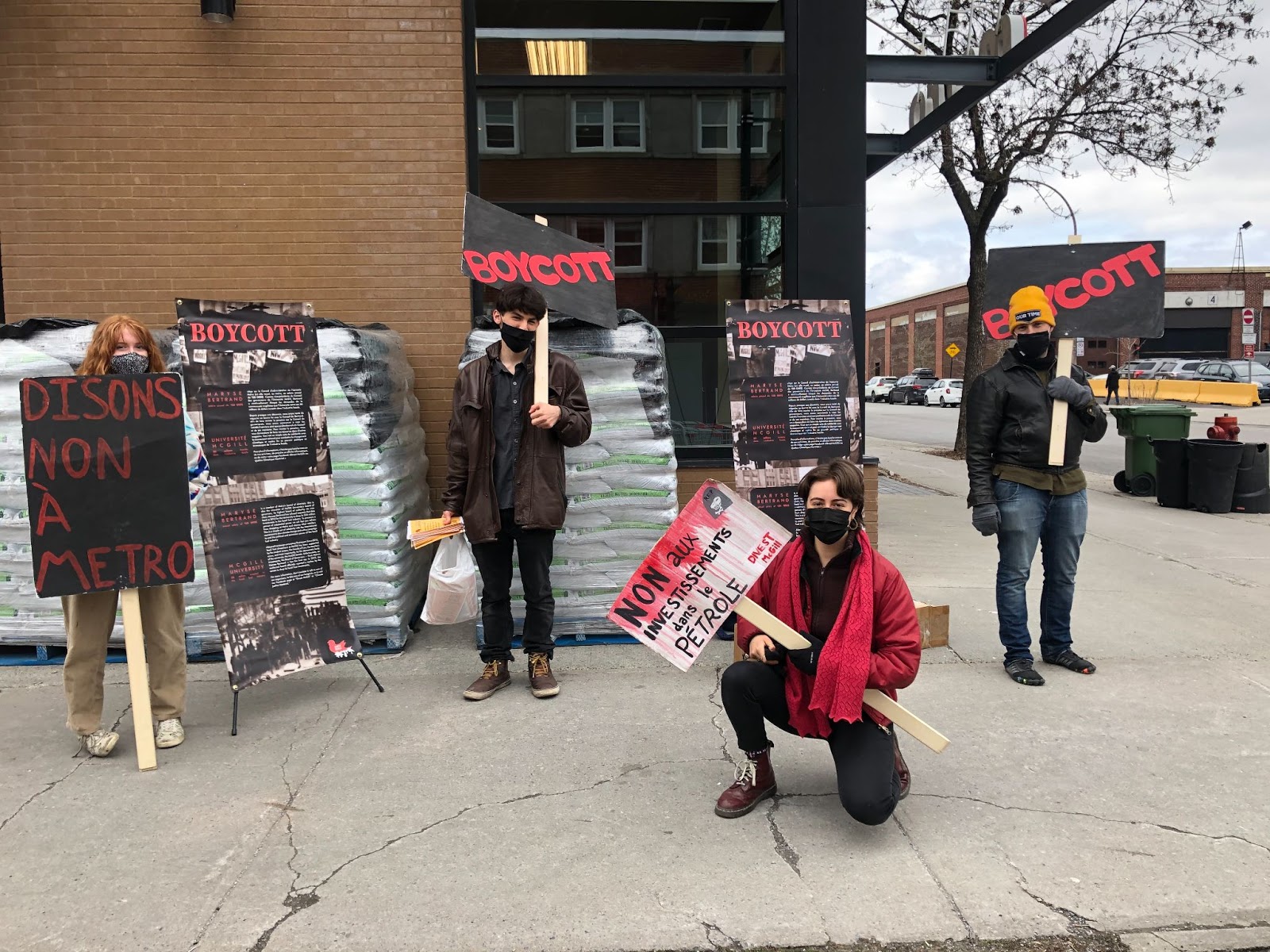
Five members of Divest McGill gathered on April 17 outside of the Metro grocery store located in the De Lorimier neighbourhood to encourage Montrealers to boycott Metro Inc. Despite the cold and windy conditions, the Divest members connected with passersby for almost an hour to try to convince Metro shoppers to buy their food elsewhere and to spread awareness about their campaign.

Divest McGill launched their Metro Inc. boycott in August 2020 in an effort to pressure the McGill Board of Governors (BoG) to divest from its multi-million investment in the fossil fuel industry. Divest McGill is targeting Metro in order to pressure Maryse Bertrand—the BoG’s vice-chair and a member of Metro Inc.’s Board of Directors—to support McGill’s divestment.

On April 14, Divest McGill published an open letter calling for the boycott of Metro grocery stores to supplement their campaign. Prior to its publication, Divest McGill sent the letter to environmental groups across Canada in order to gather signatories. Among the organizations who have signed the letter are Extinction Rebellion Quebec, Climate Justice Montreal, and the Milton Parc Citizen’s Committee. Samuel Helguero, U2 Law and Divest McGill organizer, discussed why it is important to Divest McGill to have these organizations as sponsors.

“Their support shows Metro that the Divest McGill campaign is a building threat to Metro’s profits and brand,” Helguero said. “The support [also] helps [the movement] gain more public credibility and attention.”

The open letter outlines four demands that Metro Inc. must accommodate in order to end the boycott. Demands one and two call on Metro Inc. to publicly condemn McGill for not divesting from fossil fuels, and to aid in conversations about divestment between Divest McGill, Climate Justice Montreal and Bertrand. The third demand is for Maryse Bertrand to advance a motion for divestment at a BoG meeting, and the fourth demand is for Metro Inc. to lobby the provincial and federal governments against investment in the fossil fuel industry. Alexia Wildhaber-Riley, U2 Science and Divest McGill organizer, said she believes Metro could play an important role in the divestment campaign.

“Metro would act as a third party that facilitates and moderates the conversation between Divest McGill and McGill,” Wildhaber-Riley said. “Metro [would approach] McGill and say ‘hey, McGill, we want your students to stop boycotting us, so you need to answer their demands.’”

David Summerhays, B.A. ‘05 and original member of Divest McGill, acknowledged that divestment may not easy to achieve.

“When we started [Divest McGill,] we had the idea that, if students, faculty, and staff unanimously [supported divestment], [McGill] would feel pressured to do it,” Summerhays said. “I think we have learned that [this is not the case], and that is why we are here today. We have learned that at the highest level, McGill is not accountable to students, faculty, and staff, but rather to the rich people that [are] brought onto the [BoG] as donors.”

Divest McGill’s next initiative is to publish a zine—a short, self-published magazine-style booklet—that will be titled Divestopia. Laine McCrory, U1 Arts and part of the creative team behind the zine, explained that the zine will combine artwork by McGill artists and information about the Metro Boycott campaign to inform the public about McGill’s fossil fuel investments. Divest McGill’s goal is to publish the zine on their website and social media platforms by the end of April. McCrory explained why Divest McGill chose a zine as their next initiative.

“A while ago, we decided we are not reaching everyone we could in Montreal through [our] protests,” McCrory said. “[After] reading our open letter, people might want to learn more [about Divest McGill] and learn in different ways, so we are making a zine to hopefully reach out to people in a better way.”

McGill, News

McGill town hall details plans for the Fall 2021 semester

McGill hosted a virtual town hall on April 20 to update students and staff about preparations for the Fall 2021 in-person semester. Following an official announcement on Feb. 23 stating that students will return to in-person learning, the recent town hall presented an updated overview of the plan to return to campus, which included new details about safety protocols and academic expectations. 

Deputy Provost (Student Life & Learning) Fabrice Labeau explained that the administration is preparing for five scenarios of operation next semester. In the worst case scenario, if Montreal were to remain in a red zone, McGill would continue to operate at its current level, with minimal on-campus activity. In the best case scenario, McGill would resume all of its activities at close to pre-pandemic levels. Labeau predicted that operations will likely be somewhere between these two scenarios.

“The realistic scenario we are looking at is relying on the assumption that we will live in a world where most people are vaccinated,” Labeau said. “The Quebec government has said that their goal is to have a first dose for everyone by June 24. The Canadian-level goal is to have everybody vaccinated by September [….] We are looking at a level of protection in the community in general that is going to be pretty high.” 

Labeau said that most lectures with fewer than 150 people will be held in person. Additionally, midterm and final exams may take place in person regardless of whether or not the class takes place on campus. Associate Provost (Teaching & Academic Programs) Christopher Buddle noted that all students are expected to be in Montreal in the Fall 2021 semester to take their assessments on campus. 

“There is definitely an expectation that students will have to be available in Montreal,” Buddle said. “Do not forget that professors will still be able to record lectures [….] We are looking at a blended environment.”

Buddle explained that the administration is prioritizing academic activity ahead of extra-curricular operations and events. 

“[Academic programs] are the critical mission of the university […] and research activities as well,” Buddle said. “We understand the interest of many of our students beyond academics, […] but it’s really a matter of first prioritizing the planning of our academics [….] It’s just too early to make a specific prediction around that.” 

According to Labeau, the resumption of on-campus activities will involve heightened security protocols within campus buildings.

“In [terms of] physical security […], we are looking at a case where the buildings will be unlocked, but only a few of them,” Labeau said. “It also means that there will be enhanced COVID-19 protocols [so] we can check that people who are within the building indeed have business within the building. There [will be] be mask dispensers.” 

McGill also plans to implement a bursary program to compensate international students for the expenses incurred due to the federally mandated three-day hotel quarantine. Labeau encouraged international students to apply for their visas as soon as possible.

“We are in discussion with Immigration Canada to try and tighten the duration of the process, so we are confident that visa delays should not be a major hurdle,” Labeau said.

Students’ Society of McGill University (SSMU) Vice-President of University Affairs Brooklyn Frizzle felt that despite McGill’s extensive planning, many uncertainties remain. 

“While many students are excited to return to in-person learning, many are fearful of being forced back into a COVID-19 red zone,” Frizzle said. “Although I am quite confident that McGill has gone above and beyond in preparing for the Fall semester, [as] their protocols are exceedingly detailed and all-encompassing, some variables are beyond their control. As we have seen over the past few months, having extensive protocols does not eliminate the risk of community transmission.”

Read the latest issue

Read the latest issue