
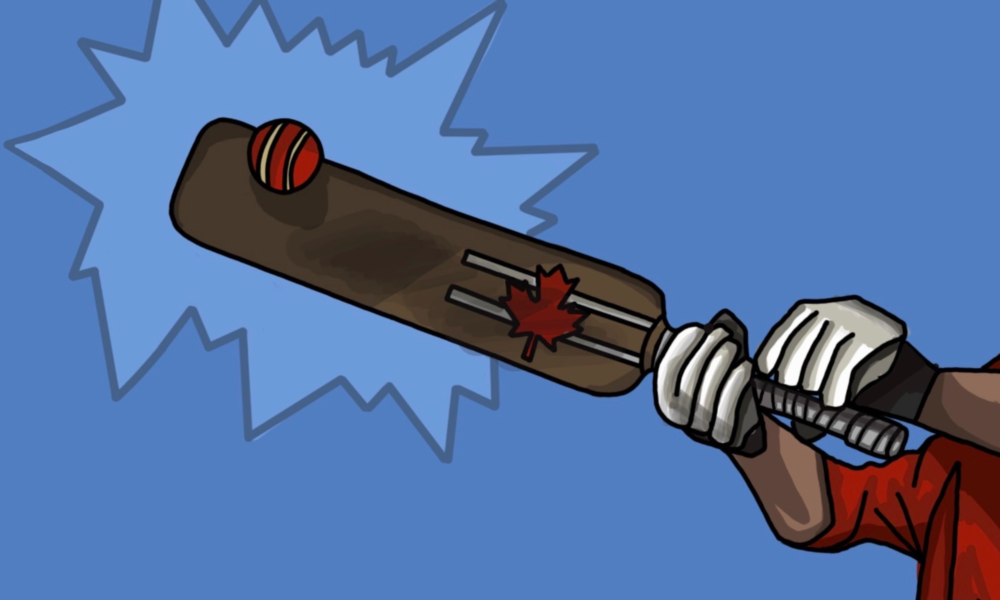


Following a year-long break due to a breach of contract between Cricket Canada and its former tournament host, the sole professional cricket league in the country has made its comeback on July 16 in Toronto with the fifth installment of the Global T20 Canada tournament.
In many sports, bringing back a professional league following months of legal issues would be considered significant news. In Canada, cricket’s revival is likely to go by with merely a press release: a quietness that shows how little attention Canadian sports media gives to cricket overall.
A peculiar hush follows after a wicket falls. This means a batsman has been dismissed—the cricket counterpart to a baseball “out.” The crowd takes a shared breath before the last delivery: a single bowled ball, cricket’s version of a pitch. Then, the crowd bursts into excited cheers and leaps to their feet as a six is hit—when the ball is launched over the field’s boundary without touching the ground first. Even after the match ends, fans keep arguing over contested umpiring calls and bold in-game decisions, debates that can run for days.
That staying power says something: cricket is more than a hobby for its supporters. It acts as a shared medium of happiness, conversation, and togetherness across different communities. The fact that it hardly appears in Canada’s wider sports conversations is thus noteworthy.
It is ironic that cricket is overlooked, considering it has been part of Canada’s history for centuries—long before the now highly popular ice hockey. British soldiers played cricket near Montreal as early as 1785. In 1844, Canada and the United States competed in what is often reported as the first international sporting event: not soccer or baseball, but cricket.
When Canada officially became a nation in 1867, founding prime minister John A. Macdonald named cricket the country’s first official sport. But as hockey and baseball grew in popularity, cricket faded from mainstream attention. While cricket persisted among immigrant communities in Canada, the country’s sports media gradually shifted its portrayal of cricket’s identity from a sport tied to Canada’s history to one associated with other cultures.
That perception persists today. The Canadian Broadcast Corporation has streamed Global T20 Canada matches online, but streaming a tournament differs from treating it as an important sports event. When Canadian-raised cricketers achieve international success, they seldom receive front-page coverage. Cricket overall receives sporadic broadcasts and limited mentions when compared to the consistent public focus sports media grants to other Canadian sports. Meanwhile, regular news in Canadian hockey, football, and baseball lead to minute analyses of these leagues and their players across television, podcasts, newspapers, and social media, including discussions of lineup adjustments and minor trades. Even when Canadian cricket players achieve international success, they rarely receive the detailed coverage, player profiles, or follow-up reporting that routinely accompany achievements in Canada’s major sports.
Sports media goes beyond merely reporting scores. It influences the stories a nation shares about itself and its citizens. When hockey, baseball, and football are consistently presented as the nation’s primary sports while cricket remains on the sidelines, that presentation reinforces a hierarchy: Certain Canadian sporting traditions are the national norm, while others are viewed as secondary.
For many South Asian, Caribbean, and African Canadians—for whom cricket often serves as a cultural tradition of continuity, community gathering space, and important marker of diasporic identity—the contrast between the extensive coverage afforded to Canada’s major sports and the limited attention given to cricket communicates a subtle yet unmistakable message about which aspects of their identities are acknowledged as authentically Canadian, and which continue to be viewed as outside.
The solution does not require Canadians to embrace cricket in the same way they embrace hockey. Rather, it requires sports media organizations to cover cricket as they cover other sports with significant Canadian audiences by publishing match reports, player profiles, standings, and feature stories about cricket teams and athletes, rather than relegating their games to hidden streaming links within an app. Media outlets should give tournaments like Global T20 Canada the same editorial attention they devote to other domestic sports competitions.
The Global T20 league is already making a comeback on the field after a year-long absence. What is still unclear is if Canadian sports media will treat that resurgence with the same seriousness it affords other popular sports. A sport with origins that precede Canadian Confederation, kept alive today by an expanding and active community, deserves a spot in the national sports narrative: and Canadian media must recognize it as such.