
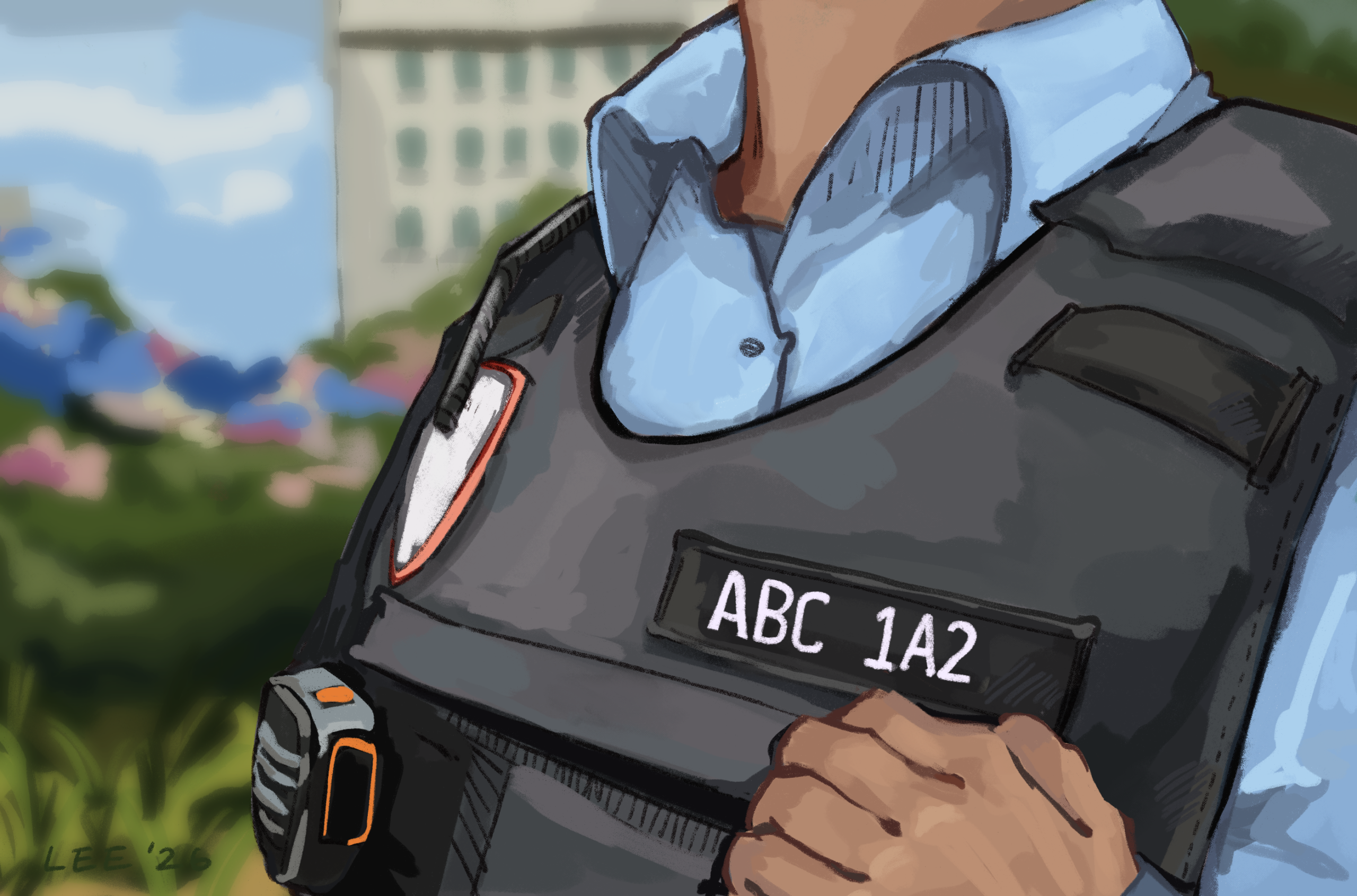


Following a joint meeting with student leaders and members of McGill Campus Public Safety earlier this year, a student-led initiative mandated McGill campus security to wear visible, distinct badges on their uniforms starting at the beginning of the 2026-27 academic year. These badges contain six alphanumerical digits—three pronounceable letters followed by a combination of numbers and letters.
The resolution comes months after the McGill Board of Governors ratified the Identification Policy for Access to Properties Owned, Occupied or Used by the University in April 2026, which granted McGill security the right to request identification from anyone on campus grounds.
In a written exchange with The Tribune, Students’ Society of McGill University (SSMU) President Hamza Abu-Alkhair explained that the badge policy is a meaningful result of community members expressing concern the past few years over campus safety and officer accountability.
“[This is] a project proposed […] and heavily consulted on [by student leaders],” Abu-Alkhair wrote. “SSMU Senators last year had been discussing the ID Policy […] in particular to how it reflects on the policy having a dual context of both academic and discipline.”
In an email to The Tribune, McGill’s Media Relations Office (MRO) highlighted that the new badge system gives community members greater clarity when interacting with security on campus.
“The new agent badges improve transparency and help the McGill community better identify security personnel,” the MRO wrote. “[The Identification Policy] establishes a framework for requesting identification from people on properties that the University owns, occupies, or uses for its operations and activities.”
Naya Wardeh, former president of the Arts and Science Undergraduate Society, reiterated this perspective, explaining that the new badge policy allows for simpler identification of security staff for easier reporting purposes in an interview with The Tribune.
“[Agents previously] kept IDs in their pockets that they were to show on request,” Wardeh said. “We wanted something visible and, because the whole point of the ID implementation was to develop the reporting system, we also needed something easy to memorize.”
Wardeh worked with McGill Associate Professor of Psychology Oliver Hardt to design the six-digit badge identifiers, accounting for colourblindness and visibility in low-light conditions as well as alphanumeric distinctiveness. According to Wardeh, this design and the process behind it has helped increase opportunities for students to hold security accountable.
“Our main duty in the [Chief Security Officer (CSO)] meetings was advocating for and relaying student concerns about campus security, especially given [its] heightened presence recently,” Wardeh said. “As the meetings progressed […] [CSO Tom O’Neill and security representatives] became a lot more collaborative.”
The meeting that brought about the badge policy came shortly after McGill appointed O’Neill. Wardeh underscored that students and campus security under O’Neill’s leadership now have a set of action items for future meetings and are working to implement a reporting system.
“It’s the middle ground we reached to give students the ability to report agents in case of emergencies, all the while protecting the agents’ identities,” Wardeh said.
In March 2025, a security guard detained a University Affairs (UA) staff member without probable cause, refusing to tell her what she was being held for. When the staff member tried to report the officer through Campus Public Safety, the website contained little to no reachable contacts. This is still the case today: The link to the Senior Director’s email is for Pierre Barbarie, who left the post a year ago.
Despite the positive exchanges between security representatives and student leaders throughout badge policy negotiations, Wardeh remains skeptical about the future.
“I don’t want to sanitize the issues with campus security and admin by saying all of this. I think it’s important to also acknowledge the problems in the same conversation,” Wardeh said. “[It was previously] understandable to wonder if our communication efforts with McGill admin [made] any difference at all.”