
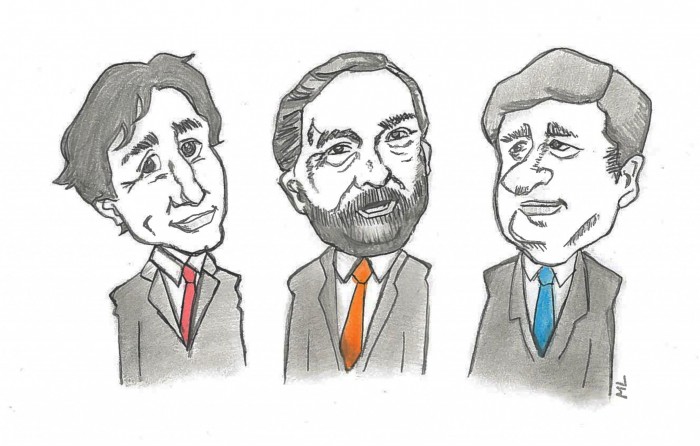


federal election is finally over after the longest campaign period in modern Canadian history. Over the past 11 weeks, the three political parties with the strongest chances of forming government—Conservative Party of Canada, Liberal Party of Canada, and the New Democratic Party(NDP)—have been hard at work trying to win the hearts and minds of undecided voters. But by now, the NDP and Conservative party leaders have gone home disappointed. Their months of hard work—while not in vain—certainly did not pan out the way they might have hoped.
On campus, the story is similar, but on a smaller scale. Each major political party has a corresponding student group at McGill, run semi-autonomously by student leaders. These leaders; Alexei Simakov of the Conservative Association at McGill University (CAMU), Greta Hoaken of Liberal McGill, and Malaya Powers and Jacob Schweda of the McGill University chapter of the NDP, have campaigned tirelessly in and around the McGill community. These parties had to contend with a demographic that is statistically less likely to vote, and an issue space full of topics that aren’t always directly applicable to young Canadians, such as universal childcare or changes to income tax.
Creating further barriers is a campus discourse that tends to create tension, making it difficult for political moderates and undecided voters to ask questions or have their voices heard without being shouted down by either end of the political spectrum. Political polarization is a real issue on campus, but it’s also one that the parties cannot address without conflicting with the strong notion of party centralization in Canada. While these student parties are guilty of making the campus conversation more rigid along party lines to a certain extent, the individuals behind the parties share a common goal: the desire to reduce voter apathy and create a meaningful discourse to enhance youth voting in general.
probably the hardest job changing people’s minds on McGill’s campus, where left-leaning discourse seems to take precedence. Simakov, the leader of CAMU, finds himself out of step with this discourse. A self-professed libertarian, he differs from the popular conversation on campus.
“I believe […] that we have a government that’s willing to do less because it gives the opportunity for Canadians to do more,” Simakov said.
Simakov espouses a lot of ideology that’s reactionary to certain elements, like his upbringing in interventionist Russia, from where he emigrated at a young age. After arriving in Canada at the age of eight, Simakov began campaigning in the eighth grade. He joined the Young Liberals of Canada, but left because he became fed up with their take on human nature.
“I saw a mentality of coddling, of superiority complex of most amongst the Liberals I worked with, and the belief that, yes, the people are great, but they need a bit of our help, and they need a bit of our leadership, and a bit of our support to make sure they can get through their lives’,” Simakov said. “I didn’t believe that.”
While both the Liberals and NDP are able to position themselves as parties that represent youth issues, the federal Conservative party doesn’t give student Conservative groups the same kind of rhetorical ammunition. Basing off of the idea that young people tend to vote for left-leaning parties, encouraging young people to vote is less advantageous to the Conservative Party than others.