MUNACA
On the first day of classes, McGill students arrived on campus to the sound of picketing. MUNACA, the union representing roughly 1,700 of McGill’s non-academic staff, went on strike starting Sept. 1 after months of strained negotiations between the union and the university finally broke down. A better wage scale, pensions, and benefits were among MUNACA’s key demands. Negotiations for their current collective agreement began in November 2010.
What began as a calm dispute between the two groups soon escalated-both in rhetoric and in action. After demonstrations allegedly began to disrupt university activities, the administration sought an injunction against the group from the Quebec government which limited picketing, and then extended the injunction. After the union began picketing activities at private residences and offices, the administration secured a second injunction preventing picketing at administrators’ homes.
In her public email entitled ‘We Are All McGill’ on Oct. 18, Principal and Vice-Chancellor Heather Munroe-Blum forcefully denounced the actions of the union, accusing striking support workers of physical threats, vandalism, and defacement of university buildings. Many on campus, however, found her accusations to be unsubstantiated and overtly propagandist. Campus media outlets, including the Tribune, received a flurry of letters condemning the principal’s statement.
For a few weeks in late November, the groups stopped issuing public statements, and many predicted a coming end to the disruption. The parties reached a tentative agreement on Nov. 30, and signed a back-to-work protocol on Dec. 2. The protocol was finally ratified on Dec. 5, with 71.4 per cent of MUNACA members in favour, bringing an end to the strike.
Both parties have been negotiating a final version of the agreement this winter term and have not yet signed it.
Few on campus on that bright day in early September could have predicted the effect the dispute would have had on the McGill community. Lines were clearly drawn-not just the tape that delineated where picketers could stand -but also the one separating green button-clad union supporters from those who sympathized with the administration’s stance. Long before occupations and student strikes, divisions on campus this academic year had already begun.
QPIRG and CKUT
Starting on Nov. 4 students voted on two fall referendum questions, which asked whether the Quebec Public Interest Research Group (QPIRG) and CKUT radio’s student fees should cease to be opt-outable via the Minerva online system and instead by refundable directly through each organization. Also included in these referenda was the question of the clubs’ existence, because a ‘Yes’ vote would enable them to renew their Memoranda of Agreement (MoAs) with the McGill administration which are set to expire on May 31, 2012.
Both questions passed with an overwhelming majority, with 65.6 per cent voting yes to QPIRG’s question and 72.3 per cent voting yes to CKUT’s question. However, in January the referenda results were invalidated by the McGill administration, who said that the questions dealt with two separate issues by asking students to vote both on the club’s existence as well as a change to the organization’s fees to be opt-outable only in person.
The announcement followed a notice of appeal filed on Nov. 11 with the Judicial Board (J-Board) of the SSMU co-petitioned by Zach Newburgh, 2010-2011 SSMU President, and Brendan Steven, co-founder of the Prince Arthur Herald. However, the McGill administration’s decision to not accept the referenda results was not related to the notice of appeal filed to J-Board.
On Feb. 5 the J-Board heard the case against respondent Rebecca Tacoma in her function as Chief Electoral Office (CEO) of Elections SSMU. The petitioners specifically questioned the results of QPIRG’s question, asking that it be invalidated and citing violations during the campaign period, the CEO’s alleged inability to fulfill her functions, and the unconstitutionality of the question. On Feb. 14 J-Board ruled to invalidate QPIRG’s fall referendum question. The J-Board stated that this decision was based on the fact that the question was unconstitutional because it dealt with two separate questions.
Following recommendations from the administration to CKUT executives regarding the potential to ask a revised question winter referendum period, CKUT decided to hold a question asking only if their student fee should become non-opt outable. The question failed with 42.9 per cent of the voters answering ‘No’ on March 14.
During a special referendum period from that ends April 16, QPIRG is running a question asking students to support the existence of the organization.
While the debate surrounding the constitutionality of the Fall referendum questions for both QPIRG and CKUT has died down, both organizations may face difficulties with funding next year, and increasing amount of student opt-outs will be challenges both will need to address.
NOV.10
On Nov. 10, 14 students occupied Principal Heather Munroe-Blum’s office on the fifth floor of the James Administration Building, some wearing hoods and masks. The occupation, which had been planned a few days in advance, occurred in response the administration’s handling of various issues on campus last semester, including the MUNACA strike and admin support for tuition fee increases.
Occupiers moved into a secure area on the fifth floor and flew a banner reading “Nov. 10 Occupons McGill” from a window. After receiving phone calls from staff on the fifth floor as well as a signal from the area’s panic button, McGill security sent personnel to the building and called the Montreal city police for assistance.
Soon after, students outside the James Administration Building learned through social media that acts of aggression were occurring inside. Students formed a human chain around the building in an attempt to deny security and police access into the building.
Police on bicycles arrived on the scene, and both police and d
emonstrating students were aggressive towards one another. After a few minutes, the police turned away and around 5:00 p.m., approximately 100 police in riot gear arrived through the Milton and Roddick Gates.
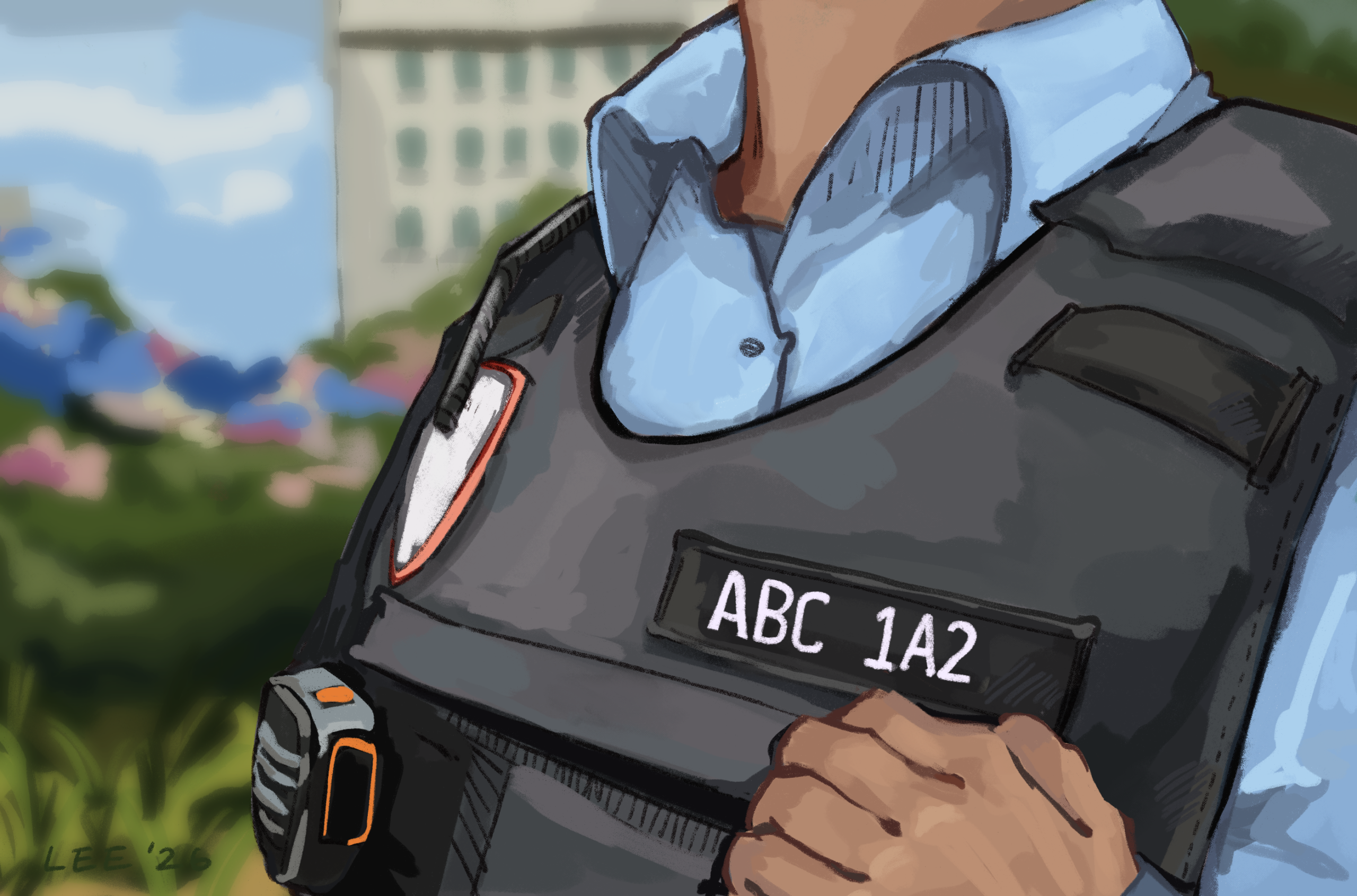
The riot police disbanded the line of students around the building and blocked its entrance, pepper spraying students. Riot police charged towards students, pushing them outside from the Milton Gates, and then charged again along Milton. Students and faculty members, many of whom were just passing by, were pepper sprayed or hurt.
The occupiers later negotiated their exit from the building with Provost Anthony Masi and Deputy Provost (Student Life and Learning) Morton Mendelson, who agreed that no disciplinary charges would be laid against them.
Released Dec. 15, dean of law Daniel Jutras’ report investigating the events of Nov. 10 addressed some concerns raised by the fifth floor occupation. Mandated by Principal Heather Munroe-Blum, the report recommended that the university work to discuss the meaning of free expression and peaceful assembly on campus, including the legitimacy of occupations and sit-ins as a form of protest. To address these concerns, Munroe-Blum authorized a four-part Open Forum led by Dean Christopher Manfredi, keeping the events of Nov. 10 open for discussion throughout the rest of the school year.
Concerns with the transparency of Jutras’ internal investigation led a group of students to lead the Independent Student Inquiry, which published a chronology of events Dec. 1, and a final report with recommendations on March 1. The McGill Association of University Teachers also created a report on governance, collegiality and security on campus that aimed to foster discussion following the events of Nov. 10.
Nov. 10 was probably the climax of this academic year, polarizing many students, who for the first few days thought that the administration had called the riot police to campus. Ultimately, Nov. 10 raised issues of freedom of speech and security on campus that still need to be succesfully addressed.
Student movement at McGill
The student protest movement against the Quebec government’s proposed tuition fee increases kicked off on Nov. 10, when over 20,000 Quebec students gathered to march through Montreal in opposition to the announcement that the Quebec government would be increasing local university tuition by $1,625 over five years.
On Feb. 13, two student associations at the University of Laval voted to go on strike. Since then, a total of 170 student unions, representing approximately 191,316 students across Quebec, have gone on unlimited strike against tuition increases.
At McGill, a special General Assembly (GA) was held on March 13 by the Arts Undergraduate Society (AUS) where students voted on whether to go on strike. With over 1,100 students attending the GA, the motion to strike ultimately failed with 609 against, 495 for, and 16 abstentions.
The next day, the Social Work Student Association became the first McGill association to join the province-wide strike. They voted to go on unlimited strike, with a majority of 61 per cent voting in favour.
Following the AUS GA, various departments within the faculty of arts voted to go on strike, including the philosophy, geography, and English departments.
The Macdonald Campus Students’ Society voted to go on a one day strike, and the Post Graduate Students’ Society voted to go on a three day strike from March 20 to March 22. This was in an effort to join the Quebec student-wide day of action on March 22 against tuition increases.
March 22 saw over 200,000 people march through the streets of Montreal, making it the largest protest in Quebec history. Over 500 McGill students participated in the demonstration. Also in the crowd were other university students, CEGEP and high school students, as well as professors and concerned parents.
Despite the mobilization, the government has not agreed to talk with student leaders on tuition increases. On April 5, Education Minister Line Beauchamp announced that the government would not back down on the expected increases.
The student movement has been marked by passionate support and increasingly creative forms of demonstration. With an anglophone majority, McGill featured less impetus to favour the strike than most other universities across Montreal. However, the turnout at the AUS GA demonstrated that hundreds of students were eager to express their views, and that there is no such thing as student apathy when the issues at hand are controversial enough. The validity of student democracy was also called into question following mobilization by departmental GAs-arguably unconstitutional in light of a negative vote from the faculty GA.
Asbestos
Early in the winter semester, McGill was the subject of criticism and national media attention for its links with the asbestos industry. In early February, over 70 medical doctors and health researchers called for the resignation of asbestos exporter and member of the McGill Board of Governors Roshi Chadha, citing her involvement in plans to reopen the Jeffrey Mine in Asbestos, Quebec. Chadha is a director of Seja Trade Ltd., a company that exported asbestos from the Jeffrey Mine until the mine’s activities were suspended last fall. She announced on Feb. 1 that she would take a leave of absence from her positions on McGill’s Board of Governors and the St. Mary’s Hospital Foundation.
In a CBC documentary that aired in early February, professor David Egilman of Brock University accused McGill of allowing the industry to sponsor scientific studies that misrepresented the health effects of asbestos. Egilman said that the government is using these same studies to justify the reopening of the Jeffrey Mine, which would allow asbestos companies to export asbestos to countries where people are unaware of its universally acknowledged health risks.
On Feb. 9, Dr. David Eidelman, vice-principal (health affairs) and dean of medicine, announced an investigation into professor J. Corbett McDonald’s epidemiological research on the health effects of chrysotile asbestos, which had come under fire in the CBC documentary. The investigati
on was conducted by chair of the department of epidemiology professor Rebecca Fuhrer, despite calls for an independent and transparent investigation by anti-asbestos activists.
Eidelman announced the results of the preliminary review on April 4, stating that Fuhrer did not find evidence of research misconduct. However, Eidelman has asked McGill’s Research Integrity Office for guidance in his proceedings, because he said the faculty did not have access to all the information necessary to completely determine the integrity of McDonald’s research.
While the controversies surrounding McGill’s connections with the asbestos industry may not be resolved, they have raised questions about the role of corporations at McGill and the standards to which prominent leaders at the university should be held. In addition, some activists have accused the university of implicitly endorsing the use and export of asbestos by not taking stern and direct action following these controversies. The internal investigation may not have uncovered proof of research misconduct, but the damage that these continuing controversies could have on McGill’s reputation seem to warrant a greater response from the university than the few MROs we have received.
#6party
Around 11:00 a.m. on Tuesday, Feb. 7, a group of about 20 students occupied the office of Deputy Provost (Student Life and Learning) Morton Mendelson on the sixth floor of the James Administration Building. The occupiers said they would not leave until the administration met their two demands-that Mendelson resign, and that the administration ratify the QPIRG and CKUT fall referenda results, which they had previously invalidated due to concerns of the questions’ clarity.
Throughout the day, additional protesters positioned themselves in the lobby of the building in solidarity with the occupiers. McGill security prevented these students from using the elevators to reach the sixth floor, and after 9:30 p.m. security no longer allowed students to enter or bring food inside the building. Around 20 students stayed in the lobby overnight, despite being denied access to washrooms or Internet. The lobby protestors left the building around 11:20 a.m. the following day.
Over the next four days, the sixth floor occupiers ran out of food, relocated to an office with a window, and received groceries through using a pulley system. The McGill administration continued to send daily email updates of the situation. After occupying the sixth floor for 118 hours, the nine remaining students were peacefully evicted by the police on Sunday, Feb. 12 around 9 a.m.
Later that day, the McGill administration issued the Provisional Protocol Regarding Demonstrations, Protests, and Occupations on McGill University Campuses, which outlines situations where the administration will interfere in a demonstration or call the police. According to Principal Heather Munroe-Blum, there is no set date for the termination of the provisional protocol, but there will be some “repositioning” in the fall.
The occupation provoked many different reactions from members of the McGill community. Several organizations openly declared their support for the occupiers, including QPIRG, although they stated that they were unaware of the plans for the occupation. Others expressed strong disapproval of the occupiers’ tactic. The presidents of the engineering, management, arts, and science students’ societies, signed a letter collectively condemning the way that the occupiers’ tactics “alienated” students instead of encouraging greater student participation in campus dialogue.
In response to the occupation, some students created a Facebook event titled “The James 6th Floor occupiers do NOT represent me,” an event that claimed to represent the “silent majority” of students on McGill campus who did not agree with the occupiers’ tactics. This event led to the creation of the Moderate Political Action Committee (ModPAC)-a group seeking to promote “collaboration, not conflict” between students and the McGill administration.
Three months after the Nov. 10 occupation, the sixth floor occupiers caused concerns to resurface in the McGill community, with questions about appropriate methods of student protest and the role of the administration in dealing with them. The gap between students and administration, students and occupiers, and supporters and critics of the occupation widened as many community members felt the pressure to declare allegiance for one side or another. From renewed security measures at James Admin to the growing discussion concerning the polarization of campus, the occupation remains a solid presence at McGill long after its participants left the sixth floor.




 Melanie Dunea
 Michael Paolucci / McGill Tribune
 Michael Paolucci / McGill Tribune