


Latest News

Science & Technology

The science behind the beat

Imagine a world where every sound makes you want to move. Why is it that some sounds, like the rhythm of a song, spark an irresistible urge to dance while others, like everyday conversation, leave us still and focused?

Benjamin Morillon, who completed his postdoc at Montreal Neurological Institute-Hospital (The Neuro), tackled this puzzle in his recent lecture at the Feindel Brain and Mind Seminar Series, revealing the ways our brain distinguishes between music and language and how these differences shape our responses to these sonic stimuli.

On Oct. 1, Morillon presented his work on the neural dynamics that underlie music perception and speech comprehension. His talk, Neural Dynamics and Computations Constraining Music and Speech Processing, explored the intricate ways our brains process these auditory experiences.

Morillon’s talk began with a question many of us might not have considered before: Why do we instinctively dance to music?

“Why do humans dance? It’s completely weird,” Morillon questioned. “You have a vibration in the ear that you perceive thanks to your sensory systems, and then you spontaneously move yourself. It’s completely ridiculous.” 

Central to his research is the idea that the brain’s auditory and motor systems work together to anticipate the next beat in a song. This process of “predictive timing” is what causes us to naturally want to move to music. 

“Dance is the expression of an oscillatory entrainment. Your body is entrained to the sound of music and is anticipating the next beat within the audio-motor loop,” Morillon explained in his talk.

This entrainment happens within the dorsal auditory pathway, a brain pathway that helps determine the source and location of sounds. While auditory regions track the rhythm of a song, the motor system uses this information to anticipate when the next beat will occur, leading to the desire to move in time with the beat. Interestingly, this response works best for rhythms that occur around 2Hz—or two beats per second—a frequency that aligns with natural movement patterns like walking or nodding. 

“The motor system is actually quite simple; you can do stuff at 2Hz, and you can anticipate things in time at 2Hz. That’s quite limited for cognitive function that was evolutionarily selected for its flexibility,” Morillon remarked. 

Additionally, the motor system engages more when music follows a moderate level of complexity. If a song is too simple, we lose interest; if it is overly complex, it becomes difficult for us to synchronize our movements. This “sweet spot” of syncopation triggers a “groove”—a sense of wanting to move to the music.

After discussing music, Morillon transitioned to another fundamental human behaviour: Speech comprehension. Like music, speech engages specific brain regions along the auditory pathway. Speech comprehension involves the brain adapting to different acoustic features, particularly when speech is presented in challenging conditions, such as when it is compressed, sped up, or layered with background noise.

Morillon’s findings also touch on the concept of “channel capacity”—the brain’s ability to manage and process multiple streams of information simultaneously, such as different acoustic or linguistic features in speech.

Morillon demonstrated that different features of speech, including syllabic rate and pitch, impact our comprehension to varying degrees, with the syllabic rate being one of the most influential factors. 

Through human intracranial recordings, Morillon’s team found that the auditory cortex processes syllables and phonemes at different time scales, allowing for parallel processing of speech signals. While the brain is decoding the syllabic rhythm of speech, it is simultaneously processing finer phonemic details—a remarkable example of neural efficiency. 

Morillon’s research sheds light on the fascinating ways our brains juggle the rhythms of music and speech, offering a glimpse into how these neural processes shape our everyday experiences—whether we’re moving to the beat of a song or engaging in a conversation.


Editorial, Opinion

As climate crises reach an unprecedented scale, Canada needs to rethink eco-justice

The climate crisis in Canada is worsening every year. In 2023, wildfires burned six times their historical average, polluting Montreal’s air quality to the lowest level in the world for two days. In 2024, 32,000 hectares of Jasper National Park burned down, rapidly eliminating critical local biodiversity and natural ecosystems. Across all of northern Canada, the permafrost is melting, destroying the ecosystems which sustain local Indigenous communities. In August, Montreal received more rainfall than it had in 100 years due to Hurricane Debby, causing flooding and the most costly damage in the city’s history. Meanwhile, as 2023 was revealed as the hottest year on global record, studies revealed Canada as the fastest-warming country in the world

While Canada as a whole is on track to reduce emissions by about 35 per cent by 2030, Quebec is falling behind, projected to reduce emissions by just 26 per cent. Quebecers took to the streets on Sept. 27 to demand more transparency and concrete climate action in the province. Like many places around the world, Quebec is prioritizing economic growth at the expense of sustainability. And while its goals for economic development include investment in Indigenous communities, they ignore the reality of Canada’s systematic eco-racism, and the fact that no investment in marginalized communities will promote systematic equity if climate justice is not first and foremost addressed.

While the climate crisis affects everyone, certain communities feel its effects much more severely. In Canada, Indigenous and low-income communities without the resources to escape or protect themselves against the disastrous effects of climate change bear the greatest burden of the crisis. The ability to evade wildfires or floods by car, or to survive deadly heat waves with air conditioning, is a potentially lifesaving privilege available only to those who can afford it. These same heat waves are destroying crops both in Canada and abroad, hiking up food prices and exacerbating Canada’s already high food insecurity and cost of living. Meanwhile, the damage to biodiversity, especially in Northern Canada, puts Indigenous communities at unique risk, as they rely directly on the land and its ecosystems for much of their food security. 

McGill—as an institution and as a student body—has the potential to hugely influence Quebec’s policies and initiatives towards climate action and climate justice. McGill has made important steps towards addressing its own complicity in the global carbon footprint by divesting from fossil fuels in December of 2023. While decisions like these deserve due credit, they are not enough; McGill’s vast room for improvement cannot be hidden under micro-scale band-aid initiatives, such as upgrading to an electric heating system or expanding campus green spaces. McGill continues to propagate environmental racism through expansions such as the New Vic Project, which is located on unceded Kanien’keha:ka territory and is potentially home to unmarked Indigenous graves. 

A recognition of global citizenship and a responsibility towards a healthy planet for future generations is the defining task of this generation. On the provincial level, Quebec must enact tangible policies which rethink climate issues from the bottom up, and construct infrastructure with the changing climate in mind first, and economic growth second. McGill must move away from performative greenwashing towards more divestment from companies invested in fossil fuels such as Royal Bank Canada. It must use its state-of-the-art STEM facilities and faculty to make progress towards new sustainable technologies, and it must work in any and all ways possible towards substantive reparations for the Indigenous communities whose land and history McGill has violently disrupted. Finally, the McGill student body must recognize and utilize its own power—the power that successfully pushed McGill once before to divest from fossil fuels—and find space in its activism every day for climate action and climate justice.

In Competition With, Sports

McGill Squash(es) the competition at home opener

The McGill Squash team had a weekend to remember, hosting their only home match of the season against the Ottawa Gee-Gees and the Queen’s Gaels. The energy at the Webster Squash Courts was palpable as the players took to the court, eager to showcase their skills and lay down statement victories in front of home-crowd support. 

The men’s team kicked off the tournament with a convincing 6-1 victory over the Gee-Gees. The match was highlighted by dominant performances from several McGill players. Grayson Wheeler, U3 Arts, cruised to a straight 3-0 win, showcasing his exceptional shot-making and court coverage. Co-captain Mo Kamal, U3 Science, also delivered a commanding performance, utilizing his powerful shots and tactical awareness to overwhelm his opponent. The Gee-Gees battled valiantly but ultimately fell short against a determined McGill side. The second match against the Queen’s Gaels proved to be a much closer affair. The men’s team fought hard but ultimately fell by a narrow 4-3 margin. Kamal and Zachary Llewellyn, U0 Management, led the way for McGill, securing emphatic wins. However, the Gaels proved to be a formidable opponent.

Speaking to The Tribune about the progression in quality and dedication of the team, Kamal explained the consistent improvements to the McGill Squash program in the last few years. 

“Our first tournament, we show up in cars, unmarked clothing, everyone’s wearing random stuff,” he said. “And then we became more and more legitimate throughout the season, we were training more, winning games, and here we are. McGill squash is on the rise.”

The Redbirds will look to bounce back from their disappointing loss to Queen’s and continue the season in good form. Kamal is hopeful for the rest of the season.

“The women’s team were the only team last year to beat [Queen’s], and so we finished first in the league,” he said. “On the men’s side, we finished fourth last year. So we’re hoping to start to push that, maybe get top three, aiming for second at least to Western.

The women’s team also enjoyed a successful weekend, sweeping both the Gee-Gees and the Gaels. Against Ottawa, the women’s team dominated from start to finish, winning all seven matches in straight sets. Co-captain Ava Bicknell, U2 Arts, was particularly impressive, displaying exceptional skill and athleticism to cruise to a 3-0 victory against her opponent. 

The victory over Queen’s was a more challenging test for the women’s team, but they ultimately prevailed by a score of 5-2. Bicknell and Lialah Mavani, U2 Arts, led the way, winning their matches in straight sets. Bicknell fought hard to a 3-0 victory. Meanwhile, Mavani pressured her opponent, Gabriella Waite, to a four-game victory for the first time in the pair’s four-match history—a huge moment for her in front of the home crowd. Bicknell shared her story on the squash court.

 “It’s a family sport for us [….] I started when I was eight years old,” Bicknell recounted. “After playing the Junior League in high school, I stopped during COVID, [and] I didn’t know I was going to pick it back up until I came to McGill. I’m so happy that I tried out. The team is my family.”

As the season progresses, the McGill Squash program will look to build on this weekend’s success and achieve even greater heights. With a talented group of players and a supportive home crowd, the future looks bright for the team.

Moment of the game: 

Mo Kamal had back-to-back victories against the UOttawa and Queen’s number 1 seeds (one of whom was ex-McGill Squash player Sayeed Mavani). 

Quotable:

“One of my favourite parts of the day was getting to see the rookies’ first tournament experience as a team. Seeing their nerves turn into energy and excitement built up so much momentum for the rest of the season.” — Women’s co-captain Chloe Stoneburgh.

Stat corner: 

McGill’s women’s squash team won 12 of 14 matches , and the men’s team won nine of 14 matches. 

Current Sports Editor Lialah Mavani is on the women’s squash team but was not involved in the writing of this article.

Arts & Entertainment, Pop Rhetoric

Bowen Yang might be the best person to talk about Chappell Roan

Season 50 of Saturday Night Live (SNL) premiered on Sept. 28 to the highest ratings it has received since 2020, but the comedic sketch show’s return was not without controversy. Cast member Bowen Yang appeared on Weekend Update dressed as famed internet hippo Moo Deng. In recent years, Yang has become a regular on these segments, frequently portraying animals or inanimate objects, like the absurd personification of the Titanic iceberg. His characters are hilariously melodramatic and serve as cutting cultural commentary on modern celebrities, so naturally, Yang’s baby hippo wasn’t all that different. However, about 30 seconds into the impression, it becomes obvious that Moo Deng is operating as a stand-in for rising pop icon Chappell Roan. This comes shortly after Roan announced that she would be stepping away from the All Things Go Music Festival to take some time for her mental health. 

The morning after the sketch aired, the internet got up in arms, calling it offensive for supposedly mocking Roan, a woman who is already enduring internet hate for calling out obsessive fans. However, this is just a really strong piece of satire; the sketch perfectly toes the line between poking fun at and bringing to light real issues that seem to be plaguing the new generation of pop stars. Yang himself most certainly understands the importance of prioritizing mental health, as he has faced struggles with depersonalization and, like Roan, took a break from his work to recuperate. 

The secret behind Yang’s ability to tap into this unique landscape of the modern celebrity might come from his years of co-hosting the podcast Las Culturistas with friend and comedian Matt Rogers. On the show, Rogers and Yang break down pop and celebrity culture through the lens of what cultures shaped them and who they were made for. Along with a variety of guests, the hosts are often able to pinpoint exactly why something or someone has captured the imagination of the general public. Years of this in-depth analysis prepared Yang to offer a near-perfect satirization of a modern celebrity persona. Casting it through the lens of an inanimate object or an animal simply heightens the eccentricities. 

Following the backlash to his sketch, Yang posted an Instagram story clarifying that his intention was always to support Roan and to emphasize that she should not be treated like a zoo animal. Yet the fact that Yang even had to address this “controversy” raises serious questions about the nature of fandom culture and the often dramatic behaviours that accompany it. 

On social media, audiences are divided; some are making fun of modern audiences’ inability to enjoy a man in a hippo costume impersonating a pop star, while others have gone as far as invoking identity politics, highlighting that Bowen is a “cishet gay man” (have we forgotten that “gay” and “heterosexual” are antonyms?) and is perpetuating misogyny by mocking and belittling women’s mental health struggles. These claims are so outlandish that they only further fuel Yang’s point about crazy fans. 

It’s clear that Yang is trying to illustrate the absurdity of the accusations against Roan rather than shaming her, as he said so explicitly in the skit: “Leave her alone. Let her take as much time as she needs for her mental health.” Just because fans can’t recognize the sketch as satire doesn’t mean it isn’t. It’s interesting how Roan was forced to address obsessive fan behaviour, yet this backlash exemplifies that very issue—fans taking things out of proportion. 

By highlighting characteristics that Roan is often accused of or defamed for having—namely, being rude or ungrateful—Yang can make light of just how ridiculous those complaints really are. If die-hard fans want to counter the “parasocial bestie” allegations, they’re going to have to loosen up a bit. With some critical thinking, it’s obvious that Yang’s message is simply to leave Roan alone. And while you’re at it, give the slippery, bouncing baby hippo some space, too.

McGill, News

Indigenous speakers discuss reconciliation at sixth annual We Will Walk Together event

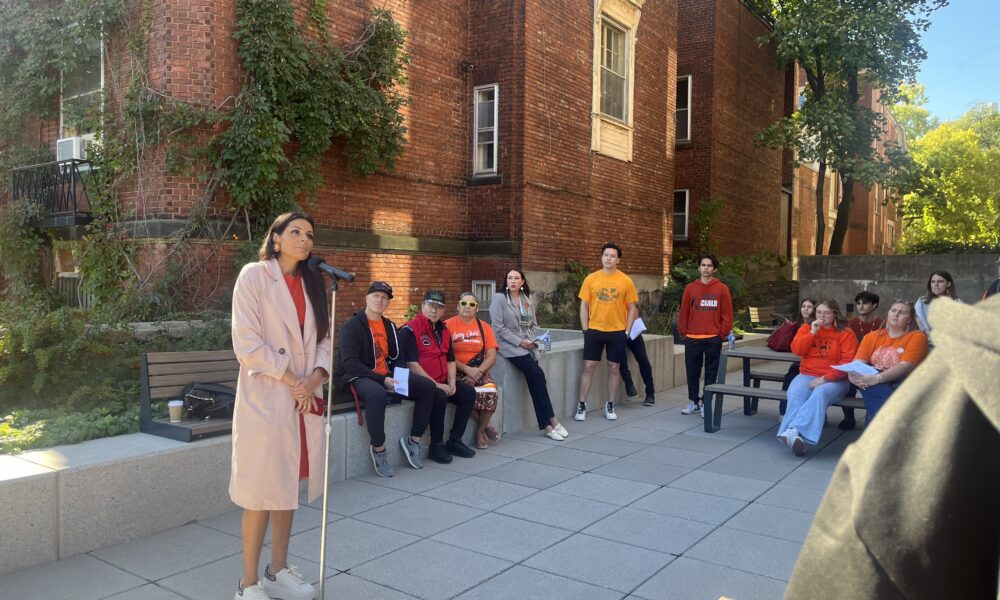
McGill’s Faculty of Education held its sixth annual We Will Walk Together / Skátne Entewathahíta event at the McTavish Terrace on Sept. 30 in recognition of the National Day for Truth and Reconciliation. The ceremony featured speeches from members of the Faculty of Education, Office of Indigenous Initiatives, and Indigenous students and elders, who recalled stories of residential school survivors and reflected on what reconciliation means for McGill and across Canada. Indigenous student organizers then led the crowd on a Critical Campus Tour, which aimed to spark conversations about McGill’s institutional history. 

Associate Professor Jordan Koch, who was the co-master of ceremonies of the event alongside Assistant Professor Michelle Kennedy, offered a land acknowledgement before welcoming former Akwesasne Grand Chief Michael Kanentakeron Mitchell to the mic to open the event. 

Mitchell shared a song and highlighted the importance of learning to care for the planet and each other in the wake of Canada’s genocide against Indigenous peoples. 

“It’s our ancient way of life that they took away from us and replaced it with something that didn’t belong to us,” Mitchell said. “And so we are now returning. You are all returning to what all Indigenous people have always carried and that’s the respect for Mother Earth and everything that lives.”

Kennedy then returned to the mic to introduce Ojibwe scholar and Associate Provost (Indigenous Initiatives) Celeste Pedri-Spade, who supervises the university’s progress on the 52 Calls to Action outlined by the Provost’s Task Force on Indigenous Studies and Indigenous Education. Pedri-Spade told the crowd that McGill needs to “stick to the plan” laid out by the 52 Calls to Action. These include concrete goals the university has been working towards since the plan was created in 2017, two years after the Truth and Reconciliation Commission issued its 94 calls to action for the Canadian government. Pedri-Spade underlined that reconciliation requires tangible action.

“Reconciliation is not a metaphor. It’s not a metaphor for Indigenization. It’s not a metaphor for any other kind of social justice issue that’s equally as important,” Pedri-Spade said. “We need to think about who fought for those 94 calls to action [….][The people] who fought for those calls were survivors […] and their families [….] They fought for compensation. They fought to hold institutions accountable [….] We’re here to remember [and] to center those people, their experiences, and their stories.”

Dean of Education Vivek Venkatesh came to the mic next and echoed Pedri-Spade’s call for university action. Venkatesh underscored the importance of listening to Indigenous voices and urged allies to educate themselves and others.

“To be effective allies, we must take the lessons we’re learning today and share them,” Venkatesh said.

Finally, Kennedy invited Ryder Cody, a Kitigan Zibi U3 Education student from Rapid Lake First Nation to speak to the crowd. Cody explained that the first step towards reconciliation is reckoning with Canada’s colonial legacy.

“Your government failed you. The real truth was swept under the rug, was buried. Well, little did they know they were burying seeds of hope, seeds of truth that are now blossoming,” Cody said. “Now it’s your duty to go out of your way and learn about the true history of Canada, the dark history. It’s not a dark chapter in Canada’s history, it’s the whole book.”

Cody ended his speech with a prayer. 

“Today, on this walk, let every step be a prayer for those who didn’t make it home. Let every step be a prayer for the children who did make it home. Let every step be a prayer for the children who have yet to come.”
Koch then introduced the students leading the Critical Campus Tour, who noted that they would be leading the crowd to the First People’s House, Hochelaga Rock, and the McLennan Library Building. The student organizers urged participants to reflect on how McGill has erased, misrepresented, and harmed Indigenous communities and how the university can do better.

Arts & Entertainment, Books

Sally Rooney’s latest masterpiece: ‘Intermezzo’

Since the release of the wildly popular television adaptation of her novel Normal People in 2020, author Sally Rooney’s books have been garnering obsessive attention from young people everywhere. Her three poignant past novels—two of which have been adapted into TV shows—captivated both international fans and those from Rooney’s home country of Ireland. Her latest novel, Intermezzo, was published on Sept. 24 and is already the fastest-selling book in Ireland this year, also reaching similar heights on U.K. and U.S. charts.

The story follows two brothers, Peter and Ivan, as they deal with the recent loss of their father and their complicated relationships with both women and each other. Peter is a successful lawyer who is emotionally detached from seemingly everyone in his life besides his ex-girlfriend, Sylvia, who remains a close friend despite breaking up with him after a tragic accident. He struggles to balance this relationship with his new, chaotic younger lover, Naomi. 

Ivan is a socially awkward chess prodigy who fears that his talents are declining until he meets an older woman named Margaret at a chess tournament. They fall into a thorny relationship, plagued by Margaret’s age, marriage, and past. The tension between the women, the age gaps, the brothers, their careers, and the finishing touch of their father’s death make for a messy and evocative story. 

As in her previous work, Rooney demonstrates her talent for balancing such complicated characters and plotlines with immense grace. For many authors, the act of writing can seem like a limiting form of media, as it necessitates simplifying the intricacies of real life into a digestible story. It is a near-impossible task to thoroughly explore every angle of every character needed to understand their complete reality, which is typically far more multidimensional than stories allow. However, Rooney has always masterfully fought against this; she allows her characters to be flawed and elaborate, without making her writing too decorative or wordy. This level of honesty and realism is what resonates with so many readers and is the common thread running through all of Rooney’s work. 

Unlike her previous novels, however, Intermezzo prominently features the theme of existentialism. Peter’s troubles with drug use and sleeping echo the nihilism of Ottessa Moshfegh’s My Year of Rest and Relaxation, which attracted a similar fanbase of young people grappling to find meaning in a cynical world. Nearly every other character in Intermezzo has a moment in which they seem to question their entire existence. Rooney’s trademark choppy sentences, which are even more exaggerated in Intermezzo than in her previous works, add to this feeling of a fast-paced and almost hollow reality. This existential tone is more intense than it has been in her past books, potentially reflecting a society that is becoming increasingly hard to navigate and extract meaning from. However, it is carefully balanced with comforting moments of peace and strong emotion, usually occurring in intimate scenes between lovers. 

This stark contrast between existentialism and sentimentality pushes readers through scenes that deal with difficult topics in hopes that there will be another moment of joy and love. Rooney never disappoints; although her work can be described as existential and painfully realistic, it is nevertheless hopeful and ultimately optimistic. 

Throughout the novel, Rooney develops a sense that life, even one that is subpar in most aspects, is still worth living because of its special moments. She boldly trumpets that love, be it romantic, platonic, or familial, is what gives meaning to a nonsensical world. Her characters agree; after sharing an intimate moment with Sylvia, the cynical Peter thinks to himself that “To love just these few people, to know myself capable of that, I would suffer every day of my life.” This powerful theme alone makes Intermezzo worth the read. 


Intermezzo was published on Sept. 24 and is now available for purchase.

Commentary, Opinion

McGill is leading in research but lagging in workers’ rights

McGill is continually ranked as a top research university in Canada, recently coming in second for medical research. Despite this status, the school consistently fails to adequately recognize the rights of its workers. From pushing its teaching assistants (TAs) to a hard strike for livable wages to undermining its law professors’ union, McGill has time and again resisted progress that would lead to fair labour practices. 

How can a university be leading in research while lagging so severely in workers’ rights? Does top-ranked research come at the expense of workers’ rights, or even worse, in spite of them?

If McGill aims to maintain its prestigious ranking, it must prioritize the needs of its TAs and professors—the driving force behind its research output. This became especially clear after the Association of Graduate Students Employed at McGill (AGSEM) strike in March 2024. After nearly a year of McGill disregarding AGSEM’s demands, the TA strike began. Even as the work stoppage unfolded, the university resisted reasonable requests for a month before finally conceding to a deal. Some of these included a wage increase, demands for more say in Teaching Support budgets and the working hours of TAs, as well as special protection for transgender TAs and support for mental health. 

Some might argue that because of McGill’s high ranking and reputation, it is justified in having high demands of workers, or that these demands contribute towards McGill’s prestige. But many TAs have said that, under these conditions, they have been forced to sacrifice their quality of work to get by. If graduate students are struggling with mental health, overloaded with extra hours, working a second job, or worried about paying rent, they will not be able to produce the cutting-edge research that McGill boasts, or the high-quality education necessary to remain in the undergraduate rankings. 

McGill faces a stark choice: Support its workers or forfeit the benefits of their labour. The university cannot expect excellence while its staff struggles to make ends meet.

A study by Northwestern University shows that productivity increases with minimum wage—that higher pay will lead to better output. So what is standing in the way of McGill prioritizing its workers when it is likely to benefit the TAs and the university alike? 

While the AGSEM strike was significant progress—offering TAs a 15.5 per cent raise over four years—for McGill Law professors, things are different.

Before temporarily suspending their strike on Oct. 1, the Association of McGill Professors of Law (AMPL) was striking for better pay, for more of a say in the governance of the faculty, and for their right to unionize. McGill resisted their demands for months, taking actions to undermine the legitimacy of the union by legally challenging its certification, which was granted by Quebec in 2022. 

McGill’s actions were ruled illegal by the Quebec labour tribunal after two administrators attempted to undermine the union in communications to Law professors just before a critical strike vote. On Oct. 1, AMPL agreed to go back to teaching for now, after McGill threatened to cancel the semester if the strike continued.

Progress has been made since then, but not because of McGill’s support for unions—rather, because of AMPL’s tireless work for months on end. AMPL reached an agreement with McGill on Oct. 7, with McGill agreeing to drop its legal challenge of the union in exchange for AMPL negotiating collective agreements with two other unions in the Arts and Education faculties. Still, this decision took far too long to reach and shouldn’t have been challenged in the first place; it reflects McGill’s stubbornness and reluctance to prioritize constructive dialogue with its faculty and staff. 

So, can McGill balance its high rankings with low workers’ rights? Worker rights are non-negotiable, and McGill can no longer afford to ignore them. Silencing dissent only transforms isolated grievances into a unified call for change. The more the university resists, the stronger its workers’ resolve grows.

Science & Technology

Exploring galactic evolution from the Big Bang to the Milky Way

On Oct. 3, McGill’s Trottier Space Institute presented a public talk titled “From Clouds to Cosmic Giants: The formation and evolution of galaxies.” This event featured Tracy Webb, associate professor in McGill’s Department of Physics and observational astronomer, who discussed the development of galaxies from the Big Bang to the present day. The talk also highlighted current innovations aimed at demystifying our understanding of these complex systems. 

Webb began her talk by discussing the galaxy we call home: The Milky Way. Amongst the whopping hundreds of billions of galaxies in our observable universe, Webb emphasized that the Milky Way is just one of many. 

“[The Milky Way] is sort of a regular galaxy in a regular group of galaxies, nothing really special […] except that it is home to us,” Webb stated in her talk. 

The composition of galaxies 

Galaxies are primarily composed of a large oval called the dark matter halo, which forms the body of a galaxy and accounts for most of its mass. At the center of the halo lies the bulge and disk—made up of stars and surrounded by what’s called the “interstellar medium.” At the very centre of the galaxy resides a supermassive black hole. 

“A galaxy has a total mass of [around] 1 to 2 trillion times the mass of our own sun, and that mass is made up of dark matter, which makes up about 90 per cent of the galaxy. Then we have gas and dust making up the next component, around seven per cent, and stars […] only make up about three per cent,” Webb explained. 

Galaxy classification 

After focusing on the components of a galaxy, Webb shifted to a broader topic: How galaxies are classified. Edward Hubble, astronomer and namesake of the Hubble Space Telescope, came up with a simple classification of galaxies based solely on their shape, known as the Hubble Tuning Fork. The first type of galaxy is elliptical galaxies, and the second is spiral galaxies. 

“There’s a whole bunch of galaxies that don’t fit into the Hubble Tuning Fork, [which we] call irregular galaxies,” Webb clarified. 

Galaxy formation and growth mechanisms

According to the Big Bang Theory—which is the idea that the universe began as a single point and has been perpetually expanding ever since—galaxies formed approximately one billion years after the beginning of the universe. Galaxies first coalesce as dense packs of gas and grow larger over time by merging with other galaxies. The Milky Way is on a collision course with our neighbouring galaxy, Andromeda, although the impact is still a few billion years away. 

Apart from collisions, galaxies also grow by absorbing the cosmic material around them. A more obscure growth mechanism of galaxies has to do with the supermassive black holes at their center, which are suspected of regulating galaxy growth during this process.

The future of telescopes 

Webb then moved on to talking about the use of telescopes in studying galaxies. When observing galaxies, telescopes behave as time machines. The images we see of galaxies actually show how they appeared billions of years ago since the further away they are, the longer it takes for light to travel to us. This means that when observing the Andromeda galaxy, we’re observing it 2.5 million years ago, and when observing the furthest galaxies visible through the Hubble Telescope, we’re actually observing them 13 billion years in the past.

The James Webb Telescope is a recent telescope project launched into space that surpasses the Hubble Space Telescope in terms of its observational capabilities. Another upcoming project is the Square Kilometer Array—an international effort to build the world’s largest radio telescope array, which is a network of separate telescopes located across the globe that operate as one. 

While many advancements are underway to deepen our understanding of the galaxy, much is left uncertain. The more knowledge we gain on galaxy formation, the better we will understand how the world we live in came to be.

News, PGSS

PGSS Council votes on McGill-amended motion, removes mentions of Gaza and genocide

The Post-Graduate Students’ Society (PGSS) met on Oct. 2 for its second Council meeting of the Fall semester. Thirty-six voting members attended the meeting, surpassing quorum—one per cent of regular members, as laid out in PGSS’s Bylaws—for the first time since February of this year. As the previous Council meeting on Sept. 10 had failed to meet quorum and attendees were unable to vote on the motions discussed, this month’s meeting had a particularly long agenda. 

The hybrid meeting was held in Thomson House and on Zoom. The discussion primarily centred on three motions—5.4, 5.5, and 5.6—from the December 2023 Council meeting, which expressed solidarity with Palestine. After PGSS and McGill received a legal notice from an anonymous member on June 20 that asked both parties to abide by an interlocutory injunction, the McGill administration proposed modifications to the motions, which would uphold PGSS’ Memoranda of Understanding with the university. These amendments included changing the name of motion 5.4 from “Council stand in solidarity with Palestine” to “Motion on Divestment from Armaments and Efforts to Promote Peace,” and removing words such as “Gaza,” and amending mentions of “genocide” to say “war.” 

Many members abstained from voting on Motion 5.4. During the discussion, Member Services Officer Ambre Lambert offered insight on the importance for PGSS members to be familiar with the motions before voting as approving or rejecting them is their choice. She also added nuance to a previous discourse she held about advising voters to oppose Motion 5.4.

“I was encouraging students not to agree with the motion that was done last month [because the wording] was extremely restrictive and was losing the sense of the motions,” Ambre said.  “I do think they are still losing some of their original meanings but I also think that I don’t know if we’ll reach an agreement with McGill [if we keep on debating].”

Some attendees voiced concerns that abstaining could lead to commissioners reentering negotiations—and even arbitration—with McGill over the wording of these motions. Councillors also raised questions throughout the discussion about adding context around McGill’s “watered-down” wording as Lambert put it. 

The conversation turned to motion 5.6, originally called ‘Motion to support and encourage [Post-graduate Student Associations] PGSAs to address the ongoing genocide in Gaza and investigate their ties to settler-colonial violence and genocide against the Palestinian people.’ It was amended to be called ‘Motion to support and uphold the academic freedom and rights of freedom of expression, conscience, and assembly of PGSS members.’ Brenagh Rapoport from the Organization of Urban Planning Students highlighted the aspect of the motion that ensures PGSAs cannot condemn, penalize, or restrict students’ discussions or actions.

“Protecting our students from backlash from the university for [engaging in meaningful] action is really important [and] a material commitment to students not receiving [sanctions] for expressing opinions and engaging in political action […] is a concern for people in my department,” Rapoport said. 

Councillors stressed that work still needs to be done to ensure students know their rights to freedom of expression. In response, University Affairs Officer Racchana Ramamurthy suggested adding shorter versions of the Code of Student Conduct with important points on myCourses.

In the end, abstention was disregarded, and Motions 5.4, 5.5, and 5.6, all passed—with 24 votes in favour of 5.4 and 5.6, and 17 votes for 5.5. 

For the last part of the meeting, Shona Watt, Associate Director of Sustainability Projects Fund (SPF) presented the SPF, which funds environmental projects on campus. Since its founding in 2010, the initiative has allocated over $12.6 million CAD in funding to 370 sustainability-related projects. According to Watt, the SPF is the largest dedicated campus sustainability fund of its kind in Canada.

Moment of the meeting: 

With the meeting’s extended agenda, the Council put forth a vote to extend the meeting to 8:30 p.m.. While 10 members voted in favour of continuing, 15 voted against. As a result, the meeting was not prolonged and the remaining agenda items will be postponed to future meetings.

Soundbite: 

“It is 100 per cent your choice as a councillor and you have absolutely that option, to not accept those changes that are basically a compromise between us and McGill.” — Ambre Lambert, Member Services Officer, on voting members’ right to abstain on approving Motion 5.4.

Arts & Entertainment, Music

The stories and sounds of Montreal’s Black women DJs

Montreal’s cultural fabric is shaped by its artists. From writers and sculptors to fashion designers and chefs, there is a scene for everyone. When it comes to musical history, the city’s Black communities hold great significance. The music scene extends to DJing, with events like Igloofest and Aire Commune, along with collectives like Boiler Room, showcasing its vibrancy and diversity. Given this cultural backdrop, I sought to explore the experiences of Black women DJs whose perspectives are underrepresented despite their significant contributions. I interviewed three Black women DJs to understand what the art means to them—and how their identities influence their artistry. 

Drawing on her Cameroonian heritage and upbringing in France, Inès, who performs under the name Ms Baby, skillfully blends traditional and contemporary African and European electronic influences with the richness of popular African American music. The result is a sound that resonates beautifully within Montreal’s diverse landscape. Playing African music, especially traditional tunes, holds immense significance, as countless African artists have shaped music globally while going unrecognized for it. For Inès, it’s not just about playing songs; it’s her mission to give those artists their flowers, honouring and celebrating their contributions to the music world. 

Another voice in the scene is Asha, a Toronto-born DJ with Guyanese parents who entered the electronic music scene after living in Berlin. Like Inès, she noted that many DJs draw from diverse global influences, but the creators behind the sounds are often overlooked. She emphasized that DJing involves much more than playing music; it requires research and proper crediting of the artists.

“If there’s one thing I wish people understood better, it’s how much weight the music you play carries,” Asha explained. “When you take on the role of a DJ, you’re not just spinning tracks; you’re also a curator of culture and history.” 

Asha noted that this awareness is not only about respecting artistry but also about recognizing the political implications of music selection. “In my opinion, DJing is political,” she asserted. “It’s about acknowledging the producers you support and the cultural energies you’re promoting.”

For Janelle (IAMNOTMYHISTORY), the music she chooses to play is largely influenced by her Trinidadian background. When asked about her DJ name, Janelle shared that it reflects her awareness of how Black history is often simplified or distorted in educational contexts. She pointed to the importance of recognizing the depth and complexity of her heritage beyond a single narrative. 

Janelle emphasized that her name is also a personal declaration. “I don’t want to be defined by my past,” she explained. “I am not just my history; I am so much more.” Her perspective embodies her desire to remain present and open to growth, allowing her to evolve as an artist and an individual. “While my background informs my music, I want to continue creating and exploring new avenues without being confined by what I’ve already accomplished,” she said. 

All three women highlighted the unique challenges of being Black women DJs in a male-dominated industry. Inès emphasized the importance of representation, noting that seeing other Black women DJing fostered a sense of belonging. She described the frustrating expectation for Black women DJs to simply be grateful to be given opportunities, which often results in low performance expectations and relegation to less prestigious slots. Despite these obstacles, the three women expressed empowerment in their journeys, citing the joy of sharing music in the city as a key source of their success.

As Black women artists like Inès, Asha, and Janelle navigate the complexities of being minorities in the DJ scene, they are carving out spaces that honour their heritage while also embracing their multifaceted identities. In a city where a shared love of music fosters creativity and collaboration, these DJs remind us that the past does not define one’s future; instead, it serves as a foundation to build limitless possibilities. As they continue to break barriers and inspire the next generation, the unique contributions of Black women DJs enrich Montreal’s artistic landscape, ensuring that their voices are heard in the sound of the city.

Read the latest issue

Read the latest issue