Latest News

McGill, News

Office of Indigenous Initiatives kicks off 13th annual Indigenous Awareness Weeks

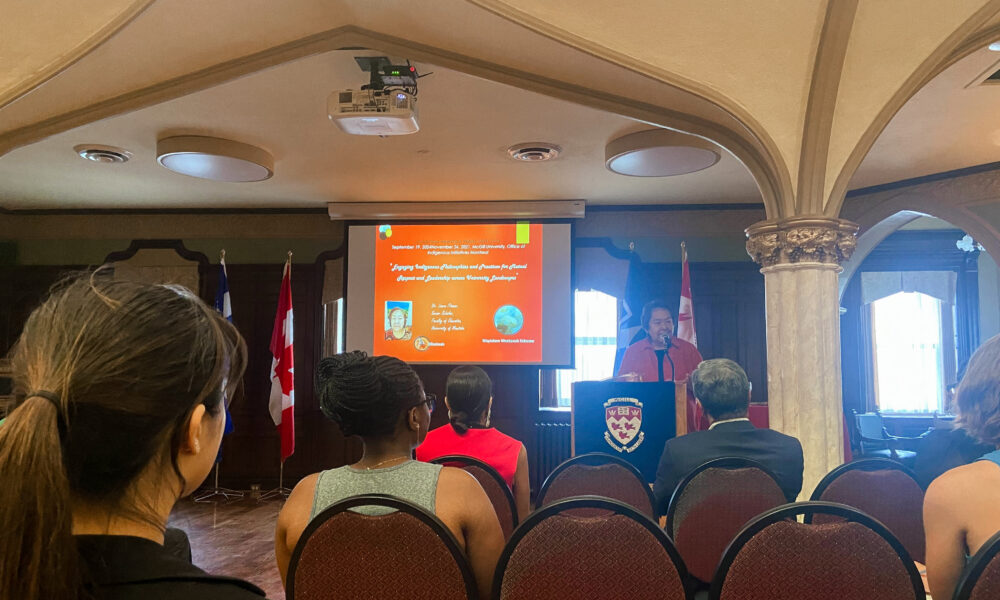
McGill’s Office of Indigenous Initiatives (OII) commenced its 13th annual Indigenous Awareness Weeks with an opening talk given by Laara Fitznor, formerly with the University of Manitoba, on Sept. 19. The event, held in the Faculty Club, was titled “Engaging Indigenous Philosophies and Practices for Mutual Respect and Leadership across University Landscapes.”

To open the event, the emcee of the evening, Faculty of Education assistant professor Geraldine King, introduced Faithkeeper Otsi’tsaken:ra (Charlie) Patton to the podium. Otsi’tsaken:ra provide the Ohen:ton Karihwatehkwen or the “words that come before all things,” first in Kanien’kéha followed by a version in English. He recognized and offered gratitude to the trees, sky, water, and other elements of the natural world. He also spoke to the diversity of Indigenous cultures across Canada.

“Amongst our nations we all have different ways that we understood [the creation of the earth] in the languages, in the way we sing, in the way we drum, the way we dance. It’s all about giving thanks for what the Creation has given us,” Otsi’tsaken:ra said.

King then invited McGill President and Vice-Chancellor Deep Saini and Provost and Executive Vice-President (Academic) Christopher Manfredi to share words of welcome.

“[Indigenous Awareness Weeks] has helped foster an environment in which McGill’s Indigenous community members are represented, recognized and celebrated,” Saini said. “We are a proudly diverse university of which our First Nations, Métis, and Inuit community members are an integral part. We have so much to learn from one another and events such as this—which allow us to exchange openly and respectfully on important issues—deeply enrich and strengthen our community.”

The theme of this year’s Indigenous Awareness Weeks is recognizing trailblazers. Fitznor, the keynote speaker of the evening, was a professor at the University of Manitoba and the University of Toronto before her retirement in 2019. Fitznor is a member of the Nisichawaysihk Cree Nation in Northern Manitoba. She spoke about her family history and how it has shaped her understanding of how Indigenous knowledge can be included in academic contexts. 

“Family ties [and] reminders of cultural and land responsibilities [are] a backdrop for understanding education,” Fitznor said.

She shared stories about microaggressions that she faced in the workplace and urged allies to show up for their Indigenous co-workers in a tangible way.

“Don’t just say ‘I support you,’” Fitznor said. “Get involved, but don’t lead the way [….] Stand behind us. Work with us, but never ahead of us.”

She also encouraged the roughly 30 attendees to take the lessons they learned from the talk into their daily lives outside of the two weeks dedicated to Indigenous awareness at McGill.

“I think it’s amazing that we have that focus […] of gathering minds and hearts for different activities that can be shared with people,” Fitznor said. “Everyone that’s in this room, your work is to take that forward to the other folks around you, whether it’s with your family or friends, your coursework, and your research, and your community work [….] What [will] you do with what you learn?”

To close out the event, King invited professor Robert Spade from the Schulich School of Music to perform an Anishinaabe honour song. He introduced the song by saying that it recognizes the gift of life.

“Your life is precious. You are pure, however you are today. You have achieved it already. You have it. We are not deficient, and today is not an accident. You belong. You belong here,” Spade told the crowd.

The Indigenous Awareness Weeks will continue until Oct. 2 with talks on Inuit education, Mohawk governance, and Ojibwe Anishinaabe art among others. On Sept. 30, the Faculty of Education will hold its sixth annual Skátne Entewathahíta – We Will Walk Together event for the National Day for Truth and Reconciliation.

Know Your Athlete, Sports

Know Your Athlete: Chloe Renaud

Chloe Renaud, U3 Arts, is a talented midfielder on the McGill women’s soccer team who has been making her mark both on and off the field. Having been named the Réseau du sport étudiant du Québec (RSEQ) Player of the Week within the first week of the season and the McGill Player of the Week two weeks in a row, Renaud is undoubtedly a star on the Martlets squad. 

Renaud’s love for soccer began at a young age, drawing inspiration from her older brother who played before her. At the age of six, she joined her first team, Club de Soccer Spatial de St-Hubert. She developed skills quickly and rose through the ranks of her local team, eventually representing both Quebec and Canada at national and international levels between the ages of 15 and 18.

“Eventually I started to get better, more competitive, so all [of] my high school and Cegep, I worked towards a [sports academy] before I came to university to be a varsity athlete,” Renaud told The Tribune

The Martlets soccer team is starting the season strong with a current record of 5–0–0. Renaud believes the team has shifted its mindset from previous seasons and is determined to compete for a spot at Nationals. Despite settling for a draw against Laval—the best team in the league last year—on Sept. 15, the Martlets put their best foot forward, with Renaud at the forefront of their 1-1 tie. 

“I think we gained a lot more confidence,” she explained. “I remember before playing Laval on Friday, we played Bishop’s, and we scored the first goal, and then just before going to the half break, they scored. Last year, if we got scored on just before going to the second half we would have been a little bit shaky and [maybe] started to doubt ourselves. But this Friday, we felt a sense of calmness, like, ‘okay, we got this, we’re gonna score.’”

Balancing her studies in psychology and soccer commitments has been no easy task for Renaud. The demands of high-level soccer training and competition, combined with the coursework required for a university degree, can be overwhelming. However, she has managed to excel in both areas through careful planning, time management, and a strong support system.

“It’s definitely tough to juggle everything, but I’m passionate about both soccer and psychology,” Renaud said. “I’m grateful for the support of my family and friends who have helped me stay focused and motivated.” 

Renaud’s dedication to her goals has not gone unnoticed. She often finds herself in the spotlight for her performances on the field, like with recognition by the RSEQ and McGill Athletics in recent weeks. 

As Renaud looks to the future, she is excited about the potential for growth in women’s soccer in Canada. The upcoming Canadian professional women’s soccer organization, the Northern Super League, represents a significant step forward for the sport, offering woman athletes new opportunities and increased visibility. She believes that this league will inspire more young girls to pursue their dreams in soccer and will help to create a more equitable and inclusive environment for women in sports. It is also her aspiration after university to join the league as a professional soccer player. 

“There’s a pro league in the U.S. and also [a few in] in Europe, but we don’t have one in Canada, and that’s when we lose a lot of talent, because everyone’s going to the U.S. or Europe.” Renaud said. “So this lets them develop assets within the country and keeps them within the country.”

To young woman athletes looking to continue their athletic journeys in university, she imparted some words of wisdom: “If you know that this is what you want to do, then just work your ass off, and every day it will pay off.”

Recipes, Student Life

Two cozy recipes to start the fall off right

Now that the Fall equinox has officially passed, it’s time to head to the store for some cinnamon, nutmeg, and cloves to make sure your kitchen smells better than a pumpkin-spiced latte. 

For those who need a dose of sugar to start the day off right: Oat Chocolate Chip Cookies

As I returned to Montreal for the new school year, I wanted to change up my regular diet, which was made of the same ingredients used over and over again. Since breakfast is the most important meal of the day, I decided that my transformative journey would start there. The fact that fall is about to enter the scene got my cinnamon addiction running again. Here are some ideas The Tribune recommends trying.

As a snack, dessert, or for breakfast, cookies can never go wrong. Chocolate chip cookies are basic, but what if you were to add oats to change the texture? Here is a quick and easy way to rediscover chocolate chip cookies.

Ingredients:

  • 1 ½ cup of flour
  • 2 cups of oats
  • 1 tsp of cinnamon
  • ½ tsp of baking powder
  • ½ tsp of salt
  • 1 cup of sugar 
  • 6 tbsp of melted butter
  • 2 eggs
  • 1 cup of milk 
  • 1 tsp of vanilla extract
  • 2 cups of chocolate chips

Steps:

  1. Preheat the oven to 400°F (200°C).
  2. Mix the flour, oats, cinnamon, baking powder, salt, and sugar in a bowl.
  3. In a second bowl, whisk the eggs. Add the milk, vanilla extract, and melted butter and pour the mixture into the first bowl with the dry ingredients. 
  4. Mix and add a bit of milk if necessary.
  5. Separate the mixture in tablespoon scoops and shape it into balls. Place 4 cm apart on a sheet of parchment paper.
  6. Bake in the oven for around 15 minutes.

For those who cannot wait for the season to kick in: Apple Cake

Nothing screams fall more than an apple-based recipe. Whether you’re hosting a gathering with friends and family or simply trying to enjoy a delicious dessert, an easy and quick cake recipe is the perfect way to embrace the new season. The Tribune presents a homemade apple cake recipe that truly captures the essence of fall. 

Ingredients:

  • 2 large apples or 3 small apples (the number of apples depends on your personal preference, however, The Tribune recommends adding a maximum of three large apples for the best flavor)
  • 1 tsp of lemon juice
  • ½ cup of unsalted butter
  • ½ cup of granulated sugar 
  • 2 eggs
  • 1 ¾ cup of all-purpose flour
  • 2 tsp baking soda or powder 
  • 2 tbsp honey
  • 1 tbsp of maple syrup
  • ¼ tsp of salt
  • 2 tsp of ground cinnamon

Steps:

  1. Preheat the oven to 350°F (175°C). 
  2. Peel your apples and cut them into small cubes. 
  3. In a separate bowl, cream the butter and sugar together.
  4. Add in the eggs, one at a time. Then, add your all-purpose flour, baking soda, honey, salt, ground cinnamon, and diced apples.
  5. Spray an eight-inch rectangular cake pan with baking spray and transfer your mixture to the pan.
  6. Bake for 40 minutes or until well-cooked (insert a toothpick into the center of the cake; if it comes out clean, your cake is ready).
  7. Let the cake cool for 15 minutes and taste it! The Tribune recommends eating the cake hot. You may also remove the cake from the pan after 15 minutes and place it on a serving plate.

Note: You may also add pecans to the recipe and/or substitute the granulated sugar with brown sugar for a different flavor.

Album Reviews, Arts & Entertainment

The Dare revives indie sleaze with ‘What’s Wrong With New York?’

⭐⭐⭐ (out of 5)

The Dare has been everywhere this summer. He produced “Guess” off Charli XCX’s BRAT, which has gone on to be the album’s highest charting song with a feature from Billie Eilish, and he opened several times for Charli’s tour. After this sudden rise from obscurity, The Dare is looking to take advantage of his current wealth of attention with his debut album: What’s Wrong With New York?

When I first saw The Dare (stage name for Harrison Patrick Smith) live on stage at the inaugural Palomosa Festival, my immediate thought was how much he looked like LCD Soundsystem’s James Murphy: Signature black suit, black tie, and sunglasses. It makes sense, then, that What’s Wrong With New York? would be a revival of the indie-sleaze aesthetics of the early-2000s, of which LCD Soundsystem were pioneers. Smith even delivers his vocals in the same whiny, snotty way Murphy was known for, all the while using suspiciously similar dance-punk instrumentals. Through rich synths, retro drum-machine sounds, and distorted bass transport, the album transports its listeners to the 2005 New York City club scene. The lyrics are desperately debaucherous, as Smith pants about women and drugs. An ode to hedonism in all its forms, the album is limited by its unoriginality, yet still produces a cohesive and entertaining result.

There are some true high points on the tracks “Girls” and “Good Time.” “Girls,” Smith’s breakout hit, is a breathlessly raunchy dance track whose beauty lies in its simplicity, with list-form lyrics about the titular subjects recited over a single catchy synth riff. The result is the horniest, most straightforward song in recent memory, but also one that unfailingly gets stuck in your head. “Good Time” follows the same pattern: Hedonistic lyrics with a confident half-sung delivery, repetitive but catchy synth lines, and even an added chorus. The surrounding production is masterful, leading to a colossal and exhilarating sound.

Unfortunately, the rest of the songs fail to stand out to the same degree. On “Elevation,” Smith tries his hand at singing, and while his voice isn’t bad, the song is uninteresting and falls flat. It’s the longest song on the album, and it really drags on. The drums are just a repeated eighth-note pattern, the synths are similarly bland and monotonous, and it has perhaps the most predictable chorus of all time. The back half of the album feels somewhat rushed and formulaic, like Smith pumped out the songs to cash in on the success of “Girls.” Each track might have stood well on its own, but after eight of the same songs in a row, it starts to get old.
This isn’t to say the album is bad; it’s hugely enjoyable if you lean into the sleaziness Smith is so obviously trying to evoke. Smith manages this masterfully—the unabashed confidence of The Dare smacks you across the face on every song. The depravity of the lyrics and the griminess of the instrumentals are crafted with drug-fueled nights out well in mind. What’s Wrong With New York? isn’t meant to be anything groundbreaking, and it is best experienced when the listener turns their brain off and focuses on having a good time.

Campus Spotlight, Student Life

Putting down roots: An introduction to Little Forests McGill

The lush canopies of Mount Royal may be the most quintessential of Montreal’s renowned green—and soon to be red and orange—spaces; but thanks to one McGill club, students and city residents alike may soon have new woods to admire in their downtown backyard. 

Little Forests McGill, a student association founded in 2022 with the goal of integrating nature into urban areas, is working to plant one of Canada’s few Miyawaki Forests in Montreal. Originally pioneered by Japanese botanist Akira Miyawaki, these forests were conceived as densely planted, biodiverse hubs of multi-layered greenery. Designed to be tailored to a specific region’s native species, climate conditions, and available land, these forests are ideal for cities’ often-limited horizontal space. Once planted, they require only up to two years of watering and weeding before becoming entirely self-sustaining. Not only do Miyawaki forests provide birds, pollinators, and other local wildlife with sustenance and shelter, residents also benefit from carbon dioxide absorption, reduced noise and air pollution, and cooler temperatures. 

While most popular in Japan and India, Quebec has gained several Miyawaki forests over the past decade. Since 2021, community initiatives in Rosemont–La Petite-Patrie, Pierrefonds-Roxboro, Boisbriand, and Verdun have successfully planted Miyawaki or other similar micro-forests in Montreal and its surroundings. 

In an interview with The Tribune, club president Kimsoo Gopnik described the club’s efforts to jumpstart one of these forests. The first two major steps of their initiative have been to find an available plot of land suitable for planting and to secure funding from sponsors—steps that the group hopes will be completed in time for this spring when they can begin soil testing, sapling purchasing, and ultimately, planting. Thus far, finding a planting site has proved to be easier said than done. 

“The ideal area [of a Miyawaki forest] is 100 square meters but that’s harder to find in a busy city,” Gopnik explained. “Technically it can be done in as little as three square meters but it’s just not going to have the same benefits as the larger forest does.” 

Nonetheless, Gopnik expressed that the club was entering a promising period of discussions with holders of two sites, one bordering McGill’s Macdonald Campus and the other downtown. 

“We have very optimistic landowners who are open to work with us, to collaborate, so that’s very very exciting,” she added.

Finding sponsors from local businesses is also challenging. While they generally receive positive first responses, Gopnik shared that many businesses are hesitant to commit to collaboration until specific budget estimates can be provided; estimates that will only become available once a planting location is settled on. 

Nonetheless, Little Forests has succeeded in obtaining sponsorship from Services d’arbres Primeau—a tree-planting company that has agreed to provide the project’s wood chips, compost, water supply and expertise once tree planting begins. The club’s funding team has also begun the process of grant-writing and considering McGill’s Sustainability Projects Fund, which awards community applicants working on sustainability projects with funding of up to $400,000 CAD. 
For students looking to contribute to the Little Forest project, Gopnik recommended applying to one of the newly available executive positions posted on the club’s Instagram page, including sponsorship, finance, and event-planning roles. Options for more laid-back involvement include attending the club’s monthly general meeting and subscribing to the club newsletter. Most importantly, once tree planting starts, the club will call for volunteers on all their platforms. And when that time comes, Gopnik says, “we’ll definitely need all hands on deck.”

Out on the Town, Student Life

Beyond the McGill bubble

The McGill bubble is a perpetual plight. When a semester ends and the most recent round of exams is behind us, we often come up for air only to realize that we’ve seldom escaped the same few blocks between Boulevard Saint-Laurent and Rue Sherbrooke. Despite living in a lively, ever-evolving city, it can be hard to break out of routines and find new adventures in Montreal. Exploring beyond the bubble doesn’t have to be complicated. Here is an afternoon itinerary of shopping and snacking in Mile End. 

Boulangerie Guillaume  

5170 Boulevard Saint-Laurent 

Start your time in Mile End with a trip to this esteemed Montreal bakery. Inside its signature industrial-style space, you’ll find an array of unique artisanal loaves of bread and pastries to  choose from. Pick up a snack—such as the white chocolate and vanilla mushroom-shaped brioche—and don’t leave without selecting fresh bread to bring home. Arrive early to claim their popular fig cheddar baguette before it sells out! 

Price: $ 

Seconde  

5274 Boulevard Saint-Laurent  

Seconde is an upscale vintage clothing store that perfectly captures the Montreal-chic you’ve  been admiring around campus. With its elegant selection of clothing, jewelry, and accessories, each item is curated with impeccable attention to detail, making their collection truly stand out.  

Price: $$  

Annex Vintage 

5364 Boulevard Saint-Laurent  

This Mile End gem blends vintage boutique and gift shop to create a haven of second-hand  clothing, local art, self-care products, and fragrant home items. This is the perfect spot to find  affordable, one-of-a-kind fashion, and charming gifts. 

Price: $$  

Brookies  

162 Rue Saint-Viateur Ouest 

After browsing numerous clothing racks, you may be ready for a pick-me-up. Brookies—true to  its name—offers a variety of cookies, from their signature marriage of brownie and cookie to unique flavors like raspberry matcha. Made with high-quality ingredients, these treats couldn’t be better for indulging in a sweet break from a busy day. Choose one—or a few—of their delicious offerings to fuel up for the exploring ahead. 

Price: $  

Boutique Take 3 

5594 Boulevard Saint-Laurent  

Mile End’s artsy boutique culture is epitomized in Boutique Take 3, where the racks shine with an expert mix of eclectic and chic clothing. The store’s selection exemplifies a careful curation of items and a conscious commitment to supporting local artists. Their unique offerings promise an  experience that is both elegant and effortlessly stylish.  

Price: $$  

Dragon Flowers  

173 Rue Bernard Ouest  

With the help of her daughters, Tamey has run this beloved Mile End staple for over 30 years.  Whether you’re looking for a skillfully arranged bouquet or a brand new houseplant to brighten  your space, Tamey will be knowledgeable, helpful, and remarkably kind. Treat yourself or  someone you love to a nice flower arrangement—it’s a guaranteed feel-good. Plus, supporting a small business will make your purchase feel even more rewarding.  

Price: $$  

Empire Exchange 

5225 Boulevard Saint-Laurent 

As Annex Vintage’s sister store, Empire Exchange serves as another gorgeous stop to browse a  melange of old and new. The front of the store offers eco-friendly kitchen products, gorgeous  glassware, and colorful candles. Toward the back, you’ll find radiant racks of second-hand goods, including a section of affordably priced designer brands. On Thursday, Friday, and Saturday, you can call ahead and reserve a spot to exchange your clothes for cash or credit.

Price $$ 

Argent Tonic  

5171 Boulevard Saint-Laurent  

Argent Tonic’s handmade gold and silver jewelry showcases gorgeous natural stones, which make for exquisite eye candy. With their inventive designs and slightly hammered finishes, the pieces are undeniably special. Due to the craftsmanship, the products come with a higher price tag, but they’re perfect for a special occasion—or a window shopping session! 

Price: $$$

Behind the Bench, Sports

Video games can drive passion for women’s sports

Five weeks into the Premier League season, the league rankings are beginning to display preliminary trends: Manchester City and Liverpool have started an early battle for the top spot, Chelsea has been fighting its way into the top four despite a rough start, and struggling Everton has found itself sitting in the relegation zone for weeks. Although the league rankings are all-important, there is another ranking system that many fans are devoting almost as much attention to: The rankings of their Fantasy Premier League (FPL) teams. 

Every week, myself and 11 million other FPL managers agonize over the changes—or lack thereof—that we want to make to our team based on the previous week’s results. FPL players are given a £100 million budget to work with, and distribute this money among 15 Premier League players of varying positions who they think will yield the highest number of points. One player can be transferred for free (without losing points) each week, making strategic decision-making, careful research, and the prudence to update one’s team on time crucial.

I started playing FPL last year, and have found it captivating to compete against the other managers in my league and compare myself to the overall rankings. Beyond being an enjoyable experience, the video game impacted how I interacted with the sport itself. Although I love watching soccer in general, I found it very difficult to make myself care about domestic league games unless my team, Chelsea F.C., were either playing or were otherwise impacted by the result. Now, I am finding myself heavily invested in a mid-table clash between Tottenham Hotspur and Brentford because Pedro Porro is in my FPL team (no, I am not doing okay).

The video-gamification of sports has power in its ability to expand the scope of sports fans’ interests. Raising the stakes and immersing people in the competition piques their interest in something that they may not have otherwise went out of their way to pay attention to. This makes it a great tool to help grow women’s sports. Having women players represented in popular video games like EA FC (formerly FIFA) that are played by thousands of worldwide users of every demographic normalizes the presence of women within soccer media and soccer fandom—even in spaces that aren’t specifically targeted at women or at women’s soccer fans.

Although soccer has recently seen an exciting trend of increasing the representation of women athletes in video games, progress has still been slow. Released in late 2015, EA SportsFIFA 16 game included women’s national teams, but club teams were not added until seven years later in FIFA 23, and the option to include women players in ultimate teams was nonexistent until EA FC 24. As of now, there is no officially-recognized equivalent to FPL, even though the game has a high potential for getting fans invested in Women’s Super League (WSL) games.

Such a slow rate of progress can be discouraging, but the passion from dedicated fans who want women soccer players to experience the recognition they deserve is inspiring. 50,000 people signed Spanish player Verónica Boquete’s petition to include women in FIFA video games, emphasizing the strong support behind the women’s side of the game. And although the WSL does not have an official fantasy game, fans created an unofficial game that essentially follows the same rules of FPL, but with WSL players.

As more women’s leagues emerge, video games are a fantastic way to integrate the teams and players into the sport’s culture. Sports—particularly women’s sports—typically see a disparity between the domestic club seasons and national-level competitions where fans throw their support behind a sport when their country is competing in it but do not transfer their passion over to games outside international competition. Including women’s domestic leagues in video games can remind fans about these players, encouraging the viewership of these leagues.

McGill, News

McGill Senate debates campus security, discusses freedom of assembly and expression

The McGill Senate convened on Sept. 18 for its first meeting of the academic year, discussing topics such as the suspension of the Fiat Lux Library Project, private security on campus, and freedom of assembly and expression. 

Among the first items on the agenda were memorial tributes for Linguistics professor emeritus Douglas Ellis, Medicine professor emeritus Norbert Gilmore, and Pharmacology and Therapeutics professor Barbara Hales, followed soon after by remarks from McGill President, Vice-Chancellor, and Senate Chair Deep Saini

Saini began by speaking about the university’s enrolment, which he noted was comparable to the previous year’s. This comes despite Quebec’s tuition increase for out-of-province students, which is offset by McGill’s Canada Award for students in most bachelor’s programs. He also shared that there has been an increase of 5.2 per cent in the number of students coming from Cegeps enrolled in bachelor’s programs. 

Saini went on to note that the provincial government’s proposed bill seeking to limit the number of international students in the province will be tabled at the National Assembly of Quebec this fall. McGill has asked to present arguments in favour of international students to the government during that time.

“McGill is working in concert with other research institutions in the province to develop key points of common interest to stress in conversations with the Minister, stressing growth and development occasioned by the presence of international students which benefits all Quebecers,” Saini said.

Saini then turned to the provincial government’s new spending limit on capital funding for university construction and renovation projects. Due to these funding changes, Saini announced that McGill has suspended all work on the Fiat Lux Project. Construction for this new library project—which was set to incorporate the McLennan Library Building and the Redpath Library Building—was previously planned to begin in 2026.

“I want to emphasize our collective sadness at this reality, because there was much excitement about this project, and I want to express our gratitude to the many staff members, supporters, and champions of the Fiat Lux project who have been involved,” Saini said. 

Answering a question from Senator David Greene, Vice-President (VP) (Administration and Finance) Fabrice Labeau noted that although project development has been halted, it is possible that the project or a “modified version” of it could eventually be realized. Saini noted that the university is looking into other ways to increase library space and that it is also conducting a review of other infrastructural projects.

The Senate later turned to a question on demonstrations on campus, which was submitted by Senator and Students’ Society of McGill University VP University Affairs Abe Berglas and Senator Nicholas Chow. The question asked whether the Charter of Student Rights was upheld while campus was restricted from mid-July to Aug. 5 following the dismantlement of the Palestine Solidarity Encampment on the Lower Field. The question also asked how security personnel were trained to intervene in demonstrations during that period and going forward. During the meeting, Berglas also stated that a student had reported to them that a security guard had instructed the student to leave campus for carrying a flag, stating “no protesting is allowed during this period.” Berglas then reiterated their question on whether the university had respected the Charter of Student Rights in light of this student’s experience.

Senator, Provost, and Executive Vice-President (Academic) Christopher Manfredi responded that he was unaware of any formal complaint like what Berglas described, and that the Charter of Students Rights was upheld throughout the period specified.

Labeau also drew attention to the last paragraph of his and Manfredi’s written response, which notes that McGill hires private security, who they do not train on all university policies. These private security guards work under the university’s permanent security team, who supervise all operations and who McGill trains on their policies. 

“We of course train our staff in the best possible way […] sometimes these mistakes can happen, but definitely that’s not policy,” Labeau said.

This was followed by an open discussion on the university’s policies for freedom of expression and assembly, particularly in relation to “political activism” on campus. 

Saini began this period by stating that over the past year, McGill administration has had to make decisions regarding student demonstrations in “extremely challenging circumstances.” Saini emphasized that actions on these matters should be guided by governance bodies such as the Senate, not just senior administration.

“It is our collective responsibility, and indeed duty, as a Senate to discuss and debate these difficult matters and to come together to chart a course that serves the best interest of our institution and its mission,” Saini said. “The goal of today’s open discussion is therefore to give us all a chance to examine collectively and collegially some of the difficult questions we have encountered over the last months.”

Senators then broke into smaller groups to evaluate fictional case studies and to discuss which of McGill’s policies might apply to these examples to best steer decision-making. The groups then briefly shared their findings with the entire Senate.

Following a report providing updates from the Board of Governors (BoG) given by Senator Edith Zorychta, Senator Marc Richard asked for more information on an item stating that at the request of the donor, the board had rescinded the renaming of the Leacock Building to the ‘Rimer Building.’ In 2021, McGill reported that donations totalling $13 million CAD from alumnus Gerald Rimer and the Rimer family would go towards a number of initiatives on campus, including the renovation of the Leacock Building and its renaming. Senator and VP (University Advancement) Marc Weinstein explained that donations allocated towards the renaming will now go towards scholarships for McGill students.

Drawing from a report item on McGill’s approval of a contract extension with the private security firm Garda, Senator Ipek Türeli asked about any ongoing contracts between McGill and Sirco, the private company that it hired to dismantle the Palestine Solidarity Encampment. Türeli stated that some have reported Sirco taking photos and videos of student protestors, and asked for McGill to describe the cost of these services and its broader decision-making process for hiring private security.

Labeau responded by saying that the university does have a contract with “an additional security service” other than Garda, and that the university does not have a timeframe for when this might change.

Moment of the meeting: While the Senate was discussing the training of private security on campus, Senator Catherine Lu suggested the university offer students a way to report incidents with security guards in an informal capacity. Students can file formal complaints through the Code of Student Grievances.

“It already seems that we know that there is defective or incomplete training. Perhaps there’s a way in which we can give students and others who have encounters with security an avenue to report any incidents […] so that we have an actual empirical record of the kinds of problems that people face,” Lu said. “Because we all want to have a community where people are able to exercise their rights respectfully and not be disciplined or fear that they will be on the campus.”

Soundbite: “[The BoG Committee on Sustainability and Social Responsibility (CSSR)] has to present a report with any recommendations to the board by their meeting in December 2024, so that’s fairly soon. CSSR has sent an email […] whereby you can send a response to the committee. The committee will take in all of the input from the university community and has also looked into a lot of information […] and it will work very hard to come up with a report by the designated time.”

— Senator Zorychta, on the CSSR’s mandate to evaluate “the question of divestment from direct investments in companies that derive a dominant portion of their direct revenues from the production of military weapons regardless of the countries in which they operate.”

Student Life, The Tribune Tries

Reviewing Canada’s No. 1 rated restaurant: Vin Mon Lapin

The Tribune took to the streets to explore the famous French and Italian-inspired restaurant, Vin Mon Lapin, ahead of rumours about the Michelin guide making its way to Montreal in 2025. The guide covers top gastronomic destinations around the world to help you discover the best restaurants and upcoming talents. Mon Lapin has graced the number-one spot on Canada’s 100 Best Restaurants List for the past two years. The obvious question now is whether co-owners and chefs—Jessica Noël and Marc-Olivier Frappier—will receive a star in the coming months. 

Mon Lapin is located in Little Italy on the corner of Casgrain and Rue St-Zotique. Contrary to what one might imagine when the words “best restaurant” are put together—white table cloths, stuffy vibes, waitstaff in suits—their building is extremely unassuming. 

Upon entering the restaurant, however, you can expect to be greeted by a lively interior. The vibe is relaxed, the dining room small, and the clientele very hip. Rabbit paraphernalia punctuates the space where you’d least expect it.

What’s notable about Mon Lapin is that their menu changes every day according to available local produce. But fear not, they rotate through their signature dishes with each iteration bringing something new and unexpected. Their plates are described so scantily on paper that we had to ask our waiter for clarifications. For example, when we asked what the “tomato cherry, cherry tomatoes” was, our waiter described it to us as “cherry tomatoes and cherry vinaigrette, candied cherries like a tomato, candied tomatoes like a cherry, cherries with tomato water,” and so on.

We settled on five sharing plates. 

Le croque-pétoncle: A scallop sandwich served with green onion dipping sauce. It wasn’t hard to understand why it’s one of Mon Lapin’s specialties. The scallop had great texture and paired nicely with its mayo-esque dip.

Beef tartare: It was pretty tasty—if raw beef is your thing, that is. 

La tarte aux tomates with mustard chantilly: This dish felt disjointed. On one hand, a refreshing tart with a gorgeous heirloom tomato slice on top. On the other, a rather astringent mousse that overpowered the other flavours on the plate.

Cavatelli with polpettine in Sungold tomato sauce: The pasta had a great mouth feel, and each little meatball packed a lot of flavour. 

Porchetta Beaurivage, served with green beans and anchovies: The meat was reminiscent of classic Chinese BBQ pork, and the porchetta was a great way to end the main courses. 

Throughout the night, we enjoyed two cocktails: The Bitter Sour and the Cherry Bomb. While pleasant, Mon Lapin’s drink menu is better known for its wide selection of organic wines.

At last, we enjoyed two desserts: Their Gâteau Sarrasin—a buckwheat cake—and their Mille-fleurs, which tasted almost exactly like funnel cake but more delicate and made with zucchini flowers.

After eating seven plates, it makes sense why Mon Lapin is so beloved by some and considered overrated by others. Your perception of what a high-ranking restaurant should be matters. If you’re looking for the kind of dining experience you’ve seen on MasterChef, this isn’t the place for you. Rather, Mon Lapin is a love letter to the culture that surrounds it, from its ingredients to its French-only menu. It goes to show that good food can be straightforward and ephemeral—like a mother’s recipe that’s slightly different every time but consistently delivers the feeling of joy.
That being said, it’s hard to tell whether Mon Lapin will receive a star or not. They need to improve their plating style to be on par with other Canadian restaurants currently on the Michelin Guide. Only time will tell if their plates are good enough to be considered excellent.

Science & Technology

Demystifying sports injuries for effective prevention and treatment

Sports and physical activity are vital for health, offering benefits such as reduced risk of chronic diseases, lower morbidity, and better mental health. However, excessive exercise can lead to injuries and affect the musculoskeletal system, resulting in prolonged recovery, increased risk of further injury, and stress. 

A recent review published by Chinchin Wang, a PhD graduate in epidemiology, and her team under the supervision of Ian Shrier, an associate professor in McGill’s School of Population and Global Health, aimed to provide epidemiologists with a concise introduction to musculoskeletal (MSK) sport injuries. Wang, who also currently works as an epidemiologist at the Public Health Agency of Canada, focused her research on gaps in how epidemiological standards of injuries describe MSK injuries. 

“I spend a considerable amount of time doing endurance training for myself, and I am aware that injuries often occur when you push yourself too hard. I think that’s how my pursuit of knowledge in studying MSK injuries and their preventive measures began,” Wang said in an interview with The Tribune. 

The definition of “injury” varies widely. From a biological perspective, an injury is broadly defined as tissue damage resulting from forces that exceed the tissue’s load capacity, causing deformation and stress. However, researchers in sport injury epidemiology take a different approach. They instead define an injury based on its impact on a patient’s ability to participate in sports while undergoing treatment and rehabilitation for the injury. These injuries are typically categorized as any “complaint” injuries, “medical attention” injuries, or “time-loss” injuries. This categorization emphasizes the functional consequences of the injury and the necessity for medical intervention or time away from sports. 

“Ideally, we aim to enhance our understanding of how epidemiologists categorize injuries and their severity in subject groups by incorporating more scientific background into the classification process,” Wang elaborated. 

While acute injuries are commonly associated with MSK injuries, the accumulation of microtraumas—microscopic tears on muscle cell surfaces—can also significantly contribute to prolonged recovery periods following intense physical activities. 

Microtrauma injuries represent early stages of tissue injury that can accumulate over time, potentially leading to more significant injuries if not properly managed. Understanding these processes can help individuals better identify risk factors and develop strategies to prevent sports injuries. 

Recognizing microtraumas also allows for the assessment of injury mechanisms and the impact of repetitive loading—applying a force repeatedly to a tissue over days or weeks, which is crucial for designing interventions to enhance athletes’ safety and performance.

“Neglecting little problems often leads to more stress in life afterwards. That’s how it works with muscles too,” Wang said. 

The review also provides a precise outline of muscle, tendon, and ligament injuries, the most damaging of which are joint injuries—problems that arise in parts of the body that connect bones together. 

Joint injuries are common because joints are complex structures that endure significant stress during physical activities, especially in sports that involve high-impact movements, twisting, or sudden directional changes. These stresses can lead to acute injuries, such as anterior cruciate ligament tears in the knee that often need surgery for repair. 

Adding further obfuscation, pain is often attributable to nerve impingements and damage rather than being solely related to muscle injuries. As a result, clinical studies often struggle to predict the outcomes of individuals who report similar damage from sports injuries but have different causes of trauma. 

Wang’s contributions establish the necessary foundation for applying epidemiological methods to identify the most efficient strategies for preventing and treating sports injuries and their related health consequences. Further research in this field may shed light on the possibility of developing targeted interventions and tailored rehabilitation programs that can minimize the risk of injury, optimize recovery, and enhance long-term health outcomes. A stitch in time saves nine.

Read the latest issue

Read the latest issue