On Oct. 20, McGill Redbirds Football (1–6) played in their 54th Annual Shaughnessy Cup homecoming game against the Concordia Stingers (4–3) with the hopes of snapping a five-game losing streak. However, the Redbirds were unsuccessful, falling 40-23 to the Stingers in front of a sold-out homecoming crowd.
Concordia set the game’s pace early with a touchdown just over eight minutes into the first quarter. The Redbirds responded with a touchdown from running back Brandon Ciccarello with just two minutes remaining in the first to tie the game 7-7. However, with 48 seconds on the clock, the Stingers snagged their second touchdown to end the quarter up 14-7.
With 3,500 fans in the stands, the enthusiasm and spirit were high, despite an overwhelming number of Concordia supporters. On the sideline, the McGill cheerleading team performed stunts and led the crowd in chants, generating a lively atmosphere for the players and fans to enjoy.
“We were excited because [homecoming] games are always jam-packed with lots of fans, so we were expecting a huge turnout,” slotback Daunte Rowe said.
The second quarter began similarly to the first, with Concordia scoring another touchdown and making the field goal with eight minutes to go, widening the gap to 21-7.
Despite the scoreboard, the Redbirds kept up a hard fight and sustained their high energy levels. In the seventh minute, the offence was able to make a play that initially looked like a second touchdown for McGill. The brief moment of excitement from the crowd was dulled as the play was called as a dropped pass, hindering hopes of a McGill comeback.
“The dropped pass was tough,” Rowe told //The Tribune//. “We had the energy, so, if we got the touchdown, we would have had more momentum.”
Concordia then scored yet another touchdown, leaving McGill to fight back from 28-7 at halftime.
The third quarter saw the Redbirds struggle to take possession and secure much-needed points. Concordia closed the quarter with a touchdown and last-second field goal to make it 40-7.
“We made good plays, but too many mistakes and missed opportunities,” quarterback Eloa Latendresse-Regimbald said, referring to the second and third quarters.
Although this looked like a tough loss for McGill, the team continued to push through the final fifteen minutes and scored two touchdowns from slotback Darius Simmons and running back Cedric Dabady. The Redbirds’ defence managed to shut down a strong Concordia offence, allowing no points in the fourth, making the game’s final score 40-23.
Simmons’ touchdown was particularly rousing for the crowd. After walking off in the first quarter due to what looked like a head injury, he made a quick comeback on the field.
“The last quarter felt good, we finished strong and we still had a lot of energy,” assistant coach Kenny Charles said. “We still have one more game to go, so we’re gonna use the fourth quarter to take us where we want.”
The Redbirds will play against Université de Sherbrooke (0–6) on Oct. 28, which will decide whether they make it into the Réseau du sport étudiant du Québec (RSEQ) playoffs. Despite the loss against Concordia, the Redbirds are optimistic.
“I think we’re fine,” Rowe said of the game against Sherbrooke. “We showed a lot of heart at the end so I’m super excited for next week.”
Quotable: “Scoring is always going to give us momentum. Defensive plays are great, but we also have to capitalize and keep scoring to bring the fight back.”
––Quarterback Eloa Latendresse-Regimbald
Stat corner: After having a mere 3:36 possession time in the third quarter, McGill took over in the fourth with a 9:19 possession time for a final 29:13 to Concordia’s 30:47.
A recent article published in the Financial Post titled “Montreal 2.0: Could it challenge Toronto for Canadian economic supremacy?” describes how Montreal could regain its position as Canada’s business capital. Montreal was Canada’s largest and wealthiest city until the 1970s, when the rise of Québécois nationalism during the Quiet Revolution drove most English-speaking businesses to move to Toronto. In the article, the Montreal of today comes off as bursting with entrepreneurial spirit, a city of immigrants and hustlers aided by a “pro-business” government and an early advantage in artificial intelligence. However, a realistic comparison of the two cities reveals that Montreal is unlikely to overtake Toronto anytime soon.
For many Montrealers, the city’s constant measuring against Toronto is draining. For Torontonians living in Montreal, the comparison may seem outlandish. Economic growth is not a zero-sum game, and the context of Montreal’s loss of prominence to Toronto in the 1970s must be acknowledged when weighing the two against one another. However, while Montreal’s era of business dominance may evoke fond memories for anglophone Montrealers and former residents, this is certainly not the case for the rest of Quebec, particularly Francophones. In Quebec, this period, when the Anglo business elite colluded with the Catholic Church and the government to control the province, is known as “la Grande Noirceur” or “the Great Darkness.” French-speakers in Montreal were second-class citizens in a city where they were the majority, and English-speakers held disproportionate economic and political power. These historical tensions exist today, where Quebec’s government prioritizes protecting the French language through policies such as Bill 96 rather than trying to attract English-speaking business, at the expense of potential economic growth.
The Financial Post touts Quebec’s “pro-business” government as a potential growth driver. However, Ontario too has a self-proclaimed “pro-business” government under Premier Doug Ford—although the effectiveness of either of these governments is debatable. More distinguishing is that Quebec’s government is anti-immigration, while Ontario is not, at least in terms of its policies, which include doubling the number of economic immigrants it selects in 2025 to over 18,000 . In 2021, Toronto welcomed nearly 30 per cent of the country’s new immigrants, while the Montreal area welcomed only 12 percent. Montreal’s surprisingly small share of the country’s immigrants reflects the government’s attitude that high immigration levels would be “suicidal,” in the words of Premier François Legault, for French culture in Quebec. As a result of strict immigration measures imposed by Quebec’s government, Toronto enjoys a burgeoning labour force while Montreal suffers from a labour shortage which costs the province billion CAD annually in lost manufacturing output. In all, Toronto’s GDP per capita is 25 per cent greater than that of Montreal, and Toronto also has a considerably larger and faster growing population. Montreal’s historically lower housing and childcare costs can make it more liveable for families, but employment and business opportunities remain scarce compared to Toronto.
The recent doubling of tuition imposed on out-of-province students by Quebec’s government exemplifies their reluctance to attract English-speaking Canadians to the province. Their strict immigration policies and language laws, such as Bill 96, will also ensure that the labor shortage persists. As Québécois voters mull the next election, there should be no illusions as to the impact of such policies on Montreal’s economy.
However, Montreal doesn’t need to be or beat Toronto. Montreal 2.0 has been in the making since the Quiet Revolution. The proudly French-speaking, cosmopolitan, beautiful, and chaotic city that has sprung up is something to appreciate, warts and all. Accepting that economic growth is, and will likely continue to be, slower than in Toronto is accepting reality. But there are so many things to appreciate about living here. It’s better to focus on sustaining the wonders of Montreal—the excellent architecture, parks, nightlife, restaurants, bicycle infrastructure and art scene that make this city special.
McGill lacrosse (6–2) returned to Percival Molson Stadium on Oct. 18 against Bishop’s University’s Gaiters (2–6) in their final home game of the season.
The first quarter started with midfielder Dylan James assisting midfielder Joshua Jewell’s goal in the second minute of play. Midfielder John Miraglia foiled Bishop’s attempts to pierce McGill’s defence as he intercepted the ball and passed it to James, allowing attacker Massimo Thauvette to score another goal. Bishop’s tied the score up by netting a goal from the doorstep and another goal with just under three minutes left in the quarter.
The second quarter opened with a couple of saves from goalie Joseph Boehm before he brought the ball up the field. The Gaiters intercepted the lobbed ball as they unsuccessfully attempted an open goal from the midfield line. Midfielder Louis-Antoine Habre brought the ball to midfielder Rowan Birrell, who scored a goal, and was quickly followed by Miraglia. The Gaiters scored three more goals, leaving McGill down 6-4 at the half.
The second half saw Bishop’s score three minutes in, while the Redbirds came back with a goal from midfielder Owen Howard making the score 7-5.
“When you’re down in that momentum, that first goal means everything,” head coach Nicolas Soubry said, crediting Howard.
James scored two minutes later before attacker Isaiah Cree netted another goal with 30 seconds left. With just 18 seconds left, midfielder Luke Dawick put the team in the lead 8-7.
“Once you get the chemistry to click, this team is just on fire. It’s really beautiful to watch,” James told //The Tribune// in a post-game interview. “I’d say the turning point was in the third quarter and then we got seven straight.”
Carrying on their momentum, the Redbirds won the face-off and attacker Mark Symon scored. Thauvette netted another goal and Birrell scored the last goal of the game, ending 11-7.
“We really battled back as a team, and it makes the coaching staff really proud,” Soubry expressed his final thoughts.
The Redbirds won against Ottawa (0–10) on Oct. 21, in one of their final two games in the regular season.
Moment of the game: Redbirds come back from a three-point disparity, scoring seven consecutive goals in the second half of the game.
Quotable:
“It was a rough start, but we really picked up the energy and the mentality in the second half. It was a real mental fight towards the end of the game and we won it in the second half.”
– Midfielder John Miraglia on key points from the game.
On a misty Friday afternoon, the Redbirds’ rugby team (4–2) took the field against Bishop’s University’s Gaiters (3–3) in front of an enthusiastic homecoming crowd.
The Redbirds set the tone early in the afternoon, as inside centre Alexander Armstrong buried a try in the third minute. The first half saw significant efforts on both sides, as the Gaiters closed the gap with a successful penalty kick. After missing the first two penalty opportunities, outside centre Martin Laval successfully set a first penalty. The Gaiters quickly equalized with a converted try in the 32nd, bringing the scoreboard to 10-10 at half-time.
The second half saw increased intensity, with Laval successfully setting three more penalties amidst attempts to break through the Gaiters’ defence. As the Gaiters buried an unconverted try and a penalty, the pressure mounted on the Redbirds’ defensive line. The referees’ final whistle at the end of the additional time saw the Redbirds erupt in joy, celebrating their last win of the regular season.
“We went in today with a game plan in mind, we stuck to our game plan for the most part. […] We knew what we had to do to beat them and we went out there and did exactly what we had to,” Loosehead prop Nicholas Smith said in an interview with //The Tribune//.
The Redbirds clinched the third spot in the Réseau du Sport Étudiant du Québec (RSEQ) standings and will face the University of Ottawa’s Gee Gees (4–2) in the semi-final on Oct. 27.
Quotable:
“ÉTS and Ottawa are the two squads that have beaten us, and they’re strong squads too [….] We’ll have to work on our planning and make sure we get how we want to play structurally sorted out; give ourselves the best opportunity.”
— Head Coach Ian Baillie, on the semi-final the team just secured a spot for.
Stat: This win constituted the sixth victory in a row against Bishop’s University, who last won this face-off in 2018.
Moment of the game: Right before halftime, after a kick, the ball went into the stands amongst the supporters. A child caught it and threw it back to the team on the field.
At the Cannes Film Festival in May, Todd Haynes premiered his new film, May December, an immediate fan favourite.Known for his work on the critically-acclaimed Carol (2015), the director diverges from indie romance to a campy drama focused on Hollywood exploitation. The film draws parallels with real-world events, presenting them through a satirical lens to enhance the complex sentiments woven into the narrative. The story centres around Joe (Charles Melton) and Gracie (Julianne Moore), a couple with a shocking 23-year age gap. The couple is now married with two children, but they are still haunted by the controversy of Gracie’s sexual abuse conviction for her relationship with then-seventh grader Joe, who is the same age as her children from a previous marriage. Despite the occasional fecal hate mail, the family seems relatively happy. However, the pair finds themselves overwhelmed as actress Elizabeth (Natalie Portman) approaches them to conduct research for a movie delving into their relationship’s illicit history. As familial tensions rise, Joe and Gracie are forced to re-examine their relationships with each other and their extended family.
The movie does a fantastic job of getting into the characters’ heads with the actors’ visceral portrayals, and subtle changes in cinematography. Viewers begin to see how Elizabeth and Gracie are both so calculating in their own actions that they begin to almost merge as characters. Melton’s performance intensifies the film, bringing conviction to an already fantastic turn from both actresses. Joe’s character feels extremely honest and unvarnished, leaving the audience feeling guilty for witnessing the manipulation he undergoes.
While the movie intially addresses sexual abuse, it expands its lens to exploitation as a whole. Elizabeth initially seems to observe the couple with unique compassion, but ultimately manipulates them both in a futile attempt to achieve her fullest artistic expression. Unbothered by the family’s reaction to her depiction, Elizabeth treats Gracie and Joe as playthings to fulfill her character analysis rather than as real people. The film skillfully portrays the pervasive and far-reaching consequences of unresolved trauma. These impacts, then, ripple through Joe and Gracie’s children.
What sets this movie apart is its willingness to fully embrace its own absurdity. It doesn’t shy away from poking fun at itself and maintains a level of self-awareness that its characters continuously lack. The film calls out the glamorization of true crime, both by filmmakers and viewers, who treat victims as commodities. This distinctive approach blurs the lines between comedy and drama, extracting genuine human emotion from the very material of tabloid sensationalism. As viewers, we are thrust into a deeply uncomfortable space, encouraged to question our intrigue of the story and the morality of our viewership. The 23-year age gap between Joe and Gracie becomes a central point of intrigue and scrutiny, challenging our preconceptions about love, relationships, and social expectations. In doing so, the film elevates itself beyond a mere exploration of a sensationalized story and invites us to reflect on the intricacies of human relationships and the mediation of reality and fiction.
May December is a profound and unconventional film that reflects the human condition in all its absurd and uncomfortable glory. As the characters grapple with their scandalous past and an intrusive filmmaker’s lens, the movie pushes us to question not just its own logic but the very fabric of our own relationships and societal norms. All of the film’s actors bring their roles to life, forcing the viewer to look beyond tabloid sensationalism to a deeper exploration of exploitation and the profound, long-lasting effects of trauma.
The artist Marisol was a 1960s pioneer, with Warhol-like pop art and sculptures that highlight the role of women in society. Open as of Oct. 7 at the Montréal Museum of Fine Arts (MMFA), Marisol: a retrospective highlights works from Marisol Escobar, a Venezuelan-American artist known for her massive, striking wooden sculptures. After its run in Montréal, the Marisol exhibit, organized by the Buffalo AKG Art Museum in New York, will travel to the Toledo Museum of Art, the Buffalo AKG Art Museum, and the Dallas Museum of Art.
The exhibit follows Marisol’s life’s work, starting chronologically from the 1950s to the end of her career in the mid-2010s. Her artwork fills an entire floor and is sectioned into six rooms—Material Experimentations, Mutable Forms, Mutable Selves, Self and Society, Into the Swim, Troubling Doubles, and Portraiture, from the Personal to the Political—that showcase the unique focuses of family, connection, and marginalization in her sculptures.
“I want people, even if they’ve never heard of Marisol before, to come away with a sense that [Marisol] is a truly visionary artist whose work is deeply relevant to us today,” Cathleen Chaffee, the Chief Curator of Buffalo AKG Art Museum, said in an interview with The Tribune.
After climbing the MMFA’s elegant staircase, the first sculpture one sees is Mi Mama y Yo (1968), which depicts an 11-year-old Marisol and her mother, Josefina Hernández Escobar. This piece introduces the viewer to her art style, which combines bold colours with cubic wooden people—each person connected by their geometry and symmetry. Huge geometric wooden blocks and bronze faces form both figures. Marisol’s body has a slightly lighter shade of pink paint than her mother, but their faces could be of the same mould. This creates a duplicate effect which echoes within her portrayals of people throughout the exhibit. Her mother tragically passed away when she was eleven, which inspired the sculpture of them side-by-side. This first look is raw and authentic, establishing the poignant and devastating themes that Marisol explores within her work.
Another striking sculpture, Baby Girl (1963), depicts a six-foot-tall wooden baby, adorned with a white bow and fringe. Minute in comparison, a small wooden mannequin standing on the baby’s thigh represents Marisol. Most of her sculptures are taller than those viewing them, the baby being a prime example of this distortion. The enormous infant reflects the immense pressure on mothers, the responsibility of raising children towering over them just as the baby comically towers over the mannequin. Marisol used this sculpture to foster empathy with caregivers and families. It visualizes the pressure on women to have children, which Marisol faced herself: She never had children but would often be asked when she would. Baby Girl epitomizes Marisol’s intent to bring light to women’s struggles, and similar feminist themes can be seen throughout the exhibition.
“Looking from our position today, when we think so much about women’s roles, understanding of self, feminist issues, and ecological issues; [Marisol is] approaching all of those concerns and questions through her own subjectivity,” Chaffee said. “She makes herself vulnerable as a way of understanding the tropes we need to address.”
Journeying through each room, the larger-than-life wooden sculptures form a garden of statues, making the visitor feel humbled and small. The exhibit also includes sketches and drawings from Marisol’s childhood to her later years, providing viewers a glimpse into her growth as an artist throughout her life. There are films, also, one of which she made with Andy Warhol, that give the exhibit a fuller, dynamic experience. Additionally, quotes from Marisol pop up along the walls, giving context to her pieces. With each sculpture that highlights issues we still face today, she urges people to find solace in one another, and have empathy and meditation for the struggles of marginalized people.
Marisol: a retrospective runs at the MMFA until Jan. 21, 2024.
Content Warning: Descriptions of Israel-Palestine conflict, mentions of death, violence, and mourning
Hundreds protested against McGill University’s administration and Quebec Premier François Legault on Friday, Oct. 20, condemning Israel’s airstrikes in Gaza and the suppression of Palestinian voices on the university’s campus.
Friday’s Montreal protests came after two weeks of Israeli and Palestinian demonstrations globally following an escalation between Hamas and the Israeli government. According to Reuters, the Oct. 7 Hamas attack killed an estimated 1,200 Israelis, with more than 200 taken hostage. As of Oct. 23, Israel’s retaliation had since killed more than 5,000 Palestinians and displaced at least 1.4 million people in Gaza.
McGill students and staff gathered at 2 p.m. on campus for a protest organized by Solidarity for Palestinian Human Rights (SPHR) McGill.
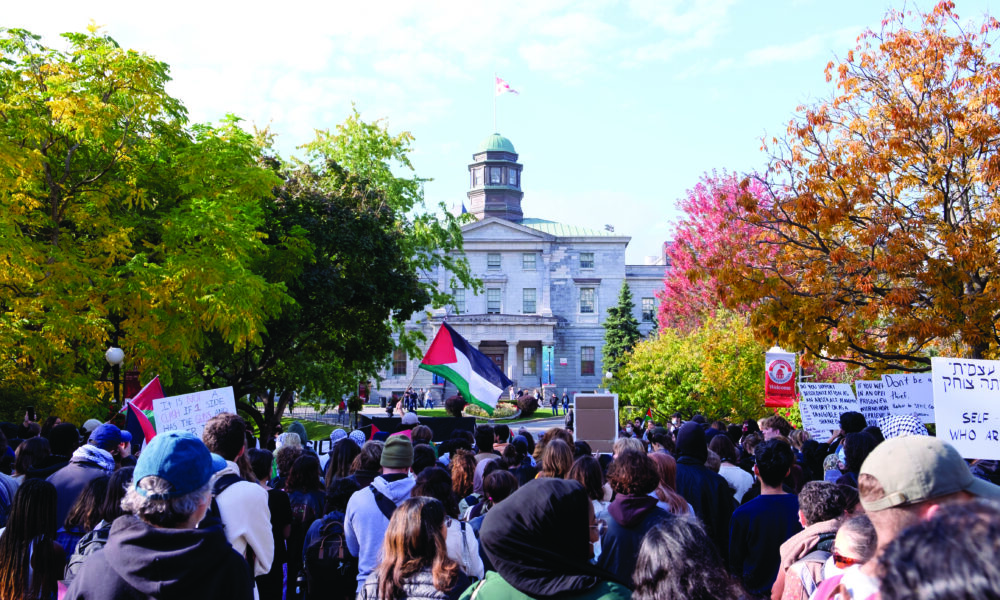
Speakers stood by the Y-intersection in front of a Palestinian flag and pro-Palestine banners with the backdrop of the McGill Arts building behind them. The around 200-person crowd, mostly students, waved hand-drawn signs. Passersby watched from a distance, while a half-dozen police officers remained around the perimeter.
“Free free,” a SPHR member said into a microphone, kicking off the protest. “Palestine,” the crowd responded.
“We are here today because it is our right and duty to support the people of Palestine,” the speaker continued. “What we are witnessing today is a genocide.”
Between chants, the speaker asserted that McGill had targeted SPHR McGill in its recent emails to staff and students. The speaker also denounced McGill’s partnership with Israel’s Tel Aviv University and McGill’s history of oppression. They turned and pointed to the flower bed in front of the Arts building that is the burial site of the university’s namesake and founder, James McGill, who enslaved at least two Indigenous children, and three people of African descent.
McGill University media relations, when asked for comment about SPHR McGill’s protest, referred The Tribune to an Oct. 20 communication from Angela Campbell, Associate Provost of Equity and Academic Policies, and Fabrice Labeau, Deputy Provost of Student Life and Learning. They called for the community to “show compassion for one another even when [they] feel scared, shocked, or outraged by current events.”
“While this is a very big ask, especially if these sentiments are rooted in personal experiences and circumstances, it is essential for our ability to function as a campus community,” Campbell and Labeau wrote.
McGill’s Provost and Vice-Principal (Academic) Christopher Manfredi denounced SPHR McGill’s social media posts in an Oct. 10 message to students and staff and ordered them to stop using the university name.
SPHR McGill responded to Manfredi’s message in a public statement on Oct. 19 condemning the McGill administration.
“In the face of active genocide against Palestinians in Gaza, rather than offering its Palestinian students and allies support, McGill is doubling down on its complicity with the Zionist state of Israel. Intimidated by the presence of our activism, the McGill administration is attempting to erase SPHR McGill’s right to represent the students of our university, pressuring SSMU to revoke our name and penalize us,” the group wrote.
The group commented on the protest in a statement to The Tribune on Oct. 23, affirming their previous public statements against the university and citing a letter of support signed by 28 McGill staff. They also called students to join them on Oct. 25 to walk out of their classes at 1:30 p.m. in solidarity with Palestine.
After the first speaker, the crowd heard from other SPHR McGill members, representatives from the Palestinian Youth Movement (PYM), the Association of Graduate Students Employed at McGill (AGSEM), and a McGill professor. The speakers voiced their support for SPHR McGill and rallied for Palestinians. The Delegates’ Council of AGSEM voted on Oct. 18 to approve two separate motions in solidarity with Palestine and SPHR McGill.
Prior to the student protest on the McGill campus, the PYM led a protest at 1 p.m. which started in front of the U.S. Consulate General at the corner of Rue Stanley and Rue St. Catherine. Chants of “Free free, Palestine” echoed as around 100 people gathered to protest the Canadian and American governments’ support of Israel.
(The Tribune)
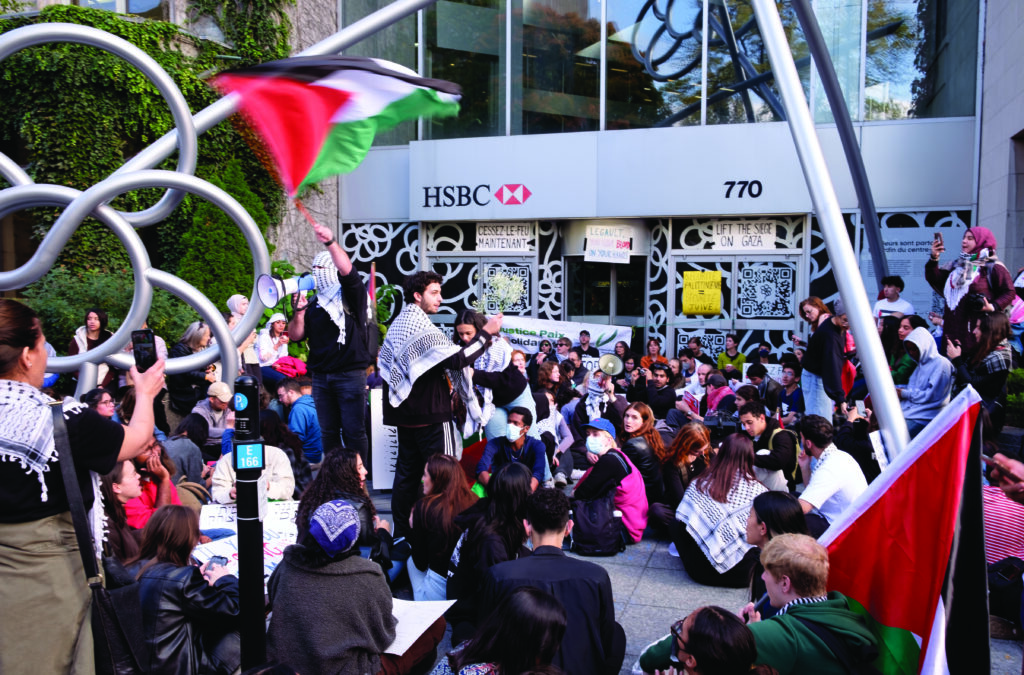
The crowd grew to around 300 people by 2 p.m. and made its way toward Premier François Legault’s office on Rue Sherbrooke to join members of Independent Jewish Voices (IJV)—a grassroots Jewish organization that advocates for peace in Israel-Palestine—who were blocking the entrance to the building. A heavy police presence, with officers on foot, bikes, horses, and in cars surrounded the area while Rue Sherbrooke was blocked off from Rue University to Rue Stanley.
“In partnership with the Palestinian Youth Movement [….] We’re calling on Legault to pressure the Canadian government to send immediate humanitarian aid to Gaza to acknowledge and respond to rising Islamophobic violence in Quebec and Canada,” a member of IJV told The Tribune while blocking the entrance to Legault’s office.
“We’re calling Legault to recognize and respond to that rising Islamophobic violence here in Quebec and call on the Canadian federal state to do the same in Canada. And we are calling on Legault to push the Canadian government to acknowledge its complicity in the unfolding genocide in Palestine,” they continued.
According to a CBC article on Oct. 23, the Canadian government has previously said that Israel’s actions against Palestinians do not constitute genocide.
As the protest gathered around Legault’s office, PYM representative Sarah Shamy, BA ‘21, also called for justice for people in Gaza, and led protesters to chant “End the siege on Gaza now!” and “End the bombing now!”
By 3 p.m., the SPHR McGill protest wrapped up and the protesters marched to join the PYM and IJV protest outside Legault’s office. The crowd moved through the Roddick Gates before being met with cheers as they stood opposite the PYM and IJV protest before merging into one.
(The Tribune)
“I don’t want another genocide committed in the name of Jewish people. Certainly not in my name,” an IJV member and McGill PhD student told The Tribune. “I find McGill’s response to these events to be incredibly one-sided and narrow-minded. They’re actively erasing the voices of Palestinian students on campus and of students who support them.”
The protest started to thin out around 4 p.m. Since the crowd was small enough to fit on the sidewalk in front of Legault’s office, Rue Sherbrooke was slowly reopened to traffic by police. The PYM organizers called the remaining protesters to stage a sit-in in front of Legault’s office. They stayed seated for several hours as parked police cars surrounded them. Supporters taped signs to the front door of Legault’s office before the protest ended peacefully at 7 p.m.
(The Tribune)
“It makes me feel very energized and hopeful because, you know, day after day, when we organize a protest, even when it’s under extreme[ly] short notice, hundreds and thousands of people show up,” said Shamy, reflecting on the protest. “So it definitely makes me feel hopeful that even though our states are turning a blind eye, the people are refusing to.”
The office of Premier Legault and The Students’ Society of McGill University did not respond to The Tribune’s request for comment before the time of publication.
The Student Wellness Hub offers counselling services for students located in Montreal.
Keep.MeSafe is a service accessible 24/7 whenever you need to speak (or text) with a mental health professional for support. You can access Keep.MeSafe from anywhere in the world.
This piece was updated at 11 p.m. on Nov. 13 to fix a capitalization error and to revise the estimated Israeli death toll. On Nov. 10, Israel lowered its estimated death toll following the Oct. 7 attack from 1,400 people to 1,200.
Since 1978, the Quebec government has upheld several bilateral student mobility agreements with foreign French-speaking countries. They signed the first of these with the French government in August 1978, and later signed another with the Belgian government in 2018, allowing French-speaking Belgians to attend the university at a discounted rate. Although these policies aim to increase student mobility, they have an underlying goal: To promote the French language in Quebec.
Under these agreements, some foreign students holding a French or Belgian passport are eligible to receive a significant discount on Quebec’s international student tuition fees. Instead of paying the standard international rate of $42,190.38 for a Bachelor of Arts degree, French and French-speaking Belgian students can instead benefit from the province’s out-of-province tuition of $11,426.28—a 73 per cent discount. Because of the policy, ever-increasing numbers of Francophone students are drawn to McGill each year, which plays out in the makeup of the school’s student population. Together, McGill’s French and Belgian students represent a combined 18.6 per cent of the total international student population—making it one of the largest international communities at the university.
To better understand these agreements’ impact on McGill’s student population, four francophone students shared how the tuition exemption policies have benefited their educational opportunities and fostered a strong francophone community at the university.
Paul Boura, U2Finance
As a France-born Malaysian, Boura’s dual citizenship allowed him to benefit from Quebec’s bilateral agreement with the French government. Wanting to pursue a degree in management, he explored educational opportunities abroad, but options in France were limited and not entirely suited to his needs. McGill compelled him with its high-standing reputation, international student population, and low cost. The $11,000 annual tuition rate, combined with Montreal’s relatively low cost of living, enabled him to pursue an affordable, international undergraduate experience.
He noted that French students, especially in Management, are “very close to each other.”
“When I hear French being spoken, I am drawn to it,” Boura added. “Although I can say that McGill’s high French population facilitated my integration and making friends here, it did also restrict me from meeting other types of people and going outside of my comfort zone.”
Lisa Matmati, U2 Political Science
Matmati is a second-year French student, raised both in Lyon, France, and San Francisco, USA. Her dual citizenship deeply influenced her selection of a post-secondary institution. Despite living in France at the time, she hoped to pursue a university education in English. However, she found all of these boxes difficult to check; the desire to study in English combined with her hope to pursue an international education was not easy to find.
“Outside of France, your options of where [to go] are limited [by] price, distance and what you want to study,” Matmati explained. “Before Brexit, a lot of people went to the UK, since it’s close to home and prices were feasible, but that is no longer the case. Being American, I did want to find a North American type of school system without having to pay the cost of American schools.”
Matmati shared that without the tuition exemption for French students, she never would have considered McGill.
“It simply wasn’t feasible for my family,” she said. “As an international student, going to and from Montreal is already a huge expense—flight tickets aren’t cheap—so if you add that to international tuition fees, it would’ve been way out of budget.”
Mathieu Fouilloux, U2 Joint Honours in Economics and Finance
Fouilloux was born in France and lived in Singapore and other cities before coming to Montreal. Despite growing up outside of France, his French citizenship made him eligible for Quebec’s international tuition fee exemption.
Like many, Fouilloux admitted to being surprised by the number of francophones at McGill, and he recognizes that it made a positive difference in his student experience.
“I was expecting a much more anglophone experience,” he shared. “Although meeting other French-speaking students wasn’t my primary goal, being surrounded by people who spoke my first language felt comforting.”
Fouilloux shared that his first-year living situation played into his socialization patterns at McGill.
“I lived in New Residence Hall when I was a first-year, where there was a particularly high concentration of French-speaking students,” he said. “Not only did that help me create a sense of community, but I also reunited with people from my international schools that I hadn’t seen in 10 years. It really reinforced a sense of belonging between French people from international schools.”
This speaks to how big and diverse the francophone community is; that subgroups of French people from different backgrounds emerge within the larger French student population.
Olivia Neuray, U2 International Development
Born and raised in Brussels, Belgium, Neuray moved to Canada at the age of 17 to pursue her undergraduate degree at McGill University. She highlighted the affordability of the tuition cost—in contrast with that of England—as a decisive factor in her choice to attend McGill. Neuray also cited the increased cost for European students to attend English universities due to Brexit.
Neuray insists that the influence of a student’s francophone surroundings mostly depends on the type of person they are.
“If a francophone student only feels comfortable with French-speaking people, then I think they’ll be more prone to seek out a community of other French people,” Neuray said. “Personally, I don’t feel that way, but I was still naturally drawn toward francophone students nonetheless.”
In Neuray’s case, the high concentration of French-speaking students at McGill has had a dual impact on her experience as a francophone student.
“Although I love the bond I have created with my [French] roommates, I didn’t travel across the world to end up spending most of my time with people from my country, or from a neighbouring country,” Neuray said.
These international student mobility agreements have, amongst other things, revealed how the impact of tuition fees extends beyond the simple matter of access to education; they have broader demographic and social consequences on student bodies. While 2,000 French and Belgian students benefit from Quebec’s low out-of-province tuition, similar agreements with non-European French-speaking countries are seemingly nonexistent. How would McGill’s population look different if Haitian, Vietnamese, Moroccan, and Senegalese students were offered the same policies? Student population numbers from countries such as Nigeria (81) or Lebanon (119) are equivalent to or higher than McGill’s Belgian community. Yet, they face higher financial barriers when pursuing an education in Quebec. This begs the question as to what efforts have been made in this sense, or why the Quebec government has yet to undertake student mobility agreements with other countries.
The question of attracting francophone students remains a central issue in Quebec. A recent provincial policy proposal intends to double tuition fees for incoming out-of-province students and threatens to unbalance the distribution of McGill’s student demographic. Just like in 1978 and 2018, if enacted, this policy will change the face of who can and will be a McGill student.
For many USPORTS hockey players, their dreams of playing professionally ended upon their enrolment in post-secondary education. However, for McGill’s Zach Gallant, the dream is still alive.
Hailing from Oakville, Ontario, the Redbirds’ forward had a rather unorthodox path to McGill. Prior to being picked fifth overall in the 2015 Ontario Hockey League (OHL) draft by the Peterborough Petes, Gallant was set on going to play National Collegiate Athletic Association (NCAA) hockey in the U.S., as the prospect of playing professionally was still up in the air.
“I had just come off shoulder surgery [heading into the draft],” Gallant told The Tribune. “Going into that season was the first time I really trained in the summer so I felt really good [and] I played [for Ontario] in the Winter Games that year, and we won gold. [….] I really wanted to go to college, but being drafted so high kind of put me on the trajectory to play in the NHL.”
The decision to play for the Petes proved to be the right choice as the Detroit Red Wings drafted Gallant 83rd overall right before he graduated high school in 2017. Following the Red Wings’ development camp, the team elected not to sign him, prompting Gallant to head back to the Petes for his first season as captain in 2018-19. Unfortunately, seven games into the season, Gallant suffered another injury that required ankle surgery. Having only played 30 games that season, Gallant elected to play in the Eastern Coast Hockey League (ECHL) so the Red Wings could get a better look at his playing style. So, Gallant played four games with the Toledo Walleye before heading back to the Petes for his final year in the OHL.
“The Coast [ECHL] is a real big grind,” Gallant said. “You travel a lot, you don’t really live in the best apartments, you’re not making a ton of money, and that’s when I originally applied to McGill [….] But lucky enough, in the summer, I had gotten an invite to [the] San Jose [Sharks’] development camp, and they offered me a deal after that camp, which kind of changed my trajectory.”
Gallant then signed an entry-level deal with the Sharks in 2019 and headed back to Peterborough to play in his final year of eligibility with the Petes while enrolling in a few courses at Trent University to jump-start his degree. However, Gallant’s final season was cut short by the COVID-19 pandemic.
“It was just such a killer,” said Gallant. “We were really good. Mason McTavish was on pace for 30 goals as a 16-year-old, Nick Robertson scored 55. We had a lot of buzz.”
“The players are just so good,” Gallant explained. “The difference between guys playing the AHL and the NHL is so slim. I really didn’t love the travel aspects of being on the road all the time, and being at the rink and then being at home, so I thought it was time to mix it up and go to school.”
Prior to the 2023-24 McGill hockey season, Gallant was sidelined for 18 months between his last game with the Barracudas and his first game with the Redbirds. In accordance with the USPORTS rules, athletes that play professionally must sit out a season prior to becoming eligible.
But this year of ineligibility did not hinder Gallant’s positive McGill experience. Despite being on the older side as a 24-year-old U3 student, Gallant has enjoyed his time studying finance and accounting, and the journey of returning to the life of being a full-time student.
Gallant is planning to graduate in 2025 with one remaining year of eligibility, and is not quite sure what the future holds for him.
“I still think I want to be an athlete and play hockey because I won’t be able to do it forever,” Gallant concluded.
Whether that means playing in North America or Europe, Gallant is open to any path that will keep him in the game.
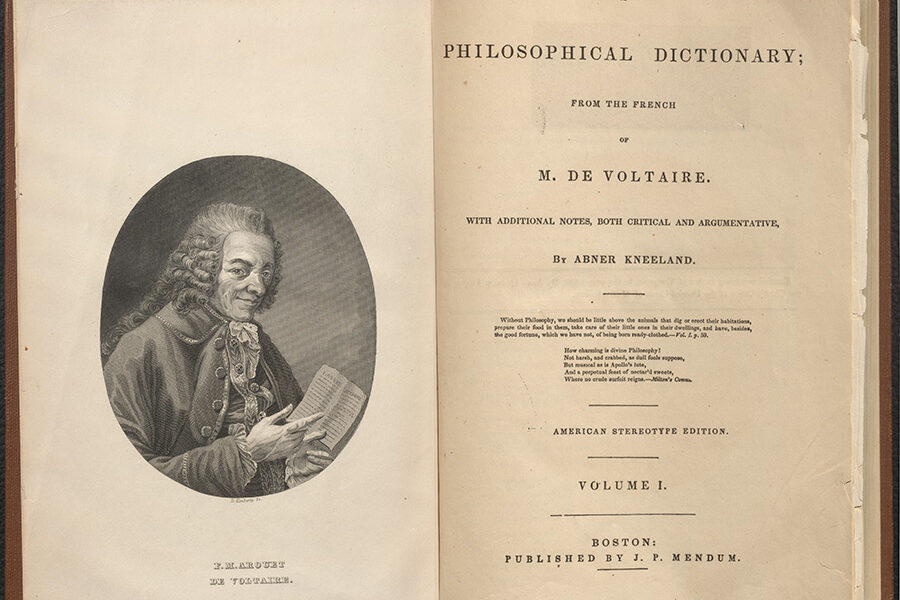
Elegant script, frayed edges, the occasional hole, and sketches of the man himself. Letters signed Voltaire, V, or—occasionally—Volt.
Université de Sherbrooke professor Peter Lambert-David Southam has gifted McGill a stunning manuscript collection of 290 documents including handwritten letters, correspondences, and fragments of Voltaire’s work. Curated by Ann-Marie Holland in collaboration with professor Nicholas Cronk and digitized by faculty and students at the Université de Sherbrooke, these documents allow us to gaze into Voltaire’s life—particularly his time at the Château de Ferney. Four generations of Southam’s family lived in the Château after Voltaire, which is how the collection was assembled and brought to Québec.
As Cronk noted during his lecture on Oct. 28, “The McGill Library has now become one of the world’s major centres for the study of Voltaire.”
But why care about manuscripts today? Cronk made a case in his lecture.
An 1841 letter has “Open Cautiously” written on the envelope. “Mr. Reed, who lives in Leeds” sent a letter to novelist Maria Edgeworth, begging for a signature. She wrote back with a signed reply—written on the inside of the envelope, knowing that if he ripped it open in his enthusiasm, he would destroy the signature.
An Ariosto manuscript at the Biblioteca Ariostea is smudged at the bottom. Over 200 years after its writing, Alfieri visited and loved the manuscript so much, he signed it like a visitor’s book (generally frowned upon today, but the librarians made an exception for Alfieri). He cried, smudging the ink.
These remnants let us see a different side of the author’s life, one unpublished, uncirculated, unremembered. Authors are often so much more than what they publish—we go far beyond the selves we choose to present to the world.
Voltaire—whose given name was François-Marie Arouet—was an enormous celebrity as well as an amusing character in his time. He won the lottery multiple times—but not through luck. He and a group of friends discovered that the prize fund exceeded the cost of each ticket. So they proceeded to divide and conquer: Buy every single ticket, split the profits, laugh at the authorities, repeat. But what about the parts of his life that society didn’t see?
“In the French sphere, we’re all familiar with those writers mainly in the 19th through 20th centuries: Flaubert, Proust, Valéry, who kept enormous numbers of manuscripts, they kept all their work in drafts… Sadly—or maybe happily—you can’t do that for Voltaire,” Cronk said.
There are exceptions. A famous scene in Candideinvolves the titular character encountering an escaped enslaved person. He sobs. A manuscript was found in the 1950s, written the year before publication. This scene isn’t there—it was added later.
The Collection allows us to connect with a different side of Voltaire. These are letters he wrote to friends, fans, and loved ones (Voltaire often gave his work to “women admirers”). There are holes. No margins. Cheap paper. But we can also see the inverse: Instances of extreme formality, almost forced and very funny.
Voltaire wrote a letter to the (extremely Catholic) Queen of France seeking her approval of La Henriade (an epic poem criticizing the Catholic Church). The letter-writing convention of the time indicated that the more space left after the address, the more respect for the receiver. He left nearly a full page of space. She never answered.
The Collection offers incredible insight into Voltaire’s later years: Who he was writing to, what he was writing, how. Strings of poetry, history, fun, official correspondences, and mistresses weave a tapestry of not only his essence as a person and author, but his everyday life.
Fragments of quotidian life allow us to connect with the past on another level. These documents bring us to the fantastic—but also disconcerting—conclusion that authors are everyday people as well.
Selected works from the collection can be viewed in the ROAAr Reading Room without appointment from Mon.-Thurs., 10 a.m.-6 p.m. with a piece of government or student ID.
In November 2022, Quebec’s Tribunal administratif du travail (TAT) certified the Association of McGill Professors of Law (AMPL) as the bargaining unit representing the Faculty of Law’s tenured and tenure-track professors, a first in McGill’s history. Less than a year later, the Faculty of Education, almost double the size, has followed suit.
The Association of McGill Professors of Education (AMPE) was created on July 4, 2023, and applied to the TAT for certification on Sept. 21, 2023. Dennis Wendt, Interim President of AMPE, says the demand for a union grew stronger within the faculty as dissatisfaction accumulated.
“There are different concerns that different faculty [members] have. If there is a grand narrative, it’s dissatisfaction. And, if there’s one thing that stands out more than anything, I think, is workload,” Wendt told The Tribune. “Any one thing is not a problem, but it’s like death by a thousand paper cuts, and so we have one thing after another after another laid on us, but nothing’s ever taken away.”
Helena Silen, U2 Education, is the vice-president of Academic Affairs at the Education Undergraduate Society of McGill (EdUS). She expressed solidarity with the Education professors on behalf of the EdUS and stressed the importance of fairly compensated faculty for students’ learning conditions.
“As students, I think the bottom line is […] that a happy teacher and a teacher who has the bandwidth and support to be present in the classroom will lead to a better class,” Silen said. “So, it makes me happy to think that they could be more fairly compensated.”
According to Wendt, teaching is only 40 per cent of a professor’s duties. Research occupies another 40 per cent of their workload, and the remaining 20 per cent is dedicated to service and community contributions.
Wendt argues that the expected workload exceeds the time and effort professors are compensated for. In part, he attributes this issue to changes in course-relief policies, which temporarily release professors of certain teaching duties following awards, research grants, or major administrative roles. Wendt told The Tribune that the administration has “cracked down” on granting course releases in the recent past, to the professors’ dismay.
AMPL President Evan Fox-Decent has found that since unionizing, the faculty has more equal footing against McGill. The union is currently in negotiations with the university over their first collective agreement.
“AMPL is thrilled that another faculty at McGill has decided to take better control of its own governance, and is confident that our colleagues in the Faculty of Education are going to find, as we have, that the opportunities available to professors, once they organize into a certified Faculty Association, are unlike opportunities that are otherwise ever available to them,” Fox-Decent said in an interview with The Tribune.
The path to faculty-level certification was laborious for AMPL, with the university contesting the certification in a year-long legal battle and appealing to the Superior Court of Quebec for judicial review of TAT’s certification decision. Given the administration’s litigious approach to AMPL’s certification, Fox-Decent anticipates a similar attitude towards AMPE. However, he remains hopeful that the precedent law professors set will relieve the need for long litigation.
“It’s regrettable because it’s a distraction. It costs money […] so it deprives us of a certain amount of resources and time and it expresses a regrettable attitude on the part of McGill toward some of their colleagues,” Fox-Decent said. “But it is what it is. It’s going to run its course, McGill is going to lose. And eventually, they’re going to have to just come to grips with the fact that two of their faculties now are organized, and it’s possible that others will be in the future.”
On Oct. 11, McGill informed AMPE of their decision to contest the union’s certification. In a statement to The Tribune, McGill’s media relations office reiterated the university’s commitment to Quebec’s Labour Code, but refrained from disclosing more.
“We, as an employer, are limited in what we can communicate during a unionization drive, in order to not be perceived or construed as interfering with the employee’s freedom of association,” McGill Media Relations Officer Frédérique Mazerolle wrote.
The hearings regarding AMPE’s certification will commence on Nov. 9 before the TAT.