Latest News

News, PGSS

PGSS says Bill 96 costs the society $7,000 per month, seeks monetary compensation

The Post-Graduate Students’ Society (PGSS) gathered for its first council meeting of the Fall 2023 semester on Sept. 6. Led by speaker Nora Delahaye, the hybrid session’s agenda included teaching assistants’ (TA) rights and Bill 96

The meeting began with a presentation from Kiersten van Vliet, a representative from the Association of Graduate Students Employed at McGill (AGSEM)—the union representing graduate TAs and invigilators. Van Vliet outlined the rights and responsibilities of TAs and invigilators and encouraged them to reach out if they felt that their workers’ rights were being violated.

“If you have experienced harassment, discrimination, or sexual violence, [AGSEM officials] will be your advocates because you are entitled to a safe working environment as an employee of McGill,” van Vliet said. 

Van Vliet also informed the council about AGSEM’s No More Free Hours campaign, a work-to-rule strike aiming to prevent course supervisors from asking TAs to exceed their contracted working hours—time that they are not compensated for. 

“Before AGSEM represented graduate teaching assistants at McGill, the lowest paid TAs were earning minimum wage, which at that time was $7.25 an hour,” van Vliet said. “There are some departments at McGill that would pay us minimum wage if they could.”

PGSS University Affairs Officer Racchana Ramamurthy stressed in an email to The Tribune that this campaign is key to reducing the power imbalance between TAs and course supervisors.

“TAs hesitate to update the workload form if they exceed the hours fearing refutation from their supervisors and departments,” Ramamurthy wrote. “This has to be addressed immediately, and I am sure AGSEM’s No More Free Hours campaign will raise awareness about this and encourage TAs to exercise their rights.”

Following van Vliet’s presentation, PGSS External Affairs Officer Ansley Gnanapragasam took the floor to discuss the impacts of Bill 96 on the society. The bill, which requires that all organizations and businesses serving people in Quebec produce documents written in French, has reportedly cost PGSS $7,000 per month in translation fees since its implementation in June

“This is an unsustainable cost,” Gnanapragasam told the council. “We [need] to translate documents such as meeting minutes, contracts, and other documents pertaining to the PGSS.” 

Gnanapragasam acknowledged that this is not only an issue that graduate students at McGill face, but one that also affects other English-speaking institutions throughout the province.

“[We have] contacted some other English-speaking universities to see whether or not this is an issue that they’re also facing,” Gnanapragasam said. “This has been the case at Concordia, some CEGEPs, as well as Bishop’s University.”

PGSS has reached out to both the provincial and federal governments to request monetary compensation to help cover the cost of translation. The council hopes that the government will establish a fund to assist non-French-speaking organizations grapple with the effects of Bill 96. 

PGSS Secretary-General Satish Kumar Tulumu echoed the financial strain of Bill 96 on the council in an email to The Tribune.

“More than three-quarters of PGSS membership are from outside Quebec and the vast majority of members from outside Quebec are also from non-French-speaking nations,” Tulumu wrote. “Many of the office bearers can’t write [in the] French language, leading to the hiring of French translators. This is good that we are employing local [francophones] but it makes us economically unsustainable.”

Moment of the Meeting:

Despite being scheduled for 1.5 hours, PGSS’s general meeting lasted only 42 minutes. Additionally, the council met its quorum of one per cent of total graduate membership, which has been a struggle in previous years. 

Soundbite: 

“What we have found by surveying teaching assistants is that 48 per cent of teaching assistants worked above their contracted hours. On average, that would equal $430 of unpaid labour per TA. That equals a million dollars of unpaid TA labour that McGill is stealing from us every year.” 
Kiersten van Vliet on the importance of fair pay for TAs

News, The Tribune Explains

Tribune explains: Unions and associations at McGill

McGill employs over 12,500 staff across its two campuses. There are fourteen unions and two associations that represent, support, and advocate for part- and full-time, academic and non-academic employees of the university. 

What are unions and associations?

Unions bring workers together to hear their concerns and advocate for better working conditions. They negotiate collective agreements (CAs) with employers that outline the specific terms of employment; for example, CAs often spell out regulations surrounding pay scales, benefits, health and safety of workers, and discrimination. Similarly, associations bring members together to try to better working conditions and advocate for their members, but generally have less bargaining power than unions. Both unions and associations typically elect their leadership.


Unions at McGill

The Association of Graduate Students Employed at McGill (AGSEM)

AGSEM has two units, one representing invigilators and another representing teaching assistants (TAs). Each unit has its own CA with the university. AGSEM was accredited in 1993, making it the oldest TA union in Quebec. The union was certified to represent invigilators in 2010. It is currently pushing for better working conditions and pay for TAs—who they claim are overworked and underpaid by the university. The most recent CA for TAs expired at the end of July, and negotiations for a new contract are underway between AGSEM and the university.

The Association of McGill University Research Employees (AMURE)

AMURE represents postdoctoral fellows and research associates and assistants at the university. AMURE was accredited to represent research associates and assistants in 2010 and signed the first CA for research associates and assistants with the university in 2013. The union was accredited to represent postdoctoral fellows in 2015, and the first CA for postdoctoral fellows was signed in 2017. 

The Association of McGill University Support Employees (AMUSE)

AMUSE represents floor fellows and non-academic casuals at McGill. The union was certified to represent non-academic casuals—part-time, non-academic McGill workers—in 2010, and was later certified to represent floor fellows in 2014. Both CAs are set to expire in 2025. In March 2023, McGill decided to reduce the size of Floor Fellows’ accommodations, citing increased demand for housing. This announcement led to backlash from the union, which believes this is a breach of the floor fellows’ CA and has filed a grievance against the university.

The McGill Course Lecturers and Instructors Union (MCLIU)

MCLIU represents course lecturers and instructors at the university. The union was accredited in 2011 as a third unit of AGSEM, but broke away and was re-certified in 2013. It ratified its first CA in 2015. The second MCLIU CA expired in August 2022, and negotiations are currently underway to sign a new one. 

The McGill University Non-­Academic Certified Association (MUNACA

MUNACA represents clerical staff, laboratory and IT technicians, support staff, and library assistants at the university. The union was accredited in 1994. The current CA will expire in May 2024.

Service Employees Union Local 800 (SEU)

The Service Employees International Union (SEIU) represents over two million service employees globally. SEU Local 800, a member of the SEIU, represents service employees throughout Quebec, including some at McGill. Data Centre employees, Faculties Management and Ancillary Services employees, Powerhouse employees on the downtown campus, Printing Services employees, Trades employees at the downtown campus, and Trades and Powerhouse employees at the Macdonald campus are all unionized, and each group has its own CA with the university.

The Association of McGill Professors of Law (AMPL)

AMPL, the first professors’ union at McGill, was certified in late 2022 after an extensive push from professors in the Faculty of Law. The new union is currently facing litigation from the university and has not yet signed its first collective agreement.


Associations at McGill

McGill Association of University Teachers (MAUT)

MAUT is a voluntary association that represents non-unionized teaching staff at the university. Founded in 1951, their website states that it works to engage faculty in the governance process, “foster academic freedom,” and better working conditions.

McGill University Non-Academic Staff Association (MUNASA)

MUNASA is a voluntary association that represents non-unionized non-academic staff at McGill. It was created in 1972 and amended after MUNACA was formed to represent management staff.

Arts & Entertainment

What we liked this summer break!

The summer season may be cooling down, but The Tribune’s Arts & Entertainment (A&E) section is heating up! Here is a breakdown of what the A&E enjoyed over summer break.

Joanna Newsom: The Milk-Eyed Mender (2004)

(Emily Prince & Alissa Anderson/pitchfork.com)

By: Annabella Lawlor, Contributor

In her first studio album, The Milk-Eyed Mender, Joanna Newsom creates a uniquely authentic world of whimsical sound. Released in 2004, the record contributed to the rising popularity of the “freak folk” genre in Brooklyn and San Francisco. Newsom’s combination of mature lyrical prose with the unconventional sounds of doleful harp and harpsichord elicits the playful nature of her creations. The storybook aspect of her songs acts as an ode to the sanguine perceptions of childhood, prompting listeners to question the lost imaginations that come with growing up. Her vocal inflections vary from the utter sombreness of “This Side of the Blue” to the chant-like playfulness of “Inflammatory Writ.” The lyrical poignancy that she possesses from such a young age leaves the listener wanting more and questioning what else she is capable of.

Saw (2004) 

By: Alyssa Sequeira, Contributor

(bloody-disgusting.com)

This summer, I entered the Saw universe by watching all nine movies in preparation for Saw X’s release on Sept. 29. Creepy puppets and serial killers aside, the faces that stood out are those of Dr. Lawrence Gordon (Cary Elwes) and Adam Stanheight (Leigh Whannell)—the original film’s protagonists. Lawrence and Adam begin the franchise chained by their ankles in a grimy (understatement!) bathroom with a dead body as the room’s centrepiece. The horrific setting unexpectedly gives way to underpinnings of romance. Along the way, the two men engage in sarcastic banter and quips loaded with sexual tension, such as Adam noting the fun they’re having without lubricant. Even the official Saw account tweeted a photo of the two adorned with a bloody heart on Valentine’s Day. Do these two make it out alive and spend the rest of their lives together? Watch and see for yourself. 

Pure Colour by Sheila Heti (2022)

By: Izzi Holmes, Contributor

In her 2022 novel Pure Colour, Canadian author Sheila Heti reimagines creation as an artistic process. Much like a painter or writer, God revises the world in drafts. In God’s second draft, all people emerge from eggs as critics, taking the interpretive point of view of either a bird, fish, or bear. Heti essentially retells the book of Genesis, examining the dynamics each animal propagates through the relationships and life of “birdlike” Mira. Grieving the physical and emotional losses of those close to her, Mira grapples with the purpose of her own existence as an artist and a critic. As the fate of both Mira and humanity relies on the belief that to create and critique art is to live, Mira must contend with what it means to die after her father’s passing. The modern cynicism and philosophical precision of Heti’s prose ensure the resonance and relevance of seemingly archaic anxieties. 

Lives of Girls and Women by Alice Munro (1971)

By: Kellie Elrick, Contributor

Alice Munro’s Lives of Girls and Women follows Del Jordan as she comes of age in small-town Southwestern Ontario, shrewdly observing the intricacies and hypocrisies of class, religion, education, sex, desire, and of course, the lives of girls and women. The book’s beauty does not manifest itself through florid prose, but rather in its expression of beautiful truths that remain too often unspoken. Munro explores how we may all live multiple lives and often multiple truths. The novel’s structure illustrates this brilliantly, as it is arguably a short story collection in disguise as a novel. “People’s lives, in Jubilee as elsewhere, were dull, simple, amazing, and unfathomable—deep caves paved with kitchen linoleum,” Munro writes. Lives of Girls and Women explores how perhaps we are not made whole by grand revelations and moments of intensity, but rather through everyday motions that quietly mould us into new selves. 

Features

Asbestos in Canada: A forgotten killer remains at large

Once touted as Canada’s ‘white gold’. Now it’s banned—but its legacy lingers. Experts believe asbestos exposures still kills thousands each year.

Daniel Miskin of family-law firm Miskin Law says they deal with some 50 to 90 cancer cases a year from asbestos exposures.

“I hear of every type of job […] pipefitters and drywallers; floor tile installers and electricians, even a bank worker. And then jobs I’ve never heard of like a roustabout or a farrier.”

He also says that while most of their clients are 50 and older, they have had some dying as young as 14 years old.

Miskin specializes in claiming just compensation for victims of mesothelioma cancer, a cancer of the membrane on the outside of the lungs, heart, and intestines. The life expectancy for most is around a year—and there is no cure. The only known cause is asbestos exposure.

The cases Miskin and his colleagues take on are among the thousands of asbestos-caused diseases each year in Canada. 

Asbestos, a known carcinogenic mineral, was widely used as an insulator and fireproofing agent due to its heat-resistant properties from the 1930s to the 1980s—until it was banned from homes in 1990. According to Statistics Canada, some 9.2 million homes occupied today were built before the ban. Most will have asbestos in them.  

Canada’s history with asbestos, however, goes far beyond household use. Until 2011, Canada was one of the world’s leading asbestos producers and exporters, selling mainly to countries like India and Bangladesh. The abundance of the mineral, found mostly in Quebec, provided thousands of jobs for years—and millions in profits. It was touted as Canada’s ‘white gold.’ 

There was just one snag: Its dust fibres are deadly.   

Inhaling these asbestos fibres can cause mesothelioma and lung cancers as well as other non-cancerous diseases, like asbestosis—a deadly hardening of the lungs.

Exposures occur when the asbestos is disturbed or damaged—it is safe when the material is intact. And disturbances can be human-caused—like breaking a ceiling or floor tile that has asbestos in it—or they can happen naturally over time with gradual degradation and crumbling. 

The World Health Organization (WHO) now recognizes that there is no safe exposure threshold to inhalable asbestos fibres, urging countries to impose extremely low control limits to minimize the risks, or avoid using asbestos at all.

Canada’s Prime Minister, Justin Trudeau, eventually set out to ban the sale and production of asbestos in 2016, with the ban coming into effect in 2018, seeking to end the country’s relationship with the deadly mineral—which at one point saw the major political parties, leading academics at universities (including McGill University) and even the trade union representing the asbestos miners, all supporting the asbestos lobby.  

Today, however, the deadly legacy of asbestos in Canada lingers. 

Asbestos is Canada’s number one workplace killer

Official compensation statistics—while scattered by province—confirm that asbestos is still Canada’s number one workplace killer. 

In British Columbia, asbestos-related deaths in 2022 amounted to a third of all workplace deaths, while in Quebec, asbestos-related diseases were responsible for 124 deaths in 2022. But many researchers and lawyers believe these figures underestimate the true burden. 

The most recent comprehensive national study in 2019 estimated that asbestos-caused cancers are responsible for around 2400 cases each year, accounting for 81 per cent of mesotheliomas and 8 per cent of all lung cancer cases. 

According to Cheryl Peters, a senior scientist at the British Columbia Centre for Disease Control (BCCDC) and one of the study’s authors, the percentages should still hold as estimates since they were based on decades of empirical analysis. Using the latest data from 2022 puts the current estimates upward of 2,800 new cases a year. 

Most victims will be in their 60s and 70s—exposed while working decades ago. But as Miskin and others are witnessing, an increasing number of workers 50 and younger are falling victim, and from non-construction-based industries—the likes of teachers and bank workers.

Lung cancer and mesothelioma make up the highest number of cases. The other types included in the study were laryngeal and ovarian cancers, which account for a smaller number.

Both lung cancer and mesothelioma normally take decades to develop. Most victims eventually go to the doctor with mild symptoms—say, a cough or shortness of breath. The doctor will tell them that they may only have a year to live. 

Chemotherapy and immunotherapies can delay the spread. But the survival rates are among the lowest of all cancers. Just 7 per cent of mesothelioma victims will live past five years.

Normally the impact on victims and their families is devastating—many anti-asbestos campaigners had their interest ignited by a family member or friend falling ill. 

The government of Canada’s current strategy maintains the federal ban on the production, sale, and import of asbestos, Health Canada confirmed to the The Tribune

The strategy also includes increasing awareness about the health risks and continuing expanding the online list of government buildings with asbestos in them. There is no mention of a systematic plan to remove it from public buildings. 

A spokesperson for Health Canada said, while risks related to asbestos-containing products that are already in use or installed, such as in existing buildings, are managed by existing federal, provincial, and municipal rules and regulations, Health Canada and the federal government has made efforts to raise awareness among Canadians about to the dangers of asbestos [citing Canada help pages].”

Regulations and standards are made more complex in Canada than other countries such as the United Kingdom because of the interplay between municipal, provincial, and federal jurisdictions. 

The gradual phasing out of products in homes across the 1980s came from all strands of government, and ended in a federal ban in 1990.

The 2018 federal regulation is the latest major ban—coming over two decades after European counterparts. But the ban includes exemptions for industries, such as for military and nuclear industries, which anti-asbestos campaigners advocated against. 

Kathleen Ruff, one of the leading human rights advocates involved with the fight against the asbestos lobby, said at the time, “they seem to have, if anything, weakened their proposed regulations and succumbed to lobbying by vested interests.”

Also exempt was the chlor-alkali industry, which produces chlorine. Asbestos had historically been used in the production of chlorine in the ‘diaphragms’ that separate the two compartments of an electrolytic cell. The diaphragm prevents sodium hydroxide from reacting with chlorine. The chlor-alkali industry is exempt from the ban until the end of 2029.

Canada’s Ministry of Environment and Climate Change (ECCC) justified the exemptions to The Tribune, saying, “Exclusions to the regulations were only considered in exceptional circumstances, taking into account socio-economic factors, the demonstrated absence of suitable alternatives, and with the consideration of health risks.

“For the exclusion related to a chlor-alkali facility, the exemption applied to the use of asbestos in diaphragms […] This time-limited exclusion was provided to allow the facility sufficient time to develop and test non-asbestos alternative technologies and safely implement necessary adjustments.” 

Alternatives in the chlor-alkali industry are already in use internationally. According to the United States’ Environmental Protection Agency (EPA), more than half of the chlor-alkali corporations using asbestos diaphragms in the U.S. have already transitioned to alternatives. 

Olin Corporation, one of the last three American chlorine companies using asbestos diaphragms—also with factories in Canada—stated in April that they now support an asbestos ban in the industry. 

Health Canada commented on the matter to The Tribune saying, “we are actively monitoring the development of alternatives and may accelerate the phase out exemptions if circumstances permit.”

Provincial governments play a larger role setting and enforcing workplace guidelines, but campaigners have called them to move faster on these issues. It was only last year that Quebec lowered its exposure limit for airborne fibres from 1 fibre/mL to 0.1, following the recommendations of an independent commission in 2020 from the Bureau d’audiences publiques sur l’environnement (BAPE). 

The new airborne standard in Quebec aligns the province with Canada’s Labour Code limit, but questions remain about whether it will be observed. Gabriel Levesque with the Asbestos Victims Association of Quebec (AVAQ) told  The Tribune that workplace regulation in construction industries is already difficult to enforce. 

“Does it actually matter for the construction workers [if there is new regulation],” Levesque asked. “Most of the time, it’s not even 1 [fibre/mL], it’s even higher than that.” 

Construction studies undertaken by Quebec in the late 2000s showed that factories often exceeded asbestos standards, posing deadly threats to workers. And to this day, the sentiment amongst campaigners The Tribune has spoken with is that rules are unlikely to be observed. 

Other provinces have become more proactive. British Columbia in June announced asbestos removal contractors will have an official government licence by the end of the year—making it the first jurisdiction in Canada to do so, according to WorkSafe BC. But most provinces’ regulations are still hazy—including for private homes. 

The BAPE report stated that in 2020, the City of Westmount in Quebec, one of the more affluent neighbourhoods, was the only municipality of over 1200 in Quebec to have asbestos home renovation regulations. 

Data from Statistics Canada shows, however, that there are still some 1.4 million homes in Quebec built before 1990, which may have asbestos products in them. 

And despite efforts made by the federal government to increase awareness, according to researchers and campaigners The Tribune has spoken to, awareness amongst the general public still remains low—with mostly former construction workers aware of the risks. But when citizens do identify an asbestos problem, there is often confusion around what to do next—and whose responsibility it is. 

Levesque from AVAQ said that one of the members in the victims association went around in circles with municipal, provincial, and federal authorities after they discovered there was exposed asbestos following a renovation. 

“She contacted the municipality […] got a response saying ‘it’s not in our jurisdiction […] contact the Institut national de santé public du Quebec’[…] They said it’s the Quebec Ministry of Health. The Quebec ministry then said ‘no, it’s not our responsibility. It’s the city’s responsibility’ […] They went like this for like, two months […] We never got a response.”

Workers are the ones who pay the ultimate price

Since the provincial and federal action over the last five years, unions across Canada continue to hear member’s concerns—from construction and non-construction industries. 

Those exposed can usually file a claim against some combination of their employer, the asbestos product manufacturer or their provincial worker’s compensation board. 

But as the exposures likely occurred some decades ago, victims—who may have already been served a death sentence—face an uphill battle proving liability. Statute laws also mean there is normally a time limit of around two to three years, depending on the province, to file a claim—or victims wait until they have passed, and leave it to their families to take up the claim. 

“I barely remember what I had for breakfast. It’s difficult to remember what type of pipe insulation you were using 40 years ago,” Miskin said.

The asbestos companies that are liable sought to protect themselves by filing for chapter 11 bankruptcy in the 80s and 90s—setting up trust funds to pay out victims. The majority of these companies remain in business today. 

Other workers (that did not want to be named) who have not fallen ill yet but believe they have been exposed have also expressed difficulty speaking out to their employer. 

“We have double standards [with workers], we don’t treat the lives of workers as being as valuable as others. And so we just don’t take action,” Ruff said.  

Across the world, WHO still estimates asbestos to be the world’s biggest workplace killer. And friends of Canada are moving to reduce asbestos exposures more drastically. The European Union announced in June they would lower the airborne regulation further to 0.01 fibre/ml, while countries like Poland have implemented a strategy of removing asbestos from public buildings. 

“I think we need more openness [in Canada] and more attention on this, so that people are aware of the dangers,” Ruff said. “We still need better standards, and you don’t need masses and masses of people to speak up and stand up for protecting human life […] but you need a certain number.” 

Off the Board, Opinion

Hearing queers through new ears

I was not a podcast person until the world came to a halt. But upon frenzied shutdowns, curfews, and public health measures, I turned to the auditory for its unique pleasures. Walking in my suburban Ontarian neighbourhood, I could tune in to the experiences I had not grasped as an overinvolved high schooler. Bustling city life, chaotic and ephemeral relationships, underground arts communities surfaced quietly while my choices remained anonymous. Unsurveilled, I got to visualize, create, and live a new world. These are not podcasts to pass on.

The privacy of consuming a podcast is its greatest strength. Dance, theatre, and performance art rely on an audience, visual art and photography depend on the presence of the beholder and her object, and in its specific demands for time and space, reading enacts an eventful display. Any fellow reader miffed by the question, “What are you reading?” will understand. The contents of my listening lie solely between my phone and myself, with my headphones mediating. Within this intimate relationship of technology and self comes a reckoning. Will these private forms enter public life? If they should, whose interests will they actually serve? The margins do not need to cater to the centre. 

In the outskirts of Toronto, where sidewalks meet driveways that sprawl onto single-family homes, where social liberalism and fiscal conservatism emerge as rapt dance partners, where whiteness and heteronormativity more easily tangle, multiply, and destroy other life-worlds, this form of unspectacular consumption would rehearse a freer future. I feel nostalgic for the lives I have not yet lived.

These walks became an escape. At most, four hours a day—but never under one and a half and always audibly accompanied. I eagerly await the opportunity to leave the house. My feet soften on the synthetic terrain, floating above over-manicured lawns, toxins ravaging each other to appear green. The knots in my back come undone, the crick in my neck dissipates, my head unclouds itself from the fear, the hate, and the force that is now a distant memory. Quiet as it is kept, an episode ends and I queue up what is to follow. I hear queers of colour chatting about sex and culture, gossiping about the show’s producer; radical feminists talking about surviving red states, affirming why they choose to fight; Black queer and trans people discussing HIV-AIDS, the lived “rainbow,” and the imperative of love in South Africa. Passing a pedestrian who does not hear the lewd joke a host has made, a bitchy remark from a guest, a cutting quip from a caller, I relish the freedom to chortle innocently. In their eyes, I might be listening to a darkly-funny true-crime podcast or on a call with an up-and-coming friend in standup. In a way they might be right. This allows my days to pass.

The walk to campus does not take long enough for me to properly listen. The rush and unsettled horizon of university keeps my brain otherwise occupied. There are texts to read, essays to write, and events to attend. These times develop as ones in which disclosures happen and confessions occur as brief words uttered aloud in the cold, where the orange sign of a 24-hour A&Wflickers, daring us to admit to one another, to pull each other closer. Private becomes public. Definitions hop off the page and into the atmosphere. I strive to dream, to inherit, and to practice what I have heard.

Some of my podcasts do not come back. The hosts have reintegrated themselves into community work, lost funding from the state and, needing to crowd-source, have disappeared from the apps. They give us what we need, and they deserve to recharge. I cannot say how much they have provided me. Their hope may be found in my bones. Relistening now allows me to reclaim what we have lost. I am overjoyed, I am breathing unburdened, and this time, if you do not mind, I will keep this experience to myself.

Arts & Entertainment, Film and TV

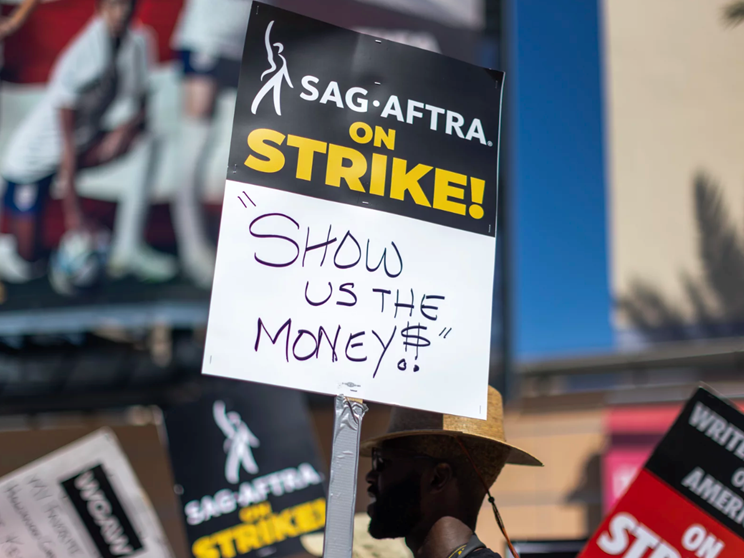
SAG-AFTRA is negotiating for the future of the entertainment industry

On July 13th, the Screen Actors Guild (SAG) and the American Federation of Television and Radio Artists (AFTRA) voted to strike after unsuccessful contract negotiations with the Alliance of Motion Picture and Television Producers (AMPTP). The next day, SAG-AFTRA joined the Writers Guild of America (WGA) on picket lines across the United States, marking their first joint protest since 1960

The AMPTP represents multi-billion-dollar production studios such as HBO, Disney, Netflix, Sony, Amazon, and Apple. Despite these companies’ overwhelming wealth, a staggering 87 per cent of SAG-AFTRA members earn under $26,470, making them unable to qualify for union health insurance. Meanwhile, Disney CEO Bob Iger dismissed SAG-AFTRA’s demands as “unrealistic”—a deeply ironic statement from a man who makes $31 million annually. These workers’ rights issues are not isolated to the entertainment industry, further justifying the broader need for this strike.

SAG-AFTRA is fighting for fair compensation in the era of streaming platforms and, now, artificial intelligence (AI). Out of SAG-AFTRA’s 86 proposals, key demands include increases in general wages, updated employer contributions to health and retirement plans, and better residual payments. The AMPTP’s inadequate counter-offers revealed more-than-mild disagreements on those core subjects. SAG-AFTRA seeks higher wages because their previous contract with the AMPTP failed to support actors through high inflation. The union also claims that the AMPTP’s response toward raising employer contribution caps for health and pension plans—which haven’t changed in 40 years—was “insufficient.” 

Unsurprisingly, the growing threat of AI exacerbates these issues. If left unregulated, AI will quickly jeopardize the livelihoods of all actors. Background actors in particular face an immediate risk because their digital likeness would eliminate the need for studios to hire extras by using and reusing the actors’ image on other projects. 

Other than regular salary shortcomings, actors and writers are fighting to change how studios disburse residual paychecks. Residuals were determined by a formula—which writers and actors established the first time they struck together—and reflect the number of times a production is played and replayed on a cable network or sold as a DVD copy. Streaming services operate very differently, and top media executives have capitalized on these discrepancies for over a decade. Consequently, residuals have decreased dramatically, going from tens of thousands of dollars to cents

Recently, the story of Alex O’Keefe, a writer for The Bear, went viral because he could not afford to buy the suit in which he accepted his WGA Award for Best Comedy Series—and such occurrences affect actors, as well. Recurring cast members of Orange Is The New Black—a show credited for Netflix’s ascendancy in TV and film—said they were paid the union minimum and kept their day jobs while working on the multi-award-winning series. If the artists behind critically acclaimed shows cannot make a living, then it’s not hard to envision the predicament of the myriad of artists working on smaller-scale, independent projects. Since the public has found these concerns to be valid, reasonable, and universal, support was strong in the strike’s early days. Now, as the writers’ strike approaches the five-month mark and the actors’ begin its second, the economic impact of this decision—albeit a necessary one—is becoming clearer. Other than 39 indie projects (which SAG-AFTRA authorized as they are being produced by non-struck companies),commercials, and reality television shows, union members cannot partake in any on or off-screen work, auditions, or promotional activities. So, much of the entertainment industry is on hold for the foreseeable future. It’s understandably difficult to imagine the world’s most beloved A-list actors struggling to make ends meet after months of unemployment, and for good reason: They aren’t. For too long, production studios have exploited working-class actors to make their already rich executives even richer. In an unprecedented time, these artists have the upper hand. And it’s the perfect occasion to support the 160,000 striking actors fighting for the future of performing arts.

Editorial, Opinion

Protect our Floor Fellows, or lose them

McGill employees will once again bear the brunt of poor administrative choices. AMUSE (Association of McGill University Support Employees) has been fighting for better living conditions and wages for residence Floor Fellows, but they now have to make yet another sacrifice: Their living space. 

In March 2023, the McGill administration decided that Floor Fellows’ living space will be decreased in every residence except Solin Hall—they will no longer be housed in the more spacious rooms of the university’s dormitory residences as was customary. In Carrefour Sherbrooke and La Citadelle, the change will simply be a reduction of personal space. According to AMUSE, in Upper Residence (Molson Hall, McConnell Hall, and Gardner Hall), Douglas Hall, and Royal Victoria College (RVC), the Floor Fellow suites—typically including a private kitchenette and bathroom—have either been partitioned and renovated into two single bedrooms, or kept intact and rented to first-year non-employee residents, while Floor Fellows have been moved into the smallest single bedrooms available. Additionally, in Upper, Douglas Hall, and RVC, Floor Fellows will be sharing the communal washrooms with the first year students they supervise, a significant imposition on  the daily-life of both students and Floor Fellows living in McGill’s residences. 

The university justified their decision citing an increasing number of applicants for student housing. In response to this decision, AMUSE filed  a grievance against McGill, stating that this decision violates articles 1.01, 4.02, 5.01, 5.02, 12.01 and 12.07, non-inclusively, of the Floor Fellow collective agreement.

Floor Fellows are an essential aspect of residence life, as their job directly contributes to the experience and success of first-year students. When the barrier between their working environment and living space is broken, Floor Fellows are left with an extremely challenging student job. The assigned shifts do not account for the intimate, informal, and essential work Floor Fellows do, when living amongst students inevitably demands constant awareness to unpredictable situations and the pressures of uncompensated emotional labour. With McGill putting profits over people, conditions for everyone in student residences worsen. By eliminating the distinct privacy that comes with the traditional Floor Fellow spaces, first-year students and Floor Fellows both lose their autonomy, with the former having to share a common space with an older figure of authority and the latter mediating between being an authority figure in shared spaces and accessing personal time. 

It should be obvious to the McGill administration that diminishing the living conditions of Floor Fellows will inevitably impede on the quality of their work, both in their ability to provide for first-years and to be strong students in their own studies. Although McGill fairly asserts that students need places to live on campus, it must not be done at the expense of Floor Fellows. 

Floor Fellows do the hard work of helping students navigate through their first year, compensating for the poor mental health services that McGill provides; thus, neglecting and suppressing workers’ rights only adds to an endless cycle of abuse. McGill’s fraught relationship to unions will only be overcome with serious organization and consolidation of students, staff, and professors to speak out and use their collective power to hold the administration accountable.  

Given the housing and affordability crisis in Montreal, there need to be more institutional and collaborative solutions from students, activists, and the McGill administration responding to what the community needs. If McGill is unable to meet the housing needs of first-year students while providing safe and private housing for Floor Fellows and students alike, they must be more transparent with incoming students and resolve the false idea that residence can be provided for all. Appropriate living—and thus working—conditions are necessary to ensure the supposedly high-quality service in residences which McGill currently claims to offer. If the university wants to continue to offer first-years a fulfilling living experience so they thrive in residence, it must put Floor Fellows first. 

Album Reviews, Arts & Entertainment

‘The Loveliest Time’: A musical journey, or an excuse for more?

In the dynamic realm of pop music, artists consistently seek innovative ways to captivate their audiences while pushing the boundaries of their creativity. Carly Rae Jepsen (CRJ) is no exception. Since she shocked the world in 2012 with Call Me Maybe, she has gone on to release multiple pop anthems including “I Really Like You” and “Run Away With Me”. After the releases of B-sides to her albums Emotion and Dedicated, her July 28th companion album to 2022’s The Loneliest Time wasn’t a surprise. While both albums undoubtedly showcase musical prowess, a vital question arises for her listeners: Does The Loveliest Time maintain a coherent narrative or primarily serve as a vessel for unused songs?

Companion albums, a trend seen across the industry, can be both a boon and a bane for artists. Artists such as CRJ possess a surplus of songs that might not harmonize seamlessly within a single record, mirroring Taylor Swift’s Folklore and Evermore. This dual-release strategy may either enhance or, as exemplified by The Loveliest Time, contrast with the original story; But, this might just reveal a ploy to sell more music rather than create aesthetic harmony. 

Released during one of the first “normal” summers during the COVID-19 pandemic, The Loneliest Time provided an opportunity to reflect on the preceding two years while conveying hope for the future. The titular track, a collaboration with Canadian icon Rufus Wainwright, sees CRJ yearning to reconnect with an old flame, expressed through a disco-infused melody that masks underlying sorrow. This motif persists across the album—buoyant music overshadowing lyrics tinged with sadness. While certain tracks like “Western Wind” and “So Nice” bolster the album, weaker entries like “Beach House” detract from its overall strength; the latter is shockingly corny for a CRJ song. “Go Find Yourself Or Whatever,” toward the album’s close, evokes a sense of post-party introspection, effectively embodying the album’s claim as her loneliest.

In contrast, The Loveliest Time struggles to differentiate itself from its predecessor despite its alleged mood change. While CRJ clearly has an extensive musical repertoire, this album comes across as an outlet for unreleased tracks from the original. Evaluated in isolation, the album could merit a higher rating, yet it falters when you try to find the link to its companion. Unsurprisingly, listening to The Loneliest Time is now more confusing with the newly released B-sides. I have a hard time remembering which songs are on which album, as they have such similar sounds. Even the album covers, although each is stunning, do not give us a hint about the music inside. 

Double releases pose a significant risk. A successful outcome requires the second release to oppose or complement the original. Regrettably, these albums do not fall into that category—the second release muddies the narrative the first creates. The adjective change in the title makes the listener expect something different. The anticipation of a distinction of mood and atmosphere in the second sets the listener up for disappointment when the albums are so similar in their sound. 

The Loveliest Time begins on a boom with “Anything To Be With You”, altering the vibe set by its predecessor. With a funky drum shot and an instant rhythm, I thought I was in for an entirely different aesthetic. However, subsequent tracks struggled to find their footing until “Psychedelic Switch”, a standout on the album. These songs are stronger when divorced from The Loneliest Time. Nonetheless, the overlap between the albums makes it challenging to attribute specific songs to either.

The current trend of companion albums underscores the intricate balance between artistic evolution and thematic coherence. As music’s landscape evolves, the takeaway from this dual-release experience is clear: The Loveliest Time struggles to establish its own identity separate from The Loneliest Time. The risk of blurring the lines between CRJ’s two releases underscores the necessity for thoughtful curation and seamless thematic progression. 


Carly Rae Jepsen’s album The Loveliest Time is available to stream on Spotify, Apple Music, and YouTube Music as well as all other music platforms.

Men's Varsity, Soccer, Sports

Redbirds soccer takes home win in first Pride game

After losing their RSEQ season opener to the Université de Québec à Trois-Rivières (UQTR) Patriotes (1–1–0) on Aug. 30, the Redbirds faced off against the Concordia Stingers (0–1–1) in their second home game of the regular season. In a physical match-up that left the Redbirds short-handed for most of the game, the Redbirds (1–1–0) took home their first win of the season. Sunday’s match also marked the Redbirds’ Pride game, with both coaching staff and most players wearing rainbow armbands.

“It’s important to raise awareness among our spectators and players too,” assistant coach Pierre Lepage told The Tribune. “I know that our players received a seminar on the matter during the preseason. You shouldn’t be discriminated against because of your sexual orientation, your skin colour, your religion. This is a message we’re trying to reinforce, to become a more tolerant community that accepts differences.”*

The game opened on a sweltering 28 degree afternoon, with stands filled up by spectators, eager for the match to get underway. As the sun beat down on the Redbirds throughout the first half, the Stingers mounted a strong offense, and despite McGill’s best defensive efforts, buried the ball past goalkeeper Ludovyck Ciociola for a 1-0 lead. 

The pressure from a rowdy crowd and heat started to affect the gameplay, with players getting more and more brusque as the game went on. Although there was rough play from both teams, midfielder Emilio Rossi-Levin landed two yellow cards within one minute, resulting in his ejection from the game and leaving the Redbirds short-handed for the remainder of the match. 

“It wasn’t an easy game, because you’re ten men against eleven [for almost the whole game], and keeping the ball is difficult,” third-year defender Martin Baudelet told The Tribune. “The game was very choppy, [having us] running away, running down the wing […] and for the other shifting from left to right. Obviously, it was very tiring.”

As the first half came to a close, forward Mathis Cyr equalized the score with a corner kick and the Redbirds headed into the second half in a 1-1 tie.

The second half saw more successful action from the Redbirds, with no less physicality. First-year midfielder Nassim Kemel pierced through the Stingers goalkeeper, to give McGill a 2-1 lead early in the second half. 

As the action continued, Ciociola faced several scoring attempts from the Stingers, before being taken out due to an injury sustained while making a save. However, Ciociola’s injury opened the door for goalkeeper Christopher Cinelli-Faia to enter the game.

As the Redbirds settled back in with their new keeper in net, first-year forward Yoan Simard buried another goal to make it 3-1. However, in the last few moments of the game, a Concordia shot hit a McGill player, going into the back of the net for a 3-2 final score. 

*This interview was translated from French by the author.

Moment of the game: Following a breakthrough toward the Stingers’ net, unfortunately thwarted by Concordia’s defense, third-year defender Baudelet sustained an injury. He was ultimately able to continue the game after receiving medical attention.

Quotable: “It’s McGill against Concordia; it’s a hard game. It wasn’t a beautiful game. But it’s very, very, very pleasing to get this win.”

– Third-year defender Martin Baudelet on the importance of beating Concordia
Stat Corner: The match featured 14 penalty cards, including one against the McGill team as a whole and one red card, 21 fouls, 13 attempted shots, five goals and 13 corner kicks.

McGill, News

McGill TAs allege $1 million in wage theft by the university

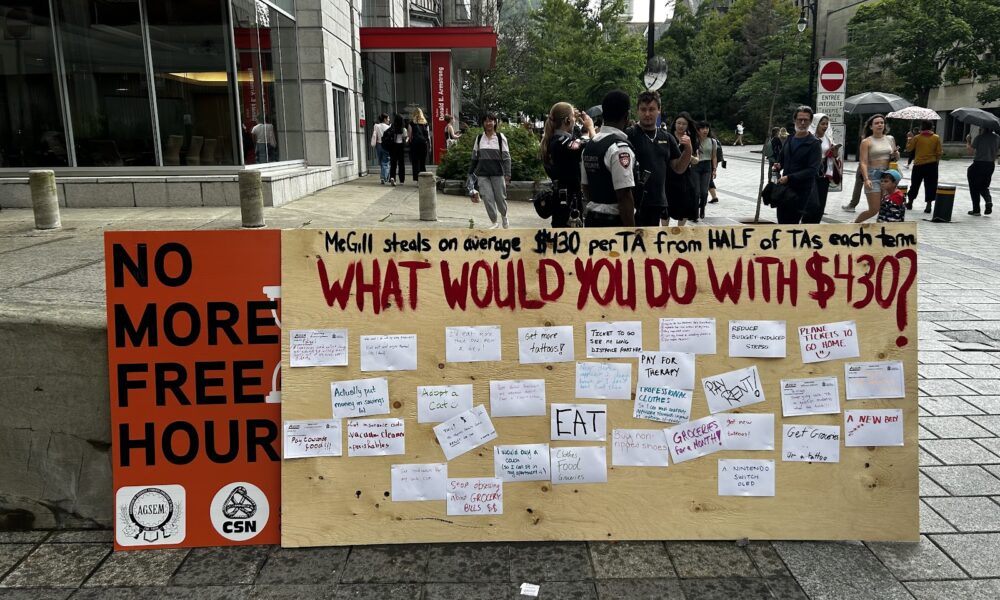
As McGill students returned to campus for the first day of classes on the morning of Aug. 30, they were greeted by food trucks and music on McTavish Street as part of the Association of Graduate Students Employed at McGill (AGSEM)’s rally for better contracts. AGSEM, the union representing teaching assistants (TAs) and invigilators at McGill’s downtown and Macdonald campuses, has been in pre-negotiation talks with the university since July 2023, when their collective agreement (CA) expired. AGSEM alleges that McGill steals $1 million in TA wages annually by exploiting the assistants’ labour and making them work beyond their contracted hours. As the pair await a bargaining date, the union has launched the No More Free Hours campaign to combat and raise awareness about the administration’s alleged wage theft.

The campaign encourages TAs to track every hour they spend on work, from writing emails to reading course material, and to withhold labour as soon as their contract hours have been exhausted. Faculty and students who are not TAs have been asked to show solidarity by signing an open letter that calls on the university to stop the exploitation of TAs. 

Kiersten van Vliet, AGSEM’s Mobilization Officer and a Musicology Ph.D. candidate, has been working as a TA since 2017. They explained that the $1 million in wage theft figure was calculated from a 2017 survey in which 48 per cent of TAs reported working thirteen hours over their contract, leading to an average of $430 of unpaid labour per person each term. Additionally, the same 2017 membership survey found that more than a third of TAs forgo medical services—such as dental or optical check-ups—due to lack of income. As AGSEM heads to the bargaining table this year, van Vliet says wages and healthcare are two of their top priorities.  

“Of course, wages are usually the bread and butter of every negotiation, but we really need to see an investment in healthcare,” van Vliet told The Tribune. “We need to supplement our graduate student healthcare. We’re also demanding a transgender healthcare fund for gender-affirming care because many procedures or treatments are not covered under provincial insurance.”

In addition to food trucks and music, the Aug. 30 rally featured interactive activities for passersby to learn more about the union and its new campaign. On a wooden banner, members of the community were invited to write what they would do with an extra $430 per term. Paying for groceries, rent, or therapy were among the repeated answers on the papers stapled to the board.  

Around noon, AGSEM hosted speakers such as rally organizer Emma McKay, Physics TA Nick Vieira, and student labour activist Alex Engler from the Concordia Research and Education Workers’ Union (CREW). Philosophy professor Marguerite Deslauriers also took the stage to encourage the McGill community to acknowledge the value that TAs bring to the university’s quality of education. 

“[T]hose of us who have teaching assistants swan into the lecture hall oftentimes to leave scattered words of wisdom and bog off, leaving the teaching assistants to actually engage with the students, make sure they understand it, read their work, which we mostly don’t do, give them […] guidance, encouragement, and feedback,” Deslauriers said. “It’s just very important work. It’s really the fundaments of teaching in the university—the work done by teaching assistants in conferences and then grading.”

The Tribune reached out to the university for a statement on AGSEM’s allegations of wage theft and its No More Free Hours campaign. In response, McGill Media Relations Officer Frédérique Mazerolle said “The TA collective agreement expired on July 31, 2023. McGill will not make any comments regarding upcoming discussions and will let the negotiation process run its course.”

Read the latest issue

Read the latest issue