Latest News

Sports

Know Your Admin: McGill Athletics

If you’re a McGill student that cares even a little bit about McGill sports, odds are you follow @mcgillathletics on Instagram. With over 10,000 followers, the Instagram account connects athletes, students, fans, and alumni who root for the Martlets and the Redbirds. From schedule updates to analytics to live game coverage, the beautifully curated content leaves many followers wondering: Who is behind the account?

Matt Garies and Evelyn Silverson-Tokatlidis are the architects behind all of the McGill Athletics accounts on social media, including Facebook, Linkedin, and Twitter. Silverson-Tokatlidis is the Social Media Coordinator for McGill Athletics, while Garies is the Creative Lead. Silverson-Tokatlidis is a former student-athlete who played on the Martlets rugby team for five years and is also the former president of the McGill Varsity Council. Garies is the official sports photographer for McGill Athletics and does a variety of freelance work for various brands, including the Montreal Canadiens and Sportsnet.  

The duo brings a multifaceted perspective to social media management. Silverson-Tokatlidis’ experience as a student-athlete gives her a better understanding of athletes’ needs, while Garies’ experience as a sports photographer allows him to skillfully capture the essence of McGill sports. 

“Our main goal is to have people follow along with our athletes and create that connection for an online audience,” Silverson-Tokatlidis told The Tribune. “[We hope] to share the voices of our athletes and showcase that student side of athletics at McGill.”

Central to fostering this connection is ensuring that students have quick and easy access to information about athletics. Whether it’s the latest scores or upcoming game schedules, providing followers with timely and engaging content is key to building a dynamic sports scene at McGill.

“We want to be constantly engaging as a focal point of content,” Garies said. “We want people coming to our Instagram to get updates and information, and then we can use that as a quicker social point for easy access to links. Our goal was to sort of create a memory where people will be like, ‘Oh, I can check the Instagram; everything will be there.’” 

However, running the McGill Athletics social media is not just getting to attend all the games for free and meet athletes––it’s a complex and demanding job that requires creativity, strategic thinking, and a deep understanding of social media trends.

“We definitely have to be up to date regarding trends,” Silverson-Tokatlidis said. “Even bridging the gap between our first-year athletes and sixth-year athletes [is a challenge] because there are a lot of differences in the way in which people communicate. It’s about trying to find that middle ground and find trends that appeal to everybody.” 

Keeping up to date also requires research on how other teams’ social media management, professional and otherwise, run their accounts. However, they always make sure to maintain a personality fans can recognize. 

“Our voice does shine through a little bit to make our brand a little bit unique,” Garies said. “We also know our athletes very well because we speak to them all the time, which gives us a pretty relatable way of communicating.” 

Garies and Silverson-Tokatlidis go beyond just posting on Instagram to amplify the voices of McGill’s athletes. They also lead the production of the UNSCRIPTED Series on the McGill Athletics YouTube channel, which features interviews with student-athletes specifically highlighting the experiences of Black, Indigenous, and 2SLGBTQIA+ athletes. 

McGill Athletics’ social media presence has become central to the university’s sports culture. Silverson-Tokatlidis’ and Garies’ tireless efforts allow fans to feel connected to athletes by uplifting their stories Their work goes beyond just running social media accounts—it is a crucial part of building a strong and inclusive sports culture at McGill.

Sports

Earl Zukerman: McGill Athletics’ living archive

Earl Zukerman is an icon. The Sports Information Officer has been a fixture in the McGill Athletics department for the past 44 years, spending much of his career working seven-day weeks, at times covering 30 to 40 events during the homecoming weekend. 

Zukerman, or “Zukster” to his close friends, has lived in Montreal his whole life. While he did not initially grow up watching or playing sports—he described himself as more of a bookish child—Zukerman became fascinated with sports at the age of 10 when he started following the Montreal Canadiens, Expos, and Alouettes.

“You know, when parents put their kids in sports, I was never put into that,” Zukerman told The Tribune in an interview. “I only played [in] the street with friends [or] in the park. But once I got to around [the age of 10] […] I started following pro sports from that time on. It has really been my main interest most of my life since then.”

After arriving at the university, Zukerman discovered a whole new world of sports. 

“At McGill, we have 26 teams now. But going back a few years, we used to have up to 50 teams. So in the role that I’ve been in, you have to sort of be an expert in all sports.”

Zukerman, who oversees media relations for McGill Athletics and serves as the main communication point for all McGill varsity teams, started off his writing career as a journalist and Sports Editor for The McGill Daily. Game coverage soon turned into investigations of McGill’s rich sports history, yielding some interesting results. 

“It’s pretty set that James Naismith, a McGill graduate, invented basketball pretty much overnight,” Zukerman said. 

While McGill reports facing Harvard in the first-ever modern football game, and McGill is arguably the birthplace of hockey, Zukerman explained that defining the origins of these sports is a bit trickier. 

“Their origins are a bit murky, because it depends on what form of the game you’re playing,” Zukerman said. “For example, if a bunch of kids are playing hockey in the street, is that hockey? So there’s a debate about how you define hockey and how you define football. And depending on how you define it, then the game could be invented in Canada […] or it could be invented elsewhere.”

After coming to McGill in 1976 as an undergraduate student, Zukerman never left. He’s witnessed 10 of McGill’s 11 National Championships, just missing the 1972 swimming title. Many of his best memories are from McGill and the connections he has made in the sports world, such as his friendship with former Detroit Red Wings coach Mike Babcock, BEd ‘86. He has even been granted several once-in-a-lifetime opportunities.

“I got to drink out of the Stanley Cup three times […] I am not a huge beer fan, but drinking a cold beer out of the Stanley Cup was just amazing. Truly amazing. I did that in 2008, with Detroit. And then I had the opportunity to celebrate Stanley Cups with Los Angeles in 2014 and Chicago in 2015,” Zukerman recounted. 

“Another moment that comes to mind is, in 2001, I went to Beijing for the World University Games as a communications officer with the Canadian contingent and walked on the Great Wall of China. I didn’t really think much of it before I got there, but when I got on the Wall, and you saw how far it was, and you saw how old it was, I found that really to be a moving moment.”

While he has had an amazing career filled with incredible highlights and more championship rings than he has fingers, Zukerman still has dreams for McGill’s future. For one, he would love to see improvements to the athletics facilities because many of them are quite old and run-down.

“If we go down to an NCAA school, most of the big schools, if you go into their gym, and their arenas and their facilities, it’s mind-blowing,” Zuckerman said. “Some of them are better than professional teams. I don’t know if we’ll ever get to that level. But I would certainly like to see improvements.” 

While Zukerman has no plans to go anywhere in the next few years—he hopes to be the first person at any university to reach 50 years as a sports information officer—he is confident that sports will always be a part of his life.

Formula One, Sports

Going green at 200 km/h: Formula 1 takes a climate conscious turn

Between the roar of engines, lightning-fast pit stops, and pursuits of victory, the world of Formula 1 (F1) has successfully established itself as a world of glamour and exclusivity. Champagne showers, good-looking drivers, and yacht-filled victory celebrations paint the picture of a perfect, untouchable world. However, behind the velvet curtain is a dark side characterized by car crashes, political influence, and exorbitant amounts of oil-fuelled travel

Setting restrictions on and off the track 

As of late, the Fédération Internationale de l’Automobile (FIA) has taken steps to promote a greener F1. In 2019, the FIA released a Sustainability Strategy with the goal of reaching carbon neutrality by 2030. The report also revealed that 45 per cent of F1 carbon emissions are linked to transportation, and an added 27.7 per cent to the transportation of personnel and event partners. Identifying these emissions revealed key areas of concern for F1 as the deadline to reach carbon neutrality looms over the world of pro sports.

F1’s strides to be more environmentally conscious begin with the conception and designs of cars themselves. While many believe that the actual racing of cars is what generates the most pollution in the sport, the FIA heavily regulates the fuel consumption  and composition of cars since fuel types greatly impact how much carbon dioxide is released. In an effort to reduce competitive advantages between each car and reduce their environmental footprint, cars can only consume up to 110 kilograms of fuel per race, a substantive decrease from the 150 kilograms of fuel per race allowed in 2010.

“[The requirements for sustainability] are a little bit different than the requirements for performance that you need in racing,” said Susan Gaskin, a professor in McGill’s Department of Civil Engineering, in an interview with The Tribune. “In racing […] the aim is to get the greatest power and the greatest speed, but if we’re thinking about sustainable aims, then we’re looking for the greatest utility for the lowest energy or material inputs.”

The core tension between the search for sustainability and performance creates a precarious task for teams trying to balance both. And with racing success hanging in the balance, more often than not, teams are forced to prioritize performance.  

As part of their Sustainability Strategy, F1 also pledged to offset the emissions of certain Grand Prix races, as is the case for the Circuit Gilles Villeneuve and the Algarve International Circuit, where solar panels will be used to power the venues.

When it comes to the engineering of vehicles, F1 acts as a sort of innovation playground. But while improvements are possible at the development stage of producing a car, there is a limit to how much advancements can significantly decrease pollution during races. 

“You do have greater improvements at the beginning of technology development and then improvements get smaller and smaller as you progress,” Gaskin said. 

The track’s environmental impact 

This year, over the course of nine months, each F1 team will compete in 23 races across 20 different countries and five continents, introducing the Las Vegas Grand Prix and returning to the Qatar Grand Prix—which was not part of the 2022 season because the country hosted the FIFA World Cup. 

FIA takes several factors into account when deciding where and when races will be held. One of the most important factors is weather. While the Montreal Grand Prix must be held during the summer to avoid harsh Canadian winters, Gulf races in Bahrain, Qatar, and Abu Dhabi are held during the winter, spring, and fall months to avoid extreme heat. 

Outside of weather considerations, the racing schedule, and more importantly, locations, are also based on tradition—many of the European races such as Monaco and Monza, Italy are attended by high-profile celebrities and other social elites. 

The destinations and racing schedule make it such that drivers and teams will travel over 135,000 kilometres for the 2023 season, an increase from last year’s 115,000 kilometres. The insane travel schedule sees drivers, team personnel, cars, and all sorts of equipment transported around the world, resulting in astronomical fuel emissions which are not offset by controlled gas consumption in races or other sustainable practices promoted by the FIA. 

Grand Prix races are not solely for F1—Formula 2 and Formula 3 races are also part of the events and emit their own pollutants. As such, not only do 10 F1 teams travel across the globe every other week, but all 11 F2 teams and 10 F3 teams do, too. Those added participants come with their respective cargo and thus, emissions that cannot be ignored.

Some teams have suggested a rotating calendar for the regular season structure to reduce the sport’s carbon footprint. This method would see the FIA organize a limited number of races per year, allowing a different collection of cities to host races every season. Many fans believe the rotating schedule is a crucial step forward for the league.

“I won’t be [satisfied with the FIA’s efforts towards sustainability] until F1 makes major schedule changes so that the 10 teams do not have to fly F1 cars that weigh a lot over oceans and continents every other week,” McGill alumni Erin Smith, BA ‘22, told the Tribune. “As the regulator, the FIA should do more. If individual drivers or teams want to, more power to them.”

In an effort to reduce their individual carbon emissions, Mercedes-AMG-Petronas experimented with the use of biofuels for transport during the 2022 European triple-header––a collection of races in Spa, Zandvoort, and Monza––and found that this reduced their carbon emissions by an impressive 89 per cent

Mercedes proved that reducing emissions while remaining highly competitive is possible, so why don’t more teams do it? 

Competing interests

Despite the importance of sustainable practices, F1 remains a business where money takes precedence and everything else takes the back seat. This leaves the FIA in a difficult position when it comes to sustainability.

“To some degree, I don’t think they can reconcile it fully. It’s more of a matter of figuring out what actually matters most to them,” said Matthias Hoenisch, a former senior editor for the McGill International Review and current master’s student in political science, in an interview with the Tribune. “Frankly, like in any sport, or any pastime, the people who are dedicated fans aren’t gonna stop being fans because of [F1’s] environmental progress or lack thereof.”

The FIA’s lack of tangible efforts to make F1 more sustainable aligns with its refusal to allow drivers to be outspoken about their political beliefs––an intentional move by the FIA to maintain a “neutral” stance on political issues and avoid controversy. The recently retired Sebastian Vettel has become outspoken about his efforts to promote sustainability and involvement in initiatives like Green Racing. Vettel’s actions are telling: Environmental concerns are not beyond the scope of drivers’ hopes for a better racing future. 

Some of the biggest sponsors of F1 are heavy polluters, like ARAMCO, the biggest oil and gas company in the world that is also the world’s biggest polluter. What’s more, the newest races have been added in the United States, Saudi Arabia, and China––some of the leading polluters worldwide. These decisions reflect the FIA’s hierarchy of interests, with profits placed far above any concerns for the environment. 

“By holding an event in a certain place, you’re still endorsing the government of that place, to at least some degree,” Hoenisch said. “It’s pretty cynical to claim that you can keep politics out of sport in any way. Sports have been instrumentalized by politicians forever.”

F1, one of the most elitist sports in the world, is known for its traditionalism and refusal to break from the status quo. It’s unsurprising that when it comes to the environment, the only way substantive, institutional change will happen is if public outcry becomes too loud to ignore. 

“They have the technology, they have the funds, they have the resources, they have the engineers, they can figure it out,” Hoenisch said. 

By continuing to prioritize environmental responsibility and push the boundaries of green technology, F1 has the potential to not only maintain its status as a premier motorsport, but also make a meaningful contribution to the global effort to build a more sustainable future. 

McGill, Montreal, News

McGill hit with class action lawsuit for alleged mind control, brainwashing experiments from 1943 to 1964

Content Warning: Descriptions of medical abuse, physical abuse, and psychological torture

Charles Tanny visited the Allan Memorial Institute, a research and psychiatric centre operated by McGill’s Royal Victoria Hospital, in August 1957. He was referred to the Allan after experiencing pain in his face, a condition his family doctor believed was psychosomatic—Charles suffered from trigeminal neuralgia, a neuropathic condition—rather than a psychological one.  

Nearly seven decades later, Charles’s daughter, Julie Tanny, is now the lead plaintiff in a class action lawsuit against McGill, the Royal Victoria Hospital, the Canadian government, and the U.S. Central Intelligence Agency (CIA). Tanny, along with hundreds of other plaintiffs, alleges that the Allan conducted psychological experimentation on unconsenting patients between 1943 and 1964. 

From 1957 to 1964, the CIA funded 89 institutions that researched mind control and brainwashing techniques in a project known as MK ULTRA. Subproject 68, one of 144, took place at the Allan under the supervision of psychiatry professor Donald Ewen Cameron. Tanny’s lawsuit alleges that the experiments started in 1943 when McGill hired Cameron as the founding director of the Allan, years before the CIA’s involvement. 

Cameron, whose research focused on the causes of mental illnesses such as schizophrenia, believed that mentally ill patients could be “depatterned” through prolonged comas, large doses of psychedelic drugs such as LSD, and extreme electroconvulsive therapy (ECT). After “depatterning”—which resulted in memory erasure, acute confusion, and/or losing bladder and bowel control—Cameron believed patients could be re-taught healthy behaviour through “psychic driving,” a process during which patients were sedated and subjected to tape recordings of a single sentence on repeat. Tanny, who obtained her father’s medical records in 1977, says her dad was put into an insulin coma and kept asleep for 23 out of 24 hours every day, while a background audio recording played endlessly. The content of the recording was not disclosed in his medical records.

“After the first months, he asked to see my mother, so they wrote in his file that he still had connections to his former life […] so they put him back into treatment for another month,” Tanny told The Tribune. “After the second month, they said that it looked like this was as far as they could take him.”

Charles, Tanny’s father, was also subject to extreme ECT shocks, allegedly administered two to three times per day at 20 to 40 times the normal voltage at the Allan. Tanny says that when Charles returned from the Allan after two and half months of experiments, he had no recollection of his three children. 

“My father was a very devoted father [….] Every weekend, he took us to Belmont Park, we went fishing, he built us a skating rink, very attached. And after the experiments, there was zero relationship. He was extremely detached, and that never changed,” Tanny said. “There’s one common thread with a lot of people who were depatterned: They came home quite physically violent and angry. And in my father’s case, he went from a very loving and gentle man to someone who used to hit me regularly.”

Lana Jean Ponting spent a month at the Allan in April 1958. She was admitted because of a court order her parents received after running away from her house at 15 years old. Now 81, she remembers her time at the Allan vividly. 

“When I got to the Allan, it was a scary-looking building,” Ponting said in an interview with The Tribune. “When I went in there, I noticed a strange chemical smell. Dr. Cameron assured my parents that he would take care of me. I remember going to sit in Dr. Cameron’s office, he took me to a room where I had one pillow, a mattress, and a blanket. He told me to stay in the room. The nurse came in with a pole and a bag with something in it. She told me to lie down and she put a needle in my arm. I felt funny. And so it began.”

Ponting, who has been on medication since the experiments to offset the side effects, suffers from flashbacks and never spoke of her time at the Allan with anyone, not even her husband. She only recently uncovered that she was a victim of the experiments after her brother noticed an ad about the class action lawsuit in The Montreal Gazette

Since piecing together her memories of the Allan with her newfound knowledge of the experiments, Ponting has testified in the Kanien’kehà:ka Kahnistensera (Mohawk Mothers)’s ongoing lawsuit against McGill. The Mothers suspect the university’s New Vic site, formerly the Royal Victoria Hospital, holds unmarked Indigenous graves. In an affidavit that was enclosed with a note from her doctor attesting that she is of sound mind and body, Ponting says she saw digging at night as a patient. 

“I would sneak out of the Allan at night when I could. I actually saw people with shovels. I could see them because their lights were so bright. And I noticed that [the shovels] had red handles, I will never forget the red handles,” Ponting said. 

While most of the plaintiffs are the relatives of victims, Ponting is one of the few living child survivors. 

“I’m hoping this lawsuit can bring to the attention of the Canadian people what we suffered,” Ponting said. “I consider what all of us went through as a journey into madness [….] I’m not doing this for myself. I’m doing this for all of the people that have suffered without knowing through the Allan.”

While the class action was filed in 2019, it has yet to be certified—the process through which a lawsuit is approved by a court before proceeding to trial. In March 2021, the United States Attorney General filed a motion to be dismissed as a defendant, claiming it had immunity from lawsuits in Canada at the time of the alleged experiments. The motion was heard and later won in 2022. The plaintiffs have since filed an appeal, which was heard at the Quebec Court of Appeals on March 30, 2023.  

Jeff Orenstein, the plaintiffs’ lawyer, says the State Immunity Act, which determines how foreign states can be sued in Canada, is retrospective and can apply to cases before the Act was passed. Orenstein argues that when Canada drafted the Act, it took direction from similar documents in Europe, the U.K., and the U.S. While the British and European documents clearly indicate that their immunity acts are not retroactive, both the American and Canadian immunity acts do not establish whether they apply to instances prior to the policies’ adoptions. Orenstein sees the lack of a specific retrospectivity clause in the Act as an intentional choice. 

“Anyone who was a Canadian who was injured on Canadian soil for personal injury has jurisdiction in Canada, without a doubt. And so, if the Act applies, there’s not much else to decide. Clearly, we have jurisdiction in Quebec,” Orenstein told the Tribune. “If Canada didn’t recopy [the retrospectivity clause], they obviously intended it to apply to things that happened in the past.”

As Tanny and Orenstein await an appeals decision from the judges, they are optimistic that they will win based on the questions the judges asked during the March 30 hearing. 

“The judges seemed to be quite interested in the retrospectivity debate,” Orenstein said. “It is a serious question that I think will take them some time to work through [….] They’re going to want to take their time to really write a very serious, reasoned judgement, knowing that it might end up in front of nine judges in Ottawa [at the Supreme Court].”

After the U.S.’s status as a defendant is decided, the remaining defendants, including McGill, will have to present their defences for the class action to be certified, a process that Orenstein estimates could take years.

In a statement to Global News in 2019, the McGill University Health Centre (MUHC), which was born from the merger of the Royal Victoria Hospital with four other hospitals in the city,  recognized Cameron’s experiments but denied responsibility, claiming that Cameron acted independently and was not an official MUHC employee. The plaintiffs amended their application to list McGill as a defendant instead of the MUHC. The Tribune contacted McGill in light of its involvement in the lawsuit, but was referred to the MUHC, who declined to comment, citing the ongoing nature of the suit.

Science & Technology

Planting a SEED: McGill sustainability project moves forward in UN competition

Two years ago, roughly half of high school-aged Canadians did not believe that climate change could be stopped. Some of this hopelessness stems from climate education, which still revolves around causes and effects, rather than solutions. 

But, can climate change be stopped without spurring the next generation to action? That is exactly what the founders of Student Education for Environmental Development (SEED) asked themselves. 

The four founders of SEED, Oliver Abrams, U0 Management, Hugo Paulat, U1 Biochemistry, Cameron Kluger, U1 Environmental Science, and Felix Harpe, U1 Finance, came together out of a shared love for the environment. The SEED founders were inspired by the World Federation of United Nations Association (WFUNA) Under the Starry Sky project competition, where participants have to come up with a sustainability initiative. In an interview with The Tribune, the group described their project, which involves setting up sustainable education programs in classrooms around Montreal.

“Through our curriculum, making it hands-on, interactive, and fun, we really think that with something that seems so simple we can actually make a difference,” Abrams said.       

The Under the Starry Sky program received thousands of project proposals covering a wide range of the UN’s sustainable development goals, like no poverty or zero hunger. Of these applications, only 15, including SEED, were selected for future instruction and guidance in achieving their goals. 

“We get their supervision for six months, until eventually we go to Norway in September [.…] In this period, we’ll be able to do our whole implementation,” Kluger said. “Along the way, we’ll have check-ins with WFUNA every week or two weeks and we’ll just be able to continuously receive their supervision and their advice and they’ll help us along the process.”  

SEED aims to educate elementary to middle school-aged students on sustainability and climate change. Currently, the program is trying to integrate itself into Montreal schools, focusing particularly on lower-income areas of the city. 

“The research that we found was that those who are equipped with these tools or given these resources or educated about these ideas at a young age are more likely to be involved in sustainability when they’re older, more likely to pursue a STEM [science, technology, engineering, and mathematics] career when they’re older, more likely to create change in this sustainability field,” Abrams said.    

Although Montreal is a relatively sustainable city—it has one of the best public transit systems in the world and is highly energy efficient—the team believes that sustainable education needs to be expanded in order to take advantage of this infrastructure. Although they plan to broaden their programs, SEED is beginning with a simple workshop on reducing food waste and the importance of composting. 

“Even if there were these robust systems in the city such as composting […] a lot of people don’t know how to use them, or aren’t prepared to correctly compost their food because they don’t have the education to use these tools, ” Kluger said.

SEED is also working to establish an online component for the program to let students keep learning after they complete workshops. 

The team may expand their membership in the near future, but for the time being are focusing on solidifying their project’s goals of bringing sustainability to underserved classrooms. As a final perk of the WFUNA program, the finalists are invited on a historic Norwegian boat, set to sail in September, stopping at several cities around the country along the way. Once they return, SEED will have even more knowledge in its repertoire to better educate students in Montreal classrooms. 

Ask a Scientist, Science & Technology

The infinite potential of untangling quantum numbers

Over the last decade, thanks to developments in hardware and software technologies, computers can now tackle problems previously thought impossible. Computer chips are faster (in accordance with Moore’s Law) and developing fields like deep learning—a class of algorithms that use brain-inspired neural networks to process data—allow computers to more efficiently organize and generate data, further propelling artificial intelligence forward.

Quantum technology is another developing field with revolutionary potential that has gained traction in recent years. The technology relies on quantum mechanics, which is a theory in physics that describes high-momentum objects on the smallest scales, like individual atoms and subatomic particles. 

According to quantum mechanics, particles can exhibit random and counter-intuitive behaviours like superposition—the principle that a particle’s location is not actually a single location, but instead occupies several locations at once. But, as soon as the particle is observed, it randomly “chooses” one of those locations via a process called decoherence. It’s like Shrödinger’s cat. We only know the cat is dead once we open the box—until then, anything is possible.

Besides location, particles have other properties that exhibit this same behaviour, like momentum and spin. As long as the particle is not directly observed, these precarious quantum behaviours are present.

Quantum computing is one exciting application of this principle. By confining and isolating particles, scientists and engineers try to leverage quantum behaviours to create computers that process information differently than your laptop would. While a classical computer uses bits—digits of 0 or 1—to encode information, a quantum computer uses qubits—digits that can be in a superposition of both 0 and 1 by harnessing particles with quantum properties. This affords extra flexibility when doing certain arithmetic computations, theoretically allowing quantum computers to exponentially outperform classical computers.

“If we want to build such a computer, it has some minimal requirements,” says Bill Coish, an associate physics professor at McGill who researches physical systems that are applied in quantum computers. “That we can prepare quantum states arbitrarily in this physical system, that we can evolve them in time in a way that preserves quantum information, and that we can measure them in the end.” 

Currently, scientists can construct quantum computers that meet these requirements, but not at the scales necessary to perform useful computing tasks. 

“If you want to do something practical, current estimates suggest that you probably need millions of these qubits. And you need them to operate extremely well,” Coish said. “People have demonstrated qubits that operate extremely well for up to a few hundred [qubits in a quantum computer].” 

Due to the instability of quantum particles, handling quantum states without disrupting the information they contain is a major challenge to building practical quantum computers. In an attempt to circumvent this issue, physicists and computer engineers are trying to integrate an error correction protocol into quantum computers.

Error correction is the process of mitigating the unwanted decoherence of delicate quantum states that hold information. The particles used to make qubits are prone to unwanted interactions with their environments that collapse the quantum superpositions that make them special. Often, error correction requires adding extra qubits to the quantum computer to create redundant backups of data so that if one quantum state collapses, its information is not lost.

“When you want to introduce a quantum error correction protocol, you need redundancy, and that’s why people estimate you need millions of quantum bits,” Coish explained.

Many algorithms for quantum computers have already been designed and are now awaiting machines to run on. If scientists can successfully construct quantum computers that contain millions of qubits, they could accomplish tasks that would irrevocably change many of the technologies we depend on. 

A working quantum computer could produce more powerful simulations of chemical and physical systems, which would support the development of robust, sustainable materials and medicines. It would also provide much faster solutions to optimization problems used in machine learning and solve the impossible-by-design puzzles that are the backbone of current cybersecurity systems. If we woke up tomorrow with fully-fledged quantum computers, there could be an economic catastrophe within days.

Luckily, the timeline of quantum computing is thought to be slow enough to give us a chance to prepare for these problems before they arise.

“It will be 20 to 50 years, I believe, before we have a full-scale quantum computer. But for us cryptographers, it’s good news,” said Claude Crépeau, a McGill computer science professor and quantum cryptographer, in an interview with The Tribune.

As quantum technologies change the landscape of cryptography, quantum cryptographers look to implement new security protocols in a timely manner.

“From this point on, it’s going to be the industry’s responsibility to change their systems,” Crépeau said. “The budgets to get these changes done are being voted on and governments push [the] industry to do these things. I think this change will happen.”

Outside of pure quantum computing, there is an active scene of quantum technology that could see great advancements in the next couple of years, including light sensors and novel communication methods. 

McGill assistant physics professor Kai Wang, who researches meta-optic materials that manipulate light and harness its quantum properties, is optimistic about the development of these technologies.

“No matter if the goal [of building quantum computers] gets achieved, I think there could be many other things related to this goal that also get developed,” Wang said.

Wang hopes that by applying quantum physics principles, light sensors with lower margins of error and less error overall could be developed. One possible application of such sensors is in lidar technology.

“Lidar is like the light version of radar. There’s an interest in developing this technology for automatic driving,” Wang said. “It scans the 3D environment, then light gets scattered back and there’s some sensor collecting the information.”

Crépeau’s field of quantum cryptography is another rapidly developing area. He researches how quantum effects send information more secretly and securely than classical cryptographic methods, leveraging the same decoherence that haunts quantum computing to provide information on whether a message has been tapped.

Though slower than classical communication, these methods have already been used to stream video from a Chinese satellite back to Earth.

Another developing area is noisy intermediate-scale quantum systems (NISQ). NISQ systems use classical computers and small, noise-prone quantum computers we currently have in tandem to solve optimization problems or perform difficult mathematical computations.

“These problems might be really interesting in the next year or two years. It’s not some far, future, abstract idea,” Coish said. “The best way forward in that area, in my opinion, is to have some really good intuition about what problems you should try, and just go and run them.”

The private sector plays a significant role in these developments, but contact between academics and private industry is an important part of driving the field forward.

“Everyone who works [in the private sphere] comes at some point from academia [….] They started their lives as scientists where they would publish their information as much as possible, and so I think they still have that attitude,” Coish said.

The private quantum space is more collaborative than other technology industries, where trade secrets are more confidential. For Wang, the backgrounds of quantum computer developers have made a difference in the developments achieved in the field.

“I do see a lot of emerging startup companies and people trying to push quantum computing into real-world applications,” Wang said. “This is probably one of the biggest changes that I have observed, but on the other hand, the research community is working closely with the industrial partners.”

As more companies enter the space to tackle specific applications of quantum science, we must prepare for rapid development in the next few years, with frontrunners like IBM and Google working towards building large quantum computers in the long term.


Montreal, News, SSMU

Café-pub-working space Bar Milton-Parc gradually opening to public

In a plebiscite during the Winter 2023 Students’ Society of McGill University (SSMU) referendum, students voted overwhelmingly in favour of investing their student fees in Co-op Bar Milton-Parc—a community-led cooperative that aims to create a space for students and local groups to gather. 

The café-pub, located at the corner of Parc and des Pins, will be a multifunctional co-working space and meeting place for community events and projects by day, with a lively community bar by night. Bar Milton-Parc has gradually begun opening to the public since July 2022 by hosting occasional events and launching “Co-work Wednesdays”, where the coworking space is open from 4 p.m. to 10 p.m. for members. It hopes to fully open as early as Fall 2023. 

The Société de Développement Communautaire Milton Parc (SDC)—a non-profit organization that owns multiple businesses and offices along Parc Avenue—purchased the former Bar des Pins in early 2021. The SDC extended a vote to the Milton Parc community to decide what should be done with the commercial space. The community decided on the creation of Bar Milton-Parc, which aims to become a hub for live events, speaker panels, and community forums. For a one-time fee of $20, members can buy into the cooperative, giving them access to the co-working space and reduced prices on food and beverages.

Malcolm McClintock, a leader of the Bar Milton-Parc project and former Engineering representative to SSMU, has several hopes for the future of the initiative. 

“We want to make this a transformative space that is welcoming to all folks,” McClintock said in an interview with The Tribune. “Our main purpose is to provide a space for groups who are animating for the direct community around us.”

Central to the Bar Milton-Parc project is a solidarity meal program, through which the bar hopes to provide affordable meals to the Milton Parc community. The co-op will take a local approach to combat rising food insecurity in Montreal and offer relief to community members and students in need

“In the near future, we want to be able to offer [a pay-what-you-can system] at least every day of the week for lunch,” McClintock said. “Unfortunately, the infrastructure to support something like that requires a lot of upfront money, something that we currently don’t have. We want to be a transformative space, but that requires renovations, and renovations cost money.” 

SSMU vice-president (VP) Finance Marco Pizarro says there is a possibility of investing five per cent of SSMU’s Capital Investment Fund into Bar Milton-Parc, but stressed that the recent vote was non-binding.

“Future funding for Bar Milton-Parc ultimately needs to be voted upon by the Board of Directors,” Pizarro wrote to The Tribune via email. “Following interest by the student body, there needs to be consultation with the SSMU finance committee, [the] community engagement committee, and the Legislative Council.”

Five per cent of SSMU’s Capital Investment Fund would represent approximately $150,000, which would greatly accelerate Bar Milton-Parc’s renovation plans and allow it to expand both its opening hours and its services. 

“The Co-op Bar Milton-Parc is built on the history of the Milton Parc neighbourhood. It is only made possible by the longer standing history of the housing network of cooperatives that have come together with the desire to create a space where the community can gather, and meet the general needs that people have, both socially and physically.”

– Malcolm McClintock in an interview with the tribune


Delineated by University Street, Avenue des Pins, Saint-Laurent Boulevard, and Sherbrooke Street, the Milton Parc neighbourhood is considered one of Montreal’s historical residential areas. Over 600 buildings in the area, including Bar Milton-Parc, are owned by the Milton Parc Community (CMP), a community-led cooperative that offers affordable housing and various social provisions. 

By 1968, Concordia Estates Ltd had bought 96 per cent of the properties in Milton Parc, and planned to demolish the neighbourhood to construct a massive real-estate development project. The residents of Milton Parc came together to oppose the urban renewal project and formed the Milton Parc Citizen’s Committee (CCMP/MPCC) in an effort to preserve the area’ architectural diversity and heritage. After nearly two decades of struggle, only the first phase of the project, the construction of the La Cité Complex, was completed. 

Dimitri Roussopoulos, a founding member of the CCMP, recounted the community’s struggle to preserve the neighbourhood during an interview with The Tribune.

“We undertook to save this whole six-block area from complete destruction by a company of speculators that wanted to build high-rises, condominiums, and apartment buildings,” Roussopoulos said. “It involved a lot of demonstrations, petitioning, and public information meetings. We created a city-wide coalition to support the struggle […] and managed to convince the federal and provincial government to give us the money to buy the whole area and renovate it.”

With the aid of Héritage Montréal and the Canadian Mortgage and Housing Corporation (CMHC), the Milton Parc community repurchased the remaining properties between 1979 and 1982, creating the largest cooperative housing project in North America. At this point, the characteristic Victorian architecture of Milton Parc, which dates back to the 19th century, was falling into disrepair. 

Phyllis Lambert, director and founder of the Canadian Centre for Architecture, played a pivotal role in the renovations and in securing CMHC’s approval of the project.

“You have to follow your dreams. When we started Heritage Montreal to save buildings from demolition, we had no idea how you could ever occupy these buildings again,” Lambert said.  “But we didn’t worry about that. And then, as you work through what the possibilities are, you find solutions.” 

In 1987, the National Assembly of Quebec passed a private bill to allow the co-ops and non-profit organizations of Milton Parc to jointly own the land under a syndicate: the Milton Parc Community. The CMP is governed by a panel of representatives from each of the 24 non-profit organizations and cooperatives that co-own the land trust. 

Unlike a regular land trust, which identifies a legal entity and the assets it has authority over, the CMP is characterized by its unique “Declaration of Co-ownership.” The Declaration includes socio-economic clauses which mandate signatory organizations to uphold social responsibilities and limit real estate speculation in order to maintain low rents in the area. 

Milton Parc is home to many community initiatives, including a library on Parc Avenue, which the CCMP runs and that serves as a hub to promote events within the community. Every Friday, the CCMP works with the Saint John’s food bank and distributes 80 to 100 meals to Montrealers in need. 

Since the 2000s, the community has actively fought to preserve green spaces in the neighbourhood. Under Lucia Kowaluk’s leadership, the CCMP thwarted the construction of a high-rise in 2019 in favour of the construction of a park through a successful petition that amassed thousands of signatures. The park, located at the junction of Parc and des Pins, will be named in honour of the late Kowaluk.

Since 2010, McGill’s Office of the Dean of Students, SSMU, and the CCMP have coordinated their efforts through the Community Actions and Relations Endeavour in order to facilitate the coexistence of students and permanent residents of Milton Parc. Tensions have stemmed from the turbulent nightlife of student tenants, as well as the accumulation of trash in the streets during the months of May and June, when many are moving. 

“We’re constantly interested in working towards better relations with the McGill faculty and the bigger student body. That’s our sincere hope. But it’s a work in progress,” Roussopoulos said.

SSMU’s endorsement of the Bar Milton-Parc project would not only expedite the bar’s opening, but also result in SSMU being eligible for support-member status at the bar, giving McGill students privileged booking opportunities to host events. SSMU’s investment in the bar rests on the conditions that McGill students be eligible for the co-op’s solidarity meal program and that student groups get priority booking. 

Daniel Tamblyn-Watts, 4L, told  The Tribune that he regularly frequents the bar because of its ties to Milton Parc and McGill.

“I love that it’s run by a very community-oriented crowd, they give off the vibe they aren’t just trying to turn a profit on you,” Tamblyn-Watts said. “It’s amazing, you can listen to different conversations where people are talking about really interesting things they’re doing in the community, and at the same time, it’s a really low-cost and friendly environment to have a beer with some friends.”

Commentary, Opinion

The discriminatory disarray of Quebec’s health-care system

Over 800,000 Quebecers are currently looking for a new primary care physician in their area. Wait times to find one can extend to more than two years in Montreal, where the population faces one of the worst health-care accessibility crises in the country. This issue directly results from Quebec’s poor commitment to creating a safe, inclusive, and anti-oppressive workplace in the health sector. The province needs to address the institutional racism plaguing its healthcare sector and foster a space where health professionals can focus on their work without being exploited or oppressed. 

Instead of dedicating themselves to mitigating high patient demand, doctors in Quebec are required to spend around 40 per cent of their time working shifts in short-staffed hospitals and nursing homes. The requirement was introduced in 1990 amid considerable nursing staff shortages in the public sector. Over the past 30 years, this staffing crisis has only worsened and hit a fever pitch during the COVID-19 pandemic, when the public sector saw roughly 4,000 nurses step away due to burnout and inadequate pay.    

Beyond this, physicians spend between 15 and 20 per cent of their time on unnecessary paperwork to reconfirm the statuses of already injured or disabled patients. Cutting this number by any margin would dramatically increase the time doctors have to see patients. 

The government must support nurses with better compensation and management. Without this essential step, dissatisfied physicians in the public sector will keep quitting and moving to private practices, a shift that the provincial and federal governments have implicitly and explicitly encouraged

Past policy decisions in Quebec also played a part in fostering the current health-care crisis. Caps on medical school enrollment in the 1990s due to low population growth and cost-cutting efforts by former Premier Lucien Bouchard resulted in upwards of 500 doctors taking buyouts or retiring, many of whom would still be in practice today. 

The false austerity outlined above is only compounded by the institutional racism within the health-care sector. In 2022, a McGill University Health Centre study on racism found that both employees and patients of colour have been subject to shared experiences such as racist verbal harassment and microaggressions. The first of its kind in Canada, the report also offered an empirical argument against Premier Legault’s false assertions that there is no systemic racism in Quebec. 

Health care is not a safe space, especially for Black and Indigenous health-care workers and women of colour in particular. Black nurses in Quebec are regularly turned away by patients while also experiencing considerable difficulties finding employment in the first place. Racist and sexist discrimination is explicitly manifested, as evidenced by a 2021 job posting from the Saint-Eustache Hospital requesting that only white women apply.

The treatment of Indigenous patients also fosters a dangerous and oppressive environment, turning away any possible Indigenous nurses, especially those trained in traditional wellness and healing that the province does not consider scientifically sound. The story of Joyce Echaquan, an Atikamekw woman who livestreamed her nurses insulting and degrading her as she died, reflects how hateful cultures of exclusion in the health-care system determine who deserves to be “saved.” In response, the province announced in 2021 a $15 million plan to implement diversity training for employees. But the National Assembly has failed to advance motions toward equitable access to health care such as Joyce’s Principle, a document demanding that Indigenous people gain access to all health-care and social services free of discrimination. 

By listening to nurses on the ground such as Yvonne Sam, the province must sanction the racist barriers of access to health care and invest in anti-oppressive medical school education. In order to address the systemic racism that pervades Quebec’s health-care system, the government must first recognize it. If the government cannot offer solutions to a health-care system as racist, overworked, and fundamentally flawed as Quebec’s, the road to care and recovery for workers and patients alike will be paved with peril. 

Campus Spotlight, Student Life

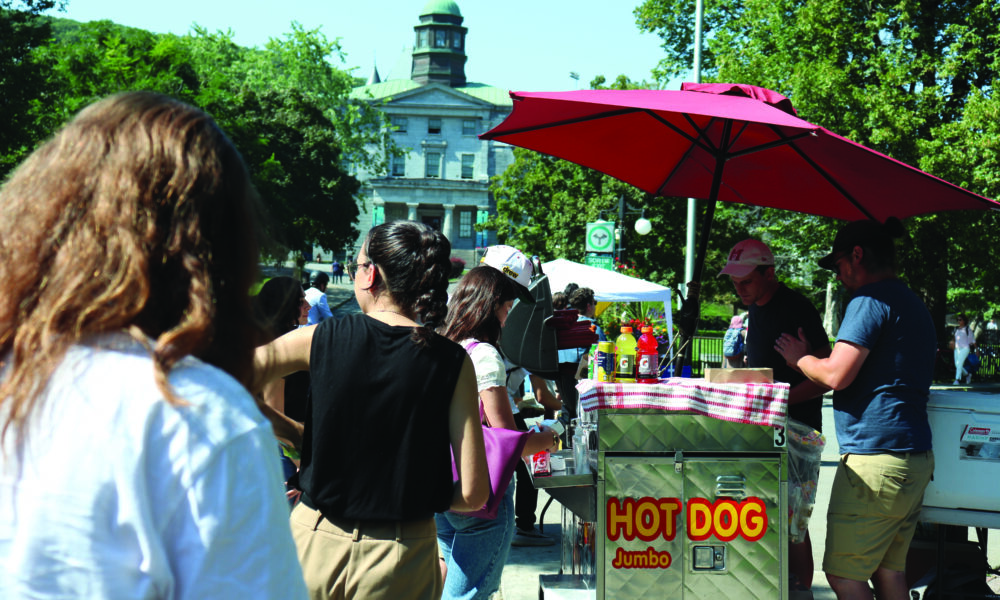
McGill’s campus hot dog stand is losing its spark

Finding a meal simpler than a hot dog is a hard sell. It was The New York Times sports cartoonist Tad Dorgan who coined the term in the early 1900s. Now it’s a North American street food staple, with Nathan’s World Hot Dog Eating Contest taking place at Coney Island every July. 

At McGill, the downtown hot dog stand is one of Montreal’s only street food vendors. The stand is also McGill’s unofficial weatherman. 

Indeed, when temperatures rise above zero, and there’s no rain, a flimsy shade and fiery grill, accompanied by a wobbly table lined with dozens of ketchup and mustard bottles, emerges at McGill’s Y-intersection—the telltale sign that summer is on the way. The middle-aged, lightly-stubbled, baseball-capped men running the stand are perhaps the most fair-weathered folks in Canada. 

So, with the snow melting, the hot dog stand has returned, and last week, one of The Tribune’s Managing Editors, Mady, and I stopped by for lunch. The usual throngs of student droolers, thankfully, weren’t snaking the line—we went straight to the front. 

Watching on, the stand felt like it had been taken from a 1980s postcard. The 40-something man under the shade ran a strict ship on the barbie, while the 60-something shorter man took payments. The idyllic simplicity twisted the arm of nostalgia and even made the tree-hugging hippies and the self-obsessed finance bros forget their identities.

Just before I ordered, an angry screech came from the man behind the grill, aimed at the older man. He said something along the lines of “Quand je dit arrête, ça veut dire arrête, et tu m’écoutes!” Which, for my English friends, translates to “When I say stop, that means stop, and you listen to me”—referring to an issue with the cash. The bellowing man also said no to us taking a picture of the stand. 

Menu 

Original – $5.50 

Vegan – $5.50 

Polish – $8.00

McGill’s hot dog cart has been around for decades, but has always enjoyed a lack of nearby competition, with Montreal’s strict rules restricting the number of street vendors to near nilch and McGill’s Food and Dining Services’ uninspiring mantra ruling with an iron fist. 

The stand had three hot dog options, sufficient for a hot dog stand—this isn’t some European sausage delicacy house. They normally serve soft drinks,  but on this occasion, they didn’t have any, and this included—to my utter apoplectic, incandescent rage—Diet Coke. 

We started with the original hot dog, made of beef. We dolloped some ketchup and mustard, and it was beaming, almost smugly. The dog’s size was sufficient, not that size matters, but it starts to when there’s a $5.50 price tag. Flavour-wise, it had a juicy, borderline watery, but simple taste bolstered by the ketchup and mustard. 

The vegan hot dog came next, and I have to say, I hate the labelling. Calling it vegan is stupid and backward. It makes ordering a black-and-white decision: Meat or non-meat. Vague or vaguer. How dull. Tell me the ingredients, or use the specific name for it, and if it’s tempeh, I’ll stay well, well clear. 

Anyway, this ‘vegan’ hot dog looked like it was sulking. Mind you, if I were a vegan hot dog, I’d be miffed, too. 

Taking the first bite, the yellow-stained dry texture inside resembled a chemical experiment. The taste was better than the appearance. A little doughy, as the dog was smaller, with the weakest zip of spice that was interesting for about a half-second. 

The Polish hot dog, which typically contains more garlic, was named more appropriately, but I doubt the Poles would have been chuffed with it. It tasted raw. Perhaps I took too long to eat it, so it cooled down, or perhaps the man behind the barbie should focus on cooking them properly instead of screeching orders to an old man like a querulous high school sports coach.

Score: ⭐⭐

What does the score mean? Scores are out of five stars. 

Five stars: Your Aussie friend’s barbie extravaganza. 

Four Stars: Family friend’s BBQ. 

Three Stars: Five Guys. 

Two Stars: Costco. 

One Star: McGill Cafeteria hot dog night.

Commentary, Opinion

Campus Conversations: Archives

Community, Commemoration, and the Collective Archive

Matthew Molinaro, Managing Editor

Last semester, I started working in the Black Students’ Network (BSN) archive as part of my elected responsibilities in our political portfolio. In our small office nestled in the University Centre, I sat in front of hundreds of books, an aging MacBook on my lap, going through each page one by one. With the sweetness of future critical consciousness hanging over my brain, my tongue tickled with the words we must find. Immersed in this library, lingering with the tender notes, the writings bristling with weapons, the pulses and rhythms of the collective my predecessors remembered to keep close would be the only way forward.

The dust speckled off of a collection of Alice Walker’s poetry dedicated to her mentor Muriel Rukeyser. To be at Sarah Lawrence with them. How do we make legible our collaboration? The spines of Dudley Randall and Henry Dumas’ collected works winced under my categorizing caress. We never speak of the informal methods of canonization. I read lines from each aloud, militancy and beauty rustle together in this melody. Archival weight hangs on the Black writer––we will forget you––as the Black reader wanders for recuperation, crouching below legacies that loom, tangled at the roots to be rhizomatic. 

My work goes abroad. Countless tomes, past and present, devoted to the ruthless destruction of apartheid in South Africa, sociological excavations, multilingual prose-poems for freedom, memoirs that documented the violence, stared back at me as I parsed through them. Eyes that bite. The hairs on the back of my neck stand as moments of both being and radical remembering haunt this government building—freeze the air. Sitting in the cold nothingness of quiet, I ask myself: Who do I institutionalize? What forms can liberation take for us all?

The list grows on a desultory Google Sheet. Stories turn into numbers, columns make containers for our meaning-making. After a few days’ work, I read back the riches. The ledger, the possessions, the objects at my disposal. Black life, Black livelihood, Black livingness rendered into a familiarly brutal mathematics whose hold grips the nimble, wayward poetics of new creative and collective worlds. I struggle to speak the language of this archival practice. This translation transforms an ethics. The lives we save can’t reproduce, the technologies that justified the lives we’ve lost. But, in being in the archive, extraction seen for its exploitative guise, we can propel libraries for us, writing fruitfully the future we must work toward together.

Asking the digital archive who I am 

Madison McLauchlan, Editor-in-Chief

At the age of 11, a Facebook account became the portal into the rest of my young life. Somewhere between the mourning cries of MySpace and the over-filtered Instagram era, I uploaded my first photo and thus began my personal, digital archive. A profile, a full name (naïvely), some likes, and a network: A person, created. 

No digital trace of me exists before this age—I was coddled, grandfathered in by a generation so attached to physical mementos. VHS tapes, CD-ROMs, polaroids faded into obsolescence. Looking back now, I can’t pinpoint when the prospect of an online presence stopped being the riveting unknown and morphed into an extension of myself. High school dances, memes, birthday posts, acne and awkwardness, a political consciousness, all preserved on a timeline scroll, under the deceptive, out of a “Delete” button. 

The insidiousness of the digital archive reveals itself as we age. At a certain point, you decide to lean in or lean out. I ask the perennial question: When does surveillance stop being a privilege? When employers crawl Instagram tagged photos to find a drop of liquor? Or when the government rejects a passport application because of a reposted political statement? In the metaverse, digital borders are just as violent. 

Of course, a digital archive holds so much good, too: The kind that our tired, melting brains cannot recall. People we loved, pets we adored, songs we had on repeat, and articles we authored combine to form the breadcrumb trail of a life. But it’s a double-edged sword: Playlists become elegies, laughter becomes screenshots, and frozen, photographed smiles haunt you forever. Some things you can never take back.

If we have children someday, their archive will begin in the womb. How do we reject cyborg motherhood from within the matrix? I’ll put the ultrasound on my close friends story, but not on my main. Or nowhere at all. Life’s accomplishments deserve to be recorded, but the question of where has serious ramifications. Like it or not, digital archives are digital legacies—pixellated and permanent. 

The more of ourselves we stamp into the digital ether, the clearer the truth becomes: Originality still exists, but privacy is dead. 

Open your eyes to the archives around you

Theodore Yohalem Shouse, Contributor

My new favourite study spot is the Bibliothèque et Archives nationales du Québec (BAnQ). It’s nice to get off campus and be immersed in the city. Spending time at BAnQ has made me think, as we reach the end of the semester, that it’s worth looking back on the year and considering how we’d like to spend the next one. 

Our brief time at McGill is precious: It’s a time of learning, development, and the creation of our character. The people we meet and the things we do here will have a significant impact on our lives to come. All the choices we make here—to study biology, to learn a new language, to live with friends—will affect everything that comes after. These few university years are crucial; our memories of them will inform the rest of our lives.

This is why I fear that too many of us will finish our degrees simply as McGill students and not as Montrealers. There’s an entire city around us—a city of culture, beauty, and wonder—yet many of us remain in the McGill bubble because it’s socially convenient. It’s much easier to make friends with others in our classes and residences, but it is much more difficult to branch out into the unknown. And as busy students, we often reserve our non-studying hours for sleeping and partying, making it difficult to dedicate time to exploring Montreal. But if we want our few years here to expose us to new lives and opportunities, then we must step beyond Roddick Gates. Take the metro far away, strike up conversation at the farmers market, café, or bookstore. Make that extra scary step to meet someone new. What’s the worst that could happen?

This brings me back to BAnQ. The impressive library is found in the Quartier des Spectacles, near UQÀM. It’s worth a visit simply for its architecture: Sleek glass panels and wooden walls lend the interior a striking yet peaceful ambience. People study quietly, write, and read at desks flooded in light by the immense windows. From high up on the fourth floor balcony, there’s a view of the entire library. It’s an impressive space that puts McLennan and Redpath to shame.

So, here’s an easy way to step out of the McGill bubble: Spice up your routine, and make a short trip to the Grande Bibliothèque to study, not as a McGillian, but as a Montrealer. Maybe you’ll meet someone at the café on the ground floor of the library and make a new friend; maybe you’ll chat quietly with someone reading a favourite book of yours; maybe you’ll get the cute librarian’s number. It’s worth joining the larger Montreal community that McGill is only a small part of.

Read the latest issue

Read the latest issue