

Latest News

Campus Spotlight, Student Life

McGill’s campus hot dog stand is losing its spark

Finding a meal simpler than a hot dog is a hard sell. It was The New York Times sports cartoonist Tad Dorgan who coined the term in the early 1900s. Now it’s a North American street food staple, with Nathan’s World Hot Dog Eating Contest taking place at Coney Island every July. 

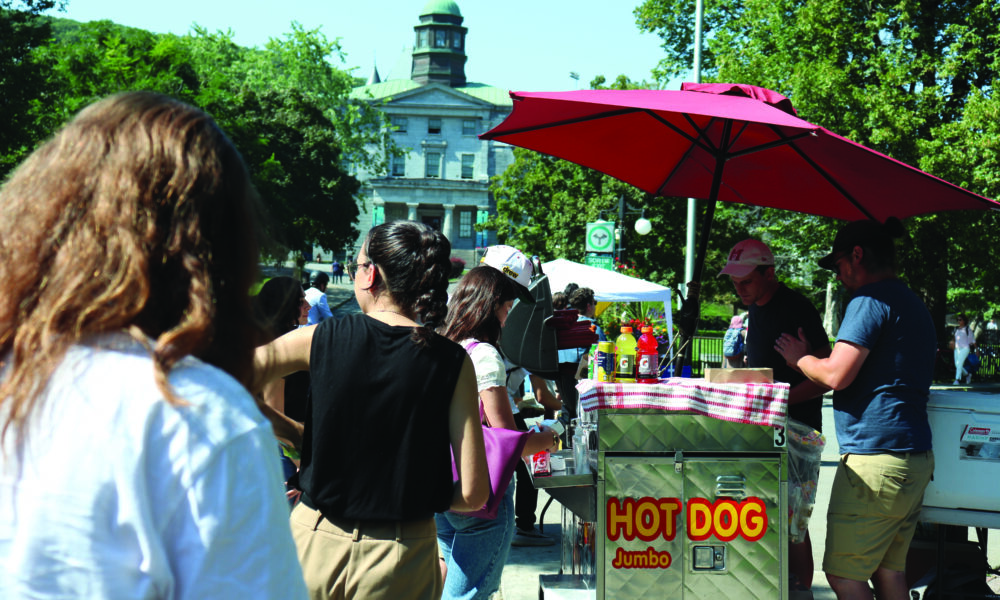
At McGill, the downtown hot dog stand is one of Montreal’s only street food vendors. The stand is also McGill’s unofficial weatherman. 

Indeed, when temperatures rise above zero, and there’s no rain, a flimsy shade and fiery grill, accompanied by a wobbly table lined with dozens of ketchup and mustard bottles, emerges at McGill’s Y-intersection—the telltale sign that summer is on the way. The middle-aged, lightly-stubbled, baseball-capped men running the stand are perhaps the most fair-weathered folks in Canada. 

So, with the snow melting, the hot dog stand has returned, and last week, one of The Tribune’s Managing Editors, Mady, and I stopped by for lunch. The usual throngs of student droolers, thankfully, weren’t snaking the line—we went straight to the front. 

Watching on, the stand felt like it had been taken from a 1980s postcard. The 40-something man under the shade ran a strict ship on the barbie, while the 60-something shorter man took payments. The idyllic simplicity twisted the arm of nostalgia and even made the tree-hugging hippies and the self-obsessed finance bros forget their identities.

Just before I ordered, an angry screech came from the man behind the grill, aimed at the older man. He said something along the lines of “Quand je dit arrête, ça veut dire arrête, et tu m’écoutes!” Which, for my English friends, translates to “When I say stop, that means stop, and you listen to me”—referring to an issue with the cash. The bellowing man also said no to us taking a picture of the stand. 

Menu 

Original – $5.50 

Vegan – $5.50 

Polish – $8.00

McGill’s hot dog cart has been around for decades, but has always enjoyed a lack of nearby competition, with Montreal’s strict rules restricting the number of street vendors to near nilch and McGill’s Food and Dining Services’ uninspiring mantra ruling with an iron fist. 

The stand had three hot dog options, sufficient for a hot dog stand—this isn’t some European sausage delicacy house. They normally serve soft drinks,  but on this occasion, they didn’t have any, and this included—to my utter apoplectic, incandescent rage—Diet Coke. 

We started with the original hot dog, made of beef. We dolloped some ketchup and mustard, and it was beaming, almost smugly. The dog’s size was sufficient, not that size matters, but it starts to when there’s a $5.50 price tag. Flavour-wise, it had a juicy, borderline watery, but simple taste bolstered by the ketchup and mustard. 

The vegan hot dog came next, and I have to say, I hate the labelling. Calling it vegan is stupid and backward. It makes ordering a black-and-white decision: Meat or non-meat. Vague or vaguer. How dull. Tell me the ingredients, or use the specific name for it, and if it’s tempeh, I’ll stay well, well clear. 

Anyway, this ‘vegan’ hot dog looked like it was sulking. Mind you, if I were a vegan hot dog, I’d be miffed, too. 

Taking the first bite, the yellow-stained dry texture inside resembled a chemical experiment. The taste was better than the appearance. A little doughy, as the dog was smaller, with the weakest zip of spice that was interesting for about a half-second. 

The Polish hot dog, which typically contains more garlic, was named more appropriately, but I doubt the Poles would have been chuffed with it. It tasted raw. Perhaps I took too long to eat it, so it cooled down, or perhaps the man behind the barbie should focus on cooking them properly instead of screeching orders to an old man like a querulous high school sports coach.

Score: ⭐⭐

What does the score mean? Scores are out of five stars. 

Five stars: Your Aussie friend’s barbie extravaganza. 

Four Stars: Family friend’s BBQ. 

Three Stars: Five Guys. 

Two Stars: Costco. 

One Star: McGill Cafeteria hot dog night.

Ask a Scientist, Science & Technology

Walking the academic tightrope

Canadians have been calling for reform in higher education for years because many feel that such institutions fail to effectively prepare students for the workforce. This isn’t the only issue on students’ minds though—the university’s priorities are, too. From recycled class lectures, rotating professors, and the struggles with contacting lecturers, students feel the very real effects of McGill’s duelling priorities: Teaching and research. 

Students may prefer to blame professors for this imbalance rather than the systems that create them. Out of 101 responses received on a recent poll posted to The Tribune Instagram asking McGill students whether they felt prioritized by their professors, over half responded that they did not. However, conflating professors’ priorities with McGill’s would be misleading given faculty are often just as frustrated with the system as students. 

When a professor is hired at McGill, the university has a number of expectations for them, such as teaching, research, and departmental service work. Balancing these tasks can be a momentous undertaking for professors, especially when maintaining a life outside of academia. In an interview with The Tribune, professor Nikolas Provatas, from McGill’s Department of Physics, shared his experience managing these responsibilities.    

“I put a lot of time into my teaching. I put hundreds of hours into making animated slides, ordering them, rewording them, continuously, so that explanations are refined and perfected. So that takes up a huge amount of my year,” Provatas said. 

Provatas was also clear that his teaching and research goals are not separate. First, he has several graduate students, each of which he devotes several hours a week to. The graduate students, in turn, help him research and write papers that contribute to Provatas’ ability to meet research responsibilities. 

“I spend at least two full days a week, top to bottom […] where I just sit with my research group,” Provatas said. “They’re still trying to learn, but it’s in a different format. And that’s my ‘research.’”

According to Provatas, this is how the “big six” research universities in Canada work. Together, professors and graduate students form the base of knowledge diffusion and discovery at McGill and other research institutions. For Provatas, teaching and research are well-integrated but, at the same time, balancing these responsibilities can prove to be a tricky test of patience. 

“My wife’s not happy that on Thursday-Fridays, I don’t get home till 10:00 [p.m.]. I’m eating supper at 11,” Provatas said. “I’m clearly not always there for my family.”

This isn’t necessarily abnormal, either: The average workweek for professors is about 48 hours, with 14 per cent reporting working over 60 hours a week compared to the average Canadian’s (25 and up) 40 hours a week. 

“It’s exhausting some days. I feel like quitting. I feel like it’s too much […] Some days, I just feel like saying, you know, ‘who can I call?’” Provatas said.

Provatas believes that, although the intense research and administrative tasks required of many professors may make their job difficult, professors have a genuine desire to teach. 

“I think, in physics, people really enjoy [teaching] their craft. Because I think it really is entertaining and inspiring,” Provatas said.  

Not all students are satisfied, though. In an interview with the The Tribune, Cypress Zufferli, U0 Arts and Science, explained that in his experience, it feels like there is a wide gap between student engagement in Arts classes versus Science courses at McGill. 

“I think I prefer the Arts side in terms of teaching,” Zufferli said. “Even if they’re only just a couple hundred [people] smaller, I feel like it’s noticeable because the professors just seem to care more about the subject.”   

For the professors who may not have as much dedication to their teaching, Provatas has an explanation. McGill’s tenure review requirements necessitate work in three categories, namely research, teaching, and service, which Provatas calls administration. These obligations are required of both tenure-track and tenured professors, albeit to varying degrees. However, Provatas stated McGill prioritizes research in this review.

A 2018 survey of nearly 3,000 professors throughout Canada found that only 17 per cent preferred research to teaching. So, if professors do not heavily favour research, why do students often feel like they are playing second fiddle to professors’ research projects? 

“There’s one other thing we have to do: Write government grants to get funding to pay for those graduate students [.…] And that’s a very stressful and time-consuming task,” Provatas said. “So professors are heavily on the hook, and if they don’t succeed at meeting certain production metrics in their research, they won’t get funded anymore. Then the university will punish them doubly by viewing them as underperformers.”

According to Provatas, many of the larger research universities in Canada, including McGill, also punish professors for poor student performance or negative feedback. This especially affects women and instructors of colour, whose feedback is often tainted by sexist and racist bias. 

Compounding poor teaching performances is poor research—however, for tenure-track professors, weak research comes with even higher stakes. 

“If you’re up for tenure, you will be ranked based on teaching or research, but the research often has a huge impact if you screw up at it, because you can’t get any future grants, and so the university also suffers because you’re not bringing money in,” Provatas said. “If you don’t get grants to publish impactful papers in the first five years [of tenure-track], your career is essentially over.” 

A number of courses also rotate professors. This is particularly prevalent in science, technology, engineering, and mathematics courses at McGill, with large undergraduate courses rotating through four or five professors. For example, BIOL 200, a large, primarily second-year course, has five instructors listed for the Fall semester. Transitioning in rapid succession from one lecturer to another, many of which have different ways of lecturing, organizing notes, and availability, can make it hard to keep up. 

Professor Christopher Buddle, Associate Provost of Teaching and Academic Programs, told The Tribune that “the course may be subdivided into thematic areas for which different instructors have responsibility and relevant expertise.” 

This does seem to link research and teaching more effectively, but it can feel disorienting, as Zufferli explained in a follow-up email to The Tribune. 

“I do like the idea of having specific professors teach the subject they know best, but I do find the switch a bit jarring as the two profs have different teaching styles,” Zufferli wrote. “The nice part of it is having profs who are more interested in the subject.” 

By maintaining the focus on integrating research and teaching, McGill’s administration often forgoes quality, leaving students to fend for themselves during transitions happening at almost breakneck speeds. At times, some students don’t even realize their professors have other responsibilities outside of teaching. 

“With most of the research that my profs are doing, either they just don’t talk about it because it is out of our league, or when they do I’m like, ‘That’s really cool, but I understand nothing that you’ve said,’ so I can’t actually take anything away from the research that they’re doing,” Zufferli said. “I often actually forget that professors have to do research on the side.’”

Not only does this highlight the fact that research may not play as integral a role in student education as previously thought, but it also underlines the confusion around professors’ goals and responsibilities. 

Research is a defining characteristic of a “research university,” but so is teaching, and it is getting the short shift. By recognizing that professors are, for the most part, on the students’ side, the frustration with professors’ seeming indifference can be shifted to the actual sources of students’ feelings of isolation: An administration that is not working hard enough to rectify the issues in student engagement and higher education. 

Commentary, Opinion

Campus Conversations: Archives

Community, Commemoration, and the Collective Archive

Matthew Molinaro, Managing Editor

Last semester, I started working in the Black Students’ Network (BSN) archive as part of my elected responsibilities in our political portfolio. In our small office nestled in the University Centre, I sat in front of hundreds of books, an aging MacBook on my lap, going through each page one by one. With the sweetness of future critical consciousness hanging over my brain, my tongue tickled with the words we must find. Immersed in this library, lingering with the tender notes, the writings bristling with weapons, the pulses and rhythms of the collective my predecessors remembered to keep close would be the only way forward.

The dust speckled off of a collection of Alice Walker’s poetry dedicated to her mentor Muriel Rukeyser. To be at Sarah Lawrence with them. How do we make legible our collaboration? The spines of Dudley Randall and Henry Dumas’ collected works winced under my categorizing caress. We never speak of the informal methods of canonization. I read lines from each aloud, militancy and beauty rustle together in this melody. Archival weight hangs on the Black writer––we will forget you––as the Black reader wanders for recuperation, crouching below legacies that loom, tangled at the roots to be rhizomatic. 

My work goes abroad. Countless tomes, past and present, devoted to the ruthless destruction of apartheid in South Africa, sociological excavations, multilingual prose-poems for freedom, memoirs that documented the violence, stared back at me as I parsed through them. Eyes that bite. The hairs on the back of my neck stand as moments of both being and radical remembering haunt this government building—freeze the air. Sitting in the cold nothingness of quiet, I ask myself: Who do I institutionalize? What forms can liberation take for us all?

The list grows on a desultory Google Sheet. Stories turn into numbers, columns make containers for our meaning-making. After a few days’ work, I read back the riches. The ledger, the possessions, the objects at my disposal. Black life, Black livelihood, Black livingness rendered into a familiarly brutal mathematics whose hold grips the nimble, wayward poetics of new creative and collective worlds. I struggle to speak the language of this archival practice. This translation transforms an ethics. The lives we save can’t reproduce, the technologies that justified the lives we’ve lost. But, in being in the archive, extraction seen for its exploitative guise, we can propel libraries for us, writing fruitfully the future we must work toward together.

Asking the digital archive who I am 

Madison McLauchlan, Editor-in-Chief

At the age of 11, a Facebook account became the portal into the rest of my young life. Somewhere between the mourning cries of MySpace and the over-filtered Instagram era, I uploaded my first photo and thus began my personal, digital archive. A profile, a full name (naïvely), some likes, and a network: A person, created. 

No digital trace of me exists before this age—I was coddled, grandfathered in by a generation so attached to physical mementos. VHS tapes, CD-ROMs, polaroids faded into obsolescence. Looking back now, I can’t pinpoint when the prospect of an online presence stopped being the riveting unknown and morphed into an extension of myself. High school dances, memes, birthday posts, acne and awkwardness, a political consciousness, all preserved on a timeline scroll, under the deceptive, out of a “Delete” button. 

The insidiousness of the digital archive reveals itself as we age. At a certain point, you decide to lean in or lean out. I ask the perennial question: When does surveillance stop being a privilege? When employers crawl Instagram tagged photos to find a drop of liquor? Or when the government rejects a passport application because of a reposted political statement? In the metaverse, digital borders are just as violent. 

Of course, a digital archive holds so much good, too: The kind that our tired, melting brains cannot recall. People we loved, pets we adored, songs we had on repeat, and articles we authored combine to form the breadcrumb trail of a life. But it’s a double-edged sword: Playlists become elegies, laughter becomes screenshots, and frozen, photographed smiles haunt you forever. Some things you can never take back.

If we have children someday, their archive will begin in the womb. How do we reject cyborg motherhood from within the matrix? I’ll put the ultrasound on my close friends story, but not on my main. Or nowhere at all. Life’s accomplishments deserve to be recorded, but the question of where has serious ramifications. Like it or not, digital archives are digital legacies—pixellated and permanent. 

The more of ourselves we stamp into the digital ether, the clearer the truth becomes: Originality still exists, but privacy is dead. 

Open your eyes to the archives around you

Theodore Yohalem Shouse, Contributor

My new favourite study spot is the Bibliothèque et Archives nationales du Québec (BAnQ). It’s nice to get off campus and be immersed in the city. Spending time at BAnQ has made me think, as we reach the end of the semester, that it’s worth looking back on the year and considering how we’d like to spend the next one. 

Our brief time at McGill is precious: It’s a time of learning, development, and the creation of our character. The people we meet and the things we do here will have a significant impact on our lives to come. All the choices we make here—to study biology, to learn a new language, to live with friends—will affect everything that comes after. These few university years are crucial; our memories of them will inform the rest of our lives.

This is why I fear that too many of us will finish our degrees simply as McGill students and not as Montrealers. There’s an entire city around us—a city of culture, beauty, and wonder—yet many of us remain in the McGill bubble because it’s socially convenient. It’s much easier to make friends with others in our classes and residences, but it is much more difficult to branch out into the unknown. And as busy students, we often reserve our non-studying hours for sleeping and partying, making it difficult to dedicate time to exploring Montreal. But if we want our few years here to expose us to new lives and opportunities, then we must step beyond Roddick Gates. Take the metro far away, strike up conversation at the farmers market, café, or bookstore. Make that extra scary step to meet someone new. What’s the worst that could happen?

This brings me back to BAnQ. The impressive library is found in the Quartier des Spectacles, near UQÀM. It’s worth a visit simply for its architecture: Sleek glass panels and wooden walls lend the interior a striking yet peaceful ambience. People study quietly, write, and read at desks flooded in light by the immense windows. From high up on the fourth floor balcony, there’s a view of the entire library. It’s an impressive space that puts McLennan and Redpath to shame.

So, here’s an easy way to step out of the McGill bubble: Spice up your routine, and make a short trip to the Grande Bibliothèque to study, not as a McGillian, but as a Montrealer. Maybe you’ll meet someone at the café on the ground floor of the library and make a new friend; maybe you’ll chat quietly with someone reading a favourite book of yours; maybe you’ll get the cute librarian’s number. It’s worth joining the larger Montreal community that McGill is only a small part of.

Commentary, Opinion

Airbnb’s free range has disastrous consequences

Originally conceived out of its founders’ struggles to pay their exorbitant San Francisco rent, Airbnb has become the very thing it had hoped to rectify. Driving rent increases and housing displacement, Airbnb exports risk, shirks responsibility, and generates massive profit.

On March 16, a fire in a historic building in Montreal’s Old Port claimed the lives of seven people. In the weeks following the fire, reports revealed that six out of the seven people who died were staying in illegal Airbnbs. The owner of the building, Emile Benamor, told the CBC that the building was up to code. Yet, multiple reviews left on the now-deleted Airbnb listings reference the absence of windows, amongst other safety concerns. Airbnb property owners don’t need to show proof that they have functioning smoke and carbon monoxide detectors for their listings to be approved by the host company. Unlike hotels, fire exits, smoke detectors, and sprinkler systems are not mandatory. Instead, Airbnb simply urges owners to install and maintain these safety necessities, knowing some will cut corners—but is perfectly willing to accept that reality as it translates to more overall units and fewer funds dedicated to oversight.

The human cost of unregulated Airbnbs is immeasurable. Quebecois photographer and filmmaker Camille Maheux was among those killed in the fire. She had lived in the apartment for over 30 years and survived multiple attempts at illegal eviction. Throughout her career, the 76-year-old photographed the women’s movement and LGBTQIA+ communities—but the archive of her life’s work perished alongside her. Friends from France, Spain, Italy, and Brazil are trying to reassemble the bits and pieces of Maheux’s work the fire didn’t claim. Google her photographs now—they prove quite difficult to find. 

In Montreal, over 90 per cent of Airbnbs are unauthorized, rendering fire regulations a nuisance rather than a necessity for landlords. Current Montreal laws stipulate that Airbnb and other short-term rentals (STRs) can only be located on  selected strips of the city and must register with the provincial government. However, regulation and enforcement of these policies have been both absent and ineffectual. 

An Airbnb spokesperson said that the company will launch a registration field requiring all new listings to provide a permit number. Yet, the lives lost in the Old Port fire illustrate that this introduction of laws is too little, too late. And this has been a staple of Airbnb regulation, which only banned open-invite party listings after a fatal shooting in Pittsburgh. This reactive response to known risks has allowed Airbnb to profit and only address safety concerns after a tragedy forces them to.

While the impact of Airbnb and other short-term rentals has been felt globally, Montreal has experienced particularly devastating effects on its housing market, where the search for affordable housing has become increasingly difficult. Airbnb and other STRs can be far more profitable than long-term rentals, which, in the absence of regulation, creates an economic incentive for landlords to turn units into STRs. Oftentimes, this transition leads to harassment at the hands of landlords and the forcing out of long-term tenants, as was the case with Benamor. 

A study conducted in 2017 estimated that 14,000 additional homes would be available for long-term residence across Montreal, Toronto, and Vancouver if they weren’t currently rented as Airbnbs. STRs raise the price of the long-term units that do stay on the market, as people are increasingly willing to buy properties with the intention of renting them out at a profit. Those not personally interested in renting a part of their home are in direct competition with those who are. The existence of a robust STR industry thus takes houses off the market and raises the price of those houses that remain. 

It’s time for Airbnb to put the safety and life of its tenants before profits. The Old Port tragedy is a lesson for both the company and the city of Montreal, which must immediately increase and enforce the regulations for short-term rentals.

McGill, News

Principal and Vice-Chancellor H. Deep Saini begins five-year term at McGill

McGill’s eighteenth Principal and Vice-Chancellor H. Deep Saini began his five-year term on April 1. Saini hosted a round-table discussion with McGill student media outlets on April 5, during which he answered questions about his plans to work alongside students, Indigenous groups such as the Mohawk Mothers, and unions to strengthen community ties. Saini also outlined his strategies for creating accessible channels for student communication and touched on concerns students may have about his previous tenure at Dalhousie University

In response to reporters’ questions regarding McGill’s relationships with Indigenous communities, Saini acknowledged that McGill sits on Indigenous lands and vowed to go beyond simple words when it comes to justice for Indigenous communities.

“Respect [towards Indigenous groups] is not simply paid in terms of words, it is paid through actions,” Saini said. “I think we start by building a culture where [inclusion is a] part of the natural ethos of the university rather than part of just simply our policies and legislations.”

He said that while he is aware of the Mohawk Mothers’ legal case against McGill, he has yet to inform himself enough to offer his own opinion.

Saini shared that during his term at Dalhousie, which is located on Mi’kmaq territory, he launched the Truro Start Program. The program helps Indigenous students and others facing barriers to access begin their university experience on Dalhousie’s Agricultural Campus, located in Truro, Nova Scotia, in a small cohort with devoted resources. 

When asked about his previous term at Dalhousie, during which the Dalhousie Gazette reported that tuition fees for international students increased substantially, Saini responded that he has no intention of raising McGill’s tuition. He stated that the Dalhousie tuition fee increase stemmed from the university having the lowest fees of all U15 Canadian Research Universities, with some Dalhousie programs charging 50 per cent less than competing institutions. According to Saini, Dalhousie raised tuition in a way that did not impact existing students’ fees whilst simultaneously maintaining a high quality of education.

“I see absolutely no reason to do anything like that because McGill’s tuition is very much in line with the tuition in comparable universities,” Saini said. “I’m not a tuition-increase happy principal or president. That’s not what drives me.” 

In a written statement to The Tribune, Law Senator Josh Werber stressed that while student senators are aware of the tuition hikes at Dalhousie, as well as Saini’s reputation of tense relations with unions, students should not dismiss creating a working relationship with Saini. 

“Undeniably, reports of union opposition and tuition hikes are concerning,” Werber wrote. “The Principal at times has limited direct influence on such decisions, so I hesitate to assign responsibility to him personally without more information. Instead, [the Students’ Society of McGill University] will focus on working constructively with Mr. Saini going forward.”

Saini says that working with unions begins with a good-faith relationship between employees and university officials. To further improve the student experience and union relationships with the administration, Saini feels that he needs to understand the campus atmosphere, which he intends to do by introducing new communication channels so that students feel comfortable approaching McGill administrators. 

“Nobody should be intimidated about approaching anybody in the university,” Saini said. “We should have open dialogue for everything. That doesn’t mean we’ll always agree, that doesn’t mean we will always find solutions to everything, but that means that we will talk openly and frankly.”

SSMU vice-president University Affairs Kerry Yang was on the selection committee to hire Saini. Though his own term is coming to an end, Yang looks forward to creating a strong and productive relationship between Saini and SSMU. 

“What we learned this year was that a strong collaborative relationship between McGill administration and students has allowed us to move forward on many different projects at speeds much quicker than usual,” Yang wrote to the Tribune. “I hope to be able to work with Principal Saini in a collaborative and diplomatic manner built upon mutual understanding and the commitment towards bettering the educational experience for all students.” 

A previous version of this article incorrectly stated that Saini launched Dalhousie University’s Indigenous Student Access Pathway. It also stated that Dalhousie once had the lowest fees of all Universities in Nova Scotia. In fact, Saini launched the Truro Start Program and Dalhousie once had the lowest fees of all U15 universities. The Tribune regrets these errors.

Science & Technology, Student Research

Health misinformation: A hidden obstacle to better patient outcomes

The internet has become a widely used source of health information by the public, including cancer patients. However, the quality and reliability of online information vary greatly, leading to misunderstandings of treatments and, ultimately, reduced quality of care for those living with cancer.

In a recent paper, Marrah Nicolas-Joseph, U3 at McGill’s Ingram School of Nursing, and colleagues evaluated the quality of online information on cancer treatment and proposed a template for high-quality resources for cancer patients receiving immunotherapy.

Immunotherapy, an increasingly common type of cancer treatment, works to boost the immune system to target cancer cells. This type of therapy can train the immune system to remember cancer cells, effectively preventing cancer from recurring in the long term. 

Despite the clinical benefits of immunotherapy, it often causes severe side effects, such as fatigue, diarrhea, liver injuries, and lung inflammation. The onset of these symptoms often causes patients to interrupt their treatment. Therefore, managing these unpleasant side effects is a priority in improving patients’ quality of life.

To support patients dealing with the side effects of immunotherapy, high-quality, online resources must be a priority. In their paper, Nicolas-Joseph and her team, under the supervision of associate professor Sylvie D. Lambert, identified publicly available resources, including webpages, pamphlets, and booklets, through various search engines. Each resource included was scored based on its quality.

High-quality resources are those that comprehensively address immunotherapy’s side effects,” Nicolas-Joseph wrote in an email to The Tribune. “These resources may significantly optimize patient health literacy and promote patients’ involvement in decision-making.”

They found that many of the online resources were written at an inappropriate literacy level. The average reading grade level was equivalent to a post-secondary reading level, meaning that the resources were relatively difficult for the general public to understand.

Nicolas-Joseph’s team also determined that the resources lacked depth and comprehensiveness. While the online resources addressed areas such as how each treatment works and explained the benefits of treatment well, other important information, such as the risks, the chances of not receiving medical care, and the effects of medicine on the overall quality of life, were poorly explained. Similarly, resources did not adequately address strategies for patients to self-manage immunotherapy’s side effects, especially loss of balance, bloating, and slowed thinking. 

 The researchers also found that the method of delivery could affect the average quality of the resources. 

“Pamphlets and booklets were [of higher quality], as they usually included more graphics and illustrations than webpages, which enhance patients’ learning,” Nicolas-Joseph wrote.

Overall, the findings suggest that there is a lack of high-quality resources to teach patients who are receiving immunotherapy how to self-manage the side effects. 

“As immunotherapy is a relatively new cancer treatment, we expected few educational resources for patients online. Indeed, most of the resources found on the internet during the search were addressed to the scientific community,” Nicolas-Joseph wrote. “Moreover, it seems like there is a lack of guidelines for developing information resources.”

So, the team developed a template for patient education material based on publicly available high-quality resources. 

“We decided to create a template for patient educational resources based on the suitability, readability, and quality criteria used to evaluate the included resources in the research to make the manuscript more useful to readers,” Nicolas-Joseph wrote.

The template includes several sections addressing why after-treatment symptoms arise, how the symptoms can affect a patient’s quality of life, when to get help for the symptoms, and how to self-manage the symptoms. The template also provides detailed guidance on what information to include under each section.

On a larger scale, this paper points to the importance of developing high-quality resources for patients to self-manage a range of other illnesses, such as diabetes.

Laughing Matters, Opinion

McGill needs fewer pedestrians and more cars

McGill is known for its efforts to ensure accessibility, but one key component, and arguably the most important, is being overlooked: Car accessibility on campus. While being in the heart of Montreal might not be conducive to such an intricate road system, it’s positively too much to ask students to walk all the way from Otto Maass to Leacock.  

Budapest, Paris, and Munich, while beautiful, lack one important thing: Motorways everywhere. For this exact reason, McGill should follow the likes of Kansas City and Dallas in their emphasis on motorways per capita. McGill must create more roadways on campus for faster access to buildings and increased efficiency—students would be able to get their work done much faster if they didn’t have to walk everywhere. 

Montreal is known for not being car-friendly, whether that be because the roads are, to say the least, subpar, or because of the interconnected nature of the city. Yet, a car not only gives you more personal space than public transportation, but it is also much quicker than walking from place to place, especially during peak hours. Everyone should have the ability to drive through the cobblestone streets of Old Port as opposed to walking through it. There’s no need to admire the picturesque buildings of the surrounding area or to window-shop and peruse their merchandise. Instead, you need to focus on getting to your destination as quickly as possible. 

Parking garages are beautiful. Anyone who opposes them simply cannot appreciate the brutalist architectural style. The Old Port is without a doubt a nice part of Montreal, but a five-story parking garage would only bring a modern flair to such an outdated area. Any opportunity for a garage would increase tourism—bringing much-needed traffic to the streets and creating a festive atmosphere.

Why, then, should McGill adopt roadways? Simply for increased maneuverability across campus. The Redpath Museum might be architecturally aesthetic, but it feels incomplete without a parking lot. Traditionalists will ask where the parking lot will go. My response? It should be built on Lower Field. All that space is not being used optimally, especially when taken up with an ice rink during the winter. But a parking lot could finally put all that green space to use and considerably boost the attractiveness of the university, in turn increasing McGill’s revenue.Instead of a skating rink, the McGill community could rejoice in slipping and sliding across a parking lot and avoiding near death.

Oftentimes, students have back-to-back classes, requiring quick transportation in a gas-guzzling machine. Having a roadway cutting directly through campus would remedy this. Purists will point to the inconvenience of having to wait to cross a street in the middle of campus, but this would, in fact, help students reflect on the simple moments in life and appreciate the time they have at their drivable university. 

McTavish, in particular, should be open to vehicular transportation. McGill students are tired of walking up the hill from Sherbrooke to Stewart Bio, and allowing vehicles would ultimately make students more productive, and boost their GPAs. And to ensure that no student is hit by a car, pedestrians would obviously be forbidden from McTavish. If this causes an unjustified uproar among conservative students, establishing one crosswalk on McTavish to cross at their own risk should suffice. 

It’s time for Montreal and McGill to stop reinforcing archaic notions of tradition such as pedestrians and public transit. The age of progress is here, and we must allow cars to have immediate access everywhere. If McGill doesn’t sanction this modernization, then students are likely to tire themselves out before they even get to lectures, and this will lead UofT to finally dominate the rankings. When Montreal starts banning pedestrians in areas such as Old Port, McGill could follow and look less like a university and more like a highway.  

Student Life, The Viewpoint

Farewell to the Tribune

Sarah Farnand: To the place I have called home for the past four years, the place that has helped me grow from a shy, insecure writer to someone who is proud of her work and confident in her abilities, The Tribune will have my heart forever. And to all of my lovely editors, staff writers, and contributors, I will miss you dearly. Don’t forget to believe in yourselves. Sending you all so much love.

Taneeshaa Pradhan: The Tribune gently coaxed me out of a shell built from online classes and too many breakout rooms, and I couldn’t be more grateful. Thank you for making the newness of moving across continents feel easier than it seems. I will carry my love and appreciation for the student journalists of The Tribune everywhere I go. Good luck with all future issues! 

Madison Edward-Wright: I came to The Tribune at a time when I felt like I had nothing to dedicate myself to in life. Looking back, that decision was one of the most important ones I’ve ever made. Not only did I learn to write, investigate, and ultimately become a journalist, I met the most amazing people. It has been an honour to call all who work at The Tribune friends and family—much love my dears <33

Madison McLauchlan: The Tribune is a special operation. Through every hardship, triumph, and late night, I never forgot how lucky we are—to have the means to tell stories, share opinions, and hold truth to power within the boundless world of McGill and Montreal. Thank you to those who edited me, and every person I edited: I am incredibly humbled to have led a team of such brilliant, insightful, creative people. You inspired me every single week. For those who are continuing on, remember why we do this: Curiosity delivers. Some truths are simple enough.

Mahnoor Chaudhry: What started off as just another extracurricular activity quickly became one of the most looked-forward-to experiences of my week. Reading, editing, and commenting on some of the most intelligent and beautiful pieces of writing has been an absolute treat this year. To be in the midst of such talented individuals has not only made me realize what journalism should look like, but also what camaraderie, friendship, and support in organizations feel like. The Tribune, I already know, will continue to inspire me, and I will forever carry this experience in my heart. 

Oliver Warne: Last year, I joined The Tribune with little confidence in myself as a writer, yet I was determined to learn more and sharpen my skills. Thanks to the immense help and support of my fellow editors, I was able to publish pieces that I was proud of, and I could never have done it without you all. I am constantly amazed by how hardworking and dedicated each and every member of The Tribune is, and it’s no surprise that you all run such an amazing newspaper.

Michelle Siegel: Unlike anywhere else, at The Tribune, I was never told “please stop talking about Twilight.” All jokes aside, I’m so grateful for all the different editors and writers I’ve worked with; it’s been such a joy to read and edit pieces over the last few years. For every weird pitch or article idea I had, someone was always there to give feedback, encourage me, or sometimes, just help ground the idea in Montreal. I love and will miss you all, thanks to everyone who came to A&E meetings and entertained my strange icebreakers!


Sarina Macleod: As a newcomer to The Tribune this year, being the sole member of my section with no managing editors or staff writers, I thought I would have a relatively isolated experience. Little did I know, I would be welcomed with open arms, becoming closer to my fellow editors with each passing post-Edboard Gerts night. What started out as a chance to add to my resume has now become a place where I’ve seen a true testament to people supporting people. I am incredibly grateful that all of you have given me the chance to one day say “I knew them when.”

Campus Spotlight, Student Life

Spotlight on McGill’s Union for Gender Empowerment

Founded in 1912 as the McGill Women’s Union, the Union for Gender Empowerment (UGE) was established as the university’s only female social club. It provided a space for women to gather since the Alma Mater Society, the precursor to the Student’s Society of McGill University, was a men’s-only club until 1931. In 2004, the Women’s Union was rebirthed as the UGE, with the aim of promoting a wider, more inclusive struggle against all types of gendered oppression. This made the collective open to all, regardless of gender identity. Today, the organization functions non-hierarchically—a legacy of the 1970s club members. 

The UGE’s activities have changed a lot over its more than 100 years of activity, in line with the shifting realities of the century. When going through the archives of the collective, one of the members of the UGE, Keith Bellec-Warrick, a master’s student in the Faculty of Education, found a pamphlet created by the Women’s Union that explained to women how to fake a psychotic episode in order to obtain the three doctors’ approval required to receive an abortion. In 2023, the UGE focuses its resources on anti-oppressive, trans-positive, and anti-racist feminist activism and education.

The UGE office is home to the largest queer anglophone library in all of Quebec, which it runs in collaboration with Queer McGill. The library is composed of films, books, research archives, zines, booklets, and more, many of which are hard to find elsewhere. For instance, the library boasts a substantial collection of self-published 1970s feminist poetry that was purchased and donated by former members of the McGill Women’s Union. 

“The library is in the office, it has an online catalogue that you can consult which is the queer library and the UGE library,” Bellec-Warrick told The Tribune. “All you need to do is come to the office and a staffer will help you create an account and you [can check out a book], we don’t ask for any proof of ID or anything like that.”

Also in line with its educational mandate, the group hosts weekly discussions and readings that are open to all on Wednesdays, known as their Feminist Café. “[The Feminist Café] is pretty simple—you show up on Wednesday night, we print out a reading, read it together, and discuss over coffee and snacks,” Bellec-Warrick explained. 

In February, the Feminist Café embarked on a four-week series exploring Black feminist texts, which featured a selection of Black feminist and womanist writers, including Assata Shakur, bell hooks, Audre Lorde, and Angela Davis. 

It’s clear to any attendee that UGE is dedicated to accessible event-planning, like offering transit tickets and allergen-free snacks to attendees who may need them. 

To expand access to critical resources, the UGE operates a co-op that provides menstrual health and gender-affirming products to the McGill and Montreal community on a pay-what-you-can basis. 

“Along with our menstrual products, we also keep basic makeup, specialized underwear for trans women, bras on order (even specialized bras), and anything people need for nursing on order as well,” said Bellec-Warrick. “And of course, we take requests, so if someone is like we need something, we order it, no questions asked.”

They are currently well stocked with menstrual products and binders, which can be ordered using a Google form on the group’s website. 

The UGE intends to ask for a fee levy next fall in order to increase its operating budget and meet rising costs amid inflation. Bellec-Warrick explained that 300 pairs of menstrual underwear, which UGE stocks in its co-op, cost around $10,000—a third of the yearly budget—even at bulk price.

The UGE office is open to all and located in room 413 of the University Centre––It’s what Margaret Hopkins, a master’s student in music technology and UGE member, would call a “safe space to hang out and find someone to talk.” To keep in touch with the UGE and up to date on their activities, sign up to their Listserv and check out their Linktree. Follow them on social media on Instagram, Facebook and Twitter.

Features

At the precipice of discovery

Abstract

Scientific publishing has become a ruthless game. The infamous aphorism of “publish or perish” describes the pressure academics feel to publish their research extensively and stay relevant within their field. This problem manifests and is tied to a host of other disparities of accessibility within the science research field. Because of this culture, academics may be inspired to cut corners in their research to keep up with the increasing demand of being a scientist. So how can science be restructured from the decades of problems that plague it so that it can achieve equity and address systemic issues? How can one enter the system when it is stricken with socioeconomic barriers and structural racism? Scientists today are saying that science has become too unwieldy, and yet despite seeing the treacherous track of this road, many academics can do nothing but traipse along the same path. 


Publish or Perish: The quiet death of scientific inquiry

The term philosophy can be linked back to Ancient Greece as the combination of the words philein and sophia, meaning “lover of knowledge.” Instead of the Lyceum, however, the lovers of knowledge of today now instead present their findings to a myriad of journals, like Nature or PLOS

Like ancient philosophers, I have also fallen in love with knowledge and the process of building upon my predecessors’ works. But conducting research as an undergraduate student can come with its own costs. 

Undergraduate student researchers hold a special place inside of a lab. Compared to their graduate counterparts, undergraduates are rarely doing this work to further their own research inquiries. More often, they are seeking to become a competitive applicant for graduate school or to obtain a recommendation letter from the lab’s principal investigator (PI).

Q*, U2 Science and student researcher, says that undergraduates’ position in a lab can make them susceptible to exploitation from the lead researchers.

“So a lot of students, just to gain some level of experience, start to reach out to labs and are desperate for any kind of experience in lab work at all,” Q told me.  “And that allows for some very exploitable undergraduates because they are not looking for pay […] they’re just looking for some level of experience.” 

Q believes that “publish or perish” culture can distill students’ passion for scientific research early on. The lack of research opportunities available for undergraduates  pushes them to get involved not out of genuine interest, but to become more marketable to future recruiters.  

“Many undergrads are just forced into these situations where they are working on a project that they have no interest in, where their only goal is to get a publication […] before they can apply for grad school, ” Q said. 

The pressure to publish makes it difficult for academics to balance their personal life with their work. For Q, this endless chase of achievement often feels pointless. 

“It’s not even like having a publication really guarantees you anything given how competitive academia is and how much importance is placed on grades […] even if you’re an excellent researcher, you might get cut off for having a lower GPA,” Q said. “In this context, why research a subject that you want [or] is useful if there’s no return on your time investment?”

Read the latest issue

Read the latest issue