One night this semester, at a bar on St. Denis, I was watching the closing set of Growve, a jam session I regularly attend. Some professional musicians barged in at the last minute, ecstatic and hugging friends they had not seen in a while. They were there to hang out, but given their credentials, the hosts immediately welcomed them on stage. For two minutes, the bassist, drummer, and keyboard player tried to lock into a groove. It was awkward, and the audience could tell that the jam was not going too well. Suddenly, the bass player found a rhythmic low end complementing the drumline, and the keyboard player played rich synthesizer lines. With every passing minute of their set, the music only got better. It was the closest thing I’ve experienced to a musical trance; I was locked into their unique soundscape. Sweat dripped off the drummer playing his final big lines while the keyboard lingered on the last chord of the set. The crowd roared in awe, and the host yelled out one last time: “This. Is. A. Jam!”
Growve occurs every Wednesday night at 8 p.m. at Turbo Haüs. Musicians come and take a break from regular life, playing their hearts out. The three hosts, Shayne, Shem, and Marcus, offer a free performance for an audience that wants to dance to improvised R&B, neo-soul, and hip-hop. Among the musicians, you will find artists, industry producers, session musicians, and even hobbyists. The vibes are right, and the music is tight. Every session, Shem calls out “this is a jam,” the show’s motto, to a raucous crowd under the signature arrow-shaped lights.
“The quality of the jams [are] very good,” guitarist Joseph Anidjar said in an interview with The McGill Tribune. “The hosts are very welcoming. Sometimes the jams are cutthroat, and this is what I like.”
For those like Joseph seeking an artistic challenge, the jam often delves into technical and jazzier sounds as professionals drop in to perform. Yet, there is always a place for those going out with their friends or those who want to show their hidden talents on any instrument.
Growve traces its roots back to Le Cypher, a jam session produced in the now-defunct Bleury Bar à Vinyle. Shayne, Joseph, and Shem, who were CEGEP students in 2017, used to go to test their chops.
“There were couches in the middle of the venue,” Shayne said. “We hung out and played tunes we could not perform in music school.”
Soon, Shayne, Shem, and others began hosting Mercredi Live at Bleury. Even though the bar closed before the pandemic, Marcus joined in and the show moved shop to Turbo Haüs, bearing its current namesake.
Saxophone player Seuss (U3 Music) frequents the jams—his playing is improvisational and rooted in traditional jazz, but as he says, “I want to have fun, man.”
“It’s relaxed,” Seuss told the Tribune. “You meet so many nice people, you get to show off, and you get gigs. All these people know me thanks to Growve.”
You will find jazz students at the bar ready to play some Beyoncé or D’Angelo, casual flavours compared to the rigidity of academic music. The ease of the songs and their broad appeal keep the jam inclusive by bridging artistic backgrounds. Additionally, bands and artists that got started through Growve play their original music. The jam, and Turbo Haüs in general, showcases the city’s musical zeitgeist.
“Many acts started thanks to this event,” Shem and Shayne said. “We can tell people where to go when they ask where the music is.”
Whether you’re a suit, musician, or anyone else under the rare Montreal winter sun, everyone is welcome at Growve. The equipment and musicians on stage may cost thousands of dollars, but you won’t have to pay a Canadian dime to get down on a Wednesday night.
Music at sporting events has the remarkable ability to intensify each twist and turn of a game, create a gripping narrative, and even sway the outcome in one team’s favour.
Some might say this is best evidenced by the opening scene of High School Musical 3, where Troy Bolton (Zac Efron) plays his final basketball game at East High School. With just 16 minutes left on the clock, the high-energy Wildcats weave through the defence singing, “this is the last time to get it right / this is the last chance to make it our night,” while the crowd claps along. When Troy is shoved to the ground by the rival team, the encouraging words sung to him by Gabriella Montez (Vanessa Hudgens) motivate Troy to get his head back in the game and lead the Wildcats to victory.
Although McGill’s varsity sporting events sadly lack East High’s spontaneous musical outbursts, the music played at games serves the same purpose: It fosters team spirit and energizes athletes to perform their best. At the same time, music creates a thrilling atmosphere for the audience, making for an entertaining game.
Meeting the musical needs of both the players and the fans is a difficult task that requires attention to detail and careful deliberation. However, McGill Athletics Varsity Sports Official Tommy Schnarr is up to the challenge. The U2 Education student has set the tunes for lacrosse, hockey, basketball, and volleyball games, and his song choice is dependent on what audience the sport draws. For example, the crowd at volleyball games is often made up of newer fans who don’t follow the sport. Because of this, Schnarr plays high-energy pop to keep the atmosphere fun and exciting.
“We go for, like, fast-paced songs with high levels of energy,” Schnarr told The McGill Tribune. “A lot of EDM [electronic dance music] kind of stuff, especially for time-outs, [which are] a lot more intense. In between sets we’ll play “Country Roads,” kind of thing, but to get the crowd nice and into [the game].”
The influence of hockey culture
In contrast to volleyball, there is a far more pronounced hockey culture in North America, given the sport’s popularity. One important part of this shared tradition is classic rock from the 1980s and 1990s featuring artists such as AC/DC and Guns N’Roses mixed in with newer rock from the Black Keys and Green Day. Much of what Schnarr plays stems from this culture, a culture he was exposed to through his own experience playing and watching the sport.
Zoe Frantz, a forward on the Martlets hockey team, echoed the role that broader hockey culture in North America has had in shaping the songs played at games throughout her career. The first-year athlete noted that the nostalgia associated with older songs from her childhood makes them especially meaningful.
“These aren’t just songs that your team shares, it’s like, ‘I remember this from my other team, I remember this from when I was a kid,’” Frantz said. “And the same thing with throwback songs [from the 2010s] [….] It’s just this really cool thing where it’s like, ‘this song has been such a big part of my life and I didn’t consider it until now.’”
Adapting to unique preferences
When crafting playlists for games, the Martlets hockey team puts their own spin on the song selection while including tracks that speak to North American hockey culture. Many of their picks rally and energize the team because they hearken back to season highlights. One song played at games is “Jimmy Cooks” by Drake and 21 Savage, which the team bonded over before their match against Carleton University on Nov. 4.
“I don’t like saying, […] ‘vibes,’ but it had really good vibes,” Frantz said with a laugh. “Everyone was [really] into it and you could feel the room wasn’t tense or stressed, it was more just like, ‘okay, we got this.’”
Schnarr explained that part of catering to audience preferences means carefully observing the crowd’s reactions to music throughout the game and modifying the playlist to adjust to their taste.
“If I see someone not [liking] Ozzy Osbourne for instance, you know, I’ll look at them when I play a Taylor Swift song in the next stoppage, see what they like there,” Schnarr said. “If people are moving a little bit, that’s a good sign. If they’re standing still or ignoring the music, that’s not really what you want.”
Fostering community through popular songs
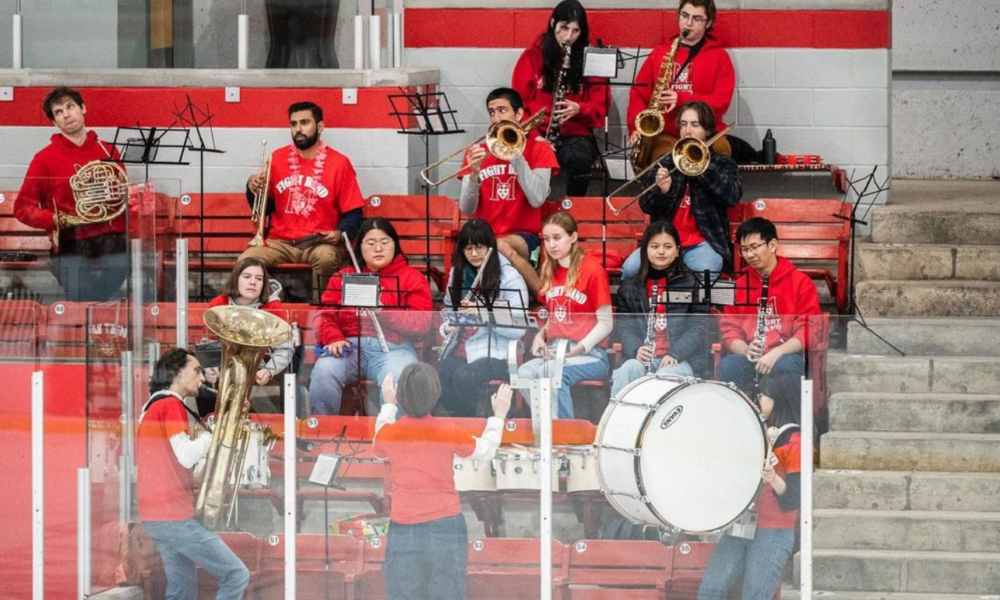
Being attentive to the audience’s taste is just as important for the McGill Fight Band. The student-run band has been playing live music at varsity games since 2006 and is an integral part of McGill varsity culture. Fight Band incorporates both older and more contemporary music into their repertoire, from “Hey! Baby” by Bruce Channel to “Bad Romance” by Lady Gaga, the latter being one of Fight Band’s hallmark songs. According to Fight Band vice-president Administrative Zachary Roberts, one important feature that shapes the band’s music selection is how recognizable songs are to the audience.
“[The purpose is] to remind the team and the crowd […] it’s not time to give up yet,” Roberts said. “Because people will recognize the song and be like, ‘oh what’s that song, what’s that song?’ And they’ll go, ‘Don’t Stop Believin,’ and they’ll say the word mentally, and in that sense, they’ll be thinking it.”
That same audience recognition works to create an encouraging atmosphere for players, Frantz says. Like Troy and Gabriella exchanging a duet from the court to the stands, enjoying a popular song together can unite the audience and athletes, creating a sense of community and motivating the team to keep pushing for victory.
“It’s cool because you’ve got your team who knows the song, but then you’ve got the audience kind of recognizing the song,” Frantz said. “When you see that everyone’s just kind of enjoying themselves and having a good time […] [it creates a] connection [because] I know you’re there to support me, and we’re connecting on this deeper level, and we all go to McGill, and we’re all just kind of there to have fun.”
Game day music strategy
Music selection varies along with the events of the game itself. Schnarr plays different music depending on how much time is left in the game. In the case of hockey, Schnarr plays more popular songs during the first and second periods to keep the audience engaged, while in the third period, he changes the music in favour of an energetic atmosphere that will benefit the players first and foremost.
“First period and second period, [the players are] still hyped from the music that they have playing in their locker room, from the music that they have in warm-up,” Schnarr explained. “The third period is when they really need that extra boost of energy from the songs that have high beats per minute, so I play a lot of EDM for that.”
As for Fight Band, they base their music on the play happening in the moment. Band President Rosalie Joly-Simard noted that the band will play the theme from Jaws after an opposing hockey team draws a penalty to build anticipation for McGill’s upcoming power play, or will loudly play their instruments to distract a rival basketball player during their free throws.
“Sometimes it works really well, sometimes the players are like, too focused, it doesn’t work.” Joly Simard said. “We give ourselves really good credit when they miss.”
This careful selection of songs is designed to build excitement and keep spirits high. Even when the game is not in McGill’s favour, the band still strives to create a fun atmosphere—in the event of a loss, the band will play “Fuck You” by CeeLo Green.
Thanks to the thoughtful intention that goes into song choice at varsity games, the music at McGill varsity events is far from background noise. Songs can unravel memories of an entire career in the game, foster team bonding, and rally a crowd around a team. The music at games is more than a beat for audiences to clap along to—it’s a tool to uplift athletes, a source of community, and an expression of a love for the sport.

Jeannie Marshall lived in Rome for 12 years before setting foot inside the Sistine Chapel.
“I could hardly bear the thought of standing amongst a crowd only to look at something that seemed simultaneously too complex to be understood just by looking at it and too worn out from overexposure,” she writes. “[I]t never seemed like the right time to take on such an enormous symbol of Western culture.”
Then her sister Marion died. Over the next few years, her mother and brother Ken passed away, as well. So did her husband James’s father, followed by his brother-in-law Michael, and then his mother.
After her mother’s death, she decided it was time to set foot inside. Her decision wasn’t spurred on by a grand epiphany or a sudden compulsion, but rather, by emptiness. The long-awaited visit was unfulfilling. It was overwhelming. It “seemed too much, too enormous, and too religious.”
Then she went back. Again. And again.
Marshall’s book All Things Move, which started out as an essay, raises crucial questions about how we interact with art and why it matters at all. How should we look at art? What makes art great? Who is art for? What if you wait and prepare your entire life to see a great piece of art, and it doesn’t live up to your expectations?
All Things Move explores how relationships to art can evolve over different stages of life. Beginnings and endings are carefully woven into the narrative. Chronologically, Michelangelo painted The Deluge first, starting with the end of the world. During her third visit, Marshall has a crucial realization: The people depicted on this panel trying to climb out of the water are not survivors—they’re all about to die.
The book is also chock-full of lyrical descriptions of everyday life in Rome. Marshall describes the different parts of Rome she sees while running errands: The metro, fruit sellers, groceries, pigeons, and art shops. But also apartment buildings abandoned during the 2008 financial crisis, graffiti (both fascist and anti-fascist), and brass cobblestones in front of houses engraved with the names of their former inhabitants who had been sent to concentration camps during the Second World War.
Douglas Anthony Cooper’s accompanying photos are beautiful, but he is careful to not only capture beautiful things. Marshall was drawn to the candour of his photos. Art blends into everyday streetscapes: A red ball, a dog in a sweater, and a nun on the metro. The photos of the city are often black and white. The art is mostly in colour.
Marshall puts moments into melody when writing about photos in colour. The book explores how art has the ability to not only uniquely capture and explain key moments in human history, but to do the same for one’s own personal history. In other words, art should matter because it matters to you.
Intriguingly, Marshall is not Christian. She ruminates on the idea that perhaps we ought to approach religion in the way we approach art. The Sistine Chapel has served as both the backdrop and foreground for many religious conflicts throughout history. In a time when the humanities are increasingly seen as decorative, art can evoke an invaluable sense of openness and uncertainty.
“Great Art” can often have a highbrow, inaccessible aura, but Marshall’s individual approach to the Sistine Chapel makes it so compelling. She writes about her grandmother, growing up in a family of fur trappers in North Bay, and falling in love with Michelangelo. She weaves her personal history alongside centuries of religious conflict, struggle, beauty, and identity.
“I wanted to see something enduring, something that outlasts its creator. I wanted to feel part of a world that means something, a world that continues; I wanted to feel that those we had lost were part of it too.”
All Things Move will be published on April 4, available at your local bookstore and as an audiobook.
News coverage about the Chinese government’s alleged interference in Canada’s 2021 federal elections has continued for more than a month since The Globe and Mail reported that CSIS received intelligence about the Beijing government’s possible meddling in the 2021 federal election.
The media attention has created a public uproar because of how it could threaten faith in our democracy and in Prime Minister Justin Trudeau’s leadership—to certain lawmakers’ benefit. Even if they seem to only concern the Chinese and Canadian governments, the Asian Canadian community is already feeling the repercussions of recent allegations.
For legislators working on China-Canada relations, these repercussions could not be more detrimental. After reports that he helped the Chinese consulate interfere in the 2019 election and advised against the release of Michael Spavor and Michael Kovrig, Member of Parliament Han Dong, who represents Don Valley North in Ontario, left the Liberal caucus to become an independent. Dong stated that he received hateful, aggressive comments, and even death threats in light of recent allegations.
As Dong is a powerful legislator, his missteps have consequences for Chinese residents in Canada. As new developments have rolled out, increasing political distrust towards China and the Chinese Communist Party (CCP) manifests in the mistreatment of Chinese Canadians. These developments are only adding to the reasons why some are sceptical of high-profile politicians, and wondering whether Chinese and Asian Canadians more broadly are more loyal to Canada or to their home country—a racist and dangerous sentiment.
Despite the understandable concern about these allegations, we must note that no politician has stated that the Chinese government manipulated the election in a way that changed any outcome. The Angus Reid Institute conducted a survey amongst nearly one-fourth of the Canadian population and revealed that 42 per cent of past Conservative voters believe the election was “stolen.” Does that ring a bell? It should. With existing distrust in our political institutions, any proceeding into inquiries on interference in our elections therefore must be thorough, rigorous, and attuned to institutional trust.
Since the COVID-19 pandemic started in 2020, North America has seen a resurfacing of overt racism and xenophobia toward the Asian community through rising hate crimes. At the same time, the relationship between the Canadian government and the Chinese government has become more strained. Anti-Asian racism is embedded in Canadian history. As early as 1885, the Chinese head tax dictated that every Chinese person wanting to enter Canada needed to pay up to $500, explicitly deterring immigration inflow amongst that population. And from 1923 to 1947, the Chinese Immigration Act openly denied entry to all Chinese people.
More recently, anti-immigration agendas have been used as a political tactic by many of Canada’s politicians, including Premier François Legault during the 2022 Quebec provincial elections. Economic crises and other historically difficult periods are often a justification for politicians and the general population to use immigrant groups as scapegoats to explain large societal issues and to cull favour from voters. Even though the CCP’s policy decisions are not representative of the beliefs of Chinese Canadians, the negative impression of the CCP overflows and washes over the community. Canada’s Chief Public Health Officer, Theresa Tam, was even berated by the Conservative Derek Sloan, who questioned her loyalty towards Canada. This kind of suspicion targeted at Chinese and Asian immigrants could reinforce Asian Canadians’ sentiment of not belonging to the country in which many of them are born.
Of course, the allegations made about interference in Canadian elections must be investigated so as to ensure the validity of our democratic process. In the meantime, the Canadian government and citizens must work to mitigate the growing discrimination and hatred against Asian Canadians. Institutions and individuals are equally responsible to ensure that our country stays a civil, accepting place that treats people with respect and that supports a racially-inclusive democracy. As immigrants represent almost a quarter of the Canadian population, ensuring the well-being of minority groups is ensuring the well-being of a significant part of our city, province, and country, and the democracy that unites them all.
Erratum: “A previous version of this article incorrectly stated that Derek Sloan was leader of the Conservative party. In fact, Sloan was a Member of Parliament who unsuccessfully ran for party leadership. The Tribune regrets this error.”
The 2023 NCAA basketball tournament kicked off on March 12, and it’s already shaping up to be one of the most memorable in March Madness history, with several shocking upsets in the first three rounds. A record 53 Canadians round out the men’s and women’s brackets and have already turned in incredible performances, fuelling fans north of the border. In honour of this historic year, The McGill Tribune ranks the top two upsets and Canadian players of the tournament so far.
Upset #2: Princeton 59-55 Arizona
Three years counting, the 15-seed has defeated a number two seed, but that doesn’t take away from Princeton’s miraculous achievement. Arizona entered the tournament in great form after winning the Pac-12 championship and boasting a top-15-ranked offence. Over a quarter of all brackets had Arizona going to the final four. Instead, 111th-ranked Princeton held Arizona to just 55 points––their lowest all season––breaking millions of brackets in the process. Princeton did not stop there: They beat seventh seed Missouri two days later to become the fourth 15 seed to reach the sweet 16 in March Madness history. Princeton eventually lost to Creighton in the next round, but their incredible underdog run won’t soon be forgotten.
Upset #1: FDU 63-58 Purdue
Sixteen-seed Fairleigh Dickinson pulled off perhaps the greatest upset in March Madness history by beating first-seed Purdue—the second time this has ever happened. On paper, the two teams could not have been more mismatched; Purdue entered the tournament as Big 10 Champions, led by 7-foot-4 Zach Edey, whereas FDU was the shortest team in Division I and ranked 301 out of 363 teams. Despite their advantage, Purdue’s offence struggled the entire game and FDU shot the ball decisively in the second half, allowing them to take the lead and hold on for the shocking victory. FDU lost in the next round, but their victory over Purdue will make them legends in college basketball lore.
Honourable mentions:
In the women’s bracket, ninth-seed Miami took down first-seed Indiana in the second round thanks to Destiny Harden’s clutch basket with three seconds left. On the men’s side, 13-seed Furman stunned fourth-seed Virginia in a thrilling game—Virginia had possession and the lead with five seconds left, but a wild pass led to a Furman victory on a deep three-point shot. Finally, fifth seeds San Diego State and Miami knocked off first seeds Alabama and Houston respectively, making this the first men’s tournament where no number one seed has progressed past the sweet 16.
Canadian #2: Ryan Nembhard
Edey and Marcus Carr entered the tournament as the most recognizable Canadian players, but once the tournament began, Creighton guard Ryan Nembhard stole the show. Born and raised in Aurora, Ontario, Nembhard had a stellar 2022-23 season with Creighton, leading the team in both assists and steals. But Nembhard brought the tournament to another level. In three games, he recorded 13 rebounds and 49 points, including a career-high 30 points in Creighton’s upset win over Baylor. If Creighton makes it to the final four, Nembhard’s hard work will be a big reason why.
Canadian #1: Aaliyah Edwards
University of Connecticut (UConn) forward Aaliyah Edwards took women’s college basketball by storm this season, leading UConn to a second-seed placement in the tournament. Hailing from Kingston, Ontario, Edwards dominated both sides of the ball this season, leading UConn in both points and blocks. Her seismic performances have continued during March Madness—she’s recorded six assists, 11 rebounds, and 47 points while shooting over 80 per cent from the field in two games so far, allowing UConn to cruise through to the sweet 16. UConn’s tournament ended in the next round, but Edwards’ career is just getting started.
Honourable mentions:
Despite riding the bench for most of the season, South Carolina forward and Mississaugan Laeticia Amihere stood out in this year’s tournament. In two games, she’s had eight rebounds and 21 points, making her a big reason why South Carolina is the best team in the women’s bracket. On the men’s side, Carr has played outstandingly well for second-seed Texas: His eight rebounds, 13 assists, and 45 points in three games have been instrumental to the team’s success. Finally, despite their shocking first-round loss, Purdue centre Edey deserves a special mention, as he is expected to be the first Canadian to win the prestigious Naismith College Player of the Year award.
The annual reports of the Policy on Harassment and Discrimination and the Policy Against Sexual Violence were presented to the McGill Senate on March 22. Both policies are handled by the Office of Mediation and Reporting (OMR), which oversees inquiries and reports made under the policies. The McGill Tribune breaks down the annual reports and examines the 2022 numbers.
Policy on Harassment and Discrimination
McGill’s Policy on Harassment and Discrimination outlines how one can seek redress after an incident of harassment or discrimination.
Per the Policy, harassment is defined as “any vexatious behaviour […] in the form of repeated hostile or unwanted conduct, verbal comments, actions or gestures, that affect the dignity or psychological or physical integrity of a Member of the University Community.”
Discrimination refers to illegal discrimination under Quebec law on the basis of “race, colour, sex, gender identity or expression, pregnancy, family status, sexual orientation, civil status, age (except as provided by law), religion, political conviction, language, ethnic or national origin, social condition, a disability or the use of any means to palliate a disability, which results in the exclusion or preference of an individual or group within the University community.” Under the Policy, it can include “both the actions of individual members of the University and systemic institutional practices and policies of the University.”
The reporting process starts at the OMR, where any member of the McGill community can inquire about filing a report or accessing support services. Between Jan. 1 and Dec. 31, 2022, the Office received 212 inquiries about reporting under the Policy.
Associate Provost (Equity & Academic Policies) Angela Campbell, whose office is in charge of preparing the annual reports, told the Tribune that the numbers show an uptick in the Policy’s usage. She attributed the upward trend to increased awareness about available reporting channels.
“The trends show […] that there’s an increase in the uses of the policies for sure. And an increase in accessing the services at the university, especially around seeking information,” Campbell said. “So if you look at the number of people who [request] information, that’s certainly gone up over time.”
*The reporting period of 2020-2021 was 16 months, as opposed to the regular 12 in order to align the Policy’s reporting period with the calendar year. **Reporting periods 2010-2011 until 2018-2019 also include complaints of sexual violence.
The majority of inquiries, however, do not lead to formal reports. Out of 212 inquiries in 2022, only 24 reports were filed.
Ultimately, 12 reports were eliminated because they either went beyond the Policy’s scope—meaning they did not occur in the McGill context with both parties as members of the McGill community at the time of the report and the alleged incident—or the issue was resolved through a different internal conflict-resolution channel identified as more appropriate by the OMR.
Campbell noted that though 12 reports might seem small compared to the McGill population of 50, 000, the number is still consequential.
“Twelve reports is 12 people […] who felt that the matter was serious enough, and were able to muster up the strength to be able to file a report and go through a full investigation,” Campbell said.
A person filing a report can choose between two processes: Mediation or investigation. Mediation is a process where a mediator facilitates discussion about the reported incident between the parties involved to reach a resolution that all parties believe is appropriate. An investigation is a formal process that can result in disciplinary action against the respondent if university assessors—typically OMR full-time staff—find that harassment or discrimination did occur.
Of the reports filed in 2022 that fell under the scope of the policy, eight were about harassment, one about discrimination, and three fell into the “mixed” category. All of these reports proceeded to an investigation, meaning none of the reporters withdrew their report or reached an agreement through mediation.
If an investigation finds that harassment or discrimination as outlined in the Policy took place, the Provost will then refer the case to university disciplinary authorities for next steps. In 2022, all founded reports resulted in disciplinary action for the respondent.
Policy Against Sexual Violence
The Policy Against Sexual Violence covers McGill’s educational initiatives around sexual violence, procedures for reporting, and the activities of McGill’s central sexual violence support service, the Office for Sexual Violence Response, Support, and Education (OSVRSE).
McGill recognizes seven categories of sexual violence: Sexual assault, sexual harassment, voyeurism/stalking, sexual exploitation, indecent exposure, distribution of sexual images, and breach of the Code of Conduct (sec. 8).
In 2022, there were 105 disclosures of sexual violence. Although the Policy outlines OSVRSE as the main body in charge of receiving disclosures, beginning in mid-October, the Office of the Dean of Students took over the responsibility as OSVRSE was closed.
Just like the Policy on Harassment and Discrimination, the majority of people who disclosed an incident of sexual violence decided not to file an official report. Only 15 out of 105 disclosures became reports in 2021-2022, three of which were out of the Policy’s scope.
*There was a slight overlap between the 2019 reporting period (April 2019 – March 2020) and the 2020 reporting period (Jan. 2020 – Dec. 2020)
After a report is filed, the OMR will review it and decide whether the university has jurisdiction to pursue an investigation.
If a report falls within the university’s jurisdiction, an independent special investigator (SI) will begin an investigation process to determine if an incident of sexual violence occurred.
Most reports were filed under the categories of sexual assault (5) and sexual harassment (6).
*One report under the Policy can contain more than one form of sexual violence.
Although SIs are given 90 days to complete their investigation, only three investigations were wrapped up within that period. The university can provide an extension in complex cases or “where the parties or a witness delay meetings with or responses to the investigators.”
Two of the delayed investigations concluded within a week of the 90-day deadline. The third required an additional 120 days because the survivor withdrew from the process.
Of the 12 reports investigated this year, five were founded, one was unfounded, and six were ongoing by the end of the reporting period.
Disciplinary measures were imposed in all cases, except for one where the respondent left McGill. In the single unfounded case, authorities also imposed disciplinary measures as they found that the respondent’s actions during the alleged encounter constituted a breach of the Code of Student Conduct and Disciplinary Procedures.
In an interview with the Tribune, senior employment equity advisorSarah Pierre said she was “encouraged” that an increasing number of community members were accessing the OMR.
“All of the awareness and campaigns have shown that the OMR is more top of mind for people and they know that there is somewhere they can go for formal reports,” Pierre said. “I think people are more aware of their rights as well as feeling more empowered to actually come to the OMR with their stories and with their questions and concerns.”
Although reporting and investigations are complex, Campbell expressed that she was confident in McGill’s procedures.
There’s a certain rush that comes with writing an important story. The words stream out as you find the quote that reveals the essence of the piece. Bits of reporting you collate together into a story that guides the public and exposes the truth. I’ve been thinking about this rush a lot as I stare down the end of my third year at McGill and ask myself whether I want to pursue journalism professionally.
Three years ago, the idea of doing journalism intimidated me. Journalists were really smart people who wrote on ridiculous deadlines and put themselves in harm’s way for the sake of telling a story. I didn’t really know how to write or deal with sources, and I didn’t really know how to pull a story together. The perfectionist first-year me, afraid of trying something new, didn’t want to try and fail.
But I got over myself. On a visit home in January, I happened upon The Fourth Estate, a documentary that took an inside look at The New York Times during the first year of the Trump presidency. I was immediately drawn to the fast-paced environment that featured inquisitive people bustling around and grappling with how best to convey breaking issues to the public. Whatever was happening in that newsroom, it seemed like those reporters were at the centre of the world—and I wanted in. That night, I emailed McGill’s student papers to learn how to contribute.
Campus journalism, of course, isn’t The New York Times. The stories you write are rarely breaking news and don’t typically cause broad shifts in public opinion. But I’ve found that covering campus life, administrative decisions, and student movements is unique and important work in and of itself. Doing this kind of journalism has informed my university experience and self-perception in turn.
Entering McGill during the height of COVID-19 drastically limited my exposure to student life. But through chasing stories every week, my world opened up. Every time I researched a new story or conducted an interview, I learned something new about McGill. Through my reporting, I became acquainted with my community through their eyes.
Student journalists are in a unique position. We have a different sort of responsibility to our community than professionals. We face these issues every day and are often directly affected by the administration’s decisions, like our sources. Reporting in a smaller community also changes your relationship with pieces—the stories you’re writing unravel in front of you. And rather than moving on after a piece gets published, your idea of “campus” shifts.
McGill is a fascinating place. The university is a large and powerful institution with a very real impact on people’s lives. At times, I’d argue, even more so than the provincial or federal government, because it’s closer to us students. Being a campus journalist has forced me to pay attention to the institutional harm and negligence that occurs every day—whether it’s pursuing legal action against students filing access to information requests or neglecting to tell the community their central sexual violence support service has been shut. And seeing these struggles up close has been formative for my own political awareness.
While journalism is ultimately the practice of speaking truth to power, the most important skill I’ve gained has been learning to listen. News reporting forces you to take a backseat. Your singular voice, your opinion on these issues doesn’t matter in comparison to accurately conveying someone’s, or a community’s, story. It’s humbling. I learned that pretty quickly through all of those nights of huddling up at the Law Library, two hours before deadline, listening back to my interviews in search of the truth.
I’m still not sure if I want to be a journalist after graduation. With cuts across the industry, tenuous employment, and increasing rates of harassment, violence, and repression, it’s not the most ideal time to pursue this career path. But reflecting on my experience, it’s hard to say no when practicing journalism has taught me so much.
The Trottier Institute for Sustainability in Engineering and Design hosted the fifth annual edition of SEDTalks, a program where three graduate students work throughout the winter semester to present their research to the public in an accessible, engaging way. This year’s students presented a wide array of research in public health, sustainable energy, and detecting the impacts of pollution.
Can blueberries help ward off superbugs?
Fathima Afsal, PhD candidate in the Department of Civil Engineering and Applied Mechanics, is researching superviruses that proliferate in the human gut. According to Afsal, one of the most pressing risks facing humanity right now is the development of pathogens that are resistant to antibiotic treatments.
“The next health crisis is not going to be a surprise,” Afsal said during her talk. “In fact, it is going to be due to antimicrobial resistance.”
To better understand how these antimicrobial-resistant pathogens may be developing inside of the digestive system, Afsal studies the human gut biome in all of its complexity.
“Over the past year, I have built in the lab an artificial human digestive system,” Afsal said. “We have tried to give it a very creative name: The ‘gut-imulator,’ consisting of different compartments ranging from the stomach to the small intestine.”
The gut-imulator is fed three times a day, with pH levels and bacteria presence carefully monitored in each compartment. Using this technique, Afsal can study how specific chemicals called anthocyanins affect the proliferation of resistant bacteria. Anthocyanins, commonly found in blueberries, are believed to help ward against microbial resistance, but a comprehensive study into its effects has yet to be carried out.
Using rocks to store energy sustainably
Hamidreza Ermagan, a PhD candidate in the Department of Mining and Materials Engineering, is studying a new way to store energy for later use: Heating rocks in an insulated chamber and releasing that heat later, in the form of energy. According to Ermagan, this could be the key to harnessing the full potential of renewable energy.
“Renewables are not always available when needed and they’re not always needed when available,” Ermagan said during his presentation. “We need to find a way to address this mismatch between energy supply and demand.”
Current energy storage methods, like lithium-ion batteries, are expensive and require the mining of toxic chemicals. Simple rocks, on the other hand, are cheap and abundantly available. They also have several beneficial properties for energy storage.
“Rocks do exceptionally well at withstanding really high temperatures, and that is really important for us, because we are not only interested in storing heat as heat, but we also want to transform it to electricity,” Ermagan said.
Detecting nanoplastics in our environment
Arav Saherwala, a master’s student in McGill’s Department of Chemical Engineering, is currently developing a reliable method of detecting nanoplastics—small particles that break off from plastic products and pollute the environment.
“These nanoplastics that we’re generating can be smaller than one micron in size,” Saherwala explained. “This is much smaller than a red blood cell and orders of magnitude smaller than a hair.”
“What’s high-tech about this microscope is that we get two types of information, we get spatial information, as well as spectral information,” Saherwala said. “For every single pixel that’s on this image, we get a spectrum. And this spectrum is much like a fingerprint, as it’s unique to every element.”
Using this spectral data to identify each material in a sample, Saherwala could identify the precise types and locations of nanoplastics, getting us one step closer to understanding how widespread they are and what impacts they may be having on our environment.
Two hundred and three feet in the air, looking out over the silhouette of Montreal through blue-lit steel, the lights of the city seemed to gleam. Funnily enough, they weren’t as bright as the stars in the room behind me.
This year, the Arts Undergraduate Society (AUS) hosted its annual awards ceremony at the Montreal Biosphere. The zero-waste environment museum is more commonly recognized as the huge, geometric, metal dome just across the river from the Old Port—it glows electric blue at night.
The night overflowed with jubilant feelings of celebration. The semi-formal theme was brushed past: Red lips, floor-length gowns, and the highest of heels took to the Biodome that night. Rihanna’s old hits were playing, and the dances in the room were easy and light. People came together from different programs, finding time (as Arts students do) to “just consider the other side of a debate” before splitting off again to find new partners and stories.
The night was a heady mix of elegance and excitement. High cocktail tables stood throughout the room, with plush couches scattered along the perimeter—the atmosphere inviting people to mingle. The entire space was wrapped in floor-to-ceiling windows, which allowed for a moment truly worthy of the word “breathtaking” when the sun dipped below the Montreal skyline. Side tables were filled with cheese platters, fruit platters, gourmet cookies, and chocolate dipping sauce. Bartenders were mixing up vibrant-hued drinks, and, with what looked like a waffle-maker, frozen shots. Photographers circled the room, conversations punctuated by the flash of cameras. Despite the night being a little chilly, more than one person ventured out onto the surrounding balcony, taking in a close-up view of the dome and the city, and snapping a couple shots for the ’Gram.
To kick off the ceremony, AUS vice-president (VP) Communications, Britney Vu, called it a night of celebration and recognition, a night to applaud all of the hard work, dedication, and passion that came from each department. With the hoots and hollers that rose up for every honourable mention and award called, the energy in the room was palpable. Of course, attendees came in with hopes for their own shining glass plaque, but there was also something like a collective pat-on-the-back going throughout the room. It was a night for everyone, all together and individually, to look back on their contributions at McGill and simply appreciate it.
The History Students Association (HSA) took home the final prize of the night, for Most Outstanding Departmental Executive Team. To receive an award, Arts undergraduate departments nominated members of their executive team. After nominations, prizes were voted upon by the AUS team, and when there were conflicts of interest, the AUS secretary-generals voted in their place. AUS’s VP Academic, Nick Rieck, U2, told The McGill Tribune that they tried to make the decisions as equitable as possible.
With AUS missing a VP Internal, Rieck took it upon himself to put together the awards ceremony this year. With preparations beginning as early as November and continuing through until Friday night, it was a daunting project for Rieck, but feelings of gratitude propelled him.
“There are so many cool events and things that go on with the different departments […] what we really want to do is honour the work that our departments do,” he explained.
After seeing firsthand how the departments positively contribute to Arts students’ experiences at McGill, Rieck said that the night was a way of giving back to the students who work to make that happen.
Somewhere between the bright blue lights of the night, the frozen shots being doled out at the bar, and snapshots being taken, an inspiring sense of pride and appreciation flowed throughout the room. There was a sense of teamwork—between departments, and between everyone in the Faculty of Arts. The dome’s blue lights and camera flashes that night shone bright. But that feeling…it shone the brightest of all.
Students and community organizers filed into the Students’ Society of McGill University (SSMU) Ballroom on March 21 to talk about the housing crisis in Montreal. The two-hour annual general meeting (AGM), held by the SSMU External Affairs (EA) office’s Affordable Student Housing Committee (ASHC), showcased booths from eight guest organizations and a brief presentation from Unité de travail pour l’implantation de logement étudiant (UTILE).
Members of ASHC sought to collect testimonies about students’ housing conditions, which will be compiled in a report for distribution to student media outlets, various student associations, and the student body via the SSMU listserv.
In an interview with The McGill Tribune, ASHC member William Li shared that ASHC has limited data about off-campus housing, which limits the committee’s advocacy work almost entirely to on-campus housing. ASHC recommends that McGill develop new methods and technologies to gather data about off-campus housing.
Association of McGill University Support Employees (AMUSE) team members, who represent floor fellows, were also present at the event to speak with students about housing access and equity.
In an interview with the Tribune, AMUSE president James Newman shared his frustration with McGill for raising the rent of its residences year after year. Although Quebec landlords can annually increase rent prices in accordance with the Tribunal administratif du logement’s (TAL) yearly calculations, Newman believes it’s the university’s prerogative to keep rents stable.
“It’s disheartening as a union to see our employer replicating some of the same precarity-worsening practices that we’re seeing landlords do,” Newman said. “They often say, ‘Oh we’re special, we’re an academic institution.’ But you’re replicating so many of the worst evils you see in the private sector. It’s a real shame.”
Comité logement du Plateau Mont-Royal (CLPMR) member Alain Deschamps shared how the committee can help students deal with the various abuses they may face as a vulnerable population in the housing sector. The organization helps defend tenant rights and advocates for the development of social housing. In an interview with the Tribune, Deschamps explained that tenants often hesitate to stand up for their rights against landlords due to the power dynamics at play.
“To have your rights respected, you have to sometimes take a confrontational attitude. You have to threaten […] that you’re going to take them to court,” Deschamps said. “But now you have a relationship dynamic where your landlord might get pissed off at you and they can retaliate in all sorts of stupid, annoying, petty ways.”
Other organizations present included ECOLE, a sustainable housing cooperative situated on University Street that also operates as a rentable community event space; the Concordia Student Union’s Housing and Job Resource Center, a legal support clinic that hosts workshops for students to learn skills ranging from finding their first apartment to refusing rental increases; and Syndicat de locataires autonomes de Montréal, a tenants’ union that strives to hold landlords accountable.
The event also hosted a brief presentation from UTILE, an organization that provides non-profit housing for students. UTILE team member Marianne Lamoure spoke about their current partnership with SSMU in which UTILE is developing an affordable student housing complex on the corner of Boulevard St. Laurent and Rue Ontario East. In an interview with the Tribune, Lamoure shared that the non-profit organization is currently waiting on approval from the city of Montreal, which could take anywhere between six months and two years.
“The lot we found, we can’t build any higher than four floors up. Our whole concept depends on density, doing a lot of apartments in one place so that each apartment can cost low, so [the approval] will take time,” Lamoure said. “We’re hoping this project will be ready by 2026.”