


Latest News

Out on the Town, Student Life

Montréal en Lumière makes its long-awaited post-pandemic return

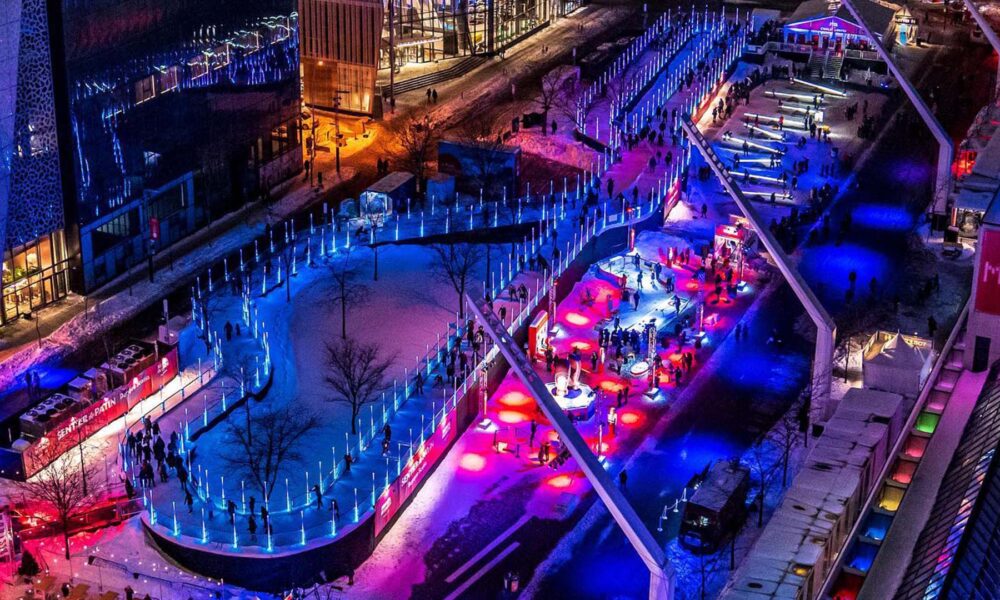
The long, gloomy days of February aren’t for the faint of heart. But, amid the never-ending winter, Montreal brought some life and light—quite literally—back to the city. On Feb. 16, Montreal’s Quartier des Spectacles opened its doors to Montréal en Lumière, welcoming teenagers, students, and parents looking to keep themselves busy over spring break. 

Located steps away from the Place-des-Arts metro station, this 18-day-long festival included an array of events catered to foodies, concert lovers, and outdoor-activity fanatics. Skating rinks, concerts, shows, DJ booths, food trucks, and outdoor exhibits lined the intersections of Jeanne-Mance, Balmoral, St. Catherine, and de Maisonneuve Ouest. Most of the outdoor activities were free and open for hours on end, making the festival accessible to those with varying schedules. And, for students like myself, with a small budget and some extra time to kill during Reading Week, this was the perfect occasion to ditch the books and get a taste of Montreal’s cultural scene. 

Establishing an action plan prior to my arrival would’ve been appropriate considering the festival’s popularity, but, alas, it had completely slipped my mind. As I wandered into Place des Arts at 9 p.m., skates in hand, my friend and I were baffled to see how the length of the queue for the skating rink—or skating “loop,” as it was described—rivalled that of McGill’s Activities Night and how, by 10 p.m., it seemed to be primarily composed of eight to 12-year-olds. After much shivering and endless back-and-forths between the rink and the central fire pit to warm up, we finally made it onto the main rink.

Most of the fun had less to do with the actual skating—or participating in any given activity—and more to do with simply enjoying the ambiance. MingXi Gu, U1 Science (and first-timer at Montréal en Lumière) quickly came to realize this. 

“I’ve never seen the city so lit up,” he said. “The energy was amazing—the lights and music truly made the city feel magical.”

Braving the cold and the interminable lines called for a must-needed wintery treat—good thing for Beaver Tails, Tim Hortons, and the event’s signature maple taffy. Although $9 for a Beaver Tail seemed a little bit pricey, nothing beats the feeling of wolfing down a piece of Nutella-coated fried dough after shivering in the -13-degree-Celsius weather for a few hours.

Beyond the radiating energy of the festival, what was most enjoyable was getting outside in the wintertime, which can otherwise be very difficult. Colder temperatures are often an excuse to stay indoors, but Montréal en Lumière’s objective was to make spending time outdoors more appealing to all, despite the colder temperatures of the season. The festival’s various activities and creative ways of keeping participants warm was its way of doing just that.

“Despite people’s general lack of motivation and the season being so dreadful, everyone really came together to make Montreal feel alive again,” Gu shared.

For locals, Montréal en Lumière is an excellent reminder of all the city has to offer and the benefits of getting outside and enjoying the wintertime, even when it seems impossible to do so. But, for international students, it can provide even more—an understanding and appreciation of the city and its culture beyond the few neighbourhoods surrounding McGill’s downtown campus. Conveniently located and low-cost, Montréal en Lumière is a pit stop for those looking to combine fun, accessible, affordable, and creative pastimes. 

Unfortunately, the festival—with all of its shimmery lights and loud music—came to an end on Sunday. But, for those who missed out or who are looking for a similar taste of Montréal en Lumière, the city has similar—albeit warmer—events lined up in the upcoming months, including Quebec’s International Film Festival, starting in April, the Jazz Fest, which kicks off on June 29, along with its comedy-centred Just for Laughs festival, which takes place in July.


McGill, News

Open letter urges McGill to make statement about devastating earthquake in Türkiye and Syria

A 7.8 magnitude earthquake hit northern and western Syria and south central Türkiye on Feb. 6, claiming an estimated 50,000 lives, injuring an estimated 100,000, and causing tremendous damage in a region already struggling through the more than a decade-long Syrian civil war and subsequent refugee crisis. Millions of people have been displaced, humanitarian aid has been limited in Syria, and health-care services are scarce as several hospitals and clinics collapsed following the quake. 

In light of the devastating earthquake and aftershocks, students and professors in the McGill community have rallied to support those affected.

On Feb. 15, an open letter calling on the university to issue an official statement of support for people in Türkiye and Syria was sent to Interim Principal and Vice-Chancellor Christopher Manfredi. Initiated by Aslihan Gürbüzel, assistant professor at the Institute of Islamic Studies, and Ipek Türeli, associate professor at the Peter Guo-hua Fu School of Architecture, the letter urges the university to raise awareness within its community by sharing information about the main organizations trying to provide relief. The letter has since collected over 300 signatures from current students, faculty, staff, and alumni.  

Türeli explained that she and Gürbüzel did not receive any response from the Principal about the initial letter, so a follow-up was sent on Feb. 22. They then received a response from Associate Provost (Equity and Academic Policies) Angela Campbell, explaining that the administration would not be issuing such a statement. Instead, Campbell wrote that the McGill Reporter would publish an article as it would have “further reach.” 

Türeli explained that she was disappointed in the administration’s response in an email to The McGill Tribune

“The university has sent many MROs of the nature we are seeking, […] for example, in the case of the war in Ukraine, both the Principal and the Provost sent out MROs,” Türeli wrote. “The McGill Reporter article that eventually came out on [Feb.] 15 celebrates what McGillians are doing to help, and it is not about the humanitarian disaster that is unfolding [….] Why is McGill not standing in solidarity with the Turkish and Syrian universities in the affected region?”

McGill media relations officer Frédérique Mazerolle informed the Tribune that following the Feb. 6 earthquake and aftershocks, the Office of the Dean of Students reached out to all Turkish and Syrian students to offer support and share resources that they can turn to in case they require help. 

“The health and well-being of our community remain our top priority,” Mazerolle wrote. “The University continues to amplify the efforts made by members of our community to collect donations for survivors in the area by sharing them through our channels.”

Berfin Simsek, a Turkish U2 Arts student, explained that she felt “let down” and “uncared for” by McGill because she had expected a statement of solidarity addressing the situation. 

“It makes me feel like people from my background, from where I’m from, are not worthy of their attention or time,” Simsek wrote in an email to the Tribune. “We have been struggling so much mentally and emotionally […] we needed to hear that they were there for us. We needed to feel like school was one thing we did not need to worry about. But they failed to do that.”

Gürbüzel explained that it would not be too late for McGill to issue a statement of solidarity as the crisis is still unfolding and it will take time for the region to fully recover. She thinks that an acknowledgment of support would mean a lot to affected students and members of the McGill community. 

“I believe that a statement of support that emphasizes the long-term nature of the destruction and recovery processes is going to make a strong impact now as we observe the attention and solidarity to the Turkey-Syria earthquake slowly dwindle,” Gürbüzel wrote. 

McGill, News

Arts students vote in new executives, strike down motion to raise AUS fees

Undergraduate students in the Faculty of Arts, the university’s largest of 11, voted in next year’s Arts Undergraduate Society of McGill University (AUS) executives and representatives in a ballot that ran from Feb. 20 to 24. A referendum also took place during the same period, where students decided to continue funding the McGill Journal of Human Behaviour (MJHB) but struck down a proposed AUS fee increase.

According to AUS, 1,102 people—13.1 per cent of the electorate—voted in the 2023-2024 elections. Those who did vote decided that Matthew O’Boyle, who is currently an Arts representative to the Students’ Society of McGill University (SSMU), will be the next AUS President. 

“Working between SSMU and AUS this year, I’ve developed a pretty good understanding of what powers each institution holds and how these powers can be enacted to serve the interests of students,” O’Boyle wrote by email to The McGill Tribune. “I look forward to overseeing the various portfolios of the AUS and offer my institutional knowledge to help get things done efficiently and effectively. I worked under both Adin Chan and Ghania Javed, the AUS presidents these past two years, and […] I learned a lot from both of them and am eager to carry this knowledge forward in my new role.”

Julia Widing was elected as the vice-president (VP) Finance, Suzanne Levandier as VP Internal, Sophia Weiqi Li as VP External, Lauren Hicken as VP Communications, Sarah Jiang as VP Social, and Nick Rieck as VP Academic.

Three Arts representatives to SSMU, who will sit on the SSMU Legislative Council, were elected: Keith Baybayon, Quinn Porter, and Aishwarya Rajan. Two Arts Senators, who will represent students in the faculty at the McGill Senate, the university’s highest democratic governing body, were also elected: Sophia Garofalo and Juliet Morrison*.

In addition to elections, Arts students voted on two referendum questions. According to AUS, 877 students—or 10.4 per cent of the electorate—participated in the Winter 2023 referendum.

A question regarding raising the AUS fee from $16.50 to $17.50 for full-time Bachelor of Arts (BA) students, and from $8.25 to $8.75 for part-time BA students failed, with 60.9 per cent of students voting against it. Current AUS President Javed found it “a bit disappointing” that the fee increase did not pass, explaining that the additional funds would have gone toward higher wages for AUS employees.

“The most important reason behind the fee change, or fee increase, was because of the minimum wage increase,” Javed explained in an interview with the Tribune. “So it went from $13.[50] last year to $14.25 this year. That’s what we’re operating with, and it’s going to change again in May to $15.25 [….] The fee has not been increased for years.”  

“So the meaning of this fee increase was so we could pay our staff adequately. We do have a lot of stipend and hourly wage staff […], a lot of them work anywhere from 10 to 20 hours a week.”

The MJHB fee, which was also up for a vote, was approved with 59.1 per cent of voters in favour. The student-run Journal publishes a wide array of “exemplary” work by Arts students twice a year.

“Our goal is to foster conversations that transcend disciplinary boundaries to better understand why we act the way we do,” MJHB Editor-in-Chief Sophie Cleff wrote in an email to the Tribune. “The implementation of the MJHB fee as decided by the AUS referendum will not only allow us to continue running our publication, research fellowship, and speaker series, but also expand our operations with even more ambitious projects.”

*Morrison is currently a News Editor at the Tribune and was not involved in the publication of this article.

Commentary, Opinion

How (not) to leave home

A joke of history: North America is the centre of the modern world, so it can never truly feel international. Inane metaphors––melting pot, mosaic, salad bowl––only distract from the inexorable crush of the market and the English language. Even Quebec’s vaguely nationalist slogan, “//Je me souviens//,” today feels without content, as separatist dreams dissipate into a cultural project with little imagination beyond its own borders.

But in the decrepit cradle of empire, something stirs with life. Europe, hoary and fossilized, its immortal meaning shaped by primordial violence. I return to it like a worm to mulch.

I’m going to Berlin. I’ve been “going to Berlin” for several months now; my semester abroad begins in the middle of McGill’s winter semester. My home, classmates, and partner returned to their routine after the Christmas break, but I could not––I am elsewhere, almost. I pass the time watching German television and practicing the language online. //Babylon Berlin// and //Kleo// are both fun watches set during pivotal moments: The fall of Weimar Germany and the Berlin Wall, respectively. Both are crime thrillers, and I wonder sometimes if this will shape my grasp of the language, breathing wit and intrigue into those harsh words.

In my desire to be anywhere but here, I’ve assiduously avoided the Western hemisphere in my studies at McGill. But my German is still shaky, so I’m enrolled in the Free University of Berlin’s only department offering reliable English courses: The John F. Kennedy School of North American Studies. Of course, “North American Studies” refers to the U.S. of A. Should I be offended that Canada has yet to enter history, or comforted? Here I prepare, I read Karl Marx and listen to The Threepenny Opera. In Berlin, I will study Hemingway and the New Deal at a conspicuous remnant of the Cold War. 

Walter Benjamin wrote: “The past can be seized only as an image which flashes up at the instant when it can be recognized and is never seen again.” The philosopher died later that year fleeing the Gestapo. What to make of these flashes of memory? My mother visited Poland as a young woman. She was warned to never, ever mention the trip to her grandparents. They are gone now, along with most of their generation, and their fear and fury hide in the debris. Am I a disloyal son, seeking rebirth on the graves of my ancestors? But I forget: Berlin is a city of memorials and museums, not of graves. Like any good empire, Germany exported its violence.

I leave soon. I am preoccupied with the petty business of preparation, with baggage, clothes, face creams, antidepressants, and the opaque mysticism of McGill’s transfer-credit system. It’s exhausting, of course, but what a miracle of bureaucracy! I travel across the globe and a 20-year-old paper trail follows me, all for the sake of something new. Then I will go through the same steps as I return, and McGill will snatch me back up, richer by 15 credits and half a language.

My partner and I walked through Jeanne Mance in the snow. We had said goodbye before, and have said it many times since, but we did not speak as we walked. Our hoods were up, and the snow swallowed every noise. No cars. No music. The world seemed shapeless and made new. We struggled through it with our heads down and our feet scrabbling for purchase.

A truth hides in the crime thriller: Whatever last episode’s revelation, the mystery only deepens, the cloud of cigarette smoke only grows thicker. No one really gets over anything. There will be no rebirth, no spark of newness buried with the dead, only accretion, only sediment. History collects like dandruff. When the page is saturated with ink, we continue in another colour. I leave Montreal with love and anger packed between my molecules, so I can never really leave Montreal.

Commentary, Opinion

McGill’s academic freedom policy is rude-imentary

Last April, to appease their older rural voters, the Quebec government unveiled a new policy concerning academic freedom in schools and universities: Bill 32. 

Naturally, the policy had little to do with Quebec’s rural population and very much to do with enforcing its definition of academic freedom upon universities, prompting some 130 professors to sign a petition against the bill. 

You see, central to Bill 32 is free speech, it seems, at all costs. 

To comply, McGill has drafted a new academic freedom policy touching on what you should be allowed to say (anything), trigger warnings (not compelled), and the various procedures for academic complaints (a small, secret committee). 

The draft’s biggest problem comes back to the straightforward question: How can you facilitate academic freedom without respect? 

It was the Centre for Human Rights and Legal Pluralism’s welcoming of Professor Robert Wintemute, who opposed a U.K. policy to improve the legal recognition of transgender people that really did it for me, and showed McGill’s true colours. Hiding behind “free speech” is the constant mantra of those who want to guise hate as debate. And for McGill, it’s snorting a line of danger.  

And look, being able to speak freely and question ideas must be the university’s bread and butter. But if that speech incites hate or violence, how can we expect an environment of academic debate to prosper? 

It’s at this point that Interim Principal Christopher Manfredi might throng the university’s policy on equity and inclusivity in my face. Or perhaps he’ll show off the article he wrote in The Montreal Gazette last year about academic freedom and equity going hand in hand, no doubt framed in his office. 

But not so fast, Sir. The notion that universities can defend unchecked speech while advancing equity and inclusion is a thought which didn’t get past one glass of Chardonnay. 

To defend academic freedom, equity and inclusivity guidance must be ingrained within the institution. While it’s a question of enabling freedom of speech, it’s also a question of what type of community McGill seeks to shape. And without guidance on how to create an environment where everyone can freely participate, the policy becomes nothing more than a used tissue. 

Take the recent hosting of Wintemute. He opposed the legal recognition of someone because of their identity—no different from race, sexual orientation, and place of birth. These views, first of all, violate the university’s own equity policy. Second of all, from an academic freedom perspective, it’s ludicrous to expect that those he targets will feel able to contribute to the discussion when he insinuates bigotry.   

And the real kick up the backside with McGill’s draft policy is that instead of providing direction for respect, it does the opposite. 

Point 20 in the draft states how the university will not compel instructors to provide content and trigger warnings. 

This measure, I think, is to align the university with Bill 32’s new policy. But it’s phrased all wrong. Because McGill can comply with the law and still endeavour to ingrain best practices. 

A professor shouldn’t feel like they have the barrel to the head about using content warnings. . But just like you eat with your mouth closed or don’t by way of introduction yell obscenities at strangers, giving a heads-up about a sensitive topic is good manners—and it facilitates an environment where everyone can engage freely, and from which academic freedom can flourish.  

Ingraining respect and fostering an environment of inclusivity is currently omitted from McGill’s draft, and it would be wise to rethink, or at least for the Deans to talk about it over a full bottle of wine, instead of just the glass. 

Academic freedom can only come by creating conditions where all individuals can join the discussion. Because that’s the thing—McGill’s job is not to produce academic content or discussions. It’s to facilitate them. 

Arts & Entertainment, Music

Artist Spotlight: Bibi Club shines in vibrant performance of their debut album

Bibi Club is a growing force amongst Quebec’s burgeoning alternative pop scene—a scene that has seen the likes of Men I Trust and TOPS achieve global acclaim. 

The Montreal dream-pop duo’s debut record, Le soleil et la mer, represents the most fully realized version of their sound, widening their sonic palette from the analog synths and drum machine grooves of their 2019 self-titled EP. 

“It’s not driven by performance abilities. It’s driven by instinct,” said guitarist Nicolas Basque when describing their debut album in an interview with The McGill Tribune. “Labels are tough but at the same time they help you describe what you’re doing [….] I think now indie-pop is anything that’s done in an arts and crafts way musically […] I’m not uncomfortable with that.”

The band’s music cuts through the predictability that often characterizes so-called “dreamy” music. Le soleil et la mer is marked by its dynamism: Basque’s sparkly guitars playfully interact with Adèle Trottier-Rivard’s synth lines and warm, alluring vocals, underpinned by danceable drum loops. In marrying these elements, Bibi Club’s songs resist staticism, rising and falling in swells of shimmer and reverb. Fittingly, Trottier-Rivard and Basque have also been a couple for seven years, balancing their musical lives with raising their children. 

Ahead of their Feb. 9 homecoming gig at Quai Des Brumes, Basque noted how the band enjoys presenting a heavier, more raucous version of their music live. On the night, they eased into proceedings with the track “Le Balcon,” featuring tranquil guitar-picking and wind chimes, before Basque fulfilled his end of the promise and slammed on his effects pedals and drum machines. 

“It’s a bit like listening to the record really loud,” Basque said. “There’s a more, dare I say, punkier energy.”

Meanwhile, Trottier-Rivard stood at the helm of a Prophet 6 synth, surrounded by an array of cymbals and percussion, providing an organic touch to the group’s predominantly electronic setup. The band leaned on material from Le soleil et la mer through their set, with highlights like the unrelenting beats on “La Plage” and the layered vocals and scratchy guitars on the frenetic “Femme-Lady.” The bouncy, glitched-out “Parasite” was particularly well-received by the enthusiastic crowd, morphing from an uptempo bop into a serene half-time groove, over which Basque tastefully soloed on guitar. Ultimately, Bibi Club’s performance style communicates the sense that its members thoroughly enjoy playing as a central facet of their artistry. 

“It’s never heavy in the studio when we work together,” Basque said. “We always try to find a tension between two things […] like being awake and being asleep […] we’re looking for tension but without going into a depressing, darker mode.” 

Much of the band’s playful sound has also been shaped by their schedule as a family, fitting ad-hoc improvisatory home sessions around Trottier-Rivard and Basque’s children. 

“A lot of the sparkle for a song comes from a guitar and vocals jam […] when the kids are in bed,” Basque said. “Then the shape and timbre of the song come to life in the studio.” 

Bibi Club centres community in their musical approach. The band sees the aesthetic aspects of their album art and live performances as opportunities to collaborate with Montreal creatives. They enlisted local artist and painter Mégane Voghell to produce Le soleil et la mer’s cover art, interpolating a childhood image of Trottier-Rivard behind a drum kit into an abstract painting. Such collaborations have become symbiotic, with Voghell even contributing backing vocals on “Le Matin.”

“It brought the record further than what we had done with just the music,” Basque said. “The collective work made it cooler and added depth for me […] even when I play live now, it informs a lot of the process.” 

In the future, Bibi Club plans to keep evolving their craft, and Basque is keen to explore how much minimalism they can incorporate while maintaining a rich sound. With the band returning to the studio this month, Bibi Club’s fans can look forward to hearing the fruits of this sonic experimentation shortly. 

Arts & Entertainment, Books

‘Strange Bewildering Time’ is a time capsule of forgotten history

Forty years ago, author and poet Mark Abley went on a three-month journey that changed his outlook on life. Accompanied by his friend Clare, the two travelled through several countries during the last year of the Hippie trail, at a time when it seemed that travel within Asia was cheap, the sights bountiful, and the hospitality exceptional. He filled three journals during his travels to be used for poetic inspiration; instead, they were left in the depths of his desk drawer. Years later, Abley decided his stories should be shared, and thus he collected and reflected on these stories in his newest work: Strange Bewildering Time.

The travel autobiography tracks Abley and Clare’s wandering journey through Eastern Asia and the Middle East. With no plan except a return ticket to London three months after their arrival, Abley and Clare began their adventure as wide-eyed university students, searching for enlightenment and a good story. In fact, Abley originally planned to transform his journals into a poetry collection. However, the journals became a space for Abley to psychologically ground himself and reflect during the trip. Over three months, the travellers’ journey became an experience that built self-awareness and knowledge of new cultures and strangers’ kindness. 

But as Abley restructured his journals into a travel book 40 years later, he instead discovered his accounts to be somewhat of a time capsule of 1978. The journals housed a naive young man unaware of the cultural, political, and environmental changes bubbling under the surface of his surroundings.

“[At the time], I hadn’t read enough or thought enough about the countries I was travelling through,” Abley told The McGill Tribune. “[O]ne conscious decision I made right from the start of this book was that I would not quote Western writers in the tradition of literary travel writing.”

To rectify this lack of awareness as a white man in a literary tradition filled with voices of the same demographic, Abley sought to incorporate texts and references from the literary canon of the Global South, such as Alboqasem Ferdowsi’s Shahnameh: The Persian Book of King. In doing so, he uses Strange Bewildering Time as a collage for offering lessons and teachings about the cultures he visited so many years ago. His reflective self-awareness reveals his younger self to be ignorant of his privilege as a man, even while travelling with Clare. Abley thus intends to question how locals at the time would’ve viewed him as the ‘scruffy traveller’ he remembers himself as while acknowledging his naive narration in the journals. 

“I feel regret that so many of these countries and places are so much more difficult to travel into and through than they used to be,” Abley said. “But I hoped that nostalgia is not the emotion that comes across. What I more accept is a sense of loss [and] a sense of joy at my own good fortune, at having these experiences and being able to see these places.”

Besides capturing a cultural moment in time, Strange Bewildering Time tracks the environmental changes between 1978 and the present day. Abley ruminates on his bewilderment of the gorgeous landscapes that he and Clare explored mournfully, as the climate crisis has all but eliminated these natural wonders and harmed local communities in its wake. 

“The fact [is] that we crossed rivers and lakes in Iran that don’t exist anymore. The fact [is] that we clambered over a glacier in Kashmir that’s a fragment of its former size,” Abley told the Tribune. “The fact [is] that Kathmandu is suffering from its lack of safe drinking water because they just don’t have the infrastructure in place.”

All in all, Strange Bewildering Time acts as a complex narration of naive youth and learned wisdom through a single journey. Abley masterfully navigates his acknowledgement of his innocent self as a foundation for the book while introducing witty and philosophical remarks that allow the reader to reevaluate the authority of the narrative lens. Abley’s book, therefore, is a remarkable time capsule of culture and circumstance wrapped up in an enticing story about meeting new people on a hippie adventure.

Strange Bewildering Time is available everywhere where books are sold.

Sports

“We need recognition”: McGill Squash wants varsity status after successful season

On Feb. 12, the Ontario University Athletics (OUA) squash championships took place at Queen’s University, bringing an end to the 2022-23 season. But instead of competing for the men’s and women’s titles in Kingston, the McGill Squash Club was running its weekly Sunday practice here in Montreal.

Despite being one of the best teams in the OUA, McGill’s squash team is not allowed to compete in the league’s championship since they are not an official varsity team––a fact which, according to fourth-year co-captain Matt Bicknell, is affecting the team’s competitiveness. 

“When we play in Ontario, we are not allowed to compete in their finals,” Bicknell told The McGill Tribune. “We have to play their C-tier teams which we just obliterate, it’s not even close, so it’s just not worth it to go.”

The Squash Club ceased to be a varsity team after the McGill Athletics system was significantly restructured in the Fall 2010 semester. The change stripped McGill’s intercollegiate clubs of their varsity status, prohibiting them from competing in OUA competitions. Despite competing in the OUA regular season annually (organized by the Ontario Jesters University Squash League), McGill squash has been unable to compete in the OUA championships since 2010. This year, it was an especially bitter pill to swallow for the McGill players considering their success in the regular season, as the women’s and men’s teams placed third and fourth in their respective divisions. 

“We need recognition,” said fourth-year co-captain Anika Kurji. “Both the men’s and women’s teams are doing really well, so it’s frustrating that we are not varsity considering that we are competing with all these varsity teams and beating them.” 

If McGill squash were to be reinstated as a varsity team, they would potentially be eligible for OUA playing privileges as there is an existing by-law that allows non-Ontario schools to compete in certain sports. This currently allows certain McGill teams like the Redbirds’ hockey team to fully compete in the OUA. 

The McGill squash team’s inability to compete is not their only issue, however, as a severe lack of funding poses a serious threat to the team’s future. McGill cut all funding to intercollegiate clubs during the 2010 varsity restructuring, imposing a serious financial burden on the squash team. As a result, the maintenance of McGill’s squash program has become a costly and time-consuming endeavour, as players are responsible for travel expenses and logistics, as well as fundraising. 

“We get absolutely no funding from McGill and no help whatsoever, so it’s me and the other captains that do all of the organizing,” said Kurji. “We book hotels, we book train tickets, rent cars, all that stuff, and we have to do it all ourselves.”

“We are always scrounging for money to travel,” Bicknell added.

In addition to travel expenses, the lack of funding has also prevented McGill’s squash team from hiring a professional coach. Instead, the team’s student captains act as coaches by running practices and training the other players to the best of their abilities. The captains are typically the team’s most experienced players and some have prior coaching experience, but the lack of professional training still puts McGill at a disadvantage. 

“We have people in the top couple spots on the team who have been playing for years and start to go stagnant, so with the extra professional coaching, it would make a really big difference,” said second-year player Simone Visram

The lack of professional coaching has also hindered McGill’s ability to recruit top squash players. In fact, of the players interviewed by the Tribune, all stated that squash played a negligible role in their decision to attend McGill. Due to these disadvantages, the team believes a return to varsity status must come sooner rather than later if they are to compete at the highest level.

“Right now I feel like we are performing at a varsity level, we are beating all the other varsity teams in Canada, other than Western and Toronto,” said Biknell. “But that could all change if we don’t have good leadership or funding in the future.”

Only time will tell whether McGill’s squash club will succeed in their venture, but in the meantime, the team is staying focused and training hard as they look to build on their success next season.

Arts & Entertainment, Theatre

‘The Sorcerer’ bewitches audiences

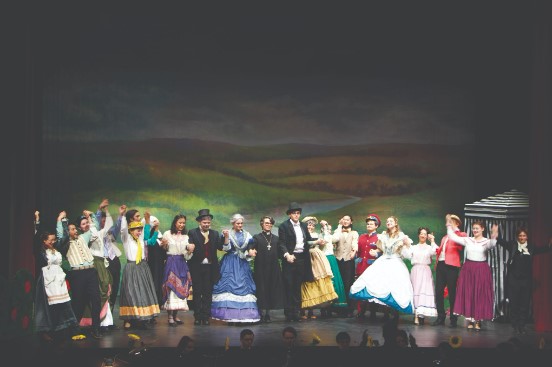
Gilbert and Sullivan’s comic opera, The Sorcerer, debuted in 1877 with a bizarre cast of priests, lovers, and sorcerers. This Victorian-era opera about marriage and love potions was not exactly what one would expect from the occasionally club and drug-obsessed—dare I say depraved—city of Montreal. Suffice it to say, when the McGill Savoy Society announced that they would be putting on The Sorcerer, McGill students paused their rambunctious night lives for an evening of opera.  

In The Sorcerer, the newly-betrothed Alexis (Samuel Valentim-Gervais, U3 Science) enlists the titular sorcerer John Wellington Wells (Aidan McGartland, PhD Music) to brew a love potion for the village so the villagers must share in his lovesickness. Wells agrees, and slips the potion into a pot of tea for a village gathering, wherein the rallying cry is not unlike that of McGill Arts students: To “eat, drink, and be gay!”  But if The Sorcerer can teach McGill students one lesson, it’s this: Always bring your own drinks to parties. 

After the potion takes effect, every villager falls in love with the first person they see. This gambit leads to some fairly unconventional and often hilarious pairings, the funniest being the romantic attraction shared between the young Constance (Alice Wu, U4 Arts) and, my favourite, the hard-of-hearing and certainly geriatric Notary (Melody Grant). In one of the show’s shining moments, the Notary uses an ornate ear trumpet in an attempt to hear Constance.  Despite all its humour, the show ends on an eerie note: To reverse the bizarre effects of the love potion, Wells sacrifices his life.

Even so, the McGill Savoy Society’s production of The Sorcerer was a hilarious and magical night of song and dance.  The cast’s costuming, designed by the show’s director, Natalie Demmon, consisted of intricate Victorian skirts and suits of various pastel hues, and especially mesmerizing cage crinolines and hoop skirts. Unlike the fashion scene in Montreal—pardoning the bright, blue eyeshadow—the costuming made me wonder if the heavy doors to Moyse Hall had opened up a portal to the late-19th-century village of Ploverleigh.  

Natalie Demmon also designed the set: A Monet-like landscape with rolling hills and twisting lakes, then a picnic spot with intricate wooden tables and food platters, and later a potion-making lair complete with a sorcery hut that resembled the cover of an Albert Camus novel.  Throughout the show, characters picked flowers from the set’s hedges to wear in their hair or give to their lover. The lighting, designed by Asa Kohn (first year master’s in math), was powerful enough to change the setting from a relaxing, rolling hillside where lovers profess their feelings for one another to the demonic potion-making chamber of a sorcerer within seconds.

Whether singing within or without the ensemble, each vocalist sounded beautiful. The ornate solos that Aline (Sophie Gaudreau, U3 Arts and Science) sang were particularly noteworthy—especially “Oh, Happy Young Heart.”  I only wished the characters spent more time listening and responding to one another with their songs; their heavy focus on the audience limited genuine conversation between characters. But ultimately, the professional quality of the vocalists more than made up for it.

Despite the orchestra’s small size, their rendering of Arthur Sullivan’s markedly brassy score, evident from the show’s starting “Overture”, was euphonious. “Dear Friends, Take Pity On My Lot” stood out as it alternated between the fast and vivacious tempo of Constance and chorus and the slow waltz of the old Notary who is “67 nearly”—gasp!  The orchestra was an incredibly talented and passionate group of musical artists whom I urge to play with even more confidence during their following musical pursuits—anyone would be lucky to listen.  

Despite debuting nearly 150 years ago,  The Sorcerer still tickles contemporary audiences.  The McGill Savoy Society’s performance of a 19th-century opera about marriage plots and sorcery allowed students to escape the misery of midterms and the monotony of the club scene.  Readers should absolutely attend future performances by this passionate group of technicians, musicians, and artists. Apt. 200 can wait another day.  

The Sorcerer ran from Feb. 10-18 in Moyse Hall.

Basketball, Sports

Martlets’ basketball misses playoffs in crushing defeat to Concordia Stingers

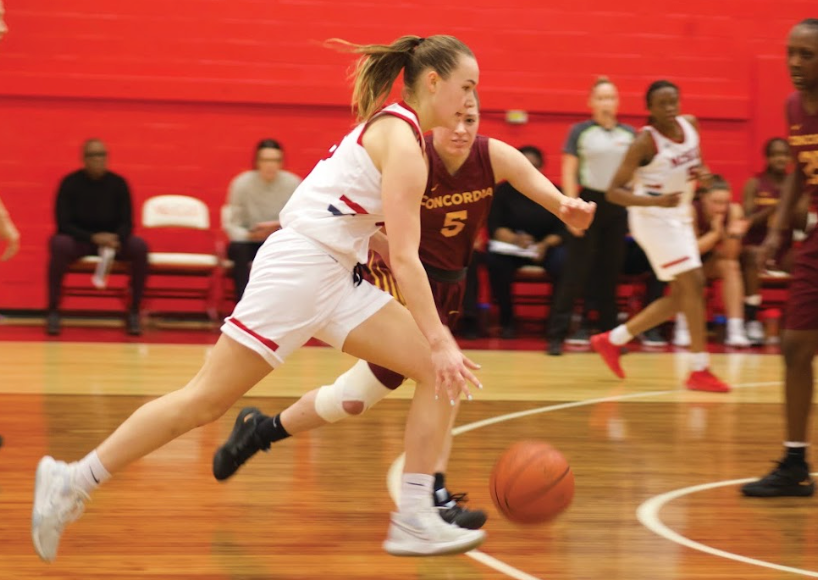
It wasn’t meant to be for the McGill Martlets (3–11) in their must-win showdown against the Concordia Stingers (4–11) on Saturday, Feb. 18. In an emotional farewell to senior players Jessica Salanon and Amélie Rochon in their final home game, the Martlets were unable to contain Stingers star Areej Burgonio, in a 75-58 defeat for the home side. The result means the Martlets fall short of securing the final place in the RSEQ league playoffs.  

In her last game at Love Competition Hall, team captain Salanon told The McGill Tribune it was do-or-die for the team. 

“They came up stronger than us,” Salanon said. “They fought harder. So I guess they deserve the win. It just hurts [….] For us, there’s no chance for playoffs. But hey, basketball is just a game, right?”

After a narrow loss to the Stingers the week before, the Martlets started with intent, capitalizing on early fouls to secure a tight lead in the first quarter. First-year guard Daniella Mbengo led the charge with driving layups as Martlets head coach Rikki Bowles prowled on courtside. Point guard Burgonio, who stands at just five feet tall, kept the Stingers within touching distance, but first-year guard Stephy Tchoukuiegno provided the edge from the far-right corner with an assured three-pointer to close out the quarter with a 17-15 lead.

In the second quarter, the Martlets let their lead slip. Although there were positives from Tchoukuiengo’s sharp shooting, the Martlets were unable to seize on the free throw opportunities and the Stingers pulled away with a 30-26 lead after sinking nine unanswered points. The moment of the quarter came from Burgonio, who closed the half by zipping up the court on the counter-attack in the dying moments of the second, before pausing at the three-point line, shimmying to the left of her marker, pulling back, and sinking the two points.

Launching the second half, third-year guard Emma-Jane Scotten led the Martlets in an attempted comeback, gathering an offensive-rebound and burying her attempts at the free-throw line. Despite this, Concordia maintained their grip on the game. The Martlets fought back in the latter end of the quarter, with Sydney Foran and Salanon both swishing three-pointers. The animated Stingers bench sirened throughout the quarter, while the Martlet crowd cheered and jeered ‘defence’ from courtside, as the Martlets finished the third quarter down 56-40.

The Martlets gritted their teeth in the final quarter, with third-year centre Kristy Awikeh gathering a rebound and calmly finishing the subsequent layup. However, the Martlets’ resolve would not be enough, as the Stingers continued to toy with their defence, sinking the Martlets’ chances of a prized playoff spot. 

Rochon, who’s finishing her fourth year studying medicine, told the Tribune that she will miss the Martlets’ close family spirit. 

“It’s so many things,” Rochon said. “I’ll remember the moments on the court, especially this year, the wins that we got were so special to me [….] There [are] just so many variants outside like just doing groceries or  chilling with the team […] all of it. Even practice. It’s just a great bunch of people and that’s what I’m gonna miss.”

Martlets head coach Rikki Bowles spoke to the Tribune about how Rochon and Salanon, the teams’ graduating seniors, will be an immense loss on and off the court. 

“The thing about Martlets basketball is that it really is a family, so we look forward to seeing them back in the stands and as involved alumni.”

Although this spelled the end of the Martlets’ playoff chances, the Martlets hope to end the season on a high note with their final game of the season next week at UQAM, on Feb 25.  

Moment of the game:

In the game’s final minutes, a ripple of applause waved through the crowd and courtside benches for senior players Amélie Rochon and Jessica Salanon, who both took the court for one final time. 

Quotable: 

“I just appreciate every, every, every single day with [the] team. I’m grateful. And you know, these years, they’ve passed by really quick. And it’s just when you’re at the end that you realize.” —Jessica Salanon on her time playing for the Martlets

Stat Corner: 

The Martlets averaged 52.3 points per game this season, a substantial improvement on last season’s average of 44.4.

Read the latest issue

Read the latest issue