

Latest News

McGill, News, SSMU

SSMU Legislative Council discusses student federations, upcoming referendum

The Students’ Society of McGill University (SSMU) held its second Legislative Council meeting of the year on Feb. 9. Members of the council voted on whether to approve questions for the upcoming Winter 2023 referendum. While questions regarding a fee increase for campus groups such as the Muslim Students Association and Midnight Kitchen were approved, a question regarding the continuation of the Student Support fee was struck down.

The meeting began with two presentations, one of which was a pitch from University of Toronto student Nelson Lee, the founder and CEO of HAVEN, a campus safety app. The app allows users to send alerts, seek resources, and communicate with emergency services in cases of harassment or assault on campus

“We noticed that a lot of current resources [offered by universities] are more on the reactive side, dealing with things such as counselling after a traumatic instance, rather than providing tools for students to preemptively get help from campus police, from their friends or family, or from emergency services,” Lee said.

The second presentation was given by SSMU vice-president (VP) External Val Masny, who recommended several student federations SSMU should consider joining. They suggested Undergraduates of the Canadian Research-Intensive Universities (UCRU) and Inter-Associatif, which are coalitions of student associations at the federal and provincial levels, respectively. UCRU would require a fee collection of $0.50 per semester per student, while Inter-Associatif would require $4 per semester per student. 

Masny argued that, because Inter-Associatif services would allow for both faculty-student unions and departmental student unions to be affiliated, it would be worth considering despite the higher fee. An alignment with UCRU would mean that SSMU could continue to represent student interests on Parliament Hill as part of the organization’s federal lobby week, which, in the past, has helped eliminate interest rates on student loans across the country.

A representative from the Bar Milton-Parc Solidarity Cooperative—a community-owned gathering space—motioned for a plebiscite question asking students whether they are interested in investing five per cent of SSMU’s Capital Expenditure Reserve Fund (CERF) into a project to revitalize Bar des Pins, which has been closed since 2019. The project, which would be owned and operated by the Milton-Parc community, would offer free lunches twice a week, café services, and a co-working space during the day, doubling as a pub at night. 

“The cooperative is going to be owned and operated by the community,” the representative said. “The name of the game is a space that is open to all groups in the area, students and non-students alike.”  

The plebiscite question would be a non-binding trial poll to gauge student interest in the project. The motion passed with 15 votes in favour. 

There was a great deal of contention surrounding a Winter 2023 referendum question that would implement a fee for the for-profit Student Support corporation, which provides the university with access to Calm, Udemy, and Grammarly. In March 2022, the Student Support fee passed in a student referendum for a trial period of one year.

For the upcoming referendum, Student Support is seeking an opt-outable levy fee of $10.29 per semester for providing these subscriptions. Ajamu Attard and Karim Atassi, founder and representative from Student Support respectively, argued that to disapprove the motion would be to deprive students of vital learning services. 

Councillor Amelia Whitcomb began the debate period by asserting that while the services are important to many students, they worry about the corporate nature of Student Support. 

“I feel that working with a for-profit company as a student society is probably not within reason, because for our students to be supporting the profits of a company doesn’t really feel good for me,” Whitcomb said. “I would prefer if it was possible for SSMU to do the leg work on our side and work with the companies on our own.” 

Councillors struck down the referendum question, prompting an email from Student Support on Feb. 13 explaining that their services would be discontinued as of Aug. 13. The company is urging students to fill out a poll stating whether they would have voted yes to the fee.

Moment of the Meeting:

SSMU President Risann Wright announced that the nomination period for executive positions at SSMU has opened and will run until Feb. 20, and encouraged students to reach out to any of the current executives if they are interested in applying. 

Soundbite:

“I recognize that there were concerns about the overall validity of this company as an organization and previous ethics questions, but I think […] this is ultimately a value statement that each of us individually is making about whether this is worthwhile for our peers, and I think that our peers are better equipped to answer that question than we are.” 

— Engineering representative Mahia Reed arguing in favour of the Student Support referendum question


Ask a Scientist, Science & Technology

Shining a light on a new breast cancer vaccine’s potential

Most of us know the statistics associated with cancer. It has touched, directly or indirectly, almost every Canadian. But thanks to the relentless work of researchers, around two out of three patients diagnosed with cancer today will survive beyond five years from their initial diagnosis—up from 55 per cent in the early 1990s. The most recent innovations in cancer treatment have stemmed from immunotherapy, a fast-growing and exciting field of study for cancer researchers.

“Cancer immunotherapy unleashes the power of the patient’s own immune system. It is today considered the fourth pillar of cancer therapy,” Sonia del Rincón, assistant professor in McGill’s Department of Oncology, said in an interview with The McGill Tribune.

Recently, University of Washington (UW) researchers developed a cancer vaccine targeting HER2/ErbB2, a protein on the surface of tumour cells which affects one in five breast cancer patients. The vaccine was shown to have minimal side effects, like fevers and fatigue, while generating a significant immune response in the non-randomized trial.

William Muller, a professor in the Department of Oncology and renowned investigator of the HER2/ERbB2 genes in breast cancer, explained in an interview with the Tribune that the paper is a phase I trial, or a safety trial, that looks specifically at a safe dose range and adverse effects.

“The concept of vaccinating patients against specific tumour targets has its roots in the early 90s when Thierry Boon’s group identified the first human [tumour] associated antigen called MAGE-1,” added del Rincón, whose lab studies novel therapies for melanoma and breast cancer.

Vaccines generally work by training the body’s immune system to recognize and attack a foreign body, called an antigen. One such antigen is the spike glycoprotein, found on the surface of the COVID-19 virus. However, because cancer occurs when our own cells grow uncontrollably, specific proteins like MAGE-1 or HER2 that are overexpressed on the surface of only cancerous cells, must be targeted. “The target [of the UW breast cancer vaccine] is unusual in that it’s the intracellular domain of HER2, which is normally not presented on the surface,” Muller said.

The outcomes that the UW researchers reported are also promising because their breast cancer vaccine did not lead to any adverse effects.

“Researchers of the study did not report any severe side effects associated with the DNA vaccine,” del Rincón said. “Patients receiving other types of immunotherapy can be at risk for severe immune-related toxicities.”

Patients enrolled in the study had an 80 per cent five-year survival rate, compared with the expected 50 per cent for patients with stages III and IV breast cancer. Of course, there is still work to do before this treatment could become widely available. The true efficacy of the approach will come from phase II and III trials,” Muller said. 

When it comes to cancer research, only 25 per cent of phase II trials and 40 per cent of phase III trials succeed. Phase II trials are meant to further study a vaccine’s safety and evaluate its effectiveness, while phase III trials are meant to compare the medicine to the best treatments we have today, also known as the gold standard

Dr. Nora Disis, the lead researcher from the UW breast cancer vaccine team, explained in the most recent episode of Freakonomics, M.D. that the rapid development of mRNA vaccines against COVID-19 was in large part because its safety profile in innumerable cancer patients had already been defined.

Whether this breast cancer vaccine or other vaccines under evaluation will change the landscape of cancer therapeutics remains to be seen. But, while the Emperor of All Maladies carries on its reign of terror, cancer scientists and oncologists, like del Rincón, Muller, and Disis, continue to pursue the disease with fervour.

Commentary, Opinion

McGill needs a complete summer term

Registration for the summer term at McGill is set to open in a few weeks. As it stands, McGill students can only take two courses per summer session, or 12 total credits, over the four summer months, and are usually provided with relatively few class options. 

This system, however, is based on outdated academic norms that do not adequately meet student needs. Providing a complete, well-rounded summer semester would enable greater flexibility for students and researchers in their academic careers and would make more efficient use of university facilities and resources. 

The McGill administration has already hinted at making the transition toward having a full summer term. The Working Group on New Programs of Academic Program Delivery, a sub-committee of the Provost’s Office, indicated that the current academic calendar might not be the best way to further integrate online learning and accommodate the university’s credit system, programs, and activities. The working group’s final plan was set to be submitted to the Provost and Vice Principal (Academic) by the end of last semester, but the student community has yet to receive any updates. 

In North America, the emphasis on long summer breaks is part of an outdated yet culturally significant system from over 200 years ago. Schools and universities saw higher rates of truancy over the summer when air conditioners hadn’t yet been invented and seasonal epidemics were prevalent. Additionally, school calendars were initially shaped by the needs of rural and agrarian communities where the help of children was necessary for harvesting. Since then, the summer vacation has established itself as a cultural staple of North American family life and an essential component of the consumer economy. Naturally, to students in today’s context, the structure of the academic calendar may seem quite arbitrary.

A three-semester academic calendar would integrate a complete new summer term that offers the same course load and range as the Fall and Winter semesters. The 120-credit requirement often forces students to compromise on courses of interest to finish their degrees on time. Further, a shortage of learning spaces on campus suggests that McGill’s infrastructural capacity is not meeting the needs of its undergraduate students. A three-semester system would accommodate a greater number of students by spreading full-time student enrollment throughout the year that would help create more space—without compromising on matters of class size and quality. This could allow for more efficient use of university infrastructure as it ensures the continuous presence of students and lecturers on campus. Additionally, a full summer semester would afford students greater flexibility with work-study programs, seasonal work, and internships offered during the winter months. 

Faculty guidelines assert an expectation that professors dedicate at least 50 per cent of their work time to research-related activities. This makes it more difficult for professors to teach during the summer, with graduate students stepping in to provide teaching relief for such positions. Student concerns suggest that while the current system provides more opportunities for graduate funding, it demands a lot from inexperienced teachers approaching intensive courses in an increasingly remote pedagogical environment. These policies may be responsible for substandard instruction quality and shortages of qualified teachers for McGill’s summer terms. If the university plans to seriously rethink its strategic development, it must address the parameters that prioritize its research outputs and limit the course load of faculty members.

McGill’s current academic calendar, therefore, does not accommodate the needs of its students. The university must seriously consider instituting a complete summer semester to provide both students and faculty with greater flexibility. The pandemic has forced our education systems to undergo a transformation. As we adjust to a post-pandemic world, McGill’s gears are slowly grinding to a halt, and we mustn’t let the momentum of positive change in methods of academic delivery die out.

Arts & Entertainment, Pop Rhetoric

Celebrating Black Hollywood—even if the Oscars won’t 

Ryan Coogler. Viola Davis. Keke Palmer. This sounds like the line-up for the next tear-jerking, mind-bending, oh-she’s-acting-acting film, right? Unfortunately, not. It’s a small—and I mean SMALL—portion of the list of Black actors left out of this year’s Oscar nominations and ensuing celebration. Maybe you’ll remember the hashtag #OscarsSoWhite, which blew up in 2015—well, in typical Hollywood fashion, nearly 10 years later, we’re back for a (disappointing) sequel. 

Out of their nearly 100 years of running, this is the 83rd time that there are no Black actors being featured in best actor nominations. There are no women directors at all—and no Black women directors have ever been—nominated in the director’s category. The Woman King, Till, and Nope all grossed millions of dollars at the box office and boast Rotten Tomatoes scores above 80 per cent; yet, none of them garnered a single nomination. 

As I clicked through article after article about Oscar nominations, my heart was dropping. Each one gave a different angle on why Black artists were being shut out of the Academy Awards this season. Some people were mad, railing that even after the awareness spread in 2015 and inclusionary efforts made by award institutions, nothing had really changed. Some people were more jaded, explaining that studios were simply out to do whatever would make them the most money. My mood sank deeper and deeper until I came across an article in the LA Times. The author, Shawn Edwards, argued that yes, so many awards shows and awards institutions ignore Black talent, but there are so many smaller organizations that uplift it.

During this year’s Black History Month, the idea of making this a time to celebrate Black achievement and experiences through Black Joy Month has gained popularity. In that spirit, this isn’t an article lamenting the lack of appropriate recognition for Black artists in Hollywood––this is one that celebrates the institutions that uplift them. Supporting those ones, bringing attention and renown to them is a way to make Black voices heard, Black performances celebrated, and Black experiences told. Don’t let your appreciation end with these awards ceremonies listed here—there are so many more rejoicing in Black talent on-screen.

Toronto Black Film Festival 

In their own words, “the Toronto Black Film Festival is about discovery.” The annual festival occurs every February and seeks to create a space for people to debate cultural, social, and socio-economic topics specific to Black Canadians. The festival hosts a mixture of live musical performances, film screenings, talks from industry professionals, and networking events. They celebrate a milestone anniversary this year—10 years of celebrating diversity within Black communities. It was just a decade ago that this festival was created by its sister festival that happens right here in Montreal.

Montreal International Black Film Festival 

Starting in 2005, the festival sought to showcase Black cinema and bring light to the types of movies often ignored by the mainstream media. Nearly 20 years later, after having welcomed thousands of guests, received international media coverage, and shown films from over 50 countries, the Montreal International Black Film Festival (MIBFF) is still going strong. This festival’s activities aren’t restricted to any one week; they put on workshops, film screenings, debates, and round tables all year round. The MIBFF also maintains a serious commitment to discovering and fostering new talent while seeking to develop the independent film industry in Montreal and across Canada. 

NAACP Image Awards

Finally, coming in a little more prominent than the previous two, are the NAACP Image Awards. Founded in 1967 as a response to Hollywood’s exclusion of Black talent, the awards show was created by the National Association for the Advancement of Coloured People (NAACP) in the United States. Today, the show boasts over 40 different categories, with awards across television, film, music, and literature. The event is broadcast live annually on Fox Network, with this year’s ceremony airing on Feb. 25.  

While there is a lot to be desired with acknowledging Black talent in Hollywood, there is also reason for cheer. And who knows? If the focus shifts to institutions that are praising Black talent—and they are praised loudly and proudly—other awards institutions might have no option but to join in and celebrate it, too. 


The 2023 Toronto Black Film Festival will run from Feb. 15-20. The 2022 Montreal International Black Film Festival ran from Sept. 20-25.

Editorial, Opinion

Targeting Elghawaby is a bigoted political play

On Jan. 26, Canadian Prime Minister Justin Trudeau appointed Amira Elghawaby as the country’s first federal representative on combating Islamophobia. Within mere days of her appointment, various politicians and Members of Parliament began calling for the resignation of the Canadian journalist, communications professional, and human rights activist. 

Elghawaby was accused of promoting “anti-Quebec sentiment” for a column she co-authored in 2019 in which she argued that Quebec supporters of Bill 21 are swayed by Islamophobia. Calls for her resignation came less than a day after Elghawaby gathered with politicians and relatives of victims to mark the anniversary of the 2017 Quebec City mosque attack, an event that Legault chose not to attend. Conservative and Quebec nationalist political leadership have resorted to bullying Elghawaby because they are threatened by the position she occupies in the federal government. 

Leaders of the Conservative Party of Canada, Bloc Québécois, and Legault’s Coalition Avenir Québec targeted Elghawaby for daring to criticize the racism ingrained in Quebec society. Enacted in 2019, Bill 21 bans public servants from wearing religious symbols, such as hijabs, while working. Elghawaby wrote that the “majority of Quebecers appeared to be swayed not by the rule of law, but by anti-Muslim sentiment,” as supported by a survey showing that deeply-rooted Islamophobia was the primary motivator behind support of the bill. The Léger poll found that of those who had negative feelings about Islam, approximately 88 per cent supported a ban on public school teachers wearing religious garments. Elghawaby also rightfully argued that legislation such as Bill 21 has served as a means of justifying and institutionalizing bigotry. Between 2020 and 2021, the number of police-reported anti-Muslim hate crimes in Canada increased by 71 per cent, making Elghawaby’s concerns just as relevant at the onset of the legislation as they are now. 

Backlash against Elghawaby’s appointment demonstrates the ulterior political interests of opposition leadership in establishing party solidarity and rallying voter support. Members of the Conservative Party, including its leader, Pierre Poilievre, have even publicly opposed Bill 21 and argued that it infringes on people’s freedom. This suggests that their opposition to Elghawaby is primarily a play to appeal to Quebec voters. The bill is cloaked in rhetoric pandering to nationalistic anti-immigrant Quebecers, and criticism of Elghawaby is being instrumentalized to win the favour of this voter base. 

Legault manipulated Elghawaby’s comments, framing them as motivated by contempt towards the province, in order to champion Quebec nationalism. After a meeting with Elghawaby on Feb. 1, during which she apologized for her comments, Bloc Québécois leader Yves-François Blanchet rejected her apology and called for the removal of the position entirely. The refusal to acknowledge the growing Islamophobic sentiment across Canada, as well as the need for a representative dedicated to fighting it, demonstrates Canadian politicians’ weaponized ignorance. The immediate outrage suggests that it is not just Elghawaby that Quebec politicians are virulently against, but rather the new federal position itself.

Akin to the targeting of Elghawaby, on Feb. 2, Representative Ilhan Omar was ousted from the Foreign Affairs Committee of the Republican-led House for comments critiquing the United States’ support of Israel. This follows a slew of Islamophobic remarks from other congresspeople. The congresswoman was the first member of the U.S. Congress to wear a hijab, which was forbidden until her appointment. In 2021, Omar introduced and passed a bill that would establish a special envoy to combat international Islamophobia. Both Elghawaby and Omar are trailblazing Muslim women of colour and embody targeted minorities within their respective political institutions. The backlash they have each faced are racist attacks by right-wing leadership that feels entitled to define Islamophobia without ever seeking to dismantle it. 

The response to Elghawaby’s appointment demonstrates Quebec’s dominant political ideology of exclusion and nationalism. Calls for Elghawaby’s resignation must end, and Quebec residents must pressure the province’s current political leadership to support her—not demonize her.

Arts & Entertainment, Theatre

‘Hair’ transports McGill to a night of drug-fuelled, nonsensical fun

Hair is a famously controversial musical. Delving into the hippie counterculture movement of the 1960s, the show covers antiwar tensions in the U.S., draft dodging, the sexual revolution, and pretty much every drug in the book. Now, this raunchy production has been brought to life in Moyse Hall by a cast and crew from across the Montreal community, including many Concordia students and McGill alumni. 

The show follows a group of New York hippies protesting conscription to the Vietnam War. Observations of the free love movement drive the rock musical’s storyline. Nearly plotless, the show tracks the bizarre, complex relationships between characters navigating this cultural moment. 

The performance opens with perhaps my favourite number, the famous “Age of Aquarius,” with stunning lead vocals by Ronny (Sarah Rodricks). The audience is then shockingly, unceremoniously transported into the world of Hair by Berger (Julien DaSilva). He traipses around the stage, performs a musical number, and moons the audience at several points, sporting a criminally saggy pair of underwear emblazoned with the phrase “Make Love Not War.” DaSilva’s uninhibited, manic energy drives the show. His counterpart, Claude (Milo Chaveau), represents another side of the hippie movement and imbues the performance with his character’s pensive coolness. 

Davis Dewan, U1 Arts, gives a spectacular performance as the starry-eyed political activist Sheila, with several memorable vocal interludes. Riley Wilson plays a hilarious, Phoebe Buffay–esque Jeanie; she is massively pregnant with the child of an unnamed “speed freak,” and deeply enamoured with Claude for the entirety of the production. Sean Ryan portrays a very lively and eccentric Woof, who frequently professes a profound and celestial love for Mick Jagger.

Other standout performances include Éléonore Crépin and Duncan Bain as Claude’s uptight parents. And let’s not forget Noa Irene, who plays Margaret Mead, the tourist whose earnest, playful performance and incredible high notes brought the audience to instant applause.

The show’s costuming is one of its greatest triumphs, with design by Myriam Olivier and Sienna Edwards, both U3 Arts. Each character is barefoot, decked in gorgeous vintage pieces, or decidedly bare-skinned (Berger, with his proclivity for undressing throughout, wears only a leather fringe vest and a pair of jeans). Note the star motif throughout the production that creates a cohesive look for the cast, either cleverly selected from thrift store offerings or patched to match. Olivier is also responsible for a deeply strange, lumpy, alien puppet with lamplike eyes, which appears periodically throughout the show—to the audience’s delight. 

Océanie Renaud’s choreography strikingly develops the show’s brilliance. She combines loose, groovy movements, impressive tricks and lifts, some shocking physical comedy, and depraved sexual innuendos, ultimately creating a dynamic visual performance. Her vision comes to life through featured dancers Emanuelle Ranger, Julia Pye, Abbie O’Hara, and Julia Santarella, as well as the entirety of the Hair tribe.

The show’s strongly anti-establishment, anti-authoritarian, and entirely unrepressed message seems peculiar for the sometimes-uptight McGill crowd. Director Abi Sanie clearly attempted to adapt the show for a modern audience. She prioritized a diverse cast and removed specific numbers to ensure that all characterizations remained comfortable and appropriate. 

But Sanie did not sanitize the script entirely, so several lines have a significant woke-for-the-60s-but-not-anymore feel (i.e. the song about the sixteen-year-old virgin, and another that references races using colours). While this carries a certain distaste, it also correctly represents Hair’s position as a historically progressive, vulgar, unrelenting representation of counterculture—one that has become dated over time. Sanie maintained the musical’s characteristic obscenity, refusing to alter the frequent references to sex and drugs. The message is political, but also silly and fun, delighting in its own whimsy and nonsense. 

Altogether, the cast and crew at AUTS have done a fantastic job with a production as entertaining as it is offbeat, complete with wonderful musical and dance interludes.

Hair ran from McGill’s Moyse Hall from Feb. 2-4. Read more about the cast, crew, and orchestra at the AUTS website.

Know Your Athlete, Sports

Know Your Athlete: Donna Ntambue

As the first woman to earn RSEQ player, rookie, and defensive player of the year awards all in the same season (2018-2019) during her time at Collège Montmorency, athletic success is nothing new to Donna Ntambue. After two seasons abroad playing basketball for the University of Utah (2020-21) and Northeastern University (2021-22), Ntambue was finally ready to bring her talents back up north.  

Braving the winter wind on a balmy -40 degree evening, Ntambue made her way to The McGill Tribune office to sit down with me and discuss her decision to return to her hometown of Montreal and transition into being a single-sport athlete.  

Growing up, Ntambue’s focus was always on basketball, even though she preferred track. Coming from a family of 12, several considerations factored into her decision to start her university athletics career at the University of Utah, with the main one being the financial accessibility of competing in both track and basketball. 

“I was young, I had to make a choice for myself and for my family,” Ntambue explained. “If I [went] to the States, it [would] be easier for my mom and for my dad. I knew that with basketball I would get a scholarship.”

However, the American experience was not what she expected, nor what she wanted. The pressure and competitiveness of the collegiate basketball circuit were not worth it for Ntambue. When it came down to it, she had to put her well-being—both mental and physical—first. 

“When I was actually in the States, which was my dream, I realized that it wasn’t really what I wanted [….] It’s like, yeah, it’s not greener on the other side,” said Ntambue. “My basketball coach kicked me out of the team last year […] because I wasn’t doing well mentally. I came back from an injury and she forced me […] to come back faster because they needed me. And after that, […] I couldn’t do it anymore.”

When it came down to it, the decision to continue track was obvious. Running was always Ntambue’s first love. But the choice to quit varsity basketball proved to be more difficult.  

“I never stopped basketball in my life, it’s been my whole life,” Ntambue admitted. “I thought ‘I’ll be nothing’, all my best friends are basketball players.”

Ntambue’s adaptable mindset when it comes to competition and performance, however, is exactly what allowed her to be successful in her pursuit of track as a single-sport athlete. The key was to be kind to herself. 

“I wouldn’t [have been able to] come back if I was being hard on myself,Ntambue told me.   “It’s just [being] more gentle […] I am still doing the work I have to do, but I’m more like, just have fun with it and just do your best because it didn’t work with me being hard on [myself].” 

Ntambue explained how running allows her to clear her head and led to the realization that she prefers individual over team sports. 

“[When I’m running], I’m free,” she said. “I’m just running  [….] I don’t have time to think that’s so much better for me [….] I don’t have to depend on my teammates [….] I don’t mind being a team, but I’m more introverted.” 

The increased pressure that came with her recent success at the McGill Team Challenge doesn’t stress Ntambue out like it used to. Instead, she welcomes it. 

“I think pressure is a privilege,” Ntambue explained. “Not a lot of people get to have pressure [….] I’m really really here for the pressure because I know that all I’ve been doing, what I’ve had to do, my work ethic, it’s been towards that.” 

After putting up a new McGill record in the 60-metre race last weekend, Ntambue hopes to get back to a point where she can represent Canada internationally, just as she did in 2018 at the Buenos Aires Youth Olympic Games for track and for the Team Canada under-16 International Basketball Federation Americas Tournament for basketball. 

“I did it before,” Ntambue said. “That’s for sure my goal because I love the maple leaf. Who doesn’t love the maple leaf?”

Sports, Volleyball

Martlets volleyball rallies to defeat UQTR in five-set thriller

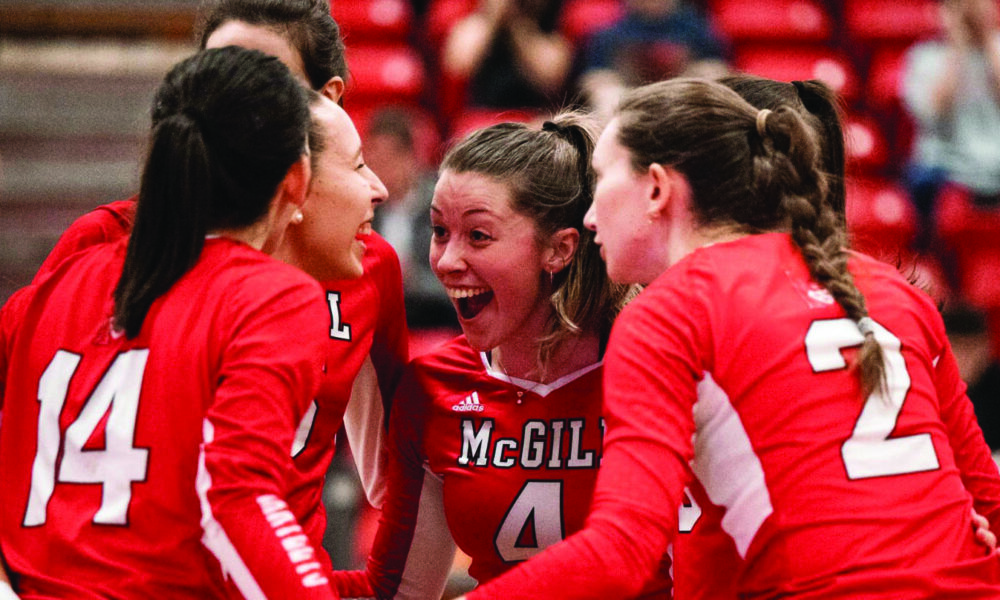
On Feb. 5, McGill women’s volleyball (10–5) hosted the Université du Québec à Trois-Rivières (UQTR) Patriotes (2–13) in front of a lively crowd for their Black History Month game. The Martlets found themselves down by a set twice during the match but battled back for an ultimate  3–2 victory over a sneaky Patriotes team. 

Despite sitting at the bottom of the league, UQTR started the first set on the front foot, racing out to a 5-1 lead due, in part, to a pair of McGill misplays. The Martlets quickly recovered, however, and tied the game thanks to superb blocking and attacking from fifth-year middle-blocker Charlene Robitaille and fourth-year right-side hitter Clara Poiré. Robitaille and Poiré continued to command the Martlets’ defence throughout the set, but UQTR capitalized on offensive errors to take the first set 25-21. 

The second set played out similarly to the first, as UQTR held a narrow lead over the Martlets early on. Poiré and Robitaille continued their stellar play and received some much-needed offensive help from fourth-year power hitter Victoria Iannotti, who hammered multiple spikes past the Patriotes’ defence. The Martlets finally pulled away from UQTR late in the set when second-year setter Charlotte Chouinard-Laliberté followed up a deadly spike with an ace, helping McGill claim the set 25-20. 

The Martlets failed to build on their momentum during the third set, as both teams followed up highlight-worthy plays with unforced errors. McGill’s defensive play improved significantly from the first two sets thanks to third-year forward Olivia Krishnan, but were ultimately overpowered by the Patriotes’ offence, who took the set 25-20 to restore their lead. 

Faced with the prospect of a must-win set, the Martlets entered the fourth with a newfound energy and looked like a completely different team. Chouinard-Laliberté and Krishnan made a number of crucial digs and Poiré hit back-to-back aces as McGill jumped into a 6-0 lead. UQTR laboured to close the gap, but McGill continued to pile on the pressure on both sides of the net. 

Fourth-year power-hitter Melanie Dormann came into the game halfway through the set and led the Martlets on a 9-1 run, putting them up 19-11. UQTR fought back hard and closed the gap to three points, but a massive spike from Poiré killed their momentum, and McGill took the set 25-21—tying the match at two sets a piece. 

“We are a team that can adapt [.…] We made the adjustments,” head coach Rachèle Béliveau said about the team’s fourth set performance in an interview with The McGill Tribune. “It took us a while to find the solution, but we eventually got it.”

The Martlets proved they did indeed have the solution during the decisive fifth set, as they outplayed UQTR offensively and defensively. UQTR kept it close early on, but an ace from Robitaille and a kill from Iannotti helped the Martlets pull away. Poiré then scored on three consecutive possessions as the Martlets took the set 15-9 and claimed a 3–2 victory in a true team effort.  

“Our team’s depth has been really important,” third-year middle blocker Erin Keating said. “We’ve had injuries at a lot of positions, so I think it’s a testament to how important our depth is that we can go out […] and have absolutely great days.”

Béliveau emphasized the need to stay focused heading into the final stretch of the season. 

“I think sometimes we focus too much on the result instead of just being in the moment and playing the game point by point [.…] We need one more win to make sure we are in the playoffs.”

The Martlets continue their season against Laval (8–7) on Feb. 10 and will look to keep their momentum heading into the postseason. 

Moment of the Game: 

Clara Poiré scored off two spikes and a block on consecutive possessions late in the fifth set to all but end the match. 

Stat Corner: 

Seven Martlets players recorded multiple kills, with three players notching at least 10.  

Quotable:

“We practice serving a lot in our practices. It’s really important because the offence on the other side is struggling after that.” –Second-year setter Charlotte Chouinard-Laliberté on the importance of serving

Arts & Entertainment, Theatre

‘Ithacan Idol Presents: The Odyssey’ vibrantly reimagines the classic tale

On Feb. 2, audiences at Théâtre Sainte-Catherine attended the opening night of Ithacan Idol Presents: The Odyssey, this year’s rendition of the McGill Classics Play. Since 2011, the McGill Classics Play program has showcased annual student-led English performances of ancient Greek and Latin texts, in addition to offering public lectures from guest speakers and free workshops for the community. 

In 2023’s installment of the theatrical tradition, directors Audrey Michel and Emma Weiser adapted the classic Greek epic The Odyssey into a spunky, fun, and subversive game show that asks, “Who is Odysseus?

Set amid Odysseus’s (Gabrielle Gaston, U3 Arts) travels away from home, the play centres around his loving wife, Penelope’s (Fiona Vail, U3 Arts) staging of the Ithacan Idol: A competition in which contestants perform their own renditions of Odysseus’s story to prove who knows the epic hero best. The show’s open-ended nature allows every contestant to shine in their own unique ways, each showing off a different school of thought used to dissect The Odyssey throughout history. 

From the Victorian era to modern fan fiction, the cast is replete with colourful caricatures of each method. Percy (El Bush, U2 Arts) proclaims the heroism of both Odysseus and football. Mabel (Zeynep Alsancak, U2 Science) taps into the artistic sensuality of his adulterous affairs, much to Penelope’s chagrin. Charlie (Charlie Gagnon, U2 Arts) expresses the beauty in the epic hero’s humanity. Lexi (Maddie Butler, U3 Arts) retells Circe’s side of the story with heaps of confidence and an affinity for self-promotion. Lastly, Georgie (Théa Sebaaly, U0 Arts) critiques Odysseus’s colonial impact. 

As the contestants repeatedly argue over which perspective is correct, each interpretation’s strengths and shortcomings come to light. While Charlie protests a critique of Odysseus that denies him the ability to make mistakes, Georgie counters by pointing out his disturbing treatment of Polyphemus (Théa Sebaaly, U0 Arts) that mirrors settler colonialism. Among important debates about interpreting historical figures with a modern sensibility, audiences are treated to hilarious bits and quips, including Lexi’s references to online culture and the reimagination of Odysseus’s crew as a gaggle of frat boys. In a post-show talkback, Michel explained the intent behind the decision to balance each perspective. 

“I think what was very important to us is not putting one reception of the Odyssey above the others, in a sense,” Michel said. “All are important, and all are important to see together, but also, all are incomplete.”

Penelope stands as the character with perhaps the most complete story arc. While many of the contestants remain somewhat tied to the caricatured qualities of their era’s interpretation style, Penelope’s upbeat, confident demeanour noticeably fades over the course of the two acts as Odysseus’ flaws are put on full display. Michel and Weiser focused significantly on Penelope’s development, which culminates in an effective emotional monologue that showcases the Ithacan queen in a raw, vulnerable light. 

When discussing their motivation to dissect The Odyssey in this year’s performance during the play’s talkback, Weiser expressed a feeling of being “haunted” by Odysseus: “He has been interpreted and reinterpreted so many times throughout literary history that we just knew we wanted to do something to kind of showcase that slipperiness of his.” 

The play’s centring of Penelope and its highlighting of The Odyssey’s various interpretations cleverly produces an introspective on the work’s long history of reception and adaptation. Complete with eccentric personas, clever reimaginations of supporting characters, and well-written monologues, Ithacan Idol Presents: The Odyssey provides a unique educational deep-dive into an iconic hero.

Ithacan Idol Presents: The Odyssey will complete its final performances on Feb. 9 and 10 at the Théâtre Sainte-Catherine, both at 7 p.m. Tickets are available online. On Feb. 10, at 2:30 p.m., the accompanying McGill Classics Play Talk will take place in Leacock 808.

Behind the Bench, Sports

Maternity in sports must be brought into modernity

The past decade has seen remarkable progress in protections for pregnant athletes. In 2020, FIFA and the Women’s National Basketball League (WNBA) introduced mandatory paid maternity leave. The Premier Hockey Federation (PHF) also has paid maternity leave and maintains that no player can be released from their team due to pregnancy. 

These protections, however, are not enough. Many players who get pregnant see their lives and careers permanently altered by mistreatment from both teams and sponsors alike. 

Sara Björk Gunnarsdóttir, a former midfielder on the Olympique Lyonnais’s women’s team (Lyon), wrote a piece for The Players’ Tribune outlining the mistreatment she faced from the French club throughout her pregnancy. The club purposely withheld her salary and did not provide her with any form of support. 

Gunnarsdóttir sued Lyon through the Fédération Internationale des Associations des Footballeurs Professionnels . Despite winning the lawsuit and having the club pay her lost salary in full, the move illustrated that even when the necessary rules and regulations are in place, players are still forced to fight for financial security. 

Gunnarsdótir’s mistreatment is, unfortunately, not an isolated incident. Athletes who become pregnant are regularly cast aside and treated like pariahs by their clubs and sponsors, who act as though pregnancy marks the end of an athlete’s career. 

Track athletes Allyson Felix and Alysia Montaño both wrote essays for The New York Times exploring the mistreatment they dealt with at the hands of one of their sponsors, Nike, when the company learned of their respective pregnancies. For Felix, they proposed a 70 per cent pay cut when renegotiating her contract, while Nike elected to put Montaño’s contract on hold entirely. 

With salaries for women athletes often being unsustainable, sponsorships are vital to their ability to compete at the professional level. The treatment Felix and Montaño endured at the hands of Nike reflects the sports world’s hypocrisy towards pregnant women. Pregnant athletes are celebrated in public as superheroes by clubs and sponsors but treated as disposable behind the scenes. 

In 2021, Nike released an advertisement celebrating the toughest athletes of all: Mothers. The ad depicted various pregnant people doing physical activity and branding them as the epitome of athleticism. The company gets to directly profit off the promotion of pregnant athletes while simultaneously offering dehumanizing pay cuts to the pregnant athletes they sponsor. 

The insincerity of clubs and sponsors directly impairs the physical and mental health of athletes who are expecting. Often, a sponsorship renewal is dangled in front of pregnant athletes on the condition that they get back to their pre-pregnancy fitness level as soon as possible.

The precarity brought about by the stigmatization of pregnancy within sports is not only career-threatening—it can be life-threatening as well. Kara Goucher, an American long-distance runner and Olympic silver-medallist, exposed herself to severe health risks due to over-exercising after her high-risk pregnancy because Nike told her they could renew her contract if they saw satisfactory results from her during races. 

As seen in the case of Gunnarsdótir, even when regulations exist to protect athletes, clubs will still try to take advantage of them. Pregnant athletes cannot risk exposing themselves to long-term physical or mental health problems for the sake of abusive clubs and sponsors. Not only does this affect the trajectory and health of their pregnancy, but it can also create long-lasting problems for their future athletic careers. 

If clubs and sponsors want to see athletes in their greatest physical shape after pregnancy, they need to start taking care of them during those nine months. Rather than piling on undue emotional stress, athletes should be provided with a variety of resources and support by their clubs and sponsors, who have a duty of care toward them. Athletes are human beings who deserve to be treated with dignity and respect, not simply toys that can be thrown away if they are not deemed bankable.

Read the latest issue

Read the latest issue