


Latest News

Features

It’s a lot, and it’s honest work

I don’t remember when I first learned about the existence of sex work. Certainly, I learned about sex at some point in a middle-school classroom, probably among a group of snickering teens. Yet the idea of sex as a job did not exist in my mind until cinematic depictions introduced me to the stereotypical image of a sex worker: A woman in the night, heavily made up, dressed up in provocative clothing, standing at the corners of dark streets and getting into strangers’ cars. At the time, I didn’t see this as work. I saw what she did as a shameful, criminal act;, almost a threat to society. Because I believed that sex work was not an “admirable” profession, I did not see it as a profession at all. It was incongruent with my perception of how a job should be. It took the longer portion of my life to understand that no matter my opinions on the task itself, sex work is real work. 

The moral status of sex work has long been debated, both by a sex-conservative establishment and revolutionary feminists. Is it sex? Is it work? Can it be both? These are questions that have divided feminist circles for the last century. Some feminists, whom critics accuse of participating in “carceral feminism,” advocate for increasing legal penalties. For them, sex work and sex trafficking live on the same spectrum of degradation and exploitation. Many carceral feminists, like the radical feminist Catherine MacKinnon, or the anti-prostitution advocate Julie Bindel, believe that sex work should be outlawed altogether, with the ultimate goal of abolition. Some advocate for harsher prison sentences for those selling sexual services, even if the services are their own, in an effort to completely eliminate sexual labour. 

Clearly, there are problems with this framework. But on the other hand, critics of carceral feminism can sometimes veer into a romanticized version of sex work—one in which exploitation is notnever a factor. In the book //Revolting Prostitutes: The Fight for Sex Workers Rights//, activists and sex workers Juno Mac and Molly Smith argue that this philosophical binary creates two inverse images of sex workers: The “happy hooker,” an empowered, often young, white woman who participates in sex work as a form of liberation and autonomy, versus the young girl, stolen from her bed in the middle of the night and forced into sex trafficking. Ultimately, these two characters form a reductive dichotomy of sexual labour. The first image ignores the realities of migrant women, for instance, who are coerced or threatened into exploitative sexual labour because of their potentially unstable immigration status. The second image paints all sex workers as helpless victims and strips them of their autonomy. The truth of the matter is that there is no one kind of sex work. Safe and well-compensated sex workers exist, as do unsafe and worried sex workers who exist in volatile spaces with poor working conditions. 

Sex work is what McGill law professor Angela Campbell calls a “morally ambiguous” profession. As she wrote in her 2013 book, //Sister Wives, Surrogates and Sex Workers: Outlaws by Choice?//, prevailing perceptions of sex work are dominated by a choice-coercion binary.

“I think we think of people as enlightened or as exploited and subject to [societal] pressures,” Campbell said. But, she added, “Any of us can be subject to forces that feel coercive.”

Whether or not something is coercive depends on who you ask. To those with the privilege of a secure, legally unambiguous job, the complex choice to enter sex work can look like a product of exploitation and restriction. But Campbell pointed out that activities deemed degrading by some, like selling services on the street, can be viewed entirely differently by those actually working.

“There are people who appear to be in circumstances that are very limiting, when in fact they exercise incredible resilience and resistance in their own communities,” Campbell said.

At least in some ways, sex work has become more normalized in recent years. Nathan*’s path into sex work began during the pandemic. He explained that returning to his home country of Malaysia with a schedule full of online classes presented him with a newfound amount of free time.

“Everything was up in the air, school became ridiculously easy and all of a sudden I had all this time,” Nathan said. “A pimp in Malaysia reached out through my Instagram […] and asked if I’d be interested in doing this and I thought ‘Why not?’ I had nothing to lose if I tried it out. If I like it, then it’s money.”

For Nathan, sex work tends to be transactional, rather than something sexually fulfilling for the service provider.

“When we have sex with our clients, it’s a service in exchange for something else,” Nathan said. “You’re offering something that you wouldn’t normally do and you’re doing it for the perks, not for the pleasure [….] When you really think about it, what’s the difference between sex work and just giving somebody a regular massage?”

But, of course, the two professions aren’t the same in the eyes of the law. “[By] taking it one step further and making it an erotic massage, suddenly it’s sex work and it’s illegal,” he added.

Despite its history of being stifled and criminalized, sex work remains one of the oldest professions in the world. In Canada, the history of sex work legislation is impressively convoluted and ambiguous. The first recorded sex work laws were introduced in Nova Scotia in 1759, but the legislation was centred on removing “vagrants”—anyone considered undesirable—from the street. The real legislative history began after the Canadian Confederation was formed in 1867, when these vagrancy laws were combined in the Canadian Criminal Code with more sweeping laws that forbade brothels and pimps from employing women. Since then, legislators have expanded the definitions of criminal conduct; by 1985, the Parliament passed a law that barred public communication for the purposes of “prostitution.” Finally, in 2014, after a Supreme Court overruling of previous sex work laws, Canada implemented Bill C-36. This bill followed the lines of the Nordic Model framework, meaning that the purchase—but not the selling—of sex is illegal.

On the surface, the Nordic model seems like the ideal compromise for both sex work critics and advocates: Punish the buyer, but not the seller; protect the woman, arrest the man. But although the Nordic model has been hailed by many as the ultimate fix to sex work legislation, it only increases financial precarity for sex workers. If one half of the transaction is outlawed, how is a sex worker supposed to find the means to live? The Nordic model criminalizes a central the entire goal of sex work—the compensation. Thus, even though the selling of sex is not illegal, sex work falls into a grey category of illegal occupations. Secrecy is incentivized in this model, since a sex worker who exposes an abusive client to arrest risks losing income. The ultimate result is that sex workers are at much higher risks of experiencing labour violations. 

More recently, advocates for sex work have moved away from the word “legalization” toward the word “decriminalization.” The distinction is crucial. Legalization typically involves the regulation of certain streams of sex work. However, exactly what kind of sex work is allowed is up to legislators, who can potentially criminalize many categories of sex work. On the flip side, decriminalization implies fully removing sex work from the list of criminal offences and treating sex work just like any other type of work. This would open the doors to labour rights for sex workers, as their form of employment would fall under the Canada Labour Code. 

“When sex work is viewed as criminal, sex workers’ clients and other third parties are constantly trying to evade law enforcement, and when you’re evading law enforcement, it means that you’re in isolation, you can’t access services you need,” explained Jenn Clamen. “It means you don’t tell people you’re working in the industry.”

Clamen is the National Coordinator for the Canadian Alliance for Sex Work Law Reform (CASWLR) have been working nonstop to help provide the support and resources that sex workers need. The organization formed in 2012 in the middle of a constitutional challenge called the Bedford case. The case was initiated by Terri Jean Bedford, a Canadian dominatrix, initiated the now historic 2007 lawsuit, who arguinged that Canada’s anti-prostitution laws were unconstitutional in a historic 2007 lawsuit. After a seven-day trial in 2009 and a year of judicial deliberation, Bedford and her two colleagues, Valerie Scott and Amy Lebovitch, won the suit in its entirety, and it was their work that led to the eventual Supreme Court decision to overturn previous sex work laws in 2013.
Since we continue to live in a country where sex work is criminalized, organizations like the Canadian Alliance for Sex Work Law Reform (CASWLR) have been working nonstop to help provide the support and resources that sex workers need. Despite the fact that the selling of sex is not criminalized, sex workers continue to fear the police, and rightly so—over-policing of sex workers remains a critical issue. And uUltimately

Behind the Bench, Sports

McGill must stop resisting before Athletics ceases existing

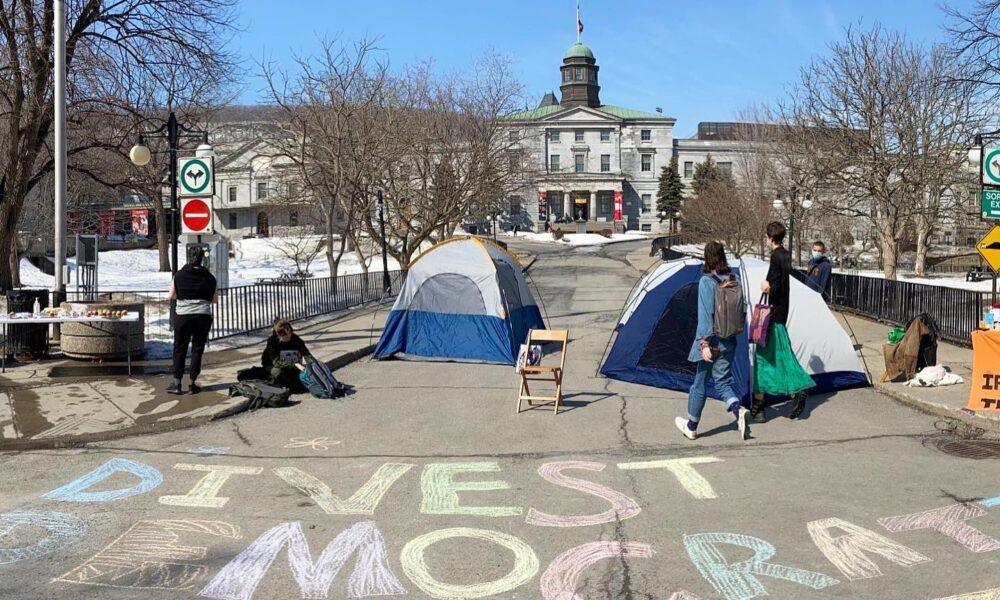
As another school year draws to a close, it offers an opportunity to reflect on the areas of the McGill community that have evolved—as well as those that have stayed tragically stagnant. A year marked by the return to in-person classes, sports games, social events, and cycles of relaxed restrictions followed by lockdowns has brought a whirlwind of changes to student life. However, for Divest McGill, the year has looked frustratingly similar to every other: Strong student support and protests backing their fight for change, and those in power refusing to budge. 

To make matters worse, this year has also shown that the administration’s refusal to divest is beginning to form cracks across other areas of student life at McGill. Their unwillingness to compromise is having unintended consequences for students, including in areas such as McGill Athletics and Recreation (A&R). 

Divest McGill and McGill Athletics are, on the surface, two organizations few would guess are interconnected. But due to student tactics to get the administration to divest, compounded by the McGill administration’s unwavering stance, A&R is getting hit where it hurts: The balance sheet.

In Winter 2019, the Students’ Society of McGill University (SSMU) Legislative Council put the renewal of the Athletics Facility Improvement Fee to referendum. The 10-dollar fee created in 2004 went toward maintaining and improving the facilities, and the renewal would have funded air conditioning for the fieldhouse and locker rooms. However, since the fee renewal came amidst the #ChangeTheName movement, a counter ‘No’ campaign was heavily supported by students, including Indigenous students, who pointed out that approving this fee would allow McGill to continue to fund their programs under a racist team name and mascot. The referendum question ultimately failed with 58 per cent voting ‘No,’ and the Athletics Facility Improvement fee was removed from student fees for the next five years. 

“This means that there is a loss of $500,000 per semester for the Athletics department,” Evelyn Silverson-Tokatlidis, Varsity Council president, said in an interview with The McGill Tribune

As the administration dragged their feet on changing the varsity team name, the loss was compounded by SSMU identifying blocking ancillary fees as an effective way to apply pressure on the university to divest. As a result, the Legislative Council passed a Policy on Moratorium on McGill fees until Fossil Fuel Divestment. This meant that for the next five years, no new ancillary fees—which serve programs such as the McGill Writing Centre and the World University Services Canada Refugee Program, as well as  A&R—could be added to student’s bills until McGill divests, with the Athletics Facility Improvement fee locked on the outside. 

A total of $1,200,000 would be withheld from Athletics and Recreation over the next five semesters. 

Since the university does not provide funding for the facilities of A&R, the implications of this moratorium has wide-ranging impacts. Facility upgrades such as air conditioning in the fieldhouse and gym that would benefit all students, not just athletes, have been pushed back. Longer-term projects, such as the renovation of the locker rooms, fieldhouse resurfacing, and turf improvements all have uncertain timelines because of inadequate funds.

“Almost a quarter of the student body uses McGill athletics facilities,” Silverson-Tokatlidis said. “The refusal to divest by McGill is impacting the quality of these facilities for a huge amount of the student population.”

In an interview with the Tribune, Joseph,* a representative from Divest McGill and a varsity athlete, explained how the facilities are in dire need of improvement, making it harder for them to train and enjoy their time as a student athlete.

“We understand that there are updates to the Athletics facilities that are urgent. My coach talks about them and how much money needs to be put into it,” they said. “Being an athlete has created my identity, it has made me who I am. But the fact that McGill is refusing to divest means they are refusing to provide the services the athlete community needs. Everyone needs to get behind divestment.”

On Feb. 17, 2022, the Legislative Council met to discuss, amongst other things, putting the Athletics Facility Improvement fee back up to vote in the Winter 2022 referendum. The motion was postponed indefinitely. The current SSMU representative for Athletics, Sêdami-Habib Djossou, went into the meeting with the goal of getting the fee reinstated.

“My main aim was to make an amendment to the moratorium, not remove it,” he said. “The amendment would make an exception to the Athletics Facilities Fee because of the intense impact the moratorium is having on Athletics and Recreation. The renovations are essential, and we may have to discontinue some services in order to afford them.”

The amendment argued that the self-funded A&R program is being financially targeted due to McGill’s refusal to divest, a decision that they have no control over.

“If I am honest, the question period was really tense,” Djossou continued. “There was a huge concern about what the amendment would do. A member of Divest McGill said that if we allow the amendment to go through it will push the message that we don’t care that much. It will undermine all the efforts made so far.”

Joseph, who also attended the meeting, was frustrated that a student group and Athletics were positioned on opposite sides of the issue. 

“It felt as though the discussion was being framed as Athletics against Divest,” they said. “It was very difficult for me, being attached to both. Ultimately, the Divest [argument] was that it would ruin the momentum of the campaign.”

With the issue yet again at a standstill, it is easy for both sides in the Legislative Council debate to point fingers at one another—and this would certainly be convenient for the McGill administration. The administration’s refusal to divest is pitting students against each other, when energies should be focussed on holding those with power to account.  The more energy spent by students fighting amongst themselves, the less is spent on collective action.

However, both groups are keen to show that the issue is not with each other. The moratorium does not represent one group of students seeking to worsen the university experience for another group. Instead, it represents a blatant refusal from the administration to ethically invest its money, with students ultimately shouldering the cost. Universities all over the country, including Concordia, UQAM, University of Toronto, uOttawa, University of British Columbia, and many more, have divested, or at least pledged to—. What, then, is McGill’s excuse?

The Athletics Facility Improvement fee will not be reinstated this year after the motion was postponed, and it will take nothing less than divestment for the student group to lift the moratorium. At this point, any amendment to the moratorium will be seen as a victory for the administration. With the clock ticking for both the Athletics and Recreation budget as well as our planet, McGill needs to make the smart choice to divest from fossil fuels, and invest in the future of our athletes.

*Joseph’s name has been changed to preserve their anonymity.

Behind the Bench, Sports

When money trumps morals: Do human rights have a place in the professional sports world?

On Feb. 25, the Fédération Internationale de l’Automobile (FIA), the governing agency of Formula 1, announced its decision to cancel the Russian Grand Prix. The decision came after concern from both stakeholders and drivers following the Russian invasion of Ukraine. The FIA also announced that Russian and Belarusian drivers would only be allowed to compete under a neutral flag, while Russian and Belarusian members of FIA commissions would have to temporarily step down from their positions. 

Formula 1’s response to Russia’s invasion of Ukraine is not an isolated case, but rather a reflection of a broader movement observed across the sports world. A number of international organizations either cancelled events to be hosted in Russia or prohibited Russian and Belarusian athletes from competing. For example, FIFA and UEFA have announced that they were suspending all Russian international and club teams, preventing them from playing in the 2022 World Cup, which Russia hosted in 2018. The International Volleyball Federation also cancelled Russia’s hosting of the men’s 2022 Volleyball World Championship.

This universal condemnation of Russia’s war crimes by the sports world is honourable. It reflects a willingness to publicly oppose the Russian government, and it demonstrates to fans across the world that there are tangible, even financial, consequences when a state violates human rights. From this, a new question arises: Why is the sports world denouncing Russia’s actions while they overlook human rights abuses in other countries?

The sports world’s complicity in human rights violations are not only errors of the past. On the contrary, sports organizations often ignore the atrocities of various states to maintain lucrative contracts. FIFA is set to hold the World Cup in Qatar, despite numerous reports of human rights abuses linked to the construction of both the arenas and stands needed to host the tournament. Migrant workers have reported working without pay, having their passports stolen by officers, and being denied the right to leave the premises. Noah Edmunds, a U2 student studying political science and an avid soccer fan, told The McGill Tribune that he believes that FIFA’s decision to host the World Cup in Qatar is motivated by financial reasons only.

“I think that by holding the World Cup in Qatar, FIFA is blatantly ignoring the signs that Qatar has a poor human rights record,” Edmunds said. “I think that there are a lot of countries that are more appropriate to host the World Cup [….] I think that this is an attempt by both parties to increase their profits. If FIFA really cared to promote a fair and equal society for the game of football, it would be wise to avoid these […] countries.”

It is crucial to underline that FIFA is not only actively supporting these labour abuses but is also creating a demand for it. FIFA’s lack of concern truly shows that in the world of sports, money trumps morality.

Another recent case of blatant disregard for human rights has been the 2022 Winter Olympics in Beijing. The International Olympic Committee (IOC) maintained the location of the event, despite the country’s ongoing genocide targeting the Uyghur Muslim population. The genocide has been publicly recognized by countries including the U.S., Canada, and France. Despite global knowledge of the horrors happening in Xinjiang at the hands of the Chinese government, the Winter Olympics carried on. Elliott Rozental, U0 Engineering, believes that the IOC’s refusal to acknowledge the gravity of China’s actions makes them complicit in human rights abuses. 

“I think we should stop holding the biggest sports competition in countries that violate human rights. I think that doing nothing is like allowing these acts,” Rozental said. “I agree that it may not stop them directly, but it is something we have the power to do and it’s already a first step toward progress. I think that the organizers and leaders of sport events like the Olympics should stop turning a blind eye to their horrible acts, and sanction the countries at fault. ”

Similarly, the FIA was one of the first organizations to denounce Russia’s actions and remove the Russian Grand Prix. Yet, Western sports organizations seem to only be concerned about human rights violations when white or European people are suffering, while simultaneously exploiting what value they can from Middle Eastern countries and ignoring the abuses faced by the population. 

The Formula 1 calendar routinely hosts races in countries whose governments have perpetrated human rights abuses against their own citizens, such as Bahrain and Qatar. However, what is considered a human rights violation in one country, such as suppression of freedom, is often observed across other countries without particular concern. For example, the U.S. failed to respect its domestic human rights agenda, but there has been no controversy regarding their hosting of the Austin Grand Prix. The U.S. also backs the Saudi-led coalition that has killed hundreds of thousands of Yemeni civilians—and the FIA continues to host races in both countries. 

The FIA’s lack of concern for some of these atrocities demonstrates their hypocrisy: They only seem to care about this issue when it benefits them. Juliette Barlier, U1 Arts, explained how the publicity surrounding Formula 1 is almost always only positive.

“In regards to Formula 1, I’ve only ever heard good things about it,” Barlier said. “But the fact that I have no idea that it’s being held in countries with very serious human rights violations just shows how little it’s talked about and how much these violations are covered up, while the sport is being praised.”

The sports world’s recent sanctions against Russia have completely upset the narrative regarding the usual response to questions of human rights in sports. A widely accepted take among stakeholders in pro sports is that sports are for entertainment, not politics. Proponents of this view often argue that sports organizations should not be arbiters of justice and that it is not their duty to punish human rights violations. Some also say that expecting organizations to make decisions of this magnitude reflects a Manichean worldview, whereby all actions are labelled as either “good” or “bad.” 

However, the lightning speed with which sports organizations worldwide have sanctioned Russia is indicative that there is a possibility for change. Organizations have shown that they can impart a judgment on what is right and what is wrong. It is now of crucial importance that sports fans look to the world’s reaction to Russia to continue advocating for better attention to human rights in sports.

When sports organizations publicly make a profit by condoning abuse in the countries where they choose to hold events, they are telling their fans that they prioritize money over the lives and freedoms of others. Fans should also hold themselves accountable—people should not have their fundamental human rights violated just for a fan to see their country win the World Cup. It may be too hopeful to expect professional sports to change entirely, but the worldwide reaction to the Russian war shows that it can be done.

Art, Arts & Entertainment

Visual artist Sampson McFerrin gives an intimate presentation of his favourite work yet

Sampson McFerrin, Montreal-based visual artist and Print Media student, opened his Checarré exhibition the first weekend of April, issuing a display of his artistic adroitness in all its blossoming splendour. Providing a candid presentation of his maturing technique, Checarré features a multiplicity of art forms, ranging from oil to acrylic, inkjet to photopolymer, photography to sketch work—all arranged in a striking visual concoction embellishing the brick-walls of McFerrin’s Montreal apartment.

(Karthikeya Gautam / The McGill Tribune)

In an interview with The McGill Tribune, McFerrin acknowledged the lack of uniformity in his artwork, noting that his aesthetic is still evolving. His aim with Checarré is to open his work to public opinion by taking a creative backseat. McFerrin engages with this goal through the exhibition’s name, a witty triple-entendre itself. 

Checarré is a mix of two words,” McFerrin said. “Firstly, it is ‘checking-in’ to see where my art is at right now, where it has been, and where it is headed to in the future. The second word, carrée, is French for square. A lot of my works have ended up in squares, despite having initially framed them differently. My brother added a further note to that—chez moi. Because the exhibition is at my apartment.”

McFerrin does not cite any single individual for inspiring this creative enterprise. Instead, he credits his experiences abroad over the years as a major driver behind his work.  

“I have spent over three years of my life on a bike, sleeping in a tent, in almost 30 countries around the world,” McFerrin said. “That experience has made me who I am, given me the belief systems that I have, along with the flexible mindset I approach every day with.”

(Karthikeya Gautam / The McGill Tribune)

McFerrin places value on a piece of art by following a unique code, wherein an artwork’s worth is extracted from a quartet of interconnected sources—the aesthetic value the artist derives from it, the aesthetic value the audience derives from it, whether it has a personal connection with the artist, and whether it has a personal connection with the audience. In creating a piece, he tries to achieve all four, as he believes them all to be of equal importance. 

“To spark dialogue or conversation is [an] inspiration for me,” McFerrin said. “Discussing my pieces with others, so that it’s not just me in the process, is what’s important. A piece can just grow by others’ involvement in it.”

(Karthikeya Gautam / The McGill Tribune)

Rain Pants Party, a 36×36-inch acrylic made by McFerrin, is not only his personal favourite, but also a piece he believes fulfills all four sources of value.

“When my brother, my best friend, and I were biking across Canada, there was a particular day when it was raining heavily outside, and we were wearing our rain pants,” McFerrin explained. “The farmers we were staying with said that we can cook our meal and stay dry in their barn. So, we took off our raincoats, sitting there in the barn in our rain pants, listening to tunes and having fun. That’s when we said, it’s a rain pants party.”  

While McFerrin has no galas or exhibits planned for the near future, he is optimistic about spreading his work and message as his artistic vision progresses. 

The second opening of Checarré will occur on April 10 at 3546 Avenue Lorne, Apartment #6, from 1 p.m. to 8 p.m. 

Science & Technology

War: The enemy of air, land, and sea

On Feb. 24, Russian troops launched an illegal invasion of Ukraine that rapidly escalated into full-blown war. On televisions and on the front pages of newspapers, the world watched as families were split apart on crowded train platforms and cities were leveled by bomb blasts. Ukrainian civilians faced the harrowing decision of whether to flee or fight. 

But while the political and social aspects of Ukraine’s humanitarian crisis have garnered the lion’s share of media attention over the past two months, there is a less obvious, but no less insidious, threat to Eastern Europe that few are talking about: Irreparable environmental damage. 

Too often, pollution, destruction of infrastructure, and biodiversity loss are seen as unfortunate, but inevitable, costs of warfare whose alleviation should come secondary to humanitarian aid. However, no understanding of the human costs of war is complete without also considering the environmental costs.

“People still view the protection of civilians and the protection of the environment as somehow separate from one another, when instead they are two sides of the same coin,” wrote Doug Weir, founder of the Conflict and Environment Observatory, in an email to The McGill Tribune. Weir’s observatory is a not-for-profit research organization that has been reporting on the intersection of warfare and environmental damage since 2018.

Weir described how Putin’s army has indiscriminately bombed industrial zones in Ukraine, releasing toxic fuels and waste into the air, water, and soil. This contamination will present health threats for decades to come. Coal, for example, is produced across Ukraine, and the subsequent release of fly ash from damaged production facilities can cause asthma, cancer, and neurological disorders in humans under direct exposure or consumption.

Even more troubling is Russia’s occupation of nuclear sites such as Chernobyl and Zaporizhzhia. In the days following Russia’s occupation of Chernobyl, public monitors showed spikes in radiation readings around the site’s buildings before Russian soldiers cut off access to the plant’s information systems. Some speculate that controlling potentially lethal nuclear sites is part of a long-term Russian military strategy.

Unfortunately, Russia’s tactics are nothing new. As long as there has been human conflict, the environment has been both a victim and a weapon of war. Ancient Assyrian texts reference victors salting the fields of their enemies to prevent future crops from ever taking root even after the conflict has ended. 

Political scientists have long studied these tactics, but not always through a purely environmental lens. Daniel Douek, a professor in McGill’s Department of Political Science, teaches courses on African politics and Middle Eastern foreign policy. In an interview with the Tribune, he detailed examples of devastating environmental damage in other wars. In Iraq, for instance, Saddam Hussein responded to dissent from Marsh Arabs by cutting off their water supply, forcing 85 per cent of the population to flee their homes and migrate elsewhere.

“That wasn’t a strategy of conquest or subjugation so much, it’s just a strategy of spitefulness,” Douek said.

He sees similarities between Hussein’s actions in Iraq and Putin’s occupation of nuclear zones.

“[Putin is] kind of intimating that he’s willing to target Chernobyl or target some of the other nuclear power plants, and thus release catastrophic radiation,” Douek said.

It is not only despotic dictators who resort to catastrophic environmental measures in times of conflict. During the Vietnam War, the U.S. military used Agent Orange, a chemical herbicide, around roads, cities, and agricultural areas in Vietnam, despite knowing that it causes physical disability and damage to the nervous, muscular, and cardiovascular systems. Thousands of civilians and U.S. soldiers are still dealing with the fallout today. 

Though Russia has not, and hopefully will not, use chemical weapons, the destruction of coal mines and nuclear power plants is likely to have long-lasting health effects, the likes of which are becoming apparent as reports surface of Russian soldiers suffering radiation poisoning due to the mismanagement of occupied nuclear plants.

Then, there’s the question of climate change, burning hot on everyone’s mind as the world edges closer to the UN’s 2050 deadline for net-zero emissions. 

Beyond the toxins released from jet fuel, explosions, and chemical weapons, armed conflict also contributes enormously to fossil fuel emissions. Since 2001, the U.S. military alone has emitted more than 1.2 billion tons of CO2, the same as entire countries such as Portugal or Denmark. And that’s just at the domestic level—the U.S. does not record or publish data on the emissions they produce overseas or on air missions, so the true number is much higher.

Despite the noted effects of war on the environment, some, including Chris Ragan, director of McGill’s Max Bell School of Public Policy, believe those effects should be understood in the context of broader societal structures.

“Climate change is a long-run problem,” Ragan said. “It is not fundamentally about war—it is not fundamentally about peace, for that matter. It is fundamentally about how our economies are structured, and in particular, the massive use of fossil fuels.” 

Though the emissions generated by war may not make or break the long-term environmental damage we’ve done to the planet, the resulting disruption to energy markets caused by sanctions against Russia could lead to new innovations in the energy sector.

“I actually think this moment, and hopefully it isn’t much longer than a moment, […] is going to spark a very serious rethink about our reliance on Russian oil and gas,” Ragan said.

No matter what the future holds for Ukraine, policy makers will need to decide what role the West will play in helping Ukrainians in their recovery. Ragan cited the need for a new kind of Marshall Plan, a reference to the U.S.-led financial and infrastructural rebuilding program that helped Europe recover from World War II. Though there’s a dearth of academic research surrounding war’s impact on the environment, there are few clear strategies for repairing urban or rural environments damaged during conflict.

Jon Unruh, a geography professor at McGill, specializes in migration, resettlement, and environmental change during times of conflict. Unruh is also one of few researchers who tackle the subject of conflict recovery through an explicitly environmental lens. It’s given him insight into the ways that human behaviour changes to inadvertently harm the environment during times of war.

“When very large numbers of people switch into a crisis livelihood, they do things that tend toward a very short-term decision making horizon [….] That’s a problem, because very short-term decision making in terms of one’s livelihood is always […] extracting from the environment,” Unruh said. 

Changing one’s fuel source from ordinary gasoline to wood is one example that, along with off-cycle crop harvesting, offers a short-term solution at the expense of the environment. For example, in temporary refugee camps, it’s common to use wood burning stoves using local materials because they are more accessible than natural gas or propane. However, this can deplete the surrounding area of resources.

In a world where 40 per cent of wars result from failed peace agreements, and where climate change will increase the risk of violent conflict, any recovery strategy that does not consider environmental recovery is doomed to fail. 

It’s unlikely that the damaging tactics of war will change anytime soon, but the way we respond to them can. Right now, world leaders face a challenge of daunting scale, but they also face an opportunity to chart a new course forward and to pioneer new strategies for conflict recovery that will allow humans and the environment to work in tandem.

A previous version of this article incorrectly stated that Russian forces had bombed over 500 industrial zones. In fact, there exist over 500 industrial zones in Ukraine, but not all of them have been bombed.

Know Your Athlete, Sports

Varsity highlights of the 2021-2022 season

(McGill Athletics)

Stephanie Desjardins (Martlets hockey, fifth-year)

“The season was challenging with the pandemic coming back at full swing right after the Christmas break. We fought adversity throughout the entire season with restrictions, practicing, and playing with masks. The girls fought hard physically and mentally for the last eight months and showed tremendous character and grit. I think my greatest memory this year is just being at the rink and being surrounded with amazing people every day who push you to become a better hockey player and person.” 

Matthew Beaudet (Redbirds track runner, second-year)

“My favourite moment this year was competing at the U Sports Cross Country championships. The atmosphere was great, with people cheering all along the course, and I was excited to run at this high level meet for the first time. The race itself was very difficult due to the hilly course, cold weather, and fast pace. I was aiming to finish top 10 at this race and I knew I could do it, but at the same time, a lot can go wrong in cross-country races. I started struggling and lost contact with the leaders at about 6.5 kilometres (out of eight kilometres) and started worrying that I was going to start dropping places rapidly, but then I heard one of my teammates’ dad tell me to relax and that no one was close behind me. That helped me regain composure and finish with a strong last kilometre to finish seventh.”

(Mathieu Belanger)
(Monique Francoeur)

Karl Hunger (Redbirds rugby captain, fourth-year)

“I think my most memorable varsity moment was the first game of the season where I got to share the field with my brother Brad. He scored the first try in McGill Redbirds history. We embraced almost halfway down the field. I vividly remember telling him I couldn’t let him go, or else I might burst into tears. As an older brother who couldn’t be outdone by his younger sibling, I scored two tries of my own that very same game. I remember my mom and dad being so proud of us both after the game. That is truly one of the greatest moments of my McGill rugby career.” 

(McGill Athletics)

Charlene Robitaille (Martlets volleyball captain, fourth-year)

“I know I won’t be very original, but my favourite moment is when we won the provincial at home, and when the whole team ran to hug our coach. [It was] the first time she won provincials in 30 years! It was 25-14 on the fourth set for us. I was already starting to cry a little bit on the court because I knew we were going to win […] We will for sure have the same objective to win another provincial championship and go back to the Canadians. We had the advantage of playing against really good teams last week, the girls from Canada West were extremely good, so we now know what we have to improve and focus on next year.”

Mika Chang (Martlets hockey forward, first-year)

“Getting to go to nationals was an incredible experience and what made it even more special was getting to go with the group we had. Having gone through so much adversity this year, with COVID outbreaks and general obstacles, [it] was something that […] brought us closer together. I think both on and off the ice, I’ve been able to step out of my comfort zone, which is something I’m proud of. It’s intimidating as a first year to join an incredibly talented group of new faces, but coming out of this year having developed on the ice and having created lifelong friendships is a huge win in itself.” 

(Marc St-Pierre)
(McGill Athletics)

Jamal Mayali (Redbirds basketball guard, fifth-year)

“My favourite moment was when we won the Quebec championship. It really was special to see all of us happy to achieve that and in the fashion we did it in [….] Adversity definitely was felt when the season was put to a halt earlier this year. It was really challenging because as a team we had a really good first semester and, at the time, that break may have put our momentum to a halt. However, we hit the ground running once the season was back up.”

Editorial, Opinion

The Church’s apology requires devoted action

On April 1, Pope Francis made a long-overdue apology to Indigenous peoples in Canada for the role Catholic leaders and administrators played in committing cultural genocide through the residential school system. The Pope called these leaders’ behaviour “deplorable” and asked for both God’s forgiveness and the forgiveness of Indigenous peoples for how Catholics wounded, abused, and disrespected Indigenous people’s identities, cultures, and spiritual values. Though his words serve as an important acknowledgement and indictment of the Church’s crimes, this apology is only one step toward reconciliation in Canada. Various Indigenous leaders have expressed both relief and concern in response, while also emphasizing that it is not their responsibility to accept it—rather, it is the Church’s responsibility to make good on their promise to actively redress the broad, historic, and enduring harm it inflicted. Repairing past wrongs requires substantive commitment to dismantling the Church’s doctrine that enabled, and continues to enable, Canadian settler colonialism. The impact of the Catholic Church’s apology can only be realized when it is accompanied by structural changes that place Indigenous humanity over absolving Catholic and Canadian guilt.

The Pope’s apology comes after decades of Indigenous advocacy and must be matched with the material demands Indigenous leaders have made. If the Catholic Church does not follow through on its promises, such as the $29-million payment for programs that benefit residential school survivors, the apology may look self-serving. At times, the Church appears to entertain the dangerous notion that restorative justice measures relitigate dark pasts at the expense of present struggles, but in reality, the past and present cannot be separated. Residential schools, led by Catholic organizations along with other Christian denominations, tore children from their families in order to “civilize” them and to legitimate Canadian rule over the land that belonged to generations of Indigenous people. The “schools” worked to eradicate Indigenous cultures, and were sites of state-sanctioned physical, sexual, emotional, and psychological abuse. Intergenerational trauma from these “schools” endures in various structural forms—from fractured families to poverty to houselessness to immense mental distress—all of which undermine Indigenous self-determination. As such, reparations in the form of a lump sum payment, while crucial, is not enough. 

Following the discovery of the initial 215 unmarked graves in Kamloops, Indigenous community leaders continue to search the sites of former residential schools. Investigators have found over 1,800 so far, but this number is rapidly increasing. Given the scale of this tragedy, any attempts to overcredit the Pope’s apology, however innocuous, should be put into perspective. No matter how thorough and apologetic the Pope’s words may seem, he must use his institutional power to accept and amplify current Indigenous struggles against the reprehensible crimes carried out at the hands of the Catholic Church.

Given how embedded the Catholic Church is throughout Canada and Quebec to this day, Canadians must remain resistant; the apology should only ground solidarity moving forward. This acknowledgement is not only a much-needed apology, but also a statement that allows activists to hold the Church accountable. The Church and Canada must unequivocally denounce the Doctrine of Discovery that Christian, European imperial powers used to justify their claims to ownership when conquering Indigenous land. To do so would be to repudiate a racist, long-standing doctrine and would also follow up on previous apologies Popes have made for Catholic sins. At the same time, Pope Francis and Catholics should not use this apology to salvage the Church’s optics and save face for its harmful actions around the globe.

Governments and church officials should follow Indigenous leaders’ demands by actively resisting and rethinking policies in Quebec. Catholic-influenced Quebec social welfare programs should be scrutinized when Catholic-run shelters, for example, can further marginalize Indigenous people. When a group of the Kanien’kehá:ka kahnistensera (Mohawk Mothers) suspect that there are unmarked graves under Royal Victoria Hospital and have taken McGill to court, students must stand in solidarity and remember that reconciliation is an uncomfortable process that requires everyone to confront McGill and Canada’s shameful history. The Pope’s trip to Canada, set for late July, is an opportunity for the Church to actively listen to those affected and to be held accountable. No one can remain passive in the face of persisting settler colonial injustice.

Arts & Entertainment, Pop Rhetoric

The enemies to lovers trope: Tried-and-true or time for something new?

From impassioned kisses in the rain to meet-cutes in high school hallways, romantic literature and entertainment have never failed to engage audiences through beloved clichés. One that continues to withstand the test of time is the enemies-to-lovers trope, in which two characters’ mutual hatred toward one another progressively transforms into feverish love. Boasting both a long record of positive receptions and a rocky history, this dynamic keeps us coming back for more through touching demonstrations of love’s resilience in spite of denial.

In the case of period pieces, the trope engages readers by placing familiar feelings in historical contexts, challenging the disconnect we often feel between our lived experiences and those of people from centuries past. The second season of Shonda Rhimes’s whimsical and provocative period drama Bridgerton, released on Netflix on March 25, centres around a hate-to-love storyline between Anthony Bridgerton (Jonathan Bailey) and Kate Sharma (Simone Ashley). Based on Julia Quinn’s eight-part book series of the same name, the show follows the large, wealthy Bridgerton family as they navigate London’s competitive seasons of Regency-era courtship. Through extravagant balls, romantic promenades, and passionate declarations of devotion, both verbal and physical, viewers witness each Bridgerton child find and express love in ways rarely, if ever, depicted in period pieces. 

The contrast between ardent displays of adoration and disgust within the Regency era’s stiff social rules of etiquette and formality has enraptured audiences for centuries, as demonstrated by the resonating power of Elizabeth Bennet and Mr. Darcy’s hate-turned-love relationship in Jane Austen’s Pride and Prejudice (1813). The enemies-to-lovers narrative functions effectively in period dramas as it shocks readers with an emotional aspect of the Regency era that was firmly suppressed by the upper class, and therefore rarely included in the epoch’s representation in media. Audiences are unable to look away from these period-era characters, as they are brought to life through outward expressions of the same emotions that we feel today. This relatability is not restricted to previous historical contexts: People often feel most connected to characters who are at their most vulnerable, regardless of the divide in life experiences.

However, the cliché’s “enemy” aspect can sometimes go too far. In some cases, this relationship trope is filled with disturbing demonstrations of loathing, before all is magically forgiven and the characters end up together—as is the case in the relationship between Claire (Molly Ringwald) and John Bender (Judd Nelson) in The Breakfast Club (1985). Although Claire and Bender eventually realize their feelings for one another, this resolution implicitly recontextualizes the string of mutual acts of hatred toward one another as “flirting.” At one point, Bender sexually assaults Claire, peering under her skirt and making her clearly uncomfortable. Films should demonstrate the persistence of love despite each characters’ initial resistance toward it without making characters minimize and forgive inexcusable actions, including sexual assault. The main flaw of the enemies-to-lovers storyline is thus its reluctance to hold characters accountable in favour of moving the plot forward.

Meanwhile, representations of 2SLGBTQIA+ couples fare no better under the trope. While the celebrated Netflix series Sex Education has received praise for its authenticity and inclusivity, the relationship between Eric (Ncuti Gatwa) and Adam (Connor Swindells), his former bully, has been criticized for perpetuating the idea that racialized and queer characters should forgive people who have abused and mistreated them for the sake of love. 

Nevertheless, we continue to feel the addictive comfort in watching love triumph over hate, especially considering the numerous ways different people and institutions try to place restrictions on who can love who, and how. Whether lovers are first enemies due to family rivalries (Romeo and Juliet (1597)), class divides (Titanic (1997)), or other forms of division, witnessing the heartwarming resilience of love in the face of hate momentarily restores our faith in humanity. 

Demand for enemies-to-lovers content shows no signs of disappearing any time soon. From TikTok’s fascination with Sally Thorne’s romance-novel-turned-movie The Hating Game, as well as Bridgerton’s newest season, viewers and readers alike continue to be captivated by the evolution from enmity to endearment. While many critics may be determined to hate it, if there’s anything that the trope has shown, love often follows closely behind.

McGill, News

MUNACA to vote on whether to strike following McGill’s proposal to reduce salary increases

McGill University’s Non-Academic Certified Association (MUNACA), a union that represents approximately 2,000 support staff employees, such as laboratory assistants and service representatives, will vote whether to go on strike on April 6. This is after McGill proposed measures that would decrease members’ pay increases that were negotiated in the previous collective agreement (CA). The previous CA expired in November 2018, and the two parties have yet to come to an agreement on a new one. The announcement to put a strike to vote comes amidst a strike by floor fellows, who are represented by the Association of McGill University Support Employees (AMUSE). 

MUNACA members receive two forms of salary increases. The first increase compensates for inflation. The second, called a step increase, is when employees do not get their full salary when they first get the job, instead agreeing to receive a 2.97 per cent increase yearly, capped at 12 years—when employees would reach the maximum salary set by the CA. McGill has proposed a reduction of the step increase to 1.97 per cent and a lower top salary. 

According to MUNACA representatives, the proposal would result in members earning less money per year, and step increases being eliminated for those who have reached the newly proposed top salary—even if they were scheduled to receive more according to the previous CA. McGill has stated that the pay decreases will allow the university to raise the base salary of lower-earning MUNACA members. Thomas Chalmers, MUNACA president, told The McGill Tribune that it was these measures that prompted MUNACA members to vote on a strike mandate. 

“The disrespect has to stop,” Chalmers said. “If not, then the ultimate tool we have is a strike mandate [….] It’s a misnomer that unions want to go on strike: They don’t. It’s disruptive, it’s difficult, but at times, and this is one of them, it’s the right thing to do, to stand up and say you can’t treat us like shit.”

Nancy Crowe, MUNACA vice-president labour relations, believes McGill’s justification—compromising certain MUNACA members’ salary increases for lower-earners—is unfair, and ultimately unbelievable, considering how well some top McGill administrators are paid. 

“There were decisions made to pay Suzanne [Fortier] and not others,” Crowe said. “Their priority becomes clear.” Fortier was paid over $860,000 dollars last year.

In a statement to The McGill Tribune, Frédérique Mazerolle, a McGill media relations officer, stated that the university believes its offer to MUNACA employees is fair and covers inflation by allowing for an average salary increase of 21 per cent over the 5 year period the new CA would cover. 

“In January 2022, discussions continued, now in the presence of a conciliator [and] on March 10, 2022, McGill presented its latest offer,” Mazerolle wrote. “Despite this, on March 28, 2022, the McGill administration was informed that the union will seek a strike mandate from its members.”

Chalmers, however, believes that McGill’s proposed changes are dishonest and that the step increase is not a salary increase because employees will earn less than a full salary when they begin working.

“You don’t get paid the amount of the position right away, you have to go through these steps to get to the value of that position,” Chalmers said. “We understand that it takes time for people to learn the job […] but it’s disingenuous to say that you’re covering inflation.”

Floor fellows, represented by AMUSE, went on strike for similar reasons; however, AMUSE President James Newman cited that a lack of respect was also a central reason.

“What it came down to was an issue of respect. Throughout the negotiations there was a very strong lack of it,” Newman said. “You can see they’re doing the exact same thing to MUNACA.”

Arts & Entertainment, Fashion

Oscars 2022 Fashion Roundup

In spite of falling ratings, one recent trend of contemporary Academy Awards ceremonies has steadily risen in popularity—fashion commentary. Millions of creators across social media channel their inner Miranda Priestly each year to judge the always extravagant, sometimes ostentatious outfits worn by celebrities on different red carpets throughout the night. Here are some of the best outfits from this year’s event, as selected by members of the Arts & Entertainment team.


Lily James — Post-Pam Princesscore

There are no two ways about it: Lily James has entered her bombshell era. The Pam & Tommy actress transformed from Baywatch megastar to red carpet marvel at the 2022 Academy Awards, rocking a lacy Atelier Versace number complete with a thigh-high slit, pink platforms, and a long train adorned with embroidered flowers. Doing away with her striking resemblance to Pamela Anderson, James traded in her signature blonde locks for a sultry brunette hairstyle. But don’t be fooled—the British actress hasn’t shed her old skin just yet. On the contrary, James’s ethereal look, dripping in TikTok’s viral princesscore aesthetic, served up a nod to her breakout performance in 2015’s Cinderella. We, too, wish we could appoint Versace to be our very own Fairy Godmother.

(instyle.com)

Zendaya — Secret Service Realness

Zendaya has come a long way since her days on the Disney Channel, not just as an actress, but as a fashion mogul, too. Though she was not nominated in any individual categories, the film Dune, in which she starred, was up for 10 awards, including Best Picture. The face of Valentino’s Spring 2022 campaign surprised the world by swapping her dazzling red carpet outfit for a fierce Sportsmax suit at the Vanity Fair Oscars after-party. The jacket’s prominent shoulder pads and perfectly cinched waist created a stunning silhouette. Complementing the garment, Zendaya beautifully executed an edgy, Secret Service-type look: Her slicked-back low ponytail, dark eyeshadow, and eyeliner tied the look together.

(glamour.com)

Timothée Chalamet — The Hottest Bad-Boy in Hollywood

Chalamet donned a black and bedazzled Louis Vuitton lace jacket, which belongs to the Spring 2022 womens wear collection and opened to reveal Chalamet’s bare chest. The pairing of the nontraditional bold jacket and the peek of skin was a powerful choice, and especially striking in light of previous complaints about the dullness of men’s red carpet fashion. Chalamet’s Cartier pendant necklace—a white gold panther with emerald eyes—served as the final ornamentation to his smouldering appearance. Chalamet effortlessly pulled off the fit, with black dress pants anchoring the sparkle of his top.

(esquire.com)

Jessica Chastain — All that Glitters is Glory 

California-born actress Jessica Chastain took the red carpet by storm with a dazzling floor length gown that gave off a sparkling glow. Its bottom section’s beautiful lavender tone epitomized elegance—much like the actress herself. The top of the dress had a rose gold hue and sequins, which perfectly complemented Chastain’s red hair. The ruffled tulle bottom added an extra flair to her already stunning look. Custom-made by Gucci, the dress’ flowy material and sparkles were echoes of old Hollywood glamour. Such a style managed to match Chastain’s prestige for the night, for she indeed won the Academy Award for Best Actress for her lead role in The Eyes of Tammy Faye.   

(people.com)


Read the latest issue

Read the latest issue