

Latest News

Research Briefs, Science & Technology

A killer menu: How climate change is modifying orca diets

If you’re thinking of going killer whale watching this summer, you might have a harder time than usual catching a glimpse of those famous black-and-white tail flips. 

Climate change is driving killer whales north, further into the Arctic Circle, triggering a cascade of disturbances within the Arctic marine ecosystem. Scientists, such as Melissa McKinney, an assistant professor in McGill’s Department of Natural Resources, are investigating how whale migrations have and will disrupt food webs in the Arctic. Anaïs Remili, a PhD student in McKinney’s lab, is leading a project to reconstruct killer whales’ diets and to understand how food webs are changing now that the whales are moving into unprecedented territory

Unlike many Arctic marine mammals, killer whales are restricted by the presence of ice sheets—their dorsal fins hit the sea ice as they move through the water, preventing them from crossing into the Arctic icescape. But as the Earth’s atmosphere has warmed and the ice sheets have begun to melt, more space in the Arctic has become available to whales. As they migrate northwards, into the territory of narwhals, belugas and seals, killer whales expand their diets, feasting upon these larger prey items with greater nutritional value, ultimately disrupting a food web that researchers know little about. 

 “As the Arctic is changing so rapidly, we don’t know yet if the killer whales are having a huge impact or a moderate impact […] on the food web’s dynamics,” Remili said in an interview with  The McGill Tribune. “We know from past experience that killer whales have […] some trophic cascade effects on different food webs […] and that can have huge impacts down the line.” 

Remili explained that there is some concern within the scientific community that this increase in predatory activity will shrink narwhal, beluga and seal populations, which could provoke further ecological disruptions. 

Reconstructing a killer whale’s diet is no simple task. Orcas are already difficult to track because they swim to parts of the ocean that are hard for humans to access, which also makes recording prey ingestion via observation nearly impossible. Remili has overcome this challenge by using a technique called Quantitative Fatty Acid Signature Analysis (QFASA) to understand the diets of killer whales. 

“We cannot get a long-term feeding assessment, so what we do is go to the Arctic and collect samples [by] shooting a little dart with a modified tip […] to take a biopsy,” said Remili. “We can then look at the blubber […] and look at the fatty acid composition.”

A whale’s blubber consists mostly of fatty acids, the building blocks of fat. One specific class, called dietary fatty acids, is acquired from ingesting prey and it accumulates in the predator’s fatty stores. A closer inspection of these fatty stores can reveal the exact kinds of prey that a whale has consumed. Remili used QFASA to measure the different proportions of dietary fatty acids within the biopsy sample to figure out which prey were eaten by the whales.

“The problem is there is [a] little modification that happens from the prey to the predator and that’s because the predator will metabolize some of these fatty acids,” Remili explained. “That’s the piece of the puzzle that we have been missing for such a long time.” 

Remili was able to identify the fatty acid modification between prey and predator by using captive killer whales from SeaWorld as models, who have been fed the same diet for their entire lives. Once the scientists could distinguish between the fatty acids from prey and those from the killer whales, it was possible to use QFASA to model the diets of 200 wild killer whales of the North Atlantic. 

This breakthrough is a significant step in advancing research on killer whales as they are notoriously difficult to study due to their inaccessibility. In the future, Remili is hoping to use her research to determine how anthropogenic threats, such as contaminants like pesticides and flame retardants, affect the livelihoods of these enigmatic marine mammals.


Student Life

Serving locals loaves: A taste of Paris at Le Toledo

That smell. My, isn’t it wonderful? Warm and yeasty like a Dutchman’s front pocket. It’s a smell that has fuelled nations, built pyramids, and gotten Julius Caesar out of bed! Do you smell it? Unblocking your nose might help; I know hay fever has been killer this year. Smell it now? C’mon, try harder! 

That’s the smell of fresh bread—the first thing that greets you upon entering Le Toledo, which I guess didn’t directly fuel nations and pamper emperors, but still, it can pamper me. 

Le Toledo is a bakery-café down Mont Royal—an absolutely fantastic street. It’s smack dab in the middle of the Plateau and it is the older brother to Saint Laurent. Of course, you can still find the same hustling locals and swaying hippies, still, you know, swaying. But the street is just slightly quieter and more composed. The restaurants and stores are that bit more polished. You also find fewer tourists than Saint Laurent and certainly not the hordes flocking to St. Catherine.

Inside, the room feels grand and stately, with sumptuous-looking chairs—but it isn’t intimidating. You don’t feel underdressed or like you’re in the wrong place. And while it’s a bakery first and a café second, there’s a casual, rather pleasant buzz of people working and friends gossiping. 

It’s French by influence, which brings any nostalgic Parisian to an almost instant climax. Indeed, the variety behind the counter is seemingly endless: Small loafs, large loafs, crusty loafs, long loafs, baguettes, of course, pretty pastries, and tarts, too. It’s all there and quite something. Most of the servers also speak Parisian French, not Quebecois French, which is the cherry on the cake for the Parisians. How did I notice this? Well, I didn’t, of course. My Parisian pals pointed it out while I was plucking up the courage to order. 

Now is probably a good time to mention I can’t speak French. Aside from ‘bonjour’ and ‘au revoir’, my French is somewhat limited to speaking English in a French accent. And not by choice—it’s just not my bread and butter. Anyone who knows me can confirm this. But for legal reasons now, I have to try to speak French. And unfortunately, servers are somewhat shy about stepping in as my surrogate French teacher. Here was no different. It went, well, as you’d expect—my wide array of  vocabulary combined with my traditional rustic French accent was so compelling, the server replied to me in English. 

Despite this, I did manage to get my order taken: I bought the patriarche and a slice of the tomato and blue cheese focaccia bread. 

I’ve come to love the patriarche. It’s slightly wider than regular baguettes and it has a wonderful gritty texture—truly, the upper crust of the crumby world. You only need one slice in the morning with your eggs and it’s also very tasty with butter. Incidentally, Toledo’s patriarche is as brilliant as a French kiss on acid. 

The focaccia bread wasn’t too shabby either. Light as a libertarian’s touch and cheesy as a frat boy’s pick-up line. They do a few different types of focaccia every day, usually including a vegetarian option too. 

I also got a croissant and a black Americano too, for good measure. The coffee was freshly ground and not too bitter. My only disagreement  was with the croissant. It was like having a conversation with someone who majors in business—a bit bland. 

The bill came to a pretty reasonable total. The patriarche was $7 and the rest was priced like any other café—around three or four bucks for espresso-based drinks and five for the focaccia, which can serve nicely as a light lunch.

Altogether, Le Toledo? Rather good. Perfect for bringing dates and friends, and even better for buying your weekly loaf. Don’t bother with the croissants, though—leave those for the lost American tourists. 

4/5 stars

Le Toledo, 351 Mont-Royal Avenue 

(35-minute walk from McGill’s downtown campus) 

Read more of Harry North’s restaurant reviews on Instagram: @roasting_reviews

Formula One, Sports

Tribune Tries: Canadian Formula 1 Grand Prix

After three long years, the Formula 1 (F1) Grand Prix finally made its return to Montreal. From June 17 to June 19, fans came from all over North America to see the race and The McGill Tribune followed suit, heading down to the track to scope out the scene and experience the excitement of the F1 Grand Prix firsthand. 

The city streets were filled with fancy cars, electronic racing simulators, and lavish pop-up bars all as a part of the Grand Prix weekend celebration. Before actually seeing the race, we explored some of the booths, including displays with the McLaren and Williams cars where you could take pictures and get a closer look at how each car was carefully crafted into a hundred-million-dollar racing machine.

Friday began with fairly rainy weather, making the track slippery and viewing conditions cold and wet. After the free practice sessions, Red Bull racer Max Verstappen was a clear favourite, finishing first in both FP1 and FP2. This momentum continued into Saturday, where Verstappen dominated the competition, driving the fastest lap in all three qualifying sessions.

Even with General Admission tickets, we were able to find spots right next to the track, where we were blasted by the sound of powerful engines and the best views. With cars driving by at over 300 kilometres per hour, fans were on their toes knowing they could blink and miss all the action. One surprising element was the smell. With the rain and wind, the smell of a race car—burnt rubber and gasoline—filled the air. Although these smells are traditionally unpleasant, it added to the full experience of being at the race track. After scoping out the viewing locations around the track, we settled on a spot at the start of the hairpin turn—a prime location as we were able to see the cars both as they downshifted into the turn and accelerated out of the corner. Around us were fans from Edmonton, Mexico City, Chicago, and L.A. who had all waited for years in anticipation of the return of the Canadian Grand Prix.

Going into Sunday’s race, the weather cleared and the sun crept out from behind the clouds for a beautiful day of racing. The most notable news for race day was that Charles Leclerc of Ferrari, currently P3 in the Drivers’ Championship, would be starting 19th after a 10-place grid penalty for changing his engine a third time, when only two engine changes are allowed

Leclerc proceeded to gain 14 places over the course of the race to finish fifth. With his ability to perform exceptionally under pressure, and provided the problems with his car are resolved, Leclerc is a strong contender to be the Drivers’ Champion, the single driver with the most points at the end of the F1 season. 

While Saturday’s qualifying was a historic day for the Haas team as they qualified fifth and sixth—their best-ever team results—the race was unfortunately not as successful. After an impressive race start, Mick Schumacher had a power unit issue in his car and was forced to retire just over halfway through. Teammate Kevin Magnussen sustained damage to his front wing in the opening lap of the race and was forced to make a pit stop for repairs, leaving him to finish in 17th place—dead last.

As a relatively new fan to the sport, experiencing my first Grand Prix was a once in a lifetime opportunity. Seeing the city come to life, and thousands of passionate fans fill the streets and the stadium after two pandemic summers was an unforgettable experience. 

F1 races are often inaccessible, with ticket prices reaching up to thousands of dollars per day. But if you get the chance to attend, participating in a Grand Prix weekend is a great way to feel the full intensity of a race, meet other fans, and check something new off your F1 bucket list.

McGill, Montreal, News

Community rallies against closure of McGill’s Conservatory of Music

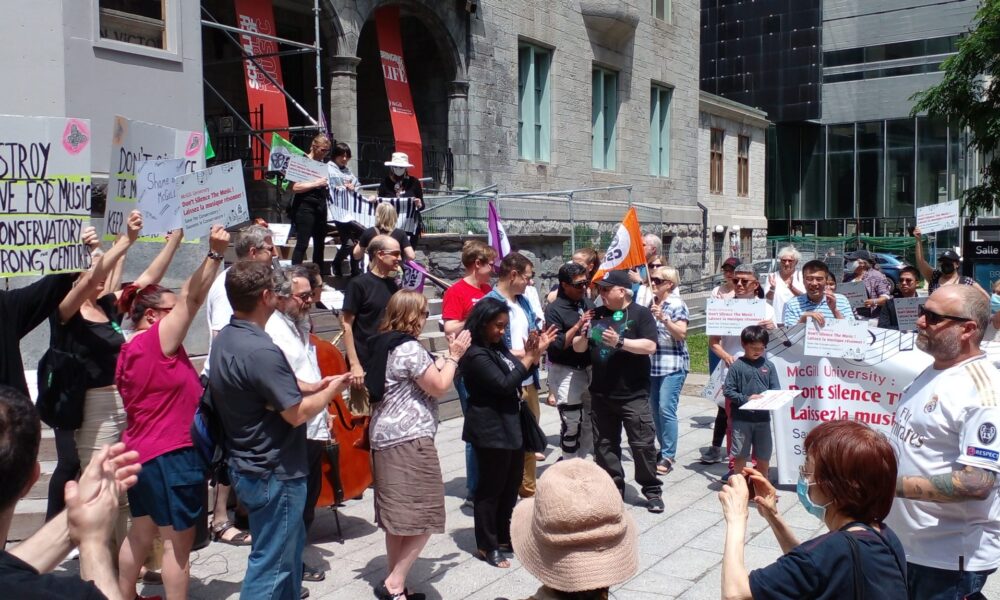
Dozens gathered in front of the Schulich School of Music on June 28 wielding signs, singing, and playing all manner of instruments. They were protesting McGill’s decision to close its Conservatory of Music at the end of the summer. McGill’s announcement, which came on June 20, cited high operational costs, a lack of space, and waning enrollment—worsened by the pandemic—as reasons for shutting down the program. 

The conservatory, housed in the Schulich School of Music, is a community program that has offered music lessons to people of all ages in the greater Montreal area for more than 100 years. Students, teachers, and community activists fighting its closure argue that it plays a vital role in the community, and that McGill could be trying harder to keep it running.

The McGill Course Lecturers and Instructors Union (MCLIU) organized the June 28 rally and launched a petition to keep the doors of the conservatory open. MCLIU president Raad Jassim explained the union’s stance in an interview with The McGill Tribune.


“It’s a labour issue. That’s number one,” Jassim said. “We have 100 instructors who are going to be losing their jobs. It’s called, in [the] labour code, mass firing [….] And there are no good reasons given to the union, to the members, to shut it down.”

According to Jassim, other unions, such as the McGill University Non-Academic Certified Association (MUNACA) and the McGill University Non-Academic Staff Association (MUNASA), will also be impacted by the conservatory’s closure. 

McGill’s claim that they do not have space to house the conservatory rings inaccurate to Jassim. He brought up the Royal Victoria Hospital—which is now under McGill’s control and sits empty, slated to undergo renovations for eventual use in 2028—as proof that enough space exists across McGill’s campus to continue the program. He further believes that the administration is prioritizing elite music education over community programming because it is more profitable.

“But is education only for money? Is our tax money only going to create money for the institute? These are the questions that we ask and [why] I have created a petition,” Jassim said.

Jennifer Bell, who taught at the conservatory for over 30 years, played the saxophone during the protest on June 28. A jazz coach, Bell described the unique nature of the conservatory and the diverse crowd that it draws in an interview with the Tribune.

“I don’t think there’s any other musical setting where you could have a group where a couple of the people are senior citizens [and] high school students,” Bell said. “We’ve had students in other faculties at McGill, we’ve had people who were […] doctors, lawyers, engineers, […] concierges, and garbage collectors [….] The diversity of the people that would come together in these groups is really quite incredible.”

Like Jassim, Bell believes that McGill is unwilling to develop a solution that could save the conservatory. Bell has also started the “Save McGill Conservatory of Music” Facebook group, at the request of a conservatory teacher, which has already amassed over 600 members. The page is used primarily to organize against the closure and to share testimonials about the conservatory’s positive impact as a creative outlet for the community. 

Claire Loewen, a McGill media relations officer, wrote in an email to the Tribune that McGill sees the conservatory as economically unsustainable and that the decision to close it is final.

“In recent years, the Conservatory has faced a growing number of challenges as operational costs have increased. It should be noted that the Conservatory is self-funded and receives no government funding,” Loewen wrote. “The lack of reliably available space is also a challenge. As the Schulich School of Music continues to grow its University-level programs, these spaces are now at a critical premium [….] The Schulich School of Music will be forming a working group to look at sustainable ways of furthering our commitment to community engagement in the future.”

McGill, Montreal, News

Bill 2 passes with proposed amendments; Queer McGill says more to be done

After months of controversy and public consultation, the National Assembly of Quebec adopted Bill 2 on June 7. The Bill was first introduced on Oct. 21, 2021 but was met with public outcry over components that were criticized as transphobic. At McGill, the opposition to Bill 2 was solidified with the formation of the McGill Coalition Against Bill 2 between the Students’ Society of McGill (SSMU), Queer McGill, and the Union for Gender Empowerment (UGE). 

Bill 2 originally required proof of gender-affirming surgery in order to change one’s sex designation on official papers; if one could not or did not wish to undergo surgery, their only option was to have separate sex and gender categories on their documents. The updated version of the Bill dropped this requirement, but retained a heavily-criticized provision that allows children over 14 to object to a parent’s change of gender label. Additionally, the amended Bill 2 waives the fee for the first gender change made on official documents—though any additional changes still incur a cost of $144—and introduces the option of selecting “X” instead of “male” or “female” as a gender marker

Kerry Yang, SSMU vice-president (VP) Student Affairs, and Val Mansy, SSMU VP External, acknowledge that the first version of the Bill was “a nightmare,” and that the amendments mark a welcome change. However, both executives expressed disappointment in some of the Bill’s unchanged sections. 

“The Bill 2 reform comes from years of struggle by trans activists. Indeed, the government of Quebec had no choice [but] to conform itself to the Moore Judgment rendered in 2021,” Yang and Mansy wrote in a joint statement to The McGill Tribune

Yang and Mansy further pointed to Minister of Justice Simon Jolin-Barrette refusing to accept the gender-neutral term “child” over “daughter” or “son” in the Quebec civil code as proof that progress is far from complete.

Grey Cooper, BA ’21, believes that the decision to amend Bill 2 was an appropriate response from the Coalition Avenir Quebec (CAQ), but that further changes, such as the inclusion of intersex individuals, should have been implemented.

“I think the Bill could have been altered more,” Cooper wrote in an email to the Tribune. “Overall the heavy medicalization of gender and sex markers reflects a lot of opinions that align more with the ‘trans exclusionary radical feminists’ than listening to trans and intersex people’s input.”

Beyond criticizing the content of the Bill, some, like Arwyn Regimbal, U1 Social Work and events coordinator at Queer McGill, take issue with the process through which the Bill was crafted. Regimbal primarily condemns how quickly the Bill was adopted despite the controversy and lack of consultation with the LGBTQIA+ community, considering how many members of the community are affected by it. 

“There are still provisions in the Bill that are inappropriate, or could be harmful towards people,” Regimbal wrote to the Tribune. “While I welcome many of the changes, I refuse to applaud the government based on their handling of the issue [….] I want to highlight [that] the original Court decision that ordered them to change the Civil Code was deliberately interpreted in the worst way to actively harm our community.”

Regimbal, Yang, and Mansy all agree that McGill’s reaction to Bill 2 has been disappointing, but unsurprising considering the university’s minimalistic approach to accommodating non-binary and transgender students on campus. Regimbal believes that McGill needs to address the adoption of Bill 2 as they have not released a statement since the Bill was tabled.

“McGill refused to take a stand on Bill 2, despite many faculties and organisations doing so,” Regimbald wrote. “I also believe that significant changes need to be made to the Wellness Hub before trans people feel comfortable seeking medical care.”
Those seeking support can contact the McGill University Sexual Identity Centre (MUSIC), Queer McGill, the Union For Gender Empowerment (UGE), or the Trans Lifeline. Those seeking legal advice can contact the Legal Information Clinic.

McGill, News

McGill to maintain partnership with Huawei despite federal ban from 5G network

McGill University plans to maintain its research partnerships with Huawei Technologies Co., a Chinese telecommunications corporation recently barred from Canadian fifth-generation (5G) mobile networks by the federal government. 

The Canadian government announced the ban on May 19, after years of pressure from federal opposition parties over privacy concerns and the company’s close ties to the Chinese government. The Canadian military and the Canadian Security Intelligence Service (CSIS) have warned against Huawei’s participation in 5G for years, and CSIS believes that research partnerships also pose a threat. Academics interviewed by The McGill Tribune express similar concerns. 

McGill and other Canadian universities, such as the University of Toronto and the University of British Columbia, partner with Huawei for research and development projects. In an email to the Tribune, McGill media relations officer Frédérique Mazerolle wrote that McGill has a limited number of research partnerships with Huawei Canada in broadband networks and optical and wireless technologies.

According to a list compiled by Jim Hinton, an intellectual property (IP) lawyer and assistant professor at Western University, McGill professors have worked as inventors on 14 patents owned by Huawei since 2016—more than at any other Canadian university.

In an interview with the Tribune, Hinton warned that researchers at McGill may be contributing to the development of technologies, such as Huawei’s 5G technology, that benefit the Chinese government economically and strategically. However, these innovations cannot be implemented in Canada due to the federal government’s cybersecurity concerns.

“If this company can’t be trusted in our 5G networks, how can there be such a distinction made when it comes to even more cutting edge research?” Hinton wondered.

Chinese law requires companies to work with security and intelligence agencies upon request. Although Huawei denies any collaboration with the Chinese Communist Party, accusations of cyber-espionage have mounted—Australian intelligence services, for example, found a hack in Huawei technologies that transmitted data to China and then self-deleted. Leaked company reports also implicate Huawei in government surveillance of China’s population, including human rights abuses against Uyghur Muslims characterized by Canada’s House of Commons as genocide.

Meanwhile, the McGill administration says that these partnerships with Huawei are integral to the university’s ability to conduct research. 

“Research is a global endeavour and it is crucial that Canadian universities partner with others at home and abroad, public and private, to ensure Canada retains its place as a global research leader,” Mazerolle wrote. “Canada’s leading universities partner with companies from around the globe to conduct research that benefits Canada and the world.”

Some, like Hinton and Ben Fung, professor of cybersecurity at McGill’s School of Information Studies, question who really benefits from these partnerships. In interviews with the Tribune, both Hinton and Fung argued that the university is at a disadvantage in the patent process, and that the partner company often takes ownership of the technology instead of the university or researcher.

“After one or two years, the professor will rely on that external company’s funding, and expect that the company will continue funding the research,” Fung said. “That’s the moment the company can demand something that may not be reasonable [….] They may ask you to invent something that completely belongs to the company.”

Huawei owns exclusive IP rights to 13 of the 14 patented inventions identified by Hinton. Despite being privately owned, most of these projects were funded by the public sector and rely heavily on university equipment and infrastructure.

New federal guidelines make researchers complete a security risk assessment before receiving grants from the Natural Sciences and Engineering Research Council (NSERC). According to Mazerolle, many of McGill’s partnerships with Huawei involve NSERC funding. However, Fung expects companies to continue partnering with professors and benefitting from university resources even if they can’t receive grants through NSERC. As an alternative, Fung believes the government should publish a registry of foreign-state-affiliated organizations to ensure that professors are fully informed about the companies they work with.  

“There should be education to professors on the consequence[s] of collaborating with foreign state companies—that they may use the research for military use, and that this is not good for Canada,” Fung said. “It’s also not good for the reputation of the professor.”

Hinton advocates for stricter intervention in university partnerships, similar to what is required of American universities. In the U.S., universities must prove that they are not involved in risky partnerships with foreign-state-sponsored companies in order to secure Defense Department funding. 

“Somebody’s got to be the leader on this,” Hinton said. “The federal government, the provincial government, and the institutions themselves have to take responsibility.”

Hockey, Sports

How the NHL failed Nazem Kadri

With the Stanley Cup Finals kicking off late last week, the hockey world is already beginning to reflect on the narratives of the playoffs: Another first-round Leafs exit, a historic Connor McDavid performance, the brick wall of Jake Oettinger, and stand-out defence from Cale Makar.  

As fun as these narratives are, the neglected story of Nazem Kadri should be at the forefront. 

The story traces back to Kadri’s NHL beginnings in Toronto. After back-to-back 32-goal seasons in 2016-17 and 2017-18, the hockey world began to see glimpses of the player Kadri would later become. Filled with promise and potential, Kadri headed into the first round of the 2017-18 playoffs, where the Boston Bruins awaited. In game one, a chippy battle filled with missed calls led Kadri to the wrong side of Bruins forward Tommy Wingels, where he delivered a hit from behind that would result in a three-game suspension. The Leafs ultimately lost 7–4 in a game seven heartbreaker. The Leafs met the Bruins in the first round of the playoffs the following year and again, Kadri was suspended for five games for cross-checking Boston forward Jake DeBrusk in the head. 

This was the end of Kadri’s tenure as a Maple Leaf. 

In 2019, after being traded to the Colorado Avalanche, Kadri was suspended in the playoffs yet again, this time for a hit on Justin Faulk—eight games and the remainder of the Avalanche’s playoff run. At this point, it was more than just a few unlucky calls thrown Kadri’s way. 

It is imperative to put these incidents into the context of the league’s treatment of non-white players to understand their broader consequences—in the case of Nazem Kadri, this extends to the treatment from fans, coaches, opposing players, and referees.

Jumping forward to the 2021-2022 season, Kadri has put on an unbelievable performance with a career-high 87 points despite missing 11 games to injury, creating space for himself as one of the most valuable players on a deep Avs team. 

After driving to the net to try and tuck in a rebound in game three of the 2022 Western Conference semi-final, Kadri lost his footing, taking out Blues’ goaltender Jordan Binnington and leaving him with a season-ending injury. Despite no penalty being called on the play, and the majority concluding that it was a clear accident, Blues fans, players, and Binnington himself decided to take Kadri’s “punishment” into their own hands. 

Binnington, who has a history of making Islamophobic comments and has previously expressed his discontent with Kadri by swinging a stick at his head, decided it would be appropriate to throw a water bottle at Kadri during a post-game interview. Binnington justified his water bottle throw as a “God-given opportunity”

The NHL, despite claiming to support anti-racism, decided that Binnington’s actions were acceptable and gave no supplemental discipline for either. Not even a fine. 

St. Louis fans began to send vulgar, violent, and racist threats via direct messages to Kadri’s wife and children, resulting in the involvement of St. Louis law enforcement. The response from the St. Louis Blues? Silence. 

The Blues organization failed to condemn the attacks from their fans at any point in time. When asked about the threats, Blues Head Coach Craig Berube said “no comment”, a response he later revoked, instead citing his absence on social media for his unwillingness to speak on the matter. 

And as for the Blues players? While all silent on their socials and in post-game interviews, David Perron and Pavel Buchnevich went after Kadri in game four. Following a scuffle after the play, Buchnevich cross-checked Kadri from behind, at which point Perron flew in with a second, more violent cross-check, tackled Kadri to the ground and began to throw punches. 

Perron received a $5,000 fine, but still no suspension. 

In a conversation with the Tribune, U2 Management student and die-hard Leafs fan, Owen Anderson, shared his thoughts on the treatment Kadri has received throughout his time in the NHL.

 “Growing up as a Toronto Maple Leafs fan, I have gotten to watch nearly all of Kadri’s career,” Anderson said. “It was obvious that he was treated differently by the league, by the refs and by the fans. Hockey has a culture problem and unfortunately, Kadri has had to face it head-on. As a fan of the sport, you would hope that the league and referees would be impartial, but that just hasn’t been the case.” 

Jumping ahead to the Western Conference Final, Edmonton Oilers forward Evander Kane boards Kadri from behind, leaving him injured for the rest of the series and potentially the Stanley Cup Final. Kane—a repeat offender—got a one-game suspension

If Kadri were the perpetrator of any of these incidents, he likely would have received a hefty suspension. But these suspensions are not handed out when Kadri is the victim of violent abuse from opposing teams. Why? 

Tim Peel, a former NHL referee who was fired after being picked up on a hot-mic saying he wanted to call a penalty against the Nashville Predators, lent some insight into the minds of the referees who make the calls. In a tweet that was quickly taken down, Peel called Kadri’s injury “KARMA!”. Enough said. 

So here we are, asking ourselves what the league can do better in its treatment of players of colour. We even forget about Kadri’s unbelievable performance in game four of the Western Conference semi-final with a hat trick that carried his team to a 6–3 win. The focus is the racism that preluded it. 

And again, we ask the question—shouldn’t hockey be for everyone? 

In a world where Kadri is treated with such overt racism and negligence by the NHL and the Department of Player Safety, and where fans threaten his family and opposing players target him after whistles, in the corners, and in post-game interviews, it’s clear that we are just not there yet. 

Commentary, Opinion

Bill 96 further ingrains systemic racism

In a devastating decision taken by the National Assembly of Quebec on May 24, Bill 96—the newest addition to the province’s array of restrictive language laws—was officially adopted. While the Coalition Avenir Québec (CAQ) advertised the bill as another small step to protect the French language, the reality is that Bill 96 will alienate and discriminate against all those who are not francophone.

As a native English speaker born and raised in Quebec, I am used to being told that I am a second-class citizen because of the language that I speak. The Sûreté du Québec, the police force that is tasked with protecting me, is not required to communicate with me in English, no matter the circumstance. Moreover, I was only permitted to attend an English high school because my parents are anglophones. My children would be forced to attend French schools if I do not request a document from the Quebec government that certifies I graduated from an English high school. By preventing allophone and francophone children from attending English schools, the government is limiting the children’s abilities to learn a language used globally, across all industries. Moreover, existing legislation in Quebec seems to contradict The Convention on the Rights of the Child, which stipulates that children have the right to use their mother tongue and that education should allow children to fully develop as people—which is facilitated when done in a child’s preferred language.  

Bill 96 further delegitimizes my status as a Quebec citizen in the eyes of the government by ingraining my otherness as a non-francophone. I will now have to demonstrate that I am a “historic anglo” in order to receive medical services in English. If I work for a company that has more than 25 employees, I will have to conduct all internal and external business in French. The obstacles that white Quebec anglophones like me will have to face, however, can hardly compare to the repercussions of Bill 96 for Indigenous people and immigrants. 

Because neither group qualifies as historic anglophones, there is nothing guaranteeing the rights of Indigenous people or immigrants to receive healthcare in any language other than French. Unsurprisingly, the Quebec government uses the term “historic” to grant rights to anglophones but ignores the fact that Indigenous people are the historic caretakers of this land. The lack of accommodation for Indigenous people proves both that systemic racism is still rampant in the province and that the government has doubled down on its attempts at assimilation.

Immigrants can receive services in English during their first six months in Quebec, which are allotted to learn French—but once that time has passed, immigrants are expected to navigate services in French with the ease of a native speaker. The communication barriers the government is set on establishing will likely lead to a decrease in the quality of care, an increase in medical malpractice cases due to miscommunication between doctors and patients, or instances where doctors purposely misinform patients. Racialized patients already face neglect due to systemic racism in Quebec’s healthcare system and Bill 96 only increases the likelihood of more widespread discriminatory practices.

The targeted racism of Bill 96 extends throughout the government and into every business and institution, including the most formative—education. The Bill limits the educational opportunities of Indigenous youth by requiring them to follow a French curriculum rather than one determined by their respective communities. According to international and Canadian federal law, Indigenous peoples have the right to self-determination, meaning they have the right to oversee their own political, economic, and cultural development. Bill 96 directly contradicts and disregards this right, while also invoking the notwithstanding clause in the Canadian constitution for protection from federal challenges.

The Quebec government is also restricting the educational opportunities available to immigrant and Indigenous students by placing a cap on the number of non-historic anglophone students that can attend English CEGEPs. The CAQ’s targeting of these students stifles their educational opportunities, which is a clear sign that the party is not invested in the futures of minority groups in the province. 

The passing of Bill 96 disadvantages all non-francophones, but Indigenous people and immigrants are more affected than anglophones. The bill institutionalizes and legitimizes the racist ideal of assimilation of racialized and non-francophone groups in Quebec. It also makes emigration an enticing option for all those the Bill discriminates against, a consequence that falls in line with the Quebec government’s desire to create an entirely francophone population. Ultimately, Bill 96 joins the ranks of Bill 101, Bill 178, and Bill 86 in the Quebec government’s arsenal of laws that perpetuate systemic racism and discrimination against non-francophones throughout the province.

McGill, News

QS 2023 Rankings names McGill top university in Canada

The Quacquarelli Symonds (QS) World University Rankings, published on June 8, listed McGill as the number-one university in Canada and the 31st in the world for the 2022-2023 academic year. In last year’s publication, McGill ranked close behind the University of Toronto (UofT) as the second-best university in Canada. The QS ranking is based on eight factors: Academic reputation, employer reputation, faculty-student ratio, citations per faculty, international faculty ratio, international student ratio, international research network, and employment outcomes.

McGill earned a total of 81.9 out of 100 points—a weighted average of its score in each category. McGill scored approximately 80 points in all categories except for faculty student ratio (68.9) and citations per faculty (59.6).  UofT and the University of British Columbia (UBC) took second and third place. McGill beat out UofT and UBC for the top spot due to their citations per faculty criterion—UofT scored 43.5 and UBC scored 42.1.

In an email to The McGill Tribune, McGill media relations officer Frédérique Mazerolle shared the administration’s pride in the university’s top ranking. She also explained that the university’s global reputation comes from the institute’s commitment to high-quality education.

“Our institution is recognized globally for the excellence of its teaching and research programs,” Mazerolle wrote. “While positive rankings can contribute to a good international profile, McGill’s international reputation is based on much more than that: [A] 200-year-old tradition of excellence in both research and teaching […] and a network of students and alumni who are ultimately our best ambassadors around the globe.”

While students were pleased by McGill’s accomplishment, many were skeptical of the ranking and its evaluation criteria.  In an email to the Tribune, Thibaut Baguette, U2 Engineering, pointed out that the ranking does not consider student well-being. He believes the quality of an institution varies from one person to another depending on student experiences, not just faculty achievements.

“I think [McGill’s ranking] is pretty cool, but apart from bragging rights, it doesn’t mean much,” Baguette wrote. “As with many other things, what’s good for one person isn’t necessarily good for another. What ultimately matters most is transparency and how much the university listens to what their students want.”

For others, including some racialized students, the ranking feels like an affront when compared with the racism they have faced while at McGill. Many students have also voiced frustration toward the administration about their refusal to divest from fossil fuels and their treatment of marginalized students.

Fanta Ly, 4L, has spoken out about her encounters with harassment from faculty and administration, including a call from the administration to her family falsely claiming she had died. Ly expressed that given her experiences, she does not want the ranking to influence other students to attend McGill. 

“[The ranking] means nothing to me and I hope it won’t encourage Black students to attend such a racist institution,” said Ly.

University rankings such as that of QS vary year to year due to changes at individual institutions and in the ranking criteria. In the past three years, McGill’s global QS ranking has fluctuated from 31st to 27th and back to 31st, but it has consistently been in the top 50 schools worldwide for decades. 

In a statement to the Tribune, Emma Gormley, U2 Management, explained that while she believes the ranking system is inherently flawed, she also acknowledges McGill’s rank as a helpful tool for her future goals. 

“Overall, university rankings are really arbitrary and there is a lot of evidence that criticizes their methodology and the privileging of certain faculties or institutions based on subjective reputations,” Gormley wrote. “Despite these flaws, however, rankings are essential for many professions or grad school applications so I cannot ignore McGill’s ranking and reputation.”

News, SSMU

SSMU suspends SPHR McGill over parody post, citing harassment

After publishing a satirical article on social media in protest of the Students’ Society of McGill University’s (SSMU) decision to revoke the Palestine Solidarity Policy, Solidarity for Palestinian Human Rights McGill (SPHR) received a 105-day suspension for harassment. SPHR will not be able to access any resources provided by the SSMU, such as funding opportunities, room booking privileges, or their SSMU bank account, until Aug. 29. Former SSMU vice-president (VP) Student Life Karla Heisele Cubilla notified SPHR of the Board of Directors’ (BoD) decision to suspend the organization on May 16 via email. 

The SPHR article, shared on April 25, was a caricature of SSMU’s April 25 statement announcing that the Society would not adopt the Palestine Solidarity Policy because it was deemed unconstitutional. SPHR’s message mimicked the format of the BoD’s announcement, but satirized SSMU and its decision-making, characterizing the processes as dictatorial.

In an interview with The McGill Tribune, SPHR executive Anya* explained that the statement was devised to raise morale among supporters of the Policy after the Palestine Solidarity Policy was struck down.

“There was a […] feeling of defeat, and, honestly, spirits were down,” Anya* said. “A lot went into this campaign, and a lot of people contributed. The parody was just a lighthearted way to criticize the Board for its decision.”

SSMU found that the post’s language—particularly, references to the BoD as the “Board of Dictators,” with “backbones made of jelly” who “uphold the white supremacist values of McGill’s Board of Governors”—to be in violation of article 3.1.6 of the Internal Regulations of Student Groups. According to article 3.1.6, all clubs’ operations must abide by SSMU and McGill’s rules, regulations, and by-laws. The SSMU claims that the language used by SPHR McGill constitutes harassment as per its Equity Policy and the McGill Policy on Harassment and Discrimination

While SPHR does not have access to room booking or funding opportunities from SSMU during its suspension, Anya* believes SPHR’s operations will not be greatly impacted. 

“We get most of our funding, and most of our resources from QPIRG [the Quebec Public Interest Research Group at McGill],” Anya* said. “With regards to funding, we don’t take funding from SSMU […] usually, just because we don’t want to deal with the receipts and have people’s identities be jeopardized.”

Other student groups have spoken out against SPHR’s suspension. In an email to the Tribune, Sebastian Seyva, a PhD candidate in the Department of Neuroscience and member of Socialist Fightback at Concordia and McGill, emphasized the importance of student union support for student activism. 

“The suspension of SPHR from the McGill SSMU is just the latest in a string of attacks on student activism and the democratic will of the student body on campus,” Seyva wrote. “As students, our primary weapon to fight back against these attacks is our student union, but recent events have revealed how the leadership of the student union (its Board of Directors) is equally complicit in clamping down on any sort of dissent in the student body, and actively preventing the student union from becoming a real avenue of struggle for students looking to fight back.”

SPHR McGill is currently working to appeal its suspension. VP Student Life Hassanatou Koulibaly explained that such a process prompts a review by the Clubs Committee.

“Depending on the nature of the issue, sanctions are determined according to the Internal Regulations of Student Groups and as detailed by Club Processes,” Koulibaly wrote in an email to the Tribune. “When a club receives a sanction, they may wish to appeal the decision through the Sanction Appeal Form which is then submitted to the Clubs and Services Coordinator for review before then being reviewed by the Clubs Committee.”

*Anya’s name has been changed to preserve their anonymity

Read the latest issue

Read the latest issue