


Latest News

Features

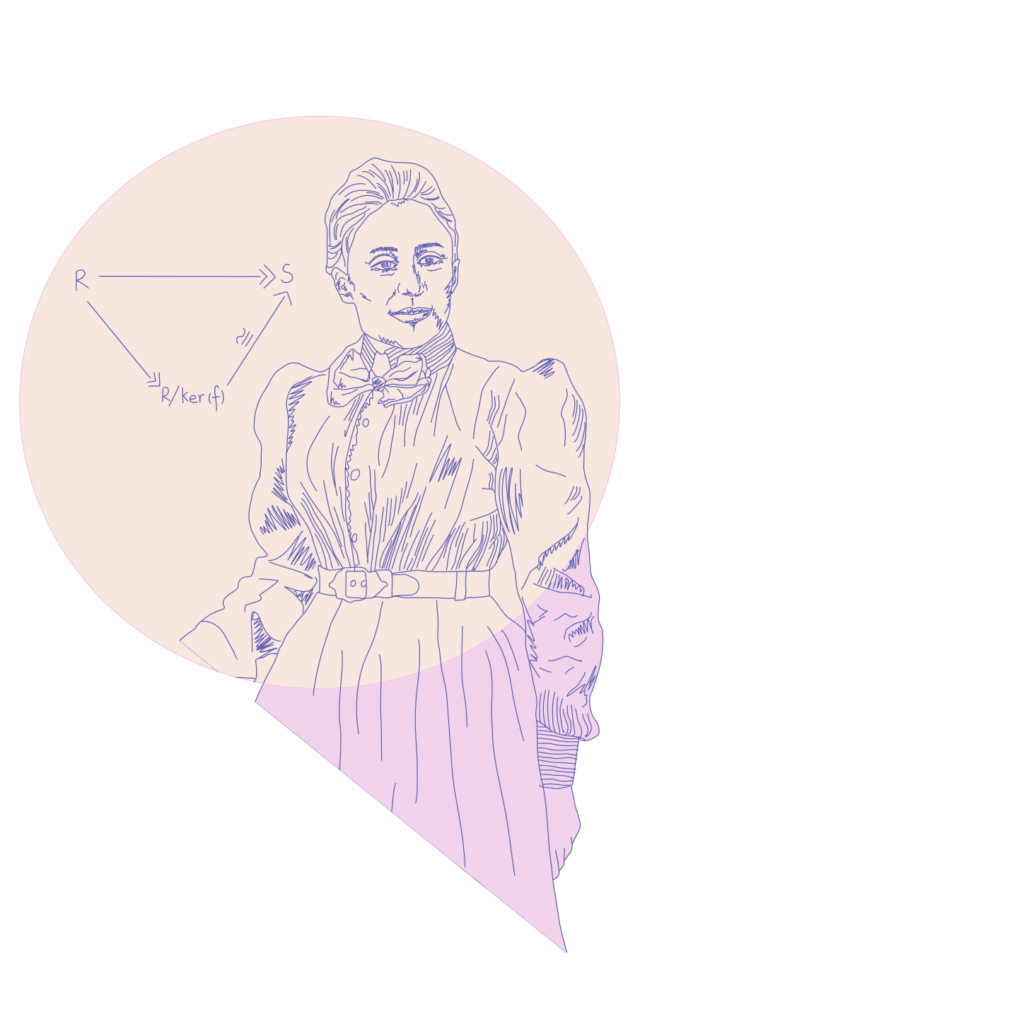
On justice and mathematics

There is a passage in Plato’s //Meno// that goes something like this: The well-born Meno asks for proof of Socrates’ claim that no one is ever taught anything, and instead they recollect things they already know. Socrates calls over one of Meno’s enslaved attendants and asks the boy, who has no mathematical experience, to solve a geometry problem. With Socrates’ guidance, the boy discovers how to double the area of a square, and Socrates suggests to Meno that what appears to be learning, then, was merely recollection: “These notions have just been stirred up in him, as in a dream.” 

It’s a strange and interesting thought experiment, one that neatly crystallizes a belief agreed upon by most mathematicians—that math is //a priori//, meaning that mathematical truths come from theoretical deduction rather than experience. But in recent years, the more I think about this anecdote, the more the social context stands out to me rather than the philosophical argument. After the dialogue ends, the boy’s chance to engage in mathematics is over. He goes back to serving his master. What he is intrinsically capable of is philosophically interesting, but realizing his mathematical abilities is never considered. 


In some ways, math can feel like the most apolitical subject of all. Its theorems proceed from axioms, not empirical data; it’s easy for, say, a pure mathematician to feel insulated from the world. But the field’s demographics reflect the stark inequalities of the society we live in. Despite an influx of initiatives in the past few years, women remain underrepresented in STEM—and the problem is particularly severe for fields like mine. While women have made significant gains in some areas of science, like psychology and life science, math-intensive fields remain behind in increasing female faculty representation. Racial minorities face the same problem: Data from the United States’ National Science Foundation reveal that only 4.5 per cent of mathematics PhD recipients in 2017 were Hispanic or Latino, and only 2.8 per cent were Black. Census data from the same year suggests that Black people accounted for 12.3 per cent of the whole population, while Hispanic people accounted for 18.1 per cent.

Unfortunately, not everyone believes that there’s an obligation to change this state of affairs. University of California, Berkeley’s Rob Kirby has maintained that the mathematical community is “generally fair” to women and minorities. On his website, he wrote, “Our society is focused towards paying attention to (and believing??) charges of sexism against women, (but not towards examples of men treating men badly or treating women particularly well).” In 2019, the topologist Abigail Thompson condemned what she called “mandatory diversity statements” in a piece published in //Notices of the American Mathematical Society//. She was referring to the statements about “contributions to diversity” that some universities solicit from job applicants—a hiring practice which she compares to a McCarthy-era loyalty test. Recently, she and Kirby, among others, founded a new organization for promoting mathematics called the Association for Mathematical Research (AMR). 

The AMR’s website is frustratingly vague; little distinguishes its purpose from pre-existing associations, like the American Mathematical Society (AMS) and the Mathematical Association of America (MAA). The number theorist Michael Harris, who was invited to join, saw the organization as a possible reaction to the AMS’s increasing focus on equity. As the AMR’s letter of invitation to him read, “Though individual members may be active in educational, social, or political issues related to the profession, the AMR intends to focus exclusively on matters of research and scholarship.”

The AMR has been met with backlash—including by Louigi Addario-Berry, a math professor at McGill. Addario-Berry has criticized the organization on his blog, writing, “The mathematical community is impoverished by its lack of diversity! A professional society that doesn’t share that view is not one that I see a great value in.” 

When I talked with Addario-Berry, I asked him why there was so much backlash to diversity initiatives. He told me that empathy tends to be asymmetrical. For example, while I might think a lot about why white tenured academics find diversity initiatives unfair or censorious, they probably don’t think about someone like me before they pen their next op-ed. 

“I think a lot of AMR signatories, or at least the founders, are really people who fundamentally haven’t spent very much time building empathy or putting themselves in the shoes of people who don’t feel welcome by the mathematical community,” he told me. “If you have never given serious credence to the idea that the mathematical community is unwelcoming and discriminatory, and you really do think that it’s a level playing field, then you’re going to be resentful of programs that are designed to level that playing field.” 

In truth, Kirby or Thompson’s statements don’t particularly offend me. But I do find what they say stupid. How can math be apolitical? The great mistake I see in the AMR is the unconsidered assumption that certain human pursuits can be isolated from the material and social conditions of the society in which we live. All human activities are bound up, inevitably, with the normative. Even the surge of research into machine learning, for example, reflects the fact that companies are invested in using these tools for profit. And more generally, racial and gender minorities who endure discrimination outside the classroom are not instantly insulated from those experiences within it. 

At the undergraduate level, gender representation in math is relatively decent at McGill. According to McGill’s official enrollment statistics, there are currently 308 undergraduate female students and 508 undergraduate male students in math. (No other category for gender identities is listed, so it’s possible some of these students are non-binary or genderqueer as well.) But things change as you go up the ladder. This year, only nine of McGill’s 45 master’s students in mathematics are women, and the gender breakdown of the PhD students is even worse. In Fall 2020, only 11 per cent of the math department’s 61 PhD students were women. Even more startling is the fact that this percentage represents a drop from recent years. In 2016, 24 per cent of PhD students were female, but by 2018, it was down to 15 per cent. Despite a surge in equity initiatives in recent years, the gender gap has only widened. The lack of female representation is certainly something that Shereen Elaidi, a master’s student in mathematics, notices in her program. 

“You walk into the grad lounge,” Elaidi said. “And I wouldn’t think about this [normally], but you realize at some point: ‘I’m the only female here in the grad lounge.’”

It’s a depressing thought. I’m often grateful, at the undergraduate level, that so many of my classmates—and a handful of my professors—are women. At the same time, though, resolving inequalities has to go beyond diversity training and increased representation. Cost is a huge barrier for graduate studies at McGill. In order to maintain full-time studies, graduate students are only allowed to work 180 hours per term, or 12 hours a week, while completing their degree—something that can leave self-supported students with few solutions. For instance, Elaidi receives an $18k stipend, which also comes with the obligation that she works as a teaching assistant for two classes. At the same time, though, she pays $20k in tuition as an international student, meaning she studies in Montreal at cost. 

“I’ve had to work so many jobs just to pay,” Elaidi said. “It sucks. It’s mentally exhausting.” She added, “The funding kind of assumes that you have another source of income to help you live.”

While graduate students will probably remain overworked for a long time, McGill could at least give international students a livable stipend. Cost is just one reason that the pipeline is leaky, a metaphor for that way that women and racialized minorities gradually disappear from STEM the higher up you go. But I also wonder if earlier interventions, like better undergraduate teaching, could draw a greater diversity of people into math. After all, bad teaching, //especially// in math, can end up testing for academic background, rather than ability—and a student’s high school background in math will obviously intersect with race and class. Reaching people with less mathematical maturity is worth the struggle. 

“Giving a talk where you get across the interesting and new ideas from a subfield in a way that gives some inkling of what they’re about to a broader audience is a real challenge,” Addario-Berry said. “Frankly, a lot of mathematicians don’t like to put in the time, and I understand it. We were almost all, in some sense, chosen for this, in the sense of having succeeded in getting a job based on a very narrow set of skills, which is almost exclusively the ability to write papers that get into good journals.”

Maybe it’s time to broaden what we look for in the mathematical community. It’s always struck me as somewhat perverse that in a field where it is unusually hard to distill and transmit information from one person to another, we still don’t seem to care that much about good teaching. And while I understand the idea behind making academics teach—giving back to the scientific community, putting students in touch with current researchers—I also wonder if it’s time to separate these professions more fully, at least for introductory classes. 

As Gavin Barill, a PhD student in the mathematics department, put it to me succinctly: “If you’re not investing in teaching, then you are using undergrads for their tuition.” He would know. Barill himself was turned off from math in undergrad by what he described as a “gatekeep-y” first-year analysis course; he ended up majoring in computer science. Speaking to him reminded me of all the people I know who are driven away from mathematics by courses that are rigorous but, frankly, taught poorly. Who gets excluded by this kind of pedagogy?


In many ways, I have an unusual level of privilege when it comes to mathematics. My father is a category theorist by training, and growing up, he would show me the odd proof here and there, demonstrating that 2 was irrational or that an infinite series converged to 2. Usually, I didn’t understand these proofs, and I would feel frustrated and mystified. At school, I excelled in math, which unfortunately meant I was forced to write math contests. But there were upsides, too; in seventh and eighth grade, I was placed in a small, collaborative math class. It felt like a class where I did puzzles all day with my friends. 

By high school, though, things became more computational. Deep down, I often felt like an imposter: One who could easily take a derivative but lacked the creativity necessary to do real mathematics. So I started my degree in biology, and later, philosophy (with a minor in math). My image of a real mathematician was that of Carl Friedrich Gauss, who derived a beautiful summation formula as a child—or maybe it was Terence Tao, the youngest person to ever win a medal in the International Math Olympiad. Personally, I found mathematics contests stressful. As soon as I could avoid them, I did. 

“We have explicitly and implicitly quite narrow ideas about who counts as a mathematician and what counts as mathematics,” Addario-Berry said. “On the spectrum, competitive problem solving is kind of the epitome of that, right? If you can solve tricky mathematical questions quickly, then you’re good at math. Other kinds of thoughts that are slow and involve a lot of analogy, which is super important for advanced math—that’s very much not selected for reward at the primary, secondary, or university levels.” 

In my second-year algebra course, though, I got lucky. During the pandemic, I worked through the details of rings and groups with the help of a supportive TA. Alone in my bedroom, I began to wonder if it had been a mistake to give up on math. And I had the startling realization that I was good at math—or maybe good //enough// at math. I knew I wasn’t exceptionally talented. But I didn’t need exceptional talent to keep doing math. 

The imposter syndrome I had was insidious—but in many ways, it was also something that was culturally reinforced. The stereotype of a mathematician is still just “a lone man” in his ivory tower, as Elaidi put it pithily. Like me, she came from a humanities background first—something that can make you particularly vulnerable to feelings of not belonging. 

“This is something I’ve noticed about the math department compared to other departments at McGill: Effortless talent is kind of rewarded,” Elaidi told me. “That culture thing made me dread it. Because none of this comes easy to me.”

Yet she stuck with math. During her undergrad, Elaidi participated in the math department’s Directed Reading Program (DRP), which pairs undergraduates with graduate student mentors. With the guidance of her mentor, she researched special relativity and differential geometry. “That was literally what made me think I want to do math research,” she recalled. 

Now Elaidi helps organize the DRP along with the graduate student who founded it, Peter Xu. The DRP gives students an opportunity to explore research and topics of their interest with a mentor. It’s a breath of fresh air compared to the NSERC or SURA research awards, which are highly dependent on GPA. The application for the DRP doesn’t take into account your transcript—a choice which Elaidi explained to me was intentional. 

Talking with her reminded me that making the field more equitable doesn’t only look like diversity training. That’s an important part, to be sure, but increasing equity can be as simple as good pedagogy, dropping GPA requirements, and increasing the accessibility of research projects. Another thing that instructors could model is a growth mindset—something Agnes Totschnig emphasized to me. Totschnig is one of several math students who founded Diversity in Math, a student group that aims to inspire people from all backgrounds to discover mathematics. “If you see math as something that you’re good at or not and everything comes easily to you, the first time you get stuck, it can be really scary,” Totschnig said.

So far, Diversity in Math has held workshops on mental health and imposter syndrome, as well as a panel demystifying the process of finding research projects. In many ways, Diversity in Math owes itself to the work of Rosalie Bélanger-Rioux, a faculty lecturer who has done enormous work for equity in the math department. In 2020, Bélanger-Rioux began the Math Equity Reading Group, giving faculty and students a chance to discuss issues of equity in the field and academia more generally. Right now, she’s thinking about organizing a training session for TA’s to get them thinking about pedagogical techniques and equity. 

“The two of them actually really mesh together,” she explained to me. In fact, the same pedagogical techniques that have been shown to be good for underrepresented minorities are also “good for everyone, basically.” It was a refreshing thing to hear at a time when so often the needs of marginalized groups are pitted against the needs of everyone else. In the same vein, Bélanger-Rioux hopes that accommodations necessitated by the pandemic—generous grading schemes, optional midterms—might become more commonplace in the future. 

“Whether or not COVID is over or almost over or whatever, bad stuff happens all the time,” Bélanger-Rioux said. “Yes, there was more bad stuff happening for everybody. But bad stuff happens all the time. Being more accommodating to students doesn’t mean being easy on them or giving them higher grades. It just means giving them a better opportunity to show us that they do know the stuff after all.”


These days, as I write my proofs and correct my notation, I think about my great-aunt, Diana Yun-dee Wei. She wrote her PhD thesis on torsion theory at McGill in the late 60s, a fact that was mundane as a child but became more extraordinary as I grew up. I can’t imagine earning a degree at that time and place with the background she had, but nevertheless, she survived difficult supervisors and grueling courses. After her was my father, who immigrated here from Taiwan when he was 14. He didn’t speak English before he came; as he told me once, “Math was the only subject I was good at.” But a bachelor’s became a master’s, and a master’s became a PhD. As for myself, I still wonder whether I can contribute at all to this field—if I have the ability or the discipline. But I’m reminded that improving the state of mathematics can be so much more broad than doing research. Doing math can also look like teaching my friends about the Cantor space and remaining critical of the status quo. The academy is not paradise, as bell hooks wrote in //Teaching to Transgress// in 1994. But, she went on, “Learning is a place where paradise can be created. The classroom, with all its limitations, remains a location of possibility.”

Sports, Volleyball

Women’s volleyball defeats Sherbrooke to secure first-ever RSEQ championship title

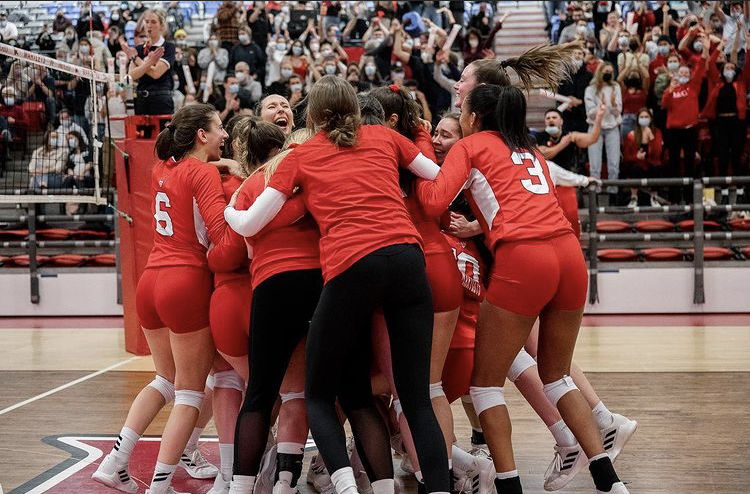
Love Competition Hall was packed shoulder-to-shoulder. It was March 12—the day Quebec ditched vaccine passports and a slew of other COVID-19 restrictions, two years after the pandemic began. While many across the city were celebrating the move, at McGill, the Martlets volleyball team (14-5) were rejoicing as they defeated the Sherbrooke Vert et Or (11-6) in four sets to win a best-of-three conference championship series. The victory marked the first RSEQ title in the team’s history. 

The opening game on March 11 saw the Martlets win 3-1 on visiting turf, but the teams were neck-and-neck in points and blocks. 

“I think our biggest challenge was that we won yesterday, so we had to […] start again from zero, not to sit on our victory and just go all-out,” said Clara Poiré in a post-game interview on March 12. The third-year right-side hitter racked up 10.5 points and four digs in game two. 

In the first set, the top-seeded Vert et Or quickly gained a lead, while the Martlets faltered, taking an early time-out to regroup. Yet, team spirits were high—with every lost point, the girls would band together for a quick word of encouragement. 

“Coach always gives us cues as to what we can improve, and […] we had a model of one point at a time,” Poiré said. “We [would] look each other in the eyes to remind each other of that model during the time-outs.” 

Sherbrooke was a force to be reckoned with—their sheer strength of will could be felt behind every spike, kill, and serve. Their blocks were their strongest suit in the first set, with gasps of disappointment making their way through the McGill crowd as shot after shot was denied at the net. Three out of McGill’s first four points were on Sherbrooke’s service errors alone. The first set went to the visitors, 25-13. 

“This was never going to be an easy match, and we dropped that first set, and we had to pick ourselves back up,” said co-captain Victoria Iannotti. “For a young team, that was the biggest challenge—showing maturity in a stressful situation.” 

McGill spent most of the second set still lagging behind, but the momentum switched when they managed five points in a row to catch up to their opponents. The team painstakingly rallied for the lead, with fourth-year libero Catherine Verchevel tallying a whopping 16 digs against Shebrooke’s lethal hits. 

“Sherbrooke is just a fantastic team,” Iannotti said. “We were very evenly matched. They’re fighters, we’re fighters, so it was about who can dig deep and keep fighting even when times were tough, even when you’re down a few points.”

The third and fourth sets saw the Martlets playing their best volleyball of the evening. Power hitter Iannotti and all-star middle blocker Charlene Robitaille led by example on the court with their infectious enthusiasm. Iannotti, as usual, led the team with a game-high 15 kills. 

Up by nine points in the final set, McGill’s final serve was a nail in the coffin for Sherbrooke’s defeat. As the ball hit the floor, the spectators, staff, and team went wild. As for how it felt to win this title with this team after two seasons lost to the pandemic, Poire was unequivocally happy. 

“Honestly, it’s amazing,” she said. “Personally, it’s the most talented team cohesion-wise [….] When we play together as a team, we’re invincible.”

Teammate Iannotti emphasized the immense team effort that went into their road to victory, both on and off the court. 

“I think [this win] really meant everything because this team is not led by one or two people,” she said. “What you see here today is the tip of the iceberg of the group of people that was working toward this.” 

The Martlets are now slated to compete for a national title in Calgary the weekend of March 22. 

Moment of the Game: Coming back from a five-point deficit in the second set, co-captain Victoria Iannotti slammed the ball into the back left corner of the court before Sherbrooke could even react, bringing the score to 21-21. 

Stat Corner: Charlene Robitaille, fifth-year middle blocker, was named the RSEQ women’s volleyball player of the year. She played in every single set this season—a total of 46—and has the second-best hitting percentage in the league (.335). 

Quotable: “To bring this win to Rachele, our coach, in her 30th season, for everything that we sacrificed and worked through in the pandemic, really means everything, and it’s a testament to our resilience and perseverance.” —Third-year power hitter Victoria Iannotti 

Cross-Country / Track, Sports

McGill track team impresses at Redbirds Last Chance meet

On March 10 and 11, the McGill track team hosted the Redbirds Last Chance meet, their final competition before the RSEQ Championships this upcoming weekend. On Friday, McGill’s Jorden Savoury finished first in the women’s 60m, and Matthew Beaudet finished first in the men’s 1,000m. Savoury ran a blistering 7.47, dominating the race and beating her personal best by 0.03 seconds. Beaudet led a McGill one-two finish in the 1,000m, with a time of 2:26.70, edging out teammate Markus Geiger by less than a second. 

After breaking four minutes in the mile earlier this season, Beaudet was less worried about his splits and more focussed on using this weekend’s race to improve his pacing and positioning in preparation for the RSEQ and USports championships. 

“The goal was to close the last 400[m] pretty quickly, but I had some trouble with getting boxed in at that point, so I had to find a way to take the lead with 300m to go before accelerating into the last lap,” Beaudet said. 

In addition to Beaudet, McGill’s distance squad had several other impressive performances. Jack Stanley and Felix Bedard went second and third for McGill in the 1,500m race, with Stanley breaking four minutes and Bedard outkicking Miles Brackenbury of Queen’s by 0.3 seconds.

Chloe Fleurent-Gregoire also had a strong race, placing second in the 3,000m on Friday night with a time of 10:00.28. However, on Saturday, the 1,500m had a rabbit who paced the start very poorly, eventually leading Fleurent-Gregoire to drop out of the race around halfway through. Nevertheless, Fleurent-Gregoire was grateful for the chance to compete again.

“[It] was really nice to get back into the competitiveness of racing again,” she said. “I feel like my confidence is slowly building back up from the cross-country season, after the break [due to COVID-19]. I am happy to be racing again and excited for the 1,500 and the 3,000 at provincials.”

On Saturday, McGill dominated the men’s 600m race, with Nicholas Bernard, Alexander-Jullian Bimm, and Sebastian Danson placing first, second, and third, respectively.

McGill also put in a strong showing in relays, with the women’s 4x400m team, composed of Marianne Djigo, Chloe Morrison, Audrey Gilmour, and Eden Muyard, coming from behind in the last leg of the relay to finish first, beating out the University of Montreal by half a second. Savoury led off the Martlets 4x200m relay to finish second, just over two seconds behind the University of Laval. The men’s 4x200m relay, consisting of Diego Dorantes-Ferreira, Jonas Schweiger, Jeremi Kolakowski, and Asad Bilal, also finished second overall. Schweiger finished second in his 300m race with a time of 36.76 seconds—the only male McGill athlete competing in that distance. 

Vanessa Lu Langley, a second-year engineering student, narrowly took second to Carleton’s Alexandra Telford in the 60m hurdles after beating Telford by 0.08 seconds in qualification. 

Next up for the track team is the RSEQ Indoor Track and Field Championships on March 20 and 21 at Sherbrooke University. 

Moment of the meet: After slipping to nearly last place during the women’s 4x400m relay, Eden Muyard passed the competition to win in the last leg of the race.

Quotable: “A lot of us have made personal bests this season, so I’m really proud of what the team has accomplished. I think performance aside, the highlight for me this season is definitely being around my teammates. I’ve found everyone to be so incredibly supportive and I’m beyond grateful for such an inclusive and positive atmosphere and training environment.” — Second-year high jumper Emily Roest 


Stats corner: Jorden Savoury ran the 60m in 7.47 seconds, breaking her own personal best and the school record.

News, SSMU

SSMU Legislative Councillors take issue with Society’s prevalent use of confidentiality

Another turbulent Students’ Society of McGill University (SSMU) administration nears the end of their tenure as the Winter semester draws to a close and students head to the ballot boxes once again. From March 14 to 18, students will get the chance to vote on a new SSMU executive council and on seven referendum questions. Though each executive position specializes in different areas, there were common threads throughout all candidates’ platforms and pen sketches: Accessibility, communication, transparency, and accountability. 

Criticisms levelled at the SSMU’s increasing privacy and alienation from the student body have been met with inaction and repeated deference to internal regulations and policies. Recent events, such as the return of SSMU President Darshan Daryanani, saw the SSMU Board of Directors (BoD) and executive officers meet increasingly in confidential sessions. In the Feb. 17 ​​Legislative Council meeting, the words “confidential” or “confidentiality” were mentioned at least 24 times over the course of the announcement and question periods alone. 

Legislative councillor Andrés Pérez Tiniacos believes the bureaucratic roadblocks he witnessed in past Legislative Council meetings are deep-rooted, but not beyond reason. 

“It was frustrating for us [councillors] to ask and not be given any information, but we do have to understand that this confidentiality is there for reasons,” Tiniacos said in an interview with the Tribune. “[The SSMU] simply cannot break the law. All of these decisions are made following the advice of the SSMU legal advisors.”

The SSMU’s confidentiality policy protects any and all information disclosed to the Human Resources committee (HRC), their appointed representative, and the general manager, unless otherwise authorized by the individual involved. Section 12.1 of the SSMU’s BoD policies further stipulates that ultimately SSMU’s general manager has final say on the decision to disclose information on matters like financial statements, ongoing legal action, and negotiations with SSMU employees.

Tiniacos explained that confidentiality is meant to safeguard everyone involved in an investigation—such as those who came forward during the investigation into the doxxing and harassment of Palestinian students at McGill. In this case and others like it, SSMU legal counsel bars executives from sharing any information that could lead to further targeting. Though the SSMU has dealt with legal proceedings in the past, Nathaniel Saad, a management representative on the Legislative Council, believes that SSMU’s increasingly corporate mindset has overshadowed its basic foundation as a student union. 

“The things that SSMU does are important and affect us, but I feel as though a lot of times people take SSMU too seriously,” Saad said. “Lawsuits are a dangerous thing, and I understand that the executives and SSMU want to protect themselves and the funds that SSMU has. But there has to be some way to avoid the political toxicity that we are completely embedded in right now, and just tell people what happened [….] At the end of the day, student government is not supposed to be this ridiculous.”

Asma Khamis, U2 Science and Legislative councillor, has hope that SSMU will work toward improving its workplace dynamics from the inside out to address its myriad of issues before they escalate to independent investigations or litigation.

“The issue of confidentiality itself is a difficult thing to address, especially since it pertains to a legal framework that SSMU has to follow as a legal entity,” Khamis said in an interview with the Tribune. “However, I do think it is within our grasp to address the underlying issues before it leads to confidentiality becoming a stumbling block—for example, trying to prevent circumstances from happening that would necessitate these types of confidential investigations or information.”

Album Reviews, Arts & Entertainment, Film and TV

‘The Batman’ is DC’s very own horror blockbuster

Scattered whispers and occasional chuckles echo hollowly through the cinema’s depths, jittery in their disposition and nervous in their delivery. Excited eyes dart back and forth between the screen and the faces surrounding them. A nearly three-year anticipatory build-up is culminating into a gentle frenzy—a feverish apogee. This is the scene my friends and I hurriedly walked in on for a Friday night screening of director Matt Reeves’ long-awaited The Batman.  

His take on the Dark Knight (Robert Pattinson)—vengeance personified—features a horrifying storyline captured through staggering cinematography and a chilling score. Released on March 4, the film takes a grim approach to the beloved character, making him anything but the classic superhero archetype. In fact, the movie would be more aptly categorized under the bracket of “action/thriller” than “action/adventure.” Its stern and steely Bruce Wayne personifies Gotham’s ruin through his disheveled appearance and stony demeanour. The story revolves around him investigating a series of mysterious deaths, each connected by a trail of riddle-filled letters addressed directly to The Batman. With Christopher Nolan’s The Dark Knight trilogy’s legacy serving as a Goliathan precedent, The Batman surely serves as strong proof that the future of DC’s most iconic character is in safe hands.

The filming locations of London, Glasgow, and Liverpool create a noir backdrop with sweeping grandeur that ironically contrasts with Gotham’s crumbling morale and murky back alleys. Colossal aerial cinema-shots beautifully capture the city, gripping the audience with every fast-paced camera-flight along Gotham’s night-slash-sky-line. The symphonically chilling musical score complements the film by darkening every scene with a cold and calm tone, warning of dread with every note. These storytelling elements conjure up a horrifying iteration of Batman, turning him into the perfect anti-hero—a character just as terrifying and unpredictable as the movie’s villains, if not more. 

The movie pits some of DC’s most recognizable antagonists against the Bat, such as the Penguin (Colin Farrell) and the Riddler (Paul Dano). The complex personalities channeled by these bad guys present a harrowing depiction of Gotham’s decaying underbelly, fleshing out its fractured social setting. They are the result of everything wrong with the city, giving reason for Batman’s vengeance to rise. 

Other supporting characters include some fan-favourites: Bruce’s butler and father-figure Alfred Pennyworth (Andy Serkis), good-cop James Gordon (Jeffrey Wright), and the mysterious Catwoman/Selina Kyle (Zoë Kravitz). Each of these characters have their own personalities, flaws, and motivations, much like Batman himself. These complexities make The Batman about more than just Bruce Wayne. The film celebrates its secondary characters in a Shakespearean manner, ensuring that they offer more than just development for the troubled protagonist. That being said, rest assured, the film’s three hours offer more than enough Batman.  
With unbridled commercial success—opening up with a global box office chart of $258.2 million in its debut week—The Batman translates the hype into reality. The film’s neo-noir theme keeps audiences on edge, providing them with a gloomy and rain-battered setting for potential future installments. Notwithstanding early casting criticism, Pattinson’s gripping performance makes him a deserving inheritor of the dark cape. With such a forceful film, it is difficult to wait for the next sighting of Gotham’s Caped Crusader.

Science & Technology

Astronomers identify new a star coated in helium-burning ashes

A recent discovery among the stars has caught the global attention of many astronomers and astrophysicists, as its existence challenges the fundamental theories of stellar astronomy.

The new star is coated in oxygen and carbon, elements that form when helium is burned, as discovered by German astronomer Klaus Werner and his team at the University of Tübingen. Their findings conflict with the previous understanding of stellar evolution and the formation of white dwarfs.

When larger stars that have exhausted their nuclear fuel collapse inwards on themselves, they form small dense bodies of carbon and oxygen known as white dwarfs. Typically, stars are covered in layers of hydrogen and helium and only become coated with carbon and oxygen after undergoing a nuclear collapse. However, this new star has layers of these elements on its surface—the “ashes” of helium burning. It also has temperatures and radii that are indicative of continuous helium burning at its core, meaning that the surface of the star is somehow expressing the products of a nuclear reaction occurring within its core without having to use the rest of its helium fuel.

Scientists speculate that this strange occurrence is a result of a rare stellar merger event between two white dwarf stars. White dwarfs in close binary systems tend to shrink their orbit as a result of emitted gravitational pull and eventually crash into each other, causing a stellar merger event. But these events don’t usually lead to a carbon and oxygen-covered surface like that of the star discovered by Werner.

Professor Victoria Kaspi, an astrophysicist at McGill, researches highly magnetized and rapidly rotating neutron stars. In an email to The McGill Tribune, Kaspi explained the novelty of this new star and the theory behind its formation.

“Seeing heavier elements in more than merely trace amounts is unexpected because they are thought to be created only deep in the interior of the star, and not easily escape from there,” Kaspi wrote. ”How do you turn a star inside out? The idea here is that if a merger had happened, it would have torn apart the star so the interior would mix with the exterior, then settled into a new configuration with some of the insides on the surface.”

This phenomenon further muddles scientists’ current collective understanding of stellar merger events, since they cannot be explained by current stellar evolution models. Discoveries like Werner’s, then, can help develop new theoretical models and lead to breakthroughs in the field.

“Interesting stars like these reveal the full range of possibilities in the structure of stars, and how they evolve and interact in binary systems,” Kaspi wrote. “They show that nature is capable of a very rich phenomenology.”

New technologies, such as high-performing telescopes, are allowing astronomers to record the temperature and size of these stars using their emitted radio waves or X-rays. Recording these waves is a critical component of stellar observation and is necessary for any analysis of the structure and formation of stars. Werner’s lab used a Large Binocular Telescope for this particular discovery, allowing the researchers to identify the high abundance of carbon and oxygen instead of hydrogen and helium.

Beyond piquing the interest of many astronomers, the hydrogen-deficient star could also be a key piece of evidence explaining newer stellar theories of star formation, especially when combined with previous discoveries. 

“These observations also give us a new angle with which to understand stellar mergers; computer simulations of merging stars will now have to sometimes result in this sort of configuration,” wrote Kaspi. “This will help us understand the physics of the merging process.”

Arts & Entertainment, Pop Rhetoric

While some see comedic actors as uncut for drama, their performances can become gems

Comedy is said to stem from tragedy, so it isn’t too far of a stretch to suggest that a great comedic actor could be an equally great dramatic actor. In fact, many performers have proved this hypothesis, from Adam Sandler’s tremendous performance in Uncut Gems to Steve Carell’s captivating role in Little Miss Sunshine. While some would expect skilled comedy actors to have little talent when it comes to serious dramas, many have delivered phenomenal performances that would rival some from the all-time greats. When artists subvert expectations in their performances, it demonstrates how creative labels can block actors from breaking out into great roles in different styles of film.

While not all of the more serious performances from comedy actors are successful—see Amy Schumer in Thank you for Your Service—others have surprised audiences with their impressive dramatic acting. Like Robin Williams in Good Will Hunting, some of comedy’s biggest names have prospered and been warmly received by critics and audience members alike. But this should not be surprising: Comedians and comic actors often make light of their own tragedies or suffering to fuel their comedic work. This, in combination with the need for a strong sense of performance timing and awareness, makes many comedic actors particularly adept at working in more dramatic settings. The natural instinct for knowing when a comedic beat will hit parallels a seasoned actors’ instinct for recognizing where a particularly tense emotional beat should land. Many comedy actors also have a deep commitment to their bits, no matter how ridiculous or melancholy the subject matter. Translating that into a dramatic performance creates mesmerizing characters that are often magnetic to watch. 

However unsuccessful some may be at transitioning into dramatic roles, comedic actors seem to do drastically better than one group in particular: Musicians. Countless musicians have found their way onto the big screen, with varying levels of success. Occasionally you end up with electric performances like those from Lady Gaga in A Star is Born or Justin Timberlake in The Social Network. These musicians play off of their strengths as stage performers to deliver exhilarating performances on screen. Although they are by no means the same thing, the ability to entertain an audience at a concert can translate well to charming audiences on the big screen. However, for every good transition into Hollywood, there are a thousand bad ones: Artists like Taylor Swift in Cats and Adam Levine in Fun Mom Dinner maybe should’ve just stuck to working on their next albums. Some musicians, even with prior acting experience, seem almost too famous to play anyone other than themselves—a category that doesn’t really have a comedic counterpart. Ariana Grande’s appearance in Don’t Look Up and Harry Styles’ in Dunkirk, although not necessarily bad, could sometimes distract from the plots of their respective films.

Although many actors could be considered mixed bags, comedic actors generally fare better than dramatic ones in delivering powerful performances against type. With such great roles in multitudes, it is beyond time to stop putting performers in creative boxes and put more faith in their varied talents. Although seeing one act against their usual type can be a wonderful surprise, imposing unnecessary labels can prevent them from accessing breakout roles in different genres. Audiences are missing out on fresh and innovative performances by pigeonholing and typecasting artists as either funny or serious, rather than a more important trait: Talented.

Science & Technology

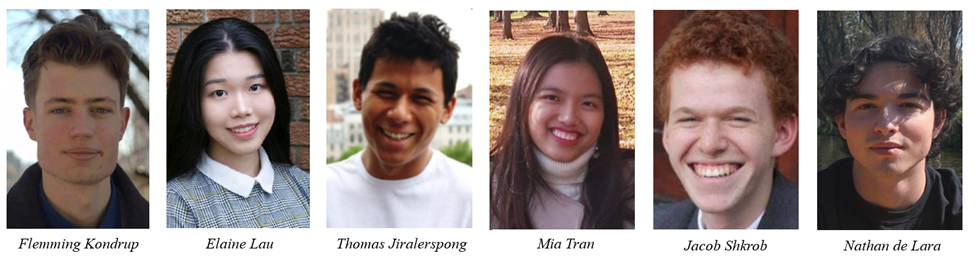
Six McGill undergrads win UofT international artificial intelligence competition

A team of six undergraduate McGill students placed first in the International Artificial Intelligence Competition ProjectX, which ran from Sept. 1 to Jan. 31. Hosted by the University of Toronto, the annual competition challenges students to develop new models of machine learning with practical, real-world applications. Of the three categories open for submissions, including clinical practice, epidemiology, and genetics, the group placed first in clinical practice and received $25,000 in prize money. 

The team worked to create DeepVent, a patient ventilator model that operates through reinforcement learning (RL)—a type of artificial intelligence (AI) that aims to recognize patterns in data to improve subsequent decision making. 

Reinforcement learning is a small, yet rapidly developing subfield of AI and machine learning. When provided with a dataset the algorithm can begin to recognize patterns so that it can learn which decisions are more beneficial to reach a certain goal, similar to the way humans learn a new skill. Reinforcement learning is the same type of AI which now holds the title of best chess player in the world.

“It’s really impossible to [teach] all the different moves in chess,” Flemming Kondrup, U4 Science student and member of the winning team, said in an interview with The McGill Tribune. “So what you do instead is you play the agent against itself, and […] it learns a general pattern of how to play. That’s how humans learn as well, [because] they develop an intuition of what’s a good move and what’s a bad move.” 

With this type of ‘intuitive’ analysis, RL can be used in medicine to learn from historical health data so that doctors can find the best, most personalized long-term treatment for individual patients. 

“RL also looks into the future, and predicts how the treatment it’s going to give now is going to affect future treatment options,” Kondrup explained. “A really good chess player doesn’t just do a move that’s good now, but sometimes they might sacrifice a move now for a better move later. And the same thing applies to health care.” 

The DeepVent team plans to use their model to regulate the dynamic ventilation needs of patients in hospital intensive care units. ICU doctors, who are often overworked and overwhelmed, may find it difficult to monitor the ventilation settings of multiple patients at once. DeepVent provides a solution to this through its personalized ventilation system that would adjust to changes in a patient’s breathing. Their results have shown a 59 per cent expected enhancement in overall treatment quality. 

“As a disease evolves, you need to adjust the settings on the ventilator,” Kondrup said.“Doctors have to constantly monitor patients and adjust these settings, and that can be pretty challenging.”

The average hospital ventilator settings include functions to manage the fraction of oxygen inhaled from the surrounding environment (FIO2), the expiratory pressure when a patient breathes out (PEEP), and the volume of air inhaled (tidal volume), all of which can impact a patient’s respiration—and as a result, their overall health. DeepVent envisions a ventilator with a built-in feedback mechanism that self-adjusts the settings without doctors having to intervene.

Another challenge the team addressed is the extensive training and experience health-care professionals need to effectively manage ventilated patients. 

“In order for a health-care practitioner to treat patients well, they need […] years of experience,” Kondrup said. “You can train AI on data of tens of thousands of patients [and] on what a real human being would need years to experience.”

As ventilators have been so central during the pandemic, it will be important to continue advancing the field of respiratory technology, both to help our intensive care units now, and into the post-pandemic future. 

“The idea of DeepVent is that instead of just focussing on the present, it tries to promote long-term health and survival,” Kondrup said.

McGill, News

QPIRG-McGill’s panel on labour exploitation at McGill discusses ongoing contract negotiations and unionization efforts

The annual Social Justice Days event series, organized by the Quebec Public Interest Research Group at McGill University (QPIRG-McGill) and the Students’ Society of McGill University (SSMU), was held from March 7 to 12. Centred on themes of harm reduction and sustainability, the series featured interactive workshops and panel discussions such as “Building care into anti-violence advocacy that sustains us” and “Supporting prisoners and parolees in their transition as returning citizens” with the purpose of engaging McGill students in community activism.

The labour crisis at McGill” panel on March 9 underscored key issues that McGill’s labour unions have faced throughout the COVID-19 pandemic. The panel brought together Evan Fox-Decent, McGill law professor and interim president of the Association of McGill Professors of Law (AMPL); Simon Deverson, chair of the McGill University Non-Academic Certified Association (MUNACA) solidarity committee; and Christian Tonnesen, U4 Science and vice-president (VP) for the floor fellows at the Association for McGill University Support Employees (AMUSE) Unit B. The featured guests each gave 10-minute speeches highlighting the changes their respective organizations are rallying toward, among them contract negotiations and unionization.

Fox-Decent kicked off the event with a presentation detailing the ongoing effort of many law faculty professors to unionize. He traced the origins of the movement to the memo Provost and VP (Academic) Christopher Manfredi sent to faculty deans and department heads on Aug. 29 requesting the names of professors who did not want to return to in-person teaching. The memo came after a group of law professors penned an open letter demanding that the university implement a campus-wide vaccination mandate soon before the Fall 2021 semester. After receiving the memo, law professors agreed that they wanted a union to represent them in their relations with the administration moving forward—which would be a more specific unit than the broader, non-unionized McGill Association of University Teachers (MAUT) currently representing them.

“The most difficult part of this for us so far has been that unfortunately, McGill is fighting us tooth-and-nail,” Fox-Decent said. “They’re challenging our bargaining unit, saying with a straight face that it should be all professors who unionize at McGill […] and that it should not be a single faculty, the Faculty of Law.” 

Quebec’s Tribunal administratif du travail (TAT) will determine whether the union will include all professors at McGill or solely law professors, with two days of hearings already completed and two more hearings dates set for this coming May.

Following Fox-Decent’s presentation, Deverson spoke about MUNACA’s contract negotiation standstill with McGill. MUNACA is a union that represents non-academic workers, such as clerical workers, librarians, and technicians. Deverson explained that the union’s contract expired in Nov. 2018, and that since Sept. 2019, MUNACA has met with McGill representatives a total of 48 times, which Deverson noted was “a large number” for such negotiations.

Some changes MUNACA would like to see in the new collective agreement include a retroactive wage increase—since employees are still being paid the salary scales stipulated in the expired 2018 agreement—pay increases that keep pace with inflation, and the maintenance of the top of workers’ salary scales. 

Deverson also mentioned that McGill did not provide MUNACA workers with a COVID-19 bonus, despite the gesture becoming commonplace in Quebec throughout lockdown periods.

“Given the labour crisis that exists in Quebec, wouldn’t it be better to have a fair and just collective agreement for its workers?” Deverson asked. “Wouldn’t that retain staff? I mean, we have people at McGill whose job title is talent acquisition advisor, wouldn’t it make their lives easier if we had good working conditions?” 

The panel then turned to Tonnesen for his presentation on AMUSE. Tonnesen explained that AMUSE comprises two units: Unit A, which represents front desk staff workers, library workers, and other similar positions, and Unit B, which represents floor fellows. While Unit A’s new collective agreement is set to be signed soon, it has been 18 months since Unit B’s previous collective agreement with McGill expired. Tonnesen explained that the money floor fellows make is insufficient as a living wage, so among other requests, AMUSE is bargaining for a pay increase. 

“As it currently stands, the money we make is not enough to cover the rent in taxes, so floor fellows are essentially working for free,” Tonnesen said. “So, the next steps as we go are to attempt to get some sort of a better pay and get our collective agreement hopefully signed such that we have full retroactivity […] and also to bring in hazard pay for those that worked during covid.” 

During the question and answer period, when asked about how McGill students can support the workers in the various ongoing campaigns, Tonnesen suggested that speaking to those with financial influence to induce change.

“McGill very much loves money,” Tonnesen said. “So, if you are dissatisfied with the way things are running, talk to someone who is paying the bill and McGill will […] respond to you [much faster].”

Off the Board, Opinion

Changing the norms of university instruction

One year into my degree, in Fall 2021, I became aware that I spent more time studying at the university of YouTube, or the university of free online textbooks, than McGill itself. 

I woke up at 5:30 a.m., a despicably early time, to watch my 8:30 a.m. lecture all the way from Vancouver Island. As I crawled out of bed and logged into the Zoom session, I made a resolution to myself that I would get my life together and start paying attention to class—unlike how I spent most of my time in previous educational institutions. I did not even make it through the first lecture of the day before I exited the class so that I could watch the lecture later at 2.5x speed.

This pattern of trying to attend lectures endured—an endless loop of getting bored watching a professor ramble on, interspersed only by two or three tidbits of information that I would actually need to pass the class.

I realized that it was McGill’s efforts toward my education that were lacking, not mine. Since there has not been a concerted effort by the university to update its outdated method of teaching, if McGill wants its students to succeed, it will need to reevaluate the actual functionality of its pedagogy rather than rely on the prestige associated with its image.

By the beginning of the following semester, I felt frustrated, overworked, and confused as to how I should be learning at McGill. This sort of frustration is common amongst many arriving at university, a transition made more difficult since it coincides with many pivotal moments of personal growth. Everyone has already spent over a decade in the school system and learning feels like it should be easy. Instead, arriving at university feels like you’re repeatedly rolling a boulder over a large mountain, only for the boulder to disappear into the aether of MyCourses.

The attachment to systems that prioritize profit and prestige over student interest makes no sense as the technological landscape has completely changed since then. We do not need to be reliable on typical techniques of in-person instruction when other methods are viable as a result of new technology. Although we received a taste of what education could be during the global pandemic, most professors seem adamant in keeping their teaching format as close to the original as possible.

This inability to adapt is not necessarily professors’ faults. A PhD does not always come with a teacher’s college diploma. Yes, they know the material in and out, but they may not necessarily have the skills to adequately share that content with other people. 

Since professors have a responsibility to disseminate their research to the public, having good public relations skills is doubly important. This means that the environments that emphasize research skills over teaching abilities in which they were able to become professors are to blame, not the professors themselves.  

McGill should perhaps consider putting more emphasis on the support component of professors’ jobs as opposed to the teaching component. One way to achieve this might be to use standardized videos or curricula for the general instruction of a course and allow professors to focus on providing tutorials. 

I am sure some people enjoy lectures and I believe that the teaching materials are extremely important. As a second-year science student, I do not need to sit in a room for an hour. Arts students, please do not harass me, as the need for in-person lectures may vary from faculty to faculty.

Instead of radically rehauling the system, steadily improving pedagogical methods would push universities in the right direction. The pandemic made us slow down and recognize what education strategies work, and which do not. Let’s hope that instead of returning back to normal, we embrace a future that prioritizes student success, rather than the model perception of success that McGill attempts to exude.

Read the latest issue

Read the latest issue