

Latest News

McGill, News, SSMU

SSMU Board of Directors postpones motion demanding president’s resignation

The Students’ Society of McGill University (SSMU) Board of Directors (BoD) convened on Dec. 2 for their penultimate meeting of the semester to address several motions. One included the re-introduction of the motion to ratify the SSMU Judicial Board’s (J-Board) final judgment on Students in Solidarity for Palestinian Human Rights McGill (SPHR) v. SSMU. The other up for ratification was the motion calling for the resignation of the SSMU president.

SPHR initially requested that the SSMU Legislative Council issue a joint statement acknowledging Nakba Day on May 15, 2021. The request, approved in a confidential session at the Legislative Council on May 13, was ultimately denied by the BoD in  a confidential discussion on May 27. SPHR submitted a petition to the J-Board to challenge the validity of this vote. The J-Board ruling called on the BoD to provide a written summary of the discussion that led them to deny SPHR’s request. 

In an updated ruling by the J-Board, it was declared that the BoD adhered to the SSMU constitution in voting against the Nakba Day motion during a confidential session. The ratification of J-Board’s final judgment between the two organizations passed with unanimous approval from the Board. “It seems, as a final judgement […] that our position was correct,” Éric Sader, SSMU vice-president (VP) Finance said. “Not passing the previous motion in the way that it was done was completely constitutional, and as such [it] stands that there was no mistake on behalf of the Board of Directors.”

Discussions then shifted to the motion approved by the SSMU Legislative council on Nov. 25 that called for the resignation of SSMU president Darshan Daryanani amid his continued absence from Legislative Council sessions and Executive Committee meetings. The BoD unanimously rejected the motion. Had it been approved, the motion would have required Daryanani to submit a letter of resignation within 48 hours of the motion’s ratification, with a failure to do so resulting in the Council calling on the BoD to initiate a special General Assembly at the outset of the Winter 2022 semester. 

During the debate session that followed, VP External Sacha Delouvrier urged the BoD not to ratify the resignation motion, arguing that it makes assumptions about the reasons for the president’s absence, which remain confidential. Delouvrier suggested that Daryanani’s case constitutes an HR issue, which should not be discussed in a public forum.

“If the board wishes to, at a separate time, move a motion to present to a special general assembly member of the executive, that’s a different story,” Delouvrier said. “I sincerely don’t believe we should go around HR matters in such a way which is why I would urge every voting director present to take a stand opposing [the motion].” 

Legislative Council representative Nathaniel Saad argued Sader and Delouvrier could have raised their concerns regarding the motion at the Nov. 25 Legislative Council meeting, a meeting that they both attended.

“As I remember, clearly they did abstain instead of bringing forward […] potential amendments or a discussion that could have been had then, so I’m […] a little confused as to why they would rather just shoot it down here.”

Sader stated he did not participate in the discussion as his responsibility as an executive on Legislative Council differs from his role as a director on the BoD.

Following a confidential discussion period, the BoD unanimously voted to postpone the motion indefinitely. 

Moment of the Meeting:

VP Student Life Karla Heisele Cubilla argued there is no need for SSMU to hire a VP Operations at this time, despite the position being vacant since 2017.

Soundbite:

“Ratifying this motion wouldn’t necessarily say that the board thinks the president has been delinquent in his duties, but rather that the Legislative Council does. [It would acknowledge] the actions that they have done in passing this motion, and by extension the will of the student body.”

—Council representative Nathaniel Saad on why he believes the BoD should ratify the motion regarding the absence of the SSMU president.

A previous version of this article incorrectly stated that Legislative Council representative Yara Coussa argued there is no need for SSMU to hire a VP operations at this time. In fact, Yara Coussa is a Director on the BoD, and it was VP Student Life Karla Heisele Cubilla who argued there is no need for SSMU to hire a VP operations at this time. The Tribune regrets this error.


Off the Board, Opinion

When Christmas isn’t how it used to be

Upon entering my go-to cafe last week, I was hit with a wave of nostalgia. Christmas music was playing and a familiar thought crept back into my mind: Christmas has not felt like Christmas to me for a while now. When familiar tunes about reindeers and Santa Claus chime from every corner, along with the incessant flashing of red, white, and green lights, I cannot help but feel nostalgic. Before I can push the thought away, I am always left wondering why the so-called Christmas “magic” is lost on me. What was it that made Christmas “feel like Christmas” in the first place?

Before the age of nine, my Christmas had religious affiliations. My parents always explained that it was Jesus’ birthday and somehow that meant we gave gifts to each other. The religious customs never stuck with me and although I observed them out of respect, they were no longer part of my Christmas experience as I grew older. What my adolescent self did latch onto was the loud, wild affair of family and relatives piling into our house to eat, drink, play games, and throw money at each other.

After I turned nine, my family moved away and though our Christmas gatherings were smaller, they were no less enjoyable. I attributed a lot of my excitement to the build-up to Christmas. There was something about scrolling through TV channels and only seeing Home Alone or Christmas specials that just made the time of year so comfortable and thrilling. Unlike Halloween, where you would not want to be any of the characters stuck in their timeline of horror, the holiday films were full of joy. I would have loved to be Danny Devito attempting to deck my house in lights so that it can be seen from space.

Now, in my 20s, I do not have the same kind of enthralled attachment to Christmas. I do not feel the same sense of anticipation. Honestly, I struggle to find what Christmas means to me now; I do not go to church, I do not have the same family traditions, and this year I will not even make it home for Christmas. I would not exactly say I have “outgrown” it––I simply do not enjoy it the way my nine-year-old self did. Maybe I never will again. But this does not have to be a bad thing, and I feel comforted that after many conversations with my friends, I know I am not the only one feeling this way.

It goes without saying, Christmas is a largely observed holiday and is practiced differently by many different people. I see it as a clear marker of time passing—like a second birthday. As we get older, we become more nostalgic each passing year and for some of us, this is amplified during the holiday season. Nostalgia is odd in the way that it can either be good or bad. Great memories make you thankful that you had them, but there is also sadness in knowing you will not have them again. The feelings that you had in that moment can never be recreated in the exact same way, and although it can be bittersweet, nostalgia is something that will always come and go—it cannot be avoided. As long as time keeps moving forward, Christmas will always come around to remind me of a time I cannot go back to.

So, even if I cannot replicate the Christmas celebrations of my childhood, nostalgia ensures that my experiences were fulfilling enough that I both remember and miss them. I do not exactly aspire to “make something out of Christmas again.” Simply knowing that I did love it at a time in my life is enough for me.

Science & Technology

Seeing double: An overview of cloning, past and present

The scientific tool of cloning, which allows humans to duplicate organisms, has soared since the birth of first-ever mammalian clone Dolly the sheep. But how has this now commonplace discipline evolved, and where might it head in the future? Scientists must continue to grapple with the ethics of such a sensitive subject, especially considering cloning’s growing potential as a commercial endeavour.

In essence, to clone an organism, scientists take the desired genomic material from a somatic cell and insert it into an enucleated oocyte—or a female sex cell whose nucleus has been removed—in a process called somatic cell nuclear transferase (SCNT). 

“This is the fundamental principle of cloning from somatic cells,” Vilceu Bordignon, an associate professor within McGill’s animal science department, in an interview with The McGill Tribune. “It has to go back to the cytoplasm of the oocyte.” 

Despite the variety of highly technical methods available, such as powerful microscopes, stereoscopes, or even “handmade cloning,” Bordignon points out that one of the most complex parts of the cloning process is related to the oocyte itself.  

“The protocols for using in vitro [are] not as good in vivo because there is a part of the development that is made in oocytes that we still don’t know what it needs, and what the oocyte stores into the cytoplasm,” Bordignon said.

For this reason, Bordignon mentioned that even if scientists select the best candidate for an oocyte, the cell could still be missing some key components that are essential for controlling development.  

“The real factors affecting these reprogramming efficiencies are epigenetic factors,” Bordignon said. Epigenetics is the study of how the environment influences gene expression without altering the DNA sequence.  “For example, one of the experiments we’ve done is produce 25 piglets from the same cell culture, so […] theoretically, they are identical twins, but if you look at them, just at the difference in the size and the difference in the viability, you reasonably understand that just having the same genome sequences is not enough to make an identical animal.”

Though many epigenetic mechanisms are poorly understood, Bordignon remains hopeful about the prospects of applying scientific knowledge to improve the efficiency of cloning. 

“The message is simple. The more we understand how the cell differentiates, which pathways [it] controls, and how they restrict the functions to become specialized, the more we can understand how to act on those pathways to bring them back to an embryonic state,” Bordignon explained.

Similar protocols for cloning have been applied in other fields, like plant science. Though the ancient use of clonal propagation in plants—taking branches or pieces of a plant to regrow the species as its own organism—replaces the direct need for SCNT, the science of cloning and epigenetics can help create transgenic plants, which have a variety of applications. 

Jean-Benoit Charron, an associate professor in the Department of Plant Science at McGill, explained that, similar to cloning processes conducted in animals, scientists must use undifferentiated cells—grouped in a mass called a callus—to effectively create a plant with an altered genome that can be passed down to future offspring. 

“The oocyte is reproductive tissue […] that can allow the genetic information to pass to the next generation,” Charron said in an interview with the Tribune. “With plants, we do exactly the same thing. If you just [alter] a leaf, you will […] transform that leaf for the time that it is alive. The callus [is] a tissue that has the possibility of transferring the genetic information that you are adding to the next generation. The overall strategy I would say is identical.” 

Applications of these laboratory processes are simultaneously expanding, especially in the domain of transgenic crops. 

“The first wave of transgenic produce that were put on the market was mostly to […] help the grower achieve a higher yield at a reduced cost,” Charron said.  “So now we’re seeing a wave […] where we are trying to improve the nutritional value of all of the products and all the produce, or to limit the losses due to pathogens. And to do this, […] they take a wild variety that resists well to a virus or pathogen, they identify the gene responsible for that, and they transfer this gene into [another variety].”

While Charron says that transgenic crops would still take a couple of years to produce, when it comes to improving crop yield and resilience, the applications are endless. However, such tools can lead to unintended negative consequences when used to attack one specific problem 

“A transgenic plant producing an insecticide that kills insects reducing the yield of the crop […] was mostly to reduce the production cost,” Charron said. “This worked so well that it created a lot of monoculture, so people started to depend a lot on this.” 

Though transgenic crops have already been integrated into industrial farming, the use of cloning has not been similarly implemented, likely due to the continuing ethical debate surrounding it. Among its prospective uses, though, is the creation of superior livestock for meat and the potential to rescue endangered species. 

“Breeding is just a way to reprogram the genome and produce the next generation, and we can achieve that by cloning as well. Should we or should we not clone for production perspectives?” Bordignon asked. 

Bordignon went on to say that when the FDA compared the alimentary products of cloned animals to regularly farmed ones, they did not find any significant difference in nutritional value. Charron says that genetically modified organisms (GMOs) present in crops are also unfairly stigmatized despite the DNA alteration being so minuscule. 

“Instead of a big chunk of the chromosomes being transferred, here we are transferring only a thousand base pairs,” Charron said. “It’s surgical, almost. At the end [of the day], DNA is DNA.” 

As cloning technology grows more sophisticated, different industries can apply it towards new commercial endeavours. For a considerable price, many companies now offer cloning to pet owners who wish to create a genetic twin of their cat or dog. One such company is ViaGen Pets, which extends cloning services not only to pet owners, but also to zoos and wildlife conservation groups. 

“We have many clients who wish to enjoy a genetic twin to a beloved companion animal. This is an amazing opportunity if you think about it,” a spokesperson for ViaGen Pets said in an email to the Tribune. “A cloned companion animal is not the same animal, but shares many of the same traits [….] We also utilize our resources to help in the world of conservation where we work closely with […] conservation-minded groups.” 

While there are certainly positives to such technology, whether we are capable of handling it responsibly remains to be seen. Evidently, cloning and similar technologies, such as those involved in the creation of transgenic plants, span a large range of practices and are considerably difficult to evaluate ethically. These questions remain unanswerable for now and require additional research and consideration before implementing cloning technologies into new contexts, whether it be in the corn fields or at the pet store.

Album Reviews, Arts & Entertainment

‘Donda (Deluxe)’ is hardly an upgrade

Choosing to not leave his fans waiting, Kanye West released the deluxe version of his album Donda on Nov. 14, 11 weeks after the original, adding five new tracks. This release reinvigorated fans’ appetite for Ye, but only one memorable song serves to fill it; the new tracks leaving listeners only partially satisfied and with an unfulfilled desire for more.

“Life Of The Party” is the strongest of the new tracks. The production is both a new direction and a return to form for Kanye—the beat is melancholic and minimalist, with a chipmunk soul sample layered beneath a jazz bass and subtle soul beat. André 3000 and Kanye’s verses stand in a stark, yet harmonized, contrast. André’s muted, free-flowing delivery gives way to Kanye’s verse; his entering line “Straight from Shibuya, on some zen” has a hard-hitting cadence evocative of Late Registration-era Ye. The emotionally charged lyrics seamlessly combine with the beat into a song destined for the repeat button. 

“Up From The Ashes” and “Never Abandon Your Family” are certainly interesting, but not incredible. While the tracks’ themes of religious renewal and family are profound, the songs themselves fail to stand out, lacking a distinct sound or character. 

In true Kanye fashion, the last two tracks seem to be included for reasons other than musical value. “Remote Control pt 2” shortens Kid Cudi’s verse for the sole purpose of extending the infamous “Globglobgabgalab” sample. “Keep My Spirit Alive pt 2” is simply the version included on the original song’s release with KayCyy featured on the chorus; Kanye originally replaced these vocals with his own for undisclosed reasons. While fans of Kanye’s humour may appreciate the comedic value of the extended sample and fans of KayCyy’s vocals may be satisfied, the updated tracks fail to add anything new. 
While Donda (Deluxe)’s new tracks do not detract from the original album, they fail to contribute to it in a meaningful way. The new songs feel tacked on, with only “Life Of The Party” distinguishing itself. A deluxe album should seek to add musical value to an album, not just more tracks; Donda (Deluxe) fails to contribute much of either.

Science & Technology

Cloudberry 101: The ecology of the urban squirrel

Although the eastern grey squirrel (Sciurus carolinensis) is native to eastern North American regions such as Montreal, their adaptive traits allow them to thrive elsewhere, like British Columbia or Europe, where they are categorized as an invasive species. Despite their name, some have dark brown or black coats. But common to each, regardless of colour, is their most notable feature: Big, bushy tails. The etymology of the word “squirrel” comes from the Greek skiouros, from skia, meaning “shadow,” and oura, meaning “tail,” presumably in reference to the shade their fluffy tails cast while they sit with them tucked above their heads.

Do they take a winter break?

Not quite. Eastern grey squirrels do not hibernate in the winter, but they are less active. They bulk up, eating in excess to put on fat in advance of the colder months to weather frigid nights and foraging sessions. In addition, their fur gets thicker and longer, and they may move from summer leaf nests to insulated dens in the hollows of trees. 

Chowing down

The eastern grey squirrel has a versatile palate, allowing them to thrive in multiple habitats, including urban ones. As the seasons change, so do their diets. They forage for nuts, seeds, buds, and the flowers of trees, but they are not herbivores, as some might believe—baby birds, eggs, insects and worms are also on the menu. Bird feeders also act as veritable seed buffets, especially in winter when food is scarce. Even as they raid feeders, eastern grey squirrels play an important role in seed dispersal, as they bury more nuts and seeds than they can inevitably eat or recover. Contrary to popular belief, they do not find their stashed goods through memory, but with their highly developed sense of smell.

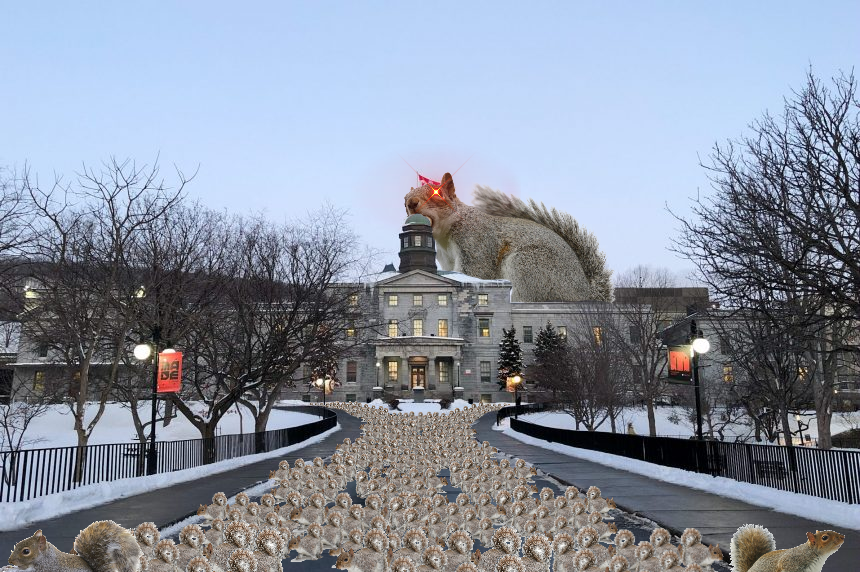
(Corey Zhu/ McGill Tribune)

Squirrely behaviour

It is also the eastern grey squirrel’s sense of smell that allows them to communicate amongst each other, primarily through twitching and chattering noises. Although generally not aggressive, they are territorial, and will alert nearby squirrels if they sense a predator nearby. Since the eastern grey squirrel can travel up to 25 kilometres an hour, they are often spotted whizzing around campus. The flight initiation distance, or distance from which an animal will flee from perceived danger, is shorter with urban squirrels because they are more acclimated to the presence of people and are therefore unafraid to get close to humans if it means snagging a snack.

What about Cloudberry?

Cloudberry is a white squirrel made popular by the McGill Reddit page, where students share photos of sightings. In North America, white squirrels are very rare—but most still count as eastern grey squirrels. There are a few different genetic aberrations that can cause the pale coats. Some white squirrels are albinos, meaning they have a mutation on a gene that codes for pigmentation and thus possess red eyes in addition to pale coats. Others are white morphs, who have a different mutated gene which leads to a partial loss of pigmentation, called leucism. Unlike albinos, they retain their black eyes. Cloudberry is not an albino squirrel, but a leucistic one. 

Run, Cloudberry, run

Although leucistic squirrels usually do not survive long in the wild since their white coats make them ultra-visible to predators, many still thrive in urban spaces—and the McGill campus, with its proximity to Mont Royal, green space, and food sources, is no exception. Despite these benefits, the eastern grey squirrel has many defence mechanisms to help protect it from predators. When climbing or descending a tree, they move head first, which allows them to slide inconspicuously around the trunk to keep out of the sight of danger. Alternatively, they can remain motionless against the bark, which makes them difficult to see. Even if a predator catches them, eastern grey squirrels are willing to lose their tail sheath and some vertebrae to escape. For this reason, it is not uncommon to spot a squirrel with only a partial tail.

Martlets, Sports, Volleyball

Martlet Volleyball ends 2021 on a high note, beating Laval 3-2

The McGill Martlets (7–3) faced the Laval Rouge et Or (6–4) in their second meeting of the season on Nov. 28. With persistence and pace, the Martlets emerged victorious. Winning three sets to two, the result placed them third in the RSEQ standings, now two points ahead of Laval.

During their first meeting of the season on Oct. 29, Laval won three sets to one. Charlene Robitaille, a fourth-year nutritional science student and middle blocker for the team, remarked that targeted practice has allowed the team to improve since then.

“For the last two weeks, we really concentrated on defence, being aggressive on the first contact, and improving serves,” Robitaille said in an interview with The McGill Tribune. “Last month, when we faced Laval, our serves were easy to return so they were in control. It was a great win tonight and the goal is to continue to practice a lot and to fight, be present, and stay together.”

The match was a hard-fought battle that sent spectators on an emotional roller coaster. The Martlets came out strong in the first set with a quick 6-3 lead, sparking confidence in the team as they dominated the set 25-17.

The second set proved to be a closer competition as the Rouge et Or adjusted—the two teams were neck-and-neck. The Martlets were relentless as their eyes glared with hunger for victory. However, after a Laval time-out, the Rouge et Or regrouped and came out to win the second set 26-24.

With the teams tied 1-1, McGill found a way to break through Laval’s defence, which led to a dominant 25-13 set win for the Martlets. Second-year setter Audrey Trottier had a great impact in the third set, making an amazing block followed by a spike of her own, leading Laval to call another timeout.

Though McGill was looking for the game-winning set in the fourth, the Rouge et Or fought hard to stay in the game. Miscommunication from the Martlets resulted in a 26-24 Rouge et Or set win to force a fifth set. Nevertheless, the Martlets proved that they came to win as they maintained a lead throughout the whole set (15-12) to seal their seventh win of the season.

Two incredible performances paved the way for the Martlet victory: Charlene Robitaille had herself a game, stacking 15 kills with a whopping 0.414 hitting percentage along with four aces. Victoria Iannotti, a third-year software engineering student and power-hitter for the team, led the team with 19 kills on a 0.372 hitting percentage and 16 digs.

Coach Béliveau was pleased with the team’s performance, but noted that there is always room for improvement.

“Today my team did an outstanding job on defence, it was amazing,” Béliveau said. “We still have a lot to improve. I am happy with our serving. Our digs were good today but I think we can do a little better towards the centre of the court eventually. I am happy to see improvements in aspects that we worked on.”

The Martlets will now have a little over a month off from competition before taking on first-place Sherbrooke on Jan. 7.

Moment of the Match:  Third-year Victoria Iannotti buried a huge spike at the end of the fifth set to clinch the win for the Martlets.

Quotable: “For many players, because of the pandemic, it was their first time stepping on the court. They did really well under this pressure and I am happy we came out with the victory.”

-Coach Béliveau on the team’s performance.

Stat Corner: The team had a season-high 57 kills and 73 total points.

Read the latest issue

Read the latest issue