


Latest News

Off the Board, Opinion

Learning to live and love through art

I cannot count the number of times I’ve remarked, “That changed my life.” It’s an exorbitant phrase, one that apparently—so I’ve been told—shouldn’t be used so casually when discussing art. I toss it around with nonchalance, proclaiming it at any mention of works that I adore. Accusations of recency bias have thus hounded me, my incessant passion denounced a diminishment of true artistic merit or simply something impossible to feel at every artistic turn. 

There’s also the allegation of the phrase’s hyperbole: Do I exaggerate? Do I announce everything as my new ‘favourite’ to construct my changing preferences as an illusion of progress? If only it were so simple.

Art—music, film, writing, visual culture, and everything in between—has meant so much to me for as long as I can remember. It has taught me to fall in love with life, through the ways it thrills and warps and wounds and inspires. For me, the statement, “That changed my life,” is never an exaggeration. That is what art is for. 

A few years ago, I read Richard Powers’ novel The Overstory, and—you heard it here first—it changed my life. Growing up in Northern California, I was constantly surrounded by the landscapes of towering trees; douglas fir, eucalyptus, and redwoods cascade through the sweeping turns of my childhood memory. Powers’ book sets its narrative within these familiar environments, weaving together the enduring presence of trees with human existence, as humanity sowed its harmful roots into the earth. I’d go through my days thinking about the trees’ witnessing eyes as I rode the MUNI bus through Golden Gate Park. The storms that washed branches and logs into the street as obstructions became a reflection of the trees’ ubiquitous becoming and death. It was an embarrassing realization, really, taking for granted something that so often surrounded me. 

The Overstory made a mark on me. It demonstrated that artistic narratives had the power to infuse intense emotions into even the most common part of everyday life. Powers’ environmental novel transformed the way I saw my home, my childhood, and the trees in my garden whose shadows grew alongside me.

Art makes visible within me the emotions I would have never known were present. Music, especially, confronts its audience with intimacies of the artist’s mind, for its power is to harness sincerity and intention through an auditory soundscape. Magnificent songwriting elucidates this navigation of emotion and life: Joni Mitchell’s sombre Blue and Kara Jackson’s reflective Why Does the Earth Give Us People to Love? are exquisite records that colour my perceptions of experiencing love and loss as a young person.

Unpalatable art also makes me love the world, in all of its complex states. Art isn’t just beautiful, nor does it have to be, as it demonstrates all the facets of our complicated world. It can be putrid and vitriolic; still and smooth; boisterous and unforgiving. It is anything the artist could possibly want it to be. Being shown this sense of interiority through art is what makes one feel less alone in our increasingly fragmented world.

The twanging teardrops of Bill Callahan’s melody in “To Be Of Use” are aching, haunting listeners with its sorrowful soundscape. Singing of his desires for purpose—almost to the point of commodified surrender—Callahan’s self-portrait is far from enjoyable. And yet, it lingers constantly in my mind with its uncompromising tenderness.

Creation puts a mirror to our reality as an intimate exploration of humanity’s endlessness. We experience so much in accessing art; it’s a privileged glimpse into our own interior lives that we could never begin to comprehend without it. For me, the creation of melody, visual art, or fictive narrative makes tangible the complicated nature of my own existence. In living within the worlds constructed by artistic visions, I come closer to finding myself in what feels like an unrelenting vastness.
It’s difficult to fully encapsulate into words all that art can do for a person. However seemingly minuscule its effects, it’s never wrong to proudly proclaim its influence on one’s personhood. “That changed my life” is never an exaggeration if it did, in fact, change your life. Through art, we know so many lives—first and foremost, our own.


Science & Technology

Immortal time bias: A source for inaccuracies in cancer prevention research

Cancer is one of the leading causes of death, and as such, cancer treatment and prevention research has been a large focus of medical professionals worldwide. Over the past few decades, several studies have proposed that metformin—a medication widely used for type II diabetes management—is a potential preventative measure for cancer. 

Unfortunately, the truth is not so glamorous. A recent study published in the Journal of Clinical Epidemiology and led by Samy Suissa, a professor in McGill’s Departments of Epidemiology and Biostatistics and Medicine, sought to put misleading claims about metformin to rest. 

“Many studies were appearing reporting that metformin, a treatment for diabetes, could lower the rates of several different cancers,” Suissa wrote to The Tribune. “What got us interested in this issue is that the reported reductions in cancer in these studies were spectacular, simply too good to be true.”

But what caused the misinformed results from these studies in the first place? Suissa traced the misleading results to a study error known as ‘immortal time bias,’ which can inflate the perceived effectiveness of a drug. He pointed to misinformation surrounding metformin and breast cancer as an example.

“Immortal time bias occurs when follow-up of breast cancer patients starts before they initiate metformin treatment. So those that receive metformin are ‘immortal’ between the start of cancer and the start of metformin; they must be alive to receive the metformin.” Suissa wrote. “The problem with immortal time bias is that all these studies started at breast cancer, but then looked at metformin use in the future, thus inherently giving a survival advantage to the women who start metformin.”

In other words, not every breast cancer patient survives long enough to actually reach the point of beginning metformin medicine. However, researchers may retroactively look at metformin use in breast cancer, and not account for the time in the interim when patients stayed alive while not using metformin. In this case, it could seem as though the metformin had a hand in treating the cancer, when in reality it was only useful for those who were able to live long enough to reach the point of taking it. This bias mischaracterizes the effectiveness of metformin as a breast cancer treatment.

Most earlier studies on metformin were observational, with no randomization occurring, and researchers only monitored the health progression of their patients without intervening. As such, Suissa stressed the importance of randomized trials—when participants are distributed by chance into different treatment groups—for producing accurate, unbiased results.

“Many scientists started to conduct randomized trials of metformin as a treatment for cancer, with the largest involving 3,600 women with breast cancer,” Suissa wrote. “Half received the usual treatment for breast cancer along with metformin, while the other half received the usual treatment. They were followed for more than five years and the study found no benefit for the metformin group.” 

Suissa has already begun examining potential misinformation in other major pharmaceutical drugs, and emphasized that both observational and randomized trials are necessary to reduce medical and scientific misinformation.

“Many such flawed studies are now appearing in many medical journals on the potential extracurricular benefits of GLP1 receptor agonists, the family of drugs that the popular Ozempic belongs to,” Suissa wrote. “The studies are also suggesting that these drugs are very effective at reducing all kinds of diseases, including cancer [….] Before expensive randomized trials are undertaken to test this hypothesis, we are undertaking properly done observational studies using rapid cutting-edge methods to confirm that the hypothesis is tenable. We wish to ensure that any time-consuming randomized trials are based on solid data and avoid a repetition of the metformin failure.”

Suissa’s studies will prevent future misinformation regarding drugs such as Ozempic. This will ensure that Ozempic and similar pharmaceuticals are only prescribed for conditions that they are completely able to alleviate or prevent.

Commentary, Opinion

Quebec independence will not solve climate change

Hundreds of Quebec separatistspredominantly younger Quebecers—gathered in Montreal on Oct. 25 for a rally reaffirming their desire for independence 30 years after the 1995 Referendum for Quebec sovereignty, which failed by less than one per cent. 

The young Quebecers at the front of this movement not only argue that secession would better protect the French language, but also that it would power climate action. The latter justification demonstrates a frustration with Canada’s ineffective and increasingly destructive climate policies. While this dissatisfaction is understandable, demanding independence for the climate agenda overlooks the need for collective action in climate protection, and fails to consider the social and economic consequences intertwined with the creation of a sovereign Quebec—setbacks which will, in fact, exacerbate climate inaction. 

Émile Simard, leader of the youth wing of the separatist Parti Québécois, stated that it was nonsensical that Quebecers had to contribute to Alberta’s large fossil fuel industry through taxes. Complicity with the destructive national energy sector appears to be an important concern for young protesters, with some even referring to Canada as a ‘petro-monarchy.’

Sovereignists view independence as an opportunity for Quebec to disentangle itself from involvement in Alberta oil production, which accounted for 84 per cent of national output in 2023. However, they fail to recognize that Quebec’s departure will not stop Canada from remaining a major actor in climate change. 

In their urgency to lead environmental initiatives, young Quebecers lose sight of the necessity of cooperation in effective climate action. ‘Separatism for climate sustainability’ sends the message that climate change is better addressed independently, thereby undermining the international community’s commitment to collective action for ecological protection. 

Emphasizing the importance of cooperation to fight climate change is critical now more than ever: President Donald Trump withdrew the United States—the second-largest greenhouse gas emitter in the world—from the Paris Agreement last January. More recently, he refused to send a delegation to the COP30 launched on Nov. 10. Economists say American disengagement from the Paris Agreement could reduce global emission //cuts// by about a third

Rhetoric preaching secession for climate protection does not have its place in a context where division could sabotage a union’s efforts towards a pressing goal. Rallying for Quebec separatism in the name of more effective climate action is misguided; it rationalizes the easy way out of the laborious task of collaborating with other provinces to achieve salient environmental progress. 

Additionally, nothing guarantees that a sovereign Quebec government will tackle climate change. The creation of fundamental institutions and infrastructures, such as an army, a potential new currency, new trade deal negotiations, and international agreements—because of their indispensability in a country’s operation—will most likely take precedence in the Quebec political agenda. Moreover, Quebec will have to face complex financial challenges: Negotiating its share of the national debt and assuming its costs, managing uncertain investors, and living without federal transfers

These political and financial difficulties would be compounded by preexisting issues. Between the housing crisis, the doctor shortage, and inflation, independence seems risky—but outright utopian if one expects it to also adequately revolutionize the way the government approaches climate action. Right now, environmental protection is urgent, and a major political transition does not promise favourable grounds on which to rapidly build sustainable environmental governance.

The Parti Québécois is currently pushing for a new sovereignty referendum in 2030. This initiative is supported largely by the younger generation: Polls show that almost half of Quebecers aged 18-34 would vote in favour. Nonetheless, when surveying all Quebecers, two-thirds say they would oppose independence. More than half of Quebecers believe that sovereignty would harm public finances and would not improve health and educational services. Evidently, regardless of the climate-centred rationale, Quebec independence is not a priority for the majority of Quebecers. 

However, renewed calls for sovereignty reflect widespread discontent with governance and its inaction on addressing climate change. Although Quebec independence might be unfeasible, the reasons driving the protests underline legitimate frustrations with Canada’s flippancy toward the environment—concerns that the federal government must address proactively and wholeheartedly. 

Arts & Entertainment, Dance, Music, Pop Rhetoric

KATSEYE represent exploitation masked as progress

Since their 2023 debut, KATSEYE have skyrocketed into the mainstream. After a year of silence, the group resurfaced in 2025 with their second EP, Beautiful Chaos. Their hyperpop sound, paired with intricate choreography, marks a departure from their previous K-pop-inspired, teen girl music and aesthetic. Fans often celebrate KATSEYE as a symbol of empowerment, but the group’s carefully manufactured image raises questions about how much agency the members actually hold.

The group was created by HYBE—the South Korean entertainment giant behind BTS and TXT—and the American record label GEFFEN. KATSEYE’s formation was documented in Netflix’s Pop Star Academy: KATSEYE, which explains how a handful of trainees went through an intensive training and development program, packed with singing, dancing, and performance lessons. After over a year of rankings and monthly evaluations, 20 girls were selected by the producers to advance to the global survival show, The Debut: Dream Academy. The finalists were pitted against each other in a popularity contest for a spot in the six-member group. The final group consists of Daniela Avanzini, from Atlanta with a Cuban and Venezuelan background; Lara Rajagopalan, from LA with Indian roots; Manon Bannerman, from Switzerland, born to Swiss-Italian and Ghanaian parents; Megan Skiendiel, from Hawaii with Chinese ancestry; Sophia Laforteza, from the Philippines; and Yoonchae Jeung, the only member born and raised in Korea.

From the start, KATSEYE’s most marketable quality has been its diversity. The six girls come from diverse ethnic and national backgrounds, attracting a broad international audience as each member proudly embraces their cultural identity. HYBExGEFFEN have co-opted the demands for diversity—a significant absence in K-pop—to expand their global reach. The members’ different backgrounds are marketed as proof of progressiveness, instead of addressing the industry’s exploitative power imbalances, tokenistic use of diversity, and beauty standards imposed on female idols.

Though KATSEYE were designed to globalize the K-pop methodology by stripping the Korean from K-pop, their popularity is built not only on talent but also on the immense corporate machinery shaping their every move. The KATSEYE brand, which is centred on inclusivity, is a facade for capitalist greed—exploiting the hard work and pain of the girls who make up the group.

On their second EP, KATSEYE embraced more mature sounds and visuals. Their image, like countless other girl groups, is inseparable from the commodification of the female body. “Gnarly,” the lead single of their EP, was the catalyst for this provocative rebranding. The music video and song are meant to be off-putting and ‘cringey,’ while refusing to shy away from the sexual innuendos. With the choreography incorporating twerking, porn soundbites inserted into the soundtrack, and a visual of bees having sexual intercourse, it is clear that the members’ sex appeal is a crucial selling point of the group. This serves as a reminder that the talented girls who make up KATSEYE are merely employees whose songs are written and choreographed by professionals, whose outfits are chosen by stylists, and whose image is crafted by executives. This commodification of sex becomes more unsettling upon realizing that the youngest member of the group, Yoonchae, is still 17 years old. 

Their corporate partnerships reinforce this dynamic, especially their recent collaboration with GAP. The “Better in Denim” ad campaign presents a dichotomy between the ideal of global cooperation that KATSEYE embodies and the very product they promote: A fast-fashion company built on an underpaid, exploited workforce with high environmental costs. With new sponsorship, partnerships, and ad campaigns every other month, KATSEYE increasingly serves corporate interests. Their racialized bodies are treated as marketable assets, revealing the moral decay embedded within the global pop music industry.

Ultimately, KATSEYE represent the contradiction of global pop: A celebration of womanhood, diversity, and hard work, all while constrained by the structures of capitalism and the male gaze. The success of this girl group proves that diversity is not enough to dismantle these systems of oppression. KATSEYE shine on the global stage, but its brilliance only reveals how much of pop’s empowerment is scripted.

Basketball, Behind the Bench, Sports

Canadian talent shines in 2025-2026 NCAA women’s basketball

The highly anticipated National Collegiate Athletic Association (NCAA) college basketball campaign resumed on Nov. 1. With a six-month-long off-season, NCAA fans are eager to return to the craziness that defines Division I (D1) college basketball in the United States. 

With the public rise of star players in the Women’s National Basketball Association (WNBA) like Caitlin Clark and Paige Bueckers, NCAA women’s basketball has also seen a recent increase in viewership and popularity. According to ESPN, the 2024-2025 women’s NCAA season finished with 8.5 billion total minutes of viewership, the second-most on record. 

Amid rising interest and investment in women’s collegiate-level athletics, the NCAA has also seen a surge of Canadian women’s basketball players. The league offers players competitive and professional opportunities—such as playing for historically significant schools, gaining exposure to WNBA scouts, and securing name, image, and likeness deals—that provide athletes with additional income. However, major league success is not guaranteed for NCAA athletes, who must navigate intense pressures both on and off the court. 

This season, more than 150 Canadian women student-athletes are playing D1 basketball in the NCAA. Here are five players to pay extra attention to during the 2025-2026 season.

Cassandre Prosper

Prosper, a six-foot-three guard from Montreal, is returning for her final season with the University of Notre Dame Fighting Irish. Last season, she was one of only two athletes to appear in all 34 of the team’s games, showcasing her reliability and consistency on the court. So far this year, Prosper has averaged 19.0 points with a field goal percentage of 66.7 per cent, making it her best season yet. Beyond college basketball, Prosper has also represented Canada at multiple levels—U17, U19, and on the senior Canadian national team—earning a bronze medal with Team Canada at the 2023 Fédération Internationale de Basketball (FIBA) AmeriCup.

Toby Fournier 

Fournier is looking to build on her impressive momentum as she enters her second season with the Duke University Blue Devils. The 10th-ranked prospect in the ESPNW 2024 class, the Toronto-born forward made an immediate impact in her freshman year, earning the title of Atlantic Coast Conference Rookie of the Year as she led the Blue Devils in scoring, field goal percentage, and free throws made. She also helped Team Canada earn a bronze medal in the 2023 FIBA U19 World Championship. In Duke’s dominant home opener this season, Fournier put on another standout performance, scoring 27 points—just one shy of her career high.

Jasmine Bascoe

Bascoe, a five-foot-seven guard from Milton, Ontario, began her basketball journey at King’s Christian Collegiate. She committed to Villanova University’s Wildcats last year, averaging 16.2 points a game. Bascoe’s stellar performance earned her All-BIG EAST First Team honours, and she was selected as a member of the All-BIG EAST Freshman Team. Under her leadership, the Wildcats have opened their 2025-2026 season with a 2–2 record, signalling a promising year ahead.

Sisi Eleko

This Montreal-born, six-foot-two forward played basketball at Saint-Laurent High School and New Hope Academy before committing to Canisius University in 2022. Eleko quickly became a standout player and earned a spot in the All-Metro Atlantic Athletic Conference team. Seeking new challenges and opportunities for growth, Eleko transferred to Eastern Michigan University last year, where she made an immediate impact. Starting in 27 of 28 games, Eleko led the Eastern Michigan Eagles, averaging 17.9 points and 10.1 rebounds per game.

Delaney Gibb

Earning the title of unanimous Big 12 Freshman of the Year last season, Albertan Gibb hopes to continue her success with the Brigham Young University Cougars this year. Like many of the standout Canadians making an impact in the NCAA, Gibb has also represented Canada across multiple youth levels of the national women’s program; she shared the court with Prosper as teammates during the 2023 FIBA Americup. The Cougars have pounced on this season with a 3–0 start. Gibb’s leadership will be key as they look to maintain this early success.

McGill, News

Senate passes amended Student Code of Conduct following months of deliberation

The McGill Senate convened on Nov. 12 for its third meeting of the academic year. Senators engaged in debate over proposed revisions to McGill’s Code of Student Conduct and Disciplinary Procedures, ultimately passing an amended version that removed Board of Governors (BoG) oversight from the Committee on Student Discipline (CSD), which implements the Code.

The meeting began with memorial tributes to Professor Erika Giselle, librarian Tatiana Bedjanian, and Professor Deborah Danoff. McGill’s President and Vice-Chancellor Deep Saini then discussed Quebec’s multi-year Immigration Plan for 2026-2029, which will maintain existing international student quotas. Saini expressed disappointment that the provincial government did not exclude graduate students from these quotas or reopen the Quebec Experience Program pathway to permanent residency for recent graduates, as McGill had recommended.

Most of the session focused on proposed revisions to the Code of Student Conduct, presented by Interim Deputy Provost of Student Life and Learning, Angela Campbell. Campbell emphasized that the Code’s revisions aimed to reflect deliberate consultation, engagement, and compromise with the McGill community.

However, Jérémy Boulanger-Bonnelly, assistant professor in the Faculty of Law, immediately moved to amend the proposed code, explaining why he sought to remove any references to BoG involvement from the document.

“This amendment […] would give the Board of Governors a veto over the appointment of members of the CSD,” Senator Boulanger-Bonnelly said. “The Board has consistently failed to justify in any compelling manner [why these changes are necessary].”

BoG Chair Maryse Bertrand defended the Board’s involvement, citing numerous incidents involving ‘angry mobs’ on campus that have prompted concern from McGill’s administration.

“The Board has heard complaints […] from students who would rather spend their entire semester attending remotely, rather than face what they call a hostile or poisonous atmosphere in their faculties,” Bertrand stated. “The Board cannot and will not do nothing in the face of these new and unprecedented disruptions.”

Boulanger-Bonnelly’s amendment, which would remove Board involvement from CSD appointments, passed narrowly with 38 votes in favour, 34 against, and 6 abstentions. He then proposed a second amendment to maintain the Code’s current ‘knowingly’ intent standard—which requires proof that a student was aware their conduct would cause the specific result they are being penalized for—rather than the newly proposed ‘unreasonableness’ standard, which only requires that student conduct seriously deviate from what a ‘reasonable’ person would do for them to receive discipline. 

Supporters argued the lower standard for punishment could discourage freedom of expression and assembly, particularly for protest-related offences. The Senate defeated the amendment in a majority vote.

After a failed motion by Vice-President Administration and Finance Fabrice Labeau to postpone the vote on whether to adopt the new Code indefinitely, the Senate heard final comments on the revised Code.

Saini warned that the updated Code may be read as a breach of power by McGill’s administration.

“[The amended Code] could be interpreted as the Senate overriding the statutes and […] seeking to regulate the authority of the [BoG],” he said.

In response, Catherine Lu, professor in the Department of Political Science, emphasized that the Senate did not intend to cause any conflict with the Board of Governors by amending the Code.

“I really would resist any kind of interpretation that somehow made this about winning or losing, because we’re all going to win or lose based on credible, convincing arguments,” she stated. 

Ultimately, the revised Code of Student Conduct passed with 44 votes in favour and 18 abstentions. 

Moment of the meeting: Associate Professor in the Faculty of Engineering, Ipek Türeli, read a statement from her Palestinian colleague in McGill’s Faculty of Medicine and Health Sciences, who described experiencing anti-Palestinian racism on campus and called on the university to recognize its role as a silent witness to violence.

Soundbite: “I came here in support of my colleague, Senator Boulanger-Bonnelly’s, motions. I got the result that I wanted on the first motion. I didn’t get the result that I wanted on the second motion. On a balance, I’m going to vote for the Code [….] I’m prepared to respect the work that was done.”—Víctor Muñiz-Fraticelli, associate professor in the Faculty of Law, on navigating disagreement through the Senate’s democratic process and on avoiding postponing a vote on the Code.

McGill, Montreal, News

Montreal REM opens 14 new stations amid STM service disruptions

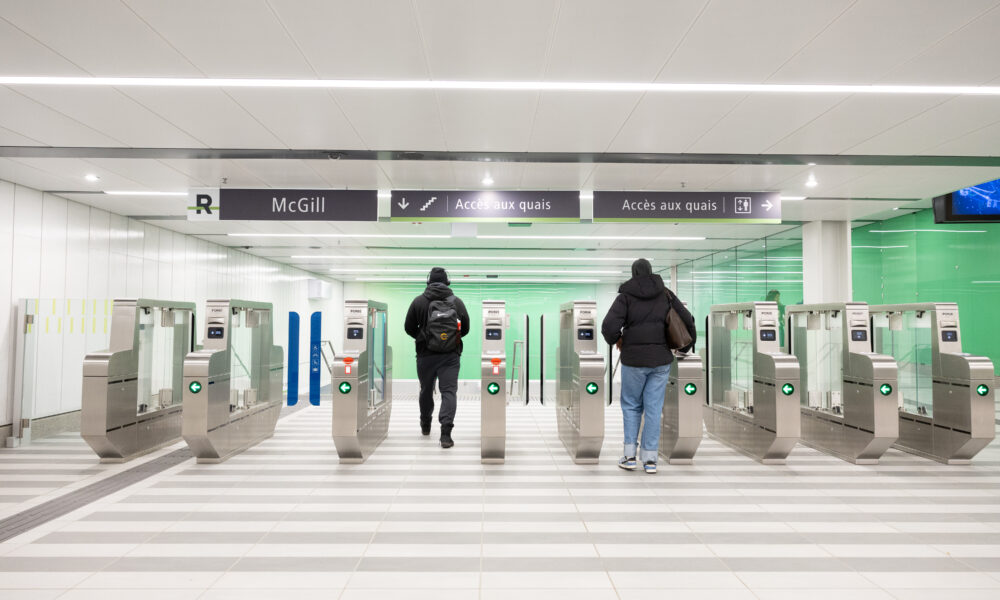
The expanded Réseau Express Métropolitain (REM) network officially opened on Nov. 17, unveiling 14 stations that stretch service from Montreal’s South Shore up to Deux-Montagnes. This expansion includes a newly shared McGill station, now a stop on both the REM and the Société de transport de Montréal (STM)’s metro lines.

The REM, a driverless light-rail system operated by private corporation CDPQ Infra, first opened in 2023 with just five stations between Brossard and Gare Centrale. Its new launch unfolded amid STM strikes that have caused disruptions in metro service, including a full shutdown of the system on Nov. 1.

For many South Shore commuters, the REM expansion marks a welcome improvement. Aïsha Nsiempba, U3 Accounting, takes the light-rail daily from Brossard to downtown Montreal and McGill’s main campus. In an interview with The Tribune, she explained how the REM allows South Shore residents to reach their destinations faster.

“I am pleased with the recent expansion of the REM, as it makes my commute more convenient and shortens travel times to areas that used to take over an hour and a half to reach,” she said.

Despite the REM’s convenience, Nsiempba expressed concern over how it has eliminated other transportation alternatives for many South Shore commuters.

“The buses that used to take us from the South Shore to Montreal were completely cut and replaced by the REM, which would have been acceptable if the [REM] system had worked optimally from the start,” Nsiempba continued.

Privately operated, the REM has a non-compete clause with Montreal’s public transit systems that prevents the REM from operating along existing municipal transit routes. In the wake of the REM’s frequent service disruptions, commuters therefore have no alternative option to get to Montreal—other than driving. Doreen Assaad, the mayor of Brossard, has called for the reinstatement of several express bus lines as a solution. Meanwhile, REM officials claim, moving forward, their system should experience shorter wait times if service interruptions occur.

In an interview with The Tribune, Meredith Alousi-Jones, PhD student at McGill’s School of Urban Planning and graduate research assistant with Transportation Research at McGill (TRAM), offered insight into how the surrounding environments of the new REM stations affect use of the system. Local government investment, which varies by municipality, strongly influences whether a station supports increased ridership and economic activity in the region.

“Ease of access to stations is a key factor in travellers’ choice to take the REM,” Alousi-Jones explained. “Features such as well-connected sidewalks, nearby activities and services, and efficient transfers between modes [of transit] can all encourage REM use.”

Alousi-Jones also explained how introducing another transit solution to the greater Montreal area can help increase social accessibility.

“At TRAM, we conducted a survey in June during the first [STM] strike and found that [its] negative impacts were particularly pronounced among women, low-income individuals, and people living with disabilities,” Alousi-Jones explained.

She stressed that the extra costs of Ubers, taxis, and BIXIs can put a financial strain on people as their everyday expenses increase. 

“Circumstantial switches to other travel modes during these strikes such as vehicles, walking or bicycles, can become more permanent,” Alousi-Jones added.

In an interview with The Tribune, Students’ Society of McGill University (SSMU) Vice-President University Affairs Susan Aloudat explained that the SSMU is committed to supporting students’ transportational expenses to counteract STM service disruptions. During the most recent strike, students could request reimbursement for these expenses by submitting transportation payment receipts through a designated form. 

“Examples of acceptable submissions [included] BIXI fees, rides between campus and your home address, parking passes, or other transportation passes,” Aloudat said.

Alousi-Jones emphasized that despite the coincidental expansion of the REM while the STM was on hold, reliability, not ownership structure, will remain the key factor in how riders judge transit quality.

“Since fares are aligned across both systems, riders will expect comparable levels [of] high-quality service,” she highlighted.

Nsiempba expressed cautious optimism that the new line will make getting to campus even a little easier.

“I plan to continue using the REM and hope it keeps improving,” she said. “It seems to be on a positive trajectory, and I genuinely hope that continues.”

Arts & Entertainment, Music

Georgia Harmer brings audience home at Montreal stop on her Canadian tour

When I entered Georgia Harmer’s show this past Thursday, Nov. 6, I was shocked to look around and see no one at all. That is, before I glanced down and noticed concert-goers sitting in groups on the hardwood floors of Sala Rossa’s upstairs venue. As I walked among the crowds, I overheard conversations in both French and English as the concert melded together members of both the anglophone and francophone Montreal communities. 

I took my seat among the gaggle and waited for Georgia Harmer’s opener, Sister Ray—the stage name of Toronto-based Métis singer-songwriter Ella Coyes—to begin. Eventually, she came forward and, in an instant, warmed up the space. Like rapt children, concert-goers gathered cross-legged at her feet as she sang songs from her 2025 album, Believer. While Coyes sang bittersweet lyrics from tunes such as “Animal Thing” and “Magic,” the space around us sprouted a familial feeling. Her bold intimacy and willingness to banter with the crowd transformed Sala Rossa, making it feel more like a cozy living room than a concert hall. 

Before performing the title song of her album, “Believer,” Coyes shared the story behind it, recounting her relationship with a man twice her age, whom she had kissed only twice within their year-long relationship. The crowd’s whooping was followed by a laughing bite back from Sister Ray, saying, “Don’t cheer for that!” 

After Sister Ray’s homey acoustic performance, the crowd warmed up and stood in anxious anticipation for the evening’s headliner: Georgia Harmer. The Toronto singer-songwriter stepped to the stage flanked by Canadian bandmates:  City and Colour’s leader Matt Kelly on guitar and pedal steel, Manitoban bassist Kris Ulrich, and Toronto drummer Dani Nash

Harmer kicked off the set with her self-proclaimed favourite song from her 2025 summer album, Eye of the Storm: “Farmhouse.” The track describes an idealized farmhouse representing nostalgia for the good days of a now-failing relationship. She sang to the audience members with a clear voice, accompanied by the tap of her black-booted foot. 

Inciting her set with a song describing the comfort of a house, she picked up where Sister Ray left off, continuing the theme of home for the evening. This idea is maintained throughout Harmer’s music. She jived on stage and sang “Home early with the flu / Your parents pick us up from the airport,” from her song, “Can We Be Still.

In an interview with The Tribune, Harmer articulated why she chose to emphasize the theme of home in her music.

“In my mid-twenties, I still feel like I am coming of age, and I think a lot of that is looking for where home is,” she said.

As a fellow Ontarian, Harmer’s music presented a specific kind of home to me, with her songs evoking a familiar landscape, even mentioning Kingston in one of her songs. While speaking with The Tribune, Harmer expressed what it means to belong in the Toronto music community. She shared that this sense of place extends beyond Ontario to Montreal, admitting to concertgoers that she had spent one semester studying at McGill before dropping out to pursue music. Harmer situates herself within the Canadian musical tradition, both in her lyrics and in the Toronto music scene, as well as in every Canadian city she visits while touring. 

She expressed to The Tribune that, for her, the biggest way home shows up is in people. This was apparent in the energy she felt with bandmates, particularly guitarist Kelly, who is, in fact, her romantic partner. 

“For me, a lot of my songs are about people, and they are very relational, and I think you can have homes in people,” Harmer said. 

As Harmer played out her encore, the title song of the album “Eye of the Storm,” audience members danced all together, singing and stomping their feet. In that moment, it was clear that, for the night, under the blue and pink lights of Sala Rossa, we had all found a home within one another. 

Arts & Entertainment, Books

‘Best Canadian Stories 2026’: In the Shadows of Apocalypse

The lived reality of an apocalypse is a daunting thought, yet one that BiblioasisBest Canadian Stories 2026, edited by Zsuzsi Gartner, confronts at length. The collection gathers a world of beautiful and provocative literature, each unique in writing yet united by shared thematic currents. Apocalypse—destruction on a catastrophic scale—appears here as an everyday occurrence, with stories exploring friendship, loneliness, and the stubborn resilience of life. Gartner’s collection puts the stories in conversation, creating new meanings between them while introducing readers to the breadth of talent in the Canadian creative writing landscape. 

The collection opens with Rishi Midha’s “We Are Busy Being Alive,” which follows a newly affluent family struggling to understand one another and their place in their community. Midha undermines their self-image as activists by repeatedly reminding readers that their mansion sits at a crisp 64 degrees during a brutal heat wave. The upheaval around them is not explicitly described, highlighting the family’s privilege to drift in and out of movements while maintaining their ability to fall asleep comfortably every night. Their shallow bond introduces a question that recurs throughout the anthology: How does connection exist in times of difficulty? 

Kaitlin Ruether’s “A Language of Shrugs and Sparks” turns to the digital world as an escape from the loneliness of reality. Ruether infuses every sentence with vitality and motion as she describes a woman who pours her energy into a vibrant virtual life, while her physical existence remains still and stagnant. Her only tangible relationship is unstable and shallow, thus emphasizing her need for an online community of anonymous friends. 

Alex Leslie’s “The Formula” similarly explores the strangeness of connection. Two teenagers forge a deep bond, united by their shared experiences, yet unable to communicate directly. Instead, they rely on their perfected formula of emoji strings meant to convey all that cannot be said. 

The space between words is further explored in Margaret Sweatman’s “Sounding a Name,” which creates kinship without familiarity. This story examines an anonymous connection between two people visiting Russia before the war with Ukraine. Their friendship is built on witty remarks and dark humour, supporting the sporadic sharing of fragments of identity. Their friendship offers both of them solace, yet never comfort. The looming war creates an ominous atmosphere around the story, yet Sweatman only mentions it a sentence at a time, allowing dread to fester beneath the narrative.

The beauty of community is best explored in Bill Gaston’s “Jack’s Christmas Dinner,” a touching tale of found friendship. In a cold town during Thanksgiving, a solitary man’s eccentric neighbour prepares a feast out of roadkill. An eclectic group forms around the holiday, united simply by their desire to attend. The effects of the pandemic and the man’s fractured family life cast a shadow of loneliness that the feast ultimately dissolves. Even the revelation that the presumed turkey is actually a vulture does not spoil the evening but instead amplifies the strange yet tender charm of strangers becoming unlikely friends. Gaston’s warm and witty writing makes this story a standout in the collection. 

The anthology closes with Julie Bouchard’s “What Burns,” a tale that boldly confronts the climate crisis rather than placing catastrophe in the background. No longer is societal destruction backgrounded in favour of succinct plots and individual character arcs. A cool, objective tone weaves statistics into an account of forest fires and arson. The narrator introduces a mystery, yet deliberately refuses to deliver narrative satisfaction, insisting that the climate crisis outweighs any one person’s story. By switching between first, second, and third person narration, Bouchard merges reader and narrator, revealing the frightening truth that we will all eventually face the climate apocalypse. 

As an art form, the short story collection uniquely allows readers to sample many authors while creating a discourse between each tale. This anthology is enjoyable to read, and I found myself wanting more from the selected authors.

Opinion

A clerical error calls Election Canada’s dedication to democracy into question

In the 2025 Canadian federal election, the Liberal Party won the riding of Terrebonne by a single vote, with Bloc Québécois as the runner-up. However, a clerical error returned a mail-in ballot to a Bloc Québecois voter. This administrative fault, framed by judicial bodies as a mere unintentional mistake, has the potential to not only obstruct the accuracy and fairness of the Terrebonne race, but sets a precedent that minimizes the cruciality of honest elections.

Since this vote could have altered the outcome of the election, Bloc Québécois candidate Nathalie Sinclair-Desgagné argued that the result should be annulled, positing that not counting a vote constitutes a violation of that voter’s Charter rights. The judge ruled against her, stating that there was no malicious intent and that there was therefore no obstruction of election integrity. 

Allowing this result to stand is not merely unjust but undemocratic, and could set a dangerous precedent that allows improper elections to be validated. Flaws in our electoral system are inevitable, but rather than neglecting those mistakes, Elections Canada should be doing everything in its power to make sure that when those inevitable incidents occur, they do not affect electoral outcomes.

In an era where online conspiracies around elections are widespread, it is imperative that Elections Canada remains a neutral and effective electoral body. Claims of fraudulent elections have grown increasingly common around the world in the past few years. Infamously, right-wing insurgents stormed the United States Capitol on Jan. 6, 2021, in an attempt to overturn the results of the 2020 election—which rioters claimed was rigged. Then, in 2023, an almost identical insurrection took place in Brazil, clearly demonstrating the damage incited by a mistrust in the electoral process.

Democratic elections are supposed to be both free and fair. A free election is one where all voters can vote for the candidate of their choice. A fair election is one where all votes are counted equally. Hungary’s elections are free but not fair. Turkey’s elections are fair but not free. Elections in the Jim Crow South were neither fair nor free. The 2025 Canadian Federal Election was free—there was no voter coercion towards any party. Yet because a vote was not counted, this election was not fair. 

Elections Canada has a track record of miscounts and errors, one they must compensate for with thoughtful, targeted solutions to clerical errors like those within the Terrebonne election. In the October 2024 elections in British Columbia, Elections BC forgot to count an entire extra box of ballots, leading to conspiracy theories that the BC New Democratic Party fabricated election results in the extremely close election.

In the 2025 federal election, Elections Canada closed several remote polling sites in northern communities due to inclement weather, preventing people from voting as there were no other polling stations nearby. While Elections Canada offers a weather contingency plan on its website, it must also invest in sufficient infrastructure to support voting in all remote communities.

With Canadian electoral mistrust and political polarization on the rise, it is Elections Canada’s responsibility to prove to the Canadian people why it deserves to be in charge of one of the most important functions of our democracy—elections. Determining the extent of an election’s error should not be a question of intent or malice, but a question of fairness.

By neglecting Sinclair-Desgagné’s deciding vote, the ruling judge is sending the message to Terrebonne that unfair elections and undemocratic outcomes are acceptable as long as those outcomes were unintended. Failing to penalize—and be proactive about preventing—anti-democratic election activity on the basis of subjective perceptions of intent is a deeply flawed principle. The law does not carve out exceptions for good intentions; Canada’s democracy should not be any different.

Read the latest issue

Read the latest issue