


In the year 2080…


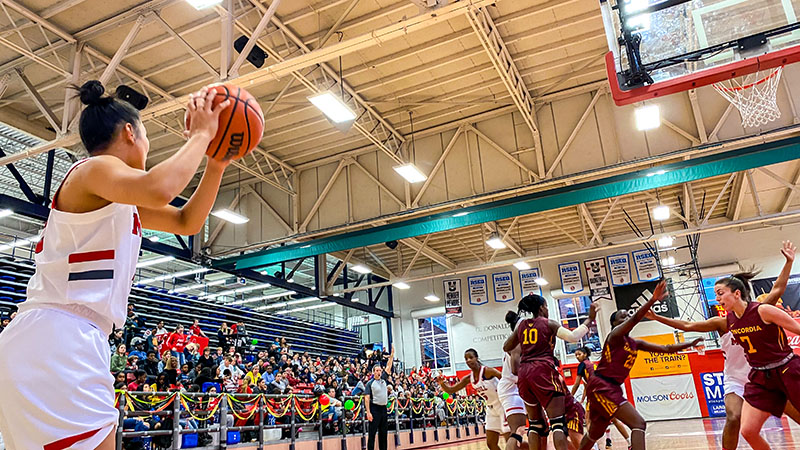
The McGill Men’s Hockey team (16–11–1) lost on Feb. 9 to the Ontario Tech University Ridgebacks (13–15) by a final score of 5–3 in a nail-biting home game filled with highs and lows. Despite strong efforts from McGill in the first and third period, the home side could not overcome the flurry of shots that bombarded first-year goalie Emmanuel Vella.
The first period started with sloppy play from both teams. McGill and the Ridgebacks turned the puck over frequently and struggled to get any shots on net. It was only halfway through the first period that both sides sharpened their play and started getting direct shots on goal. With eight minutes remaining, second-year forward Jordan-Ty Fournier scooped the puck up behind the net and wrap it around the post into the goal past the unsuspecting Ridgeback goaltender. McGill closed out the period with a strong show of offensive strength, dominating possession and getting several shots on net.
Momentum quickly shifted, as the Ridgbacks came out strong in the second period. Ridgeback forward Austin Eastman snuck a quick wrist shot past Vella just one minute into the period. The next 10 minutes were gut-wrenching for McGill fans: The Ridgebacks rarely gave up the puck and managed shot after shot, eventually resulting in another goal for the visitors.
Frustrations were running high: Several near-fights and jawing matches popped up in the last five minutes of the period, as the Ridgebacks continued their stretch of offensive dominance.
Fresh out of the locker room, the Ridgebacks started the final period strong, scoring their third goal just 53 seconds into the period. However, fortunes quickly shifted in favour of McGill. They dug in their heels, got scrappy, and cleaned up their passing. Third-year forward Antoine Dufort-Plante capitalized on energy and dinged one in with 16 minutes remaining in the third period. Fournier followed up 32 seconds later, scoring off a slap-shot from the blue line.
Unfortunately for McGill, their good luck did not last. Despite offensive control throughout the third period, they could not convert, failing to put the puck in the net for the rest of the game. With just under seven minutes remaining, the Ridgebacks scored a quick wrist shot off the top of the net. McGill upped their pace and eventually pulled Vella to add an extra skater, but they were unable to use the added pressure to score a goal. Ontario Tech scored once more on an empty net in the final minute, ending the game in a loss of 5–3 for McGill.
Nonetheless, Fournier is optimistic about McGill’s chances heading into the playoffs.
“You know, I think we could have done better, but we have a shot at redemption in the coming weeks,” Fournier said. “We might be playing them in the playoffs,”
Head Coach Liam Heelis reflected on the positives he took away from the game.
“I thought our guys did a good job being resilient and trying to edge our way back into the hockey game,” Heelis said. “I think that’s an important characteristic of our team and think our boys have shown that all season.”
With just under 15 minutes remaining in the third period, second-year forward Jordan-Ty Fournier hit a slap shot from the back right offensive zone to bring McGill back from an initial deficit of 1–3. This came hot off a goal from third-year forward Antoine Dufort-Plante at the 16 and a half minute mark—an exciting moment for a crowd of enthusiastic McGill fans.
“I think this is a team that people have to be worried about. We’ve battled adversity all year, and come playoff time it’s not gonna change. We have one of the most talented groups of guys in there. I’d say come watch, come support the team, It’s gonna be a fun few weeks.” – Second-year forward Jordan-Ty Fournier on McGill’s prospects in the postseason.
First-year goalie Emmanuel Vella set a McGill record for goaltender assists in a single game, assisting two of McGill’s three goals.
In the complex circulatory system of the human body, no artery is as vital as the aorta. This large vessel takes oxygen-rich blood from the chambers of the heart and delivers it to the brain, muscles, digestive system, and other sites of metabolism in the body. Aortic aneurysms, one of the leading causes of death in Canada, occur when the aortic wall is weakened and bulges out, causing the vessel to rupture.
To treat aortic aneurysms, doctors commonly use grafts to patch the weak points in a vessel with a more rigid material. Despite this life-saving procedure, in most cases, these prostheses are only a temporary fix. Complications can arise from surgery or from the graft itself, and the suture between the aorta and the graft is sometimes a source of postoperative infection.
According to Dr. Marco Amabili, a professor in the Department of Mechanical Engineering at McGill, prosthetics currently on the market are too stiff to properly mimic a human aorta.
“Since the present grafts don’t expand at all, they induce several cardiovascular problems for patients,” Amabili wrote in an email to The McGill Tribune. “It’s the equivalent of implanting a sick aorta instead of a healthy one.”
To address this issue, Amabili and a team of researchers are investigating the dynamics of the aorta. By observing the contracting vessel at rest and high-activity states, they are attempting to determine the best way to construct future vascular grafts.
“The main goal was to identify the dynamic material properties of the human aorta and how these vary with age,” Amabili wrote. “Identifying these parameters is necessary for developing the future generation of grafts for aortic repair, which can mimic the native behaviour of the aorta.”
The study, published in Physical Review X, found that aortic dynamics differed significantly with age: The aortas of younger donors’ hearts expanded up to 10 per cent while pumping blood, compared with just two per cent for older hearts. This finding demonstrated the stark difference between the properties of a human aorta and a standard graft, which does not expand in response to blood flow.
“Our system is capable of accurately reproducing the physiological conditions after precise tuning of the expansion chambers and the resistance valve at each heart rate,” Amabili wrote. “We tested from 60 beats-per-minute [BPM], which is obtained at rest, to 180 BPM, which is obtained [during] very intense sport activity.”
To do so, researchers first connected the aorta of a donor heart to pressure and flow sensors. An adjustable pump stood in for the heart itself, aided by expansion chambers and a valve to mimic the normal conditions of blood flow.
Using four Doppler lasers that measure circulation changes in tissue, the apparatus could calculate the aorta’s varying diameter and pulse over time.
Previously, the only scientific data on aortic dynamics was from ultrasound measurements while patients were at rest. The novel experimental design allowed Amabili’s team to access results from a wide range of heart rates.
In addition to their remarkable discovery, the team compiled empirical data on the aorta’s viscoelastic properties, which are the features of the vessel that exhibit both elastic and viscous behaviour when deformed. This data will provide the foundations for future graft prototypes.
“We hope that our research will lead to better aortic prostheses that will improve surgical outcomes, as well as patients’ quality of life long-term,” Amabili wrote. “Expanding researchers’ knowledge on the dynamics of the human aorta may also further clinicians’ understanding on the development and progression of vascular pathologies.”
It is clear that climate change—or, more appropriately, the climate crisis—is a defining issue of this century. However, it is not yet clear what the solutions to this human-made crisis are. Carbicrete, a company founded by McGill alumni Chris Stern (BEng ‘94) and Mehrdad Mahoutian (Ph.D 2014), is undertaking the ambitious task of redefining one of the most overlooked sources of carbon dioxide emissions: The concrete industry.
Concrete is essentially composed of three basic ingredients: Water; an aggregate, such as gravel, sand, or rock; and cement. The preferred choice of cement in the construction industry today is Portland cement. While cheap and readily available, Portland cement also has a major downside: Its production process is one of the world’s single biggest emitters of carbon dioxide.
To counteract the ongoing climate crisis, scientists agree that carbon dioxide emissions from building materials such as cement must be reduced. But with a material as ubiquitous as concrete, it is impossible to stop using it cold turkey.
In an interview with the The McGill Tribune, Stern, the CEO of Carbicrete, explained how a different manufacturing technique that uses an unexpected byproduct of industrial manufacturing can eliminate the carbon dioxide emissions of concrete production.
“Steel slag, which is a byproduct of the steel-making process, could be used instead of Portland cement to produce a stable carbonate, which is necessary as a binder in concrete,” Stern said.
Using steel slag, Carbicrete is attempting to eliminate Portland cement in manufacturing. The company’s goal is based on Mahoutian’s past research at McGill, which focussed on replacing Portland cement in the concrete production process.
According to Stern, Carbicrete is not only eliminating carbon dioxide emissions but also storing carbon dioxide in their finished product, making Carbicrete’s concrete carbon negative.
“In a regular concrete block, which weighs 18 kilograms, about two kilograms by weight is Portland cement,” Stern said. “By eliminating that cement from the production, which we do by replacing it with steel slag, we eliminate that source of carbon dioxide emissions.”
To produce the binding carbonate, steel slag must react with carbon dioxide, which could be taken from emitters such as fossil fuel power plants. Since Carbicrete is still in its pilot phase, the details on how to implement this carbon-storing strategy on an industrial scale have yet to be finalized. Still, Stern is optimistic about the company’s future.
“We are still trying to figure out how we are going to get large quantities of carbon dioxide to use for production,” Stern said. “One potential scenario is steel plants [….] There’s already the steel slag coming as a byproduct from the manufacturing, and then there is the carbon dioxide from smelting. Add it together, and you’ve got a product [….] It’s like Christmas Day.”
Start-ups like Carbicrete allow freedom to develop innovative products in a work environment different to that of larger companies. For students, Stern stressed the importance of taking a leap of faith and carving your own career path.
“Any student who wants to do something different instead of working for some big company shouldn’t hesitate,” Stern said. “I wouldn’t say working for big companies is a waste, but it isn’t for everyone. Had I known [this] when I graduated from McGill in 1994, I would have done things differently.”
The power of a convincing story often goes overlooked in the scientific community. While most researchers opt to display their findings in flashy publications or high impact journals, others are taking a less traditional but conceivably more impactful approach at communicating their findings.
Story maps are a simple yet elegant way for scientists to literally ‘map out’ research results. Gail Chmura, a professor in the Department of Geography and a specialist in biogeography and paleoecology, has done just that. Last week, Chmura and colleagues published two interactive story maps on the McGill Geographic Information Systems (GIS) website about the endangered Maritime Ringlet butterfly and carbon stores in the Bay of Fundy.
Chmura has been working in Atlantic Canada for as long as she can remember, specifically on salt marshes, a little-known natural resource that has immense consequences for endangered species conservation. Salt marshes are coastal wetlands flooded by tidal sea water. The unique daily drainage and flooding regimes of salt marshes make them a one-of-a-kind habitat for many of Canada’s rarest and most endangered plant and animal species, including the Maritime Ringlet.
One story map takes users on an interactive tour of Chaleur Bay in northern New Brunswick, the sole place on Earth known to support Ringlet butterflies. With every scroll, readers become further immersed in the wonderful world of salt marshes and the creatures that call them home.
“We proposed the idea of the story map because Environment and Climate Change Canada’s HabitatStewardship Program for species at risk is also very concerned with outreach,” Chmura said in an interview with The McGill Tribune. “Part of it was getting the public to care about salt marshes [… so they might] be interested in protecting them.”
Users are seamlessly introduced to the Ringlet, its specialized life-history traits, and how the salt marshes of New Brunswick are uniquely situated to support the species.
“Warning!” reads one frame of the story map in a cautionary tone. “To maintain this fragile species requires protection of its habitat and avoidance of activities that disturb its sensitive larval stage. Thus, walking on the marshes where it lives should be avoided.”
Story maps are a relatively new methodology for creatively displaying research findings. In the last five years, companies such as ESRI and design studios like Northwestern University’s Knight Lab have made available software packages that make it easy to create story maps on any computer.
Similar to any new digital tool, however, story maps pose their own set of challenges.
“One of the bigger struggles with these [maps] is to make them readable,” Chmura said.
Questions such as simple colour scheme and language choice are common dilemmas faced by first time story map creators, who have the task of making results engaging and understandable for a wide audience. For Chmura, this audience was primarily conservationists, but she also acknowledged that story maps have immense potential as an educational tool.
As water levels rise, marshes are moving inland and establishing new habitat spaces for species like the Maritime Ringlet, while pre-existing environments are flooded and lost. Chmura was frustrated by conservationists’ efforts to buy land that, in the near future, would be worthless for protecting these species.
“I was concerned with making sure [that conservationists] prioritized [marshes] properly,” Chmura said. “You want a marsh that has a future.”
Story maps and their distinct interactive character could be one of the most effective tools for conservation biology. At the intersection of art, digital media, geography, and conservation, the possibilities for story maps are seemingly endless, limited only by human imagination and the initiative of scientists who seek to tell a good story.
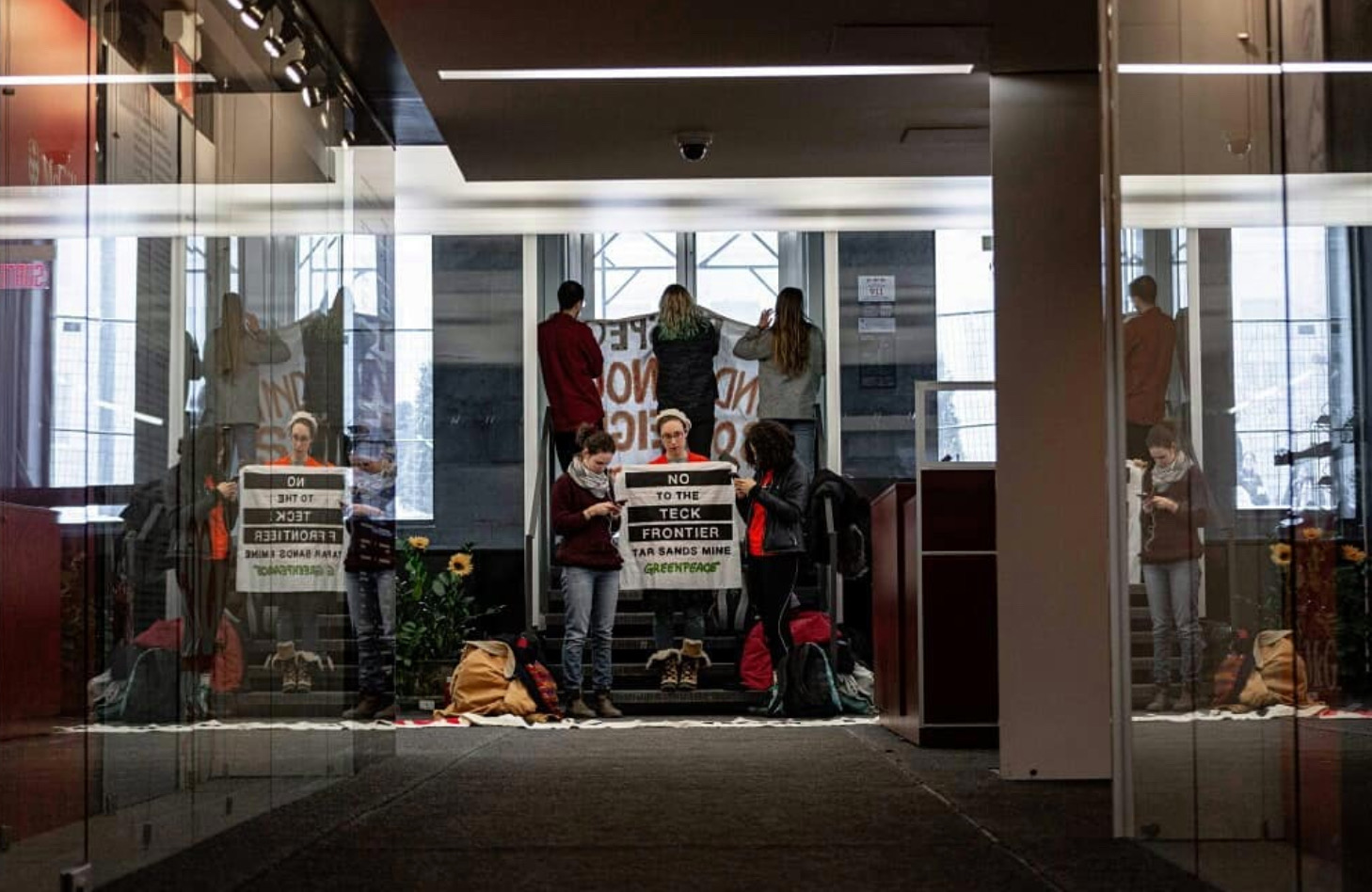
Across Canada, students are mobilizing in solidarity with the Wet’suwet’en Nation in British Columbia (BC) that is resisting a Coastal GasLink pipeline project. The Royal Canadian Mounted Police (RCMP) raided and arrested protestors late on Feb. 6, enforcing a Dec. 31 2019 Supreme Court ruling that granted Coastal GasLink an expanded injunction. On Feb. 7, McGill students organized a sit-in at Prime Minister Justin Trudeau’s constituency office in Villeray.
Catie Galbraith, co-Chair of the Indigenous Student Alliance and member of the Chickasaw Nation of Oklahoma, explained how the sit-in is part of larger resistance movements across Canada and the US.
“We’re here sitting in today in solidarity with the Wet’suwet’en and all the other folks who are resisting the RCMP on their land, we’re here as part of a broader solidarity movement,” Galbraith said. “There’s been a number of Indigenous solidarity movements across Turtle Island, both in Canada and in the US, so we just wanted to do what little we can while we are […] here so far away [from B.C.]”
Ella, a recent McGill graduate and organizer of the sit-in, described the planning and purposes of the demonstration.
“[A sit-in] was the only thing I could do this morning, to be somewhere to show Canada somehow that I hate [Canadian authorities], or that I’m unhappy with how […] they are not listening to Indigenous folks,” Ella said. “I need to be here, I need to be somewhere [We] stand in solidarity with the Wet’suwet’en peoples, and fuck the RCMP.”
Ella went on to explain that the sit-in was not a protest.
“We’re not protestors,” Ella said. “This is literally my life. I don’t protest. I don’t want my family to die, I don’t want my kin to die, I love my land, and I’m just done.”
Amy Edward, a Kanienʼkehá꞉ka student, believes that the sit-in is a larger movement to both honor their ancestors and protect future generations.
“It’s important to understand that Indigenous peoples are protectors,” Edward said. “We come here today in respect with a good mind and good heart. Even though we are rageful, we, as Indigenous peoples, always will remain respectful because that’s the way of our ancestors [We] are strengthened by the people seven generations before us, and our actions are for the goodness and the wellbeing of our kin seven generations from now. We’re not acting just for the peoples of today: We act for the wellbeing of our future.”
The sit-in is only one example of the numerous displays of solidarity with the Wet’suwet’en Nation on-and-off campus. Extinction Rebellion Quebec held a demonstration that started in Kanesatake and marched to the Montreal RCMP office. The day after the initial RCMP raids of Feb. 7, there was a vigil at Place des Arts. Most recently, on Feb. 10, there was another sit-in at Trudeau’s constituency office from 3 – 5 p.m. According to Galbraith, Indigenous resistance is stronger than ever.
“Between this, and between the Oka Crisis, and all of the incredible displays of sovereignty, I think we’re at a turning point where Indigenous people are stronger now than they’ve ever been in terms of asserting their sovereignty,” Galbraith said. “Everyone should pay attention and support however they can.”
Galbraith explained the numerous ways students can continue to support the Wet’suwet’en Nation in their efforts against Coastal GasLink, the RCMP, and the Canadian government.
“Call your [Member of Parliament], call the BC RCMP office, call the government, call anybody you can, call any of your representatives, and if you are capable, offer financial support […] to the Unist’ot’en camp,” Galbraith said. “Raise awareness through social media [and] get the word out.”
McGill Engine and Promoting Opportunities for Women in Engineering (POWE) hosted a panel featuring McGill Engineering alumni who spoke about their experiences with entrepreneurship. Specifically, the panel consisted of three women, including Boyana Stefanova (BEng’07), Naureen Anwar (BEng’10), and Laura Al Khoury (BEng’17), who reflected upon their successes, failures, and challenges thus far as leaders and innovators.
During the panel, the speakers shared tips with the audience based on their past mistakes. Al Khoury, co-founder of Yuma, a service that provides convenient meal plans for companies and their workers, emphasized the importance of maintaining positive relationships with customers, especially in the early stages of a new company.
“At the beginning, the most important thing is observing your customers’ problems,” Al Khoury said. “Understand these problems and solve them as fast as possible.”
Anwar, CEO of Name Shouts, a company that provides the proper pronunciation to over 360,000 names based on native speakers, also highlighted the importance of accessible and consistent communication with customers.
“Our first mistake is that we didn’t talk to our users as much as we should have,” Anwar said. “[That is] a mistake that I see many other entrepreneurs make.”
Al Khoury and Anwar encouraged aspiring entrepreneurs to build networks with investors frequently and early on, as initial financial backing is crucial to entrepreneurial success.
“It is important to build relationships from the first day on,” Anwar said. “[Investors] give money to people whom they trust, and it is up to us to build that trust.”
The panelists also reflected on their time at McGill and suggested changes they would make given a chance to go back to university.
“As an entrepreneur, it is important to be a storyteller,” Anwar said. “In terms of what [the Faculty of] Engineering didn’t give, I would definitely go back and get a degree in philosophy or art or literature.”
To Al Khoury, the McGill community itself was a valuable place to meet like-minded peers, as she now realizes that much of her current team are McGill alumni.
“[Campus] is where I built my initial network,” Khoury said. “If I could go back, I would spend more time building that network [because] I wouldn’t be where I am today without it.”
On the other hand, Stefanova, the Community Builder at Mouvement des accélérateurs d’innovation du Québec (MAIN), an ecosystem of Quebec-based startups, praised Montreal for its diverse resources and abundance of young entrepreneurs. She urged the crowd to pursue their ideas with confidence.
“[Montreal] is really quite a collaborative space,” Stefanova said. “There’s always a way to find people to jump into your project.”
Al Khoury pointed to the strict discipline required to truly succeed as an entrepreneur, something which university students might not be exposed to.
“In university, we’re generally not disciplined at all,” Al Khoury said. “The only consistent aspect of being an entrepreneur that I see is being very disciplined [but] making that shift is very hard.”
While each panelist has found success in entrepreneurship, women entrepreneurs still face discrimination in the workplace. For Anwar, who leads her company with another woman, the challenges she faces go beyond daily interactions and are deeply rooted in society.
“Sometimes we can give our 120 per cent but […] the system is against you,” Anwar said. “We still have lots of work to do.”
The event concluded with a word from Janna Augustin and Michaela Deneva, members of Front Row Ventures, a student-run venture capital fund in Canada.
Augustin and Deneva are also leaders of the Women Founders Project, an initiative that provides female entrepreneurs with workshops, master classes and panels. Together, they hope to educate and support young entrepreneurs in their initial journey.
“[We will] have general discussions about identity, what it’s like to be a woman in that space,” Deneva said. “We are aiming to address the most common challenges that founders, especially female founders, can encounter.”
On Jan. 31, the McGill Students’ Cancer Society (MSCS) invited students to run around McGill’s favourite finals room for 12 hours straight for their seventh annual Relay for Life. After months of promotion and organization, the night kicked off at 8:30 p.m. with a welcoming ceremony and the introduction of the event’s many teams. By reaching out to other universities around Montreal, club coordinators brought together students from Concordia, UQÀM, McGill, and other schools in the area. Many of these students rallied behind creative movie-based names including “Harry Potter and the Goblet of Life” and “Eat, Pray, Run!” Working closely with the three Canadian Cancer Society representatives supporting the university’s chapter, MSCS sought to raise awareness for contemporary cancer research, pursuing an ultimate goal of $30,000.
The overwhelming support from both the executive team and participants spoke volumes to the committed members of the Montreal community dedicated to fighting cancer. Spectators set up picnic blankets, sleeping bags, and lawn chairs to last through the night. Food was provided by a myriad of local sponsors such as McGill’s own Student Housing and Hospitality Services and Deville Dinerbar. Allegra Mendelson, U3 Arts and MSCS president, showed enthusiasm about the growing support of external sponsorships over the years.
“It’s unparalleled, we have over fifty different sponsors,” Mendelson said. “We were able to have all food and prizes provided whereas in the past, we’d have to negotiate deals or buy food ourselves.”
As the Ontario division’s youth advocate in her years leading up to university, Mendelson helped found her high school’s cancer education group. In the past year, she has helped bring in larger sponsors to fund expenses such as the event’s food and prizes. Mendelson expressed great pride in the continual efforts of her executive team’s publicity efforts which have led to a yearly increase of the annual donation sum.
“Last year saw a $10,000 increase [of participant contributions] from the previous year, and this year we’ve been on track to have a $5,000 increase,” Mendelson said.
At 11:00 p.m., participants still showed incredible energy and devotion to the cause, spreading themselves across the track floor while eagerly awaiting to learn which team had raised the most funds and would therefore get to choose the movie that would be shown at 3 a.m. Sophia Stegeman, U2 Science and director of entertainment for MSCS, explained why they incorporated team-based activities throughout the event.
“It’s not a competition between the teams, it’s all about rewarding the participants,” Stegeman said.
Stegeman described the effort that went into meticulously planning the night’s events such as heartfelt a cappella performances, a fierce lip sync battle, and the highly anticipated dodgeball tournament.
“As an [executive], we’re constantly on our feet,” Stegeman said. “I’ve practically run the entire night [in previous years]”.
Having surpassed their donation goal with $31,609.74 raised, Relay for Life concluded with a celebratory round of Timbits for the hungry crowd. According to the Canadian Cancer Society’s website, half of this funding will go towards research grants. With clinical trials underway using new breakthroughs such as CRISPR, which can be used to manipulate a patient’s immune system to destroy previously undetectable cancer, the funds raised support advances in cancer treatment. The remaining half of the funding goes to supporting programs and resources like Relay for Life across the nation. In the spirit of Terry Fox, many participants kept running long into the night in solidarity with those currently affected. With such support, MSCS successfully proved that even one person’s willpower is enough to encourage students, faculty, and staff to look forward to a cancer-free future.
Taylor Swift—renowned singer-songwriter, multi-millionaire, 35-time Grammy award nominee, 10-time Grammy award winner, one-time Kendrick Lamar collaborator, two-time Kanye clasher, and attempted Pennsylvania political reformer—sits on her couch in tears because her then-recent album, Reputation, was not nominated for Album of the Year at the Grammys. This devastating moment occurs about halfway through the new Netflix documentary, Miss Americana, which revolves around country-pop idol Taylor Swift. As crushing as it might have been for Swift, the moment is impossible to relate to. Miss Americana tries to frame this moment as her “rock bottom” but it does not land: To the audience, this just seems like an outrageously inconsequential and self-indulgent moment for an already ludicrously famous person. Furthermore, the doc glances over the fact that Reputation was nominated for Best Pop Vocal Album, which further cushions the blow of Swift’s.
Many will remember the infamous “Imma let you finish” moment: As Swift began her victorious speech at the 2009 Video Music Awards, Kanye West, the dastardly industry villain, pounced on stage to declare Beyonce’s video one of the best of all time, and the true winner of the Best Female Video category in his head-canon. Both artists made amends, or at least until 2016, when Kanye released his song “Famous” in which he takes credit for her fame and callously suggests potential for intimacy between them. While the documentary rushes through the debacle, the same questions remain unanswered regarding Kanye allegedly getting permission to record the racy line: Did Swift actually give it the go-ahead, only to backtrack once it went public? Rather than discussing the controversy, the documentary rapidly moves on to more footage of Taylor writing songs on camera.
Real, important issues Swift has addressed in the past are also pushed to the wayside. While the film broaches more sensitive topics, such as Swift’s struggles with body image or her mother’s cancer diagnosis, it ultimately spends the majority of its runtime paying lip service to Swift’s career. Miss Americana constantly reverts back to embracing disingenuity. Her valiant attempt to make sure Pennsylvania’s election swung Democratic in 2018 could have been a moment of triumph in the narrative (despite the election’s unfortunate results), but instead it feels like the effort is a footnote in a film that would rather tell the tale of hardships easily overcome. Miss Americana’s sub-90 minute runtime is bloated with scenes that make Taylor appear approximately as entertaining as being stuck in traffic, which is especially frustrating when there is clearly evidence of at least some worthwhile points of interest among the monotony.
Miss Americana fails to offer any meaningful insight into the most allegedly “down-to-Earth popstar” on the planet. Taylor Swift has had a relatively easy life. If this film were a lighthearted flick about all the fun Swift has had touring and performing, it would not be such an easy target for ridicule. However, framing it in such a way that makes it seem like Swift finds adversity around every corner is frustrating and condescending. Miss Americana tries its best to make Swift appear vulnerable, but all it does is show her as she truly is: Dull.
The 2020 NBA All-Star Game draft may have come and gone, but The McGill Tribune thinks that things could and should have gone differently. Here’s a look at two alternate teams from the Tribune sports section.
Bearing in mind the dynamic new format for the All-Star Game this year, Team LeBron is built for the playful, buddy-buddy nature. But do not be fooled—there are two clear reasons why LeBron’s team has won in the past: Raw talent and strong bonds. I’ll be drafting players with the understanding that LeBron’s previous success has been predicated on team chemistry.
I can’t imagine the fall out from not drafting your all-star teammate with your first pick. With their chemistry on the Lakers, the James-Davis one-two punch combo is simply too good to pass up.
The league’s leading scorer—averaging an astronomical 35.4 PPG—is an obvious choice for LeBron’s second pick: The All-Star Game is about getting buckets, and that is what Harden does.
Pascal Siakam has had a career year following the loss of Kawhi to the Clippers. LeBron will be betting on the first-time all-star relishing the opportunity to put the clamps down on his former teammate in front of the league’s best players.
While fun, Trae Young is just not on the same level as the other starters. At the very least, we will get to see what Young can do when he shares the court with talent that will make up for his defensive deficiencies.
Damian Lillard (#10), Ben Simmons (#12), Chris Paul (#14), Jayson Tatum (#16), Bam Adebayo (#18), Nikola Jokic (#20).
While LeBron would love to watch Westbrook chuck up terrible three-pointers or stomp down the lane and draw an offensive foul, he probably wants to win this game, so Westbrook gets picked last.
Ever since losing to the Raptors in the 2019 Eastern Conference Finals, Giannis has been on a warpath to prove that he is the best player in the league. His loss in last year’s All-Star Game is sure to have him scouring basketballreference.com for hours in preparation for this year’s draft. With that in mind, I’ll be picking players most suited to Giannis’s dominant, high tempo, slash-and-kick offence.
Fresh off a Finals victory, Kawhi is arguably the best player in the league. Giannis will need his incredibly efficient and overwhelmingly precise skills on both offence and defence.
Dončić is not just an unprecedented offensive talent; he is a symbol of the rising tide of young players that is slowly but surely flooding the league, harkening a new era of basketball. Giannis will be sure to include the second-year phenom as his deadly starting shooting guard.
Ever since his tenure began in Boston, fans would be hard-pressed to find a teammate that has anything bad to say about Walker. This is not hard to believe considering that he had the “good vibes Celtics” all over for Thanksgiving. In addition to being a straight-up good guy, Walker is also an elite point guard, capable of passing and scoring with a quick style of play that will take Team Giannis to the next level.
Despite his offensive production and health inconsistencies, Embiid has moments where he looks like the most dominant centre since Shaquille O’Neal. Considering the notoriety of the All-Star Game, Embiid will be sure to bring his A-game.
Khris Middleton (#9), Jimmy Butler (#11), Kyle Lowry (#13), Brandon Ingram (#15), Domantas Sabonis (#17), Donovan Mitchell (#19).
Let’s face it: The All Star game isn’t a show of defensive abilities. Unfortunately for Gobert, that is most of what he brings to the table. While his talents definitely merit him a spot on the team, Gobert probably won’t see much playing time.