Latest News

Science & Technology

Montreal start-up Aifred Health is applying AI to mental healthcare

Mental health treatments for conditions such as depression are currently based on an arduous ‘trial and error’ process. Matching people with the right care is difficult: An individual experiencing depression might consult different specialists who may recommend various different kinds of treatment, none of which could actually work. 

Aifred Health, a Montreal-based healthcare company, has perhaps found a better way. The company is developing a treatment-agnostic artificial intelligence (AI) model that helps make personalized treatment more widely available and match patients with the best care. Specifically, it is a machine learning model, a mathematical algorithm trained on sample data to make predictions about the most effective treatment. 

“Once the clinician has made a diagnosis, we assist in the process of treatment selection,” Dr. David Benrimoh (M.D, C.M, 2016), Aifred Health’s Chief Science Officer and a Resident in McGill’s Department of Psychiatry, said in an interview with The McGill Tribune.

Medical professionals collect a number of data when a patient visits the doctor, including symptoms and sociodemographic information. Aifred Health’s job starts with assembling this data using an AI model to predict the probability of remission with different treatments. Afterward, the clinician receives a report that helps them make a more informed decision with the patient about their treatment. 

“The clinician still makes the choice with the patient, but we help give them more information to make a better choice that is more likely to work than without the tool,” Benrimoh said.

Currently, the treatment-agnostic AI model is only intended for one condition. 

“Right now, [it is designed] for depression, with plans to expand to other conditions such as anxiety and schizophrenia in the future,” Benrimoh said.

At the moment, there are no widely accessible methods of personalizing treatment for patients. Aifred Health’s model’s main advantage is that it tailors treatment to the individual, increasing the chance that patients will receive the right medical care. What’s more, the new tool does not need huge amounts of time-consuming data collection, as it only requires patients to fill out a questionnaire.

Despite the huge potential of this technology, the model still poses many challenges to the Aifred Health team. According to Benrimoh, the biggest obstacle they face is adoption of the technology. Thus, it is essential that the tool they build is one that doctors and patients actually want to employ.

“If no one uses it, it could be the best model ever, but it’s not going to do anything,” Benrimoh said.

Still, Aifred Health has a few steps to complete before worrying about consumer reactions. The company is currently conducting a feasibility study in which they are using the technology for the first time in real clinics. Computer simulations and tests at McGill’s Arnold and Blema Steinberg Medical Simulation Centre have already yielded promising results. The Steinberg Medical Simulation Centre simulates authentic health care settings using the latest technologies to enhance the skills of healthcare professionals. Indeed, most doctors that participated in tests at the Simulation Centre found that the AI model was useful and were willing to use it in their practice, though they will have to wait a few years.

“Within roughly two to three years, the full AI tool will be market ready,” Benrimoh said.

Aifred Health’s treatment-agnostic AI model has the potential to revolutionize mental health treatment. Although still currently in the testing stages, they will soon be providing millions of individuals with more effective treatment.

McGill, News

SSMU Indigenous Affairs hosts Have A Heart Day for Indigenous youth

Content warning: Mentions of racialized and colonial violence.

The Students’ Society of McGill University (SSMU) Indigenous Affairs hosted Have A Heart Day, a reconciliation-based event held at the First Peoples’ House on Feb. 14. At the event, some participants wrote Valentine’s Day letters with messages of support to Indigenous youth, while others wrote cards addressed to Prime Minister Justin Trudeau demanding action. 

According to SSMU Indigenous Affairs Commissioner (IAC) Tomas Jirousek, Have A Heart Day provides a vital chance for participants to reflect on reconciliation more deeply. 

“Valentine’s Day is very commercialized, but I think at its core, it is centred on love, empathy, [and] caring,” Jirousek said. “[Have a Heart Day is an] outreach to First Nations kids who’ve been apprehended by the child welfare system or the foster care system, [and the idea is] kind of wrapping those kids in love and showing that there are people, First Nations and non–First Nations around the country, who really do care about them.”

The event featured the Executive Director of Montreal’s Native Women’s Shelter, Nakuset, who spoke about intergenerational trauma and the continued separation of Indigenous families in Canada. Nakuset revealed that she was a survivor of the Sixties Scoop, a period in Canadian history when around 20,000 Indigenous children were removed from their families and placed into foster care or put up for adoption. 

“So, when I was taken, the government felt that it would be better that [they adopt me] into a Jewish family than to put me with [one of my] family members,” Nakuset said. “I had family members that were willing and able to take care of me, but that was the whole idea [of] assimilation.”

In the 20 years that Nakuset has worked at the shelter, she has noticed an increase in the number of separated families. In particular, she became concerned by the frequency with which children were apprehended or taken away by Batshaw Youth and Family Centres, one of the provincially-funded organizations responsible for child welfare in Montreal.

“When I went to meet the director [of Batshaw] back in 2004 […] I told her there’s a problem here,” Nakuset said. “There’s a problem with the amount of kids that you have in care and the fact that the number is growing. She didn’t think it was a problem. […] I started to notice that there was this thing where the women would have a child, [their] child would get apprehended […] and they would never be able to get the child back.”

In an attempt to keep Indigenous families together, Nakuset developed a collaboration agreement between Batshaw and the Native Women’s Shelter in 2013 that would allow Indigenous women to access support at the shelter before child separation was considered. However, according to Nakuset, Batshaw continually failed to honour the agreement. 

“I [had] said, ‘All right, let’s sign a collaboration agreement, let’s say that Batshaw and the Native Women’s Shelter are going to work side by side,’” Nakuset said. “And so a couple of weeks after I signed the agreement, a mother called the shelter complaining, ‘Look, [Batshaw] took my child away. I told [them] that I wanted to come to the shelter, and they said, ‘We don’t know what you’re talking about. We never heard of such an agreement.’”

Following this conversation, Nakuset worked with Dr. Elizabeth Fast at Concordia University to publish a study called “One Step Forward, Two Steps Back” in Nov. 2019, about Batshaw’s practices of apprehending Indigenous children. 

“We published the report and we went to the media with it,” Nakuset said. “And now they won’t talk to us. They’re refusing to meet with us [….] Throughout all this, our women are still suffering.”

After her talk, participants wrote their Valentine’s Day cards. Hamza Bensouda, an exchange student who attended the event, addressed his Valentine Day’s Card to Justin Trudeau demanding justice.

“[Justin Trudeau] said […] that [the federal government] can always do better,” Bensouda said. “That’s exactly the sentence from his mouth, and [so] the question that I’m asking is about giving respect to people [in the spirit of that statement].”

Student Life, The Viewpoint

An existential understanding of love

As I spent the night before Valentine’s Day writing about the topic of being single, I struggled to find words for such a nuanced idea. The works of the great French philosopher Jean Paul Sartre come to mind; his idea of ‘projects,’ which are internal choices made from one’s individual values, may have something to say about love. 

“It is only in and through this project that the fatigue will be able to be understood and that it will have meaning for him,” Sartre wrote in his book Being and Nothingness

To me, this quote means that our choices affect the way we see our personal experiences. In the context of love, though, I think the idea of making a conscious decision, better encapsulated as a ‘project’, can apply to people, be it yourself or others. 

To explain my point, I want to share my personal version of How I Met your Mother. It revolves around a hard-working man from New York whose name was ET the First. After earning his licence, he got a job in Hawaii as a Port Engineer and fell in love with someone there. Although Hawaii was, at first, just a place of work for him, ET grew deeply in love with this woman as he spent months living with her. At the time, she was his world.

Being a marine engineer, he was a frequent traveler who had to go across the globe to investigate ships. However,  many of these trips end up being promiscuous. One day, ET got the news that he had gotten someone pregnant. Knowing he had to take responsibility, he gave up his love in Hawaii and moved to Hong Kong to become my dad.

Every part of this story is his own project, though done for someone of great importance to my dad’s life. As a hard worker, the conscious project he placed for himself was self-development and self-care. He found meaning in developing his career. While New York was where his roots were, the project was for his lover in Hawaii. Eventually, although it was a difficult decision, he left Hawaii for Hong Kong because his personal values called him to be there for his son. 

Whoever it was, whether it was for himself or someone else, my dad always had somebody in mind; someone that he wanted to dedicate a project to because that is what his consciousness chose. When he found meaning in introspective decisions that were not about him, he lived for the sake of others, making other people the centre of his responsibility. This is the meaning of a relationship: Making the special someone your project, your meaning, and your choice. 

Sarte’s explanation also gives a good excuse for us to love ourselves, whether it’s Valentine’s Day or just a normal Friday evening after a long week of work. It may be that our consciousness determines that we desire a night of binge-watching The Big Bang Theory instead of going out on a date. It may be that our consciousness determines that we just want to sit home and develop our introspective skills rather than socialize. Whatever it is, humans exist with personal values. These values change, and at one moment, you may be valuing yourself over others and that’s okay. 

Valentine’s Day is an annual celebration of love. In my view, love can be defined as making meaning through the most important of your conscious projects. It doesn’t matter if the project is yourself or others; what’s important is that you recognize your priorities and give love to whoever you feel deserves it.

McGill, News

Board of Governors convene to address plans for reducing carbon emissions

A report of the Committee to Advise on Matters of Social Responsibility (CAMSR) that recommends actions to decrease the overall carbon emissions of the McGill endowment portfolio was discussed at the university’s first Board of Governors (BoG) meeting of the year on Feb. 13. The meeting covered four board committee reports including those of CAMSR and the Investment Committee, which plan to operationalize the recommendations for sustainable practices.

Vice-Principal of Administration and Finance Yves Beauchamp presented a report on the Investment Committee’s collaboration with CAMSR in a meeting held on Jan. 13 that focussed on two of the recommendations: To reduce the overall carbon emissions of the university’s endowment portfolio and to invest in funds that are either low-carbon or contribute to decarbonization. 

The collaborating committees discussed options for the implementation of the recommendations with the understanding that quantifiable targets and timelines would be presented to the BoG in April. CAMSR Chair Cynthia Price said that the result of the Committees’ work will first be presented by members of the Investment Committee to CAMSR on Feb. 18 to advance the operation. 

“In our January meeting, we undertook a discussion on our work plan in order to develop an implementation plan that will operationalize the recommendations that were made to the BoG and approved on Dec. 5,”  Price said. “And our goal is to submit a report to the board by the Apr. 23 BoG meeting that will include the targets and metrics and timeline.” 

Price noted that during their meeting, the committee reviewed the status of other universities regarding their divestment from the fossil fuel industry.

“In this case, we were looking at the University of British Columbia (UBC) and Concordia in particular,” Price said. “There are letters from the community that come in, there are updates in the divest movement within our universities in North America and abroad.” 

Nikulas Dworek, an observer of the meeting, asked the board if CAMSR would be more inclined to divest should universities such as UBC fully divest. Principal and Vice-Chancellor Suzanne Fortier responded that while the BoG will keep an eye on the divestment trends of other universities, they intend to adhere to a data-based plan specific to what is best for McGill.

“Of course, we will keep track of what’s happening, but we have a course of action that is one where we are going to do our work,” Fortier said. “We are going to make decisions based on data and evidence, not based on what others are doing because they may have a different portfolio than we do.”

The BoG also confirmed that McGill intends to be carbon neutral by 2040. When Dworek asked what this meant in terms of possible investments that included financial carbons, Beauchamp stated that the university’s complete divestment was not possible.

“It cannot be zero, because there will always be emissions,” Beauchamp said. “We cannot have people not travelling [by plane], there would be upset […] but regarding action that would reduce carbon footprint, for instance, as a matter of fact, we switched from natural gas to electricity and that will reduce almost 20 per cent emission [….] Those are the types of things that we are planning on [in the upcoming years].”

Sound bite:

“We review the feedback from the community that has been submitted to CAMSR [….] There are letters from the community that come in, there are updates in the diverse movement within our universities in North America and abroad. So we will continue to work; we have our [next] meeting with the Investment Committee on February 18, which will be very compelling in the work that we need to do going forward.” – CAMSR Chair Cynthia Price

Moment of the meeting:

Principal and Vice-Chancellor Suzanne Fortier began the meeting by announcing that the McGill academic staff members have been strongly advised against non-essential travel to mainland China to reduce risk of contact with the coronavirus.

Hockey, Sports

McGill wins quarterfinals series opener

The McGill Men’s Hockey team (20–15–1) beat the Concordia Stingers (16–19) on Feb. 13 in a nail-biting opener of the OUA East quarterfinals at McConnell Arena. The game saw tempers boil over, but McGill held off a barrage of shots in the final period to clinch the Game 1 win with a tight 2–1 victory. However, two losses on Feb. 15 and Feb. 16 saw McGill end their playoff run early. 

The first period got off to a laboured start as both teams struggled to find their rhythm. McGill managed to maintain possession of the puck and forced a string of saves by Stinger goalie Kyle Jessiman. Concordia picked up the first of what would be three penalties this period and McGill took advantage of the resulting power plays by controlling their offensive zone. Their passing allowed them to create a series of opportunities. The team struck gold a minute before the end of the power play, when a well-executed sequence between third-year forward Keanu Yamamoto and fourth-year defenceman Nathanael Halbert put the puck on second-year forward Jordan-Ty Fournier’s tape, to put McGill up 1–0 before the break. 

“[Concordia’s physical play is] something we’re used to with [our] rivalry,” Head Coach Liam Heelis said. “They’re in the same city as us, and we play so many games against them. Sometimes, things tend to fizzle up, but in the end, we’re [focussed] on playing our game.” 

The McGill offence began the second period right where they left off, nearly doubling their advantage when a slapshot clattered off the goalpost. Halfway through the second period, captain and fourth-year forward Samuel Tremblay scored off of a dribble down the right to extend the lead. The goal seemed to be a wake-up call for the opposition, kicking off a period of dominance from the Stingers. Called into action, fourth-year goaltender Louis-Philip Guindon made save after save. The visitors finally broke through after a lapse in defence, which allowed them to tap the puck past Guindon. The period ended 2–1 for McGill.

The final period saw an electric Concordia team come out energized looking for the equalizer, but McGill’s defensive lockdown did not break. Tensions rose through the roof in the final five minutes after McGill picked up two penalties. The Stingers nearly scored on the power play, striking the goalpost with two minutes remaining. However, Guindon remained solid in the net, making three saves in the final minute, to secure a victory for McGill in the series opener.  

“That was a great win for us, we played really well and as a team today, and I think the results really just speak [for themselves,]” Heelis said. 

McGill’s season ended after a 5–4 OT loss against the Stingers on Feb. 15 and a  2–1 loss on Feb. 16.


Moment of the Game

Fourth-year goalie Louis-Philip Guindon pulled off a spectacular double save in the dying minutes of the game to seal the victory for McGill. 

 Quotable

“I’m really proud of the effort they put in tonight and the effort they put in [preparing] for the [game]” – Head Coach Liam Heelis on the team’s work ethic in and out of the game.  

Stat Corner 

Guindon was on top of his game, making 34 saves to keep an unrelenting Stinger’s offence to just one goal.

Commentary, Opinion

Erased by the administration: James McGill was a slave owner

Although McGill takes superficial strides toward inclusivity such as participating in a Black History Month and Indigenous Awareness Weeks, the university still refuses to address its colonial history and practices. The history of this university is intertwined with racism and the enslavement of Black and Indigenous individuals—a fact that must be addressed. To truly honour and respect Black History Month, McGill as an institution should openly acknowledge its colonial legacies. McGill’s ongoing refusal to address its racist past and present demonstrates an inability to grow and learn from its origins.

The university remains proud of its founder, James McGill, boasting about him in the history tab of their website, among other spaces. The web page commends aspects of his personal life, such as his choice to move to Montreal, his marriage, and even his generosity towards the orphan daughter of his late friend. Beyond this, McGill is praised for having a part in establishing a formal education system in Lower Canada.

James McGill enslaved Black and Indigenous people and the wealth he accrued from their exploitation was left in his will to fund a university, namely, McGill University. There is no mention of his slave ownership on the McGill website; the lack of acknowledgment on the university’s part about their founder as a slave owner leaves students and staff with nothing to grasp onto concerning the matter. As an institution that prides itself on being ‘diverse,’ McGill has a duty to students of colour to be open, transparent, and honest.

“James McGill enslaved Black and Indigenous people and the wealth he accrued from their exploitation was left in his will to fund a university, namely, McGill University.”

The administration’s silence has led to students and staff trying to fill in the blanks and force acknowledgment on the school’s part through classes and student movements. In Fall 2019, the Black Students’ Network proposed the Black Students’ Bill of Rights to create a framework of institutional support for Black students on campus. The online consultation form for the proposed legislation cited James McGill’s slave ownership as one motivation for the bill. However, rather than openly acknowledging and using the university’s fraught history as a point of contact for framing an open discussion regarding racism and colonialism at McGill, the university avoided such a public conversation, allowing feelings of resentment and unease to collect within communities of colour on campus. In addition to this student movement sparked partly by McGill’s history, professors have also been given the burden to address McGill’s racist legacies. A current art history seminar called Canadian Art and Race: James McGill was a Slave Owner: Slavery and the History of Universities spotlights the issue in an academic setting. The fact that McGill’s involvement with slavery is not talked about openly in the university is acknowledged and addressed in the course’s description.

As an international academic institution, the most responsible practice for McGill is to address its racist roots and remove the burden from students and staff who have been doing their best to accommodate those who deserve an explanation for the university’s racist history. Not only should McGill release a statement, they should also specify a plan to augment the university’s institutional structure in order to address colonialism moving forward. A plan to speak openly about their past while also vowing to pay reparations, having learned from the racist actions of James McGill is doing the right thing for its Black and Indigenous students.

Until now, Black and Indigenous students have not been given any kind of satisfying response to their concerns about McGill’s history. This plan would include concrete steps such as editing his biography on their website, a commitment to continued public acknowledgment of his involvement in the slave trade, and adjusting the university’s land acknowledgment to reflect this. The importance of a statement is not in shaming McGill for its roots, but in holding McGill accountable for its portrayal and praise of a man who enslaved people and profited from doing so.

Black History Month 2020 can be the month that the McGill administration defines their position as an institution that is willing to acknowledge and grow from their past. James McGill will never see true justice, but steps can be taken to show Black and Indigenous students that funding the university in no way erases the terrible things he profited from. Without a statement or acknowledgment from the administration, McGill is demonstrating its lack of growth, and students and professors will continue to do the work to make up for the administration’s shortcomings.

Off the Board, Opinion

Modern stories, modern media

It is a cold and wintery night as my dad and I dart into Saint-Laurent’s Mainline Theatre. We trudge up the narrow steps and slide into the foyer, just in time for the show.

That night’s act was organized by the Confabulations, a Montreal-based storytelling collective. I always look forward to their shows; each night features a cohort of performers who, deprived of props, photos, and gimmicks, are forced to manipulate their tone, gaze, and posture to tell stories. With an  abundance of online ways to share ideas in my day-to-day life, I find this intense focus on the simple qualities of communication empowering. Through a series of workshops and mentorship sessions, storytellers craft their narratives in preparation for five minutes with the microphone, speaking to a crowd of half-lit faces.

The audience squeezes into the box theatre, the lights dim, and the stories begin.  Over the course of the next two hours, we are treated to the beautiful voices and experiences of  doctors, photographers, and artists. Guided by the narrators, we explore the thematic consequences of owning goldfish, the pressures of being an astrophysicist, and the lessons learned from losing a family restaurant. Speakers share moments of vulnerability and growth while engaging their audience, carefully choosing silence, intonations, and gestures to convince and persuade. Meanwhile, the listeners expend no energy delivering comforting remarks, retorts, or anecdotes, but instead give our undivided attention to the voice in front of us.

These storytelling events are a reminder that, in the digital age, I can still connect with the strangers around me—even if only for a few moments. 

These public events are not the staples of communication that they once were. The modern story has to be prepared with a delicate palette. At conception, it must be determined whether an idea can be enjoyed in 280 characters or less. When sharing a picture, an appropriate seasoning of filters and fonts should be considered: Or perhaps, if feeling more minimalist, it might be preferable to omit such garnishes, allowing raw pixels to cut the glitz and glamour of the Instagram landscape. Only a daring  few messages will make it to my Facebook wall, before which they will have undergone meticulous inspection. I will agonize over the hints of candour, humour, and emoji-infused je ne sais quoi before posting. Often times, my  message becomes so tied up with its medium that it is hard to distinguish between the two. It will become a ‘Facebook post’ or an ‘Instagram story’ before anything else.

Unbothered by these details, storytelling nights provide a setting for people to both share and empathize with themes that are inherently ill-suited to other platforms. 

From an early age, I was warned about sharing personal information online. My family explained to me that anything I type, text, or photograph will burden me forever. Since then, I have developed a stronger connection to my virtual identity, but the threat of irreparable damage prevents me from sharing moments of growth that are less aesthetically pleasing than travel photos.

With storytelling, neither the teller nor the audience faces the consequences of eternal regret, yet the story lives on after the show.

Ultimately, the imperfections of modern communication are a good thing. Instagram may never be able to simulate the warmth of the Mainline Theatre, and I can not enjoy a blackbox performance while waiting in line at the Burnside Soupe Café, but I think the world is a better place because of it.

Podcasts

Exploring McGill’s scientific archives

You’ve read books on science, but have you ever thought about the science behind a book? Lauren Williams, curator of the Blacker Wood Natural History collection at the McGill’s Rare Books and Special Collections, sat down with Staff Writer Ronny Litvack-Katzman to talk about just that. From Issac Newton’s personal copy of a foundational physics text, to a book made entirely from bird feathers, the Blacker Wood collection is home to a diverse array of scientific literature.

Editorial, Opinion

In solidarity with Wet’suwet’en

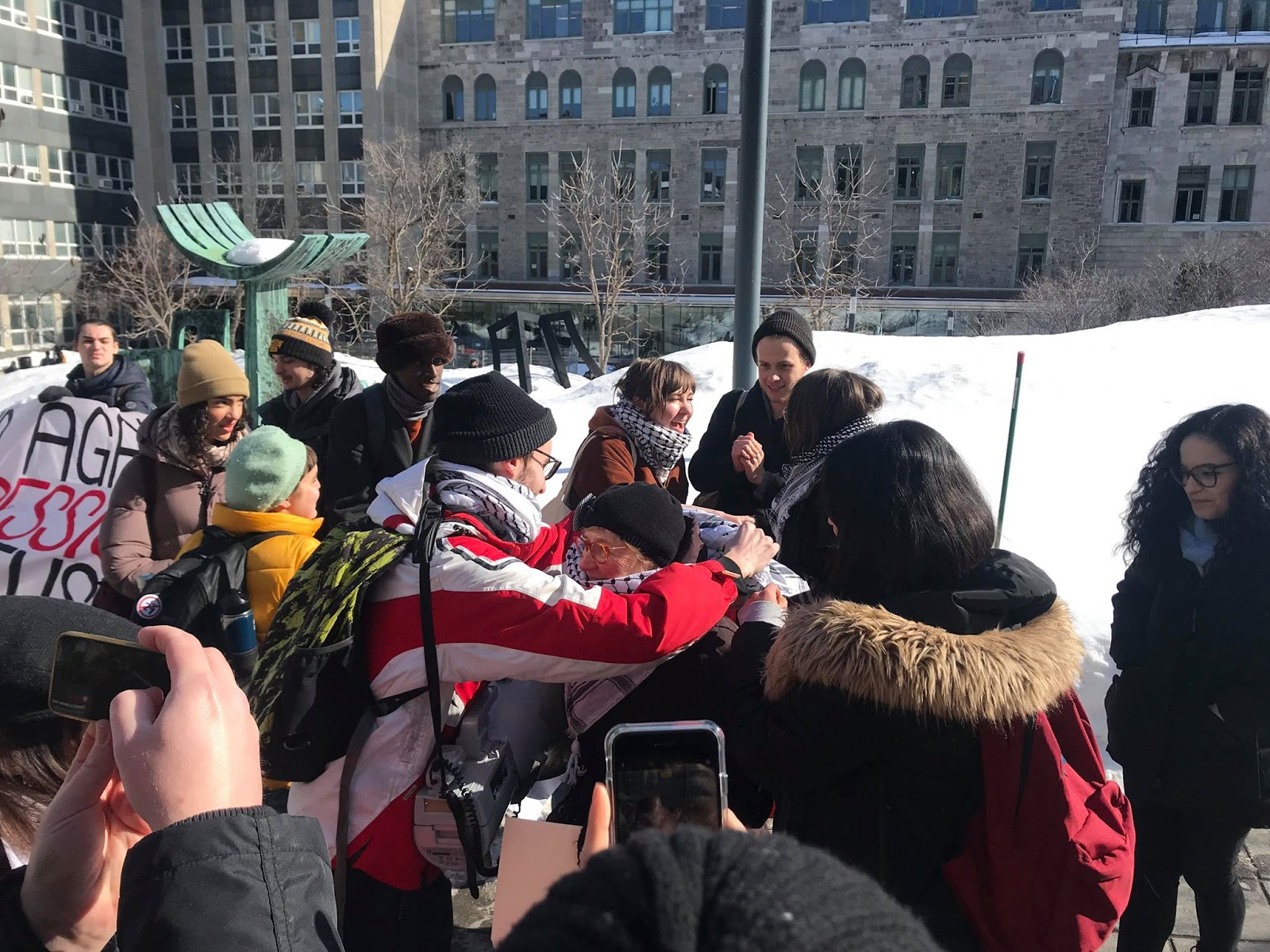
As of press time, members of the Wet’suwet’en First Nation are struggling to defend their land: For over a decade, Coastal GasLink has been attempting to construct a natural gas pipeline through Wet’suwet’en territory, without the true consent of the Wet’suwet’en peoples. On Jan. 9, students at McGill hosted a demonstration at the Y-intersection to show of solidarity with the hereditary chiefs of the Wet’suwet’en, all five of whom unequivocally oppose the construction. Since then, the situation has only become more severe. In the last two weeks, the Royal Mounted Canadian Police (RCMP) have set up multiple checkpoints within Wet’suwet’en territory in order to prevent those defending their land from blocking construction. As of Feb. 7, the RCMP began to take military action, moving further into Wet’suwet’en territory with police vehicles, tactical gear, and arresting Indigenous people for defending their home. The members of the Wet’suwet’en First Nation are being persecuted, and for those of us who are settlers living, working, and going to school on land which belongs to Indigenous Kanienʼkehá꞉ka peoples, members of the McGill and Montreal community have a responsibility to offer aid and support land defenders.

Wet’suwet’en land is unceded territory: This means that the Canadian government does not have ownership over the land. Consequently, according to its own legislation, Canada has a responsibility to consult and negotiate with the Wet’suwet’en First Nation. The RCMP have justified their advancement on the territory with an injunction recently passed by a British Columbia (BC) court which ruled that Coastal GasLink could move forward with construction. However, since the land never belonged to Canada, the Canadian government should not have the power to forcibly remove Wet’suwet’en First Nation members from their territory. 

The RCMP are enforcing a problematic provincial injunction on land which does not belong to Canada. The RCMP have stopped journalists from accessing demonstration sites. The Canadian government is continuing its well documented historical practice of engaging forcefully and unapologetically in targeted violence, oppression, and censorship of Indigenous peoples. Those in positions of privilege who observe, but fail to act in defiance of this contemporary colonization are complicit. This includes students who fail to speak up against injustices or show solidarity on campus and in the Montreal community.

The McGill protest on Jan. 9 can not be an isolated incident but rather should be the beginning of a larger, continuous movement to support the Indigenous community in Canada. Social media is a productive way to start. Sharing posts on Facebook, Instagram, or Twitter that call attention to the oppression of Indigenous communities can help educate and encourage more individuals to act. It is unfortunate that the Wet’suwet’en occupation only gained significant media attention after the situation became gravely dangerous. There is a discernible line between sharing a post which is informative and one which merely amounts to ‘trauma porn’ in that it exploits violence against Indigenous individuals to gain more clicks. Further, mobilization through social media must serve as merely the foundation of a more substantive exhibition of Indigenous solidarity. 

One way non-Indigenous individuals can show solidarity is by donating money to the communities which are protecting Wet’suwet’en territory. Not only does this provide crucial resources to those protecting their homes, offering monetary contributions is one form of paying settler reparations. While not everyone is in a financial position to offer a significant donation to the Wet’suwet’en, even those who do not have money may have time to spare. This time is valuable in that it can be spent attending rallies, protests, and events organized by Indigenous community leaders. Finally, if members of the McGill community find themselves struggling to identify ways they can support the Wet’suwet’en, the First Nation has provided a ‘supporter toolkit’ online that outlines methods of resistance. 

Individuals in positions of privilege should pursue the above types of action, not only at times when Indigenous communities are in crisis but on a consistent and continuous basis. In addition to being an Indigenous issue, the creation of this pipeline is an environmental issue. McGill also remains unapologetically invested in the fossil fuel industry and of companies that engage in pipeline projects like the one being forcefully implemented on Wet’suwet’en territory. The McGill Tribune attests that McGill University must divest, as a matter of both climate and Indigenous justice. On Feb.13, Divest McGill is holding a rally to support divestment from Coastal GasLink——as many McGill community members as possible should attend this rally. The persecution of Indigenous communities by the Canadian state through structures and institutions like the RCMP occurs every day. Indigenous solidarity must be a constant project in order to adequately address historic and ongoing oppression.


The Tribune’s Copy Editor, Keating Reid, dissented from this editorial.


Features

Ask me anything

Over 10 years ago, a user stumbled into /r/McGill and wrote the first post.

“Is this working yet?” they wrote on Feb. 6, 2010.

“Most of us hang out in /r/Montreal,” /u/iorgfeflkd replied. Ten years later, more than 4,500 users have made over 26,000 posts about topics ranging from which classes have lecture recordings to how to deal with stalkers on campus. To get an idea of how McGill’s students—and sometimes, staff—interact with Reddit, The McGill Tribune decided to download and analyse every single text post since 2010.

Read the latest issue

Read the latest issue