Latest News

Creative

Tribune Presents: Societal Siege

Societal Siege dropped by our office and performed a mini-concert for our multimedia team, showcasing some unreleased music and samples from their new EP, Joseph Ziggler. Antoine, Drew, and Jacob bring a playful warmth to college rock which radiated through the newsroom.

You can find Societal Siege’s music on Spotify, Apple Music, and SoundCloud, and Instagram: https://www.instagram.com/societalsiege/

Video by Multimedia Editors Aidan Martin and Sarah Ford and Staff Producer Alex Hinton.

Montreal, News

Candidates vie for young voters in federal election

New Democratic Party (NDP) leader Jagmeet Singh visited McGill on Sept. 16, federal  to discuss his platform with students.  As the federal election is being held on Oct. 21, political campaigns and college campus party associations are searching for ways to engage youth and attract their votes: young Canadians aged 18–24 have the lowest rates of voter turnout compared to all other age groups.

Political parties prioritize different policies targeting Canadian youth eligible to vote. Michael Forian, Conservative Party candidate for Ville-Marie—Le Sud-Ouest—Île-des-Sœurs, highlighted his campaign’s economic policies supporting higher education.

“The most important thing is being able to save for your education,” Forian said. “The new Conservative government will set up the [Registered Educational Savings Plan] grants for parents to save for [their childrens’] education.”

In contrast, the Liberal Party focuses on climate action, 2SLGBTQI+ rights, and reproductive rights to garner support from young adults. Steven Guilbeault, Liberal Party candidate for the Laurier—Sainte-Marie riding, emphasized his track record advocating to address climate change. Guilbeault’s candidacy lends the Liberals climate-change credibility in light of criticism of the government’s Trans Mountain pipeline extension project.

“Young people play a great role in today’s society […] the climate strikers are a great example of the power of student mobilization here in Quebec, Canada and around the globe,” Guilbeault wrote in an email to The McGill Tribune. “I will ask [young people] to look at who I am, to look at what I have done for over 25 years as co-founder of Équiterre or the 10 years I spent at Greenpeace, and, most importantly, to vote.”

Candidates such as Forian and Guilbeault are aided by McGill student party organizations like the Conservative Association of McGill, Liberal McGill, and NDP McGill, which all share the goal of helping to register students to vote and informing them of the electoral process. These organizations also provide pools of potential volunteers for campaigns across Montreal. 

McGill political science professor Elisabeth Gidengil argues that face-to-face interaction between a party and a voter is an effective electoral tactic.

“Reaching out and telling people what this election is about helps,” Gidengil said. “Contact by any party is important and will increase the likelihood to vote.” 

Gidengil pointed out that the turnout gap between young adults and older adults corresponds with education level. The drop in voter turnout between 1988 and 2000 was largely due to the decrease in the number of young voters; however, voter turnout amongst university students and young adults with postsecondary degrees remained steady. Although young Canadians tend to vote less than the older demographic, voters aged 18–24 have had the greatest increase in voter turnout between the 2011 and 2015 elections. 

“It’s about getting young people to realize [that] what happens in federal politics is relevant to them,” Gidengil said.

Features

For your eyes only

Admit it: You’ve watched porn. Most people past their early teen years—or who have used the internet for that matter—have watched porn. 64 per cent of young people aged 1324, seek out pornography at least weekly. It is less routine, but still fairly common, to admit that you’ve watched a live cam show, or maybe purchased nude photos from someone’s premium Snapchat. It is even more peculiar, but increasingly common, to be the person selling used panties, or posing in front of the webcam. But many students have, in fact, found lucrative side hustles selling sexual services on the internet, leveraging the autonomous nature of online work and streaming from the comfort of their own homes. Jared*, a third-year McGill student, began working as a camboy, a model performing any variety of sexualized acts to an audience in a chatroom, during his first year at McGill. He used Chaturbate, a webcam site, to stream from his dorm room, initially by himself, and eventually with his then-boyfriend. Jared was drawn to camming as a means to make money and explore their sexuality.


martlet basketball
Basketball, Martlets, Sports

Martlet Basketball falls in centennial game

Martlet basketball made a valiant effort in their first preseason game on Oct. 5, but careless fouls and missed rebounds got the best of them. They suffered a 77–55 defeat to the Queen’s University Gaels.

This game marked the 100th anniversary celebration of Canadian university women’s basketball, which began with a matchup between McGill and Queen’s on Feb. 6, 1920. Since the two teams are in different conferences (McGill plays in the RSEQ, while Queen’s plays in the OUA), this was only the third time in the past seven years where they have played each other. The previous two matches ended in Martlet victories.

Fifth-year transfer centre Sirah Diarra, who led the team with nine points, emphasized the importance of the game for both the McGill community and the sport itself.

“It means a lot knowing that we’re part of this,” Diarra said. “It’s history. It was a great game […] having all the alumni coming to watch us play. We wanted to do our best.”

The Gaels’ rock-solid defence was a substantial obstacle for the Martlets from the beginning of the game. McGill struggled to find passing lanes and was hesitant to shoot, running out the shot clock multiple times. However, a three-pointer from third-year guard Charlotte Clayton brought the energy up going into the second quarter, with McGill down 20–10.

“The beginning of the game was where we kind of fell short,” Clayton said. “We didn’t play our hardest [….] We need to take that responsibility to get ahead in the game.”

The Martlets fared much better in the second quarter. They fought back, remaining physical while committing fewer fouls. First-year forward Nadege Pluviose nabbed two rebounds in a row, and while she didn’t score, her tenacity exemplified the Martlets’ persistent rhythm. By the end of the period, McGill had almost caught up to Queen’s thanks to a layup and a successful free throw in the last minute of the half from third-year forward Kamsi Ogbudibe, bringing the score to 34-30.

“We [needed] to push the ball [and] look for open players,” Diarra said. “We [had] to match [Queen’s’] intensity.”

Unfortunately, a slew of fouls in the third quarter dashed the Martlets’ hopes of catching the Gaels. Players on both teams were on a collision course for the entire quarter, tumbling down together like dominoes. The quarter ended with a score of 55–42 in Queen’s favour.

McGill’s play was tighter in the final frame. Smooth three-pointers from Diarra, fifth-year guard Geraldine Cabillo-Abante, and second-year guard Delphine Robitaille got the crowd roaring. But ultimately, the gap was too wide to close. The final score was 77-55 for Queen’s.

Despite the loss, Clayton remains hopeful about the team’s chances for the regular season.

“We’re a very strong team,” Clayton said. “We need to work on […] showing those strengths for each other. This is just the first game, so with time that’ll come. I’m really optimistic about this season.”


Moment of the Game:

At the beginning of the third quarter, Diarra grabbed her own offensive rebound and sunk a layup to make the score 34-32, bringing the Martlets within two points of the Gaels.

Quotable:

“It’s been a hundred years. It’s definitely come a long way, but we still have a long way to go, so it’s kind of a good meet in the middle.” – Clayton on the historic significance of the game.

Stat Corner:

Even though Queen’s had the edge in free throws and fast break points, McGill managed to score more second-chance points: 13 to Queen’s’ 8.

Football, Know Your Athlete, Men's Varsity, Sports

Know Your Athlete: Findlay Brown

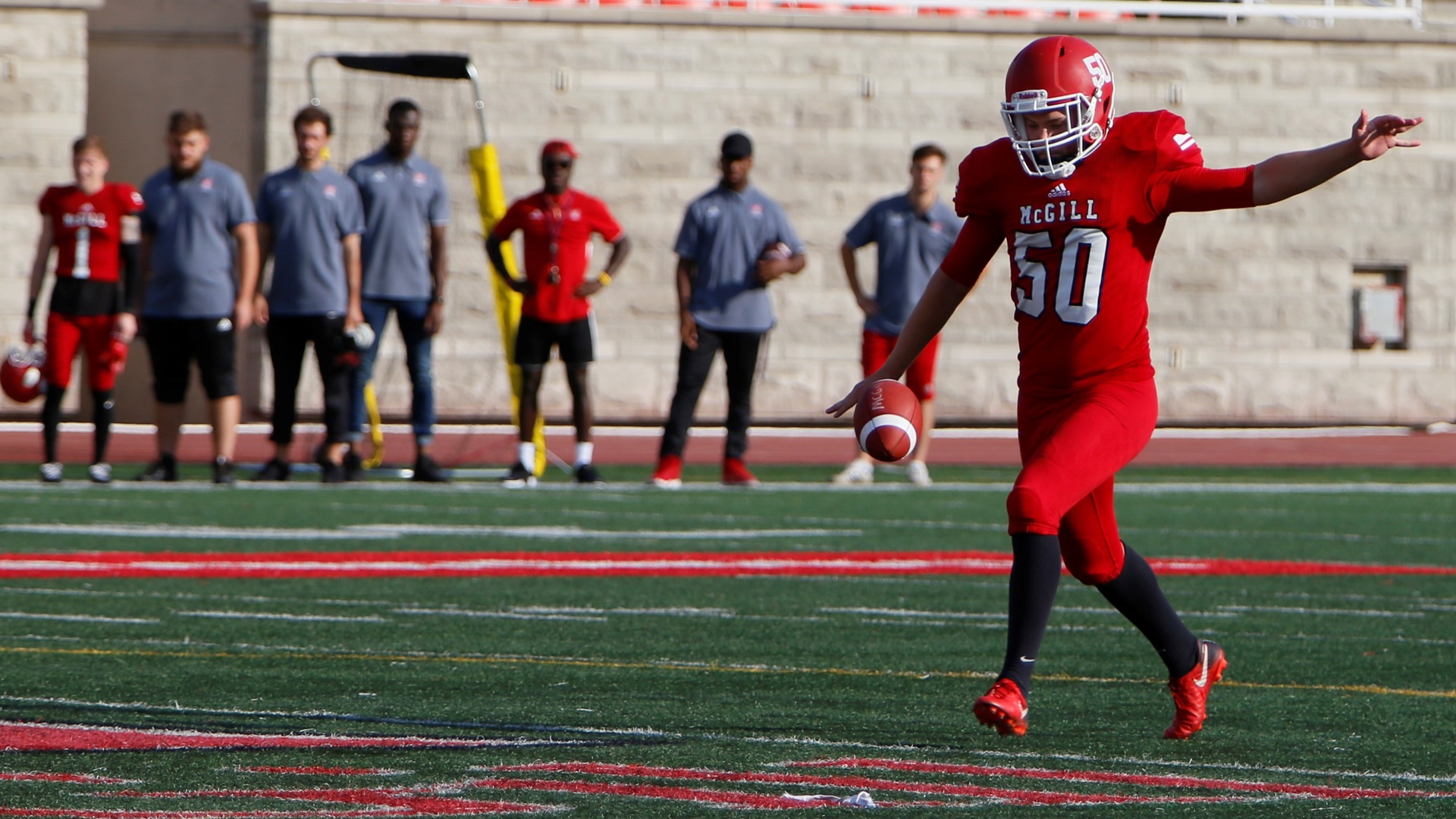
Although they are the only players to make ball contact with their feet, kickers are often overlooked in football. McGill football’s fourth-year kicker Findlay Brown, however, has been grabbing headlines after converting all three of his field-goal attempts on Sept. 28’s homecoming game and claiming his sixth RSEQ player of the week award. Despite his accolades, Brown knows there are a lot of other excellent players in the league. 

“I am honoured to be recognized in a crowded field of talented kickers, such as Université de Montréal’s Louis-Philippe Simoneau and Western’s Marc Liegghio,” Brown said. “I like to think I’ve been playing well recently, but I honestly don’t know how I stack up against these guys. My goal is to keep on improving and be the best player that I can be.”

Brown comes from an accomplished and competitive family. The Winnipegger is the eldest of three brothers, the youngest of whom is also a U Sports kicker, while the middle sibling finished third in the World Championship of Public Speaking and was a Canadian National Debating Champion. Despite his credentials, Brown insists he wins more arguments because he is not afraid to play dirty.

The kicker is not shy to brag about other facets of his life. The man that dubbed himself “The Enforcer” likes to remind McGill’s starting quarterback Dimitrios Sinodinos that he ran the 20m sprint faster than him on two occasions. 

Outside of football, Brown enjoys politics, soccer, and music, but he’s most passionate about movies and TV series. He has a particular fondness for Casablanca, The Godfather and La La Land. Brown also has strong opinions about TV shows.

 “Friends isn’t that good,” Brown said. “People should watch Parks and Recreation instead, it’s so much better.”

Brown believes that his fascination with motion pictures comes from his father, who is the CEO of a production company.

“Growing up, I was exposed to many movies, so it definitely piqued my interest,” Brown said. “But it’s only when I moved to Montreal that I rediscovered my love for film.”

Montreal is also where he had to learn to live by himself. Brown disclosed that it was hard at the beginning, especially during dinner time. He often indulged in large quantities of Kraft Dinner.

“My mom is an unbelievable chef,” Brown said. “It kills her every day the fact that I am a terrible cook.”

Except for the mediocre culinary skills, Brown’s transition to Quebec was fairly smooth. He quickly got settled, made some new acquaintances and started to discover the city. Football was instrumental in this transition.

“Football brings to your life friends, a sense of community, structure and a purpose,” Brown said.” From the outside it may seem silly, but we spend so much time together to accomplish one common goal, it feels like a second family.”

While sports, especially football, are known to bring people together, kickers often feel isolated from the team because of their unique position. However, Brown says this has not been the case for him.

“Yes, there are jokes thrown around, but I’ve never felt left out,” Brown said. “While on other teams it might [be] the case, at McGill, I know my teammates have had my back since day one.”

Brown is a smart, funny and talented individual. Not only is he excelling on the field, but also in the classroom and his personal life.

“When I finish here at McGill, I would like to produce movies or TV series, but who knows what’s next?,” Brown said. “In the meantime, I’ll just keep doing my best to help the team achieve our ultimate goal: Winning the Vanier Cup.” 

Research Briefs, Science & Technology

Small but mighty: Arctic bacteria are capable of cleaning up oil spills

Historically impassable, the ice cover of the Northwest Passage along Canada’s Arctic coast has thinned over the past few years, piquing the interest of the shipping and luxury cruise industries. This thinning, along with Arctic drilling, makes the legendary frozen passage particularly susceptible to oil and fuel spills.

To combat this, Professors Lyle Whyte and Charles Greer, microbiologists in McGill’s Department of Natural Resource Sciences, are examining Arctic bacteria’s ability to break down crude oil in the Canadian High Arctic. Their work is part of Fisheries and Oceans Canada’s Multipartner Oil Spill Research Initiative, a subunit of the national Oceans Protection Plan. The research initiative consists of multiple partners, including universities, international organizations, and government departments, that are testing various solutions for developing strategies for cleaning up oil spills.

The research takes advantage of the fact that multiple microbial species have naturally evolved to degrade hydrocarbons like crude oil, which contain chains of carbons and hydrogens.

“There are lots of natural seeps of petroleum [on] the bottom of the ocean,” Greer said in an interview with The McGill Tribune. “In fact, in the Gulf of Mexico, […] something like one million barrels of oil a year leak into the ocean naturally from these underwater seeps. Microbes living in the ocean environment have been eating this stuff for eons.”

Whyte and Greer are leading two projects: One to identify which types of Arctic microorganisms biodegrade oil, and another to study biostimulation, whereby certain added nutrients are able to promote the optimal performance of microbes.

“When you have a fuel spill, it’s like you’re creating a giant buffet of supper, lunch, and breakfast for these microorganisms to start munching on,” Whyte said. “But at the same time, they need other nutrients like nitrogen and phosphorus to do that effectively.”

Whyte and Greer emphasized in situ work, rather than lab experiments. 

“In-situ means we set up experiments, leave them on site, […] come back and take samples, then analyze microbial populations,” Whyte said. 

Preliminary experiments involved small-scale, semi-controlled ecosystems, also known as microcosms. The ecosystems were set up in rivers and oceans to identify how factors such as nutrients and temperatures influence decomposer microbial populations.

Greer will continue microcosm experiments on all three coasts of Canada, including Hudson Bay, while the next phase of Whyte’s work involves studying microbial communities on beaches. His research will test different combinations of fertilizer on a tidal Arctic beach treated with oil, mimicking an actual oil spill event. His team will then analyze fuel concentrations in sediment samples over the course of two to three years.

“This is a much better way of [studying] this than bringing beach sediments back to the lab,” Whyte said. ”Everything becomes somewhat artificial, and it becomes difficult to interpret those results accurately, as opposed to doing something right in the field.”

In the next few years, Whyte and Greer also hope to expand their previous efforts engaging northern communities and local young people in science through potential partnerships with the Nunavut Research Institute and Arctic College in Iqaluit. Both scientists emphasized the importance of scientific research in informing government policy.

“The idea is to try and provide a very solid science base to help governments develop the necessary regulations and guidelines in order to protect our oceans from oil spills,” Greer said. “We need to have better mechanisms to deal with them quickly and efficiently.”


Science & Technology

Moving beyond classical computers

A Google research paper describing one of the most powerful quantum computers in human history was leaked on NASA’s website on Sept. 20. In 200 seconds, the quantum computer executed tasks that would take the fastest of today’s computers 10,000 years to compute. 

Google was referencing an experimental type of computer that exploits complicated subatomic physics to run certain programs differently than the ‘classical’ computers we use every day. Unlike regular computers, which use bits to encode either a one or a zero, the primary unit of quantum computers is the qubit, a piece of information that can be zero, one, or both. With only 56 qubits, Google’s quantum computer achieved quantum supremacy, the point at which a quantum computer can complete a task faster than its classical counterpart. 

While the paper was swiftly removed from NASA’s website, the idea of a quantum computer is not as shocking as it seems, since such machines are limited to algorithms that take advantage of quantum properties. An enormous amount of work went into the Google project, which modelled a quantum system, an impractical task that can be done in a classical computer very slowly.

Despite this, quantum computing has the potential to change how we use computers in general. Claude Crépeau, a professor in the Department of Computer Science and a quantum computing pioneer, noted the importance of the leaked Google paper.

“It is a milestone,” Crépeau said in an interview with The McGill Tribune. “With limited technology [today], we can make things [that would have been] unbelievable 20 years ago.” 

Today’s technology is the result of companies like Microsoft and Google shovelling millions of dollars into projects. Companies are investing in quantum computing at a large scale because they already know of applications to take advantage of its strengths. One such applications is in cryptography, the field concerned with protecting information through code. Quantum computing could be used to dismantle current cryptographic systems, but it could also create amazing ones.

The internet relies on cryptography for secure data transfer. Public key cryptography is the most common cryptographic system in use and is based on the idea that finding a large number’s prime factors is computationally difficult, making it harder for hackers to access private information. Quantum computers could, however, pose a threat for cryptography and internet security, since they could potentially guess key combinations very efficiently

While quantum computing might be the biggest problem that cryptography faces, it could also be its saviour. By using quantum computers, computer scientists will be able to develop quantum secrecy, a stronger way of protecting information.

“In 50 years, I cannot guarantee public key cryptography will work,” Crépeau said. “In 100, it will probably not work. Quantum secrecy is perfectly valid, […] unless we are completely wrong about quantum physics, which would be a revolution.” 

Investigating quantum secrecy for cryptographic use could have profound implications. It may not affect all cryptographic communication, but it could still allow us to keep our most important secrets safe. There are many other promising quantum applications, such as simulating chemical interactions and financial markets, in addition to breaking old and creating new cryptographic systems. Researchers still need to create the hardware to implement quantum computing, which may still take several decades.

“[I can say with] 75 per cent certainty, something practical [will develop] in 20 years,” Crépeau said. “[But] I could be completely wrong about all that.”  

According to Crépeau, we could soon be looking at a world where people use quantum computers to execute tasks impossible to do otherwise. With the right breakthroughs in hardware, the potential applications for quantum computers are as limitless as they seemed for classical computers in the mid-20th century. 

candidates at debate
Montreal, News

SSMU hosts federal election candidates debate

Candidates running in the Montreal riding of Ville-Marie—Le-Sud-Ouest—Île-des-Soeurs clashed on Oct. 1 at the Students’ Society of McGill University’s (SSMU) federal candidates’ debate, in anticipation of the Oct. 21 federal election. Marc Miller of the Liberal Party, Sophie Thiébaut of the New Democratic Party (NDP), Liana Canton Cusmano of the Green Party, and Michael Forian of the Conservative Party discussed issues related to the riding. There were three questions set by the debate organizers, focused on the environment, reproductive rights, and Senate reform, followed by an audience question period.

Forian and Cusmano condemned the current Liberal government on their waste disposal policies, specifically regarding the dumping of raw sewage into the St. Lawrence River. Forian claimed that a Conservative government would move to make the practice illegal, while Cusmano emphasizes that other issues, like air quality and freight train traffic, have also fallen under the radar on the Liberal’s environmental agenda.

“The fact of the matter is that in Montreal alone, nine billion litres of raw sewage were dumped under this Liberal government,” Forian said. “Catherine McKenna, Minister of Environment, has to take responsibility for that. I would hope under Marc’s watch that he would have been able to stop it, [but] he did not. So I think it’s very important for us to recognize that this is something that a Conservative government will make illegal come October 21.”

Miller responded by pointing to a $26 million green infrastructure fund created under the Liberal government to deal with those issues.

Candidates also discussed reconciliation with  Indigenous communities particularly in Montreal: Despite making up 0.6 per cent of the general population, Indigenous people constitute 10 per cent of the homeless population. Cusmano called on Miller, the incumbent, to take steps to alleviate some of the burdens that Inuit people in Quebec, in particular, disproportionately face.

“I think that Marc has to speak to the staggering rates of Inuit homelessness,” Cusmano said. “The fact that since nothing has been done, a lot of them are going to be freezing in the streets this winter. And that that’s unacceptable. I think truth and reconciliation comes in many different forms. And in this riding, in particular the local level, it comes down to being there for the people who need it, because they have been systemically and systematically failed by forces that are larger than them and that are still acting on them today.”

Miller cited the Liberal government’s report on Missing and Murdered Indigenous Women and the Truth and Reconciliation report as evidence of the Trudeau government’s effort to increase dialogue with Indigenous communities, and pointed to a number of their investments that serve reconciliation.

“We’re still in the process of reviewing a very, very complex report coupled with the other report that came out,” Miller said. “I want to make clear, particularly with urban Indigenous issues and poverty, the failure at all governmental levels. But the Trudeau government made the largest investment in Indigenous people in Canadian history [and it has] yielded results.”

A question from the audience prompted discussion on student loans, given that the collective Canadian student debt currently towers above $15 billion. While Cusmano endorsed major institutional adaptive changes, Forian said that the Conservative Party’s corporate welfare taxes will redirect savings to Canadians more generally, benefiting students. Thiébaut proposed gradual changes that will work towards the NDP’s goal of making post-secondary institutions part of the public education system.

“We want to make education more affordable,” Thiébaut said. “We want to eliminate the interest of student loans to stop the fact that the bank can profit from student debt. And we want to move away from loans to bursaries.”

Additionally, all four candidates affirmed that they were pro-choice and that none of their respective parties would introduce new abortion laws.

The federal election will take place on Oct. 21. Students are able to vote at at New Residence Hall or La Citadelle from Oct. 5 to 8, or at polling stations in Montreal on the day of the election.

Science & Technology

The science of knee injuries

With today’s proliferation of high-intensity sports, the number of knee injuries in North America over the past decade has skyrocketed. Since knee injuries vary depending on a person’s sport, age, and sex, different people may experience different knee injuries in their lives. 

Shawn Robbins, a professor in the School of Physical and Occupational Therapy, explained that certain sports carry a higher risk of knee injuries, such as anterior cruciate ligament (ACL) tears.

“For women, the sports that have the highest rates of ACL injury are soccer and basketball,” Robbins said in an interview with The McGill Tribune. “For men, it is football, lacrosse, and soccer.” 

The most common knee injuries today are sprains and strains, which are injuries to ligaments and muscles, respectively. Nearly half of these occur from recreational or competitive sports activity. More severe knee injuries occur when a ligament is torn, or when there is a fracture at the joint’s surface. Certain symptoms usually indicate a sprain: A popping sound at the moment of injury, pain and swelling around the knee, and knee instability. 

One of the most common serious knee injuries in sports is a rupture, or tear, of the ACL. As one of four primary ligaments in the knee, the ACL provides stability to the joint and helps to keep the body properly orientated and stable. ACL injuries can range from a sprain to a complete tear and are classified as contact—the result of coming into contact with a person or objector non-contact. 

In general, women have more frequent non-contact ACL ruptures, likely due to factors  including differences in strength, hormones, and anatomy. Many ACL tears require reconstructive surgery that uses the patient’s own tissue or donor tissue.

“If it is completely torn, the recovery time could be months,” Robbins said. “If you have surgery to reconstruct the ACL, typical recovery time is six to 12 months, depending on the sport you play.” 

Though less researched, another common knee injury is disruption to the kneecap, or patella. Robbins explained that the biggest cause of patellar injuries are sports with lots of jumping and quick directional changes, such as volleyball, gymnastics, and soccer. Patellar injuries can be as simple as ‘pain behind the kneecap’ and tendinitis, or inflammation of the tendon. They can also be as severe as dislocation and subluxations, which is when the patella moves either partially or completely out of its normal position. 

“Often, these injuries are overuse injuries, including tendinitis,” Robbins said. “Patella subluxations and dislocations are most common in contact sports, like football or ice hockey.”

Runner’s knee’ is another umbrella term for a different group of knee injuries, common among those who run frequently and in women, particularly those with knee arthritis. However, runner’s knee can also result from any sport that puts frequent and high pressure on the knee joint. The most common form of runner’s knee is chondromalacia patellae, a condition where the cartilage beneath the patella erodes or softens as a result of overexertion improper knee alignment. Symptoms of this condition include knee pain and grinding sensations, as the cartilage has thinned out. 

For those who play contact sports such as hockey, football, and soccer, meniscal tears are common. The menisci are smooth layers of cartilage that form a circle around the ACL and posterior cruciate ligament (PCL). Over time, they begin to wear thin, increasing the chance of injury. Damage to the meniscus can also result in damage to the articular cartilage, which lines the ends of the femur and tibia to prevent them from rubbing together. Over time, osteoarthritis, the erosion of the cartilage and underlying bone, can develop, causing knee pain, stiffness, and reduced range of motion.

Taking the time to recover completely from a knee injury is very important. Knees are fragile, and there is always the chance that ‘just one more injury’ could have life-long consequences.

McGill, News

Updates made to ‘Our Shared Spaces’ to help promote equity on campus

McGill’s Rez Project workshop series, designed to educate students on issues of social justice and equity, was rebranded this fall to better reflect the message of the program. Created 16 years ago by a group of floor fellows, ‘Our Shared Spaces,’ formerly known as Rez Project, aims to promote a more inclusive atmosphere in residences and on campus. 

The educational workshop, which serves as an opportunity for conversation on race and sexuality, was revamped to include a new name, website, and improvements to the content. There are now 20 facilitators, as well as a new name, logo, and website. Today, ‘Our Shared Spaces’ educates thousands of McGill students living in residence on issues of race and Indigenous issues, gender, and sexuality. McGill’s Equity Education Program Manager Eve Finley explained the nature of the changes to the program’s image and delivery. 

“We also, largely because of the new online consent module swapped the workshop order,” Finley said. “The workshop that [now] happens in the fall is the race and colonialism workshop, and the workshop in the winter is [about] gender, sexuality, and consent.”

Finley also hopes that the rebranding will help the workshop reach more students outside of residences at McGill.

“We are also expanding to other spaces on campus,” Finley said. “We gave a bunch of workshops to incoming medical students and [….] students [living off campus].”

The renaming of Rez Project comes as part of a move away from the term ‘Rez,’ which is considered offensive by some Indigenous students for its connections to Canada’s history of reservations and residential schools. Determined by an online competition last year, the new name is more representative of the nature of the workshop, according to Equity Education Program Administrator Charlene Lewis-Sutherland.

“In the last few years, I think there’s been a larger conversation, on campus and off, about how we use our words, even words we inherit,” Lewis-Sutherland said. “We asked [students] in a survey what would you name the [workshop] if you could name it something. [Our Shared Spaces] really stuck out to us because it hit that note of what we are trying to do. We are trying to talk to people about how they share space [and] about what it respectfully means to share space.” 

The changes made this year are a continuation of a series of updates that began last year when the project moved to the Office of the Dean of Students and received a budget increase to help facilitate its operations. 

“Instead of having a hundred volunteer students that were trained for ten hours we hired fifteen students [who] are now paid by the hour to give the workshop, and they go through […] 40 hours of training in August,” Finley said. 

Adi Sneg, U2 Arts, works as an ‘Our Shared Spaces’ peer facilitator said that budget increases are important to improving the workshop’s accessibility. 

“I’m just hoping our budget increases [further] so we can get more people, more diverse bodies in the room,” Sneg said. “When you learn about this kind of stuff, it’s important to feel as though you are learning it from someone who has some sort of commonality to you.” 

Sneg explained that these updates are all part of the goal to facilitate more conversations about sensitive topics on campus. 

“The goal is to have people walk away with having learned something new, Sneg said. “[It’s] something they can critically consider every day when they live in residence and when they move and navigate through campus at McGill.” 

Read the latest issue

Read the latest issue