

Latest News

Arts & Entertainment, Books

Drawn & Quarterly welcomes up and coming Canadian authors

Canada’s contemporary literary scene is on the brink of something special. On Oct. 4, La Petite Librairie Drawn & Quarterly converted its tight space into a stage, hosting three significant writers, Alix Ohlin, Megan Gail Coles, and Audrée Wilhelmy.

Ohlin and Coles’ novels have just been shortlisted for Canada’s prestigious Giller Prize—beating out previous winners like Margaret Atwood and André Alexis. As part of their book tours, the two joined Wilhelmy, a revered French Canadian author whose many distinctions include le prix Sade to speak about their new novels. Each gave readings of their newest works, and answered audience questions during a short Q&A period. Sarah MacLachlan, president and publisher at House of Anansi Press, joined the three authors to celebrate the successes each have enjoyed this year. 

“When we acquire books at the House, we do it from a great love of the things that we read, of the manuscripts that come in, and these three women have all written extraordinary books,”  MacLachlan said. “All three of them have associations and affiliations with the city of Montreal, and the great thing is that they’re writers that represent the country from coast to coast.”

Ohlin, raised in Montreal and living in Vancouver, read the prologue to her novel, Dual Citizens. The story charts the diverging trajectories of two sisters’ lives in Montreal and later in New York City. The novel is a meditation on the complexity of female relationships, told with a distinct Canadian bent. Its prologue, which introduces a contemptuous relationship between sisters Robin and Lark as they walk through the woods, takes place during a wolf attack. With the books connection to the wilderness of the North, Ohlin shares in a tradition that many Canadian authors have explored, also echoed that night by Willhelmy and Coles. 

Wilhelmy read from her 2017 novel, Le corps des bêtes, followed by a reading of the English translation, The Body of the Beasts. Her story uses the Arctic wilderness as a central vehicle to convey her protagonist Mie’s exploration of herself and her sexuality. Using her main character’s ability to shapeshift into the animals that surround her, Wilhelmy delves into spirituality and the supernatural in order to show the multifaceted nature of identity. Wilhelmy spoke about the strange experience of having her words translated into a language she could fully understand, and of having an altered version of a text she could still identify with. 

“It’s a new discovery of the book for myself,” said Wilhelmy. “Seeing it put in other words […] [the writing] was kind of more crude […] because I [didn’t] really realize how it was crude in French.”

Last to speak was Coles, a Newfoundlander who is currently completing her PhD at Concordia, with her reading of Small Game Hunting at the Local Coward Gun Club. Coles’ novel pits a group of characters against each other in an isolated diner during a Newfoundland blizzard. The novel’s single setting, emphasizes the dynamics of its characters’ relationships instead of plot-centric action. The focus on dialogue and inner monologues likens Coles’ work to a theatre script. 

While speaking about her writing process, Coles spoke about imagining the characters first and shaping a narrative around them second. The novel’s dramatic influence might come from Coles’ own experience in theatre, having attended the Montreal-based National Theatre School of Canada. Fittingly, Cole’s reading became a full-blown performance. Standing up, employing accents, and using different gestures and movements to reflect her character’s personas, Coles concluded the evening with a raucous scene, in which her protagonist gets berated by one of the diner’s occupants.

“‘Are you stupid girl, are you? Are you stupid!’ She could talk back, but has been socialized against it,” shouted Coles during her excerpt’s last lines. The audience was silenced in awe, rapt by the force of her words.  

Emerging Trends, Student Life

Trottoir barré signs and fairy lights

For many university students, searching for off-campus housing can be difficult. Student housing can mean sharing a small, run-down space with holes in the walls and the occasional mouse sneaking around. Though most adults fear this, students today have embraced it as part of the university experience and cultivated creative ways to turn their temporary space into a cozy home. The McGill Tribune examined common styles of university decor and how they reflect their inhabitants.  

Fairy lights and foliage 

Abundant lighting and plentiful plants can help ease the stresses of a long day. This style may suggest a laid-back persona. Fake plants or succulents can indicate that someone is working to get their life on track, taking small steps while giving off the perception of having it together. On the flip side, real plants may suggest someone who is settled, has a functioning routine, and is ready for commitment and responsibility. In addition to the lights and plants, these individuals will likely have calendars and chore charts on their walls, suggesting an organized and smoothly running household. Fairy light owners and plant parents are known for hosting the best studying and late night cram sessions.

Stolen street signs and posters

A space full of street signs and dog-eared posters perfectly suits students who do not take themselves too seriously. These are generally adventurous students looking for a good time, who don’t shy away from small doses of risk taking. Anyone who spends time with this apartment’s inhabitants is inspired to jump outside their comfort zone. These tenants are social and free-spirited people who enjoy having company around. Therefore, this is generally the space where spontaneous ideas flourish. These apartments are always busy and double as the perfect location for house parties and gatherings. The constant flow of people and the calm, cool, and collected attitude of its residents might result in a cluttered space, but regardless of the mess, these apartments and their tenants are always adored by those passing though.

Photos and mementos

A photo wall can indicate a nostalgic, yet optimistic personality. It is likely they are highly ambitious and use their photos and mementos as motivation to continuously work hard for their loved ones. These apartments house grounded, down-to-earth students and are great spaces to vent with friends. Though there may be books strewn around and cluttered desks, the best listeners and most loyal of friends reside in these apartments. These walls have heard the best late-night deep talks, making their tenants the optimal company for movie nights and de-stressing days. 

DIY decor 

Finding alternative ways to decorate can indicate a creative and adaptable personality. A study in Reader’s Digest found that DIY-ers are often more inspired and welcome change more easily than others. The residents of this apartment can take any mundane situation and turn it into a good time. These DIY projects can be simple, like taking an old bottle of wine and turning it into a vase, or more extravagant, like painting lamp shades or creating makeshift shelves. The ability to allocate time to DIY projects may indicate someone who can turn their procrastination into productivity. These apartments house the most versatile group of individuals, making these students the perfect company to study with during the week and to party with on the weekends. These imaginative apartments radiate a welcoming vibe, resulting in lots of impromptu visitors. 

Quebec Quebec Cowboys Fringants
Arts & Entertainment, Music

‘Les Antipodes’ is a triumph from Quebec’s beloved folk rockers

Beloved Quebec folk-rock band Les Cowboys Fringants dropped their long awaited album, Les Antipodes, on Oct. 4. The group had not released new music since 2015, and fans were eager to see if this classic band would stay true to their roots after such a long break. Les Cowboys Fringants have always been known for the  political commentary they weave into their songs, and recurring topics include Quebec sovereignty, environmental justice, and voter apathy. As the political climate has only grown more tense since their last album was released, fans anticipated a commentary-heavy album, and Les Antipodes did not fall short. 

On the evening of the launch, Les Cowboys held a party at La Tulipe, where they signed CDs and DJs entertained the crowd with techno versions of their previous albums. Members of the crowd ranged  from children to the elderly, and businessmen dressed in suits stood next to college students wearing sweatshirts and sneakers. Despite the diverse backgrounds of the crowd, everyone shared a common excitement at the prospect of listening to the music Les Cowboys had worked on for the past four  years.

The day before Les Antipodes was released for the public, the band uploaded its first single, “L’Amérique Pleure,” on YouTube. True to the band’s name, the music video features a line dancing instructor dressed as a cowboy leading a room full of people in a dance to the song. “L’Amérique Pleure” remains subtly political. The lyrics highlight the inequalities that lay behind the veneer of North American consumerism, musing that  “…behind the beautiful landscapes/there is so much inequality/and suffering on the faces”*. The song expresses the sadness and frustration towards the current state of affairs and the hypocrisy the band sees in controlling a complacent population.

No two songs on Les Antipodes feel or sound the same. There are long, somber ballads like “Sur Mon Épaule” sandwiched by folksy dance songs like “La Traversée (de l’Atlantique en 1774),” whose upbeat instrumentals contrast with the heavy subject matter it explores. The eclectic mix of songs make it easy for the band to reach a wider audience: There is truly something for everyone in the wide variety of genres they borrow from, making the album a delight to loyal fans and new listeners. 


*Quotation was translated from its original French

Out on the Town, Student Life

Heated terraces for cool days

As the warmth of summer fades into the crisp chill of autumn, it becomes more and more difficult to justify sitting on the city’s lovely open air terraces. Students are drawn to the heat of the indoors and set up their Seasonal Affective Disorder lamps in preparation for another long winter. While most of the outdoor terraces will be closing soon, a select few will remain open and heated through the colder months so Montrealers can get their daily dose of Vitamin D without sacrificing warmth.

Café Olimpico

124 rue St-Viateur O

Hours: 6 a.m.12 a.m., every day

Price: $

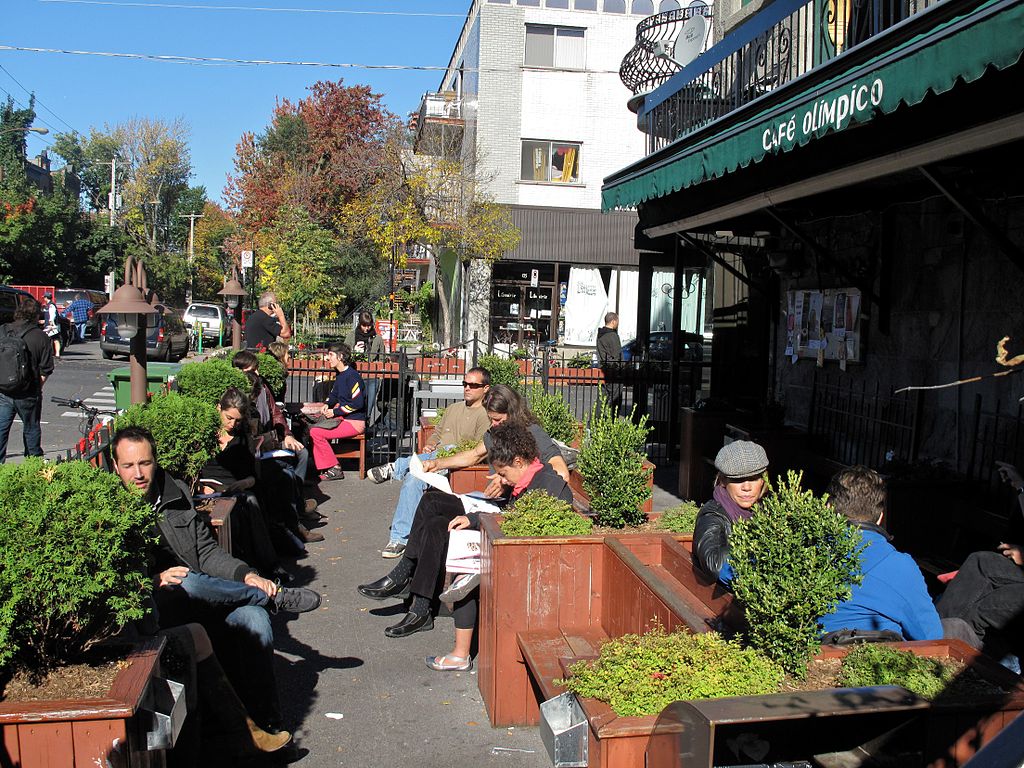
Café Olimpico, which opened in the Mile-End in 1970, has become a beloved neighbourhood staple. This café is open 18 hours every day, making it an ideal location for hours of uninterrupted work. There are a variety of work spaces, from window seating to a dimly lit quiet area in the back. People funnel in and out all day, and the baristas are friendly with every customer. The light music playing in the background is punctuated by the chatter of regulars and visitors. Olimpico’s coffee has been named among the best in Montreal numerous times, and the café was even ranked in the top 50 cafés in the world by The Telegraph. Everything from the coffee to the desserts is simple but made with care. Their terrace stays open all year round and, during the winter, it becomes a cozy annex separated from the bustling cafe where patrons can enjoy sanctuary on a cold day while bathing in the warmth of this aromatic coffee shop.

Brutopia

1219 rue Crescent

Hours: 2 p.m.3 a.m. SundayWednesday, 12 p.m.3 a.m. ThursdaySaturday

Price: $

Brutopia is a dark and cozy, slightly elevated dive bar with a welcoming and comfortable atmosphere. This brewpub in the heart of downtown boasts more than live music and specialty beers. During the winter months, their open air terrace is heated and becomes a haven to enjoy good times and fresh air in the safety of a toasty annex. The terrace is simple, just like most of the establishment, but not to be overlooked. There are lots of tables and the terrace itself is very spacious, so there is no need to worry about finding a seat. Brutopia has live entertainment every night of the week starting at 10 p.m., including an open-mic jam session every Sunday and trivia every Monday. As the name suggests, this pub is home to an active brewery, with a weekly rotating beer list. It’s perfectly suited to a chill night out with friends.

Bar Suzanne

20 ave. Duluth E.

Hours: 4 p.m. 12 a.m. SundayWednesday, 4 p.m. 3 a.m. ThursdaySaturday

Price: $$

To say that Bar Suzanne has plants would be an understatement. Plants cover the beam system that runs overhead, and the rest of the room has potted plants and leafy wallpaper. The plants on the beams are really an intermediary for your eyes; the true beauty lies just behind them. Looking beyond, it is clear that the reason all the greenery is able to thrive is because of the skylight that makes up the majority of the ceiling, bathing the entire bar in natural light to offer patrons a terrace feel while remaining fully covered. Students looking for a deal can head over for happy hour and watch the natural light fade, leaving the glow of the candles that stand on every table. Bar Suzanne serves dumplings and specialty cocktails, but they also offer an extensive beer and wine list. As their website says, Bar Suzanne offers “enough to stay out late, but gently.” 

Leméac

1045 ave. Laurier O.

Hours: 11:45 a.m.-12 a.m. weekdays, 10:00 a.m.-12 a.m. weekends

Price: $$$

Leméac is a classic French bistro off of Avenue du Parc, close to Jeanne-Mance Park. Their covered patio remains open year-round and, in winter, has a direct view of the street. The best way to take advantage of everything this bistro has to offer is to head over for brunch on the weekend, where their heated patio provides a protected place for people-watching while you enjoy one of their delicious breakfast plates. Another way to enjoy this renowned restaurant while saving your wallet is by ordering off of the late night menu, a fixed-price menu served after 10 p.m. As the day turns to night in Leméac, the lights bathe the restaurant in a warm glow, maintaining the same inviting ambiance for the late night guests as for the brunch patrons. 

Divest McGill Illustration
McGill, News

Divest McGill builds on momentum from climate march

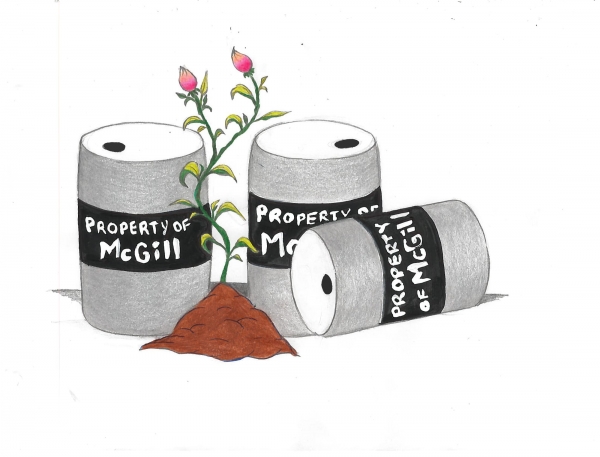
Students filled Burnside Hall on Oct. 4 for Divest McGill’s ‘Divest 101’ seminar led by Jacqueline Lee-Tam, U2 Arts, and April Kowalchuk-Reid, U2 Science, hoping to capitalize on momentum from the previous week’s climate march. The event highlighted the history of the fossil fuel divestment campaign at McGill and ways that students can get involved.

One of Divest McGill’s earliest actions was submitting a divestment request to the Committee to Advise on Matters of Social Responsibility (CAMSR) in 2013, which was later denied because the committee didn’t see enough evidence of the community being harmed by this issue. 

Since then, Divest McGill has submitted two more requests for fossil fuel divestment: One was also denied due to similar claims that climate change had not yet caused enough damage to the global community. The third request will be decided on later in the fall semester. Kowalchuk-Reid explained the group’s frustration with what they see as CAMSR inconsistently adhering to their mandate.

“[The] McGill Board of Governors is the highest functioning board and they ultimately have the final decision on how much money we have invested in the fossil fuel industry or if we’re involved in it whatsoever,” Kowalchuk-Reid said. “They made a subcommittee called CAMSR, [whose] sole mandate is to just look at [if] this [is] causing harm to the community [and] the environment. They […] made that committee mainly to discuss divestment and they are supposed to not be influenced by money, but that has not happened in the past.”

Lee-Tam emphasized that divestment campaigns have proven impactful in lobbying the fossil fuel industry to make changes. She further discussed the connection between money and divestment.

“[Divestment is] the idea of taking your money out of a [harmful] industry and putting your money into an industry that isn’t harmful or doesn’t cause grave and injurious consequences like whatever industry you were invested in.” Lee-Tam said. “If we get all these institutions to divest from fossil fuels, we’re removing the social license of the fossil fuel industry to operate …[and] insert[ing] awareness about the fossil fuel industry and its negative consequences into the public sphere.”

Despite other institutions, such as the University of California, divesting from fossil fuels, divestment at McGill has remained an elusive and opaque process. This is often due to CAMSR’s mode of operations and differing ideas of what it means to be transparent and inclusive.

Laura Mackey, U3 Environment, expressed her frustration with the results of her attempts to encourage transparency in the CAMSR evaluation process.

“When we found out [that CAMSR was] going to be revisiting divestment, one of the things that we specifically asked for was to be included in the conversation,” Mackey said. “I think if they were asked that question, they would say [that they had] included [us] in the conversation, but for us it’s very much felt the same as always where we’re on the outside, watching these internal deliberations that we don’t really know what they’re talking about or what’s happening. We just hope they’re paying attention to the mood on campus and the things our campaign is doing.”

Julia Elson, U4 Engineering, attended to learn about more effective ways to be involved in environmental protection following the march.

“I think that taking the energy that we’ve gained from the march and channeling that into something like an advocacy campaign […] will give you a lot more value for your time than sitting and being frustrated about it,” Elson said.

McGill, News

Board of Governors convenes to discuss commitments to sustainability

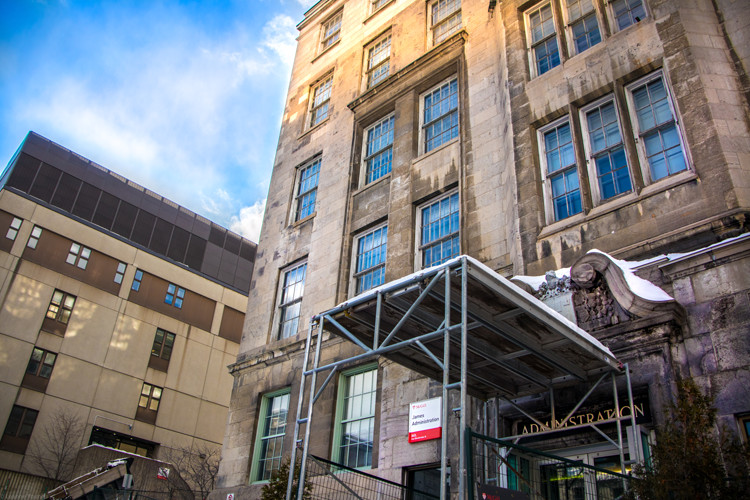
The McGill Board of Governors held its first meeting of the year on Oct. 3 to discuss investments and climate initiatives for the coming school year. Although board members were satisfied with the recognition McGill has received for its environmental vision, students advocating for divestment felt that the sustainability initiatives the Board lauded were mostly superficial.

Joel Raby, Chair of the Board’s Investment Committee, presented a report on the performance of McGill’s investable assets in the last fiscal year. A motion to revise the Statement of Investment Policy (SIP), a plan for McGill’s assets managed through the McGill Investment Pool (MIP), was quickly approved. Raby then explained that McGill’s investments have not suffered from inflation and have ultimately preserved donors’ capital. 

Students’ Society of McGill University (SSMU) President Bryan Buraga asked if Raby had any information about how the fossil fuels investments are performing compared to other investments. Ruby affirmed that although he did not have such information available, the Investment Committee would inform the Committee to Advise on Matters of Social Responsibility (CAMSR) on the university’s  risk-reward tradeoff for the divestment on fossil fuels.

As the board deferred a motion regarding divestment from fossil fuels to the Committee to Advise on Matters of Social Responsibility (CAMSR) last year, that was not discussed at the meeting. The committee has been investigating the matter and will officially recommend a course of action in December. 

Maryse Bertrand, Vice-Chair of the board and member of CAMSR, gave a brief progress report. 

“We started the work on the committee exactly a year ago [in] 2018,” Bertrand said. “The first [phase] was very much a fact-finding, evidence-receiving sort of phase.  I think we’re in the stage where we’re going to try to now deliberate on the information that we’ve received [….]” 

The committee is set to release its official report by Dec. 5. The board’s next meeting on Dec. 12 will likely be the deciding vote on divestment.

The board also focused on their successful environmental initiatives on campus. François Miller, Sustainability Director and leader of the team behind the McGill Office of Sustainability, presented the report

“I just want to highlight that we’ve been implementing quite a few successful student and staff involvement programs at McGill.” Miller said. “In fact, those programs were recognized by the Association for the Advancement of Sustainability in Higher Education [AASHE]. So both the staff garden programs that we have near the Burnside building and the Sustainable Workplace Certification were awarded the Campus Sustainability Achievement award.”

Miller talked about numerous climate-related programs started in the past year. He mentioned the student-led Desautels Sustainability Network’s Business Conference on Sustainability and a measure setting aside $250,000 to cover the extra cost of purchasing an electric vehicle when a conventional vehicle needs replacement. He also cited Minister of Environment Catherine McKenna’s visit on campus to announce a $1.8 million investment from Canada’s Low Carbon Economy Fund to help McGill meet its carbon emissions goal. Miller also mentioned some of the external recognition McGill has received, such as the Sustainability Institution of the Year award for its Vision 2020 Sustainability Strategy given at an award ceremony supported by the UN Environment Programme (UNEP).

After the meeting, Laura Mackey, U3 Environment and a member of Divest McGill, spoke with The McGill Tribune about McGill’s failure to divest from fossil fuels. 

“McGill cannot be carbon neutral while still invested in fossil fuels,” Mackey said. “It’s all very surface level commitments to sustainability. And it’s nice to see, it’s nice to hear. But without fossil fuel divestment it isn’t meaningful [.…] It really feels like McGill is using greenwashing and wants an image of being a sustainable university while actually not meeting that goal whatsoever.”


Student Life

Navigating Montreal’s by-laws

As the school year wears on, students may be tempted to dart across busy streets on the way to class, grab an electric scooter to dash to an exam, or enjoy celebratory drinks in one of Montreal’s many parks. However, students should be aware of some rules specific to Montreal to avoid any unnecessary fines associated with such activities to enjoy the semester free of any legal trouble.

Drinking in public 

The legal drinking age in Quebec is 18-years-old, meaning that until you are of age, it is illegal to buy alcohol for yourself or another person, or have someone else buy alcohol for you. 

Even for students who have reached the drinking age, Montreal does not permit the consumption of alcohol in public areas. However, there is an exception to that rule that allows people to drink alcohol in some of the city’s parks, as long as they are also consuming a meal. Quebec law defines a meal as “food sufficient to constitute a person’s lunch or dinner.” This means that a picnic in Jeanne Mance would have to be a full meal, while a bag of two-bite brownies would not be enough to avoid a possible ticket. The law also states that the alcohol and accompanying meal must be in an area of the park where picnic tables are present.  

Traffic rules 

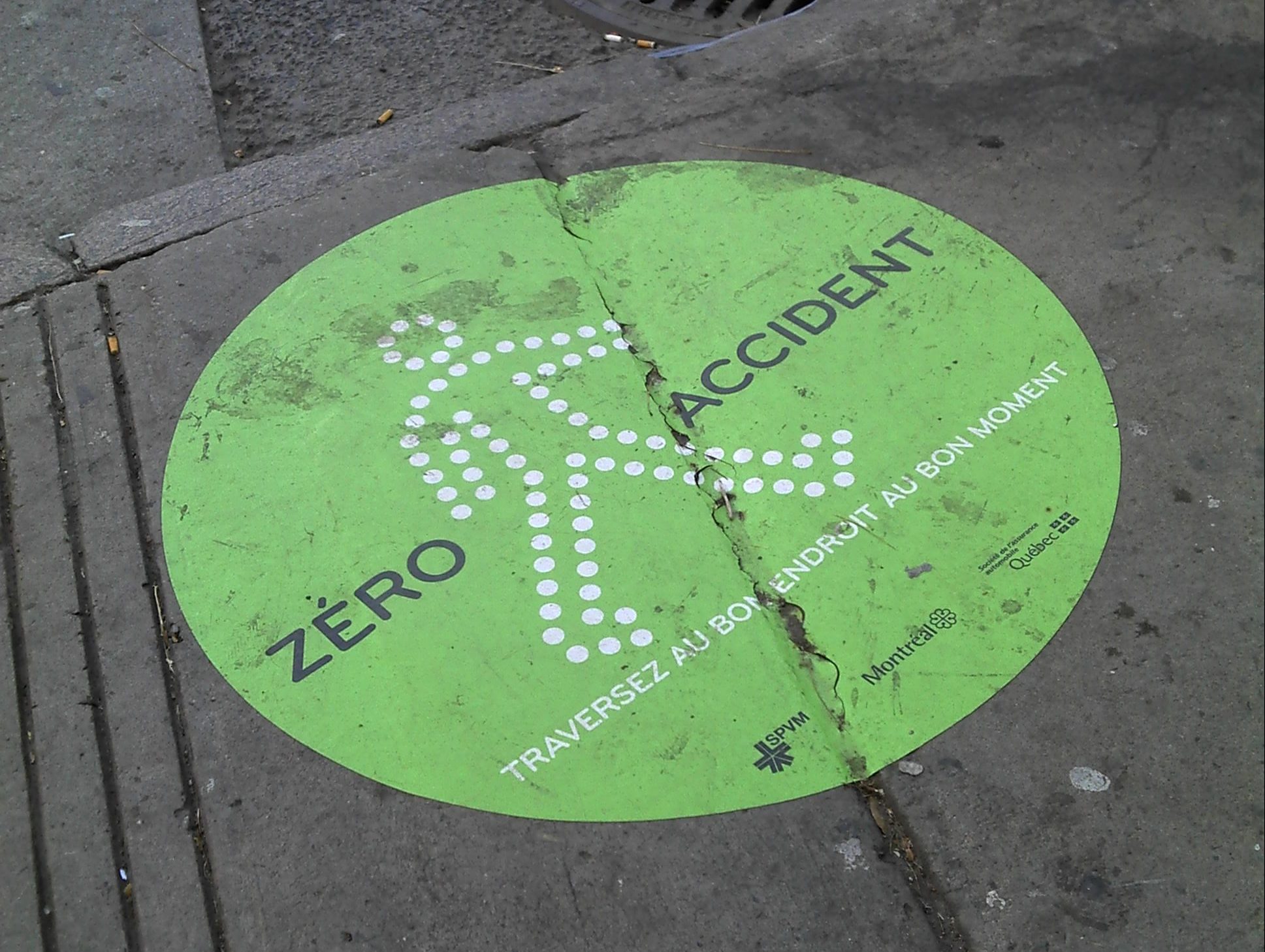
Traffic rules are very important for students walking to and from campus, especially approaching the Milton Gates. According to the Montreal police service, pedestrians must use crosswalks when going through any of the city’s intersections. Not obeying the various crosswalk signs in the city is considered a violation of traffic rules; this could include crossing a street against the signal, or beginning to cross once the light turns yellow. Even on streets without a nearby intersection or pedestrian crossing, pedestrians must yield to vehicles and cyclists and make sure there is no risk present when crossing. Additionally, people are not allowed to cross an intersection diagonally unless authorized by a police officer or if the intersection specifically allows it. 

Lime, Bird, and JUMP scooters

Many McGill students are familiar with electric scooters, the newest addition to Montreal’s streets. In recent months, the City of Montreal has enacted new by-laws in response to these e-scooters and e-bikes. Users are required to wear a helmet at all times and are prohibited from riding on the sidewalks. Across the city there are also 239 designated e-scooter parking spots where users are required to park their scooters, instead of leaving them on city sidewalks. As of Oct. 21, Montreal will begin fining riders $50 each for scooters found illegally parked outside these spots. 

Noise complaints

When it comes to noise complaints, each of Montreal’s boroughs have their own bylaws. However, police can issue tickets if they hear a noise prohibited under noise bylaws. A “prohibited noise” could be anything from cries, singing, altercations, cursing, or “any other form of uproar,” as well as noise produced by sound equipment according to Service de police de la Ville de Montréal (SPVM).


To learn more about laws and regulations in Quebec or Montreal, McGill has many resources available, such as the Legal Information Clinic at McGill (LICM). The LICM is a non-profit information service staffed by McGill Law Students, with a mandate to provide free legal information, referrals, and community services to McGill and broader Montreal. Interested students can call or visit the LICM website

McGill, News

Dean of Students suspends plans for involuntary leave policy

The Office of the Dean of Students announced on Sept. 22 that it would suspend the proposed involuntary leave policy released to the public the week before. The policy, which received immediate opposition from student groups, would have allowed McGill to involuntarily remove students from the school if they were deemed a threat to themselves or others.

Although involuntary leave policies have been met with concerns that vulnerable students may be deprived of essential mental health care services, other Canadian universities, such as Concordia University and the University of Toronto, have instituted similar policies. In response to these concerns, Dean of Students Christopher Buddle, decided to reconsider the implementation of the policy. 

“I decided that I need to pull back completely from a policy and actually have some brainstorming sessions [and have] more of a co-creation with students to try and see if there is an alternative model to the involuntary leave policy,” Buddle said. “I don’t want to rush it through, there’s no reason to if students are unhappy with its current form.” 

Frustration with this policy comes largely from many McGill students who believe that the university does not provide its student body with sufficient psychiatric resources, and that support for those struggling with mental health is not prioritized. Madeline Wilson, Students’ Society of McGill University Vice-President University Affairs, expressed her concerns to The McGill Tribune

“I think that there are exceptions to be made, but I think that by and large, […] it was not clear that [the policy] was in the best interests of the community,” Wilson said. “It seemed like it was in the best interests of McGill.”

Rine Vieth, a PhD student in anthropology and advocate for mental health care services at McGill, said that the policy should not be a replacement for adequate mental health services on campus.

“I would love for more clinical care to be available,” Vieth said. “I would love for [the Office of Students with Disabilities] to receive more funding so [that] they would be able to work with more students who need [help]. It might just be a little thing, but that little [help] might stop a crisis from happening down the line.”

According to the policy draft, which has since been removed from the Dean of Students’ website, students posing a severe threat to the security of others would be placed on leave from McGill at the discretion of a case management team of members of the McGill community, and the deputy provost on a case by case basis. 

In addition to her concerns about the effects that this policy would have on the support available for students in crisis,  Wilson noted the lack of student input in the creation of this draft.

“Policies that govern students should be created with students, not created for two years behind the scenes and then brought to students for consultation the month before it’s supposed to be brought to the Senate,” Wilson said. 

In a statement released by the Office of the Dean of Students,  Buddle stated he plans to work on addressing the concerns surrounding the policy throughout the coming academic year. 

“[From] the feedback I’ve got, clearly it’s not the time, it’s not right,” said Buddle. “We’ll stop, rethink, regroup and take a longer view.”

feminist scholar
McGill, News

Famed feminist scholar delivers lecture to McGill students

Over 600 people gathered in the 6th floor auditorium at the McIntyre Medical Building on Oct. 4 to attend “Complaint as a Queer Method: Dismantling Institutions” featuring Sara Ahmed as a keynote speaker. Ahmed  is a world renowned feminist scholar who has authored books in feminist, racial, and queer studies. The talk opened with brief speeches from organizers Charlene Lewis-Sutherland, Meryem Benslimane, and Alanna Thain.

Thain gave a short biography of Ahmed and highlighted her work concerning discrimination against minority groups and how power is enforced or challenged in everyday life and institutions. She described a morning seminar with Ahmed, and the joy she felt when reading Ahmed’s book Living a Feminist Life. 

“When I read Ahmed’s works, […] I so often feel like I am dancing with the text the way you do as a child, standing on the toes of someone who is showing you the moves,” Thain said.

Ahmed then took the stage by explaining that the purpose of her work is to dismantle the discrimination found in everyday life. Her goal is to change university policies that are ineffective at protecting people from injustice.

Filing complaints is presented by institutions as an effective way to make changes; however, Ahmed pointed out a significant gap between how organizations represent the process of making a formal complaint and how it is experienced by those who are making the complaint.

“[To file a complaint] involves becoming an ‘institutional mechanic’, figuring out how to actually get the complaint through the system,” Ahmed said. “Because of the difficulty [of] getting [them] through, complaints often end up being about the system. Something that looks linear on paper can actually be quite circular.”

According to Ahmed, another important part of complaining is the process of going through doors. These doors can be both literal, in the sense of going in for meetings, and metaphorical, in the case of minorities being shut out.

“Complaints [always] happen behind closed doors,” Ahmed said. “But you know that no matter how much you do [to be heard], there are doors that remain closed to you. Something or someone [else] is pulling the strings, but you don’t know what or who. So this gap between what does happen and what is supposed to happen remains.”

Ahmed provided examples from 40 anonymous female students who were subjected to sexual harassment at the hands of professors and an Indigenous professor who was relentlessly bullied by her white colleagues. 

The majority of the testimonials she collected came from universities in the United Kingdom and were all dismissed by the institutions that were responsible for protecting their staff and students. Ahmed finished her talk by reminding the audience that forgotten complaints do not need to be a cause for despair.

“The filing cabinet can be seen as an institutional closet [that] preserves things,” Ahmed said. “We can leave something of ourselves behind by complaining. A complaint can let others [in the same position that you were in] receive something from you, even after you are gone. Complaints are writing on the [ walls of the institutions]: we are here, we did not disappear.”

Julia Bugiel, audience member, shared her enthusiasm about the speech.

“It was an incredible talk,” Bugiel said. “I think the lengthy applause [at the end of the talk] speaks for just how much everybody in this room enjoyed their time with someone who is so poetic and also such an insightful presenter who is so knowledgeable [about the institutional systems she discusses]. I think the things that are happening in Canadian media and politics are not divorced, they are very much linked to [the material discussed here tonight].”

Emerging Trends, Student Life

How memes became a form of protest art

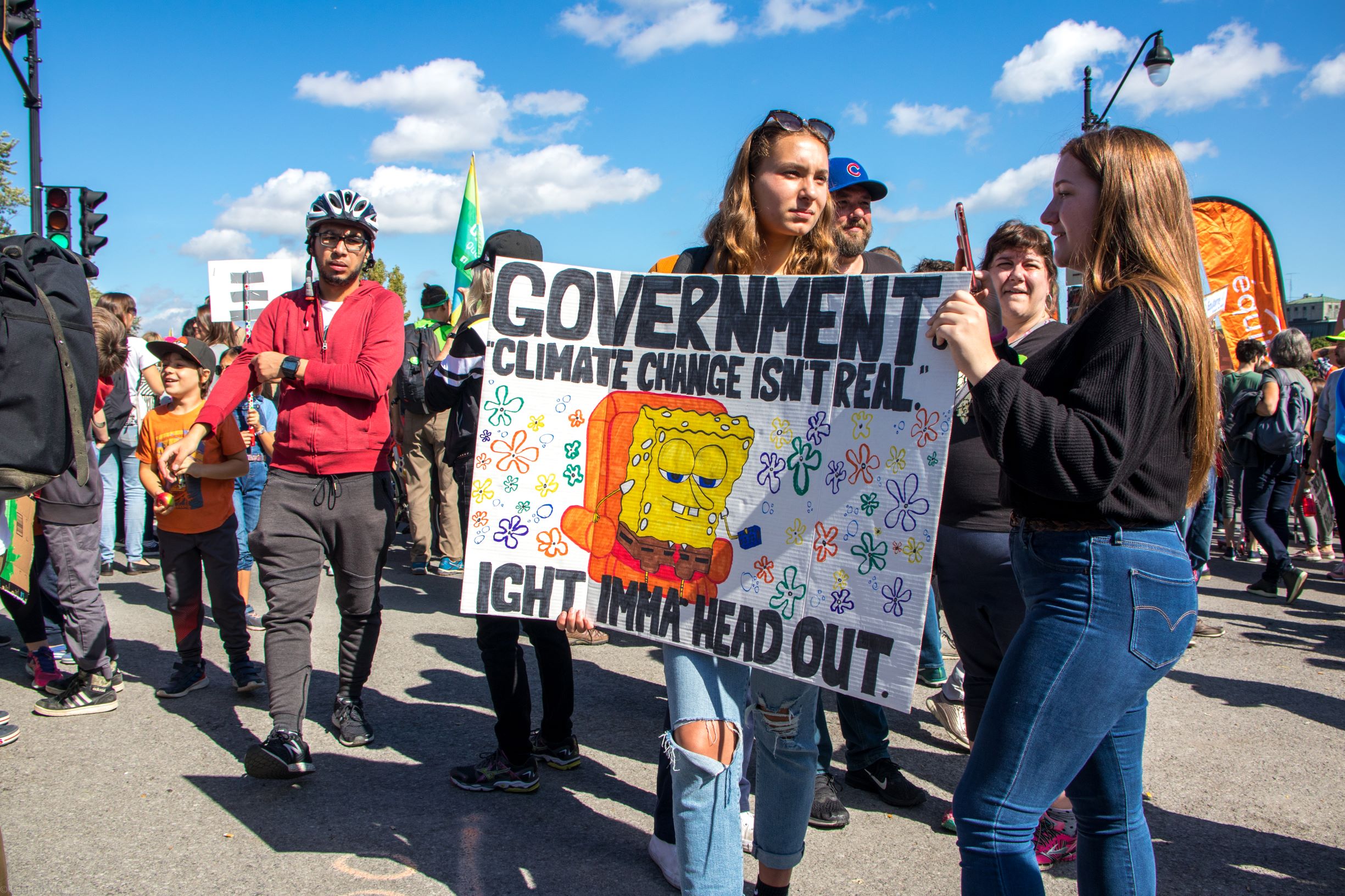
The Sept. 27 Global Climate Strike drew half a million protesters to the streets of Montreal in  a worldwide series of demonstrations against climate change. Typical environmental slogans like ‘There is no planet B’ or ‘Don’t be a fossil fool’ appeared on many marchers’ signs, but some of the messages that stood out most in the crowd were far less conventional: With references to SpongeBob, Queer Eye, “Hot Girl Summer,” and other popular memes, tweets, and Vines, there was no shortage of creativity on display.

Protests are a medium for free expression, and appreciating the originality of others’ signs creates a unique sense of camaraderie among students. However, some onlookers question whether the use of humour serves to downplay the threat of climate change as an issue. They wonder whether older generations of policymakers, many of whom may not understand niche pop culture references, are likely to respond to these messages. To those who do, however, memes serve as both a fun way of coping with the looming threat of some of today’s biggest headlines, and as powerful new tools for collective demonstration. 

Originally a term to describe the way that ideas and behaviours propagate through generations, the modern form of the word meme was derived from a Greek term meaning “that which is imitated.” The meme has since become an integral medium for political dialogue and civic engagement. Thanks to the internet, it has become increasingly easy for memes to gain popularity and go viral overnight. Given that there is no real limit on what can be considered a meme, they are often used to relay political or social commentary through humour.

Montreal’s climate march was just one instance of the unique intersection of protesting and meme culture. Pop culture references have recently fuelled a variety of movements around the globe, including Hong Kong’s anti-government protests this summer as well as national school walkouts in the US to demand gun reform. Unlike other forms of communicative protest, memes cannot easily be shut down, so they are a powerful mobilizing tool. With the internet as an efficient medium for disseminating snapshots from around the world, protesters draw inspiration from other signs and build on the movement with their own contributions.

Regardless of the political statements they make, memes are an innovative form of expression. They help to break down and articulate complex issues, spread ideas, and make sense of emotions. While some joke signs may be criticized for oversimplifying complex political matters, others can be comedic while still remaining poignant. 

While memes may not directly bring about any tangible policy action or reform, they relay important issues and spread quickly enough to bring them to the forefront of discussion. They reflect what is happening in society at a given point and help justify feelings of rage and fear while allowing us all to feel a little less alone. Further, memes are simple to create and reproduce, and they evolve over time based on their reception.

As students marched through the streets of Montreal and around the globe with posters inspired by memes, slogans, songs, and artwork, they proved that there is no one formula for demonstrating an issue as widespread as climate change. Our generation has the ability to band in solidarity over familiar images and slogans and seamlessly incorporate politics into our everyday self-expression. Memes make us laugh while simultaneously uniting us around common feelings about real world issues. Sometimes a laugh is necessary in the midst of all the political chaos, and a meme offers just that.

Read the latest issue

Read the latest issue