


Latest News

Features

Opening the Black Box

Shining light on McGill’s Palestinian students stuck in Gaza, and the bureaucratic blockades that keep them there

Part 1: Introducing the Black Box of bureaucratic violence and immigration restriction  

“Our academic aspirations are within sight, and we wish to contribute to the world through our studies. With the goodwill and empathy of Canada, our future will not slip away needlessly due to factors beyond our control.”

This sentiment from Majd, a Palestinian student in Gaza who was accepted to a master’s program in Computer Science at McGill, is not an isolated one; it reflects the circumstances of 68 Palestinian students who are admitted to graduate programs at Canada’s top universities—including McGill University, University of Toronto, and University of Calgary—but are barred from travelling to Canada to study. Their obstacles are not academic; rather, these students’ hands have been tied by a web of targeted and restrictive immigration barriers

Most of these students, like Majd, are stuck in Gaza, where daily life is marked by instability, restricted mobility, and unreliable internet and electricity due to Israel’s continued genocide. Even those who have managed to evacuate the Gaza Strip are still trapped by the selective negligence of immigration bureaucracies.  

Despite their unconscionable circumstances, many of the graduate students in Gaza continue their academic programs remotely while awaiting study permit approvals from the Canadian government. Tragically, some never received that chance. Sally and Dalia Ghazi Ibaid, twin sisters accepted into a PhD program at the University of Waterloo, were killed in an Israeli airstrike on Dec. 5, 2024, while preparing to cross the Rafah border into Egypt. 

Their deaths serve as a devastating reminder of the lives lost when bureaucratic systems tailor their efficiency to a colonial valuation of human life. Such valuation justifies the abandonment of Palestinian students while alleviating accountability from the Canadian institutions and governments perpetrating it.     

This feature examines how Canadian immigration bureaucracies block Palestinian students’ passage to Canada through selective application processing, indeterminate timelines, and impossible requirements, trapping students from Gaza in a ‘Black Box’ of restriction, uncertainty, and life-threatening physical danger.

A study permit and its impossibilities

Requirements for obtaining an international study permit to Canada are the same whether an individual is from France, the United States, or Gaza. Palestinian students, like any others hoping to study abroad, must provide proof of acceptance into a Canadian institution, evidence of financial support, valid travel documents, and biometric data. After submission, applications undergo security screening and background checks before receiving official approval. 

While standardized requirements for a study permit make sense in theory, those applying from within Gaza face unparalleled obstacles from Israel’s ongoing violence, forced displacements, border closures, and demolition of infrastructure in the Strip. As a result, many are unable to even complete their applications, while those who can are kept in limbo by long delays—often without explanation.

In August 2025, the Canadian government introduced Special Immigration Measures for Palestinians, effective until July 31, 2026. These measures are intended to support Palestinians already in Canada through fee-exempt study and work permits, extensions of temporary resident status, and expedited processing in some cases. //But these measures do not extend to Palestinians currently inside Gaza//. Biometric requirements, exit procedures from Gaza, and security screenings still apply to these students, with no adjustments tailored to the context of the ongoing genocide, famine, and destruction in the Strip.

A biometrics issue? 

The impossible procedural barrier for Palestinian students from Gaza is the biometric requirement. Applicants must provide fingerprints and photos obtained at a Visa Application Centre (VAC). However, no such facilities exist in Gaza.

In May 2024, Israel closed the Rafah border crossing—which is Gaza’s only connection to Egypt—and is not likely to reopen it. Even before the closure, reaching Rafah was risky and time-consuming. Now, with the crossing shut and the surrounding areas frequently under fire, it is effectively impossible for most students to leave.

While applicants and advocates have demanded waivers or deferrals for Gazan students’ biometrics given the exceptional circumstances, Canada has ignored these requests.

More than biometrics: The Black Box 

But biometrics are not the whole story. Even those students who successfully left Gaza and completed all application requirements, including biometrics, have now waited more than a year in the background check phase. This stage, managed by unnamed ‘third-party organizations,’ adheres to no official timeline or any precedent of direct communication with applicants. Through interviews we learned that others were barred from paying for various stages of the process because Palestinian visa cards were not accepted. Some were even prevented from //starting// the application process after submitting their ‘interest forms’ and never receiving the reference code needed to complete the application. 

Students and advocates describe this obscure knot of bureaucratic obstacles as a ‘Black Box’—a term reflecting the lack of transparency and accountability surrounding study permit applications for Palestinians. 

“It’s a Black Box. It’s unknown what is causing the block to their study permits,” said Nadia Abu-Zahra in an interview with //The Tribune//

Abu-Zahra is a professor at the University of Ottawa and an active collaborator with the Palestinian Students and Scholars at Risk (PSSAR) network. PSSAR supports students through the university, student visa, and CAQ application processes, helps them access social services, and pairs accepted students with professors to supervise research.

“These innocent students are waiting, and the only thing they want to do is to be able to study,” Abu-Zahra said. “It’s unfair to block them now [for] no reason. No one knows why they’re being blocked. No one has given a reason as to why they are being blocked.” 

Nada El-Fassou, the Director of Student Services at PSSAR, echoed this frustration in an interview with //The Tribune//

“Whenever we ask questions about [the processing delays], IRCC [Immigration, Refugees and Citizenship Canada] just says it’s done by third-party organizations,” El-Fassou said. “We don’t know what they do. They refuse to tell us what they do. They refuse to tell us who the third-party organizations are. And every time we ask for help—even from MPs [Members of Parliament]—they say the same thing: ‘There’s no processing time.’”

So, who is responsible?

While IRCC is a major cog in the immigration restriction machine, it does not act alone. The Black Box is held together not by isolated bureaucratic inefficiencies, but by broader political apathy. 

“If the Prime Minister’s Office decided to create a new process that works for these students, they could have done that a long time ago,” said El-Fassou. “So I believe it’s a shared responsibility between many different parts of the government.” 

The discrepancy between Canada’s alleged commitment to high-quality international education and humanitarian support on one hand, and its neglect of Palestinian scholars on the other, puts in sharp relief the discrimination built into its apparently egalitarian path to international education. It is a path that systematically excludes those facing the harshest persecution, enabling the Canadian government to frame education as a right for most, but for Palestinians, a hard-won privilege.

Part 2: Students’ stories from Gaza

This Black Box is neither abstract nor remote. It is a web of concerted restrictions within which McGill students are stuck //as we speak//, slashing through layer after layer of impossible hurdles and indeterminate delays with their McGill acceptance letter in one hand and a pencil in the other. 

Sherin Jadallah and Majd are two such students. In addition to pursuing her master’s degree, Majd is an alumna of the MIT Emerging Talent program in Computer and Data Science, and a student at the Artificial Intelligence Agents and Large Language Models (LLM) bootcamp based in Gaza. Sherin, a Palestinian physician also from Gaza, will start a master’s specialization in neuroscience at McGill in Winter 2026. Currently, she serves as a medical evacuation officer with the World Health Organization (WHO) in the Strip. 

At the time of publication, both Majd and Sherin have been accepted to McGill but remain trapped in Gaza, as they are unable to provide their biometrics. Majd is also currently relying on solar power, which leaves her without internet connection for her studies during the winter.

“We are trying to build our futures in a vacuum,” Majd said. “There are no safe places to study, no functioning labs, and limited ways to connect with professors for guidance.” 

The value of education for Palestinians

Sherin has never been outside Gaza, and has lived her entire life under Israeli siege. For her, McGill is a key to personal mobility and cultural fluency. But it is also the place that can best provide her with the training in pediatric neuroscience necessary to address the psychological scarring and developmental trauma inflicted upon Palestinian children by Israel’s genocide and it man-made famine back in Gaza. 

“The need for education is greater than ever,” Sherin said. “This isn’t just about knowledge gained during a single academic year or our three academic years, it’s about transferring the experience of a great nation like Canada back home.”

Sherin’s education is a medical resource. By denying it, Canada inflicts egregious violence against the hundreds of Palestinians still stuck in Gaza for whom Sherin’s degree could be the difference between life and death. 

“A breath of life in this crisis”

Just a few years ago, the Gaza Strip bustled with life: Gazans ate in restaurants, worked in offices, and attended university. But this vitality has been erased from dominant visual discourse—physically by Israel, symbolically by Western media, and legally by immigration bureaucracies. Pursuing education preserves a semblance of this denied normalcy. 

“When you look at the current status of Gaza in the news, most are naturally astonished if such a place is fit to human life,” Sherin said. “They might view anyone arriving from Gaza as a form of permanent immigration, assuming they will never return [….] However, Gaza is fit for life, and our primary desire is to acquire Canadian expert[ise] and knowledge so we can return.”

She also described education as a form of resistance and reclamation in the face of the damage-centred colonial rendering of her home.

“For me, education currently is not just a resilience of resistance. It’s a breath of life in this crisis,” Sherin said. “Many of my students have been killed just trying to reach the hospital for a lecture. But also studying makes them feel like they are now live [sic] normal life before the war.” 

Functioning in this way as a token of memory, education is both a form of preservation and a tool of psychological reconstruction of the once-flourishing Gaza. 

“Education stability is the cornerstone of stability,” Sherin told us. “It’s the memory of stability. It’s escape from death, and is sensed.”

The stability of education also comes from its indestructibility. As the Israeli state razes Palestinian homes, schools, aid sites, hospitals, libraries, museums, businesses, and houses of worship to the ground, education prevails as one of the few things of which Palestinians cannot be deprived. 

One Palestinian doctoral student told Abu-Zahra that a doctorate is something no one can take away. 

“He was comparing the doctorate and academic accomplishments to land, to homes, to agriculture, to the place [he] grew up, to [his] ancestors—everything that they’re attached to,” Abu-Zahra recalled. “Palestinians, as a people dispossessed, seek academic qualifications because they recognize that that cannot be dispossessed, that cannot be expropriated.”

Canada has everything to gain from Palestinian students. They have been accepted to the most competitive programs around the country in medicinal chemistry, mathematical cryptography, biotechnology, and civil engineering, to name only a few. Their merit shines irrefutably even after every university that once fostered it has long been reduced to rubble. 

“These students are very high-achieving,” El-Fassou said. “They would be amazing. They would contribute greatly to the Canadian academic community. And we’re really missing out on that.”

Part 3: What can be done; what //must// be done:

“What gives me hope is knowing that this is not an impossible problem to solve,” Majd told us—and it’s true. 

Universities hold the power of advocacy, and a collective influence greater than the sum of their parts. “Universities are like individuals,” Abu-Zahra said. “When they act individually, they have individual power. When they act collectively, they have collective power.” Support from organizations like PSSAR, testimony before Parliament, and acts of solidarity like the McGill Association of University Teachers (MAUT)’s historic resolution to boycott Israel, economize on this influence—and must continue to do so.

But the academy’s power is limited. It is the IRCC and the Canadian government that have the direct power to facilitate Palestinian students’ evacuation to third countries to obtain biometrics—as many other countries have already done. This year, the United Kingdom evacuated 34 Palestinian students, Ireland evacuated more than 60, and France evacuated over 100. “Their actions prove that with political will, a pathway can be created,” Majd said.

“I am very hopeful that the government will change,” El-Fassou told us, “because if they don’t, we will be on the wrong side of history.”

The Canadian government has not been straight-jacketed into quiescence. Today, it could choose to welcome to its universities some of the finest scholars in the world, to foster expertise capable of saving lives, and to be part of the psychological reconstruction and infrastructure of hope for a place razed to the ground by an apartheid state. And if not today, it could choose again tomorrow. 

“Without this kind of intervention,” Majd explained, “my application and my future at McGill remain in limbo, despite everything else I have done to make this happen.” 

“Once [Palestinian students] get here, they can flourish and they can thrive,” Abu-Zahra said. “But they’re starving at the moment. Two of the 70 people accepted into universities have been killed. I don’t know if Canada’s waiting for the other 68 to die or be killed.”

“We are not asking for the impossible,” Majd said. “We are asking for what has been shown to be possible.”

Martlets, Sports

A long-awaited return: McGill Field Hockey hosts second home weekend in over six years

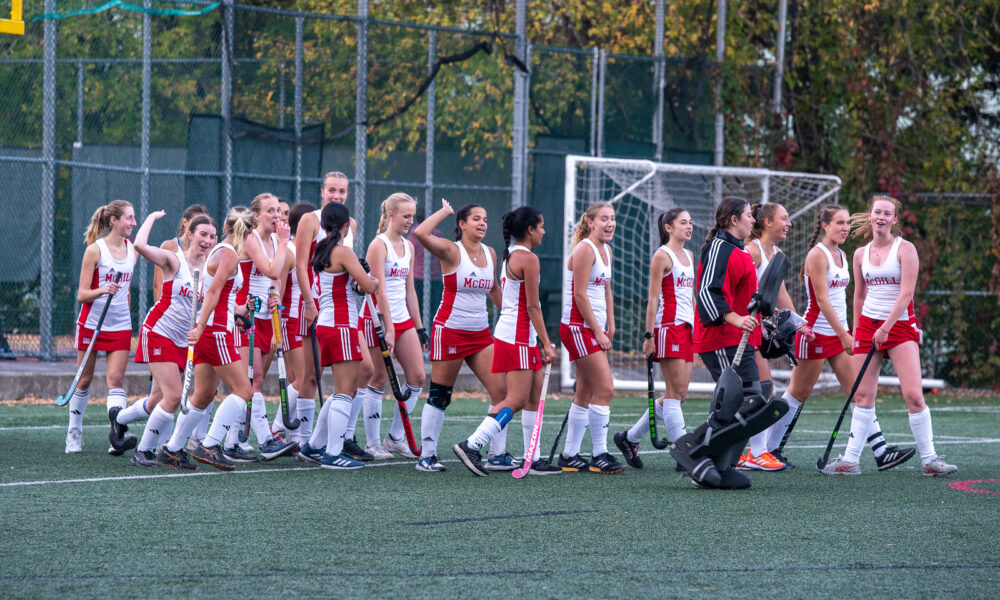
For the second consecutive year, the McGill Women’s Field Hockey team made their home debut, marking a major step in the team’s efforts to re-establish their presence on campus. On Oct. 11 and 12, the Martlets played their only home games of the season, facing off against the University of Toronto’s Varsity Blues. While the Martlets were unable to secure wins in either match against the second-ranked team—losing 4-0 and 7-0—the games were a reminder of the team’s ongoing improvement and determination. 

The team’s opening match at Forbes Field on Oct. 11 set the tone for the weekend, showcasing their defensive skills and growing their on-field chemistry.

Goalie Gabriella Fourkas, U2 Arts, and midfielder Sara Prins, U2 Arts, spoke to The Tribune about the importance of maintaining focus and composure on the pitch, which the team has majorly improved upon this year.

“We were all able to stay calm the whole time,” Fourkas reflected. “We didn’t let the excitement or the stress of it being a home game get to us too much.” 

Prins echoed that sentiment. 

“The first half definitely started off with extreme jitters,” she said. “But after the second whistle blew, every girl was in it.”

As Prins noted, the Martlets had a slow start in the first half, with the opening quarter ending in a scoreless 0-0 tie. The Varsity Blues ramped up their offensive pressure in the second quarter, pulling ahead 3-0, though Fourkas ended the half with a crucial save to deny another goal.

McGill began to settle into the ebb and flow of the game in the second half, using their strong defensive pressure and working to find open spaces to pass up the field. While the Martlets were unable to score, they stayed composed, hustling to every ball and supporting their goalkeeper. Fourkas’ relentless performance and spectacular saves earned her ‘Player of the Game,’ with special mentions by the team’s assistant and head coaches to defenders such as captain Clara Smyrski, U3 Arts and Science, and Jenna Payette, U3 Science, for greatly strengthening the defensive line.

Head Coach Sharan Gill praised the team’s determination in an interview with The Tribune

“The girls are really good. They are one of the hardest-working groups I’ve ever coached,” Gill said.

The game also sparked a broader conversation around the future of McGill’s Field Hockey program. The Martlets currently face the threat of being cut in the upcoming varsity review. Midfielder, assistant captain, and U3 Arts student Grace Hodges emphasized the necessity of hosting home games in building awareness and visibility for the team.

“Having home games builds the sport in the province,” she reflected, in an interview with The Tribune. “[If the program gets cut], it’s a shame not only for women’s sports, […] but also for the future of this sport within the province, growing different types of games, and not just the ones that have had support from McGill.”

Hodges’ sentiment that the sport is growing was echoed by the stands, where the crowd’s presence and cheers created a buzzing atmosphere. 

The Martlets carried the momentum of their home play into their Oct. 19 matches against the Queen’s University Gaels in Kingston. Though the Martlets lost their first game 2-1, Smyrski scored the first goal of the season; in their second match, the Martlets won 1-0, with a goal from U1 Arts and Science student and forward Avery Berry. Prins assisted both goals.

Quotable: “It makes a big difference for the girls to have the chance to play with their families [watching]. A lot of us are from out of province, and our families have flown in and have driven hours to be here. There’s the field hockey community in Montreal that shows up for it. So, it’s not only meaningful for us to be able to play on a home field, but it’s meaningful for the sport at large in Quebec.”—Hodges, on the importance of celebrating Women’s Field Hockey at McGill.

Stat corner: There were 112 fans in attendance, marking a major increase from the previous year’s home game attendance of 75.

Sports Editor Clara Smyrski and Sports Staff Writer Jenna Payette are members of the McGill Women’s Field Hockey team. Neither were involved in the writing, editing, or publication of this article.

Science & Technology

Could personalized interventions transform eating disorder care?

Eating disorders (EDs) are serious and prevalent conditions that can impact all aspects of one’s life. However, treatment remains difficult to access as a result of high costs, long waitlists, and geographic limitations. But what if just one encounter could significantly improve cost-effectiveness and long-term outcomes for individuals living with EDs?

Single-session interventions (SSIs)—programs designed to involve only one visit with a clinic, provider, or program—are emerging as a promising approach to better support individuals with EDs who may otherwise be unable to access care.

In a recent publication in the Journal of Eating Disorders, Laura Lapadat, a fourth-year PhD student in McGill’s Clinical Psychology program, investigated the effectiveness of a personalized feedback SSI for individuals with EDs. Lapadat explained that her motivation stems from a desire to make research more collaborative and patient-involved, ensuring that the voices of those directly affected are heard in the development of new interventions.

“When it comes to creating interventions, it’s great to talk to the people who live with the condition and know what it would be like to have to use this [intervention] day to day,” Lapadat said in an interview with The Tribune

She emphasized the need to move past a “one size fits all” approach to treating EDs, since there are many subtypes; the most well-known include anorexia nervosa, bulimia nervosa, and avoidant/restrictive food intake disorders.

“There’s a movement in the field right now towards more personalized approaches to EDs, as there is a lot of variation in how an ED can present and persist,” Lapadat said. “[Personalized interventions] capture different elements of eating disorders, such as levels of symptoms like restrictive eating or emotion regulation problems.”

Using a qualitative approach, the study interviewed 16 individuals with EDs to explore whether they would be interested in a personalized SSI. Lapadat hoped to incorporate their feedback regarding their ED symptoms and behaviours to better understand their experience during recovery.

Participants indicated that they valued the detailed personal information, appreciated actionable recommendations for their health, and hoped for feedback which could be shared with their extended healthcare team to allow for better support.

“People with EDs are interested in seeing their own data and appreciate the personalized element of it as compared to a one size fits all approach,” Lapadat said.

However, some participants reported concerns that personalized feedback may bring up feelings of shame. Lapadat highlighted the emotional complexity patients face when receiving such feedback, describing a participant who experienced strain between their ED and recovery goals. The participant explained that if the feedback indicated she was “doing well,” it could reinforce and trigger her ED habits. This finding illustrates the need for sensitive delivery in making SSIs safe and effective for people who may be at different stages of ED recovery.

“In terms of how it’s delivered, we wanted it to be engaging, to not have too much long text, and to be formatted in ways that respect the autonomy of people with EDs, ideally giving them options about how they view and receive their feedback,” Lapadat said.

Lapadat also acknowledged the study’s limitations caused by its narrow demographic representation. Most participants were white, educated, cisgender women, with many individuals in stable states of their illness.

“Interviewing individuals in more severe states of their illness may have yielded different findings,” Lapadat said.

Looking ahead, the lab’s next step involves recruiting ten individuals with EDs to conduct a pilot study, where participants receive two weeks of five daily phone surveys, to better capture the interventions’ efficacy in real-world settings. Because EDs have the highest mortality rate of any other mental illness, implementing effective interventions to overcome barriers to treatment is urgent. Personalized SSIs show an encouraging new avenue for ED care by offering treatment tailored to a patients’ unique needs, cutting costs, and reaching individuals who may otherwise not have access to traditional care.

McGill, Montreal, News

Thousands fight for Palestine during Oct. 7 student rally and strikes for divestment

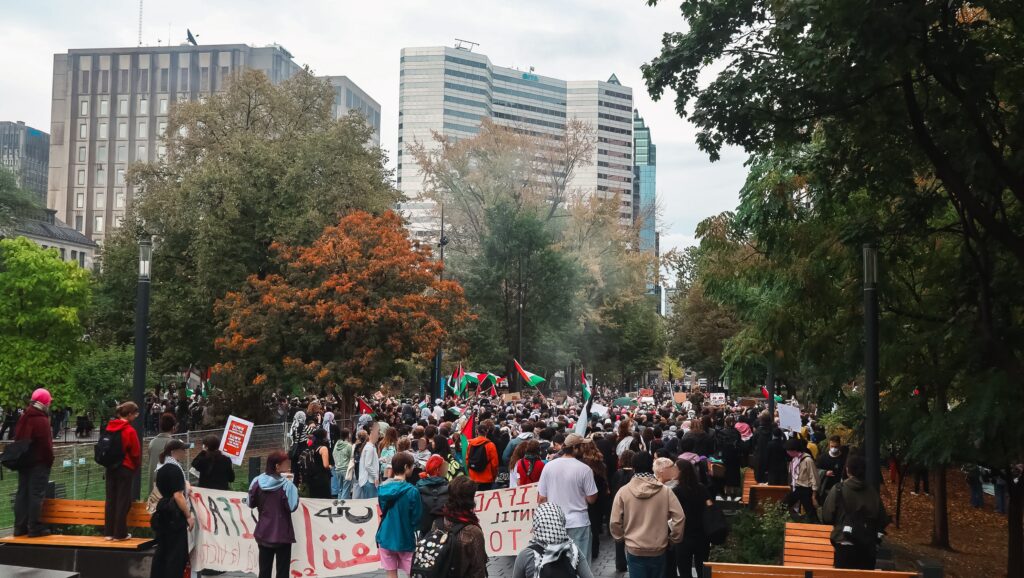
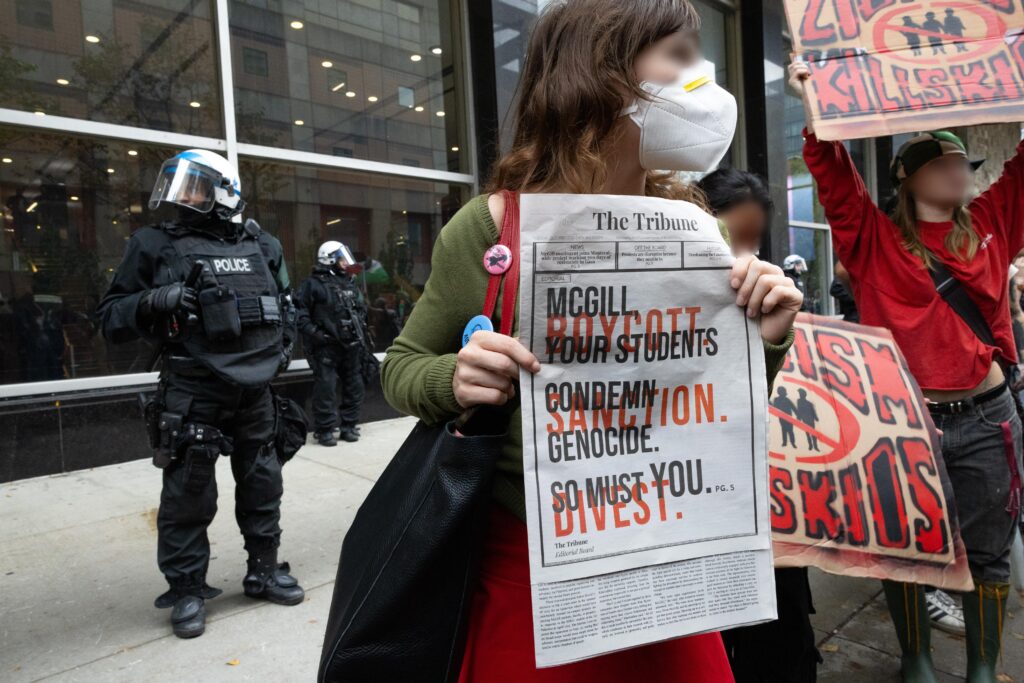
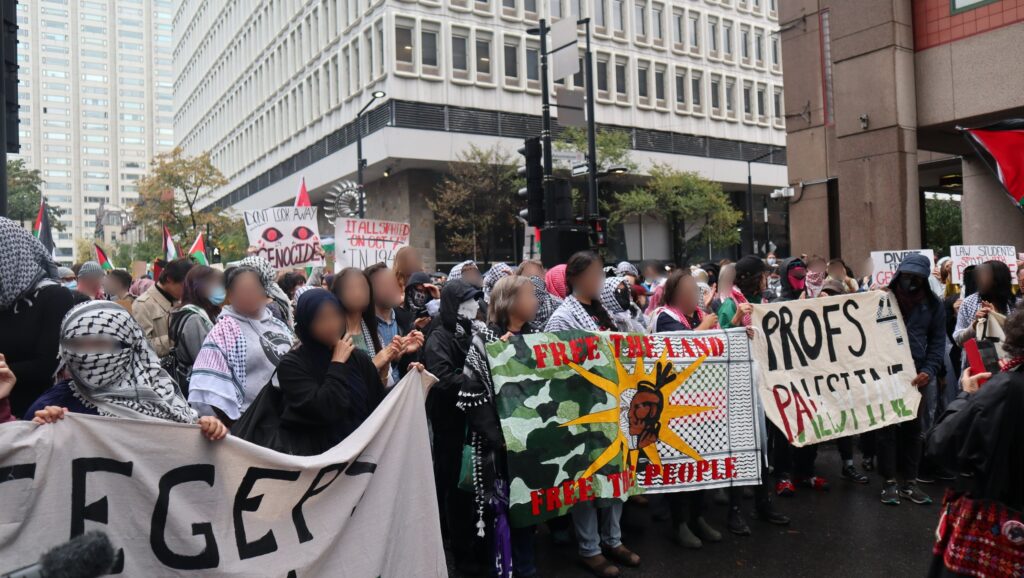
A sea of demonstrators in red, white, black, and green chanted, “From the river to the sea, Palestine will be free!” at the Montreal student rally for Palestine on Oct. 7. Commencing outside of Concordia University’s Henry F. Hall Building at 1:00 p.m., thousands of university and CEGEP students and faculty, as well as broader Montreal community members, gathered to protest two years of Israel’s genocide in Gaza. Despite the pouring rain, attendees also showed up to support the day’s Montreal-wide student strikes for academic divestment from the genocide, which applied to over 80,000 students. Chapters of Students for Palestine’s Honour and Resistance across Montreal’s post-secondary institutions organized both the strikes and rally. 

Surrounded by Service de police de la Ville de Montréal (SPVM) officers in riot gear—approximately 40 of whom were stationed in lines barricading access to the temporarily-closed Hall Building—attendees cried out chants for Palestine and for divestment. Contingents of students from different universities and CEGEPs, including McGill, Concordia, Cégep de Saint-Laurent, Université de Montréal, and Université du Québec à Montréal, continued arriving to the intersection of rue Mackay and boul. De Maisonneuve Ouest. 

Associate Professor of McGill’s Department of Languages, Literatures, and Cultures Daniel Schwartz addressed the growing crowd, affirming that the movement for Palestinian liberation is an ongoing, universal fight.

“A lot of people ask me how I, as a Jew, can make this sort of speech on October 7,” he stated. “And I say to them, as so many of you have said, that this genocide and ethnic cleansing of Palestinians did not start on October 7. I say to them that any day of the year is a good day to commemorate the Palestinian struggle.”

Schwartz continued his speech by applauding the Montreal student collective’s solidarity with Palestine.

“I am proud to stand here with students representing all the universities and CEGEPS in Montreal, [and] to be joined by a growing number of professors […] who refuse to sit on the fence,” Schwartz said. “I’m proud of the moral conscience of our students, of their patience and their steadfastness, despite all the opposition and threats they’ve received from administrators, politicians and the police.”

In an interview with The Tribune, Irene, a member of the Revolutionary Communist Party in Canada, commented on the importance of solidarity between worker and student movements.

“We’re [hoping people] see the connection between what’s happening in Gaza and the broader crisis of capitalism […] to [realize that] oppression in Gaza is tied to oppression here. [….] So we all are vested in freeing Palestine, because it means our freedom too,” they stated. “What’s needed is these students, with their palpable energy, to combine with the workers’ movement, [and] unite together. And this unity [means] we’re unbeatable.”

Around 2:00 p.m., the protest began to travel from rue Mackay onto rue St.-Catherine Ouest. It threaded through nearby streets lined with SPVM officers before moving north on rue Peel. The demonstrators then entered McGill’s campus via a service driveway behind the Bronfman Building, despite the main entrances to campus being closed. At the driveway’s entrance, faculty members held a sign that read, “Profs pour la Palestine.”

At 2:00 p.m., student protestors from all Montreal universities gather at McGill’s Y-intersection, where youth speak out against their universities’ complicity in the genocide in Palestine.

On McGill campus, Associate Professor of the university’s Department of Sociology Barry Eidlin discussed the importance of professors supporting the student movement for divestment in an interview with The Tribune.

“It’s particularly important because the university has taken a really hard line on trying to […] stifle student protest and just campus protests in general,” he stated. “[Professors] get pressure from our administration to just conduct business as usual. [But] the students are here because this is something that they’ve been fighting for, for years now, and it’s fallen on deaf ears.”

The demonstrators moved past the McLennan-Redpath library complex to reach McGill’s Y-intersection, where another protest contingent joined the larger group using the campus road alongside the Macdonald-Harrington Building. As the demonstration unfolded on campus, an individual smashed a window at McLennan-Redpath.

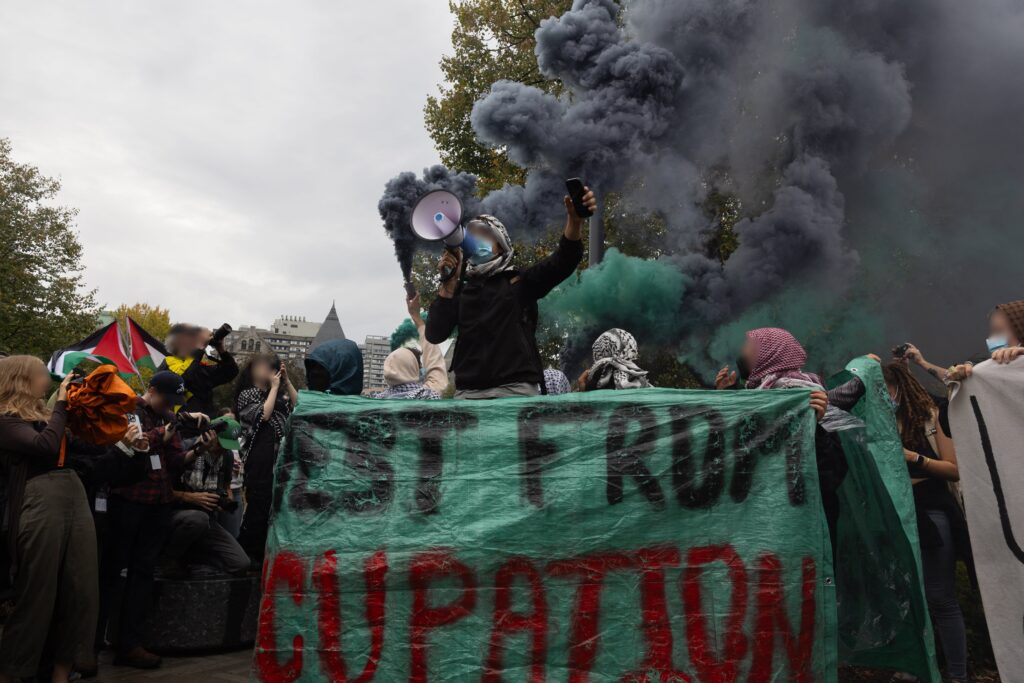
Once the marchers assembled, organizers began releasing smoke bombs and small fireworks in the colours of the Palestinian flag as they unfurled banners to form a protected circle in the centre of the Y. A student speaker in the circle began to detail how academic institutions in Montreal have recently “revealed the lengths that they will go to [to] maintain their genocidal complicity.”

“We have demanded arms embargoes, we have demanded sanctions, and we have demanded divestment, only to be redirected to the so-called diplomatic and civilized channels,” the speaker stated. “And after two years of genocide, we have learned that these channels are anything but diplomatic or civilized.”

Eidlin echoed these sentiments.

“The type of protest often matches the response that protesters received from the powerful, and we have been in a context now where the administration has basically been burying its head in the sand […] [and] the only response [to student demands has been] to lock down campus and try to stifle the ability to engage in free speech and association on campus,” he said.

Amidst chants of “shame” from the assembled crowd, the speaker continued to decry universities’ attempts to “divide [students’] collective might” in pro-Palestinian activist movements.

“Our administrations are motivated by greed and profit amid donor pressure, but do not mistake this self interest for ignorance,” they said. “In their hearts, they know that they’re standing against the tides of history, and history will not wash Deep Saini [and] our [Board of Governors] of their blood-soaked hands.”

In a written statement to The Tribune, McGill’s Media Relations Office (MRO) maintained that the university will not divest.

“McGill remains firmly committed to freedom of expression and peaceful protest,” the MRO wrote.

Organizers at the rally then burned an Israeli flag covered in red handprints, before traveling past the Leacock Building beside the Redpath Museum. “We keep us safe!” the demonstrators chanted, as they approached approximately 20 riot officers preventing access to Leacock. Diverted by the police presence, the collective moved onto rue McTavish, before re-entering the streets of the Golden Square Mile around 3:00 p.m., once more accompanied by police. Onlookers showed support, raising peace signs and honking car horns during stretches of the demonstration that occurred on roads. One attendee was shoved by an SPVM officer as they walked near a Société de transport de Montréal bus.

When the protestors returned to the Hall Building, they were once more met by police officers guarding the doors. Though the group of demonstrators edged close to the doors, there was no escalation, and the protest eventually travelled south from the building to reach Square Victoria, where it joined another demonstration for Palestine at around 4:00 p.m.

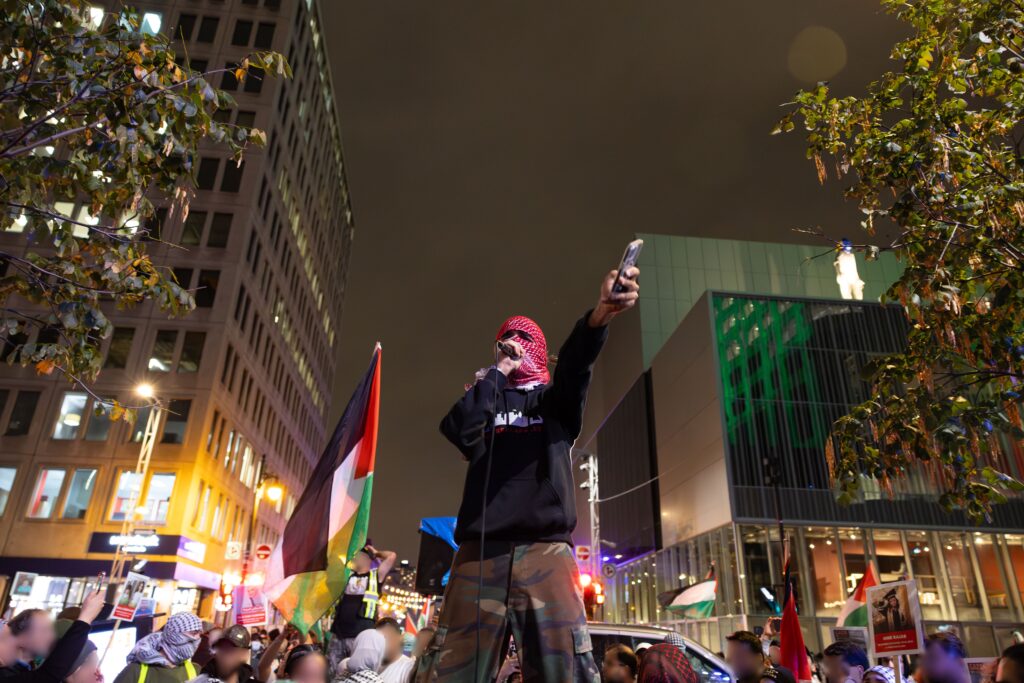
Thousands of students and Montreal community members gather at Place des Arts for a final march down René-Lévesque Street.

Upon joining the second protest at Square Victoria, demonstrators listened to speeches, including by Mohawk activist and artist Ellen Gabriel, and shared free refreshments provided by organizers. Participants also displayed a mock MK-84 guided bomb, which has been deployed by Israel amidst safe zones in Gaza designated for displaced Palestinians. The demonstration concluded at around 6:30 p.m., with the SPVM reporting no protest-related arrests. Many attendees then moved to Place des Arts to attend a second event for Palestine.

Outside of the Hall Building, Professor at McGill’s Institute of Islamic Studies Michelle Hartman expressed how meaningful inter-university solidarity is in the fight for Palestine in an interview with The Tribune.

“I didn’t recognize one student,” she commented. “Often, when I’m at a protest, I recognize students I’ve taught, and I realized everyone around me [today] was a student from a French university, and that’s the kind of solidarity I think that we need in order to make a difference, and that’s what we’re seeing being created right here, right now.”

Hartman also specifically discussed what the Oct. 7 Montreal student strikes represent, and the importance of faculty support for these student movements.

“We are the majority of the world. We’re the people who are on the right side, and we’re the people who are all over the streets,” Hartman stated. “The students voted for the strike, so professors should respect that, if not stand in total solidarity with the students. [….] I feel like increasing numbers of professors at McGill agree with me. As professors are unionizing across all the faculties now, people are becoming more and more aware of the importance of that kind of solidarity.”

Editorial, Opinion

SSMU must remember whose team it is on

On Oct. 1, the Students’ Society of McGill University (SSMU)’s Board of Directors (BoD) abruptly dismantled the student-run food accessibility collective known as Midnight Kitchen (MK), firing its staff and locking the doors to its kitchen space without any prior warning. 

SSMU’s executive termination of Midnight Kitchen betrays the fundamental duty of a student union to serve and uplift its student body. SSMU’s decision to close MK—without proper consultation with the kitchen collective beforehand—demonstrates an ignorance of the practical specificity of MK’s work, and an exploitation of inconsistent and selective information to sensationalize the circumstances surrounding MK’s dismantlement. 

MK is a non-profit, worker- and volunteer-run collective with the core mission of providing affordable, healthy, nut-free and vegan food to McGill students and the surrounding community. MK’s programs include educational workshops on food prep and food politics, free lunches, and solidarity servings.

The discrepancies between the BoD’s rationale for shutting down MK and the nuanced realities underlying these accusations lay bare SSMU’s disregard for clear and respectful communication with its student organizations. In an email sent to the study body, the BoD claimed that MK had failed to meet its fee mandate, providing only two weekly meals instead of five. In a statement regarding the restructuring of MK, the Quebec Public Interest Research Group at McGill (QPIRG-McGill) clarified this reported shortcoming, explaining that in addition to its two weekly meal servings, MK also provides two to three solidarity meals for students and local communities, totalling four to five meals per week. 

SSMU also claimed that MK did not spend enough of its budget directly on food. The email outlined that in 2023, MK spent 5.1 per cent of its $350,360 CAD budget on food, an amount that increased to 7.41 per cent in 2024, but, according to the BoD, remained insufficient. QPIRG contextualised this claim by outlining that the amount MK spent on food does not represent the true amount of food the kitchen acquires, as it sources a large portion of its ingredients free of cost from Moisson Montréal and local student farms, such as Les greniers agricoles and Élèves des Champs. The way in which SSMU offered data without providing context critical to its meaning is misleading and incomplete, demonstrating a failure to work in good faith with the collective to reach a compromise on financial and operational changes.

As a student society, SSMU’s most fundamental responsibility is to support its students and their organizations, not to antagonize and pit them against one another—as SSMU’s framing has done.  

Instead, SSMU imposed a black-and-white business-centred conception of proper management onto MK’s operations—of which SSMU has little to no expertise. The Students’ Society neglected the practical obstacles inherent to running a kitchen and serving food. MK’s kitchen, for example, can only accommodate eight people; additionally, it has no dishwasher, meaning staff must clean everything by hand. These challenges are much more likely to be at the root of organizational shortfalls than the budgetary discrepancies it problematized. 

SSMU’s unapologetic prioritization of austerity over MK’s critical social and political mandates undermines the collective’s capacity to provide food and education to students and local communities in need, and delegitimizes SSMU allyship with the student body. A student union that uses its bureaucratic power to confuse and mislead its members fails its most basic duty to serve its students—a failure that no amount of increased ‘efficiency’ can make up for. 

Regardless of the details of MK’s funding or operational strategy, the manner with which SSMU addressed its grievances with the collective was deeply damaging, disrespectful, and dismissive. SSMU must commit to transparency, not use numbers and incomplete information to sensationalize its negotiations with the student organizations with whom it is supposed to be allied. As students, it is our responsibility to remain critical of the apparent legitimacy of numbers, to seek relevant context when assessing the efficacy of clubs and collectives, and to avoid passive acceptance of information shaped by SSMU’s bureaucratic power. 

SSMU and its students are all on the same team, and we must treat each other as such.

//A previous version of this article stated that Midnight Kitchen is a non-profit, volunteer-run organization. In fact, it is a worker- and volunteer-run organization. This article has been modified to reflect this information. The Tribune regrets this error.//

Science & Technology

Rogers Place and the overlooked costs of urban development projects

The creation of public sports infrastructure often sparks excitement, as many view these projects as symbols of progress and cultural pride. Yet few consider how such developments impact marginalized populations, notably Indigenous communities. A study in the International Journal of Urban and Regional Research examining Rogers Place—Edmonton’s $613.7 million CAD publicly financed hockey arena—challenges the belief that sport-related urban development projects offer community-wide benefits.

Before opening in 2016 on Treaty 6 territory, the site was home to a significant Indigenous urban street community and several non-profit social service agencies. Following the arena’s creation, residents were evicted as subsidized apartment complexes and community hubs were replaced with upmarket housing. Thus, between 2016 and 2018, Jordan Koch—associate professor in McGill’s Department of Kinesiology and Physical Education—worked alongside researchers Jay Scherer and Rylan Kafara from the University of Alberta to conduct community-based research documenting the arena’s impact on Indigenous and unhoused residents.

Koch told The Tribune in an interview that the project began after he and his colleagues witnessed residents being displaced and losing access to local social services, including the harm reduction facility known as The Hub. 

“The three of us had this longstanding relationship in this community, and we just witnessed firsthand what was happening,” he said. “This sort of thriving community being displaced, […] often aggressively, violently, and we were kind of at a loss for what to do, so we started doing what researchers do, research it […], [and] trumpet stories that we thought were underrepresented.”

The researchers interviewed 34 city centre residents, 20 frontline staff at The Hub, and 8 managers from several non-profit agencies. They also spoke with 30 city centre residents via Homeless Connect events and unhoused individuals at three facilities outside the urban core, and conducted ethnographic observations during 40 National Hockey League (NHL) game nights.

Throughout their interviews, the researchers identified three recurring themes. The first is that the increase of racialized policing and carceral redlining—systemic social control through discriminatory policing and incarceration practices specifically targeting racialized communities—increased stress and anxiety among participants. Police and private security increased surveillance, issued fines, and used other aggressive policing measures to displace Indigenous and unhoused residents to create a “comfortable” environment for hockey fans on event nights. 

Koch recalls witnessing this directly during his ethnographic observations.

“An hour before the game, […] police were sort of clearing the corridors [and] that would lead the traffic to and from the arena. [There was] this physical cleansing of the space to kind of make it a more enjoyable experience for the fans.”

Koch also shared that a South Edmonton police officer explained to him how individuals displaced from downtown relocated south. However, limited services forced police to return them downtown and then bring them back to the south on game nights, adding to this nauseating feeling of continuous displacement.

The second common theme among residents was anger and sadness over the loss of safe community spaces. Developers destroyed dead zones in the city, such as parking lots, which often served as shared homeplaces. 

The last theme the study found was that city centre residents desired to remain on Indigenous land and retain access to The Hub, viewing it as a sacred space amid ongoing colonial violence against Indigenous Peoples.

“The community has been widely displaced. Yet there was still this hope and sense of home that I thought was really important. So that, to me, was what was kind of the most surprising,” Koch said. “People’s connectedness to that space, to that land, and to each other.”

The study notes that in 2021, the Katz Group purchased The Hub, and the Edmonton Oilers Community Foundation allocated $10 million CAD to relocate it two blocks away from Rogers Place. On Sept. 30, 2023, The Hub closed, and at least 120 city centre residents have since died amid ongoing housing and drug crises.

Ultimately, this study shows that sport-driven development often fails to provide community-wide benefits and instead reflects settler colonialism in its displacement of racialized communities for the benefit of urban elites. Indigenous resilience and connection to land emphasize that urban spaces are home to many communities, which is why ethical and inclusive planning is vital when constructing sport arenas in Edmonton, Montreal, and beyond.

Art, Arts & Entertainment, Books, Film and TV

A love letter from art to autumn 

Dearest autumn,

You’ve arrived once again, although you’ve made me wait an awfully long time this year. You seem content to torture me with thirty-degree weather in October. But the leaves have finally turned a crisp ochre, and with this comes the breaths of cozy inspiration. All around, artists and audiences alike snuggle up with their blankets to descend into the crackling fireplace of imagination and creativity. 

A classic fall pastime for coffee lovers involves sipping from warm mugs while rewatching their favourite 2000s sitcoms. The familiar bond between those in their twenties and their 40-minute episode, seven-season TV show is unmistakable. Gilmore Girls is my personal favourite, combining slice-of-life realness with a tinge of whimsy and the wittiest dialogue. Lorelai Gilmore (Lauren Graham) is a sparkling character who epitomizes fall vibes. Watching Rory Gilmore (Alexis Bledel) consistently make poor decisions throughout her early life crisis makes me want to rip out my hair—or hers. But there’s a certain comfort in knowing that no matter how off-kilter my day is going, Rory’s is going worse. This frustration and endearment alongside a steaming teacup is quintessentially autumn.

You, autumn, encourage everyone to slow down. Books are suddenly magical again, and a windy bite at one’s nose incites a desire to hide under the covers with a silly little fantasy novel. My personal recommendation this season is Rebecca Ross’s Divine Rivals. It is not often that I find a story with a plot that feels entirely new, but Ross achieves this, weaving together a perplexing and animated world that I couldn’t escape from. She charts the story of two young journalists competing for the role of columnist. Both share a fiery determination and darkened pasts, kept close and secret. As war rages on, the question emerges: What should we really be commenting on? Connected through magic typewriters, the two form an unlikely bond under precious aliases, becoming each others’ dearest confidants. Ross creates a whirl of warm love, sweet misgivings, and moral conundrum all in one. It’s perfectly paired with the pumpkin spice treat of choice, and the soft patter of rain. 

Autumn, despite the wonderful inspiration you are for writers, artists, creators, in addition to the atmosphere you create for art-lovers to immerse themselves in their passions, you are art in and of yourself. Stepping outside on an autumn day holds nearly inexplicable magic, but I shall do my best. It is a sensory exhibit of wonder: The crunch of bright leaves under my soles, the symphony of rustling above me, the slightly sweet, nutty smell in the air. It is art created by no one at all, but shared by everyone. Every leaf is a painting that changes from moment to moment: Sage, to copper, to bursts of sunset and teddy brown. Innocent kids, barely two feet tall, collect them, press them into books; they notice the art, even if growing up will make them forget. The clouds dance with the sun in autumn, light rays slanting through the cottony fluff and painting the world in vivid colours. 

Spring and summer may always hold the popular vote. But I will always love the slight inconvenience of a chill seeping through the knit of sweaters, of the wind tousling perfectly placed hair. There is dramatic art in the playful flair of autumn. Autumn flirts with everyone, like they’re the audience of an interactive play. You demand their attention, grasping them out of whatever self-centred haze they may be trapped in. We become a shared audience for autumn, united in the common experience of red-tipped ears and runny noses. 

Art and autumn go hand in hand. These months will pass by so quickly with the blur of midterms and travels home. But for a moment, even just a breath, try to find a piece of art this fall, in the blur of your train ride window or the stray leaf dancing across your textbook. 

Take a moment and notice it. We’ve worked very hard. 

Love, 
Art

Student Life

Act like a man, perform like a male

History repeats itself, first as tragedy, then as farce.” Thus wrote Marx in The Eighteenth Brumaire of Louis Bonaparte. Aligning itself with a long legacy of alternative male archetypes, the performative male exists in conversation with the Metrosexual, Soyboy, Nice GuyTM and Male Manipulator—each a cultural attempt to grapple with what it means to be a man in an era of progressive politics, where prized self-awareness is rewarded as social capital. 


What makes the performative male distinctive as a phenomenon is its self-conscious, nonthreatening nature. Originating in feminist criticism of men who appropriate aesthetics of political sensitivity for women’s validation, the label has since been embraced, blurred and reinterpreted as a kind of satire—part parody, part reclamation, culminating in a cultural onslaught of competitions to see who can most embody the archetype.

This spirit materialized on Sept. 26, when Sam Rudin, U2 Arts, in collaboration with Spotted McGill, hosted McGill’s first Performative Male Contest on campus, just hours after the university’s annual Lettuce Club competition. Among the wilted green remains of the Lower Field, competitors advanced through rounds of runway, dance-offs, and mock interview questions in a bracket format by ‘cheer-meter’—scaled to the music of audience uproar and applause. 

Recounting the organizational process, Rudin admits that he hadn’t initially planned to organize anything at all. He initially floated the idea of a performative male competition in a Spotted McGill confession—more of a suggestion than an intention, but when it garnered traction online, it became clear that what started out as a passing joke among his friends had become a serendipitous call to action. “At some point, I realized if I don’t do it, no one will,” he said in an interview with The Tribune

For Rudin, the competition was not so much a matter of political statement as it was an inclusive community-bonding exercise. When asked about the role of gender in this phenomenon, he told The Tribune, “Someone commented on the post asking if girls were allowed to perform and another person replied, ‘performative male is a mindset.’ Anyone can be a performative male.” 

Runner-up Anthanasios Wees, U1 Arts, echoed this sentiment, emphasizing in an interview with The Tribune that “gender and sexuality have no place as a discriminatory feature.” Wees highlighted that it’s the intent that defines a performative man, not the semantics of how ‘he’ acts. 

“It’s about the intention of illusion, pretending to be a safe space for women to gain an advantage in social circles opens you up to rightful criticism […] that’s when you start entering the world of being a performative male.”

Shahzaib Sultan, local social media influencer, winner of the Montreal performative male contest,  and self-identifying performative male, believes the city’s cultural landscape is particularly conducive to self expression. Between the fashion-forward Plateau, and Mile End’s melting pot of subcultures, Montreal naturally fosters performative expression where the line between personal style and deliberate performance often blends sincerity with self-aware Gen-Z irony. 

Though ultimately victorious, Sultan found himself at odds with the contest’s expectations, and at times, considered quitting. “Being queer in the contest, I questioned my place in that too,” he said. Navigating a space where crowds caricaturize the forms of self-expression he feels natural in, Sultan noted the environment’s inherent hostility in an interview with The Tribune: “It’s not authentic—straight men have appropriated queer culture in many ways and this is just one of them. We applaud men for being performative.” 

Despite the underlying tension, Sultan embraced the experience, choosing to reclaim the space on his own terms. The contest, built on exaggerated heteronormative clowning, prompted him to consider how his identity fit within the broader digital landscape. Getting ready for the contest felt ordinary—another familiar morning routine. In an ironic twist, it was perhaps the most genuine participant who triumphed in a contest defined by performative masculinity, revealing heart beneath a seemingly cynical spectacle.  

“I think the performative male trend has done a lot of good. People base their identity in significantly more ridiculous things than being a performative man. Good for them, it’s hard to figure out what we are,” said Wees. 

Behind the Bench, Martlets, Soccer, Sports

Tides and Roses split points as former Martlets reunite in NSL showdown

The Halifax Tides FC played the Montreal Roses FC in a crucial Northern Super League (NSL) match on Oct. 2, which ended in a 2-2 draw. The game was the final matchup this season between three McGill Martlets Soccer alumni: Sophie Guilmette (MA ‘25), Mara Bouchard (BA ‘24), and Stéphanie Hill (BSc ‘23, MSc ‘24).

Guilmette signed with the Tides in March 2025 and plays goalkeeper for the team. In an interview with The Tribune, she expressed her excitement about playing against her former teammates.

“It’s just joy, honestly. Mara and Steph are [some] of my closest friends,” she said. “And at the end of the day, win or lose, those are my people.”

Founded in April 2025, the NSL is Canada’s first professional women’s soccer league. Its season spans eight months, starting in February and ending in October, and features six clubs: Calgary Wild FC, the Halifax Tides FC, AFC Toronto, the Montreal Roses FC, Ottawa Rapid FC, and Vancouver Rise FC. Over the course of the regular season, each team plays a total of 25 matches, facing every opponent five times.

Bouchard, who is a midfielder for the Roses, explained the uncertainty that comes with playing in a new league in an interview with The Tribune.

“I guess the first thought is, I don’t know what to expect,” she said. “Everyone is just jumping in the league where no one has any idea of how [it’s] gonna turn out.”

Guilmette discussed how part of the NSL’s importance lies in its novelty.

“Up until this year, it was not possible to play [professional women’s soccer] in Canada,” she emphasized. “I’m super privileged to be able to do that at home in front of my family and friends [now].”

Although still in its early stages, the league has already drawn significant attention from Canadian fans, attracting over 14,000 spectators to its opening matches in Vancouver and Toronto. The NSL has also secured multiple broadcasting agreements with major streaming platforms, including CBC, TSN, and the francophone Réseau des sports.

The Tides-Roses match came just two weeks before the NSL playoffs, for which the top four seeds have already been determined. Still, it was an important match, as the Roses aimed to surpass the Rapid to become the second playoff seed, while the Tides looked to end their winless streak dating back to July 12.

“We already qualified for playoffs, so for us, [we treated] this match like a playoff game,” Bouchard explained. “We’ve always had a tough time playing against Halifax this season.”

Despite numerous scoring attempts from both sides in the opening half, a breakthrough did not come until the 36th minute, when Tides midfielder Saorla Miller capitalized on a free kick. Montreal responded in the 68th, with Lorie Thibault threading a pass to fellow midfielder Charlotte Bilbault, who chipped the ball past Tides goalkeeper Anika Tóth to bring the Roses level. 

Just two minutes later, Miller restored Halifax’s lead, scoring her second goal. But the advantage was short-lived—only four minutes later, Montreal’s Chaerim Kang tipped the ball past Tóth to secure a draw.

Hill, one of the Roses’ starting defenders, sat down with The Tribune to reflect on the team’s performance.

“We were having a hard time scoring and keeping the momentum,” she said. “We were perhaps making them look quite good at some moments, and that’s on us to step it up.”

For Hill, the intensity of the game highlighted the changes between playing professionally and collegiate competition. While both seasons end in late October, McGill’s preseason starts in early August, whereas the NSL preseason begins in February, extending players’ calendars significantly.

“It’s just so different,” she explained. “I’m getting paid to do this. It’s my full-time job. We train every day from 10:00 a.m. to 2:00 or 3:00 p.m. With McGill, academics always came first. So it was school all day, and then practice [at] 6:00 p.m. or 8:00 p.m.”

Despite these challenges and adjustments, all three former Martlets spoke with gratitude about their journey to the NSL.

“I want to remove the negative connotation that comes with the word ‘challenge’ because I think it’s something that’s to be embraced,” Hill said. “Work hard, and let’s see what kind of magic can happen.”

Science & Technology

Breast cancer clarified: Addressing medical advances and common misconceptions

Breast cancer is far more common than many people realize; in 2024, breast cancer accounted for 25 per cent of the new cancer cases in Canadian women. While breast cancer survival rates have improved drastically over time, researchers continue to study the disease to improve patient outcomes. 

One such researcher is Dr. Sarkis H. Meterissian, a McGill professor of surgery and oncology. As director of the Breast Centre at the McGill University Health Centre (MUHC), Meterissian’s research is centred on breast cancer management.

“We do a combination of clinical research, meaning looking at patient outcomes and trying to determine from our databases what the optimal [treatment] approach would be [….] We also do translational research […] and then finally, we have a lot of very interesting collaborations and projects with industry,” Meterissian explained in an interview with The Tribune.

These industry collaborations help pilot new and developing technologies in clinical settings—a crucial step in tailoring medical technology to patients’ needs. One partnership is with the Montreal company Noze which is working to develop an AI model that can ‘smell’ cancer and other diseases on exhaled breath. 

“[Noze] did a pilot study already, with us at the breast center, with over 140 patients, showing very promising data on sensitivity and specificity,” Meterissian said. “And now I’m leading a study which will hopefully start soon, and will include over 3000 patients.” 

Another collaboration with Polytechnique Montréal involves engineers developing a medical wand to detect cancer on the margins of surgical wounds. According to Meterissian, between 20 and 25 per cent of surgically-treated breast cancer patients have cancer recurrences and require a second operation. Should this project be successful, this technology could significantly reduce reoperation rates—a huge advance in breast cancer treatment.

As diagnostic and treatment technologies evolve, breast cancer treatment results and the overall patient experience are expected to improve.

However, despite doctors’ and researchers’ continued efforts to improve patient outcomes, there are still many misconceptions about breast cancer, which Meterissian hopes to address.

First, he wanted to clarify the most at-risk populations. He explained that while breast cancer is most common among older women, cancer cases are becoming more and more common in younger patients in general. He also emphasized that breast cancer is not influenced by genetics nearly as much as many people believe.

“Only in five to ten per cent of cases is [it] genetic, so you have the other 90 to 95 per cent that are sporadic,” Meterissian said. “In other words, a woman who has no family history can get breast cancer.”

He also described how lifestyle can influence breast cancer susceptibility. Most types of breast cancer are linked to hormone levels—the higher the levels of circulating hormones one has, the higher their risk of developing breast cancer.

“A woman who is of average weight has less circulating hormones than a woman who is 50 pounds overweight, because [the latter] will make hormones from the fat as well as from her ovaries,” Meterissian explained. 

Alcohol also has a definitive influence on breast cancer development.

“If you drink every weekend, every weekend your liver is taking a hit and your hormones are going up,” Meterissian said. “So the chances of you [getting] breast cancer will be higher if you are drinking on a regular basis than a woman who doesn’t drink.”

Another key misconception about breast cancer is that it is limited to one sex. While breast cancer is, expectedly, most common in women, it is important to remember that men can get breast cancer too—something that is forgotten all too often.

Ultimately, Meterissian shares that it comes down to noticing changes in your body. 

“The number one [piece of] advice I have for women is to be aware of their bodies,” Meterissian said. “We see so many times there’s a lump, there’s redness, and women haven’t noticed. So take the time to check.” 

Read the latest issue

Read the latest issue